Grant McCoy stood at his fence line, watching the road below. The sky hung low and gray, heavy with the promise of snow.
He'd been mending wire when his neighbor, Jed Murphy, rode past with two horses, one carrying a woman bundled in a worn traveling cloak.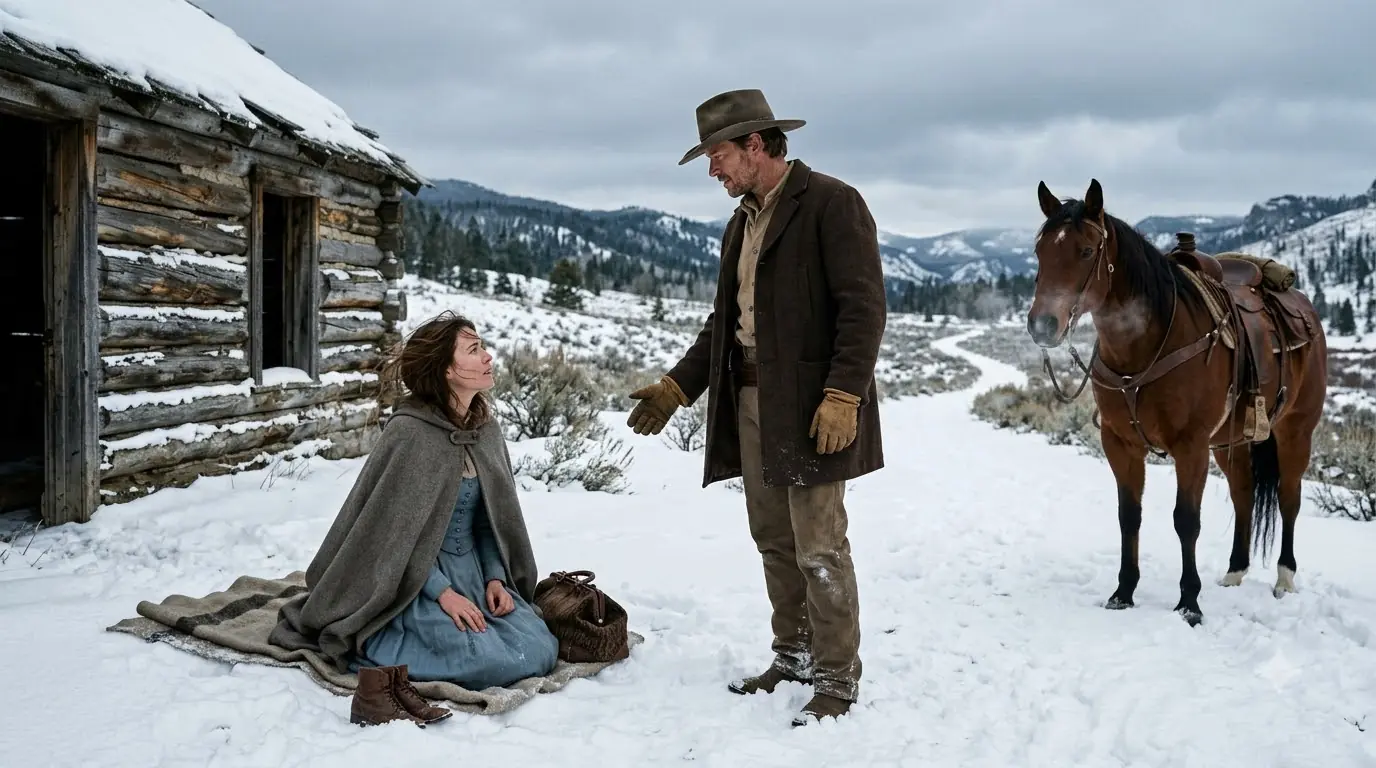
Three hours later, only Jed came back, leading one riderless mare.
Grant straightened, squinting through the gathering dusk. Fresh tracks veered off the main road, heading north toward the old line shack. Nobody used that place anymore. The roof had caved in two winters back, and the walls wouldn't hold against much more than a summer breeze.
The first snowflakes began to fall.
Grant told himself it wasn't his business. Jed Murphy had his ways, and a man didn't pry into another man's affairs out here.
But those tracks kept pulling at his mind like a burr caught in wool.
By nightfall, the blizzard hit in earnest. Wind screamed across the valley, erasing every trace of hoof and wheel. Grant stood at his cabin window, coffee growing cold in his hand.
He thought about that riderless horse. About the woman he'd glimpsed for just a moment, small frame, dark hair, hands clutching a carpet bag.
Two horses out, one back.
That wasn't right.
He set down his cup and began packing his saddlebag. Medical supplies, thick blankets, dried meat, a flask of whiskey, his rifle. He checked it, but didn't load it.
Grant McCoy had built his fortune on timber and cattle, not on violence. But he'd learned long ago that being prepared wasn't the same as looking for trouble.
Outside, the storm howled like something alive and angry.
Grant set his pocket watch alarm for first light.
If she was out there, she wouldn't last much longer.
Out here, a man was judged by what he did when no one was watching. And Grant had been alone long enough to know what that kind of cold could do to a person.
He lay down on his bed, the same one where Sarah had died three winters ago, and didn't sleep.
Dawn came pale and merciless.
The storm had blown itself out sometime before sunrise, leaving the world buried in silence and snow.
Grant saddled his strongest horse and rode north, following instinct more than memory. The drifts came up to his stirrups in places.
He found her where the wind had tried to bury her, collapsed against the line shack door, one bare hand still clutching a carpet bag, lips the color of winter twilight.
Her traveling cloak had torn somewhere along the way, and frost clung to her hair like lace.
Grant dismounted fast, his boots punching through the crust of snow. Her pulse fluttered weak beneath his fingers, still alive, barely.
"Can you hear me?"
His voice came out rougher than he intended.
Her eyelids fluttered.
"Please," she whispered. "Don't send me back."
Grant didn't waste time on questions. He wrapped her in his coat, lifted her onto his horse, and swung up behind her.
She weighed almost nothing.
Two miles to his cabin. He could make it in twenty minutes if he pushed.
The ride felt like hours.
Inside his cabin, he built the fire high and wrapped her in every blanket he owned. Her fingers were the worst, white and waxy. Two may be too far gone.
He heated water, made coffee strong enough to strip paint, and coaxed her to drink.
She wouldn't speak, just stared at the flames like they held answers she couldn't find anywhere else.
Grant noticed the wedding band on her finger, brand new, never worn in.
The pieces fell together fast.
Jed Murphy's mail-order bride, the one he'd been bragging about at the mercantile last week. Said he'd found himself a good, sturdy woman to cook and keep house.
Apparently, she hadn't measured up.
"He said I wasn't good enough."
Her voice came out small and broken.
"Said I couldn't give him what he needed."
Grant poured more coffee, his jaw tight.
"Then he's a fool."
She looked at him for the first time. Really looked.
Her eyes were brown, deep and weary as a deer that's been hunted.
"You don't know me."
"Don't need to. Nobody deserves to freeze because they didn't fit some man's idea of useful."
She pulled the blankets tighter and turned back to the fire.
Grant let her be.
He'd seen enough trauma in his years to know that words didn't fix everything. Sometimes people just needed to be warm and safe first. The talking could come later.
By evening, exhaustion pulled her under.
Grant gave her his bed and took the floor by the fire. He lay awake, listening to her breathe, and tried not to remember the last time someone else had slept in that bed.
Winter didn't care if you were rich or poor. Cold killed all the same.
Morning came with pale sunlight cutting through the windows.
Grant woke to the smell of coffee. Not his usual bitter sludge, but something that actually smelled like it might taste good.
The woman stood at his stove, favoring her left foot, still wrapped in two of his blankets.
"You should be resting," Grant said.
"I'm not an invalid."
Her voice was steadier now.
"And I won't be a burden."
"Didn't say you were."
She turned to face him, and he saw the fear beneath her pride.
"The storm's passed. I'll leave this morning. Find work somewhere."
"Storm's not done."
Grant moved to the window and pointed at the clouds building on the horizon.
"See that gray line? We've got another three days of this. Maybe more. You head out now, you won't make it a mile."
Her hands tightened on the coffee pot.
"I can't stay here. People will talk."
"Let them."
"You don't understand."
"I understand plenty."
Grant crossed to the table and sat down.
"Three days, then we'll see about what comes next. That's the deal."
She studied him for a long moment, searching for something.
Whatever she found, it must have been enough.
She nodded once and poured them both coffee.
They didn't speak much that first day.
Grant worked on mending tack while she cleaned the cabin, moving slow but determined. He noticed she was good with her hands. Everything she touched came out neater, more organized.
When she found his wife's old shawl in the trunk, she held it like something precious.
"This is beautiful," she said softly.
Grant's throat tightened.
"It was my wife Sarah's."
"She died three winters back."
The woman folded the shawl carefully and set it aside.
"I'm sorry."
"Me, too."
That night, as Grant prepared to sleep by the fire again, she finally told him her name.
"Eliza."
"Eliza May."
"Grant McCoy."
"I know. Mr. Murphy talked about you. Said you were the richest man in the valley, but too soft to be respected."
Grant smiled without humor.
"Jed Murphy thinks kindness is weakness. I think cruelty is the real failure."
Eliza pulled Sarah's shawl around her shoulders. Grant had offered it earlier, and she'd accepted with quiet gratitude.
"Three days," she said.
"Three days."
Grant agreed.
But as he lay by the fire, listening to the wind pick up outside, he knew three days wouldn't be enough. Not for her to heal. Not for him to figure out what to do about Jed Murphy and the whole rotten situation.
And maybe, if he was honest with himself, not enough for him to get used to having another voice in this cabin again.
A man could own the whole valley and still die alone if he didn't stand for something.
Grant had forgotten that for three years.
He was starting to remember.
By the fifth day, they had a routine.
Grant split wood at dawn while Eliza made coffee strong enough to wake the dead. She'd taken over the cooking entirely, and Grant couldn't remember the last time he'd eaten this well.
Simple food, beans, cornbread, venison stew, but prepared with a care he'd forgotten existed.
She was good with the horses, too. Better than good.
Grant's mare, who'd been nervous and difficult since Sarah died, gentled under Eliza's hands like butter in sunlight.
She sang to the animals while she worked, old hymns, soft and low.
"You've done this before," Grant said one morning, watching her check his gelding's hooves.
"My father kept horses before he died."
She didn't elaborate, and Grant didn't push.
The storm came and went in waves. Two days of snow, one day of sun, another day of wind so fierce it rattled the cabin walls.
Grant started teaching Eliza to read using his Bible. She knew some letters, but couldn't put them together into words.
They worked slowly.