Luther Thompson did not answer right away.
He stood in the middle of his old repair shop while rain hammered the tin roof above him and a stranger’s Harley-Davidson sat dead in bay one, still dripping water onto the cracked concrete floor.
The stranger needed a part.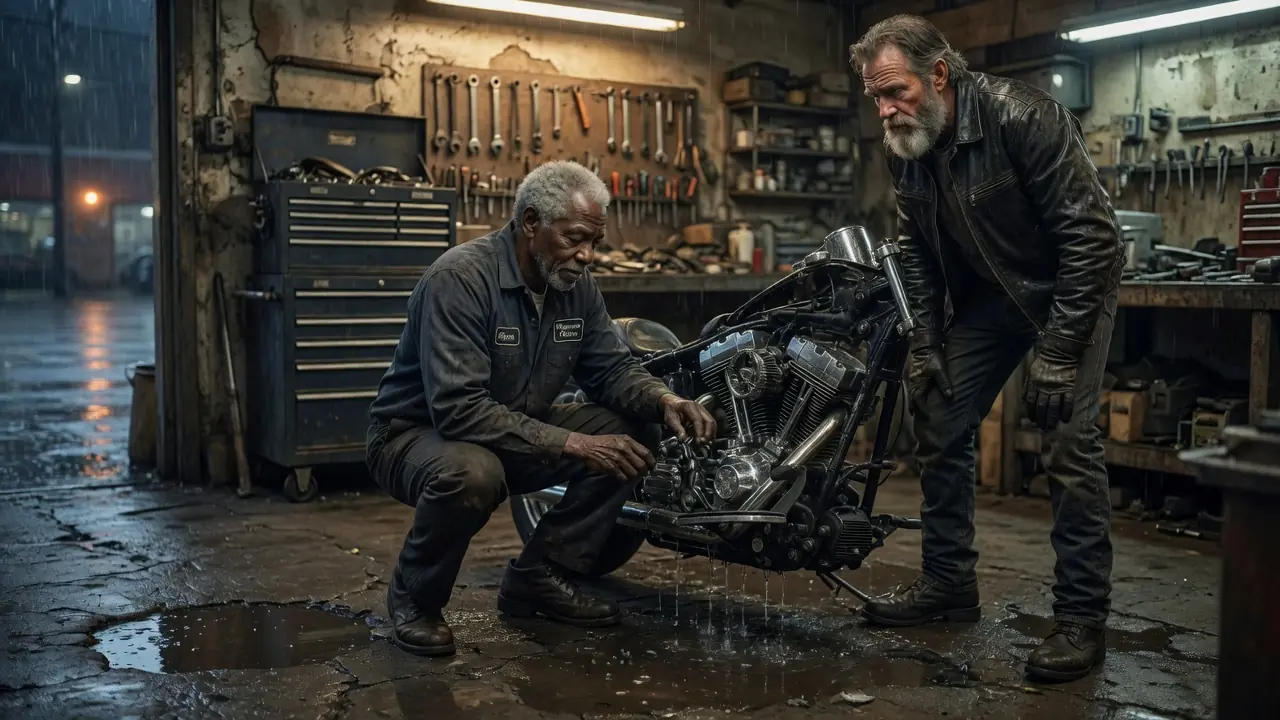
Luther needed a miracle.
He walked slowly to the workbench and opened the glass case that held his father’s valve lifter from 1967. The chrome was still bright. The edges were still clean. The small machined part rested on blue velvet beneath the buzzing fluorescent light like something sacred.
In the chest pocket of Luther’s work shirt sat a seizure notice from the city of Meridian.
Fourteen thousand two hundred dollars in unpaid taxes.
Fifteen days to pay.
After that, Thompson and Son Auto Repair would belong to someone else.
Maybe the city.
Maybe a developer.
Maybe nobody at all, because abandoned buildings on Belmont Street had a way of becoming ghosts before anyone noticed they were dead.
That valve lifter was the only thing left in the shop that might be worth real money to the right collector. Old Ford Mustang parts had value. History had value. Earl Thompson’s hands had touched that part. That made it priceless to Luther, even if the rest of the world would have put a smaller number on it.
The stranger needed it to ride home.
Luther needed it to survive.
What he did next changed Belmont Street forever.
Luther had not chosen this life.
This life had chosen him the summer he turned twelve.
His father, Earl Thompson, had hands like anvils and a voice like Sunday morning, deep, slow, and certain. Earl had come north from Alabama in 1958 with eighty dollars, a toolbox, two shirts, one pair of Sunday shoes, and a promise he had made to himself on the bus ride out of Birmingham.
His son would never shine another man’s shoes for survival.
His son would never lower his eyes just because someone had money, a title, or lighter skin.
His son would learn a trade nobody could take from him.
By 1962, Earl had scraped together enough to lease a cinder block building on Belmont Street. It was not much to look at. The roof leaked near the back wall. The office window had a crack in the corner. The bathroom door stuck in humid weather. The front lot had more weeds than gravel.
But Earl walked through the building with both hands on his hips and saw possibility where other men saw repairs.
He painted the walls himself. He patched the roof. He fixed the wiring. He bought one used hydraulic lift from a closing garage in Jackson and hauled it back in a borrowed truck.
Then he hung a hand-painted sign out front.
Thompson and Son Auto Repair
Earl stood across the street and looked at it for a long time.
Luther, twelve years old and skinny as a broom handle, stood beside him with a bottle of orange soda in one hand.
“Daddy,” Luther asked, “why does it say and Son? I don’t know how to fix cars.”
Earl looked down at him.
“You will.”
For the first two years, most people walked right past the shop.
Some crossed the street.
Some slowed down, read the sign, saw Earl in the doorway, and kept driving.
A Black man owning the shop was unusual. Some folks brought their business. Others brought their opinions. Earl ignored both equally and kept working.
He changed oil for church ladies.
He fixed tractors for farmers who pretended they did not care who fixed them as long as they ran.
He rebuilt engines for men who stood over him and questioned every move until the engine turned over clean, then suddenly remembered they had somewhere else to be.
He took payment in cash when people had it.
Sometimes vegetables.
Sometimes carpentry work.
Sometimes promises.
He never mistook kindness for weakness, but he knew the difference between a man trying to cheat him and a man trying not to drown.
Luther remembered the smell of the shop before anything else.
Castor oil.
Coffee grounds.
Hot metal.
Rain on concrete.
The sharp sweetness of fresh rubber.
The way the concrete floor stayed cool even in July, numbing his bare feet while he crouched beside the lift and watched his father work.
Earl hummed when he repaired engines.
Mostly gospel.
Never the words, only the melody, as if the song was too sacred to say out loud beneath an open hood.
He taught Luther everything, but never all at once.
A wrench first.
Then a socket.
Then how to read wear marks.
Then how to listen.
“Don’t touch it yet,” Earl would say when a customer brought in a sick engine. “First thing you do is listen.”
Luther would stand beside him, impatient and sweating.
“But Daddy, shouldn’t we open it up?”
Earl would shake his head.
“You don’t start by cutting a man open. You ask where it hurts.”
Then he would lean close, eyes half shut, one big hand resting on the fender.
“An engine doesn’t lie,” Earl used to say. “It can’t. It just runs or it doesn’t. Your job is to figure out why.”
Luther learned patience that way.
He learned that machines had memories.
A bad repair left a story.
A skipped oil change left a story.
A man trying to save money by ignoring a knock left a story.
Every engine was a confession, if you knew how to hear it.
The valve lifter came from a 1967 Ford Mustang, candy apple red, owned by a schoolteacher named Mrs. Haywood.
Her husband had died that spring, and the car was all she had left of him. He had bought it used, washed it every Saturday, and driven it to church on Sundays even when gas prices climbed. After his funeral, Mrs. Haywood kept the car under a tarp and only started it once a week, sitting behind the wheel with both hands on the steering wheel as if waiting for his hand to cover hers.
Then one afternoon, the engine failed.
Every mechanic in Meridian told her it was finished.
“Not worth the cost,” one man said.
“Sell it for parts,” said another.
Mrs. Haywood came to Earl last, not because she doubted him, but because she was afraid he would say the same thing.
Earl lifted the hood, listened, and stood there a long time.
Then he said, “Give me a weekend.”
Luther was fourteen.
He held the flashlight while Earl worked. His arms ached from keeping the beam steady for hours. Sweat ran down his spine. Mosquitoes bit his ankles. Earl did not rush.
Sixteen hours over two days.
They removed the damaged lifter, cleaned the valve train, checked the oil passages, replaced what needed replacing, and coaxed life back into an engine everyone else had buried.
On Sunday evening, Mrs. Haywood stood in the parking lot with her purse clutched to her chest while Earl slid behind the wheel.
The Mustang turned over.
Coughed once.
Then purred.
Not loudly.
Not dramatically.
Just right.
Mrs. Haywood cried right there in the parking lot.
She covered her mouth with one hand, and her knees nearly buckled.
Earl got out and handed her the keys.
She tried to pay double.
Earl charged her half.
Later, he cleaned the old valve lifter with a cotton rag, set it on the workbench, and told Luther, “Keep this.”
“Why?” Luther asked.
Earl placed the part in his son’s palm.
“So you remember what one good part can do.”
Luther kept it for fifty-four years.
Earl died on a Tuesday in 1988.
Lung cancer.
By then, Luther was grown, broad-shouldered, quiet, and already more like his father than he understood. Earl had grown thin by the end, but his eyes still carried the old steadiness. On his last morning, he asked Luther to take him to the shop.
The doctor said no.
Earl said, “I asked my son, not the doctor.”
So Luther brought him.
Earl sat in the folding chair by the bay door, the same chair he had used for years when business was slow and the weather was mild. He looked out at Belmont Street like he was memorizing it.
The barbershop still had music then.
The hardware store still had customers.
The bakery still made sweet rolls every morning.
Kids still rode bikes through the parking lot, and Earl still pretended to scold them while keeping cold sodas in the office fridge.
Luther sat beside him.
For a long time, neither man spoke.
Earl’s breathing was rough. Every inhale sounded like gravel under tires. Luther wanted to say something big, something worthy, something that could hold gratitude and fear and grief all at once.
But Earl had taught him that too.
Sometimes the best thing a man can do is just be present and let the silence carry the weight.
Near sunset, Earl reached for Luther’s hand.
“You keep it honest,” he whispered.
“The shop?”
Earl’s mouth twitched.
“Yourself.”
He died before midnight.
After Earl passed, Luther ran the shop alone.
Then came Dorothy.
Dorothy Bell had walked into Thompson and Son Auto Repair in 1990 with a broken-down Buick, a church hat in the passenger seat, and absolutely no patience for mechanics who talked down to women.
Luther had said, “Ma’am, I think your fuel pump is failing.”
Dorothy had looked him straight in the eye and said, “Do you think it, or do you know it?”
Luther had smiled before he could stop himself.
“I know it.”
“Good. I pay for knowing.”
He fixed the Buick.
She returned two days later with peach cobbler.
He married her in 1991.
Dorothy kept the books. She answered the phone. She swept the floor every evening even when Luther told her to stop.
“Sweeping is how I pray,” she told him. “One stroke at a time. Push the dirt out and let the clean in.”
Dorothy brought order to places Luther did not know were disorderly.
She labeled supplier folders.
She paid taxes on time.
She remembered birthdays.
She made customers feel expected.
She placed a jar of peppermint candy near the register and refilled it every Monday.
For years, the shop was not just a business.
It was a rhythm.
Earl’s workbench.
Dorothy’s ledger.
Luther’s hands.
Belmont Street breathing around them.
Then Dorothy died five years ago.
Pancreatic cancer.
Fast and cruel the way that kind always is.
One month she was complaining that Luther put invoices in the wrong drawer. The next, she was sitting in a hospital chair with a blanket over her knees, thinner than her own shadow.
She died in April, when dogwood trees were blooming.
Luther returned from the funeral, walked into the shop, and found the broom leaning against the wall where Dorothy had left it.
He could not move it for three weeks.
Now Luther lived in the two rooms behind the shop.
A bed.
A hot plate.
A small table.
A photograph of Dorothy on the nightstand, her reading glasses still folded beside it.
He ate dinner at the workbench most nights under the same fluorescent light his father had installed in 1974. The bulb had been replaced eleven times. The fixture never had.
Some things lasted because they were built right.
Some things lasted because nobody had the heart to take them down.
Luther was both.
Belmont Street used to breathe.
Saturday mornings, you could hear it from three blocks away.
Car horns.
Soul music leaking from open doors.
The barbershop radio playing Marvin Gaye while old men argued about nothing important.
Kids on bikes cutting through the parking lot behind the hardware store. Their laughter bouncing off brick walls.
The Nwin family bakery sending warm sugar and yeast into the street before sunrise.
There was a rhythm to it.
A pulse.
The kind of noise that meant a place was alive.
Now the street was quiet in the way hospitals are quiet.
Not peaceful.
Just waiting.
The hardware store became a pawn shop, then a dollar store, then nothing.
The barbershop closed when Mr. Owens had his stroke.
The bakery lasted longest. The Nwin family held on for nineteen years before the rent tripled and the landlord stopped returning calls. One by one, the lights went out and nobody came to turn them back on.
Luther watched it happen the way a man watches weather.
Slowly.
Then all at once.
There was nothing to do about either, except keep your own roof from leaking and your own door from locking forever.
His only neighbor left was Edna Walters.
Seventy-four years old, five foot two, voice like a church bell someone forgot to polish. She ran the laundromat next door with six washers, four dryers, and a vending machine that had not worked since 2019.
Edna stayed open mostly out of spite.
She came by every afternoon with opinions and sometimes pie.
“Luther,” she said one Tuesday, standing in his bay door with her arms crossed and her apron dusted with flour, “you know that valve thing could fetch you three, maybe five thousand from one of them online collectors.”
Luther did not look up from the carburetor he was cleaning.
“It ain’t for sale, Edna.”
“Neither was my patience, but here I am spending it on you anyway.”
She came inside and sat on the stool by the door.
“Fifteen days, Luther. That’s what’s left on that letter. You got a plan?”
“I got a carburetor that needs cleaning.”
“That ain’t a plan. That’s a Tuesday.”
He almost smiled.
Almost.
That evening, after Edna left, Luther sat alone in the shop with the lights off.
The valve lifter caught the streetlight through the window. Just a sliver of orange on chrome.
He opened the case, picked it up, turned it in his hands, and felt the weight of it.
His father’s hands had touched this metal.
His father had wiped it clean.
His father had set it down and said, “Keep this so you remember what one good part can do.”
Outside, a city inspector had come that morning and stapled a yellow condemnation notice to the empty building across the street. The paper fluttered in the wind like a surrender flag.
Luther had stared at it for a long time.
He knew his shop was next.
The building inspector had walked past his bay door, clipboard in hand, and looked inside the way a doctor looks at an X-ray he already knows is bad.
He did not say a word.
He just wrote something down and kept walking.
Luther set the valve lifter back in its case, closed the glass lid, and ran his thumb along the edge of the display where a crack in the wood had been growing for years.
He could fix it.
He fixed everything.
That was the problem.
He kept fixing things in a world that had decided it was cheaper to replace.
He locked the shop door and walked to the back rooms. He put the kettle on, sat on the edge of his bed, and listened to the nothing outside.
Then the rain started.
Light at first, tapping on the tin roof like fingertips asking to come in.
Then harder.
Then steady.
The kind of rain that did not stop until it had washed something clean or drowned it.
Luther turned off the kettle and listened.
Somewhere out there, an engine coughed.
Not just coughed.
It choked, sputtered, and dragged itself down Belmont Street like a wounded animal looking for a place to collapse.
Luther was at the bay door before he made the conscious decision to move.
Forty-six years of reflex.
A sick engine was a sound he could not ignore, the same way a doctor could not ignore a scream.
The headlight appeared first.
One beam shaking with every misfire, cutting through the rain like a flashlight in fog.
Then the shape behind it.
A motorcycle.
Big.
Heavy.
Harley-Davidson Road King.
Classic body, maybe early 2000s. Chrome pipes streaked with road grime and rain. The rider hunched forward, wrestling the handlebars like the bike was trying to throw him.
The Harley lurched into Luther’s parking lot, backfired once with a sound like a gunshot, and died.
Silence.
Just rain.
The rider sat on the dead machine for a moment, both boots flat on the asphalt, head bowed. Water ran off his helmet and pooled in the cracks of the pavement.
Then he swung his leg over, stood up, and looked around.
When he saw Luther standing in the lit bay door, he walked toward him with the heavy steps of a man who had been arguing with the road for three hundred miles and lost.
He was tall, maybe six foot two, around sixty, with a gray beard trimmed close and sharp blue eyes that did not blink in the rain. His leather jacket was cracked at the elbows and darkened with water.
No club patches.
No loud logos.
Just worn leather and road dust turned to mud.
“You still open?” the stranger asked.
His voice was low and direct. Not rude. Just the kind that went past the body and settled in the bones.
Luther looked at the clock on the shop wall.
Eleven fourteen.
He looked back at the man, rain dripping from his jaw.
“Wasn’t planning on it,” Luther said. “But your bike sounds like it is.”
The man almost laughed.
Almost.
Luther waved him inside, grabbed a clean shop towel from the stack, the last clean one, and tossed it to the stranger.
“Put a chipped mug under the coffee maker and poured.”
“It’s old, but it’s hot,” Luther said.
“Old and hot works fine.”
The man sat on Edna’s stool, drying his face while Luther walked out into the rain to roll the Harley into the bay.
He did not ask for help, and the stranger did not offer.
Some conversations happened without words.
Luther planted his boots, leaned his weight into the handlebars, and pushed the dead bike across the wet concrete.
Nine hundred pounds of American steel and stubbornness.
His shoulders burned, but he did not stop.
He had pushed heavier.
He set the kickstand and stood back, looking at the bike the way a vet looks at a dog that has been hit by a car.
Not judging.
Just assessing.
Then he crouched beside the engine.
He did not touch anything yet.
Just listened to the rain ticking on the cooling metal and the small clicks of a hot engine surrendering its heat.
He put his hand flat on the cylinder head the way his father used to, feeling for what the machine could not say out loud.
He stood, walked to the other side, crouched again, pressed his ear close to the valve cover, and tapped it with one knuckle.
A hollow, uneven rattle answered back.
Irregular.
Metallic.
Wrong.
“Valve lifter,” Luther said without turning around.
The stranger set down his coffee mug.
“You got that from a tap?”
“In forty-six years?” Luther wiped his hands on a rag. “I ought to get something from a tap.”
The stranger stood and walked over.
Luther continued, “Your lifters collapsed. Hydraulic system. Oil’s not holding pressure. Could be the lifter. Could be the oil pump feeding it. But from that knock pattern, that stutter at the top of the stroke, it’s the lifter.”
“No question?”
“No question.”
The stranger looked at the engine, then at Luther.
Something shifted in his expression.
Quiet recognition.
The kind that passes between professionals who do not need to explain themselves.
“Name’s Garrett,” the stranger said.
He extended his hand.
Luther shook it.
“Lu.”
“And the bad news?” Garrett asked.
“The bad news is this specific lifter for a Road King this year ain’t something I can order at midnight. Nobody local stocks them anymore.”
“How far to the nearest dealer?”
“Two hundred miles east. And they’d need three business days minimum.”
Garrett looked at his bike.
Then at the rain hammering the parking lot.
Then at the dark road beyond Belmont Street.
Luther looked at the glass case on his workbench.
The valve lifter sat there under the fluorescent light.
Chrome.
Clean.
Patient.
Like it had been waiting for exactly this moment.
The silence between them filled the shop.
Luther knew.
He already knew.
He walked to the workbench and stood over the case.
Garrett watched from the stool.
He did not speak.
He could tell this was not a mechanical decision.
This was something else.
Luther touched the glass lid.
Behind the shop, rain ran down the gutter in a steady stream. The fluorescent light buzzed overhead. The old wall clock ticked once, then again.
In Luther’s chest pocket, the seizure notice felt heavy as a brick.
Fourteen thousand dollars.
Fifteen days.
No extension.
No mercy.
The valve lifter might save him if he sold it. Maybe not completely, but enough to buy time. Enough to show the city he was trying. Enough to keep Earl’s sign on the building another month.
He opened the case.
The hinge creaked, small and tired.
Luther lifted the valve lifter out and held it in both hands.
It was warm from the shop air.
Or maybe that was his imagination.
Maybe it always felt warm because he had held it so many times.
He saw Earl’s face.
Not the face at the end, thin and gray and struggling for air.
The other face.
The one from 1967, bent over a candy apple Mustang, grease on his forehead, humming a melody he never named.
The face that said, “This is what we do. We fix things. That’s the whole point.”
Luther turned around.
Garrett was watching him.
Not with curiosity.
With understanding.
The kind that comes from having lost things too.
“This part,” Luther said quietly, “belonged to my father.”
Garrett’s eyes moved to the valve lifter, then back to Luther’s face.
“It came from a 1967 Mustang he saved when nobody else could. Schoolteacher owned it. Her husband had died, and the car was all she had left of him. Everybody told her it was finished. My father gave her a weekend and brought it back.”
Luther looked down at the part.
“I was fourteen. Held the flashlight until my arms felt like they belonged to somebody else. When the car started, she cried right out there in the lot.”
He swallowed.
“Daddy cleaned this part, set it in my hand, and told me to remember what one good part can do.”
Garrett did not interrupt.
“It is the only thing I got left of him that still fits in my hands.”
The rain hammered the roof.
Luther stood there another second.
Then another.
Then he walked to the Harley.
He crouched beside the engine and began fitting the valve lifter into place.
His hands moved with the precision of a man who had done this ten thousand times, but slower now. Deliberately. Like a ceremony.
Garrett stood up.
“Luther,” he said, voice low, “let me pay you whatever it’s worth.”
“It ain’t worth money.”
“Then let me pay more than money.”
Luther did not answer.
He tightened the last bolt.
Quarter turn.
Then an eighth.
His wrist knew the torque before his mind did.
He stood, wiped his hands on the rag one more time, and reached for the ignition.
The Harley turned over on the first try.
The engine caught, held, and settled into a deep, clean rumble that filled the shop like a voice finding its note.
After years of silence, Luther closed his eyes for just a second because the sound was right.
And right sounds were getting harder to come by.
Garrett listened to his bike run.
He walked around it once, ran his hand along the tank, then turned to Luther and extended his hand again.
But this time it was not a handshake.
He held Luther’s hand with both of his.
The way you hold something you are afraid might break.
“What is that part to you?” Garrett asked.
Luther looked at the empty glass case on the workbench.
The blue velvet square with nothing on it.
“Everything,” he said.
Garrett held his gaze for three seconds.
Four.
Then he nodded once, slow and heavy, the kind of nod that carried a promise.
He walked to his bike, threw his leg over, settled into the seat, and pulled on his gloves.
At the bay door, with rain falling behind him and the engine alive beneath him, Garrett looked back one more time.
“You ever need a road,” he said, “you got one.”
Luther did not know what that meant.
So he only nodded.
Garrett rode into the dark.
Luther stood in the empty shop.
The glass case was open.
The velvet was bare.
The rain kept falling.
He picked up the rag and folded it, set it on the workbench beside the empty case, turned off the lights, and went to bed in a shop that had never felt so quiet.
Luther opened the shop at seven the next morning like he always did.
He unlocked the bay door.
Turned on the fluorescent lights, which took their usual four seconds to stop flickering and commit.
Filled the coffee maker.
Set out the rag pile.
Swept the floor even though nobody had walked on it since Garrett left.
Routine was what Luther had instead of hope.
It worked the same way.
It got him out of bed.
It just did not promise anything afterward.
The glass case sat on the workbench, lid still open from the night before. The blue velvet square was empty.
Luther looked at it the way a man looks at a chair where someone used to sit.
Not with surprise.
With the slow ache of confirmation.
He closed the lid gently.
The way you close a book you are not going to read again.
Edna showed up at nine, right on schedule, carrying a foil-wrapped plate and a face that meant she already knew something was wrong.
“You look like a man who lost a bet with God,” she said, setting the plate on the counter. “Cornbread. Still warm.”
Luther told her what happened.
The biker.
The rain.
The valve lifter.
All of it.
Edna listened without interrupting, which was unusual for Edna and therefore alarming.
When he finished, she stared at him for a long time.
Then she shook her head.
“Luther Earl Thompson, you gave away the one thing in this shop worth real money to a man you met for forty-five minutes in a rainstorm.”
“It was the right thing to do.”
“The right thing to do was sell it three months ago and pay your taxes.”
“That wouldn’t have been right.”
“That would have been practical.”
“Right and practical ain’t the same.”
“They ain’t enemies either,” Edna shot back. “They can ride in the same car.”
He broke off a piece of cornbread and did not answer.
The rest of the day moved the way all his days moved now.
Slow.
Empty.
Shaped by absence.
A man called about getting his truck’s brakes checked, then never showed. Luther reorganized the socket wrench drawer for the third time that month. He replaced a washer in the shop sink that had been dripping for weeks.
Small repairs.
The kind that kept your hands busy while your mind went somewhere you did not want it to go.
At four, the mail came.
Luther sorted through it at the workbench.
Electric bill.
Coupon mailer for a restaurant that closed last year.
And one more envelope from the city of Meridian.
He opened it standing up because bad news was easier to take on your feet.
Final notice.
Fifteen days had become fourteen.
No extensions.
No payment plans.
No exceptions.
He folded the letter and put it in the same chest pocket where the other one lived. Two letters now, pressing against his heartbeat like a countdown he could not stop.
That night, Luther did not eat.
He sat at the workbench with the lights off, his hand resting on the spot where the glass case used to be. He had moved it to the shelf because he could not stand seeing it empty in the center of the bench, right where the light hit.
The shop was so quiet he could hear the walls settling.
The slow tick of metal contracting as the temperature dropped.
His own breathing, steady and stubborn, going on for reasons it could not explain.
He pressed his palm flat on the workbench and felt the scratches under his skin.
Earl’s scratches.
Dorothy’s scratches.
His own.
Forty-six years of hands on this wood.
Maybe fourteen days left to touch it.
Three days passed like three copies of the same sentence.
Luther opened the shop, cleaned things that were already clean, waited for customers who did not come, closed the shop, went to bed, and repeated.
The only variation was which meal he skipped and how late he stayed up staring at the ceiling.
On the fourth morning, something changed.
Edna was hanging laundry in the narrow alley between their buildings when she saw a navy blue pickup truck pull up across the street. Two men got out, one with a clipboard, one with a tape measure.
They walked the length of Luther’s building, measuring the frontage, checking the foundation, writing things down.
They did not come inside.
Did not knock.
Just measured and left.
Edna crossed the alley and told Luther.
“Probably the city,” Luther said, not looking up from the brake drum he was cleaning.
“They didn’t look like city.”
“What city look like?”
“City wears polo shirts with logos and walks like bad news. These men wore boots.”
Luther shrugged.
He had stopped investing energy in things he could not control.
The shop would be taken or it would not.
The measuring men were just another symptom of a diagnosis he had already accepted.
That afternoon, the shop phone rang.
Luther almost did not answer. The last three calls had been robocalls about extended car warranties, which felt like the universe making a joke at his expense.
He picked up on the fifth ring.
“Thompson and Son Auto Repair. Luther speaking.”
A woman’s voice came through, professional but warm.
She asked about his shop hours, his square footage, whether he had a bay with a hydraulic lift, whether his parking lot could hold twenty vehicles.
Luther answered each question, confused.
Nobody had asked about his shop’s capacity in years.
“May I ask what this is about?” he said.
“Just gathering information, sir. Thank you for your time.”
She hung up.
Luther set the phone down and looked at it like it had spoken a foreign language.
That evening, Edna came by with half a sweet potato pie and fresh intelligence.
“Talked to Mrs. Greer at the corner store,” she said, cutting Luther a slice he had not asked for. “She said someone came in yesterday asking about you.”
“About me?”
“Wanted to know how long you been here. What kind of man you are. Whether the neighborhood respects you.”
“What did she tell them?”
“She told them you’re the most stubborn man on Belmont Street, and that’s saying something because I’m on Belmont Street too.”
Luther almost smiled again.
The second time in a week.
At this rate, by Christmas, he might actually manage one.
He did not know what to make of any of it.
The truck.
The phone call.
The questions.
In Luther’s experience, when strangers asked about you, it usually meant trouble arriving in business casual. He had been forgotten for so long that being remembered felt suspicious.
That night, the night before everything, Luther could not sleep.
He sat on the folding chair outside the bay door, the same chair Earl used to sit in, and watched the street.
It was one in the morning.
The streetlights cast orange circles on the wet asphalt. Nothing moved except a stray cat crossing the intersection with the confidence of something that owned the night.
Two o’clock came and went.
Then three.
Luther’s eyelids grew heavy, but he could not make himself go inside.
Something in the air felt different.
Electric.
The way a field smells before a storm that has not arrived yet.
At four-fifteen, he heard it.
A low vibration so faint it was more feeling than sound.
Coming from the east, where the highway fed into town.
It could have been a truck on the interstate.
Could have been distant thunder rolling along the ridge.
But it was getting louder.
And it was not stopping.
The sound grew the way a tide comes in.
Not all at once, but with each wave louder than the last, each pulse pushing farther up the shore.
Luther stood from Earl’s chair. His knees cracked. His back protested.
But his ears were sharp.
Forty-six years of listening to engines had trained them to sort sounds the way a jeweler sorts stones.
And what he heard coming down that highway was not one engine.
It was dozens.
The vibration climbed through the pavement first.
Luther felt it in the soles of his boots.
Then in his kneecaps.
Then in the fillings of his teeth.
It was deep, guttural, the kind of sound that did not ask permission to exist.
He walked to the edge of the parking lot and looked east.
The sky was bruised with early light, purple and gray, not yet committed to morning.
Then, where the highway crested the hill before dropping into Belmont Street, a line of headlights appeared.
One.
Then two.
Then a dozen.
Then too many to count.
They spilled over the ridge like a river breaking a dam, golden beams cutting through the mist in parallel lines.
The sound hit Belmont Street like a wall.
Eighty-seven motorcycles.
Harley-Davidsons.
Indians.
Custom builds.
Touring bikes loaded with saddlebags and bedrolls.
They came in formation, two wide, stretched back a quarter mile. Their engines fed into a single rolling thunder that shook the glass in every window on the block.
Lights came on.
Curtains moved.
Doors opened.
The people of Belmont Street, the few who remained, stepped onto porches and stoops and stared at the parade of chrome and leather flooding their forgotten road.
At the front, riding alone ten yards ahead of the pack, was Garrett Shaw.
On the Road King Luther had saved four nights ago.
The engine ran clean.
The valve lifter held strong.
Garrett pulled into Luther’s parking lot and killed the engine.
Behind him, one by one, eighty-six bikes fanned out across the street, filling every inch of curb, every empty parking space, every patch of asphalt that had not felt a tire in months.
The engines cut off in a staggered wave.
A rolling silence followed.
Somehow, it was louder than the noise.
Garrett swung off his bike and removed his helmet. His gray beard caught the first light. He looked at Luther, who stood in the bay door in a white undershirt and work pants, barefoot, mouth open, unable to form a single word.
“Told you I’d find a way to pay,” Garrett said.
Luther shook his head.
Not in disagreement.
In disbelief.
Behind Garrett, the doors of three box trucks swung open.
The contents spilled out onto the pavement in organized chaos.
Lumber.
Paint cans.
Sheets of drywall.
Rolls of electrical wire.
A brand-new hydraulic lift still in its factory crating.
Tool chests.
Welding equipment.
LED light fixtures.
A commercial air compressor.
Copper air lines.
Floor sealant.
New signage.
And a folded canvas banner that had not been unrolled yet.
Men and women climbed off their bikes and started organizing.
They moved with purpose. Not the chaotic energy of volunteers, but the disciplined coordination of people who had done this before.
Because they had.
Garrett walked Luther to the edge of the lot and gestured at the convoy.
“Luther, this is the Iron Covenant Motorcycle Club. Two thousand two hundred members across the Southeast. Engineers, carpenters, electricians, welders, painters, plumbers, mechanics, roofers, veterans, nurses, teachers, and a few retired fools with more time than sense.”
Luther’s jaw worked.
No sound came out.
“Every one of them here today is a volunteer,” Garrett continued. “And every one of them knows what you did for me.”
Edna appeared at Luther’s elbow in her bathrobe, hair in rollers, holding a spatula like she had been interrupted mid-pancake.
Her mouth hung open wide enough to catch the morning.
“Lord have mercy,” she whispered.
Luther turned to her.
His eyes were wet.
He tried to speak and could not.
He tried again.
“Edna,” he managed, “I think those people are here to fix my shop.”
Edna grabbed his arm.
“Luther,” she said, “I think those people are here to fix your street.”
The canvas banner unrolled across the front of the building.
Fresh paint.
Bold letters.
Thompson and Son Auto Repair
Established 1962
Beneath it, in smaller script, were the words:
Where Every Engine Gets A Second Chance
Luther read it once.
Then again.
Then he sat down in the folding chair, Earl’s chair, and put his face in his hands.
His shoulders shook.
Not from cold.
Not from age.
From the weight of being seen after years of being invisible.
Garrett put a hand on his shoulder and did not say a word.
The sun broke the horizon.
Belmont Street woke up.
They started before Luther could say yes.
Not because they did not respect him.
Because the work could not wait.
And every member of Iron Covenant understood something Luther had not learned yet.
Saying yes to help was harder than giving it.
Sometimes, if you waited for a proud man to feel comfortable being loved, the roof would fall in before the first nail was pulled.
By seven in the morning, the shop was stripped to its bones.
The old drywall came down in sheets, revealing the original cinder block Earl had laid in 1962. One of the carpenters, a woman named Renee with tattooed forearms and a pencil tucked behind her ear, ran her hand along the blocks and whistled.
“This foundation is solid,” she said. “Your daddy knew what he was doing.”
Luther nodded.
He could not speak.
He had been trying to talk for two hours and kept failing. Every time he opened his mouth, another piece of the shop wall came down, and another piece of the wall inside him came down with it.
Garrett stayed close.
He did not hover.
He orbited.
He made sure Luther had coffee, a chair when his knees gave out, and answers when the questions finally came.
“How did you find all this?” Luther asked, standing in the parking lot while a welder reinforced the bay door frame above him. Orange sparks rained down and died on the wet concrete.
Garrett leaned against his Road King.
“Sent a message to the club the morning after you fixed my bike. Told them what happened.”
“All this from one message?”
Garrett nodded.
“Within six hours, we had eighty volunteers and three trucks. Within twelve, we had a structural engineer and a licensed electrician. Within twenty-four, your tax debt was covered.”
Luther turned sharply.
“What?”
“Fourteen thousand two hundred. Collection took about two hours. A retired judge in Knoxville sent a thousand with a note that said, ‘For the man who gives his last part.’ Check is already at the city clerk’s office. Your lien is clear.”
Luther’s legs went unsteady.
He sat down on the curb.
Garrett sat beside him.
“You can’t,” Luther said. “I can’t accept that.”
“Luther.”
“No.”
“You gave me something money couldn’t buy.”
“That was different.”
“How?”
Luther had no answer.
Garrett leaned forward, forearms on his knees.
“You looked at a stranger in a storm and gave away the last piece of your father that still fit in your hands. You think I’m going to let money stop us from giving back?”
Luther looked at his hands.
Scarred.
Cracked.
Stained with decades of oil no soap could remove.
Hands that had fixed ten thousand engines and never once asked what was in it for them.
“Okay,” he said quietly.
The hardest word he had ever spoken.
The rebuild took three days.
Day one was demolition and framing.
They gutted the interior, reinforced walls, ran new electrical, and pulled out the old wiring. Original 1962. Cloth-wrapped. Crumbling. Brittle enough to snap like dry twigs.
The electrician held up a section and shook his head.
“Sir, this was six months from burning your building down while you slept in the back.”
Luther looked at the wire.
Then toward the rooms where Dorothy’s photograph sat.
His throat closed.
Day two was mechanical.
The new hydraulic lift went in before noon. A two-post design rated for twelve thousand pounds. New air lines ran in clean copper rows along the ceiling. A new compressor sat in the corner, quiet and powerful. Tool racks were bolted to the walls and labeled by function.
Luther watched them install a diagnostic station, a laptop interface for modern engine codes, and felt a strange vertigo.
It was like his father’s shop was shaking hands with the future, and Luther was standing in the middle trying to belong to both.
But they kept the workbench.
Luther had asked for one thing.
“Don’t touch Earl’s bench.”
The carpenters built around it like a river around a boulder. They sanded it lightly, sealed it with polyurethane, and anchored it to the new floor.
Every gouge remained.
Every oil stain.
Every coffee ring.
Every cut from a blade set down in frustration.
Locked beneath resin like fossils in amber.
Day three was finish work.
Warm gray paint.
New LED panels bright as midday.
A repaired roof.
A new office window.
A clean bathroom door that did not stick.
And one more thing Luther did not expect.
Edna’s laundromat.
A crew of eight had been working next door without telling her. New washers. New dryers. A patched roof. A working vending machine. Fresh paint.
And a new sign.
Edna’s Laundry
Est. 1983
Edna stood in her doorway in her flour-dusted apron, one hand over her mouth, tears running through the creases of her face, unable to locate a single opinion for the first time in seventy-four years.
“Say something,” Luther told her gently.
She pointed at the new washers.
“If those machines eat quarters, I’m suing all of you.”
The bikers cheered.
On the third afternoon, while the last coat dried and the bikers packed their tools, something happened that mattered more than the construction.
A kid showed up.
Devon Price.
Nineteen years old.
Lean and quiet, wearing basketball shorts despite the cold and a hoodie two sizes too big.
He had been watching from across the street for all three days, hands in pockets, never speaking to anyone. On day three, he crossed.
He walked up to Luther, who stood at Earl’s sealed workbench, running his fingers over the old scratches smooth beneath the resin.
“Excuse me, sir.”
Luther turned.
Devon swallowed.
“Can you teach me?”
Three words.
That was all it took to restart a legacy.
Luther looked at Devon and saw something he recognized.
Not the clothes.
Not the posture.
Not the age.
The eyes.
The quiet hunger of a young man who wanted to be useful and did not know where to start.
The same eyes Earl must have seen when Luther was twelve, holding a flashlight with aching arms, watching his father bring a stranger’s car back to life.
“Come back tomorrow,” Luther said. “Six a.m. Bring a clean rag.”
Devon nodded and walked away.
Luther watched him disappear around the corner.
Then he smiled.
Not almost.
Not halfway.
All the way.
A full, unguarded smile that broke through the dry skin of his face like water through packed earth.
The first real smile in longer than he could remember.
The grand reopening of Thompson and Son Auto Repair did not have a ribbon cutting, a mayor, or a photographer asking people to stand closer together.
It had Luther standing in the center of his new shop at six in the morning, holding a cup of coffee, looking around like a man who had woken up in someone else’s dream and was afraid to move in case it disappeared.
Everything was different.
Everything was the same.
The walls were clean.
The floor was level.
The hydraulic lift hummed when he tested it, smooth and quiet after decades of the old jack groaning like it was doing Luther a personal favor.
The tool racks gleamed.
The LED panels made every corner bright and honest.
In the center of it all, like an altar in a cathedral, stood Earl’s workbench.
Scarred.
Sealed.
Unbroken.
Luther set his coffee on it.
The mug made a soft sound on the resin.
He wondered if Earl could hear it wherever he was.
He decided yes.
Devon showed up at five fifty-eight.
Two minutes early.
Clean rag in his back pocket.
“Where do I start?” he asked.
Luther handed him a broom.
“Same place everybody starts. You sweep.”
Devon looked at the spotless floor.
“It’s already clean.”
“Then you’ll finish fast, and we can move on to engines.”
Devon swept.
Luther watched.
Somewhere in the sound of bristles on concrete, the hum of the compressor, and the tick of the clock, Luther felt something shift.
Not in the shop.
In himself.
The same feeling Earl must have had in 1962 when he hung that first sign and waited for the world to notice.
The world noticed faster this time.
Garrett had made good on his biggest promise.
Iron Covenant designated Belmont Street as an official waypoint on their annual Southeast Rally, a three-state, five-day ride that drew hundreds of bikers every spring and fall. The first scheduled stop was Thompson and Son.
Luther’s shop would service, tune, and repair bikes for the convoy.
Guaranteed business.
Steady income.
A reason to exist that did not depend only on a neighborhood that had forgotten how to hope.
Word spread beyond the club.
A feature appeared in a regional motorcycle magazine.
A local news station called.
Luther declined the interview, so Edna did it for him.
She was magnificent.
“That man fixed this street by fixing one engine at a time,” she told the camera. “The rest of us just watched.”
The effect rippled outward.
A young couple leased the old bakery space and opened a coffee shop. A barber, grandson of Mr. Owens, came back and reopened the barbershop with new chairs and the same old radio.
A nonprofit arts collective moved into the building across the street, the one with the yellow condemnation notice Luther used to stare at. They peeled the notice off and painted a mural over the plywood.
The mural showed a pair of hands holding a valve lifter, surrounded by gears and flowers.
Luther did not take credit.
He did not even acknowledge the mural when Edna pointed it out.
He just looked at it for a long time, then went back inside and tightened a spark plug.
But the thing that changed Luther most was not the shop, the street, or the business.
It was Devon.
The kid showed up every morning at six.
He swept.
He organized.
He handed Luther tools before Luther asked for them. Not because he knew which tool came next, but because he watched Luther’s eyes and learned to read the sequence.
Within a month, Devon could change oil, rotate tires, and replace brake pads without supervision.
Within two, he was diagnosing basic engine sounds.
Not with Luther’s ear.
Not yet.
But with Luther’s method.
Hand on the hood.
Listen before you touch.
Ask the machine what hurts.
Luther taught him the way Earl had taught Luther.
Not with manuals.
Not with speeches.
With presence.
With patience.
With the quiet repetition of a man who understood that knowledge was a living thing, and it died if you did not pass it on.
One evening after Devon left, Luther stood before the glass case on Earl’s workbench.
It was no longer empty.
Garrett had returned the valve lifter.
He had sourced an identical replacement for his Road King from a collector in Nashville, installed it, then ridden back to Meridian specifically to give Luther his father’s part back.
When Garrett placed it in Luther’s hand, Luther held it for a full minute without speaking.
Then he set it in the glass case, closed the lid, and whispered, “Welcome home.”
The chrome caught the new LED light.
Brighter now.
But the same.
Six months later, Belmont Street did not look like the same place.
It was not.
And it was.
The bones were the same.
The buildings.
The sidewalks.
The intersection where kids used to ride their bikes.
But the skin was new.
Fresh paint on storefronts.
A chalkboard sign outside the coffee shop listing the daily special.
Music drifting from the barbershop on Saturday mornings.
Same station.
Different generation.
Luther stood in the bay door of Thompson and Son at sunset. The same way Earl had stood there before him. Same posture. Same rag in his hands.
But the street in front of him was alive.
Devon was inside finishing an oil change on a Honda Civic. He had gotten fast, but careful too. Luther never had to tell him twice.
The kid had a feel for machines.
An instinct that could not be taught, only awakened.
Luther saw it the first week and said nothing because naming a gift too early was a good way to make someone nervous about it.
Edna’s laundromat hummed next door. She had added a bulletin board by the door where neighbors posted flyers for yard sales, church dinners, guitar lessons, missing cats, and rooms for rent.
It was the busiest wall on the street.
Once a month, the rumble came back.
A Saturday morning, usually early, when the light was gold and the street was still waking up.
The sound rolled in from the east like a wave.
Thirty, forty bikes.
A smaller group from Iron Covenant making their regular run.
They parked along Belmont, filled Luther’s shop with handshakes and engine talk, ate at the coffee shop, got haircuts at the barbershop, and bought detergent from Edna just because they liked hearing her insult their life choices.
Then they rode out in the afternoon, single file, engines synchronized.
Belmont Street vibrated with the echo for ten minutes after they disappeared.
Luther never got tired of it.
On one of those Saturdays, Garrett pulled up alone.
Not with the club.
Just him on the Road King, engine running clean.
He parked in front of the shop and walked in like a man coming home.
They sat on folding chairs outside the bay door.
Two old men.
Two cups of coffee.
Watching the street do what streets were supposed to do.
Exist.
Breathe.
Hold people together.
“You know,” Garrett said, sipping his coffee, “I’ve been thinking about what your father said.”
Luther looked at him.
“About a man’s worth.”
Luther nodded slowly.
“He was right,” Garrett said. “But I think he left out one thing.”
“What’s that?”
“A man’s worth is also in who shows up when he’s got nothing left.”
Luther looked away.
Garrett continued, “You had nothing, Luther. And you still gave. That’s not generosity. That’s faith.”
Luther did not respond.
He looked at the mural across the street, hands holding a valve lifter, gears and flowers glowing in the late sun.
Devon walked out, wiping his hands, and nodded at Garrett.
Edna waved from her doorway.
The valve lifter sat in its glass case on Earl’s workbench, chrome catching the sunset through the bay door.
Still bright.
Still clean.
Back where it belonged.
Luther took a sip of his coffee and set the mug down on the arm of the chair.
The same chair his father sat in the morning he died.
The same chair Luther sat in the night the rumble came.
Some things lasted because they were built right.
Some things lasted because someone was brave enough to let them go and trust they might come back.
Luther was both.
A year after the rainstorm, Iron Covenant returned in full.
Not eighty-seven this time.
More than one hundred and twenty bikes rolled into Belmont Street on a clear October morning, engines shaking the windows, chrome flashing in the sun. But this time, nobody stared from doorways in disbelief.
People came prepared.
The coffee shop had extra pastries.
The barbershop had chairs lined up outside.
Edna had three folding tables of bottled water, laundry tokens, and sweet potato pies she claimed were “not for free, unless I like your face.”
Thompson and Son had every bay open.
Devon, now wearing a navy work shirt with his name stitched over the pocket, checked tire pressure on a touring bike while Luther watched from Earl’s workbench.
“Too much,” Luther said.
Devon looked up.
“It’s two pounds under recommended.”
“I was talking about your confidence.”
Devon grinned.
“You taught me.”
“Then blame me quietly.”
Garrett arrived last, as always, riding ahead of the rear group like a man closing a gate behind a herd.
He parked, removed his helmet, and walked to Luther.
This time, he carried something wrapped in brown cloth.
“What is that?” Luther asked.
Garrett handed it to him.
“Open it.”
Luther unwrapped the cloth carefully.
Inside was a framed photograph.
Not new.
Old.
Black and white.
Earl Thompson standing in front of Thompson and Son Auto Repair in 1963, arms crossed, face young and serious beneath the hand-painted sign.
Luther’s breath caught.
“Where did you get this?”
Garrett smiled.
“A woman in Alabama had it. Her father was one of Earl’s first customers after he came north. She saw the news piece Edna did and contacted the club. Said the picture belonged here.”
Luther touched the frame.
His father looked impossibly young.
Strong.
Determined.
Alive.
Below the photograph, someone had engraved a small brass plate.
Earl Thompson
He Built It Honest
Luther turned away.
Not fast enough to hide the tears.
Edna, standing nearby, said loudly, “Everybody mind your business. Old men leak sometimes.”
Garrett laughed.
Luther did too, though his voice shook.
They hung the photograph above the workbench.
Earl’s face looked out over the shop.
Over Luther.
Over Devon.
Over the valve lifter.
Over everything that had almost disappeared and did not.
Later that day, a mother came in with a twelve-year-old boy and an old Buick that would not start right. The boy hovered near the bay door, watching Devon work with the same hungry eyes Luther once had.
Luther saw it.
So did Devon.
The boy asked, “Can I watch?”
His mother opened her mouth to apologize, but Luther held up a hand.
“Watching is where it starts.”
The boy stepped closer.
“What’s wrong with it?”
Luther did not answer directly.
He put a hand on the hood, then looked at the boy.
“You tell me.”
The boy stared at him.
“I don’t know.”
“That’s honest. Now listen.”
Devon smiled from across the bay.
The engine turned over, coughed, sputtered.
Luther watched the boy’s face sharpen with attention.
Another light catching.
Another door opening.
That evening, after the rally left and the street quieted, Luther sat alone in the shop.
Not lonely.
Alone.
There was a difference, and he was learning it again.
The new lights hummed softly. Earl’s photograph watched over the bench. Dorothy’s broom leaned near the office door because Luther had brought it out from the back room and placed it where she would have wanted it.
The valve lifter rested in the glass case.
He opened it, picked up the part, and held it in his palm.
For most of his life, he had thought keeping it safe was how he honored Earl.
Now he understood something else.
A thing kept only for memory could become a weight.
A thing given at the right moment could become a seed.
He had given it away when he had nothing left.
It had come back carrying a street behind it.
Luther closed his fingers around the metal and whispered, “You were right, Daddy. One good part can do a lot.”
Outside, Belmont Street glowed.
The laundromat hummed.
The coffee shop closed its lights one by one.
The barbershop radio played low.
Somewhere down the street, kids laughed.
The sound bounced off brick walls, just like it used to.
Luther stood, placed the valve lifter back in the case, and closed the lid.
Then he turned off the lights.
Before stepping into the rooms behind the shop, he stopped at the bay door and looked back once more.
Thompson and Son Auto Repair was no longer waiting to die.
It was waiting for morning.
And for Luther, that was more than enough.