I was too cold to answer him at first. My arms were locked around my little boy Toby, and his breath had grown so faint against my chest that I kept pressing my cheek to his hair just to feel him still there. The stove had gone out hours before, and every stick of wood in the cabin was gone. I had burned the last chair leg before dawn, then sat in the dark pretending pride could warm a child.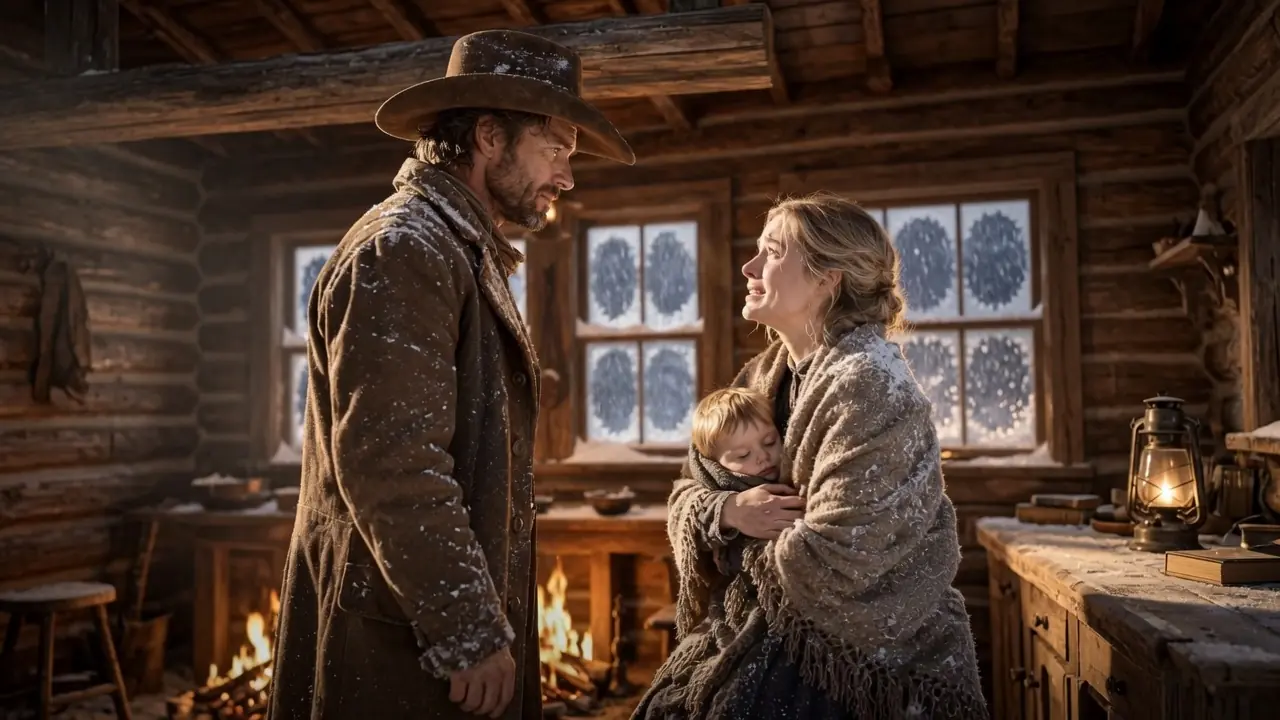
Daniel did not ask permission to save us. He stepped across the splintered boards of my frozen cabin door, lifted Toby first, then wrapped his other arm around me when my knees failed. Behind him, the blizzard swallowed the yard so completely that I could not see where earth ended and sky began. I remember only his voice, rough and steady, saying, “Stay with me, Susanna. Just stay with me.”
Cold Water had always been a hard town, but that winter made it crueler. Men spoke of bad weather as if it were a test of character, and women folded pity into prayers because prayers cost less than bread. I had been a widow for eleven months, long enough for people to stop bringing casseroles but not long enough for them to stop watching me. My husband Nathan had died beneath a fallen wagon, leaving me with debts, a weak stove, and a six-year-old boy who still asked when his father was coming home.
I had tried to survive quietly. I took in mending, washed linens for the boarding house, and stitched quilts from scraps that other women threw away. Some weeks I earned enough for flour and beans. Other weeks I smiled at Toby over thin soup and told him we were eating light because strong people did not need much.
Daniel Tabor lived at the edge of town in a log house larger than mine, though not grand by any rich man’s measure. He was a widower too, with two children of his own and grief still sitting in the lines around his eyes. His wife, Ellen, had died of fever two years earlier, and people respected him because he worked hard, paid his debts, and rarely spoke more than needed. In Cold Water, silence was often mistaken for virtue.
I did not know he had been watching the smoke from my chimney. Later, he told me he noticed it had stopped rising during the storm. He waited an hour, then another, telling himself no woman wanted a widower pounding on her door in the middle of a blizzard. But when the wind turned colder and my chimney stayed empty, he hitched his coat tight and walked through snow deep enough to swallow fence posts.
By the time he reached us, I had already accepted the kind of fear that turns quiet. Toby’s lips were pale, and my fingers had gone numb from holding him. I had whispered apologies into his hair until even my voice seemed frozen. Then Daniel broke the door open, and light rushed in like mercy.
He carried us to his house with Toby pressed beneath his coat. I remember the weight of snow on Daniel’s shoulders, the way he leaned against the wind, and the low murmur of his prayer when Toby stopped moving for a moment. His children, Ruth and Caleb, stood on the stairs when we entered, wide-eyed and barefoot. Daniel laid Toby by the fire and shouted for Ruth to bring blankets, bricks, towels, anything warm.
The doctor came an hour later, brought by Daniel’s hired boy on a half-frozen mule. Dr. Amos Bell bent over Toby with a face so grave that my heart almost stopped. Daniel stood behind him, hands clenched, and said, “Do whatever you must. They are not leaving this room cold.” Those words, more than the fire, were the first warmth I believed in that night.
Toby lived.
For three days, I slept in broken pieces near the hearth, waking each time he coughed or stirred. Daniel’s daughter Ruth brought water and tried not to stare at how thin my wrists were. Caleb placed one of his wooden soldiers beside Toby’s blanket and said it was to keep him brave. Daniel said little, but every time the fire dropped low, he was there before it died.
When Toby finally opened his eyes and whispered for water, I wept so hard I could not hold the cup steady. Daniel took it from my hand without a word and helped him drink. Then he stepped away quickly, as though kindness embarrassed him when seen too closely. That was Daniel Tabor in those days, a man who could walk through a blizzard for someone else but could not bear being thanked.
I thought we would leave once Toby could stand. I said so on the fifth morning, folding the borrowed blanket with hands that still shook. Daniel looked out at the white road and then back at my son, who was asleep in the chair by the fire. “Your cabin door is broken, your stove pipe is cracked, and the storm took half your roof shingles,” he said. “Where exactly do you plan to take him?”
I had no answer. Pride stood up inside me, thin and fierce, but it had nothing to feed a child. Daniel saw the argument on my face and softened his voice. “I’ve got room by the fire, Susanna. And I don’t care who talks.”
At first, I believed him.
For weeks, I stayed in his house because I had nowhere safe to go. I cooked when my hands stopped shaking, washed dishes, mended his children’s torn shirts, and swept the floor before dawn. I never entered the bedrooms unless Ruth asked me to help fold linens. I slept on a narrow cot near Toby, close enough to hear his breathing through the night.
Daniel never touched me except once, when I nearly dropped a pot and he caught my elbow. He always stepped back quickly, his face turning stiff with the manners of a decent man. We spoke mostly of wood, weather, meals, and Toby’s recovery. Yet every small kindness between two lonely people became something uglier by the time it reached town.
The whispers began at the mercantile. Mrs. Wick smiled too brightly when I bought thread and asked if Daniel’s house was “comfortable enough.” Two women near the sugar barrel fell silent when I passed. A boy outside the blacksmith’s shop sang under his breath about widows who warmed themselves too well. I kept walking because poor women learn early that dignity must sometimes look like deafness.
Daniel heard the talk too. I saw it in the tightening of his jaw when men stopped speaking as he entered the feed office. I saw it when Ruth came home from school with red eyes and said nothing at supper. Caleb threw a punch at a bigger boy who called me his father’s new woman, and Daniel had to drag him home by the collar.
That night, I packed my bag.
Daniel found me tying Toby’s spare shirt with a strip of cloth. His face went hard when he saw the bundle. “No.”
“Daniel, your children are suffering because of me.”
“My children are suffering because fools have mouths.”
“That does not change the suffering.”
He stood in the doorway, broad-shouldered and tired, firelight moving over the grief in his face. “If you leave tonight, where will you go?”
“My cabin.”
“It is not fit for a dog in this weather.”
I looked down. “Then I will make it fit.”
“Toby nearly died there.”
The words struck harder because they were true. I sat on the edge of the cot and pressed both hands to my face. “I cannot be the reason people shame you.”
Daniel crossed the room slowly. “Susanna, I buried a wife. I know what shame looks like when people stare at a house and decide what grief should do inside it.” His voice lowered. “This is not shame. This is shelter.”
I stayed that night. But staying did not quiet the town.
By February, Deacon Obadiah Styles had made my presence his favorite sermon without ever using my name. He spoke of decency, temptation, boundaries, and the dangers of confusing mercy with weakness. He was a narrow man with a polished cane, a smooth voice, and eyes that always seemed to measure women by how much they could endure without complaint. People nodded when he spoke because he made judgment sound like holiness.
I discovered the plan by accident on a muddy Thursday afternoon. I had gone to the mercantile to collect coins for a quilt order when I heard Styles behind the flour barrels. Mrs. Wick was with him, whispering like the sacks could carry scandal for her. I was reaching for thread when his voice stopped me cold.
“She has stayed long enough,” Styles said. “A public meeting will remind her what decency requires.”
Mrs. Wick sounded uncertain. “Daniel will defend her.”
“Then we shame him too,” Styles replied. “A man’s good name can be bent if enough people stare at it.”
My fingers went numb around the little purse of coins. I stood hidden behind calico bolts, listening while they planned to turn the fire that saved my son into a rope around my throat. Styles said he would call a church meeting. Mrs. Wick said people were ready. Another man, Mr. Larkin from the bank, muttered that Daniel’s household arrangement could affect his credit.
I did not step out. I did not cry. I bought thread, thanked the clerk, and walked back through streets gray with melting snow.
That night, after Toby fell asleep and Daniel stacked wood outside, I opened the tin box beneath my cot. Inside were the things I kept because memory needs witnesses. The doctor’s note saying Toby would not have lived another hour without heat. The unpaid mercantile account from the week Mrs. Wick refused me more coal oil without cash. A scrap of my burned chair leg. The little blue ribbon I had tied around Toby’s wrist in the dark so I could feel him breathing.
I added one more thing. A square of blue fabric from the quilt I had made for Ruth, cut from one of Ellen Tabor’s old dresses with Daniel’s permission. Ruth had cried when I gave her the quilt because it smelled faintly of cedar and lavender from the trunk where her mother’s clothes had been kept. I included that square not for drama, but for truth. In Daniel’s house, grief had not been disrespected. It had been warmed.
The meeting was called for Sunday evening. All day, Daniel moved around the house with a quiet anger that made the children whisper. I knew he wanted to stand in front of everyone and tear their accusations apart. But men like Daniel, decent as they were, did not always understand the shape of a widow’s humiliation. If he defended me alone, they would say I had hidden behind him.
So I prepared the envelope myself.
I wrote a letter in my careful hand, naming each thing they had chosen not to see. I wrote how I asked for coal oil and was refused credit. How I mended shirts until my fingers bled and still could not buy enough wood. How no one checked my chimney during the blizzard until Daniel did. How Toby lived because a widower broke propriety before the cold could finish him.
Then I added the doctor’s note, the account slip, the ribbon, the chair scrap, and the blue fabric. I sealed the envelope with plain wax. On the front, I wrote: The part of the story you hoped no one would read.
The church was full that evening. Lantern light shook across every face, making the room look softer than it was. Styles stood at the front like a judge in his own imagination, one hand resting on his cane. Mrs. Wick sat in the second row, lips tight with anticipation.
Daniel sat beside me with Toby between us. Ruth and Caleb sat on his other side, stiff and silent. Toby held my hand, unaware of all the words adults had sharpened around him. When Styles rose, the room went still.
“Some arrangements,” he began, looking straight at me, “must be corrected before they stain the whole community.”
A murmur moved through the benches. Daniel started to rise.
I touched his sleeve. “No,” I whispered. “Let me.”
He looked at me, startled. I could see the battle in his eyes, the instinct to protect and the fear of letting me stand alone. But he sat back slowly, and that trust gave me more courage than any speech could have.
I walked to the front with my knees trembling beneath my dress. The room blurred at the edges, but my voice came out calm. “You are right about one thing, Deacon. Something in this town needs correcting.”
Styles frowned. “Mrs. Hale, this meeting is meant for sober reflection, not theatrics.”
“I agree.” I placed the sealed envelope on the table before him. “That is why I brought proof.”
His eyes dropped to the writing on the front. “What is this?”
“The part of the story you hoped no one would read.”
The room stirred. Mrs. Wick leaned forward. Mr. Larkin’s face tightened. Daniel’s gaze was fixed on me, not with pity, but with something stronger.
I turned toward the congregation. “You saw a widow under a widower’s roof and called it scandal. You did not see my boy turning blue in a dead cabin. You did not see his little hand tied with ribbon so I could feel whether he still breathed. You did not see Daniel Tabor carry him through snow because everyone else was too busy protecting respectability.”
No one spoke.
I pointed to the envelope. “Inside is Dr. Bell’s note. Inside is the account Mrs. Wick refused me. Inside is proof that the same house you call improper is the only reason my child is not buried beside his father.”
Styles’s face reddened. “This is an emotional manipulation.”
“No,” I said. “It is a record.”
Mrs. Wick stood halfway. “I never meant harm.”
I looked at her. “Harm does not always announce itself. Sometimes it simply closes the ledger and sends a mother back into the cold.”
A gasp moved through the room.
Styles struck his cane once against the floor. “Enough.”
I looked at him for a long moment. “Yes, Deacon. That is exactly what I came here to say.”
Then I turned and walked toward the door.
Daniel called my name softly, but I kept walking. I would not stand there while they opened my pain and voted on whether mercy looked respectable enough. My hands shook only after I stepped outside into the cold. Snow had begun falling again, quiet and thin.
I walked back to Daniel’s house alone. The fire was still burning, as it always was now. I stood before it and let the warmth touch my face. Toby’s blanket lay folded on the chair, and beside it was Caleb’s wooden soldier, still guarding the hearth.
The telephone rang before Daniel returned.
Its sharp sound cut through the quiet hall. I stared at it for three rings, then lifted the receiver. Styles’s voice burst through before I could speak.
“You had no right to leave that in front of everyone!”
I looked at the fire, at the chair where my son had come back to life, and at the wood stacked beside the door. My hand finally stopped shaking.
“Deacon,” I said, “if the truth in that envelope embarrasses you, imagine how cold it felt to live through it.”
There was silence on the line. Then his voice came lower. “You have turned people against me.”
“No,” I said. “I showed them what you stood beside.”
He hung up.
When Daniel returned an hour later, snow covered his shoulders and his eyes were wet. Behind him came Dr. Bell, Pastor Merritt, and three men from town carrying sacks of flour, beans, and split wood. Mrs. Wick stood at the edge of the porch holding a basket, face pale with shame. She could not quite meet my eyes.
Daniel stepped inside first. For a moment, neither of us spoke. Then he took off his hat and said, “They read it.”
I nodded.
“Dr. Bell read his note aloud.”
My throat tightened.
“Then Ruth stood up.” Daniel’s voice broke slightly. “She told them the blue fabric came from Ellen’s dress, and that you asked permission before cutting even a scrap. She told them you never tried to take her mother’s place. You helped her remember her.”
I pressed a hand to my mouth.
“Caleb stood up too,” Daniel continued. “He said if saving Toby made his father shameful, then he hoped to grow up shameful too.”
A laugh escaped me through tears. It was small and broken, but it was a laugh. Daniel smiled for the first time in days, then glanced toward the porch where the townspeople waited awkwardly with their offerings.
“What happens now?” I asked.
Daniel’s face grew serious. “That depends on what you want.”
“I want my son safe.”
“He is.”
“I want work.”
“You have it.”
“I want people to stop looking at me like I survived improperly.”
Daniel stepped closer, voice low. “Then let them learn how to look again.”
The days after the meeting were not easy. Shame does not vanish from a town just because truth enters the room. Some people apologized sincerely, others only lowered their voices. Mrs. Wick came by with coal oil and flour, and when I did not reach for them, she began to cry.
“I was wrong,” she said.
“Yes,” I replied.
She flinched, but she did not leave. “May I still leave these?”
“For Toby,” I said.
She nodded, placed the goods inside, and went away without asking to be forgiven quickly. That was the first wise thing she had done.
Styles did not apologize. He preached the next Sunday about pride disguised as suffering, but the pews were half empty. Dr. Bell stopped attending his meetings. Mr. Larkin from the bank came to Daniel privately and muttered something about reconsidering credit standards. Daniel told him that if his standards required widows to freeze quietly, he could keep them.
Spring came slowly. Snow pulled back from the fence lines, mud swallowed the road, and the first green shoots appeared near the woodpile. Toby regained color in his cheeks and began chasing Caleb around the yard. Ruth asked me to teach her more quilting patterns, and sometimes she spoke of her mother without crying.
My cabin was repaired by men who should have helped before the blizzard. Daniel oversaw the work without ceremony. A new stove pipe was fitted, the roof patched, and the broken door replaced with solid wood. When the repairs were done, I stood in the empty cabin and felt no relief.
It was safer now, but it no longer felt like survival. It felt like returning to a loneliness that had nearly cost me Toby.
Daniel understood before I said a word. He stood beside me in the doorway, hat in his hands. “You do not have to decide today.”
“I cannot stay under your roof forever.”
“No.”
The single word hurt more than I expected.
Then he added, “But forever is not the only honest choice.”
I looked at him.
Daniel stared out at the yard, where Toby and Caleb were dragging sticks through mud while Ruth scolded them like a tiny schoolteacher. “I will not pretend people have stopped talking.”
“They may never stop.”
“No,” he said. “But I have learned that a good name is a poor thing if it costs a child his warmth.”
My eyes filled.
He turned to me then, voice careful. “Susanna, I did not bring you into my house because I wanted gossip. I did it because you and Toby were dying. But somewhere between the first fever and the last snow, this house changed.”
I could barely breathe. “Daniel.”
“I still love Ellen,” he said, and the honesty steadied both of us. “I will until I die.”
“I know.”
“And you still love Nathan.”
“Yes.”
He nodded. “Then we are two people who know love does not disappear just because life keeps asking us to stay alive.”
The wind moved through the new doorway. I thought of the night he broke the old one down. I thought of fire, bricks wrapped in towels, his children watching from the stairs, and the world outside deciding mercy was suspicious because it did not fit neatly inside their rules.
“What are you asking me?” I whispered.
Daniel’s eyes held mine. “Not today. Not before you are ready. I am asking you not to leave because cruel people taught you warmth must be paid for with shame.”
Tears slipped down my face. “You saved my boy when no one else even looked.”
His voice softened. “And you saved my house from staying empty while it was full of people.”
I did not answer at once. I only stood there with him in the doorway of the cabin that had almost become a grave. For the first time, I understood that survival was not the same as going back to the place where you nearly died. Sometimes survival meant accepting the fire offered without apologizing for needing it.
By summer, I still slept in Daniel’s house, but no longer as a frightened guest waiting to be thrown out by public opinion. I worked openly, took quilt orders under my own name, and saved money in a tin box that no one else controlled. Toby grew strong enough to climb fences, which terrified me and delighted Daniel. Ruth and Caleb began calling him their little brother when they thought I could not hear.
The town learned to be careful with its whispers. Not because gossip died, but because truth had answered once and could answer again. The envelope became a story people retold in lowered voices whenever someone spoke too quickly about decency. Some said I had been brave. Others said I had been improper. I had stopped needing their agreement.
One evening in late August, Daniel and I sat on the porch while the children chased fireflies near the fence. The air smelled of cut hay and woodsmoke, gentle now instead of deadly. Toby ran to me with a glowing jar and shouted that he had caught stars. Daniel laughed, and the sound moved through me like something long frozen beginning to thaw.
After the children went inside, Daniel remained beside me. “Cold weather will come again,” he said.
“It always does.”
“I’ve been thinking.”
“That sounds dangerous.”
He smiled faintly. “It might be.”
I turned toward him, my hands folded in my lap.
He took a breath. “I have room by the fire, Susanna.”
My heart began to pound.
“And I still do not care who talks.”
I looked through the window at the children asleep in chairs near the hearth, at the quilts made from old sorrow and new hope, at the house that had saved us and been judged for it. I thought of Nathan, and instead of guilt, I felt gratitude for the years I had loved him. I thought of Ellen, whose blue dress had become part of a truth that protected us all.
Then I looked at Daniel. “I am not afraid of their talk anymore.”
His eyes softened. “No?”
“No.” I reached for his hand. “But I am still afraid of being happy after so much loss.”
Daniel closed his fingers around mine, careful and warm. “Then we will be afraid slowly.”
That was the closest thing to a proposal either of us could manage then, and somehow it was enough.
We did not marry that week, or even that month. We let the children grow used to the shape of us. We let grief sit at the table without pretending it had left. We let the town watch, whisper, tire itself out, and finally turn toward newer scandals.
When we did marry, it was in the same church where they had tried to shame me. Dr. Bell stood as witness. Ruth carried a small bouquet wrapped in blue fabric from her mother’s dress. Toby held Daniel’s hand until the vows began, then ran to stand beside me as if afraid I might disappear.
Deacon Styles did not attend.
Mrs. Wick came and cried quietly in the back pew. Afterward, she pressed a jar of peach preserves into my hand and said, “For your table.” I thanked her. I did not say all was forgotten, because it was not. But forgiveness, like warmth, could be offered without letting someone own the house.
Years later, people would tell the story differently. They would say Daniel Tabor took in a freezing widow and married her after saving her child. They would say the town learned a lesson about mercy. They would make it sound simple because time smooths hard edges for people who did not bleed on them.
But I remember the cold.
I remember the sound of my cabin door breaking open. I remember Toby’s faint breath against my chest. I remember standing in church with my knees shaking while men and women waited to decide whether my son’s survival had been respectable enough.
Most of all, I remember Daniel in the doorway, covered in snow, refusing to let gossip matter more than a child’s life.
“I’ve got room by the fire,” he told me.
And in a town that had offered judgment before mercy, that fire became the place where we learned to live again.