The Camp Pendleton mess hall was loud enough that Sergeant Jaxson Miller almost had to shout when he first walked through the doors that morning.
Metal trays struck counters, coffee cups scraped across tables, chairs dragged over the floor, and dozens of Marines talked over one another while trying to finish breakfast before morning training. It was the ordinary chaos of a military dining hall at 0630, predictable enough that most people barely looked up when Miller entered with three members of his squad behind him.
Then Miller stopped walking.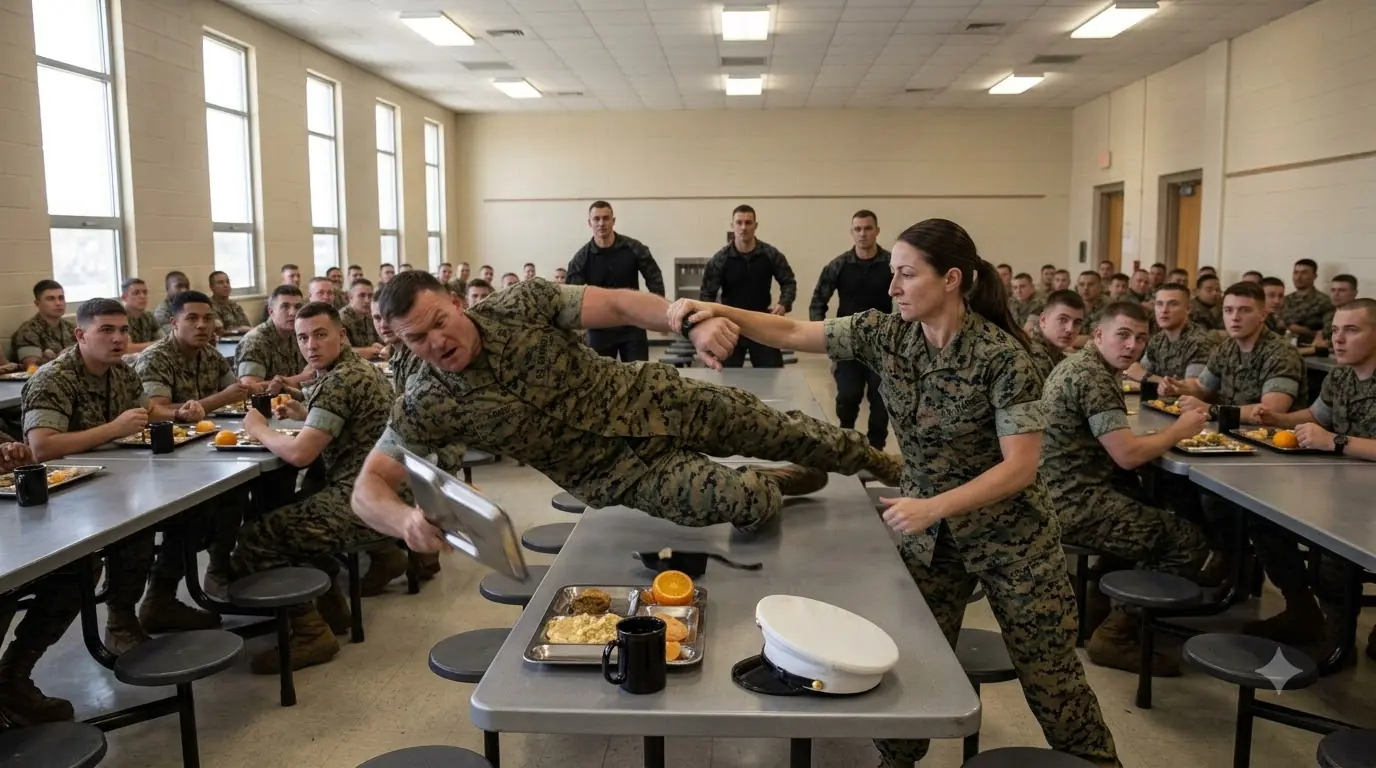
Someone was sitting at his table.
There was no official designation on the table, no reserved sign, and no regulation granting Sergeant Miller ownership of anything inside the room. Yet for nearly three years, everyone in his section had understood that the table beside the far windows belonged to him because Miller had decided it did.
Junior Marines learned quickly.
Sit elsewhere.
Do not move his chair.
Do not leave trays there.
Do not make him repeat himself.
Miller was thirty-eight years old, more than six feet tall, broad through the shoulders, with the heavy muscular build of a man who liked people noticing his physical presence before he ever spoke. He wore his authority aggressively, not through rank alone but through the certainty that consequences followed anyone who embarrassed him.
His reputation had grown through dozens of small incidents rather than one dramatic act.
A Marine who questioned a duty assignment found himself cleaning storage areas until midnight.
Another who complained about missing gear became the subject of an inspection so relentless that he eventually requested reassignment.
Young Marines learned that challenging Miller rarely produced an immediate confrontation.
It produced a long memory.
That was more effective.
This morning, however, the person occupying his preferred seat appeared completely unconcerned.
She looked to be in her late thirties, with dark brown hair tied into a low ponytail and a controlled expression that revealed nothing. Her camouflage utility uniform carried no obvious decoration that Miller noticed from where he stood.
A breakfast tray rested in front of her.
Black coffee.
Eggs.
Two sausage patties.
And an orange she was slowly peeling with both hands.
She was alone.
Miller smiled.
One of the Marines beside him saw the smile and immediately looked toward the floor.
Miller crossed the room.
Conversation around the table began thinning before he even reached it.
Then he slammed his tray down.
The coffee beside the woman jumped in its cup.
She continued peeling the orange.
Miller leaned toward her.
“You’re in my seat.”
She removed another strip of peel.
“I’m eating, Sergeant.”
The closest tables went quiet.
Miller blinked once.
He was accustomed to apologies.
He was accustomed to people standing when he approached.
What he was not accustomed to was being answered without urgency.
He leaned closer.
“Maybe you didn’t hear me.”
The woman finally looked up.
Her eyes were dark, steady, and almost unnervingly calm.
“I heard you.”
Miller’s jaw tightened.
“Then move.”
“No.”
The single word traveled farther through the mess hall than a shout would have.
A Marine three tables away slowly put down his fork.
Another glanced toward the exit.
Miller looked around and saw people watching.
That made the decision for him.
He could not walk away now.
Not in front of all of them.
He reached down and grabbed the woman’s ponytail.
Hard.
Her head pulled backward.
Several Marines inhaled sharply.
One chair scraped.
Nobody intervened.
The woman’s hands remained on the table.
Miller leaned toward her face.
“I said move.”
She looked directly into his eyes.
No panic.
No pleading.
No attempt to pull away.
That lack of fear bothered Miller more than resistance would have.
Her voice dropped.
“Let go.”
He smiled.
“You going to make me?”
“You have three seconds.”
A few Marines exchanged looks.
Miller tightened his grip.
“Or what?”
The woman’s left hand closed around his wrist.
Not desperately.
Deliberately.
“Two.”
Miller tried to pull her ponytail harder.
That was his mistake.
Her body changed instantly.
The stillness disappeared.
Her hand rotated his wrist inward while her shoulder moved underneath his arm. She rose from the chair in one sharp motion, using his own grip to pull him forward before driving his forearm downward against the table.
Miller grunted.
His free hand came up.
She moved outside it.
Her foot hooked behind his leg.
His balance disappeared.
The entire sequence took less than two seconds.
Miller hit the neighboring table sideways.
Trays jumped.
A cup rolled off the edge and struck the floor.
Before he could push himself up, the woman rotated his wrist behind his back, controlled his shoulder with her forearm, and pinned him against the tabletop.
She did not punch him.
She did not kick him.
She simply removed every option he thought he had.
The mess hall became completely silent.
Miller strained once.
Her grip tightened.
“Don’t.”
He stopped.
Only then did she say the final number.
“Three.”
Nobody laughed.
Miller’s cheek pressed against the tabletop.
His breathing became louder.
“You’re done,” she said.
Then four men moved.
They had been standing several yards away in black tactical training gear, silent throughout the confrontation.
Miller had noticed them earlier without understanding why they were there.
Now they stepped forward together.
One took control of his wrist.
Another positioned himself beside the table.
The woman released Miller and stepped backward.
Miller spun toward her.
“What the hell is this?”
She straightened her uniform.
Then reached toward the breakfast table.
Beside the orange peels rested something Miller had somehow failed to register.
A white officer’s cover.
His expression changed.
The woman picked it up.
The room remained frozen.
Miller looked at the cover.
Then at the four men.
Then back at her.
Someone near the rear whispered her name before she said it herself.
“Commander Vance.”
Miller’s face drained.
Sarah Vance placed the cover under one arm.
“You mistook restraint for weakness.”
Miller swallowed.
“Commander, I didn’t know—”
“I know.”
“I wouldn’t have—”
“I know.”
That made the situation worse.
Sarah stepped closer.
“You’re about to explain exactly why you behave differently depending on who you believe has enough power to hurt you back.”
Miller’s mouth tightened.
“That’s not what this was.”
“No?”
He looked around.
The entire mess hall was watching.
Sarah continued.
“You grabbed a woman by the hair because she refused to give you a chair.”
Miller lowered his voice.
“You don’t understand the situation here.”
“I understand it better than you think.”
One of the men in black placed a sealed evidence pouch on the table.
Miller saw it.
His attention locked onto the pouch.
Sarah noticed immediately.
“That worries you more than the chair.”
Miller said nothing.
She opened it.
Inside were printed records, photographs, financial documents, inventory discrepancies, and copies of communications collected during the previous eight weeks.
Miller’s face changed again.
Sarah placed the first document on the table.
“Fuel allocations.”
A second.
“Equipment that left secured inventory and never reached the unit listed as receiving it.”
A third.
“Cash payments from junior Marines.”
Miller’s eyes moved toward the crowd.
Several young Marines lowered their heads.
Sarah placed down another record.
“And a civilian courier paid outside the south gate last night.”
Miller stared at her.
“You’ve been watching me.”
“For eight weeks.”
He laughed once, but there was no humor in it.
“You think those papers prove anything?”
“No.”
Sarah nodded toward the men standing behind him.
“That’s why we didn’t come with only papers.”
Miller’s expression hardened.
Sarah turned toward the room.
“Private First Class Nolan Price.”
A young Marine near the center table went rigid.
Miller immediately found him.
Nolan looked barely twenty.
His face had gone pale.
Sarah waited.
“Come forward.”
Nolan remained seated for several seconds.
Miller stared at him.
The threat in that stare was unmistakable.
Nolan slowly stood.
“Price,” Miller said quietly.
Sarah turned her head.
“Sergeant, look at me.”
Miller did not.
“Look at me.”
He finally did.
Sarah’s expression had changed.
Still controlled.
Less patient.
“You don’t threaten witnesses while I’m standing three feet away.”
Miller looked back toward Nolan.
Sarah stepped between them.
“Try it again.”
Miller said nothing.
Nolan approached.
His hands trembled.
Sarah gave him time.
Finally Nolan spoke.
“He made us pay.”
Miller laughed.
“That’s a lie.”
Nolan flinched.
Sarah raised one hand without looking away from Miller.
“Continue.”
Nolan swallowed.
“He called it squad money.”
“For what?”
“Protection.”
Murmurs moved through the mess hall.
Nolan continued.
“If someone didn’t pay, they got the worst assignments. Inspections. Overnight duties. Sometimes equipment would disappear and then they’d get blamed.”
Miller’s voice sharpened.
“You little—”
Two operators stepped closer.
Sarah did not raise her voice.
“Finish that sentence.”
Miller stopped.
Nolan breathed slowly.
“There were others.”
“Who?”
Nolan looked toward several tables.
One Marine stood.
Then another.
A third.
Miller’s posture changed as the scale of the testimony became visible.
Sarah asked Nolan about the missing equipment.
He described crates redirected through maintenance channels.
He described serial numbers removed from paperwork.
He described vehicles arriving at odd hours.
He described being ordered to keep quiet.
Then Sarah asked about the courier outside the south gate.
Nolan hesitated.
Miller watched him.
Sarah saw the hesitation.
“You’re safe.”
Nolan looked at her.
“No, ma’am.”
The answer surprised her.
“Explain.”
Nolan’s voice lowered.
“Miller isn’t the top.”
The room became still again.
Sarah looked toward Miller.
Miller smiled.
For the first time since being thrown across the table, genuine confidence returned to his face.
Sarah noticed.
“Who is?”
Nolan shook his head.
“I don’t know.”