Bang.
The sound was not a gunshot. It was Victor Stone’s shoulder driving Walter Hayes into the padded wall at the back of the demonstration stage with enough force to rattle the hanging microphones and send a tremor through the cheap lumber beneath the studio mats.
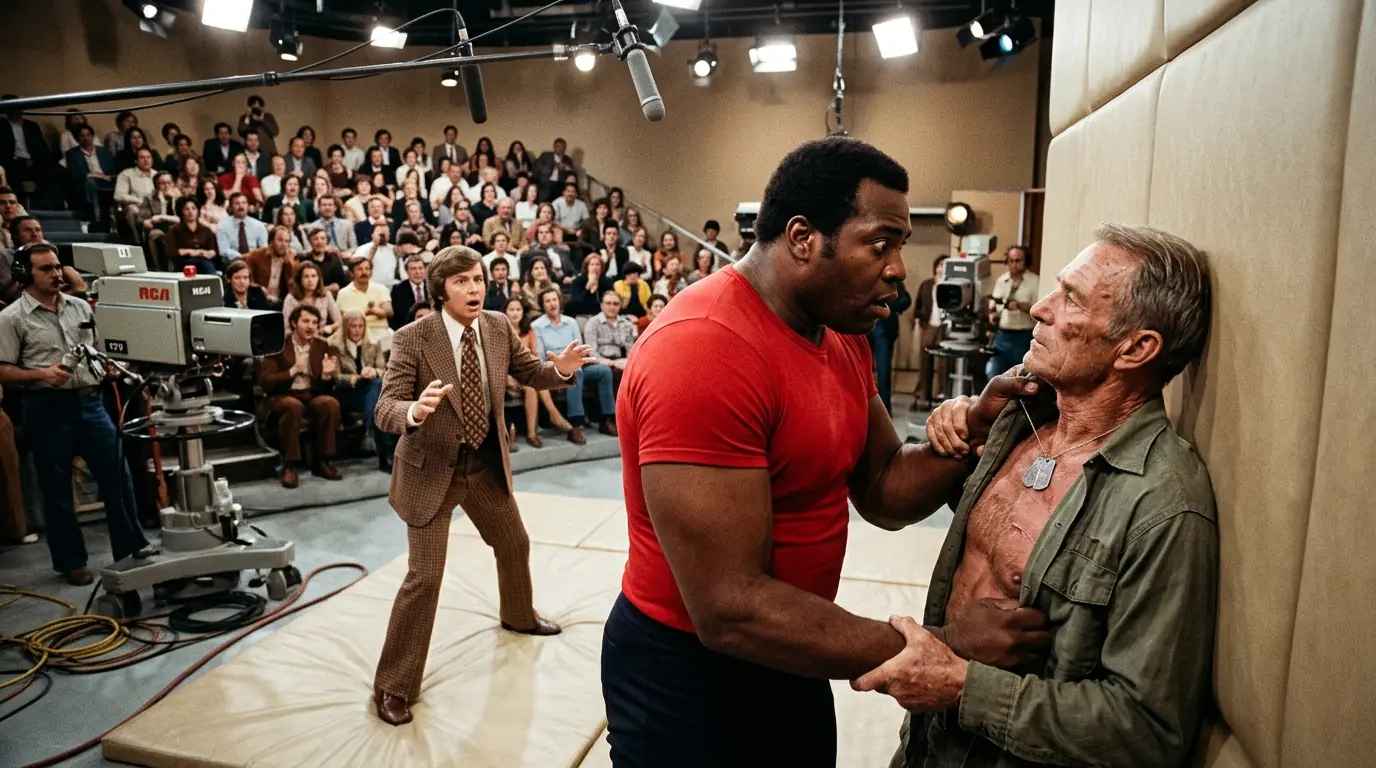
A hundred people in the front rows screamed before they understood what they were seeing.
Another hundred farther back rose half out of their folding seats. One woman clapped both hands over her mouth. Somewhere off to the left, a child started crying because children always know first when grown-ups stop pretending a thing is part of the show.
Victor’s hand closed around Walter’s throat.
Walter’s boots slid against the mat as the giant strongman drove him backward and pinned him there, forearm flexed, biceps tightening under the red athletic shirt already damp at the chest from the heat of the lamps. Victor weighed close to three hundred pounds, and in the harsh white light of the Los Angeles television studio he looked even larger than that, like something built in a carnival tent and then taught to grin for cameras.
“Ten seconds!” Victor roared. “That’s all an old man like you get!”
The audience noise broke apart into separate frightened sounds.
The middle-aged host in the brown suit, standing too close to the stage edge and too far from the kind of authority he usually borrowed from cue cards, shouted, “Put him down! This wasn’t part of the show!”
Victor either did not hear him or did not care.
Walter’s back remained against the wall. His weathered face had gone taut, but not panicked. He gripped Victor’s wrist with one hand, not with the wild flailing desperation the audience expected from a man of sixty-eight, but with a pressure so deliberate it seemed almost insulting.
Victor laughed.
It was the laugh of a man who believed size settled every argument worth having. He hooked two fingers into the front of Walter’s faded olive work shirt and tore it open in one ugly jerk.
Buttons flew. The shirt split.
The room went silent.
Under the torn cloth was not the frail chest of a grandfather out of place under television lights.
It was a scar-covered torso, lean and corded and harder than anyone expected, the skin crosshatched by old pale seams and healed burn marks. Around Walter’s neck, knocked free by the violence, hung an old pair of silver military dog tags that flashed once in the light.
Victor’s grin widened for a heartbeat.
“What—you think those scars make you dangerous?” he said.
Walter looked down at the tags.
Then he lifted his eyes and met Victor’s stare with such cold, settled control that the huge man’s laughter faltered before he could stop it.
“Ask your father where I got them,” Walter said quietly.
The change in Victor’s face was immediate and terrible.
His fingers loosened.
His grin collapsed as if someone had cut the strings behind it. He looked down—not at the scars now, but at the name engraved on one of the dog tags—and what replaced his arrogance was first disbelief, then recognition, then something raw enough to strip all performance out of him.