Nia Carter could see the white powder through the plastic, but she kept looking at the man holding it.
Officer Ryan Briggs was smiling.
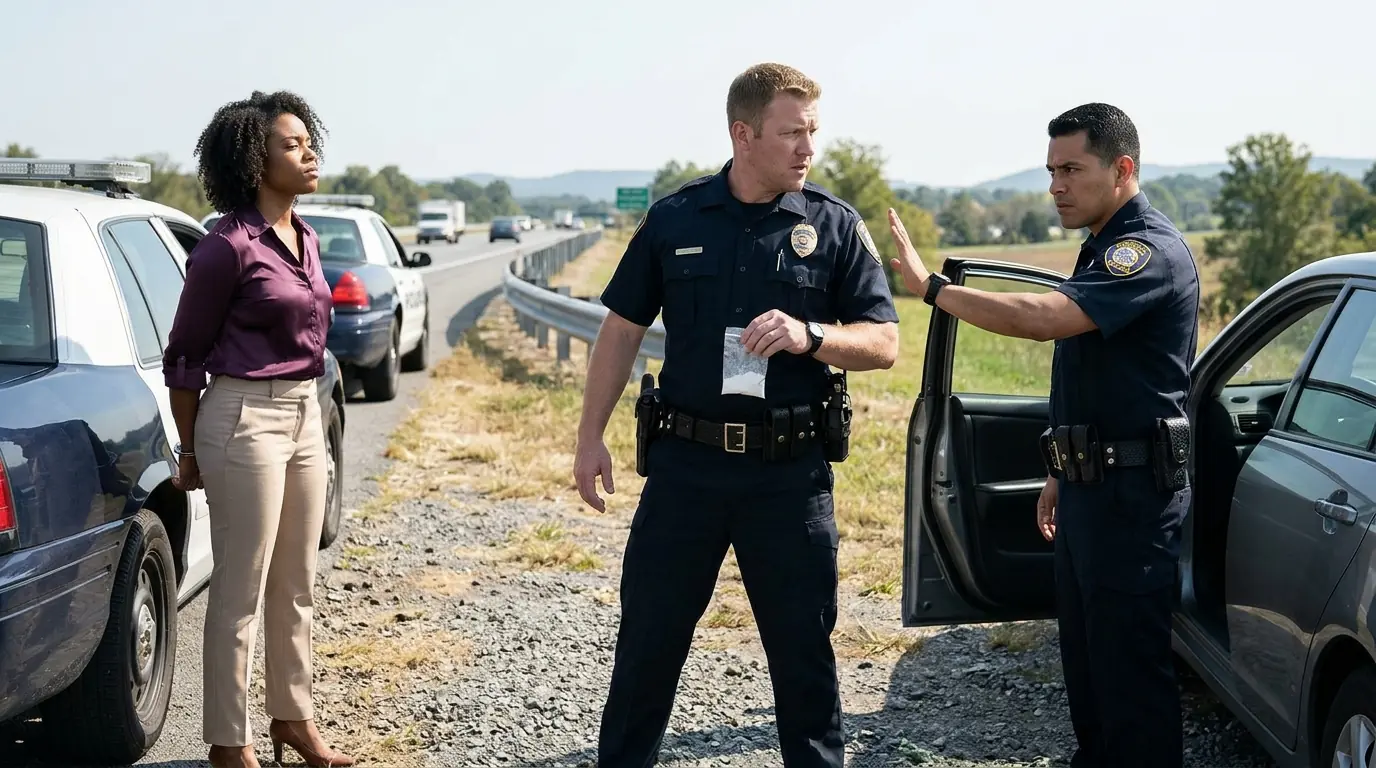
That expression frightened her more than the bag itself.
If he had looked surprised, she might have believed there was a mistake to correct. If he had looked uncertain, there might have been room for a question, a closer examination, some ordinary process by which the object in his hand could be separated from the person he was accusing.
Instead, he appeared pleased.
Nia stood beside her gray sedan with her hands cuffed behind her back. The rear passenger door remained open. Two cruisers sat behind the car, their positions turning a stretch of gravel shoulder into a place she could not leave.
Traffic moved steadily along Interstate 81.
A truck passed with a roar that pressed against the silence between her and Briggs. Wind stirred her shoulder-length curls and lifted the loose fabric near the folded cuff of her plum blouse.
She wanted to move the hair away from her mouth.
She could not.
Her hands were behind her, and the small restriction made the rest of the scene feel more real.
She had driven into the afternoon expecting to continue through it.
There had been ordinary concerns occupying her attention before the stop. The time, the traffic, the small adjustment of keeping enough distance from a truck whose movement made the air around the sedan feel uneven.
None of those thoughts had prepared her for standing outside the car while someone searched it.
She remembered the road through the windshield.
Clear daylight. The dark shape of a vehicle ahead. A view that changed continuously but predictably as she drove.
Inside the sedan, she had been responsible for small decisions that made sense.
When to slow.
When to leave more room.
Whether to remain behind a slower vehicle or wait for a safe opportunity to pass.
Now she stood on gravel in brown heels, trying to understand how a sequence of questions had become a restraint and a search.
She had answered the questions put to her.
She had tried to keep those answers simple.
There were moments during an uncomfortable exchange when giving more information felt like the obvious way to help. Nia had learned, over the course of this one, that additional words could become another thing to question.
So she had stopped trying to anticipate every possible concern.
She listened.
She answered.
She kept her movements visible.
That had not returned her to the driver’s seat.
At thirty-one, Nia was accustomed to managing how she presented herself in unfamiliar situations. She could be patient without agreeing, firm without becoming loud, and polite without inviting someone to mistake it for permission.
Those distinctions had seemed useful until Briggs began treating them as interchangeable.
A clear answer became an attitude.
A question became resistance.
Her silence became something he appeared to enjoy.
She had watched the second officer while trying to decide whether the encounter would remain reasonable.
Matthew Ortiz stood beside the nearest cruiser.
He was Latino, around thirty-five, with short black hair and a navy uniform. His posture was attentive, though he had not made himself the center of the exchange.
Nia could not tell what he thought.
She had looked toward him more than once.
Not pleading.
Checking.
There was a difference between being alone with one person’s judgment and knowing someone else was present to hear what had actually been said.
At first, his presence had been reassuring.