The call came while Ethan Cole was driving back toward Dallas, convinced the worst part of his week was already behind him. An estate attorney named Howard Bell informed him that his grandfather, Samuel Cole, had died six days earlier and left Ethan everything he owned. Ethan nearly laughed because he had not spoken to Samuel in seventeen years, not since bitterness divided the Cole family into people who shared blood but no longer shared holidays. Yet before sunset, Ethan was sitting inside a dusty legal office, staring at a ranch deed, an old brass key, and a warning written in his grandfather’s hard, uneven handwriting.
If they discover what lies beneath the land, they will come for everything.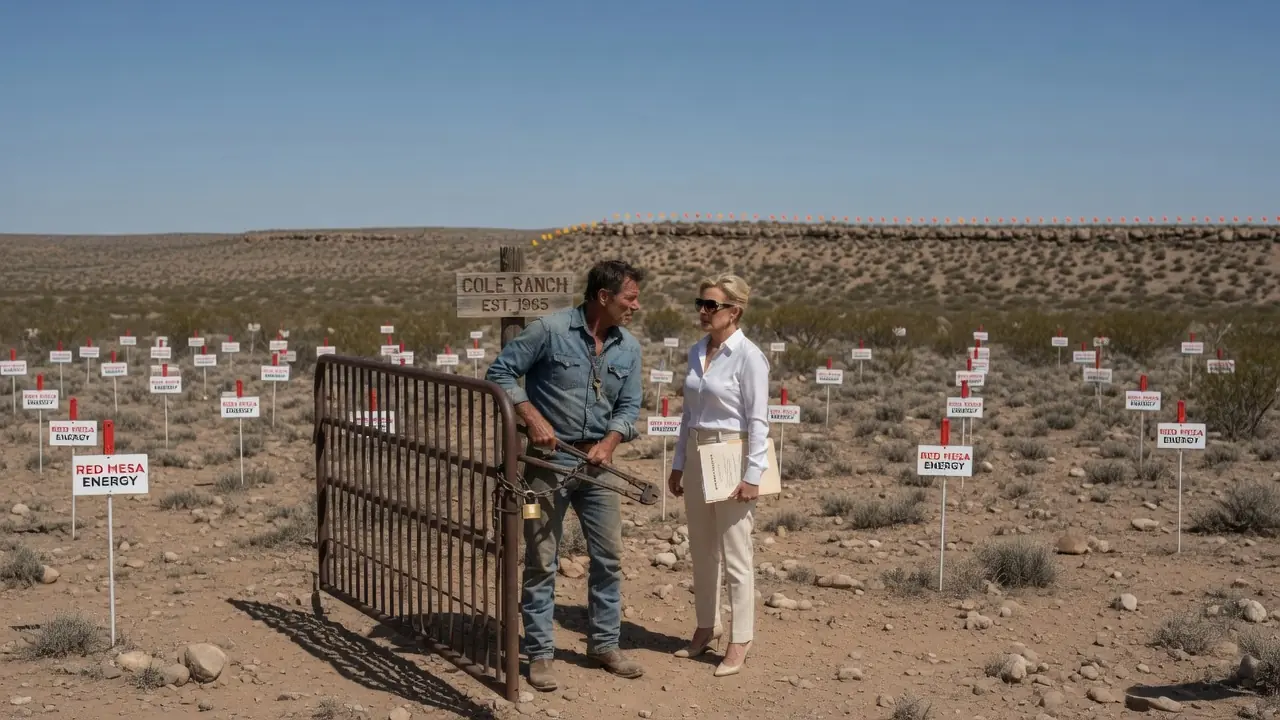
That was the entire message.
The inherited property consisted of 240 acres in West Texas, including a deteriorating ranch house, abandoned cattle pens, a frozen windmill, and fences that had not been repaired in years. Ethan had spent two decades building and selling small companies, which meant he understood assets, liabilities, and the danger of inheriting property that produced no income. His first instinct was to sell the place before taxes and repairs consumed more money than the land could ever return. But the brass key felt unusually heavy in his hand, and Howard’s final warning stopped him.
“Your grandfather said that if anyone ever asked you for this key, you were not to trust them.”
Ethan drove west the following morning.
He was forty-two, ruggedly handsome, with sun-browned skin, short dark hair, a strong build, and hard gray eyes that made people underestimate how carefully he watched them. He wore a fitted denim shirt, dusty jeans, worn leather boots, and a weathered jacket tossed across the passenger seat. The farther he drove, the emptier the land became until oil pumps moved alone against the horizon like slow metal animals. By late afternoon, the paved road ended and the ranch appeared beyond a long trail of rust-colored dirt.
The entrance gate was chained shut.
A polished steel chain ran between the old wooden posts, secured by a new industrial lock. Beside it hung a clean white sign that read:
PROPERTY OF SILVER CREEK HOMEOWNERS ASSOCIATION
NO TRESPASSING
Ethan stepped from his truck and stared at it.
The ranch had belonged to his family for more than sixty years. Silver Creek was a gated development nearly three miles east, built long after Samuel had purchased the property. No legitimate homeowners association could simply annex a working ranch without a recorded agreement, yet fresh survey stakes stood beyond the gate, and orange drilling flags covered the southern ridge.
Someone had moved quickly after Samuel’s death.
Ethan opened the toolbox behind his cab and removed a pair of heavy bolt cutters. The blades closed around the new chain just as tires hissed across the dirt behind him. A black Escalade stopped near the gate, too clean and expensive for ranch country.
A blonde woman stepped out wearing a crisp white blouse, tailored cream trousers, dark sunglasses, and spotless heels. She appeared close to sixty and carried herself with the confidence of someone accustomed to turning personal opinions into official orders. A younger brunette woman followed with a thick folder held tightly against her chest.
“This is HOA land,” the blonde woman shouted. “Put those bolt cutters down before I have you arrested.”
Ethan squeezed the handles.
The chain snapped and fell into the dust.
“Your fake sign doesn’t outrank my grandfather’s deed.”
The woman removed her sunglasses. “I am Linda Carrington, president of Silver Creek HOA. Your grandfather transferred this property into our jurisdiction eight years ago.”
Ethan pushed the gate open. “Then you won’t mind showing me the recorded agreement.”
Linda’s smile sharpened. “Sign over the mineral rights peacefully, or we’ll bury you in liens before sunset.”
Ethan touched the brass key hanging from a leather cord around his neck. “Try it. My grandfather left proof that can bury your entire HOA first.”
The younger woman looked at him for the first time.
Fear flashed across her face.
Her name was Claire Dawson, and according to Linda, she worked as the HOA’s property administrator. Linda spread several documents across the hood of Ethan’s truck: annexation agreements, unpaid assessments, boundary maps, and a transfer of mineral rights. Every page appeared official at first glance.
Then Ethan noticed the parcel number.
The inherited deed identified the ranch as Parcel 117-C.
Linda’s documents referred to Parcel 117-A.
It was not a typographical error. Parcel 117-A belonged to undeveloped land east of the ranch, close enough to Silver Creek for the HOA to claim jurisdiction. Someone had copied the neighboring parcel’s ownership history and attached Samuel’s forged signature to it.
Claire dropped part of the folder.
Several papers scattered across the ground, including an invoice from Red Mesa Energy for geological assessment work completed four years earlier. Ethan bent to retrieve it, but Claire snatched it first. Her hands shook visibly.
Linda closed the folder. “You have twenty-four hours to cooperate.”
“I have an original deed and a confirmed probate order.”
“You also have eighty-two thousand dollars in unpaid HOA assessments.”
“I inherited the ranch yesterday.”
“The debt belongs to the property.”
“No,” Ethan said. “The fraud belongs to whoever created it.”
Linda stepped closer. “You are making a very expensive mistake.”
She returned to the Escalade, and Claire followed without speaking. As the vehicle disappeared down the county road, Ethan looked toward the drilling markers across the southern ridge. Red Mesa had performed exploration years before the public knew anything might lie beneath the ranch.
That meant Linda had not come because Samuel died.
She had been waiting for him to die.
Ethan spent the rest of the afternoon documenting every sign of trespass. He photographed industrial tire tracks, metal core-sample stakes, painted survey lines, and Red Mesa identification tags. Near the ridge, he found several recently sealed boreholes, none approved by the property owner.
At sunset, three white Red Mesa trucks drove through the broken gate.
The lead vehicle stopped near the house, and a field geologist named Tom Weaver stepped out. He was a practical man in his fifties, wearing a pressed work shirt, dusty hard hat, and an expression that suggested he already knew too much.
“You Ethan Cole?”
“Yes.”
Tom looked toward the ridge. “Has anyone shown you the mineral report?”
“What report?”
The geologist hesitated. “Your grandfather never told you?”
He produced a sheet containing pressure readings, density estimates, core results, and projected extraction values. Ethan understood little of the geological language, but he understood the numbers. They represented an enormous commercial discovery.
“There’s oil beneath the southern ridge,” Tom said. “A lot of it.”
“How much?”
“Enough to make everyone in this county interested.”
“Did my grandfather authorize your testing?”
Tom did not answer.
“Did Linda Carrington?”
The geologist folded the paper. “You need an attorney.”
Then he left.
Within hours, the pressure began.
A woman claiming to represent county records called after normal business hours and announced an $82,000 HOA lien. An environmental notice arrived by email accusing Ethan of maintaining an unsafe well. The county transportation office issued a temporary restriction on the ranch road, while a local community page accused an “outsider from Dallas” of planning to sell the property to an oil company.
Someone spray-painted GO HOME across the mailbox before midnight.
Five attacks in less than six hours.
Ethan sat at Samuel’s kitchen table with the forged documents spread beneath a single hanging light. People who felt secure attacked from one direction. People who were frightened attacked from every direction at once.
He called Sandra Vance, the most aggressive land attorney he knew.
Sandra listened without interrupting as Ethan described the ranch, the mineral report, the forged transfer, the false lien, and the wrong parcel number. When he finished, she remained quiet for several seconds.
“They’re moving too quickly,” she finally said.
“Because they’re confident?”
“Or terrified.”
She instructed him to photograph and scan everything. She also forwarded the evidence to state authorities because the county agencies appeared compromised. Ethan spent half the night copying records before locking every door and sitting near the window with Samuel’s old rifle across his knees.
Headlights watched from the southern ridge until after one in the morning.
The following day, Ethan visited the county archive to obtain the original plat maps. The clerk, Nancy Benson, reacted strangely when he requested Parcel 117-C and immediately claimed the ranch fell under Silver Creek jurisdiction. When Ethan showed her Samuel’s deed, she disappeared into the back office for nearly half an hour.
The map she eventually handed him looked authentic.
But when Ethan rubbed the western boundary line, the ink smeared beneath his thumb.
Someone had altered an archived county record with fresh ink, shifting the Silver Creek boundary exactly 2.7 miles west to include Samuel’s ranch. Beneath the new line, part of the original seal remained visible.
Sandra examined it during a video call.
“This is not simple forgery,” she said. “Someone is rewriting county history.”
Back at the ranch, Ethan searched the house more carefully. Samuel had never trusted banks, attorneys, or government offices, which meant he would not have placed important evidence inside an obvious filing cabinet. In the living room, Ethan noticed one floorboard raised slightly higher than the others.
He pried it loose.
Beneath it rested a locked metal box.
The brass key opened it.
Inside were original surveys, handwritten notes, photographs, payment records, and a leather ledger containing twelve years of names and transactions. Nine local landowners had faced false liens, sudden foreclosures, disputed boundaries, or unexplained tax claims. Each property was eventually transferred to companies associated with Silver Creek or Red Mesa.
The same names appeared repeatedly.
Linda Carrington.
Sheriff Robert Doyle.
County clerk Nancy Benson.
Red Mesa executive Victor Hale.
And Dr. Alan Mercer, the medical examiner who had signed Samuel’s death certificate.
Beside Mercer’s name, Samuel had written one word.
PAID.
Ethan photographed every page and sent copies to Sandra. Then he found a Red Mesa payment made to Silver Creek four years earlier, long before the supposed oil discovery. It was labeled exploration retainer.
Red Mesa already knew what lay beneath the ranch.
The public drilling was only theater.
At 9:17 that night, Sandra called with worse news. Samuel’s death file contained no autopsy, no toxicology report, and no examination notes—only a death certificate signed by Dr. Mercer. She also discovered that Samuel had changed his will forty-eight hours before dying.
He had known something was coming.
Before Ethan could answer, he smelled smoke.
The barn was burning.
Flames climbed from four separate corners, proving the fire had been deliberately set. Ethan ran toward the side door, entered through the smoke, and heard the door slam behind him.
Someone locked it from outside.
The air became black within seconds. Ethan dropped to the floor, crawling beneath the smoke while burning wood crashed from the rafters. Near Samuel’s old workbench, his hand struck a second steel box bolted beneath the frame.
He tore it loose and dragged it toward the east wall.
The window shattered beneath a shovel, and Ethan climbed through just before part of the roof collapsed. He hit the dirt coughing, the steel box still looped around his arm. Near the tree line, a tall silhouette watched him rise.
Then the figure disappeared into a waiting truck.
Inside the second box, Ethan found a flash drive, an old videotape, and another letter.
If I die suddenly, do not trust the county.
The flash drive contained a video recorded eleven months earlier. Linda Carrington stood on Samuel’s porch, dressed almost exactly as she had been when confronting Ethan. Samuel sat in a wooden chair, older and thinner but mentally sharp.
“Sell now, Sam,” Linda said on the recording. “Or we’ll make this place impossible.”
Samuel spat into the dust beside her shoes.
Linda smiled.
“Then we’ll wait.”
The video ended.
By sunrise, Sandra had arrived at the ranch. She examined the four ignition points, the damaged lock, and the video. After reading the ledger, she closed it carefully.
“This isn’t an HOA dispute,” she said.
“It never was.”
“This is organized land theft protected by county officials.”
Ethan looked at the burned barn. “And murder.”
Later that morning, Samuel’s neighbor Walt Granger arrived in a rusted pickup. The old rancher admitted Samuel had hidden additional drilling reports years earlier because Red Mesa had discovered something beneath the southern ridge before the HOA began stealing nearby land.
“What did they find?” Ethan asked.
Walt glanced toward the road. “Your grandfather kept proof.”
“Where?”
“I’ll bring it tonight.”
A black SUV rolled slowly past the gate.
Walt immediately left.
He never returned.
That evening, Claire sent Ethan a message from an unknown number.
Walt knows too much. Be careful.
Ethan drove to Walt’s house and found the front door open, a chair overturned, and fresh coffee spilled across the floor. The rancher’s truck lay down an embankment nearby with blood across the driver’s seat.
There was no body.
Ethan’s phone rang.
A man spoke only four words.
“You should have sold.”
The following morning, Sheriff Doyle arrived with four deputies and an arrest warrant accusing Ethan of arson, trespassing, and destruction of HOA property. Ethan read the page and immediately noticed the wrong seal, an invalid county code, and a judge’s signature printed in the wrong format.
The warrant was fake.
Instead of surrendering, Ethan began streaming live from his phone.
“Sheriff Doyle is attempting to arrest me on my own land with a forged warrant,” he told the camera.
Thousands of viewers joined within minutes. Ethan displayed every error on the document while one deputy quietly warned Doyle that the audience was growing.
The sheriff ordered Ethan to stop filming.
Ethan refused.
“When your enemies need forged deeds, false liens, altered maps, arson, and a fake arrest warrant to fight one man, they’ve already admitted who owns the truth.”
Screenshots spread across social media before the sheriff could react. Doyle folded the warrant and returned to his vehicle.
“We’ll come back with a real one.”
“Bring a real judge with it.”
The county SUVs left without making an arrest.
That night, Claire sent another message.
County Line Storage. Unit 14. Midnight. They’re moving everything.
Ethan knew it might be a trap, but evidence was being destroyed, and Walt might still be alive. He parked a quarter mile from the storage facility and approached on foot with his phone recording.
At midnight, four vehicles arrived.
Linda’s Escalade.
Doyle’s county SUV.
Nancy Benson’s records sedan.
A Red Mesa truck driven by executive Victor Hale.
They opened Unit 14 and began transferring boxes labeled LAND CLAIMS, MINERAL ACCESS, and BOARD RECORDS. Doyle removed Walt’s shotgun from one container.
Then Victor opened a folder stamped PROJECT APEX.
Ethan zoomed in with his phone. The documents showed payments worth millions and a projected value of $3.8 billion. One line was visible beneath the project title:
Oil survey remains useful cover.
Oil was not the true prize.
When the group separated briefly, Ethan rushed from hiding, struck Victor against the unit wall, and seized the Project Apex box. Doyle opened fire as Ethan ran.
One bullet struck the storage door.
Another shattered the rear window of Ethan’s truck.
A county SUV rammed him from the passenger side, spinning the truck across the gravel. Ethan recovered, crashed through a section of chain-link fence, and escaped onto an irrigation road. Doyle pursued until his SUV plunged into an unseen drainage ditch.
Ethan reached the ranch with the evidence.
Project Apex contained proof that Red Mesa had secretly financed Silver Creek for years. The HOA used false liens and altered records to acquire properties above a hidden mineral deposit. Oil exploration provided a believable explanation for drilling while concealing the actual resource.
But the documents never named it.
Sandra filed emergency motions before sunrise, attaching the forged warrant, altered maps, storage footage, Samuel’s video, and the Project Apex records. Public attention from Ethan’s livestream forced the court to schedule an emergency hearing that afternoon.
The courthouse was packed.
Linda sat beside Sheriff Doyle, Nancy Benson, and Victor Hale. She wore a white suit and maintained a calm expression as Sandra presented the forged transfers and altered county plat. Then Samuel’s video played across the courtroom screen.
“Sell now, Sam, or we’ll make this place impossible.”
The room became silent.
Sandra displayed photographs of the burned barn, the false warrant, Red Mesa’s secret payments, and footage from Unit 14. Judge Keller examined the Project Apex file and asked Victor a direct question.
“What resource does this project concern?”
Victor refused to answer.
The courtroom doors opened.
Six state investigators entered.
They arrested Sheriff Doyle first, followed by Nancy and Victor. Linda remained seated until an investigator placed handcuffs around her wrists. For the first time, her confidence broke.
“You have no idea what you’ve done,” she whispered to Ethan.
The judge immediately froze all Silver Creek authority, suspended every claim against the ranch, and ordered the seizure of HOA, county, and Red Mesa records. As Linda was escorted out, she looked back.
“You still don’t know what’s beneath your land.”
She was right.
Four months later, Silver Creek HOA had been legally dissolved. Investigators uncovered nine stolen properties, multiple falsified death records, two deliberate fires, and years of coordinated corruption. Sheriff Doyle, Nancy Benson, Victor Hale, Dr. Mercer, and Linda faced charges ranging from fraud and evidence tampering to kidnapping and attempted murder.
Walt was found alive inside an abandoned hunting cabin forty miles north. He had broken ribs, a concussion, and dehydration, but he survived.
From his hospital bed, he told Ethan where Samuel’s original drilling records had been hidden: beneath the concrete footing of the old windmill in the north pasture.
Investigators recovered a sealed canister containing core samples, geological reports from 1989, and one final letter.
If you are reading this, they found the ridge. Oil is only what they will tell the public. The true value lies in the black stone veins below it.
The samples contained spodumene.
Lithium-bearing rock.
According to independent experts, the southern ridge held one of the largest undeveloped lithium deposits in Texas. The material could supply batteries, energy grids, military contracts, and electric vehicles for decades.
The estimated value exceeded $3.8 billion.
Oil had never been the prize.
It was the distraction.
Ethan refused to sell the ranch outright. Instead, he negotiated a long-term extraction lease under state oversight while keeping full ownership of the land. The agreement included environmental protections, local employment requirements, and restrictions preventing any private HOA or corporation from controlling the property.
He rebuilt the barn, repaired the fences, restored the ranch house, and kept one fire-blackened beam above the new workshop door. It reminded him how close he had come to losing everything before understanding what Samuel had protected.
One evening, Ethan sat on the same porch where Linda had threatened his grandfather. The southern ridge glowed beneath the setting Texas sun, peaceful despite the fortune hidden below it.
For most of his life, Ethan had believed Samuel was only a bitter old rancher who chose land over family.
Now he understood.
Samuel had not died protecting oil, lithium, or billions of dollars.
He had protected the right to choose what happened to the land after him.
The HOA believed a forged sign could create ownership. Linda believed official-looking papers could erase a family’s history. Red Mesa believed every man eventually surrendered when enough money or fear was placed in front of him.
They were all wrong.
Ethan kept Samuel’s brass key in his pocket, even though both hidden boxes had already been opened. Some objects remained valuable after their practical purpose ended.
They became reminders.
Samuel’s first warning had said that once people discovered what lay beneath the ranch, they would come for everything.
They came with chains.
They came with fake deeds, false debts, altered maps, fire, bullets, and a forged warrant.
But when the dust finally settled, the ranch still belonged to a Cole.