“She’s just a housekeeper,” Diego Martinez said, smiling at his boss as if he had made a harmless joke. “Someone we let stay here out of pity. She’s good with a mop.”
For one second, the entire dining room seemed to hold its breath. Rose Martinez sat at the edge of the candlelit table in her plain dark apron, her gray hair tied back, her hands folded so tightly in her lap that her knuckles whitened. Around her, Diego’s office friends laughed in that careful way rich people laugh when they are not sure whether cruelty is allowed yet. Carmen, Diego’s wife, stood beside him in her red dress with a smile so sharp it looked carved.
Rose did not look at the guests. She looked at her son. She looked at the boy she had carried through fevers, school mornings, scraped knees, heartbreak, and college tuition she paid by working double shifts after his father got sick. He stood there in a tailored suit, pointing at her like she was a stain he wanted removed before his promotion could see it.
The house around them was not Diego’s. It was hers. The crystal glasses on the table had been a twentieth anniversary gift from her late husband, Carlos. The silver candleholders had belonged to her mother, and the long polished dining table had been bought after Rose spent six years running a small catering business out of the church kitchen. Yet Diego stood beneath her chandelier, eating food she had cooked, entertaining guests in rooms she had cleaned, and calling her the housekeeper.
Rose lowered her eyes because the pain was too large to show in public. She told herself not to cry. Crying would give Carmen satisfaction, and Diego had already taken enough from her that night. She had spent the entire morning making tamales, Spanish rice, roasted peppers, braised chicken, and the dark chocolate birthday cake Diego used to ask for every year when he was little. He had not thanked her once.
Carmen had thanked her even less. That morning, she had stood in the kitchen wearing workout clothes and holding a phone against her ear, pointing at invisible dust on the cabinets. “Rose, the windows still have streaks,” she had said, not even lowering her voice. “And tonight, please stay mostly in the kitchen. Diego’s boss is coming, and we don’t need confusion about the family situation.”
The family situation. That was what Carmen called Rose living in her own house. That was what she called a mother who had let her son and daughter-in-law move in after Carlos died because Diego said he wanted to “help her manage things.” Rose had believed him then. Grief had softened her judgment, and loneliness had made his offer sound like love.
For three years, Rose cooked, cleaned, babysat Sophia, paid the property taxes from her savings, and kept the old Victorian house running while Diego and Carmen acted like they had rescued her. They talked about her medicine in front of her as if she were not there. They discussed her “future” in low voices while she washed dishes. Carmen called the downstairs guest room “Rose’s little space,” though Rose had slept in the master bedroom beside Carlos for twenty-seven years before moving herself downstairs because Diego said the stairs worried him.
The humiliation had come slowly enough that Rose kept forgiving it. A correction here. A sharp word there. A dinner where Carmen introduced her as “Diego’s mother who helps around the house.” A holiday card where Rose was placed in the back row, half-hidden behind Sophia’s chair. Each wound was small enough to excuse, until the wounds formed a pattern too clear to deny.
That birthday dinner was supposed to be Diego’s big opportunity. His boss, Robert Thompson, was coming from the Detroit office, and Diego believed the promotion to regional director would be decided by impressions as much as numbers. Carmen had turned the party into a performance of success, using Rose’s home, Rose’s dishes, Rose’s food, and Rose’s labor to decorate the lie. Rose had agreed to help because mothers often keep serving long after they know they are no longer being loved properly.
The guests had arrived at seven, shaking rain from umbrellas and stepping into the warm glow of the front hall. Diego welcomed them with open arms, Carmen kissed cheeks, and Rose watched from the kitchen doorway with a tray of appetizers in her hands. Nobody asked her name. They smiled at her the way people smile at staff they do not plan to remember.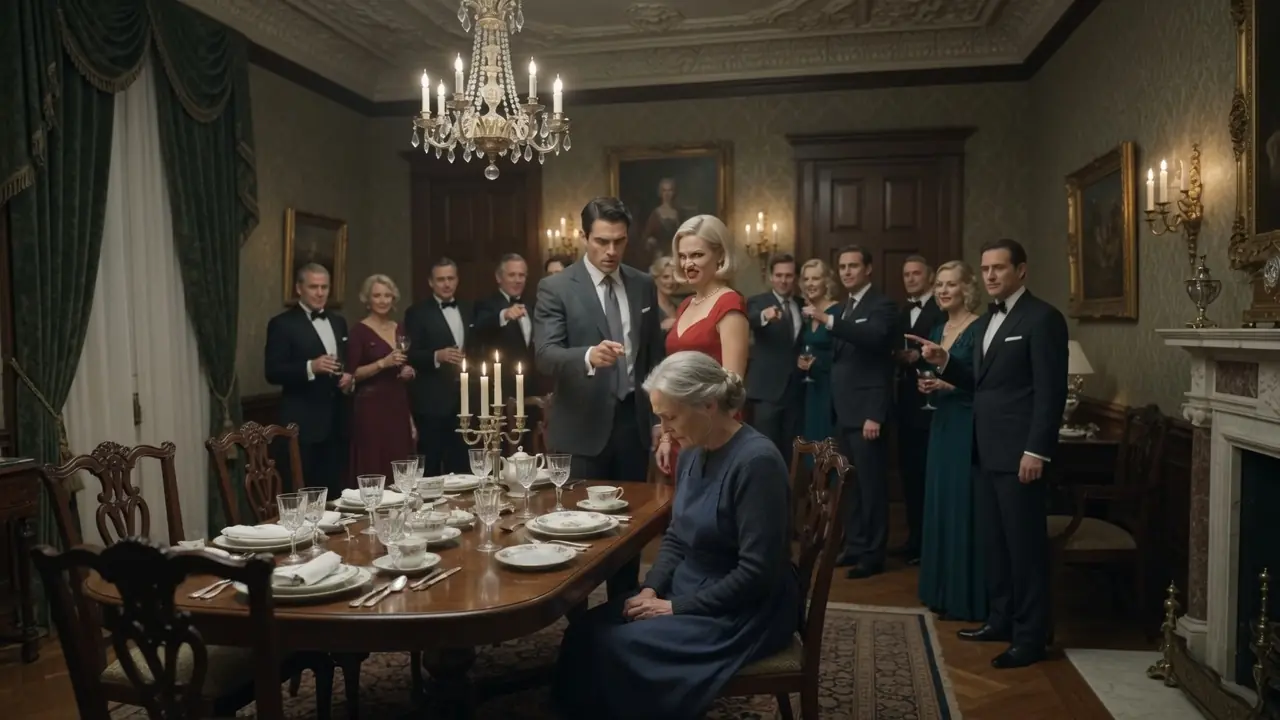
Only one guest had spoken to her like a person. Robert Thompson, a gray-haired man with thoughtful eyes and small glasses, wandered into the kitchen while looking for the bathroom. He stopped when he saw Rose stirring sauce at the stove, then looked back toward the dining room where Carmen was telling guests she had “spent all week planning the menu.”
“This smells wonderful,” Robert had said. “Did Carmen make all this?”
Rose had glanced up. Something in his voice told her he already suspected the answer. “No, sir. I did.”
He smiled faintly. “I thought so. I’ve attended enough corporate dinners to know when food has a soul.” Then he extended his hand. “Robert Thompson.”
Rose wiped her hands quickly on a towel before shaking it. “Rose Martinez.”
His eyes sharpened for a second, but before he could answer, Diego called from the hall. Robert only looked at her a moment longer and said, “Mrs. Martinez, I think we may need to talk later.”
Now, an hour later, she understood something was about to happen.
Diego was laughing too loudly, trying to recover from the awkward silence after calling her the housekeeper. Carmen lifted her champagne glass and smiled toward Robert, hoping he would laugh too. But Robert Thompson was not laughing. He stood near the head of the table, staring directly at Rose with an expression that made Diego’s smile begin to weaken.
Robert set his glass down.
“Rose Martinez?” he said slowly.
Rose lifted her head. The room changed at once, though nobody knew why. Diego’s eyes darted from Rose to Robert, and Carmen’s smile stiffened until it looked painful.
Robert took one step closer. “Rose Elena Martinez?”
The sound of her full name in that room struck Rose harder than Diego’s insult. Nobody had said it with respect in years. Carmen called her Rose when giving orders. Diego called her Mama only when he wanted something softened. But Robert said her name as if it belonged in the room before anyone else’s.
Rose’s voice came out small. “Yes.”
Robert’s face filled with recognition. “You and your husband owned Martinez Community Catering, didn’t you? You ran the food program after the Flint school closures. You fed half the district when the state funding collapsed.”
A murmur passed through the guests. Diego’s face drained of color. Carmen’s fingers tightened around her glass.
Rose swallowed. “That was a long time ago.”
Robert shook his head. “Not to families who remember eating because of you.” He turned slowly toward Diego. “This woman is your mother?”
Diego forced a laugh, but it came out cracked. “Yes, but Mr. Thompson, I was only joking. You know how family jokes are.”
Rose looked at him then. Her eyes were wet, but her face had gone still. “No, Diego. You were not joking.”
The room fell silent again.
Diego’s jaw tightened. He glanced toward his guests, angry now because his mother had spoken outside the role he assigned her. “Mama, please don’t make this dramatic.”
Rose stood slowly. Her chair scraped softly against the floor. “Dramatic?” she asked. “You called me a housekeeper in the house your father and I bought. You said you let me stay out of pity, in front of strangers eating food I made.”
Carmen stepped forward. “Rose, this is not the time.”
Rose turned to her. “You are standing beside my mother’s china, wearing pearls in my dining room, telling me when I may speak.”
Carmen’s mouth opened, then closed.
Diego’s face hardened. “Enough. You’re embarrassing me.”
Rose gave a sad little smile. “No, mijo. I have spent three years embarrassing myself by pretending you still knew how to be ashamed.”
Robert watched silently, his expression grave. Around the table, guests lowered their eyes. The people who had laughed minutes earlier now looked at the plates in front of them as if each bite had become evidence.
Diego stepped closer to Rose, lowering his voice. “You need to calm down.”
That phrase finished what his insult had started. Something inside Rose, something exhausted, wounded, and faithful for too long, finally stood up straight. She reached behind her apron and untied it with slow hands. Then she folded it once, twice, and placed it on the chair.
“I am calm,” she said. “That is why you should be worried.”
Carmen looked toward Diego, alarmed. Diego tried to laugh again. “Mr. Thompson, I apologize. My mother gets emotional sometimes.”
Robert’s eyes narrowed. “Your mother appears to be the only honest person in this room.”
The sentence struck Diego like a slap.
Rose walked to the sideboard and opened the top drawer. She removed a folder, old and cream-colored, tied with a blue ribbon. Diego frowned. Carmen’s eyes widened slightly, because she recognized the folder. She had seen it once in Rose’s room and told Diego his mother was “hiding old papers again.”
Rose placed the folder on the dining table.
“This house,” she said, “belongs to me.”
Diego stiffened. “Papa left it to us.”
“No,” Rose said. “Your father left his half to me. You received the investment account he set aside for you, the one you spent before Sophia turned five.”
Diego looked around the room, humiliated now in the place where he had hoped to look powerful. “That’s private.”
“You made my dignity public,” Rose said. “So now we will make the truth public too.”
Robert folded his hands in front of him. “Mrs. Martinez, do you want us to leave?”
Rose looked at him with gratitude. “No. I think witnesses may be useful.”
Carmen’s face went pale.
Rose opened the folder and removed the deed. Her hands trembled, but her voice did not. “Carlos and I bought this house in 1998 after working fourteen years without a vacation. I signed the mortgage. I paid the taxes. I kept the insurance current after he died.” She looked at Diego. “You moved in because you said I should not be alone.”
Diego whispered, “We were helping you.”
Rose laughed once, soft and broken. “You helped yourselves.”
Nobody spoke.
Rose took out a second document. “This is the current utility account. My name.” She placed another paper beside it. “Property tax payment. My account.” Another. “Homeowners insurance. My account.” Another. “Repairs to the roof last spring, paid from the savings Carmen said I was wasting on old house problems.”
Carmen’s face burned red. “I never said that.”
Rose looked at her. “You said it on the phone while I was folding Sophia’s laundry.”
Carmen looked away.
Diego grabbed the edge of the table. “Mama, stop.”
Rose turned to him fully. “I stopped for three years. I stopped correcting Carmen when she called me help. I stopped defending myself when you told people I lived here because I had nowhere else. I stopped crying where Sophia could see me.”
His face changed at Sophia’s name.
Rose’s voice softened, but only for a moment. “That little girl loves me better than her parents taught her to. That is the one thing I will thank God for.”
Robert looked at Diego with quiet disgust. “You told me your mother was financially dependent on you.”
Diego’s mouth went dry. “I said things were complicated.”
“You said she was unstable,” Robert continued. “You said she needed supervision. You said bringing her up in conversation might make the evening uncomfortable.”
The guests looked at Diego now with open shock.
Rose closed her eyes briefly. So that was why Carmen wanted her hidden. Not just shame. Strategy. Diego had been feeding his boss a story before the dinner even began.
Robert’s voice sharpened. “You also told me family responsibility had made you uniquely qualified to manage sensitive clients.”
Diego’s face collapsed.
Rose opened her eyes. “Is that why you kept me in the kitchen? So your boss could admire your sacrifice?”
Carmen whispered, “Diego.”
Rose picked up the apron from the chair and held it out toward him. “Here. Since you told everyone I am the housekeeper, you may finish the job.”
Diego stared at the apron like it was burning.
Rose let it fall onto the floor between them.
“That is the last thing I will clean up for you.”
A woman at the table covered her mouth. Another guest stood quietly and moved away from Carmen. The entire room had shifted, not loudly, but completely. Diego no longer looked like a rising executive. He looked like a man exposed in his mother’s dining room under candles he did not pay for.
Robert stepped toward Rose. “Mrs. Martinez, I owe you an apology. I should have questioned the way he spoke of you before tonight.”
Rose shook her head. “You saw it when it mattered.”
Then she looked at Diego again. This was the hardest part, because beneath the anger still lived the mother who remembered his first steps, his birthday candles, his little hand reaching for hers at the grocery store. But love could no longer be allowed to carry what respect refused to touch.
“Tomorrow morning,” Rose said, “you and Carmen will begin packing.”
Diego’s eyes widened. “What?”
“This is my house. You will leave.”
Carmen stepped forward in panic. “Rose, you can’t just throw us out. We have Sophia.”
Rose’s face tightened with pain. “Do not use my granddaughter as a shield after letting her watch you treat me like a servant.”
Diego’s voice shook. “Where are we supposed to go?”
Rose looked at him for a long moment. “You have two incomes, expensive clothes, and all the confidence in the world when you humiliate your mother. I trust you will manage.”
The words landed with final force.
Robert turned to Diego. “As for your promotion, it is no longer under consideration.”
Diego looked at him, stunned. “Mr. Thompson, please. This is a family matter.”
Robert’s face hardened. “Character is never only a family matter when you ask a company to trust you with power.”
Diego reached for the back of a chair, as if the room had tilted beneath him.
Robert continued, “If you can erase the woman who raised you while standing in her own home, I have no reason to believe you would protect anyone beneath you at work.”
Diego lowered his head. The guests looked away, not out of kindness, but discomfort. They had seen enough truth for one evening.
Carmen began crying, but Rose could not tell whether the tears were shame or fear of losing the life she had arranged around Rose’s labor. Either way, Rose did not move to comfort her. She had spent enough years being used as a cushion for other people’s consequences.
The guests left quietly after that. Some apologized to Rose. Some could not meet her eyes. Robert stayed until the last car pulled away, then stood in the foyer with his coat over one arm.
“Mrs. Martinez,” he said, “I meant what I said about your work years ago. My sister’s children ate because of that food program. She never forgot you.”
Rose’s eyes filled. “I never knew.”
“She used to say, ‘Rose Martinez fed us when pride could not.’”
A tear slipped down Rose’s cheek. Diego stood at the bottom of the stairs, hearing every word, and for once he looked like a child who had discovered his mother had existed beyond him all along.
Robert handed Rose his card. “If you ever want to restart anything, a food program, a kitchen, a foundation, call me. Not as Diego’s boss. As someone who remembers what you gave.”
Rose took the card with both hands.
“Thank you,” she whispered.
After he left, the house grew quiet. Carmen had gone upstairs. Diego remained in the dining room, staring at the half-cleared table. Rose began gathering the documents, but not the plates. She would not wash another dish that night.
Diego spoke without looking up. “Mama.”
Rose paused.
His voice broke. “I’m sorry.”
She looked at him carefully. “For what?”
He swallowed. “For what I said.”
“That is not enough.”
He looked up then, eyes wet. “For letting Carmen treat you like help. For pretending the house was mine. For telling people you depended on us.” His voice cracked harder. “For being ashamed of the woman who gave me everything.”
Rose stood very still.
The apology entered her, but it did not heal her. Not yet. A wound does not close because the knife regrets itself.
“I love you, Diego,” she said.
His face crumpled with relief.
“But you will still leave.”
The relief vanished.
“Please, Mama.”
“No,” she said gently. “Love is not a free room in a house where I am disrespected.”
He covered his face with one hand. “What do I tell Sophia?”
Rose’s throat tightened. “The truth, if you are brave enough. Tell her her grandmother owns this house. Tell her you forgot how to honor your mother. Tell her you are learning.”
He cried then, quietly and without performance. Rose let him cry. She had held him through enough tears in his life to know the difference between pain and change. This might have been both, but she would not allow either to trap her again.
The next morning, Carmen tried to negotiate. She spoke about school districts, schedules, Sophia’s stability, and how “family should not make rash decisions.” Rose listened from the kitchen table while drinking coffee from Carlos’s old mug.
When Carmen finished, Rose said, “You have thirty days because the law requires it. Not because your argument moved me.”
Carmen’s face hardened. “You’ll regret this when you’re alone.”
Rose looked around the kitchen, at the sunlight on the tile, the quiet stove, the table where no one had insulted her yet that morning. “I have been alone in this house for three years,” she said. “The difference is, now I will not be serving the people who made me feel that way.”
Carmen had no answer.
The thirty days were difficult. Sophia cried when she learned they were moving, and Rose held her granddaughter tightly, promising that the move was not her fault. Diego came to Rose several times, sometimes apologizing, sometimes begging, sometimes getting angry when apology did not become forgiveness fast enough. Rose stayed firm. She offered him love, advice, and nothing that looked like surrender.
Carmen moved out first, angry until the end. Diego followed two days later with Sophia, carrying boxes through the front door he had once entered without knocking. Before leaving, he stood in the foyer and touched the wall where an old family photo still hung.
“I don’t know how to fix this,” he said.
Rose stood beside him. “Start by becoming the kind of man who would never need to.”
He nodded, tears in his eyes.
After they left, the house felt enormous.
Rose walked room to room, hearing echoes of meals, arguments, laughter, and insults that had finally lost their power. She removed Carmen’s decorative pillows from the sofa and brought back her crocheted blankets. She rehung the photograph of Carlos in the dining room, the one Carmen had said made the space feel “too old-fashioned.” Then she sat at the table and ate a piece of Diego’s leftover birthday cake with a fork straight from the plate.
It tasted like grief and freedom.
Two months later, Robert Thompson called.
He asked if she had considered his offer. Rose had, though she had told no one. The house was too quiet, and her hands missed working for something larger than survival. Together with Robert’s funding and Rose’s leadership, they opened the Martinez Community Kitchen in an unused church hall outside Detroit. It provided meals for struggling families, cooking classes for young parents, and weekend lunches for children who depended on school food during the week.
Rose returned to the work that had once made her feel strong. She wore an apron again, but this time it was by choice. Volunteers called her Mrs. Martinez. Children called her Miss Rose. Reporters came once, but she cared less about cameras than the sight of hot food reaching someone who needed it.
Diego visited the kitchen six months later.
He stood in the doorway with Sophia, holding a box of donated vegetables from a farmers market. He looked nervous, humbled, and older than he had at the birthday dinner. Rose looked at the box, then at him.
“I thought maybe we could help,” he said.
Rose studied his face. “We?”
He nodded toward Sophia, who gave her grandmother a shy smile. “She said helping should be something we do with our hands, not just our mouths.”
Rose’s heart softened at that, though carefully. “Your daughter is wise.”
“She gets it from you,” Diego said.
Rose let the compliment stand, but she did not reward it too quickly. “Put the vegetables in the back. Wash your hands. Then I’ll show you where to start.”
Diego nodded and did exactly as he was told.
It was not forgiveness. It was work. Sometimes work is where forgiveness begins, if people keep showing up without demanding applause.
A year after the birthday dinner, Rose hosted a smaller dinner in her own dining room. Diego came with Sophia. Carmen did not come; she and Diego had separated months earlier after he finally admitted that their marriage had been built partly on appearances he no longer wanted to maintain. Robert came too, not as a boss, but as a friend of the kitchen.
The table was set with her mother’s dishes again. The crystal glasses shone. The candles flickered softly. Rose sat at the head of the table, not in the kitchen, not at the edge, not hidden behind service.
Before the meal, Diego stood.
His hands trembled slightly as he looked around the room. “I need to say something,” he said.
Rose watched him carefully.
He turned toward the table. “A year ago, I introduced my mother as a housekeeper in her own home. I did it because I was ashamed of where I came from, and because I cared more about impressing powerful people than honoring the woman who raised me.” His voice broke, but he kept going. “I was wrong. And I am sorry.”
Sophia reached for Rose’s hand under the table.
Rose squeezed it gently.
Diego looked at his mother. “You did not become important when Mr. Thompson recognized you. You were important before I had the sense to see it.”
The room stayed quiet.
Rose felt tears rise, and this time she allowed them. “Thank you,” she said.
That was all. It was enough for the moment.
They ate together slowly. No one rushed Rose to clear plates. No one sent her back to the kitchen. Diego stood to refill water, Sophia carried bread, and Robert asked Rose about the first meal she ever cooked for Carlos.
For the first time in years, the dining room felt like hers again.
Later that night, after everyone left, Rose stood alone beneath the chandelier. She looked at the chair where she had sat in humiliation one year earlier. She remembered Diego’s voice saying, “She’s just a housekeeper.” She remembered the laughter, Carmen’s smile, the sharp cold shame of being erased by her own child.
Then she looked at the table now, clean, quiet, and full of her chosen peace.
She was not just a housekeeper.
She was the woman who kept a home alive until she realized the home needed to keep her too.
She was a mother, a widow, a cook, a builder, a protector, and the owner of every room where someone had tried to make her feel invisible.
And from that night forward, no one entered Rose Martinez’s house without remembering whose name was on the door.