August 12th, 2023, began like every good county fair morning in Iowa, with dust rising under pickup tires, children carrying paper cups of lemonade, and farmers pretending they had only come to look. The Johnson County Fairgrounds were crowded before noon, the equipment demonstration field packed with people in seed caps, work boots, sunglasses, and folding chairs. A green banner stretched above the main lane, announcing the farm machinery showcase in huge white letters. Beneath it, two tractors waited like two different centuries standing face to face.
One was a brand-new John Deere 8R410, polished so clean the summer sun flashed off the hood. It had GPS guidance, auto steer, touchscreens, sensors, and enough technology inside the cab to make an old farmer feel like he needed permission to sit down. The machine belonged to Preston Blake, owner of Blake Farm Equipment, the largest John Deere dealership in three counties. Preston had paid to sponsor the demonstration, and he intended to make sure every farmer there remembered who brought the biggest machine.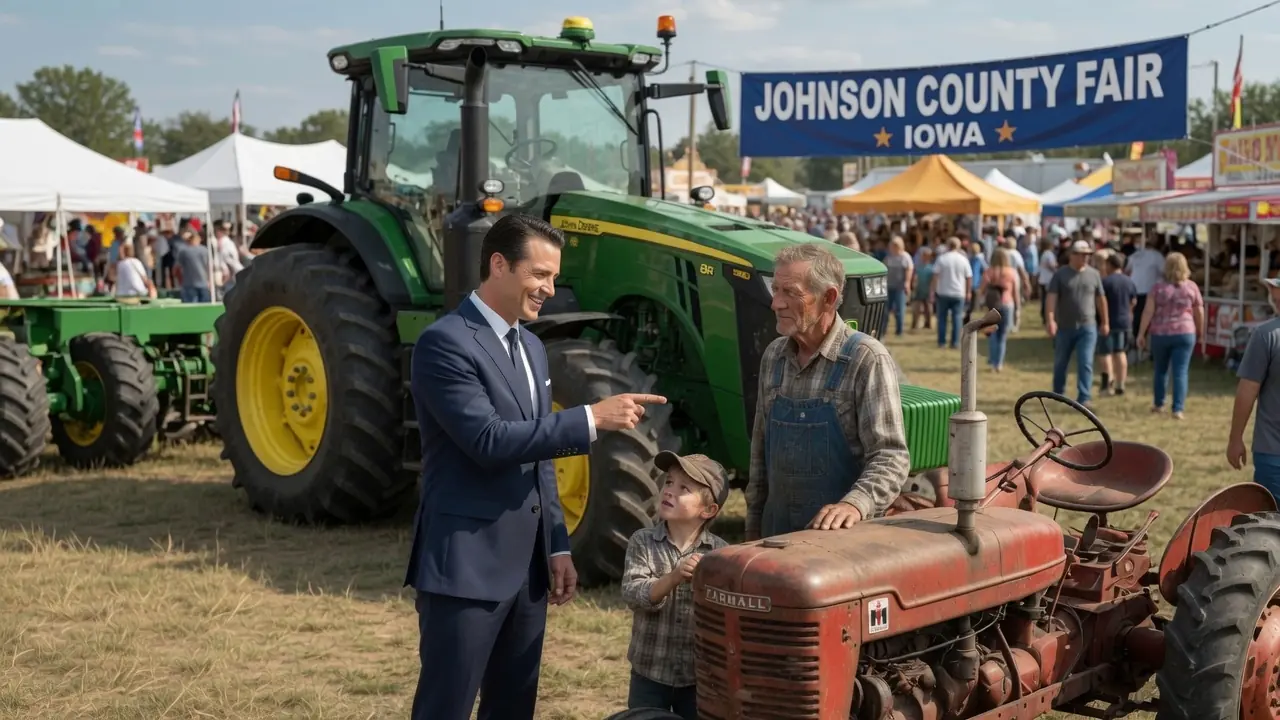
The other tractor was a 1952 Farmall M, faded red beneath years of sun, field dust, and honest wear. Its paint had chipped along the hood, its seat was cracked, and its exhaust pipe rattled slightly whenever the engine idled. Walter Morrison stood beside it in blue overalls and a plaid shirt, one weathered hand resting on the hood like he was touching the shoulder of an old friend. He had bought that tractor for eight hundred dollars in 1979, and it had helped him raise corn, soybeans, hay, three children, and a stubborn pride that time had never managed to break.
Preston saw Walter before Walter saw him. He was standing beside the John Deere with a microphone in his hand, smiling at the crowd as if the whole fair had been arranged for his benefit. Preston was forty-two, polished, successful, and too comfortable with being listened to. His boots were clean, his navy suit jacket looked expensive, and the watch on his wrist probably cost more than Walter’s pickup.
“Ladies and gentlemen,” Preston said, tapping the green tractor behind him, “today is about progress. It’s about showing what modern farming can do when a farmer stops clinging to the past.”
A few people chuckled politely. Walter did not move. He only looked across the field toward the pulling sled, where Judge Earl Patterson stood with a clipboard, checking the order of contestants. Earl had judged tractor pulls for twenty-eight years, and nobody argued with him unless they wanted the whole county to remember their foolishness.
Preston turned slightly, pretending he had just noticed Walter. “Of course,” he said into the microphone, “some folks still think old iron can stand beside modern engineering.”
Now the crowd looked at Walter.
Walter’s grandson, Caleb, stood beside him, a seven-year-old boy in a blue shirt, eyes wide with worry. He had spent the morning polishing the Farmall’s headlights with a rag, even though Walter told him the tractor would not go any faster for looking pretty. Caleb loved that old machine the way children love things that carry family stories. He knew it had belonged to his grandfather longer than his father had been alive.
Preston walked closer, still smiling. “Walter Morrison, you still bringing that museum piece out here?”
Walter looked at him calmly. “It started this morning. That’s more than I can say for some things with computers.”
A ripple of laughter moved through the crowd.
Preston’s smile tightened. He did not like being laughed at when he was not the one giving permission. “You should’ve left that antique in the weeds where it belongs.”
Walter patted the Farmall’s hood once. “This old machine has been working since before you learned how to sell payments.”
The crowd reacted louder that time.
Preston’s face hardened beneath the smile. He lifted the microphone again and turned toward everyone. “All right, then. Since Mr. Morrison is feeling confident, maybe we ought to make this interesting.”
Walter’s eyes narrowed. “Interesting how?”
Preston pointed toward the weighted sled at the far end of the track. “A pull. Official distance. Same track. Same judge. My John Deere against your Farmall.”
More laughter came from the crowd, but this time it was uneasy. Everyone knew the comparison was ridiculous. Preston’s tractor was a monster worth nearly half a million dollars. Walter’s Farmall had been built when most farmers still carried lunch in tin pails and fixed machines with wrenches, wire, and prayer.
Caleb tugged Walter’s sleeve. “Grandpa?”
Walter looked down at him. “It’s all right.”
Preston tilted his head. “What’s wrong, Walter? Afraid nostalgia doesn’t pull weight?”
Walter held his gaze. “Maybe not, Preston. But debt doesn’t add horsepower either.”
The crowd went still for half a second, then burst into laughter so hard that Preston’s sales manager looked away. Preston’s jaw flexed. He lowered the microphone, stepped close enough that only Walter and a few people nearby could hear him, and spoke through his teeth.
“You think that line makes you clever?”
“No,” Walter said. “I think it makes me honest.”
Preston raised the microphone again. “Judge Patterson, can we add Mr. Morrison and his antique to the pull?”
Judge Earl looked from the John Deere to the Farmall, then to Walter. “Walter, you sure?”
Walter did not answer immediately. He looked at Caleb, then at the crowd, then at the old Farmall. His son had once begged him to sell it. His daughter had called it sentimental scrap. Even his banker had laughed when Walter said he could still run small hay work with it. But that machine had never once mocked him for being poor, old, or slow.
“I’m sure,” Walter said.
The rules were adjusted. Preston wanted raw pull distance, but Judge Earl refused to let a modern 410-horsepower tractor simply crush a seventy-year-old machine in a contest that proved nothing except arithmetic. So the judge announced a heritage demonstration category that measured drawbar pull efficiency by class, weight, fuel use, and distance under load. Preston objected at first, but the crowd had grown too interested for him to back out without looking afraid.
“Fine,” Preston said. “Use whatever numbers you want. The result won’t change.”
Walter climbed onto the Farmall, slowly but without struggle. Caleb stood back with both hands clasped at his chest. The old tractor coughed once when Walter turned the key, then caught with a deep red-bellied rumble that made several older farmers smile before they could stop themselves. It was not smooth. It was not quiet. But it sounded like memory starting up.
Preston went first.
The John Deere rolled onto the track like a king entering a parade. Its tires were enormous, its cab sealed and cool, its digital display glowing behind tinted glass. Preston did not drive it himself. One of his dealership operators handled the pull, a young man named Tyler who knew the machine well. Preston stood beside the track with the microphone, explaining torque management, traction control, fuel mapping, and computerized load response.
The sled hooked to the John Deere with a heavy chain. The flagman stepped back. Judge Earl lifted his hand.
The green tractor roared forward.
It pulled hard, smooth, and impressive. Nobody could deny the power. The sled moved behind it, weight box crawling forward as the load increased. Dust rolled from the tires. The crowd clapped as the tractor dragged the sled down the track farther than anything else that morning.
When it finally stopped, the distance marker read one hundred eighty-six feet.
Preston raised both hands like he had personally invented horsepower. “That,” he said into the microphone, “is what modern engineering looks like.”
People applauded. Even Walter clapped twice, because the machine had done what it was built to do. He had never hated good equipment. He hated men who used good equipment to make other people feel small.
Then it was Walter’s turn.
The Farmall looked almost comical as it rolled toward the sled. Its narrow front end, faded hood, and old tires made it seem like a farm memory accidentally wandering into a modern showcase. Preston did not hide his smirk. He turned to a man beside him and said loudly enough for others to hear, “Hope the ambulance is still on the fairgrounds.”
Caleb heard it. His face tightened.
Walter heard it too, but he did not look over. He focused on the track. He knew the Farmall’s limits better than any man there knew the screen menu on Preston’s machine. He knew the way the clutch liked to be eased, the way the engine pulled best when it sounded just short of angry, the way old torque lived low and stubborn if a man respected it.
Judge Earl walked up beside him. “Walter, you don’t have to prove anything.”
Walter looked down from the seat. “I’m not proving it to him.”
The judge’s eyes moved to Caleb.
Walter nodded. “I’m proving it to the boy.”
Earl stepped back.
The chain was hooked. The sled sat heavy behind the Farmall. The flagman raised the green flag.
Walter breathed once, eased the clutch, and the Farmall began to pull.
At first, some people laughed again. The old tractor moved slowly, almost painfully, the engine knocking into a steady rhythm. But after the first twenty feet, the laughter thinned. The Farmall did not jump, did not sputter, did not die. It settled into the load like a mule lowering its shoulders.
Walter leaned slightly forward, one hand steady on the wheel. The sled crept behind him. Thirty feet. Forty. Fifty. Dust curled around the tires, and the old red machine kept crawling forward. Its engine note deepened, rough and honest, but it did not quit.
Preston’s smile weakened.
The Farmall crossed seventy feet.
An older farmer near the fence whispered, “Listen to that governor hold.”
Another said, “He’s got it weighted just right.”
Preston shot them a look, but they were no longer watching him.
At ninety feet, the old tractor began to strain. The front end lifted a few inches, then settled. Walter eased the throttle with the touch of a man who had done the same movement thousands of times in fields, rain, heat, and harvest panic. The machine responded like it remembered every acre they had ever worked together.
Caleb’s eyes were shining now. “Come on, Grandpa,” he whispered.
The Farmall passed one hundred feet.
The crowd changed.
This was no longer funny.
The machine was not going to beat the John Deere in raw distance, and no honest person expected it to. But the sight of that old tractor pulling beyond what everyone had assumed possible stirred something in the fairground. Men who had inherited farms looked at fathers. Fathers looked at machines they had once sold and wished they had kept. Younger farmers who had signed notes on new equipment suddenly understood that old did not always mean useless.
At one hundred sixteen feet, the Farmall slowed hard.
Walter kept it steady.
At one hundred twenty-two feet, the tires began to dig.
At one hundred twenty-seven feet, the tractor stopped.
The engine coughed but stayed alive.
For a moment, nobody spoke.
Then Caleb ran forward until Judge Earl caught him by the shoulder. “Wait for the unhook, son.”
Walter shut the tractor down and sat still for a second, one hand resting on the wheel. The crowd began clapping, slowly at first, then harder. It was not the wild applause Preston had received. It was deeper than that. It sounded like respect returning to something people had nearly forgotten how to honor.
Preston stepped forward quickly, trying to regain control. “Well, there you have it,” he said into the microphone. “A respectable showing for an antique, but let’s not pretend it came close.”
Walter climbed down from the Farmall. His knees hurt, but he kept his face calm. Caleb ran to his side and grabbed his hand. Preston walked toward them, pointing with the microphone like it was a weapon.
“That rusted tractor can’t beat my John Deere, Walter,” Preston said. “Nostalgia doesn’t pull weight.”
Walter looked at the judge’s clipboard. “Then let the numbers speak, because this old machine has embarrassed louder men than you.”
Preston laughed, but it came out thin. “The numbers? My tractor pulled nearly sixty feet farther.”
Judge Earl cleared his throat.
The fairground quieted.
Preston turned. “Say it loud, Judge.”
Earl looked down at the clipboard, then at the measuring crew. “Raw distance, John Deere wins.”
Preston smiled again.
“But this class was scored by efficiency rating,” the judge continued. “Weight-to-pull ratio, age class, drawbar load, and fuel consumed.”
Preston’s smile froze.
The crowd leaned in.
Judge Earl adjusted his glasses. “John Deere 8R410 scored 81.4.”
Preston’s head snapped back slightly. “And?”
Earl looked at Walter. “Farmall M scored 88.7.”
Silence.
Then someone laughed, but not at Walter.
Preston stepped forward. “That’s impossible.”
Earl’s face hardened. “You accusing my crew of bad numbers?”
“No, but—”
“You sponsored the demonstration, Preston. You agreed to my rules when you didn’t want to look scared.”
The crowd reacted instantly.
Walter said nothing.
Caleb looked up at him. “Grandpa, did we win?”
Walter’s eyes stayed on Preston for one more second. Then he looked down at the boy and smiled softly. “That’s what the judge says.”
The applause came like a storm then. People cheered, shouted, slapped each other on the back, and crowded toward the Farmall. Men who had laughed earlier now wanted to touch the hood, inspect the weights, ask Walter what he had done to keep it pulling so steady. Walter answered plainly. No magic. No secret. Just maintenance, balance, patience, and knowing the machine.
Preston stood alone beside the John Deere.
For the first time all day, nobody was looking at his banners.
A reporter from the county paper pushed through the crowd and asked Walter for a quote. Walter removed his cap, scratched his white hair, and glanced at Caleb. “Put this,” he said. “New equipment has its place. But don’t laugh at old iron if the man behind it still knows how to use it.”
The reporter wrote it down.
Preston’s sales manager tried to pull him aside, but Preston shook him off. His face was red now, and anger had replaced embarrassment. He marched toward Walter, lowering his voice.
“You think you won something today?”
Walter met his eyes. “No. I think you lost something.”
“What’s that supposed to mean?”
Walter looked at the crowd gathered around the Farmall. “Trust.”
Preston did not answer.
By evening, the story had spread across the fairgrounds. People told it near the livestock barns, over pork tenderloin sandwiches, in the parking lot, and beside the rides where children screamed with joy. Each retelling made Preston’s finger point sharper and Walter’s old Farmall redder. But the truth remained simple. Preston had mocked a machine, mocked a man, and tried to turn the fair into a showroom. The judge had turned it back into a test.
The next morning, Walter woke before sunrise, as he always did. His back ached, his hands were stiff, and his phone had more messages than he knew what to do with. His daughter had sent a picture from the county paper’s website. There he was, standing beside the Farmall with Caleb at his side, Preston in the background looking like a man trying to swallow a nail.
The headline read: Old Farmall Outpulls Expectations at Johnson County Fair.
Walter chuckled. “Outpulls expectations,” he said to the empty kitchen. “That’s one way to put it.”
By seven, Caleb arrived with his mother, still talking so fast he could barely breathe. “Grandpa, everyone at church saw it. Dad said people at the gas station were talking about it. Can we start the Farmall today? Can we drive it? Can I sit on it?”
Walter held up one hand. “One question at a time, boy.”
Caleb grinned. “Did Mr. Blake say sorry?”
Walter poured coffee into a chipped mug. “No.”
“Is he going to?”
“No.”
“Why not?”
Walter looked out the window toward the barn where the Farmall sat in the morning shade. “Because some men would rather lose twice than admit they lost once.”
Caleb thought about that. “That’s dumb.”
“It is.”
At Blake Farm Equipment, the mood was not cheerful. Preston sat in his office with the door closed, scrolling through social media posts he wished did not exist. Someone had filmed the judge’s announcement, and the video was everywhere in the county by breakfast. Comments stacked beneath it faster than he could read them.
Debt doesn’t add horsepower.
Old Walter smoked him.
That Farmall sounded better than Preston’s whole sales pitch.
Farmers don’t forget.
Preston slammed the phone on his desk.
His father, Raymond Blake, walked in without knocking. Raymond had started the dealership thirty-five years earlier from one rented building and a used parts trailer. He was older now, retired in name but not in attention. He had watched the video three times before breakfast.
“You made a fool of yourself,” Raymond said.
Preston looked up sharply. “Thanks for the support.”
“You pointed at a seventy-four-year-old man and laughed at his tractor in front of the county.”
“It was a demonstration.”
“It was arrogance.”
Preston stood. “That Farmall didn’t beat the Deere in real work.”
Raymond’s eyes narrowed. “That is exactly the sentence that proves you still don’t understand what happened.”
“What happened is people got sentimental.”
“No,” Raymond said. “People watched you disrespect the kind of farmer who built this dealership.”
That landed harder than Preston expected.
Raymond walked to the window overlooking the equipment lot. Rows of green machines stood shining in the sun, expensive and impressive. “You think we sell tractors because they’re new. I sold my first tractor because I knew the man buying it, knew his soil, knew his bank note, knew his wife was worried, and knew he needed to believe I wasn’t just selling him iron.”
Preston looked away.
Raymond continued. “Walter Morrison may never buy from you. But fifty men who watched you mock him might have. Yesterday, you told them what you really think of anyone who can’t afford your showroom.”
Preston said nothing.
For the next few weeks, the consequences came quietly. A farmer postponed a purchase. Another asked for a second quote from a smaller dealer. A third brought up used equipment instead of new. Nobody said they were leaving because of Walter’s Farmall, but they all mentioned the fair. That was enough.
Walter did not celebrate Preston’s trouble. He had never wanted to hurt the dealership. He had only wanted his grandson to see that old things were not useless just because rich men said so. Still, people began stopping by the Morrison farm more often. Some asked about the Farmall. Some brought old parts. One man asked Walter to help him get his father’s old Allis-Chalmers running again.
Caleb loved every minute of it.
One Saturday, Walter found the boy sitting on the Farmall seat in the barn, both hands on the steering wheel, making soft engine noises under his breath. Walter leaned against the doorframe and watched for a while before speaking.
“You planning to steal my tractor?”
Caleb jumped. “No, sir.”
Walter smiled. “Good. She’s particular about drivers.”
Caleb patted the wheel. “I want to learn.”
“You will.”
“When?”
Walter stepped into the barn. “Now, if you can stop making that ridiculous noise.”
Caleb grinned.
Walter showed him how to check oil, how to look for leaks, how to listen before touching anything. He explained that machines spoke in vibration, smell, sound, and resistance. Caleb listened with the seriousness of a child receiving treasure. By the time they finally started the Farmall, the boy’s face shone brighter than the tractor ever had.
The engine caught, rough and steady.
Caleb laughed with pure delight.
Walter stood beside him, one hand resting on the fender, and felt something tighten in his chest. Not pain. Not exactly. More like a thread being tied between past and future.
That autumn, the Johnson County Fair board invited Walter back for a heritage equipment feature. Preston Blake did not sponsor it. A seed company did. Walter brought the Farmall, washed and polished but not repainted. He refused to hide the rust, because the rust had earned its place.
This time, Preston came too, but without a microphone.
He stood at the edge of the crowd in jeans and a plain shirt, watching Walter show children how the clutch worked. For a long while, he said nothing. Then he walked over when the crowd thinned.
Walter saw him coming. “Preston.”
“Walter.”
Caleb stood nearby, suddenly tense.
Preston looked at the Farmall. “She runs good.”
Walter nodded. “She does.”
An awkward silence stretched between them.
Preston cleared his throat. “I was out of line last year.”
Walter waited.
Preston looked toward Caleb, then back at Walter. “I shouldn’t have made you the joke.”
“No,” Walter said. “You shouldn’t have.”
Preston took that without arguing, which surprised Walter more than the apology itself.
“I still think modern machines matter,” Preston said.
“They do.”
“But I forgot who taught this county how to farm before screens did.”
Walter studied him for a moment. Preston looked older than he had at the last fair, not physically, but in the way pride ages a man when it finally starts costing him. Walter could have twisted the knife. He had earned the right. But he had also lived long enough to know that teaching a lesson mattered more than preserving a grudge.
“Apology accepted,” Walter said.
Caleb looked up at him, surprised.
Preston let out a breath. “Thank you.”
Walter nodded toward the Farmall. “Want to hear her run?”
Preston almost smiled. “I would.”
Walter climbed onto the seat and started the old tractor. The engine turned, coughed, then settled into its familiar working rhythm. Preston listened quietly, no smirk, no microphone, no audience to perform for. Just a man hearing something old still alive.
Caleb stood beside Walter, one hand on the fender.
The county moved around them, busy with fair sounds, laughter, livestock, announcements, and the distant music of a ride spinning children in circles. Above the equipment lane, a banner snapped in the Iowa wind. New tractors gleamed under the sun, and old tractors sat beside them, each carrying its own kind of truth.
Walter looked at his grandson and leaned close enough to be heard over the engine.
“Remember this, Caleb. A machine doesn’t have to be new to matter. A man doesn’t have to be rich to be right. And when someone laughs before the work is done, wait for the judge to read the numbers.”
Caleb nodded like he would remember it forever.
And he did.