On a freezing winter afternoon in downtown Minneapolis, Terrence Hayes stood on a snowy corner with his hands going numb inside gloves too thin for December.
He was twenty-two years old, hungry, exhausted, and exactly forty-seven dollars short of making rent.
Not fifty.
Not forty-five.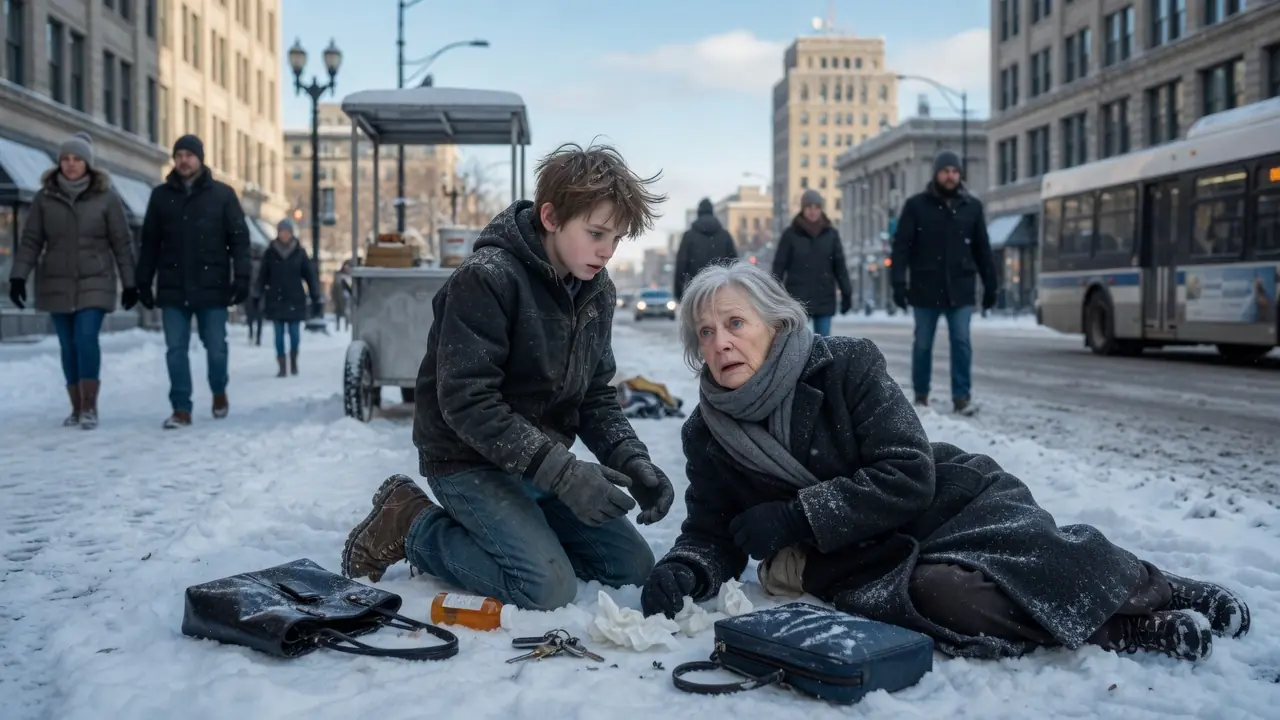
Forty-seven.
That number had been following him all morning like a debt collector with a clipboard.
Three days from now, rent would be due. His landlord had already been patient twice. Terrence knew the tone of that patience had changed. It had gone from sympathetic to formal, and formal was always the last stop before consequences.
He had also promised his mother he would help buy a winter coat for his younger sibling, Marcus, who had outgrown last year’s coat and was trying to pretend the sleeves halfway up his wrists were fine.
Everything was fine when people did not have enough.
That was one of the first lies poverty taught.
The December wind cut hard through downtown Minneapolis, carrying the promise of real winter. Street lamps glowed against the season’s first snowfall, turning the afternoon rush into something almost beautiful if you ignored the gray slush gathering near the curbs and the commuters hurrying with their heads down.
At the corner of Hennepin Avenue and 7th Street, near the Orpheum Theater, the city felt alive and indifferent at the same time.
Cars rolled past with wet tires hissing against pavement. Office workers hurried toward heated buses. Couples stepped around puddles, laughing into scarves. A man in a long wool coat complained loudly into his phone about flight delays while stepping over a woman sitting beneath a bus shelter.
Terrence tightened the strap of his worn messenger bag across his chest.
Inside the bag was the closest thing he had to treasure.
His knife set.
Not fancy. Not complete. Just basic knives his father had bought from a pawn shop years earlier for sixty dollars, back when Terrence still believed hard work moved people in a straight line upward.
His father, Calvin Hayes, had been dead for three years now.
But Terrence still heard him sometimes.
Especially on days when life felt too heavy.
“Son, there’s always someone carrying a heavier load than you. When you can help lighten it, you do.”
Terrence had not felt strong enough to lighten anyone’s load in a long time.
A year earlier, he had been working an entry-level warehouse job, steady enough to make plans around. He was not rich, but he was moving. He had a schedule, a paycheck, and a sense that if he kept showing up, things would get better.
Then a forklift pallet shifted wrong.
Terrence jumped back fast enough to save his leg, but not his shoulder.
The injury was not dramatic enough to impress anyone. That was part of the problem. He was not permanently disabled, not visibly broken, not bleeding in a way that made people understand. But his shoulder had never healed right. Heavy lifting became unreliable. Pain came and went. Work restrictions turned into reduced hours, then no hours, then a polite termination letter wrapped in language about business needs.
After that came the slow unraveling.
Late rent.
Missed bills.
Odd jobs.
Selling small meals from a portable grill because cooking was the one thing Terrence could still do with pride.
He had learned to carry his portable setup in a messenger bag, compact enough to set up in a doorway alcove and simple enough to pack quickly if security told him to move.
Hot sandwiches.
Grilled onions.
Melted cheese.
Sometimes chicken if he could afford it.
Simple food, but honest.
Terrence had learned that Minneapolis winters separated serious street vendors from amateurs. Anyone could sell food in July when the city was warm, festivals filled the streets, and people wandered around looking for something to taste. December was different. December demanded stubbornness.
The cold made fingers stiff.
The wind cooled food too fast.
Snow ruined napkins.
But commuters respected effort in bad weather. They understood, maybe not fully, but enough, that anybody standing outside cooking in a snowstorm was not lazy.
Terrence set up his compact grill in a recessed doorway near the corner. He had permission from the owner of a closed tailor shop, more or less. The old man who owned the place had once bought a sandwich from him and said, “Just don’t block the door.” Since the shop had been closed for months, Terrence considered that permission close enough.
He clicked the fuel canister into place, lit the burner, and waited for the grill plate to heat.
His fingers ached.
His shoulder throbbed.
His stomach growled.
He ignored all of it.
He sliced onions as carefully as numb hands allowed, thin enough to soften quickly. He buttered bread. He arranged cheese. He watched the flow of people like a fisherman reading water.
Afternoon rush before a snowstorm was usually good.
People felt generous when reminded that they had warm places to go.
Three blocks away, Margaret Sullivan stood inside Sullivan’s Kitchen and watched her son pace across the old hardwood floor like a lawyer presenting closing arguments.
The sign outside the building read:
Sullivan’s Kitchen
Culinary Training Center
Established 1981
At seventy-one, Margaret had survived breast cancer, the death of her husband, and forty-three Minnesota winters. She had learned to budget through recessions, repair equipment with spare parts, stretch food inventory when donations were low, comfort grieving students, encourage arrogant ones, and keep a professional kitchen alive through years when common sense said she should close it.
But she was not sure she could survive Richard’s latest business proposition.
“Mom, please be reasonable,” Richard Sullivan said.
He was forty-six, tall, polished, and dressed in an expensive suit that looked deeply uncomfortable inside a training kitchen. He was a successful commercial real estate developer in Edina, the kind of man who understood square footage, zoning leverage, tax incentives, and closing timelines better than he understood grief.
“The center is hemorrhaging money,” he continued. “You have not turned a profit in two years. The building alone is worth at least 3.2 million dollars. If we sell now, invest the proceeds properly, you can retire comfortably.”
Margaret’s left hand trembled at her side.
Part of it was Parkinson’s.
The disease had been stealing little pieces of her coordination for two years. A cup rattling against a saucer. A spoon slipping from her fingers. Buttons becoming enemies. Richard had noticed before she was ready to admit it, and he had been treating her like a problem to manage ever since.
But the tremor was not only Parkinson’s.
It was anger.
“This is not about profit, Richard.”
“It has to be about profit at some point.”
“Your father and I built this center to serve the community.”
Richard sighed.
“I know the speech.”
Margaret’s eyes sharpened.
“It is not a speech.”
“It is always the same thing. You and Dad wanted young people to have access to professional culinary training even if they could not afford culinary school. Fine. Noble. Beautiful. But the numbers do not care about noble.”
Margaret looked around the room.
Four teaching kitchens arranged by skill level. Stainless steel stations worn but polished. A prep kitchen in back where Thomas had once spent countless hours teaching knife technique to nervous students who had never held anything sharper than a butter knife. A bulletin board covered with photographs of graduates, young chefs, caterers, cafeteria managers, bakery owners, food truck operators, school nutrition workers, and home cooks who had learned how to feed their families better on limited budgets.
This was not a failing business to her.
It was a living memory.
Richard opened a folder and placed financial statements on one of the teaching counters.
“You are three months behind on property taxes. Your insurance premium doubled because the building needs updates to meet code. You have specialized equipment that has not been used properly in over a year. The scholarship program is draining cash. Every month you stay open, you lose money you cannot afford to lose.”
Margaret did not answer immediately.
Richard was good with numbers.
He had always been good with numbers, even as a boy. At ten, he could calculate baseball averages in his head. At sixteen, he understood interest rates better than most adults. At thirty, he could walk into a neglected building and see three different ways to turn it profitable.
But he had never understood the center.
To him, everything was a transaction.
Every room had a market value.
Every relationship had a cost.
Every legacy could be liquidated if the offer was good enough.
“This building is your father’s life,” Margaret said.
Richard’s face tightened.
The words landed hard.
Not because Margaret had forgotten.
Because she had not.
There were mornings she still turned to speak to Thomas before remembering the bed beside her was empty. There were nights she still made too much soup. There were afternoons she reached for his opinion and found silence.
Richard softened his tone, but not his position.
“Mom, Dad left you with a failing training center, a house too big for you, and a disease that is getting worse. You cannot drive safely anymore. You struggle with prep work. You are too proud to ask for help.”
“I do not need help.”
“You fell last month.”
“I slipped.”
“In your own kitchen.”
“I dropped a spoon.”
“You left the burner on.”
Margaret’s face flushed.
“For five minutes.”
“Long enough.”
Richard placed another paper in front of her.
“I have already talked to three commercial developers. The offers are serious. One wants to convert this building into luxury condos. Cash offer. Quick closing. We can make this painless.”
Margaret looked at him.
“Painless for whom?”
Richard’s jaw tightened.
“Mom.”
“No. Tell me. Painless for whom? For me, watching strangers tear out your father’s teaching kitchen? For the students who still call this place when they need advice? For the families who learned here because we charged less than anyone else? Or painless for you, because you can put the money somewhere clean and stop worrying about the messy parts of your mother’s life?”
The room went quiet.
Richard looked away first.
“I need an answer by next Friday,” he said. “The developer will not wait.”
“I need to think.”
“You have been thinking for two years.”
“I said I need to think.”
Richard gathered the papers slowly.
For a moment, Margaret saw not the successful developer but the little boy who used to stand in the doorway of the kitchen, waiting for his parents to finish with one more student, one more class, one more person who needed them.
Then the moment passed.
“While you are thinking,” Richard said, “remember that I am the one who will deal with the fallout when you cannot make payroll, when the bank starts calling, when you fall again and there is no one here.”
After he left, Margaret stood alone in the center.
The silence after Richard was different from silence before him. It had weight.
She moved slowly through the training space, trailing her good hand along the counters.
Here was the cast iron skillet Thomas had used during a scholarship demonstration for a teenage girl whose parents could barely afford groceries, let alone culinary school.
Here was the commercial mixer donated by parents whose daughter had cerebral palsy. In the kitchen, that young woman had not been “disabled.” She had been precise, disciplined, gifted with dough.
Here was the chef’s knife Thomas had once sold to a Vietnam veteran for five dollars because the man’s hands shook from PTSD and cooking was the only thing that calmed him.
Margaret stopped at the bulletin board.
Thomas smiled from one photograph, one arm around a graduating student, both of them dusted with flour.
“Oh, Tom,” she whispered. “What am I supposed to do?”
No answer came.
Only the hum of old refrigerators and the rattle of wind against the windows.
Margaret had to go to the bank. There were sixty-three dollars in receipts from a small class earlier that day. Not much, but every dollar mattered now. She also needed to stop at the pharmacy for her medication.
Richard had taken her car keys last month, insisting it was too dangerous for her to drive in winter conditions.
She had been furious.
She had also known he was not entirely wrong.
So she bundled into her heavy wool coat, the one Thomas had bought her fifteen years earlier, and started the three-block walk toward the bank.
The snow had begun falling harder.
Margaret kept one hand close to the buildings for balance. Cold made her joints ache and worsened the tremor. The sidewalk looked harmless beneath the fresh snow, but Minnesota ice was never harmless. It liked to hide.
Halfway down Hennepin Avenue, she caught the smell.
Grilled onions.
Melting cheese.
Warm bread crisping on a flat grill.
It cut through the cold like a memory.
Margaret slowed.
A young man stood in a doorway alcove, cooking over a small portable grill. He wore a jacket too thin for December. His fingers were red from cold. His messenger bag leaned against the wall near his feet. He moved carefully, almost tenderly, turning onions with the side of a knife, letting them soften instead of burn.
Margaret knew technique when she saw it.
He was not just making sandwiches.
He was paying attention.
The smell reminded her of Thomas on winter afternoons, humming while making stock in the back kitchen, turning cheap bones and vegetables into something rich enough to make students believe patience had flavor.
For one moment, the financial statements in her mind quieted.
She stood beneath the falling snow and watched the young man cook.
When he finished serving a customer, Margaret reached into her purse for a few dollars.
Her gloved hands were clumsy. The tremor jumped at the wrong time.
The purse slipped from her grasp.
It hit the sidewalk.
Her wallet, keys, medicine bottle, loose receipts, and bank deposit bag scattered across the snow.
Margaret bent quickly to retrieve them, embarrassed more than alarmed.
Her right foot slid.
The ice beneath the snow took her before she could react.
The fall happened in pieces.
The sidewalk tipping.
Her body pitching forward.
Her left hand shooting out by instinct.
A sharp crack of pain.
Then impact.
The breath slammed from her lungs.
For one terrifying second, she could not move.
Snow soaked immediately through her coat. Pain screamed through her wrist. Her purse contents lay scattered around her like proof of carelessness.
People moved around her.
Some gasped.
Someone said, “Oh no.”
But no one reached her first.
Terrence did.
He saw her fall, shut off his grill without thinking, and ran.
“Ma’am. Ma’am, don’t move.”
He dropped to his knees beside her, cold slush soaking through his jeans.
“My name is Terrence. Can you tell me your name? Are you hurt?”
Margaret tried to speak.
Only a gasp came out.
Her wrist was bent at an unnatural angle.
Terrence saw it and kept his face steady.
“Okay. Okay, just breathe. I’m calling 911.”
He pulled out his phone with shaking fingers, gave the dispatcher their location, described the injury, and kept one hand near Margaret’s shoulder without grabbing her.
“You’re not alone,” he said. “I’m right here.”
Margaret turned her eyes toward him.
He was young.
Too young to look so tired.
Snow gathered in his hair. His thin gloves were wet. His face held concern without panic.
“Margaret,” she managed.
“Margaret. Good. Mrs. Margaret, help is coming.”
“Sullivan.”
“Mrs. Sullivan.”
“My purse.”
“I’ll get it.”
Terrence gathered everything carefully. Wallet. Keys. Medication. Receipts. Bank deposit bag. A small photograph that had nearly blown into the street.
He paused when he saw the photo.
Margaret and a man, probably her husband, standing beneath a sign.
Sullivan’s Kitchen.
He knew the building.
Three blocks away.
The ambulance came twenty minutes later.
By then, Terrence’s knees were soaked and numb. The crowd had thinned. The commuters had returned to their own emergencies. A paramedic took over, asking questions. Margaret’s hand shook when they loaded her into the ambulance, and her eyes found Terrence again.
“My purse.”
“I have it,” he said. “I’ll make sure it gets back to you.”
She looked relieved.
That look cost him everything.
Because when the ambulance pulled away and Terrence turned back toward his doorway alcove, his grill was gone.
The cash box was gone.
His afternoon’s earnings, eighteen dollars, were gone with it.
For a moment, he just stood there in the snow.
The corner had not changed.
People still walked past.
The city still moved.
His entire working setup had disappeared because he had left it to help someone who had fallen.
His rent was still forty-seven dollars short.
His sibling still needed a coat.
His shoulder hurt.
His stomach was empty.
Terrence closed his eyes.
His father’s voice came again.
“When you can help lighten it, you do.”
“Yeah,” Terrence whispered. “But you never mentioned what happens when somebody steals the grill.”
He looked down at Margaret Sullivan’s purse in his hands.
The responsible thing would be to call her son. Her wallet contained a business card.
Richard Sullivan
Sullivan Development Group
Commercial Real Estate
Terrence stared at the card.
Then he looked toward the direction the ambulance had gone.
Something about Margaret’s eyes on the sidewalk stayed with him. Not just pain. Fear. The kind of fear people carry when they have been alone too long and suddenly realize it.
Terrence sent his mother a text.
Running late. I’ll explain.
Then he started walking toward Hennepin County Medical Center through the intensifying snow.
The emergency room was chaos.
Friday afternoon weather always turned hospitals into gathering places for bad luck. Slips, falls, car crashes, asthma attacks worsened by cold, elderly patients who had waited too long, parents with feverish children wrapped in blankets.
Terrence sat in a plastic chair with Margaret’s purse in his lap.
He had been waiting ninety minutes when a man in an expensive overcoat came through the automatic doors with snow dusting his shoulders and a phone pressed to his ear.
“Yes, I understand there is a wait,” the man said sharply. “But my mother has Parkinson’s disease. She fell on ice. She needs to be prioritized.”
Terrence recognized him from the card.
Richard Sullivan.
He looked exactly like the kind of man whose business card would be thick enough to feel like a warning.
Richard approached the admissions clerk.
“I’m looking for Margaret Sullivan. She was brought in about two hours ago. Fall on Hennepin.”
“Are you family?”
“I’m her son.”
The clerk checked the computer.
“She is in examination room three. She’s with the doctor now. You can wait in the family area.”
“I need to see her now.”
“Sir.”
“I am her medical power of attorney.”
Terrence stood.
“Excuse me. Are you Richard Sullivan?”
Richard turned.
His eyes moved over Terrence’s clothes, thin jacket, worn jeans, wet shoes, and messenger bag. His expression closed before Terrence spoke another word.
“Who are you?”
“Terrence Hayes. I was with your mother when she fell. I called the ambulance.”
Richard did not soften.
“Well, thank you. I can take over from here.”
“I have her purse and belongings.”
“I’ll take those.”
Richard held out his hand.
Terrence hesitated.
“Maybe I should give them directly to your mother. Make sure everything is accounted for.”
Richard’s eyes narrowed.
“Are you suggesting I cannot be trusted with my own mother’s belongings?”
“No. I’m suggesting she was worried about them.”
“I’m her son.”
“I understand.”
“Then hand me the purse.”
The words were calm.
The command beneath them was not.
Terrence felt something in his chest harden.
“I’d like to make sure she is okay first.”
“That is not necessary.”
“She was shaken up. Sometimes it helps to see a familiar face.”
“You are not a familiar face. You are a street vendor who happened to be nearby.”
The dismissal landed cleanly.
Terrence had been dismissed by managers, landlords, insurance adjusters, and people who thought being poor meant being dishonest. He knew the tone.
Richard stepped closer and lowered his voice.
“Look, I am sure you are expecting some kind of reward. I will give you something for your trouble, then you can leave.”
Heat rose in Terrence’s face.
“I’m not looking for money.”
“Everyone is looking for money.”
Before Terrence could answer, a nurse stepped into the waiting area.
“Mr. Sullivan?”
Richard turned immediately.
“Yes.”
“Your mother is asking for someone named Terrence.”
Both men went still.
Richard blinked.
“I am her son.”
“Yes, sir. She specifically asked for Terrence. She said he has her purse.”
Terrence met Richard’s stare.
“That would be me.”
Richard’s face reddened.
“This is ridiculous.”
The nurse looked tired enough to have no patience left for family politics.
“Sir, she is refusing to answer the doctor’s medication questions until she has her belongings.”
Richard said nothing.
The nurse turned to Terrence.
“You can come back for a minute.”
Margaret sat on an examination table, her left arm in a temporary splint. Her face was pale, but her chin remained lifted. Even injured, even frightened, there was something in her posture that refused to be reduced to a patient number.
When she saw Terrence, relief moved across her face.
“Mr. Hayes. Thank God. Do you have my things?”
“Right here.”
He set the purse beside her.
Margaret checked it with her good hand. Wallet. Medication. Keys. Deposit bag. Then she found the photograph of her and Thomas.
Her eyes filled.
“You saved this.”
“It was in the snow.”
She held the photograph carefully.
“Richard is here, isn’t he?”
“Yes.”
“I heard him demanding things.”
Terrence tried diplomacy.
“He is concerned about you.”
Margaret gave a small bitter laugh.
“He is concerned about the center, about property value, about me becoming inconvenient.”
Terrence did not know what to say.
Then Richard entered.
“Mom.”
Margaret looked past him toward Terrence.
“This man stayed with me until the ambulance came. He gathered my belongings. He kept me from being alone.”
Richard’s face tightened.
“And I appreciate that. Mr. Hayes, thank you.”
He pulled out his wallet and removed five twenty-dollar bills.
One hundred dollars.
Terrence saw his rent shortfall in that money.
The winter coat.
Food.
A little breathing room.
Richard held it out.
“For your trouble.”
The phrase made the money feel dirty.
Terrence did not take it.
Richard’s voice cooled.
“Take it.”
“No.”
“Everyone needs money, Mr. Hayes. Especially people selling food on street corners in snowstorms.”
“Richard.”
Margaret’s voice cracked like a whip.
“Do not speak to him that way.”
Richard turned to her.
“Mom, he is a stranger.”
“He is a stranger who showed more care for me today than you have shown for what matters to me in months.”
“That is unfair.”
“Is it?”
The room went silent.
Terrence stepped back.
“I should go.”
“No,” Margaret said quickly.
Richard closed his eyes.
“Mom, please.”
Margaret ignored him.
“Mr. Hayes, I need your help.”
Terrence looked at her.
“With what?”
“Sullivan’s Kitchen.”
Richard’s head snapped toward her.
“No.”
“My wrist is broken. I will need surgery. I cannot cook. I cannot inventory equipment. I cannot even properly hold a pen right now.”
“You are not hiring a street vendor to manage Dad’s training center.”
“I am asking a cook to help me understand what can be saved.”
Richard laughed once, sharp and disbelieving.
“A cook?”
Terrence felt the insult but stayed quiet.
Margaret’s eyes flashed.
“Yes, Richard. A cook. Your father would have asked him what he was making before he asked what he owned.”
Richard turned toward Terrence.
“You do not know anything about running a culinary training center.”
“No,” Terrence said. “I don’t.”
“At least you admit that.”
“But I know when someone is being pushed out of their own life.”
Margaret’s expression softened.
Richard’s hardened.
“This is a family matter.”
“Then act like family,” Margaret said.
That landed.
For a moment, Richard looked less angry than wounded.
But pride came back quickly.
“Fine,” he said. “What exactly do you want from him?”
Margaret looked at Terrence.
“I want him to help me inventory the center. Review the equipment. Speak to former students. Help me figure out if there is any path besides selling.”
Terrence swallowed.
“Mrs. Sullivan, I can help with inventory. I can cook. I can research. But I can’t promise I know enough to save a place like that.”
“I am not asking you to promise success,” Margaret said. “I am asking you to help me try.”
Terrence thought of his stolen grill, his empty stomach, his rent, his mother’s text about the coat.
“Can you pay?” he asked quietly, shame burning as soon as the words left him.
Margaret nodded.
“Four hundred a week.”
Richard stared at her.
“Mom.”
“Temporary. Until we know what we are doing.”
Terrence’s throat tightened.
Four hundred a week would not solve everything.
But it would let him breathe.
“I’ll help,” he said.
Richard pulled him aside in the hallway before he left.
“Listen carefully, Mr. Hayes. My mother is vulnerable. Parkinson’s. Grief. Now a serious injury. If you take advantage of her financially or emotionally, if you manipulate her, if you steal from her, if you do anything except exactly what she asked, I will destroy you legally and personally.”
Terrence met his eyes.
“Mr. Sullivan, maybe your mother does not need protection from strangers. Maybe she needs protection from being treated like her life is already over.”
Richard’s face went still.
Terrence walked away before he could answer.
Three days later, Terrence stood inside Sullivan’s Kitchen at seven in the morning.
The center was larger than he expected, a converted 1920s warehouse with high ceilings, exposed brick, tall windows, and old floors polished by decades of shoes. Morning light poured through the glass and touched the stainless steel counters, making everything look both worn and sacred.
Margaret moved slowly beside him, her casted arm held close.
“This was the beginners’ kitchen,” she said. “Thomas always started with eggs.”
“Eggs?”
“An egg tells you everything about a cook. Patience, heat control, attention, humility. Nobody respects eggs until they ruin them.”
Terrence smiled.
“That sounds true.”
“It is.”
She showed him the prep kitchen, the dry storage, the teaching stations, the office, the pantry, the bulletin board of graduates. Each photo had a story. Margaret knew them all.
“Janelle opened a bakery in St. Paul.”
She pointed.
“Darius runs a school cafeteria and feeds children better than most restaurants feed adults.”
Another photo.
“Elena came here after leaving an abusive marriage. She started with knife skills because she was afraid of sharp objects. Now she runs a catering company.”
Terrence wrote names in his notebook.
The more Margaret talked, the more he understood.
Richard was right about the numbers.
Margaret was right about the meaning.
The problem was that both acted as if one truth canceled the other.
For three days, Terrence reviewed account books, supplier contracts, scholarship records, payroll, equipment lists, invoices, and donation history. At night, he slept on his mother’s couch and used her laptop to research culinary nonprofits, community kitchens, workforce training grants, and food business incubators.
On the fourth morning, he sat across from Margaret at one of the teaching stations.
“Mrs. Sullivan.”
“That tone sounds dangerous.”
“I have been going through the accounts.”
“That sounds worse.”
“The center is losing money, but not because the core model has no value.”
Margaret watched him closely.
“You are running a nonprofit inside a for-profit structure. You discount classes, waive tuition, give ingredients at cost, donate kitchen hours, and pay instructors with money the center cannot replace. Richard sees a failing business. But what you really have is an unfunded mission.”
Margaret sat back.
“An unfunded mission.”
“Yes. If Sullivan’s Kitchen charged full price to everyone, it might survive as a small culinary school. But that would destroy the whole reason it exists.”
“I cannot stop helping people.”
“I know.”
“Then what?”
“Convert it. Make it a nonprofit. Culinary education, job training, food entrepreneurship, community meal support. Donations become tax deductible. Grants become possible. The building could be placed under the nonprofit, which might reduce certain burdens. You would need legal help, a board, financial oversight, and someone professional to run it eventually.”
Margaret stared at him.
“You learned all that in four days?”
“I do not sleep much.”
The bell over the door chimed.
Richard entered, brushing snow from his coat.
He saw the papers spread across the table and stopped.
“Absolutely not.”
Margaret lifted her chin.
“You have not even heard the idea.”
“I heard enough from the doorway. Nonprofit conversion? Mom, this is not a school project.”
“No. It is your father’s legacy.”
“It is a financially distressed property with code issues and tax liability.”
Terrence stood.
“Mr. Sullivan, can I show you something?”
Richard gave him a look that said he expected very little.
Terrence handed him the notebook.
“I called former students. Not all, but enough. Seventeen people in three days. Here are their names, what they do now, and what Sullivan’s Kitchen meant to them.”
Richard flipped through the pages reluctantly.
Terrence continued.
“The teenage scholarship student whose family paid five dollars a month for three years is now a pastry chef in Chicago. The veteran your father trained for free runs a lunch program at a shelter. The woman who learned here after a divorce now owns a catering company and employs six people. Your parents were not just teaching recipes. They were creating economic mobility.”
Richard closed the notebook.
“Touching does not pay taxes.”
“No,” Terrence said. “But impact attracts funding if you structure it correctly.”
Richard’s eyes narrowed.
“You know enough to be dangerous.”
“Probably.”
Margaret smiled faintly.
Richard exhaled.
“Even if I considered this, we would need startup capital, legal filings, a board, compliance, updated insurance, code improvements, and leadership my mother cannot provide alone.”
“I agree.”
That seemed to surprise him.
“You agree?”
“Yes. Your mother cannot carry this alone. She should not have to. But selling is not the only alternative.”
Richard looked at Margaret.
“You trust him?”
“Yes.”
“You met him less than a week ago.”
“He asked my name before he asked what happened to me.”
Richard’s expression flickered.
Terrence saw it.
A small crack in the hard surface.
Richard turned away.
“Three months,” he said finally.
Margaret went still.
“What?”
“We explore the nonprofit structure for three months. Mr. Hayes works under oversight. Weekly financial reports. Background check. No large expenditures without approval. If by March we do not have a viable path, we sell.”
Margaret looked at Terrence.
Terrence nodded slightly.
It was not victory.
But it was time.
And time was sometimes the first form of mercy.
That evening, Margaret led Terrence to a back storage room.
Dust floated in the light from a single bulb. Shelves held old textbooks, framed certificates, boxes of photos, and equipment no one had used in years.
“There is something Thomas left,” she said.
She pulled a worn leather knife roll from a cabinet.
Terrence immediately stepped back.
“No.”
“You do not know what it is.”
“I know enough.”
“These were Thomas’s working knives. Not the fancy demonstration set. These are the ones he used every day.”
She unrolled it.
The knives were not flashy. They were practical, balanced, well maintained. The handles were darkened from decades of use. The blades still held a clean edge.
“You lost your tools helping me,” Margaret said.
“That was not your fault.”
“No. But these should be used by someone who understands that tools are not possessions. They are promises.”
Terrence touched one handle with reverence.
“I cannot take these.”
“You can. And you will.”
His voice dropped.
“Mrs. Sullivan.”
“Thomas used to say a chef who does not respect his tools does not respect the people he feeds. I have not touched these since he died because I was afraid grief would dull them. But you need them. And I think he would rather they work than sit in a dark room being mourned.”
Terrence swallowed hard.
“I will take care of them.”
“I know.”
Three weeks into the nonprofit conversion, Richard invited Terrence to his downtown office.
The building had floor-to-ceiling windows, quiet carpet, and people who spoke softly because money had already done the shouting for them. Richard’s office overlooked Minneapolis in winter, the city clean and sharp beneath snow.
Terrence sat across from him with spreadsheets, grant lists, and a proposal for a mentorship model.
Richard tapped a pen against the desk.
“You are projecting we can serve more students with lower staffing costs.”
“Yes. Advanced students mentor beginners for wages. They get leadership experience. We reduce instructor costs. It is used in similar training nonprofits.”
Richard studied him.
“Where did you learn that?”
“Detroit. There is a nonprofit there that has operated twelve years using a version of this model.”
“You called them?”
“Yes.”
“And they answered?”
“After the third email.”
Richard almost smiled.
Almost.
“You are persistent.”
“I am poor. Persistence is cheaper than resources.”
Richard looked at him for a moment.
Then his expression shifted.
“Can I ask you something?”
“Yes.”
“Why are you really doing this?”
Terrence had expected suspicion.
He answered honestly anyway.
“Because a year ago, after my injury, I started to feel like my life had become nothing but survival. Rent, food, pain, bills, temporary jobs. I stopped thinking about purpose because purpose felt like a luxury. Your mother gave me work, yes. But more than that, she gave me something that mattered.”
Richard leaned back.
“My parents were very good at making other people feel like they mattered.”
There was bitterness in it.
Terrence noticed.
“You say that like it cost you something.”
Richard’s eyes sharpened.
“It did.”
For the first time, Richard talked about his childhood.
About waiting in the back office while his parents taught late classes.
About dinners interrupted because a student needed help.
About birthdays celebrated around center schedules.
About parents who loved him, yes, but also loved the mission so intensely that Richard sometimes felt like he had to compete with every struggling student in Minneapolis.
“Everyone thought my parents were saints,” Richard said. “Do you know how hard it is to resent saints?”
Terrence said nothing.
Richard looked out the window.
“I became good with money because money paid attention when I did. Numbers did not ask me to wait in the office. Deals did not forget me because someone else had a bigger need.”
“That sounds lonely,” Terrence said.
Richard laughed without humor.
“It was.”
His phone rang.
He looked at the screen and sighed.
“My daughter.”
“Answer.”
Richard did.
Terrence heard only pieces.
Madison.
A culinary showcase.
Thursday night.
Custody schedule.
A dinner meeting with clients.
Richard’s voice became careful, then defensive, then guilty.
When he hung up, he stared at the phone.
“My daughter has a winter culinary showcase next week. Her school’s advanced cooking class.”
“Are you going?”
“I have a client dinner.”
“Move it.”
Richard looked up.
“It is not that simple.”
“It never is. Go anyway.”
“You are giving parenting advice now?”
“No. I am telling you what a kid remembers.”
Richard’s face tightened.
Terrence lowered his voice.
“Twenty years from now, Madison will not remember the logistical difficulty. She will remember whether you showed up.”
The office went quiet.
Richard picked up his phone and sent a message to his assistant.
Then he said, “Meeting moved.”
Terrence nodded.
“Good.”
Richard looked annoyed by how relieved he seemed.
Six weeks into the nonprofit conversion, everything started failing at once.
Legal fees exceeded estimates.
Two donors backed out after hearing about Margaret’s Parkinson’s.
The insurance company demanded building updates before approving nonprofit operations.
City inspectors flagged code violations.
The projected startup budget was short by nearly thirty thousand dollars.
Margaret’s surgery had gone well, but recovery was slower than she wanted. Her wrist remained weak. Her tremor worsened under stress. Some mornings she looked smaller than the woman Terrence had first met, as if each setback took something physical from her.
On a Tuesday morning in late February, Terrence stood in Sullivan’s Kitchen surrounded by notices, rejected grant applications, and invoices.
“I’m sorry,” he said.
Margaret sat in her chair, cast removed, left hand resting in her lap.
“For what?”
“I thought I could make this work.”
“You have.”
“No. We are barely standing.”
“Barely standing is still standing.”
Before he could answer, Richard entered carrying a folder.
His face told them everything.
“We need to talk.”
Margaret closed her eyes.
Richard placed the folder on the table.
“I have three new offers for the property. All above the original asking range. One developer is willing to close in thirty days. Cash. No contingencies.”
“Richard.”
“Mom, I have been patient. I let this continue. I funded legal consultations. I reviewed Terrence’s reports. I moved slowly because you asked me to. But the nonprofit is not viable. You are running out of time and money.”
Margaret looked at the bulletin board of graduates.
For once, she did not argue.
“Maybe you are right,” she said quietly.
Both men stared at her.
Maybe I have been foolish, holding on to something that should have died with Thomas.”
Terrence felt the words hit the room like a dropped pan.
Richard’s expression shifted, not to triumph, but alarm.
“Mom.”
She looked tired beyond anger.
“I thought if I preserved this place, I preserved him. But Thomas is gone. And maybe I have been asking a building to do what grief will not.”
Terrence stepped forward.
“Mrs. Sullivan.”
“No,” she said gently. “You have done more than I had any right to ask. You gave me time. You gave me hope. Sometimes hope is not enough.”
The room went silent.
Then Terrence thought of something.
Maybe desperation. Maybe instinct. Maybe Thomas’s knives in his bag and his father’s voice in his head.
“If we are closing,” he said slowly, “then let it close feeding people.”
Margaret looked up.
“What?”
“One final dinner. One night. Open to former students, families, donors, neighborhood people, anyone touched by this place. Not a fundraiser at first. A farewell. We cook from the center’s history. We tell the story properly. If it still ends, at least it ends as Sullivan’s Kitchen, not as a line item.”
Richard frowned.
“That will cost money.”
“I will get ingredients donated.”
“That is not a plan.”
“It can become one.”
Margaret’s eyes had changed.
A faint spark returned.
“Thomas used to call those legacy suppers.”
Richard looked at her.
“What?”
“Before you were born. We did them for community families. Everybody brought what they could. Thomas cooked from donated food and taught while he served.”
Richard swallowed.
“I do not remember that.”
“You were little.”
Terrence turned to Richard.
“Give me ten days.”
“For what?”
“To prove the story is worth more than the property.”
Richard looked at the folder, then at his mother.
“Ten days,” he said. “That is all.”
Terrence did not sleep much during those ten days.
He called every former student in his notebook.
Then every graduate those students knew.
He visited restaurants during slow hours and asked for donations. He went to grocery stores, bakeries, schools, churches, food co-ops, and suppliers. Some said no. Some gave scraps. Some gave more than he dared hope.
A bakery donated bread.
A butcher donated chicken thighs.
A produce wholesaler donated onions, carrots, potatoes, greens, and apples.
A restaurant owner who had trained under Thomas donated two cases of butter and cried while signing the delivery slip.
A former student named Alma Ortiz, now head chef at a respected Minneapolis restaurant, called Terrence after midnight.
“Is it true Margaret might close?”
“Yes.”
“Not if I can help it.”
She arrived the next morning with four cooks, a van of ingredients, and a fury that made even Richard step aside.
“Chef Sullivan taught me how to hold a knife,” Alma said. “He also taught me how to hold my head up when I had no money and everybody treated me like I had no future. Nobody closes this place quietly.”
The final dinner became larger than Terrence expected.
Then larger than Richard feared.
Someone posted about it online.
Former students shared memories.
Local food writers noticed.
A television producer called.
Richard wanted to refuse cameras.
Margaret surprised him.
“No. Let them come.”
The night of the dinner, Sullivan’s Kitchen filled with warmth for the first time in months.
Not metaphorical warmth.
Actual kitchen heat.
Steam fogged windows. Pans clattered. Students, former students, volunteers, and neighbors moved through the space with the organized chaos of a living kitchen. Terrence stood at the prep table using Thomas’s knives, cutting onions with care while Alma Ortiz barked instructions like a general.
“Hayes, your dice is too slow.”
“It is consistent.”
“Consistently slow.”
Margaret sat near the teaching station, wrapped in a shawl, watching with wet eyes as the center came alive.
Richard arrived with Madison and Ethan.
Madison was fifteen, sharp-eyed, nervous, and carrying a knife roll of her own.
Richard looked surprised.
“You brought your knives?”
Madison lifted her chin.
“I wanted Grandma to see.”
Margaret’s face softened.
“You cook?”
Madison glanced at Richard.
“I wanted to tell you. Dad did not know either until my showcase.”
Richard looked ashamed.
“I know now.”
Madison unrolled her knives beside Terrence.
“Can I help?”
Terrence looked at Margaret.
Margaret nodded.
“Station three. Start with herbs. Show me your knife grip first.”
Madison’s eyes lit like someone had opened a door.
Richard watched from across the kitchen, and Terrence saw understanding strike him slowly.
This was what he had missed.
Not cooking.
Connection.
A place where a child could be seen for what she loved before the world priced it.
The dinner began at seven.
People filled every chair. Then the hallway. Then the sidewalk outside beneath rented heaters.
Margaret spoke first.
Her hands trembled, so Terrence stood beside her and held the microphone when needed.
“For forty-three years,” she said, “my husband Thomas and I believed cooking was not just a profession. It was dignity. It was memory. It was discipline. It was a way to tell someone, ‘You matter enough for me to feed you well.’”
Her voice shook, but it did not break.
“I thought I was losing this place because I was too old, too sick, too tired to fight. Then a young man stopped in the snow and reminded me that sometimes help comes from people the world is too quick to overlook.”
She turned toward Terrence.
“He lost his own tools because he would not leave me lying alone on a sidewalk. Tonight, he cooks with my husband’s knives.”
The room went quiet.
Then applause rose.
Not polite applause.
The kind that carries feeling.
Terrence looked down, unable to meet all those eyes.
Course after course came out.
Soup from one of Thomas’s earliest classes.
Chicken with collard greens inspired by community dinners.
Handmade pasta from an old intermediate curriculum.
Apple bread pudding from Margaret’s own recipe.
Between courses, former students stood and told stories.
A chef who had nearly dropped out until Thomas let him pay tuition five dollars at a time.
A school nutrition director who learned at Sullivan’s Kitchen and now fed thousands of children each week.
A veteran who said chopping vegetables had saved his hands from shaking long enough for him to sleep again.
Then Madison stood.
Richard looked startled.
His daughter walked to the front, nervous but determined.
“I did not grow up at Sullivan’s Kitchen,” she said. “I heard about it mostly as something my dad did not like talking about. I thought it was just my grandparents’ old business.”
She looked at Richard, then Margaret.
“But when my dad came to my culinary showcase last week, it was the first time I felt like he saw something I loved instead of something that complicated his schedule.”
Richard’s face tightened with emotion.
Madison continued.
“I want this place to stay open because there are kids like me who need a kitchen where adults look at them and say, ‘Show me what you can do.’”
She looked toward Terrence.
“And because someone who sells sandwiches in the snow can still be the person who saves a legacy.”
Richard lowered his head.
After the speeches, Richard stepped outside.
Terrence found him near the alley, breathing in the cold.
“You okay?”
Richard laughed once.
“No.”
“Fair.”
“I spent years hating this place because I thought it stole my parents from me.”
Terrence stood beside him.
“And tonight?”
“Tonight I realized I may have been trying to steal it from my daughter.”
That was the first time Terrence heard Richard speak without armor.
Richard wiped his face quickly, pretending the cold was the reason.
“I do not know how to fix forty-six years of resentment.”
“You start by not making it fifty.”
Richard nodded slowly.
Inside, the night was still moving.
By midnight, the impossible had happened.
A foundation representative who had attended because of Alma Ortiz pledged twenty-five thousand dollars toward the nonprofit conversion.
Three restaurant owners pledged paid apprenticeships.
A local technical college offered partnership discussions.
Former students collectively pledged monthly donations.
Richard stood before the remaining crowd near the end of the night.
For once, he looked nervous.
“My father believed this place mattered,” he said. “My mother never stopped believing it. I was slower.”
A ripple of gentle laughter moved through the room.
Richard looked at Margaret.
“I cannot undo the years I misunderstood this center. But I can choose differently now.”
He turned to the crowd.
“Sullivan Development Group will match tonight’s pledged donations up to one hundred thousand dollars. We will also fund the required code upgrades to bring this building into compliance.”
Margaret covered her mouth.
Madison burst into tears.
Terrence stared at Richard.
Richard looked back at him and said quietly, “You had ten days.”
Terrence smiled.
“You used them well.”
By spring, Sullivan’s Kitchen became the Sullivan Community Culinary Foundation.
The sign changed, but not completely.
The original letters stayed.
Sullivan’s Kitchen remained large and proud.
Below it, a new line was added.
Training. Dignity. Second Chances.
Margaret became founder emeritus, which she said sounded like a disease but accepted because it came with fewer spreadsheets.
Richard became board chair.
Not because he wanted control, though he probably still did a little, but because he understood buildings, money, and accountability. This time, those skills served the mission instead of threatening it.
Madison joined the teen culinary program.
Ethan pretended not to care, then started showing up for dinner nights because the food was better than what he got at home.
Alma Ortiz taught advanced classes twice a month.
Former students rotated through as mentors.
The first cohort of low-income students began in April.
Terrence became operations coordinator.
Then program director six months later.
He moved into the Longfellow apartment Richard had offered, managing the small building in exchange for reduced rent. It was not charity. He kept the boiler working, handled tenant calls, coordinated repairs, and learned more about property operations than he expected.
His younger sibling Marcus got the winter coat.
Then, that summer, a scholarship spot in the foundation’s youth cooking camp.
On the first day, Marcus stood in front of a cutting board, nervous and proud.
Terrence adjusted his grip on the knife.
“With the claw hand,” he said.
“I know.”
“Then do it.”
Marcus rolled his eyes.
But he did it.
Margaret watched from her chair near the front, smiling.
Her Parkinson’s did not disappear. Some days were hard. Some days her hands shook too much to hold a spoon steadily. Some days grief for Thomas came back so sharply she had to sit alone in the back office and breathe through it.
But she was no longer alone in the building.
And the building was no longer dying quietly.
One December afternoon, exactly one year after Margaret fell on the ice, snow began falling over downtown Minneapolis again.
Terrence stood inside Sullivan’s Kitchen, not on the street corner.
Through the front windows, he could see Hennepin Avenue glowing beneath street lamps. People hurried past in heavy coats, just as they had that day.
Richard entered carrying two cups of coffee.
He handed one to Terrence.
“I passed your old corner.”
Terrence took the cup.
“Any vendors out there?”
“One. Young woman selling tamales.”
“Good setup?”
“Better gloves than you had.”
“That is a low bar.”
Richard smiled.
Then he looked toward the training kitchen, where Margaret was teaching Madison how to correct a sauce that had broken.
“She looks happy,” Richard said.
“She is.”
Richard’s voice softened.
“I almost sold this place.”
“You almost did.”
“I would have regretted it.”
“Yes.”
Richard looked at him.
“You do not soften things much.”
“Food should be soft when appropriate. Truth should usually have texture.”
Richard laughed.
“You sound like my father.”
Terrence glanced toward the old photograph of Thomas Sullivan hanging above the doorway.
“I will take that as a compliment.”
Later that evening, after the last class ended and the building quieted, Margaret found Terrence in the prep kitchen cleaning Thomas’s knives.
He sharpened each blade carefully, wiped it dry, and returned it to the roll.
“You kept your promise,” she said.
Terrence looked up.
“To take care of them?”
“To use them.”
She sat beside him.
“You know, when I was lying in the snow that day, I thought I was about to lose everything. My wrist. My center. My dignity. I thought my life had narrowed to doctors, Richard’s decisions, and memories I could not hold onto tightly enough.”
Terrence said nothing.
Margaret continued.
“Then you ran from your grill to help me.”
“I lost the grill.”
“You gained a kitchen.”
He smiled.
“That is one way to calculate it.”
“The right way.”
She reached across the table with her good hand and touched the knife roll.
“Thomas always said food changes direction when the right person touches it. Maybe lives do too.”
Terrence looked around the kitchen.
Stainless steel counters.
Warm lights.
Recipe cards.
Laughter fading from the hallway.
A place that had almost become condos.
A life that had almost shrunk into survival.
“I was just trying to help you off the ice,” he said.
“No,” Margaret replied softly. “You were becoming who you were supposed to be.”
Outside, snow kept falling.
Inside, the kitchen held its warmth.
One year earlier, Terrence had been a street food vendor standing on a frozen corner, short on rent and nearly out of hope. He had shut off his grill for an elderly woman nobody else stopped to help, and that decision had cost him the little he had.
At least, that was what it looked like at first.
But kindness is strange that way.
It often feels like a loss in the moment.
A meal given away.
A shift interrupted.
A few dollars gone.
A risk taken for someone who may never repay it.
Then, somewhere beyond calculation, it returns differently.
Not always as money.
Sometimes as purpose.
Sometimes as family.
Sometimes as a door opening into a kitchen where people know your name and trust your hands.
Terrence rolled Thomas’s knives carefully and placed them in his bag.
Before leaving, he switched off the back lights, checked the ovens, locked the pantry, and walked toward the front door.
Margaret waited by the entrance with Richard and Madison.
The old sign glowed above them.
Sullivan’s Kitchen.
Training. Dignity. Second Chances.
As they stepped out into the cold Minneapolis night, Margaret slipped slightly on a patch of snow near the curb.
Three hands reached for her at once.
Terrence.
Richard.
Madison.
Margaret laughed, steadying herself.
“All right, all right. I am not made of glass.”
“No,” Terrence said, smiling. “But sidewalks are not trustworthy.”
Richard offered his arm.
This time, Margaret took it.
Together, they walked down the snowy street, past the corner where everything had begun.
And Terrence understood something his father had tried to teach him long ago.
You never really know what one act of kindness is worth.
You only know what kind of person you become when you choose it.
That freezing afternoon, Terrence thought he had lost his grill, his earnings, and maybe his last chance to make rent.
Instead, he found a legacy.
He found a kitchen.
He found people who needed him.
And most importantly, he found himself again.