Leonard Brooks first noticed the girl because she was standing outside the laundromat without a coat.
It was late January in Milwaukee, Wisconsin, and the cold had turned the sidewalks hard and pale beneath a thin layer of old snow. The laundromat windows were fogged from the dryers inside, glowing yellow against the gray afternoon. People hurried in and out carrying baskets, soap bottles, and plastic bags of folded clothes.
Leonard was seventy-nine years old, tall but stooped, with a deeply lined face, short white hair, and gentle blue eyes that had learned to notice quiet suffering. He wore a brown wool coat, a navy scarf, dark trousers, and old leather gloves that had been repaired twice. Every Wednesday, he brought his laundry to that same laundromat because the washing machine in his little house had stopped working years ago, and he had never bothered replacing it.
He had no one waiting at home. His wife, Agnes, had passed away eight years earlier. Their only son lived in Oregon and called on holidays, always kind, always rushed. Leonard did not blame him. Life had a way of carrying people far from where they began.
Still, the house felt too quiet most days.
That afternoon, Leonard was folding towels near the front window when he saw the girl.
She stood beside the pay phone outside the laundromat, hugging herself against the cold. She looked about eleven years old, with dark brown hair tied in a loose ponytail, pale cheeks, and a backpack pressed against her chest. Her sweatshirt was too thin for the weather, and her jeans were wet at the cuffs from walking through snow. She kept picking up the pay phone receiver, listening, putting it down, and searching her pockets again.
Then she wiped her face with her sleeve.
Leonard stopped folding.
A woman nearby complained that one dryer was eating quarters. A little boy chased his sister between the chairs. Someone’s radio played softly from a laundry basket.
But Leonard’s attention stayed on the girl outside.
He carried his folded towels to his basket, then walked to the door and stepped into the cold.
“Miss?” he called gently.
The girl flinched and turned.
“I’m not doing anything,” she said quickly.
Leonard lifted one hand. “I didn’t say you were.”
“I’m leaving.”
“In that sweatshirt?”
She looked down as if she had only just remembered the cold.
“I’m fine.”
Leonard had heard those words too many times from people who were not fine.
“I saw you trying to use the phone,” he said. “Do you need change?”
Her eyes sharpened. “No.”
“Do you need to call someone?”
“No.”
The pay phone receiver hung crookedly from its cord.
Leonard glanced at it. “That phone hasn’t worked since October.”
The girl’s face crumpled for one second before she forced it still.
“Oh,” she whispered.
Leonard’s heart tightened.
He reached into his coat pocket and took out his old flip phone. “You can use mine.”
She shook her head immediately. “I can’t.”
“You can.”
“I’m not supposed to take things from strangers.”
“That’s a good rule,” Leonard said. “So we’ll do this properly. My name is Leonard Brooks. I live on Cedar Avenue. I am inside that laundromat every Wednesday at three because I own exactly seven towels and refuse to buy more.”
The girl stared at him, confused despite herself.
He smiled gently. “Now I am less strange.”
“Still strange,” she muttered.
“Fair.”
Her mouth twitched, almost smiling.
“What’s your name?” Leonard asked.
She looked toward the street.
“Maya,” she said at last.
“Maya,” Leonard repeated. “Would you like to call someone?”
Her fingers tightened around the straps of her backpack.
“My mom.”
Leonard held out the phone.
Maya stared at it, then took it carefully, as if it might be taken back if she moved too quickly. Her fingers shook as she dialed.
The phone rang.
And rang.
And rang.
No answer.
Maya’s face went blank in the terrible way children’s faces sometimes do when disappointment is too familiar.
She tried again.
Still no answer.
“She’s at work,” Maya said quickly. “She probably can’t pick up.”
Leonard nodded. “Where does she work?”
“Different places.”
He did not like that answer, but he did not push too hard.
“Do you have somewhere warm to wait?”
Maya handed the phone back. “I’m okay.”
The wind cut between the buildings, and she shivered so sharply her teeth clicked.
Leonard looked toward the laundromat. “Come inside for a few minutes. You don’t have to talk. You can sit near the dryers. They’re warmer than this sidewalk.”
“I don’t have laundry.”
“I won’t report you to the laundry police.”
She blinked, then frowned. “There’s no laundry police.”
“Good. Then we’re safe.”
For a moment, she almost laughed.
Then she followed him inside.
Warm air wrapped around them. Maya stood near the door, clearly ready to run if necessary. Leonard did not crowd her. He returned to his table and continued folding towels, leaving the chair beside him empty.
After a minute, Maya sat.
Leonard pushed a pair of clean folded towels toward her.
“Put those around your shoulders.”
She hesitated.
“They are clean,” he said. “And they are not sentimental towels. If they are offended, they’ll survive.”
Maya took one and wrapped it around herself.
Her shoulders slowly lowered.
Leonard went to the vending machine and bought a packet of crackers and a bottle of orange juice. He placed them on the table between them.
“I bought too many,” he said.
“You only bought one.”
“I am old. Counting is unreliable.”
She stared at him, then at the crackers.
“I can pay you back.”
“Can you?”
She flushed. “Not today.”
“Then today is not a good day for repayment.”
Her stomach growled.
She looked deeply embarrassed.
Leonard opened the crackers and slid them closer.
Maya ate slowly at first, then faster, turning slightly away as if hunger were something private.
Leonard looked toward his towels and folded one corner twice to give her dignity.
After a while, he asked, “Why were you outside without a coat?”
Maya swallowed. “I left it.”
“Where?”
“At the apartment.”
“Can you go back?”
She froze.
That was answer enough.
Leonard kept his voice calm. “Did something happen?”
She shook her head.
Then nodded.
Then shook her head again.
“It’s complicated,” she whispered.
“Most hard things are.”
Her eyes filled, but she blinked the tears away. “My mom’s boyfriend locked me out.”
Leonard felt cold despite the warmth of the dryers.
“Was your mother home?”
“No. She works late. He said I talk too much. He said if I wanted to complain, I could complain outside.”
“How long have you been outside?”
Maya looked at the clock.
“I don’t know.”
Leonard’s jaw tightened.
“Do you know your address?”
She gave it quietly.
Leonard recognized the street. A rough stretch of apartment buildings near the old factory district.
“Maya,” he said softly, “we need to call someone safe.”
“No police,” she said immediately.
“If an adult locked you outside in January—”
“No,” she said, louder now. “Please. My mom will get in trouble. She’ll lose the apartment. We have nowhere else.”
Leonard sat back.
There it was again. A child protecting an adult from a world that had already cornered them both.
He did not want to frighten her into running.
“All right,” he said. “Not yet. But we do need to reach your mother.”
He handed her the phone again.
This time, after six rings, someone answered.
Maya sat up straight.
“Mom?”
Her face changed immediately.
“Mom, I’m at the laundromat on Wells Street. I’m okay. I’m with…” She looked at Leonard. “Mr. Brooks. The pay phone didn’t work.”
A woman’s voice came through the phone, frantic and loud enough that Leonard could hear fragments.
Locked out? Where is Darren? Stay there. Don’t move.
Maya’s eyes filled with tears. “I’m sorry.”
Leonard gently held out his hand for the phone.
“Maya’s mother?” he said. “This is Leonard Brooks. Your daughter is safe and warm. She’s had something to drink. I’ll stay with her until you arrive.”
The woman’s breath broke. “Thank you. Please don’t let her leave. I’m coming now.”
“I won’t.”
Twenty minutes later, Maya’s mother rushed into the laundromat wearing a work uniform, a thin coat, and fear all over her face. She was in her early thirties, with tired hazel eyes and dark hair pulled into a messy bun. The moment she saw Maya, she ran to her and dropped to her knees.
“Maya. Baby.”
Maya held on to her so tightly that the towel slipped from her shoulders.
“I’m sorry,” the girl cried.
“No,” her mother said, sobbing. “No, sweetheart. You did nothing wrong.”
Leonard stood quietly nearby.
The woman looked up at him, tears streaming down her face.
“I’m Talia Morgan,” she said. “Thank you. Thank you for helping her.”
Leonard nodded. “She needed a phone.”
Talia’s face twisted with shame. “I should have been there.”
“You’re here now.”
Talia looked at Maya again. “Darren is gone. I called my neighbor on the way. She saw him leave with his bags. I told him never to come back.”
Maya whispered, “Are we going to lose the apartment?”
Talia closed her eyes.
Leonard heard the answer before she spoke.
“I don’t know,” Talia admitted.
Maya began crying again.
Leonard looked at the mother and daughter clinging to each other under the harsh laundromat lights. He thought of his quiet house. Agnes’s empty sewing room. The guest bed no one used. The pantry with more cans than one old man needed.
He had not planned to change his life that afternoon.
But sometimes life placed a child in front of you and waited to see what kind of person you had become.
“You can come to my house tonight,” he said.
Talia looked up quickly. “No. Sir, we can’t.”
“It has heat. A working phone. And soup.”
“That’s too much.”
“No,” Leonard said. “Too much is leaving a child outside in January. This is soup.”
Talia’s mouth trembled.
“I can’t pay you.”
“I didn’t ask you to.”
She shook her head. “I don’t even know you.”
Leonard smiled gently. “That is true. But your daughter does, and she has already determined I am still strange.”
Maya wiped her face and gave the smallest smile.
That night, Leonard drove them home only long enough for Talia to gather clothes, documents, and Maya’s school things. The apartment door had been left open. Several drawers had been emptied. Darren had taken the television and Talia’s small emergency cash jar.
Talia stood in the doorway, shaking with anger and exhaustion.
Leonard said nothing.
He simply carried the bags.
At his house on Cedar Avenue, Leonard gave Talia the guest room and Maya the small room that had once belonged to his son during summer visits. He made tomato soup and grilled cheese sandwiches. Maya ate two sandwiches and fell asleep sitting upright at the kitchen table.
Talia apologized until Leonard threatened to bring out Agnes’s old church choir records and sing along.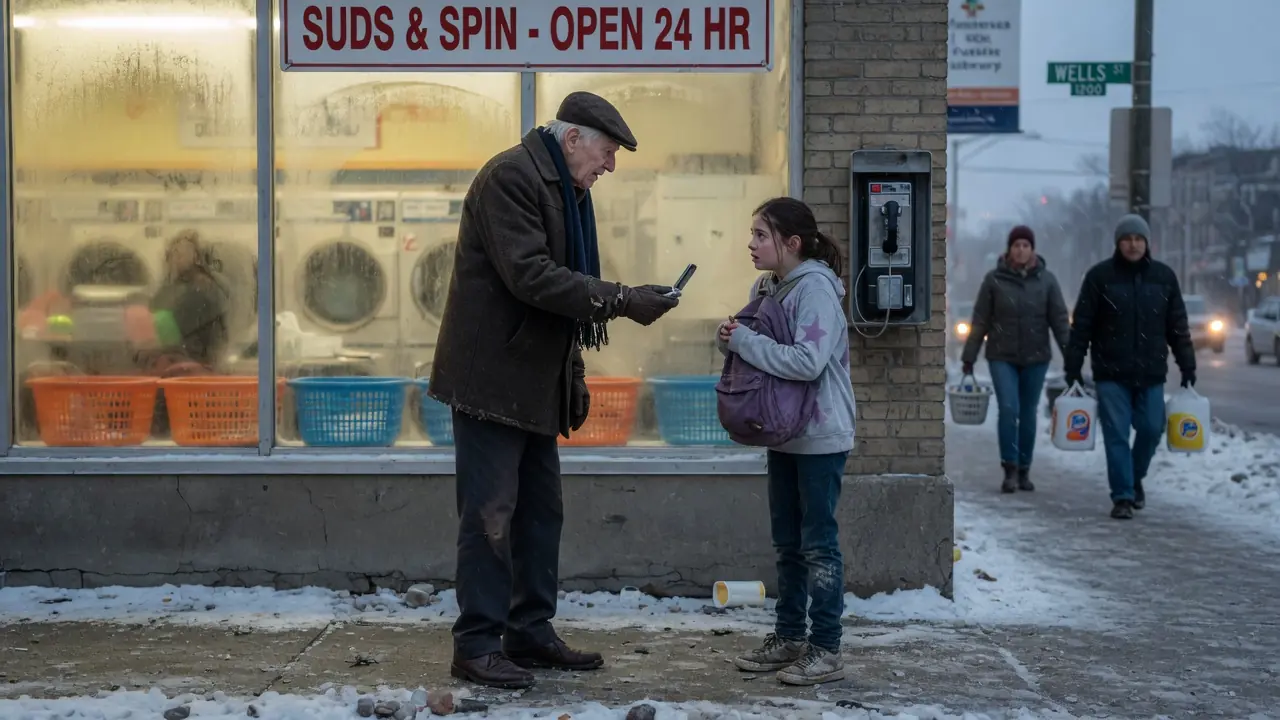
That stopped her.
For the next week, Talia and Maya stayed with Leonard while Talia tried to stabilize everything. She worked at a nursing home and picked up cleaning shifts whenever she could. Darren’s damage had left her behind on rent, behind on utilities, and nearly out of food.
Leonard helped in quiet ways.
He drove Maya to school. He packed her lunches. He let Talia use his phone for calls to landlords, shelters, assistance offices, and the police report she finally filed. He never spoke to her as if poverty were a personal failure. He never looked at Maya like she was trouble.
The house changed quickly.
Maya’s school papers appeared on the refrigerator. Talia’s work shoes sat by the back door. Leonard started buying cereal again because Maya liked it before school. The kitchen filled with sounds he had not realized he missed: a child humming, a mother checking homework, someone asking where the scissors were.
One evening, Maya found an old photo of Agnes in the hallway.
“Is that your wife?” she asked.
“Yes.”
“She looks nice.”
“She was.”
“Did she die?”
Leonard nodded.
Maya looked at the photo for a long time. “Do you get lonely?”
The question was so direct it startled him.
“Yes,” he answered honestly. “I do.”
Maya nodded seriously. “We can eat dinner with you so you’re not lonely.”
Leonard had to turn toward the window.
“I’d like that,” he said.
One week became a month.
Talia found a smaller apartment nearby, safer and cheaper, but she and Maya continued coming to Leonard’s house several evenings a week. He became “Grandpa Len” before anyone discussed it. Maya made the name official on a birthday card covered in purple stars.
At school, Maya began doing better. She had always been bright, but fear had scattered her focus. With stability, she changed. She read constantly. She wrote stories about brave girls who found doors in impossible walls. She became fascinated with law, fairness, and why some families seemed to fall through cracks no one wanted to repair.
At twelve, she asked Leonard, “Why are shelters always full?”
He sighed. “Because there are more people in trouble than places prepared for them.”
“Then there should be more places.”
“Yes.”
“Why aren’t there?”
He looked at her. “That is a question worth growing up to answer.”
She took that seriously.
Years passed.
Maya grew taller, more confident, and fiercely protective of other children. She volunteered at food drives. She helped younger kids with homework. She wrote school essays about housing, poverty, and safety. Leonard kept every report card, every drawing, every thank-you note.
Talia rebuilt her life too. She became a licensed practical nurse after years of night classes. She moved into a better apartment. She bought a used car. She never forgot what Leonard had done.
Every Sunday, she and Maya came for dinner.
Leonard always pretended to be surprised.
“You again?” he would say.
Maya would roll her eyes. “You made pot roast.”
“For myself.”
“You made enough for six people.”
“I’m optimistic.”
By the time Maya graduated high school, Leonard was eighty-six. He walked with a cane now, but he still stood proudly in the school auditorium when her name was called.
Maya received a scholarship to study social work and public policy in Madison.
After the ceremony, she hugged Leonard tightly.
“I’m going to build more places,” she whispered.
He knew exactly what she meant.
“I believe you,” he said.
College widened Maya’s world. She studied housing systems, child welfare, nonprofit management, and law. She called Leonard every Sunday evening. Sometimes she was excited. Sometimes exhausted. Sometimes angry at the unfairness she was learning how to name.
Leonard listened.
“You can be angry,” he told her once. “Just make sure anger becomes a hammer, not a fire.”
“That sounds like something from a fortune cookie.”
“It’s from an old man with soup experience.”
She laughed.
After college, Maya worked for a housing nonprofit in Milwaukee. Then she helped create emergency family placement programs. Then she led a project connecting elderly homeowners with vetted temporary family support programs, so unused rooms could safely help families in crisis without leaving either side unsupported.
Leonard bragged to everyone.
“My granddaughter builds safety,” he said.
No one corrected him.
But age was catching up.
At ninety, Leonard could no longer manage the house easily. The stairs became difficult. The roof needed repairs. Medical bills grew. His son urged him to sell and move into assisted living near him in Oregon.
Leonard understood the logic.
But the thought of leaving Agnes’s house broke something in him.
He did not tell Maya how bad things had become. He did not tell her about the roof leak over the guest room, the furnace that failed twice, or the letter from the city about exterior repairs.
Talia noticed first.
Then Maya arrived one Friday evening without warning.
She stood in the kitchen, reading the repair notice Leonard had tried to hide beneath a stack of newspapers.
“Grandpa Len.”
He closed his eyes. “That tone means trouble.”
“That tone means you were hiding trouble.”
“I didn’t want to worry you.”
“You taught me worry is sometimes love trying to organize itself.”
“I said that?”
“You say a lot of things and forget them.”
He sat heavily at the table.
“I may have to sell.”
Maya pulled out the chair across from him.
“No.”
He smiled sadly. “You say that as if houses listen.”
“This one will.”
“Maya.”
She reached across the table and took his hand.
“You let us into this house when we had nowhere safe. You didn’t know whether we would stay one night or one month. You didn’t know if helping us would complicate your life. You opened the door anyway.”
Leonard looked down.
“I was just doing what Agnes would have done.”
“And now I’m doing what you taught me to do.”
Within three months, Maya changed everything.
She worked with her nonprofit, local officials, volunteer contractors, and a senior support foundation. Leonard’s house was repaired and modified so he could remain safely: a downstairs bedroom, safer bathroom, new railings, roof repairs, and a furnace that did not sound like it was losing a fight.
But Maya had a bigger plan.
A year later, she asked Leonard to dress nicely because she wanted to take him somewhere.
“I am ninety-one,” he said. “Nicely means clean socks.”
“Wear the blue sweater.”
He did.
She drove him to a renovated brick building near the laundromat where they had met. The old laundromat was gone now, replaced by a community services center with bright windows and flower boxes along the sidewalk.
A crowd stood outside.
Talia was there. Maya’s coworkers. Families. City officials. Children holding paper stars.
Leonard looked confused. “What is this?”
Maya smiled through tears. “Something that started with a phone call.”
She helped him out of the car and led him toward the entrance.
Above the door hung a new sign:
THE BROOKS HOUSE FAMILY CENTER
Emergency Support, Warm Meals, Safe Calls, Open Doors.
Leonard stopped walking.
His hand tightened around his cane.
“Maya…”
She stood beside him. “This center will help families in crisis before they are left outside, before children have to search for broken pay phones, before mothers have to choose between work and safety. There are short-term rooms, legal aid, meal support, transportation help, and a phone room open all day for children and parents who need to reach someone safe.”
Leonard stared at the sign.
“My name shouldn’t be up there.”
“Yes,” Maya said softly. “It should.”
He shook his head. “I only let you use my phone.”
“No,” she said. “You answered when the world didn’t.”
The ribbon-cutting ceremony began with speeches Leonard barely heard because his heart was too full. Then Maya stepped forward.
“When I was eleven,” she said, “I stood outside a laundromat in January with no coat and no working phone. I was scared, hungry, and trying to protect my mother from more trouble. An old man noticed me. He did not look away. He let me use his phone, gave me food, gave us shelter, and never once made us feel like a burden.”
The crowd grew quiet.
Maya looked at Leonard.
“That day, Leonard Brooks taught me that safety can begin with something as small as a phone placed in a child’s hand. This building exists because every family deserves someone to answer.”
Talia wiped her eyes.
Leonard looked down, overwhelmed.
After the ribbon was cut, Maya brought him inside.
The first room near the entrance had several phones along one wall, comfortable chairs, snacks, and a mural painted with purple stars like the birthday card Maya had made years ago.
A plaque beside the door read:
THE AGNES AND LEONARD CALL ROOM
For every child who needs to hear a safe voice.
Leonard touched the plaque with trembling fingers.
“You included Agnes.”
Maya smiled. “You said she would have opened the door too.”
“She would have loved you.”
“She helped raise you. That was enough.”
Leonard laughed through tears.
Years later, the Brooks House Family Center became one of the most trusted places in the city. Children came in with social workers, parents came in before eviction became homelessness, elderly volunteers served soup, and no one was told they were a problem because they needed help.
Leonard visited every Wednesday afternoon.
He sat in the phone room, wearing his blue sweater, and told children terrible jokes while they waited for safe adults to arrive. Some laughed. Some stared. Some were too scared to speak. Leonard stayed anyway.
One snowy afternoon, a little boy sat across from him, holding a backpack with both arms.
“My mom’s not answering,” the boy whispered.
Leonard leaned forward gently.
“Then we’ll try again in a minute,” he said. “And while we wait, I should warn you that the crackers here are very suspicious.”
The boy blinked.
“Suspicious?”
“They disappear quickly.”
The boy smiled a little.
Across the room, Maya watched with her arms folded, eyes shining.
Leonard looked over and winked.
At ninety-four, Leonard’s steps were slow, but his heart felt less lonely than it had in decades. His house remained full of visitors. Talia brought soup. Maya brought paperwork and stories. Families from the center sent cards. Children called him Grandpa Len even when they had only met him once.
On his ninety-fifth birthday, the center held a small celebration. Leonard complained about the attention, of course.
“No fuss,” he said.
Maya ignored him, as daughters and granddaughters often do.
At the end of the party, she handed him a framed photograph.
It showed the old laundromat from years ago, still open then, with Leonard standing outside beside a much younger Maya wrapped in two clean towels. Talia had taken the picture a week after they met, when she wanted to remember the man who had saved them from the cold.
Leonard had forgotten the photo existed.
On the frame, Maya had engraved:
YOU GAVE ME A PHONE. I FOUND MY VOICE.
Leonard cried.
He did not try to hide it.
That evening, after everyone left, Leonard and Maya sat together in the phone room. Snow fell softly outside the windows.
“I thought my life was nearly over when I met you,” Leonard said.
Maya looked at him. “Why?”
“Agnes was gone. My son was far away. The house was quiet. I thought all I had left was laundry on Wednesdays.”
Maya smiled sadly.
“Then you were outside,” he said. “No coat. No phone. Too brave for your own good.”
“You called me strange.”
“You were strange.”
“I was scared.”
“I know.”
He looked around the room, at the phones, the soft chairs, the snacks, the purple stars.
“I gave you one call,” he said.
Maya took his hand.
“You gave me proof that someone would answer.”
Leonard closed his eyes.
Long ago, outside a laundromat in winter, an old man had noticed a girl trying to use a broken pay phone. He had offered his own phone, then his food, then his house, then his steady presence. He had thought it was a small act. A moment of decency. A Wednesday interruption.
But kindness rarely stays small.
A phone call became a night of shelter.
A night of shelter became Sunday dinners.
Sunday dinners became family.
A frightened girl became a woman who built doors for others.
And an old man who feared his life had gone quiet found his name above a building where safe voices answered every day.
The snow kept falling.
Inside, the phones waited.
And Leonard Brooks, who had once believed he had little left to give, sat beside the girl he had helped save and listened as the next call came in.