“Why won’t you just let me buy it?”
The question came from a frail woman in a wheelchair, her voice soft but steady inside the glittering flagship showroom of Beaumont Gallery on Tryon Street.
Marble floors shone beneath crystal chandeliers, and behind locked glass, sapphire pendants, diamond bracelets, and silk-lined jewelry trays gleamed beneath warm showroom lights.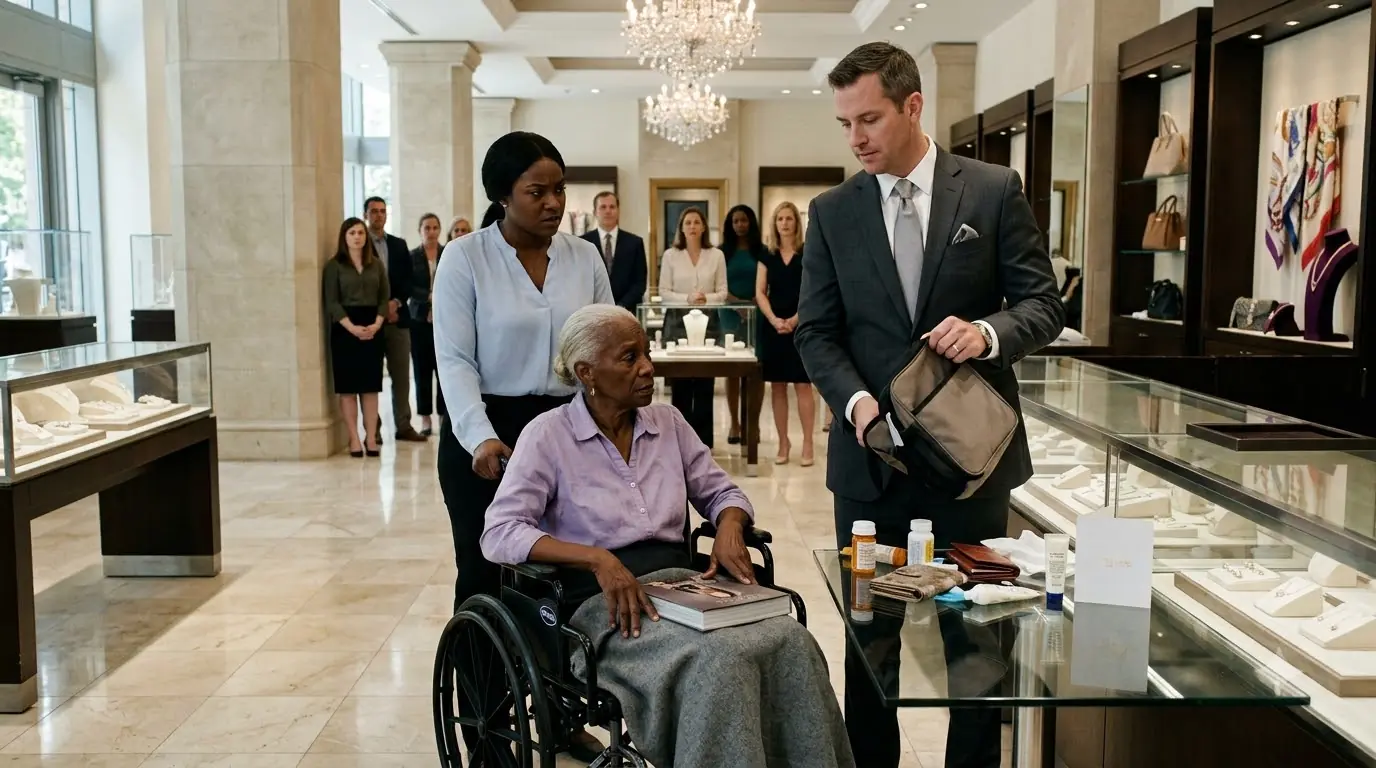
Derek Caldwell stood over her in his charcoal designer suit, looking down as if the woman had rolled into the wrong world by mistake. His jaw was sharp, his hair perfectly styled, his shoes polished to a mirror shine, and his smile had disappeared the moment he decided she was not worth the room she occupied.
“We don’t serve people like you,” he said.
Willa Saunders looked up at him from her wheelchair, her thin hands folded over a faded purse in her lap. The blouse she wore had been washed too many times, the cuffs soft and worn. A folded blanket covered her knees, and her white hair was pinned neatly at the back of her head by fingers that no longer obeyed her without pain.
“Please,” she said. “I’m buying it.”
“I told you to get out,” Derek said, his voice turning cold. “Are you unable to understand simple human speech?”
Then he slapped her hand off the counter.
Open palm across thin, veined knuckles.
The crack echoed across the marble.
For one second, the store froze.
A woman near the handbag section gasped. A man in a navy blazer stopped mid-step. The young home health aide standing behind Willa’s wheelchair screamed and reached for the handles, as if the chair itself might become the next thing Derek decided to punish.
Willa cradled her struck hand against her chest.
The skin over her knuckles was already darkening. Her fingers curled inward from pain, but she did not cry. She did not plead. She sat very still, breathing through the agony with the controlled discipline of a woman who had endured far worse than an arrogant man’s hand.
“I haven’t stolen anything,” she whispered.
Derek’s face tightened.
Then he kicked the wheel of her wheelchair.
The chair lurched forward with a harsh metallic jolt. Willa’s body jerked against the safety strap, and the heavy catalog in her lap slid to the floor with a flat slap. Her medication bottles spilled from the side pouch and rolled across the marble like little orange accusations.
Nadine Coleman screamed again and caught the handles before the chair could twist.
“Stop it,” she cried. “She can’t even stand up.”
Derek leaned close, his handsome face stripped of every trace of charm.
“Lesson one,” he said, “for daring to talk back to me.”
Willa remained calm.
Too calm for him.
With her uninjured hand, she reached into the scattered mess of her belongings and found her phone. Her fingers shook from pain, but she unlocked it and dialed one number from memory.
“Terrence,” she said when the call connected. “I need you at the Beaumont store on Tryon Street. Please come now.”
She did not explain.
She did not say she had been slapped.
She did not say her wheelchair had been kicked.
She simply said please.
In just a few minutes, everything would change completely.
But before any of that happened, the story began earlier that morning.
At 6:14 a.m., in a small brick row house on Charlotte’s East Side, Willa Saunders lay awake in the dark.
The alarm did not go off because she had been awake since four.
Pain did that.
Lupus did that.
Two years of it eating through her joints, her muscles, and her ability to stand or walk had changed almost everything about her life. It had thinned her body until her bones pressed close to the surface. It had bent her fingers, stiffened her wrists, and turned simple tasks into private battles she fought before breakfast.
Some mornings, she could not lift a glass of water without her fingers locking around it. Some mornings, she could not raise her arms high enough to pull a sweater over her head. Some mornings, the pain settled into her ribs so deeply that even breathing felt like work.
Willa had once moved through rooms with the confidence of someone who built things with her own hands.
Now she measured the day by how much energy each movement would cost.
At 6:30, Nadine Coleman came into the bedroom with the quiet knock she used every morning.
“Miss Willa?” she said gently. “You awake?”
“I have been awake for hours,” Willa replied.
Nadine stepped inside and turned on the bedside lamp.
She was twenty-six years old, tall and slim, with deep brown skin, tired kind eyes, and her black hair braided neatly down her back. She had been Willa’s live-in home health aide for fourteen months, though somewhere between the medication schedule, midnight fevers, and quiet breakfasts, she had become something closer to family.
Nadine moved with practiced care. She checked the water glass, noted the pill organizer, then helped Willa sit up slowly so the dizziness would not take her. Willa’s face tightened as her joints protested, but she made no sound.
“You should tell me when it hurts this bad,” Nadine said.
“It hurts every morning.”
“Still.”
Willa gave her a faint look.
“If I announced pain every time it arrived, neither of us would have time for breakfast.”
Nadine sighed, but she smiled despite herself.
She lifted Willa out of bed the way she did each day, one arm under her knees, the other behind her back. Willa weighed ninety-one pounds. Lifting her felt like lifting a child, and Nadine hated that, not because it was hard, but because she knew Willa hated it more.
“I can brush my own hair,” Willa said once Nadine had settled her into the wheelchair.
“I know you can.”
“Then let me.”
Nadine handed her the brush.
Willa’s hand shook the entire time. The brush snagged twice in her thin white hair, and pain flashed across her face so quickly most people would have missed it. Nadine did not miss it, but she did not reach forward.
That was one of the first things she had learned about Willa Saunders.
Help was necessary.
Pity was dangerous.
It took Willa four minutes to pull her hair into a small knot at the back of her head. When she finished, she set the brush down with the exhausted pride of someone who had climbed a hill no one else could see.
The house was small but clean.
Framed photos lined the hallway outside her bedroom. One showed a young woman standing in front of a tiny storefront on Trade Street in Charlotte in 1980. The woman wore a cream blouse, a navy skirt, and a wide smile. Above the storefront door hung a hand-painted sign that read, Beaumont Gallery.
The woman in the photo was Willa.
Forty-six years earlier.
The day she opened her first store with eight thousand dollars saved over fourteen years of sewing other people’s clothes.
Nobody walking through that hallway today would connect the woman in the photograph to the woman in the wheelchair. The photo showed someone strong, upright, radiant, with eyes full of hunger for the future. The wheelchair held someone the world had folded down to almost nothing.
But Willa knew better.
A body could fail.
That did not mean the soul had surrendered.
In the back hallway, a faded newspaper clipping from the Charlotte Observer was framed behind old glass.
Local Seamstress Opens Luxury Boutique, Bets Everything on a Dream.
Next to it hung another photo of Willa cutting the ribbon on the tenth Beaumont location.
Then the twentieth.
Then the fortieth.
She had built a twelve-hundred-square-foot shop into a forty-two-location luxury retail empire worth $1.2 billion.
Then her body failed her.
She stepped down as chairwoman eight years earlier, after the first major flare left her hospitalized for three weeks and unable to sign her name without shaking. Two outside CEOs came and went. The company she built kept running without her.
At least, that was what everyone told her.
“Nadine,” Willa said that morning, while Nadine buttoned the soft cardigan over her shoulders, “we’re going to Beaumont today.”
Nadine looked at her.
“Which one?”
“Tryon Street.”
Nadine’s hands stopped.
“The flagship?”
“Yes.”
“I can go for you.”
“No.”
Willa’s answer came too quickly.
Nadine softened her voice.
“Miss Willa, that store is big. It will be a lot. We can order online. Or I can call ahead.”
“I want to pick it myself.”
“For Amara?”
Willa’s face changed at the name.
Her granddaughter Amara was turning eighteen in three days. Bright, stubborn, full of questions, and always sketching dresses in the margins of her school notebooks. Three months earlier, Amara had visited Willa with a Beaumont catalog and circled a teardrop sapphire pendant with a purple marker.
“I know it’s too expensive,” Amara had said quickly, cheeks warm with embarrassment. “I just like the color. It looks like a piece of sky got trapped.”
Willa had laughed softly.
“A piece of sky,” she repeated.
Since that day, she had thought about the pendant constantly.
She had the money to buy a hundred of them. That was not the point. She wanted to go to the store. She wanted to see the stone herself. She wanted to choose the chain length, hold the box, sign the card, and hand it to her granddaughter with her own hands.
Her body had taken enough.
She would not let it take this too.
“Amara deserves that,” Willa said.
Nadine watched her for a long moment.
Then she nodded.
“All right. We’ll go.”
They called paratransit. The wait was forty minutes.
Nadine made oatmeal, prepared Willa’s medication, packed a bottle of water, a folded cloth, joint cream, emergency pills, and a shawl into the bag on the back of the wheelchair. She folded a blanket over Willa’s legs because the morning air still bit.
Willa stared out the window while they waited.
She was gathering herself.
Every trip outside cost her something.
Energy she did not have.
Dignity she had to fight for.
She knew what people saw when they looked at her.
A frail Black woman in a wheelchair.
A small old body in a faded blouse.
Someone poor.
Someone inconvenient.
Someone to speak over, steer around, or ignore.
She knew.
She went anyway.
The Beaumont Gallery flagship on Tryon Street occupied the ground floor of a limestone building in uptown Charlotte.
Marble floors polished to a mirror finish.
Crystal chandeliers casting soft light.
Classical music drifting from hidden speakers.
Glass cases arranged like museum exhibits.
The air smelled like leather, jasmine, and money old enough to whisper instead of shout.
Every surface seemed designed to tell visitors that luxury was not merely sold there. It was guarded there.
At 8:45 that morning, Derek Caldwell held his daily staff briefing in the back office.
He was six-foot-three, wearing a charcoal Tom Ford suit tailored to the millimeter, a silk pocket square, and Italian leather shoes polished to a mirror shine. A Breitling sat on his wrist, one he was still paying off but wore like an inheritance.
Derek had ice-blue eyes under dark brows and a jawline that belonged on a billboard. He was stunning, the kind of handsome that made people trust him before he opened his mouth.
Then he opened his mouth.
“Brand alignment,” he told his team, pacing in front of them with his tablet in hand. “That is the difference between a luxury environment and a retail mess. We do not simply sell pieces. We curate access.”
The staff stood in a loose semicircle.
Patricia Ellis, his senior associate, nodded eagerly. She was forty-one, sharp-faced, ambitious, and loyal to power rather than people. She had survived three managers by becoming whatever each one needed her to be.
Two younger associates stood near the shelves, tense and silent.
Curtis Boyd, the new security guard, stood in the doorway. He was twenty-eight, broad-shouldered, Black, and still new enough to listen harder than everyone else.
Derek continued.
“Discretion. Judgment. Control. You see someone who doesn’t fit the room, you redirect. You don’t engage. You don’t encourage browsing from people who are clearly not serious buyers. You protect the experience for the clients who actually spend.”
He did not say the word Black.
He did not say the word poor.
He did not say disabled.
He did not have to.
Everyone understood what he meant.
Curtis felt his stomach turn.
But he said nothing.
He had rent due Friday, a mother recovering from surgery, and a little sister in high school who still needed lunch money. He had learned the cost of speaking too early in rooms controlled by men like Derek Caldwell.
So he stood there.
Silent.
Hating himself a little.
The paratransit van arrived at Willa’s house at 10:15.
Nadine lowered the ramp and wheeled Willa carefully inside. The driver greeted Willa by name because she had ridden with him twice before, and he remembered her as the woman who thanked him even when the lift jammed.
The ride into uptown Charlotte took thirty minutes.
Willa watched the city pass beyond the window. New towers. Renovated storefronts. Coffee shops where old repair shops used to be. Construction cranes rising above streets where she had once carried bolts of fabric in both arms because she could not afford delivery.
When they turned onto Tryon Street, Willa sat straighter.
Her body protested.
She ignored it.
Nadine noticed.
“You okay?”
Willa’s eyes stayed on the limestone building ahead.
“I opened my first store six blocks from here,” she said.
“I know.”
“No,” Willa said softly. “You know the fact. You do not know what it felt like.”
Nadine waited.
Willa’s gaze softened.
“It felt like standing at the edge of a bridge nobody else could see. Everyone told me I was foolish. Too old to start. Too Black for luxury buyers. Too small to compete. Too practical to understand beauty.”
A faint smile touched her mouth.
“They were wrong about all of it.”
The van stopped.
Nadine wheeled Willa through the front doors of the store Willa had built from nothing forty-six years earlier.
Willa did not announce herself.
She never did.
On the way to the jewelry counter, Nadine slowed the wheelchair near a display table.
A young sales associate, maybe twenty-two and clearly new, was on her hands and knees. She had dropped a tray of display earrings. Small gold pieces had scattered across the marble floor.
Her hands were shaking.
Her eyes were wet.
Derek Caldwell stood over her, arms crossed, that perfect jaw clenched in irritation.
“Do you have any idea what those cost?” he said. “This is exactly why I said we needed experienced staff. Pick them up. Every single one. If one is missing, it comes out of your check.”
The young woman’s lip trembled.
“Yes, Mr. Caldwell.”
She picked up earrings one by one, fingers slipping on the polished floor.
One earring had rolled near Willa’s wheelchair. It sat on the cold marble, catching the light from the chandelier above.
Willa looked down at it.
Nadine reached for it automatically, but Willa lifted a hand.
“I’ll get it.”
“Miss Willa.”
“I said I’ll get it.”
Willa leaned forward slowly.
Her thin arm extended past the armrest.
Pain shot through her wrist, up her forearm, into her shoulder. The lupus did not care about kindness. It did not care that a young woman was humiliated on a marble floor. It did not care that Willa had once built the company whose earrings now lay scattered underfoot.
Her fingers trembled.
She reached.
Her hand hovered.
Then she closed her fingers around the earring and brought it up.
It took eight seconds.
It looked like it cost her everything.
She held it out to the young associate.
“Take a breath,” Willa said. “Everybody drops things. You’re doing fine.”
The young woman looked up at her.
Surprise.
Then gratitude.
Then something that almost looked like she might cry harder, but for a different reason.
“Thank you,” she whispered.
Derek watched the whole thing.
His expression hardened.
This old woman in a wheelchair had just undercut his authority on his floor.
She had not even tried.
She had just been kind.
And kindness, to Derek Caldwell, was weakness.
Weakness had no place in his store.
He decided right then what she was and what she was not.
Nadine wheeled Willa toward the jewelry section.
The sapphire pendants sat behind a locked glass case near the center of the room. There were diamonds beside them, emeralds beneath them, and white gold chains arranged on velvet like frozen streams of light.
Willa pointed at one pendant.
A teardrop sapphire on a white gold chain.
The one Amara had circled.
“Excuse me,” Willa said to the nearest associate. “Could I see that pendant, please?”
Before the associate could move, Derek appeared.
He stepped in front of the case like a wall.
Six-foot-three of charcoal Tom Ford blocking the glass entirely.
“That collection is by appointment only,” he said.
It was a lie.
There was no appointment policy.
There never had been.
Willa tilted her head slightly.
“I didn’t know that. Can I make an appointment now?”
“I’m afraid that won’t be possible today. But we have some lovely pieces near the entrance. Clearance items. Very affordable. Let me have someone show you.”
His voice was smooth, polished, and slow.
He spoke loudly, the way people speak to someone they believe cannot understand.
Nadine’s grip tightened on the wheelchair handles.
“She doesn’t want clearance,” Nadine said. “She wants a sapphire pendant. She can pay for it.”
Derek did not look at Nadine.
He acted as though she had not spoken.
As though she did not exist.
“Ma’am,” he said to Willa, “I’m going to have to ask you to move along. Other customers are waiting.”
No other customers were waiting.
Willa did not move.
She sat in her wheelchair with her thin hands folded in her lap and said, “I would like to see the pendant.”
Derek’s smile disappeared.
He leaned down toward her, close enough for her to smell his cologne, close enough for her to see the cold blue of his eyes.
He spoke quietly, almost a whisper, so only she and Nadine could hear.
“I’m not going to ask again.”
He straightened and walked to Curtis Boyd.
The security guard stood by the far wall, hands clasped, face tight.
Derek leaned in and whispered, “Keep an eye on the wheelchair. Follow it. Don’t let it out of your sight.”
Not her.
The wheelchair.
Not the woman.
Not the customer.
The wheelchair.
As though Willa were not a person, but a piece of furniture that needed watching.
Curtis hesitated.
“Sir, she’s just asking to see something.”
Derek’s eyes sharpened.
“Did I ask for your opinion?”
“No, sir.”
“Then do your job or find a new one.”
Curtis followed Willa at a distance.
His steps were heavy.
He did not want to do this.
But he did it.
Willa noticed.
She said nothing.
Her jaw set.
She kept browsing.
Nadine held up a silk scarf from a display table.
“This is pretty,” she said. “Feel the fabric.”
Willa touched it.
The silk was good, but not as good as it should have been. The weave lacked weight. The hem was machine-finished in a way she would have rejected in 1993. Beaumont had grown expensive, she thought, but not necessarily better.
That realization hurt in a place deeper than her joints.
Nadine set the scarf back down.
Thirty seconds later, Patricia Ellis walked up to Derek.
She cupped her hand near his ear and whispered, “The aide put something in the wheelchair bag. I saw it.”
She had not seen it.
Nothing had been taken.
Nothing had been hidden.
Patricia lied because she knew what Derek wanted to hear.
And Derek heard exactly what he needed.
He walked back to Willa.
This time, he did not smile.
This time, there was no politeness, no customer service mask.
He stopped in front of the wheelchair and pointed at the bag hanging from the back handle.
“Open the bag.”
Willa looked at him.
“Excuse me?”
“Your bag. I need to inspect it. Routine courtesy.”
“No,” Willa said. “You do not.”
“Ma’am, if you have nothing to hide…”
“I have nothing to hide,” Willa said. “And you have no right to search my belongings.”
Derek did not wait for permission.
He reached down and grabbed the bag from the wheelchair handle.
One hard yank.
The strap caught on the armrest and snapped.
Nadine lunged forward.
“Don’t touch her things.”
Derek ignored her.
He held the bag in one hand, unzipped it with the other, then turned it upside down over the jewelry counter.
Everything fell out.
Medication bottles clattered on the glass.
A thin wallet.
Tissues.
A tube of hand cream for joints that ached every hour of every day.
A small packet of crackers in case the medication upset her stomach.
And a birthday card.
The envelope read, Happy 18th, Amara, in shaky handwriting. The letters leaned sideways because Willa’s hand could not hold a pen straight anymore.
Derek picked up the birthday card between two fingers.
He held it up like evidence.
He looked at it.
Then he dropped it back onto the counter as if it were trash.
No stolen merchandise appeared.
Not a single item that did not belong to a seventy-six-year-old woman in a wheelchair who had come to buy her granddaughter a birthday gift.
Derek did not apologize.
He did not put the items back.
He dropped the empty bag on the floor at Willa’s feet, where her hands could not reach, where she would have to wait for someone else to pick up what belonged to her.
Nadine bent down to pick it up.
Her hands shook.
Not from fear.
From rage.
“You had no right to do that,” Nadine said.
Derek turned to face the store floor.
He raised his voice, loud enough for every customer, every associate, every person in the building to hear.
“People like you come in here, touch everything, buy nothing, and create problems for everyone else. This is a luxury establishment. It is not a shelter. It is not a charity. And it is not for you.”
The words hung in the air like smoke.
Three customers turned to stare.
A woman near the handbag section put her hand over her mouth.
A man in a blazer stopped mid-step and watched.
Grace Whitfield, fifty-eight years old, a retired schoolteacher and a nine-year regular customer, quietly pulled her phone from her purse.
She opened the camera.
She pressed record.
Her hands were steady.
Her face was not.
Nobody said a word.
Nobody stepped forward.
The store held its breath.
Derek was not finished.
He picked up a thick store catalog from the counter.
Glossy.
Heavy.
Three hundred pages of merchandise Willa had made possible.
He did not hand it to her.
He tossed it.
The catalog landed in Willa’s lap with a flat, heavy slap against her thin thighs.
Her body flinched.
The catalog was heavier than her forearm.
“Here,” he said. “Pick something from the catalog and order it from home. That way you don’t have to embarrass yourself in public.”
He straightened his pocket square.
Smoothed the front of his vest.
Looked at Willa the way a man looks at something already discarded.
She did not cry.
She did not raise her voice.
She looked at her medication bottles scattered across the glass counter. She looked at the birthday card for Amara lying face up next to a tube of hand cream. She looked at the catalog sitting heavy in her lap like an insult made of paper.
Then she looked up at Derek Caldwell.
“I am not leaving this store.”
Derek stared at her.
His jaw tightened.
His blue eyes narrowed.
Nobody had ever told him no on his own floor.
And certainly not a woman who looked like this.
“We’ll see about that,” he said.
Derek turned on his heel and walked toward the back office.
For a moment, it looked like he might leave her alone.
Like the worst had passed.
It had not.
He came back with Patricia Ellis at his side.
Patricia was already dialing her phone.
Derek walked straight at the wheelchair.
Not beside it.
Not around it.
At it.
Nadine stepped between them.
She planted herself in front of Willa’s chair and spread her arms.
Twenty-six years old.
One hundred thirty pounds.
Standing between a six-foot-three man and a woman who could not stand up.
“Do not come near her,” Nadine said. “Do not touch her.”
Derek did not slow down.
He put his hand on Nadine’s shoulder and shoved.
One hand.
One push.
Hard enough to send her stumbling backward two full steps.
Her hip hit the edge of a display table.
Glass rattled.
She caught herself before falling.
Her eyes went wide, not with fear, but shock that he had actually done it.
“Get out of my way,” Derek said. “This is my store.”
Nadine’s hip throbbed where it had hit the table.
She looked at Willa.
Willa looked back at her.
Not with panic.
Not with fear.
With something steady.
Something that said stay.
Nadine stepped right back behind the wheelchair and gripped the handles with both hands.
Her knuckles were white.
Her voice shook.
But she did not move.
“You’ll have to go through me.”
Derek looked at her like she was an insect.
Willa had watched the whole thing.
She had watched a twenty-six-year-old girl get shoved by a grown man for trying to protect her.
Something shifted behind Willa’s eyes.
Not fear.
Something harder.
Something older.
She reached up with her thin hand and gripped the edge of the jewelry counter. She pulled herself forward in the wheelchair, her arm trembling, veins standing out beneath her dark skin like blue wire. Pain flashed across her face, but she did not release the counter.
She looked up at Derek, directly into those ice-blue eyes.
“I am not leaving,” she said, “until I buy what I came for.”
Derek looked down at her hand on his counter.
At those thin, veined, trembling fingers gripping the glass edge.
And he slapped it.
Open palm.
Hard.
Across the back of her knuckles.
The sound cracked across the marble floor.
It bounced off the glass cases.
It reached the chandelier and came back down.
Everyone heard it.
Willa’s hand dropped.
She pulled it to her chest and cradled it there. Her fingers curled inward. The skin across her knuckles was already darkening into purple, rising beneath skin so thin you could see the bones move underneath.
She did not scream.
She did not cry.
She closed her eyes for two seconds.
When she opened them, they were dry.
But something behind them had changed.
A woman near the entrance gasped.
A man in a navy blazer stepped forward.
“You just hit that woman,” he said. “I watched you do it.”
Derek turned.
“Sir, this is a security matter. I would suggest you step back.”
“She’s in a wheelchair.”
“Step back.”
The man stepped back.
But he did not leave.
He pulled out his phone.
A second camera was now recording.
Patricia Ellis stood near the register, phone pressed to her ear.
“Yes, I need police at the Beaumont Gallery on Tryon Street. We have a disruptive individual refusing to leave the premises. She’s become aggressive.”
She looked at Willa as she said it.
Willa, ninety-one pounds, cradling a slapped hand, sitting in a wheelchair she could not get out of.
Aggressive.
Derek was breathing hard now.
His chest rose and fell beneath the Tom Ford suit.
The charcoal fabric stretched across his shoulders.
His jaw worked.
His eyes were flat.
Something had broken loose inside him.
Some wire that kept a man civil had snapped.
What remained underneath was not beautiful at all.
He walked behind the wheelchair.
Willa could not see him.
She could only hear his shoes on the marble.
That slow, deliberate click.
Then he kicked the wheel.
Not a nudge.
A kick.
His Italian leather shoe drove into the left wheel of Willa’s wheelchair with full force.
The chair lurched forward. Her body jerked against the seatbelt strap. Her head snapped forward and back. The catalog slid off her lap and hit the floor with a slap.
Her medication bottles, the ones Nadine had carefully gathered back from the counter, scattered from her lap onto the marble. A small orange bottle rolled across the floor and stopped at the foot of a customer who stared at it and did not move.
Nadine screamed.
She caught the handles and pulled the chair back.
“Stop,” she cried. “Stop it.”
Her voice broke.
She wrapped her arms around the back of the wheelchair and held it like she was holding a person, not a chair.
Because she was.
Curtis Boyd had been standing by the wall for the past twenty minutes.
Silent.
Frozen.
He had watched the bag search.
The catalog.
The shove.
The slap.
The kick.
He had said nothing.
Now he stepped forward.
“Man,” Curtis said, voice low, “that’s enough.”
Derek pointed at him.
“You’re done here too. Badge on my desk by end of day.”
Curtis did not move.
He did not remove his badge.
He stood where he was and said nothing more.
But he did not step back.
Willa sat in the wheelchair, her struck hand cradled against her chest, her thin body rigid.
She breathed through her nose, slow and controlled, the way someone breathes when she is holding everything inside. With her good hand, she reached for her phone.
She unlocked it.
She dialed one number.
“Terrence.”
Her voice was steady, quieter than before.
“I need you at the Beaumont store on Tryon Street. Please come now.”
Derek heard the call.
He smirked.
“Call whoever you want,” he said. “You’re trespassing. The police are already on their way.”
Twelve minutes later, two Charlotte-Mecklenburg police officers walked through the front door.
Derek met them before they reached the floor.
He adjusted his pocket square.
He extended his hand.
He was charming again.
That magazine-cover face back in place.
“Officers, thank you for coming. We have a disruptive customer and her companion refusing to leave. I have reason to believe there was an attempted theft.”
There was no attempted theft.
There was no disruption.
There was a woman in a wheelchair who had asked to see a pendant.
The officers approached Willa.
One of them, mid-thirties and professional, looked at the wheelchair, then at Willa’s thin frame, then at the bruise forming on her hand.
His expression flickered.
But he followed procedure.
“Ma’am, can I see some identification?”
Willa reached into the items Nadine had collected and handed over her driver’s license.
Her struck hand trembled as she held it out.
“Would you consent to a search of your bag?” the officer asked.
“No,” Willa said. “I will not.”
“Ma’am, it would help us resolve this faster if…”
“I have stolen nothing.” Willa’s voice was clear. Tired, but clear. “That man struck my hand and kicked my wheelchair. I am the victim in this store, not the suspect.”
The second officer looked at the bruise on Willa’s hand.
He looked at Nadine.
He looked at the two phones still recording.
He said nothing.
But his jaw tightened.
The first officer turned back to Derek.
“Sir, I’m going to need you to step back and let us handle this.”
“Handle it?” Derek said. “I called you to remove her. That’s what I need you to handle.”
“Sir, step back. Now.”
Derek stepped back, but his eyes did not leave Willa.
Twenty-three minutes had passed since Willa’s call.
Terrence was thirty-five minutes away.
His hotel was across Charlotte.
He was driving.
The store was still.
Customers stood in clusters, watching.
Two phones recorded.
The officers stood near the wheelchair, uncertain.
Nadine gripped the handles behind Willa, one hand resting gently on her shoulder.
Derek stood by the register, arms crossed, jaw set, waiting for the police to do what he had called them to do.
Willa sat in the center of it all.
Thin.
Still.
Her bruised hand pressed to her chest.
Her white hair catching the chandelier light.
She looked at the locked jewelry case.
The sapphire pendant was still there, still behind the glass, still waiting.
So was she.
A black Escalade pulled up to the curb outside the Beaumont Gallery.
The engine cut.
The driver’s door opened.
A tall man stepped out.
Six-foot-two.
Broad shoulders.
A tailored charcoal suit that fit like it had been sewn onto his body.
He closed the door without rushing.
Buttoned his jacket.
Walked toward the entrance with the kind of stride that does not speed up for anyone.
Derek saw him through the glass.
He straightened his tie.
He assumed this was whoever the old woman had called.
A son.
A nephew.
Someone who would help her leave quietly.
Derek was already preparing his speech.
Calm.
Reasonable.
Firm.
The man pushed open the glass door and stepped inside.
Derek moved toward him.
He extended his hand.
He put on the smile, the one that had worked on customers, on executives, on police officers, on almost everyone.
“Sir. We have a situation here with this woman.”
The man walked past him.
He did not shake Derek’s hand.
He did not look at Derek’s face.
He did not slow down.
He walked past Derek Caldwell the way you walk past a piece of furniture you do not need.
He went straight to the wheelchair.
Then he knelt.
One knee on the cold marble floor.
His tailored suit pressed against the stone.
He was at eye level with his mother now.
He looked at her face.
The hollow cheeks.
The thin white hair.
The dark skin lined with decades of work.
Then he looked at her hands.
He saw the bruise.
The right hand, swollen across the knuckles, darkening into purple, cradled against her faded blouse like something she was trying to protect.
He took her hand gently, the way you hold something that might break if you breathe too hard.
“Mom.”
“I’m all right,” Willa said.
He looked at her hand again.
He did not believe her.
His jaw tightened.
His eyes changed.
Not rage.
Something quieter.
Something worse.
The kind of calm that comes right before everything falls apart for someone else.
He stood.
He turned around.
He faced Derek Caldwell.
The entire store was watching.
The police officers.
The customers.
Grace Whitfield with her phone still recording.
The man in the blazer with his phone still recording.
Nadine behind the wheelchair with tears running down her face.
Curtis Boyd by the wall.
Patricia Ellis frozen near the register.
The man reached into his jacket.
He pulled out a card.
Not a business card.
A corporate identification badge.
Beaumont Luxury Holdings
Terrence Saunders
Chief Executive Officer
He held it up.
“My name is Terrence Saunders.”
His voice was not loud.
It did not need to be.
The marble carried every word.
“I am the chief executive officer of Beaumont Luxury Holdings. The company my mother founded.”
He let the words land.
“I was appointed by the board ten days ago. This store, this building, every location in this chain, they all report to me.”
Derek’s hand, the one he had extended for a handshake, was still hanging in the air.
It dropped to his side.
The color left his face.
It drained out of him like someone had pulled a plug.
Patricia Ellis’s phone slipped from her fingers and hit the counter.
Terrence was not finished.
He took one step toward Derek.
Then another.
He stopped close enough for Derek to smell the rain on his jacket.
“The woman you put your hands on,” Terrence said, “is my mother. Willa Saunders. She opened the first Beaumont boutique forty-six years ago on Trade Street, six blocks from where we are standing right now.”
His voice was steady.
Every sentence a stone dropped into still water.
“She saved eight thousand dollars over fourteen years sewing other people’s clothes. She built this company from a twelve-hundred-square-foot store into a forty-two-location luxury retail empire worth $1.2 billion.”
He paused.
He looked at the marble floor.
The chandeliers.
The glass cases.
Derek’s Tom Ford suit.
“Every piece of marble under your feet, every chandelier above your head, every suit you wear on this floor, every paycheck you have ever cashed from this company…”
He leaned in.
“All of it exists because of her.”
He stepped back.
“And she came here today to buy a birthday present for her granddaughter.”
The room did not make a sound.
Not a breath.
Not a whisper.
Not a shoe on the marble.
The classical music still played from hidden speakers, but nobody heard it.
The world had stopped.
Derek stood frozen.
His mouth opened.
It closed.
His ice-blue eyes darted left, then right.
Looking for a door.
Looking for an exit.
There was none.
There was only the truth standing in front of him in a tailored suit.
The frail woman in the wheelchair.
The woman he had snatched a bag from.
The woman whose birthday card he had held up like evidence and dropped like trash.
The woman whose hand he had slapped.
The woman whose wheelchair he had kicked across his floor.
She had built the floor.
Terrence turned to the police officers.
His voice was quiet, controlled, every word placed carefully.
“Has my mother been charged with anything?”
“No, sir,” the first officer said.
“Then I would like to file an assault report against him.”
Terrence pointed at Derek.
“He struck a seventy-six-year-old woman in a wheelchair. You have two witness recordings and a building full of security cameras.”
The officers turned to Derek.
Derek’s mouth moved.
No sound came out.
Then he found his voice.
It came out cracked.
“Sir, Mr. Saunders, I had no idea. This was a misunderstanding. If I had known…”
“If you had known what?” Terrence said.
Derek froze.
“If you had known she was the founder? If you had known I was the CEO? Would that have changed how you treated her?”
Derek blinked.
No answer came.
Terrence’s voice dropped.
“Let me ask you something. Would you have slapped a seventy-six-year-old white woman in a wheelchair?”
The question hung in the air.
Derek’s jaw clenched.
His eyes dropped to the marble floor Willa had paid for.
He could not answer.
Because the answer was written across every second of what he had done.
Terrence turned to Patricia Ellis.
She stood behind the register, hands clasped in front of her, face white.
“You made the 911 call,” Terrence said.
It was not a question.
“I was following the manager’s instructions.”
“What instructions?”
“He told me to report her. He told me to call the police.”
“And the wheelchair bag? You told him the aide stole something. Did you see her steal something?”
Patricia’s mouth opened, closed, then opened again.
“No,” she whispered. “I didn’t see anything.”
“So you lied.”
She did not answer.
She did not need to.
Everyone in the store had heard it.
Curtis Boyd walked over next.
He did not wait to be called.
He stopped in front of Terrence and stood straight.
His security badge was still clipped to his shirt.
“Sir,” Curtis said. “I was told to follow your mother. I did it. I didn’t agree with it. I watched everything that happened in this store today, and I did not stop it.”
He paused.
His voice thinned.
“I should have. I didn’t. And I’m sorry.”
Terrence looked at him for a long time.
Then he nodded.
“I appreciate your honesty. It will be remembered.”
One of the officers approached Terrence.
“Sir, given the witness recordings and your statement, we’ll be filing a report. Mr. Caldwell will need to come to the station for a formal statement. Charges may follow pending review of the footage.”
Derek stood motionless.
The charcoal Tom Ford suit that had made him look like a king now looked like a costume.
The Breitling on his wrist caught the light.
The silk pocket square sat perfectly folded.
Everything about him still looked expensive.
But the man inside the suit had collapsed.
Then something happened that no one expected.
The young sales associate, the one who had dropped the earring tray that morning, walked across the floor.
She was crying.
She stopped in front of Willa’s wheelchair and knelt down the same way Terrence had knelt.
One knee on the marble.
“You were so kind to me,” the girl said.
Her voice broke.
“You picked up that earring for me. You told me I was doing fine. And then he did this to you.”
Willa looked at her.
She reached out with her good hand, the one that was not bruised, and took the girl’s hand.
“You have nothing to be sorry for,” Willa said. “You’re doing fine.”
The same words.
The exact same words she had said that morning when the girl was on her hands and knees picking up earrings.
The circle closed.
Kindness given when Willa had nothing.
Kindness returned when it mattered most.
Nadine wiped her eyes.
Curtis Boyd looked at the floor.
Even one of the officers turned his head.
Terrence waited.
Then he wheeled his mother to the jewelry counter himself.
He positioned her chair in front of the locked case.
The sapphire pendant, the teardrop on the white gold chain, still sat behind the glass.
The same pendant she had asked about an hour earlier.
The same pendant she had been slapped for wanting to see.
“Would someone please open this case?” Terrence said.
It was not a request.
A trembling associate unlocked it.
She lifted the pendant out and set it on a velvet tray.
Willa looked at it.
She picked it up with her good hand.
Held it to the light.
The sapphire caught the chandelier glow and threw blue across the glass.
“This is the one,” she said.
Terrence reached for his wallet.
“No,” Willa said. “I’m paying.”
He stopped.
She pulled her own card from the items Nadine had gathered.
She handed it to the associate.
She paid full price.
No corporate discount.
No apology gift.
No gesture from the company she had built.
She had come to buy a present for Amara.
She bought it with her own money.
On her own terms.
Nadine wheeled her toward the door.
Terrence walked beside them.
The store watched them leave.
Nobody spoke.
Within the hour, Helen Mercer, the district manager from Richmond, arrived.
She reviewed the security footage from start to finish.
Every frame.
The redirect.
The bag search.
The shove.
The slap.
The kick.
She interviewed Patricia.
She interviewed Curtis.
She called Beaumont Luxury Holdings headquarters.
Derek Caldwell was suspended effective immediately.
His corporate ID was collected.
His access was revoked.
He was escorted to the back office and told not to leave until further notice.
He sat in the chair behind his desk.
The desk in the store Willa Saunders had built.
The irony was not lost on anyone.
Except maybe Derek.
The next morning, Grace Whitfield sat at her kitchen table in Charlotte.
She was fifty-eight, a retired schoolteacher with a personal Facebook account and 312 friends. She had never posted anything that more than forty people had seen.
She uploaded the video.
Then she wrote five sentences.
I watched a store manager slap a seventy-six-year-old woman in a wheelchair and kick her chair across the floor.
She had asked to see a pendant for her granddaughter’s birthday.
Nobody helped her.
I recorded it.
Please share this.
By noon, the video had four thousand views.
By six in the evening, a local Charlotte news page shared it.
By midnight, it had crossed two million.
Within forty-eight hours, fifteen million people had watched Derek Caldwell slap a frail woman’s hand and kick her wheelchair across a marble floor.
Grace Whitfield did not have a platform.
She did not have followers.
She had a phone and a conscience.
The algorithm did not care who posted the video.
It cared what was in it.
And what was in it made people stop scrolling.
Then journalists found out who the woman in the wheelchair was.
The Charlotte Observer ran it first.
Beaumont Founder Assaulted in Her Own Store
The story spread from there.
CNN picked it up.
The Washington Post.
NPR.
Local stations.
National outlets.
Every report told the same impossible story.
Willa Saunders was a woman who had worked as a seamstress for fourteen years, saved eight thousand dollars, opened a single boutique on Trade Street in 1980, and built that boutique into Beaumont Luxury Holdings, with forty-two locations and $1.2 billion in value.
She stepped down eight years earlier because her body could no longer carry her.
Then she returned to her own flagship store in a wheelchair, wearing a faded blouse, to buy a pendant for her granddaughter.
And she was slapped.
Kicked.
And told she was nothing.
The public did not just get angry.
The public became furious.
The hashtag Justice for Willa trended for three consecutive days.
Protest groups organized outside the Charlotte flagship.
Former employees began reaching out to reporters.
The dam broke.
Beaumont Luxury Holdings launched an internal investigation led by an independent firm.
Investigators pulled two years of security footage from Derek’s store.
What they found was not an isolated incident.
It was a system.
Black and brown customers were followed by security at three times the rate of white customers.
Customers using wheelchairs, walkers, or canes were often redirected away from high-value displays.
Women who arrived in uniforms after work were ignored or offered clearance items.
Customers with visible disabilities were frequently spoken to loudly and slowly, as though disability and understanding were the same thing.
Six former employees submitted sworn statements confirming Derek’s practices.
Three described being fired or pressured to resign after refusing to participate.
One former associate, a young woman named Leila Marsh, told investigators she had been terminated for refusing to call security on a family browsing winter coats. The family had done nothing wrong. They had simply been Black, casually dressed, and interested in merchandise Derek considered beyond them.
Leila had worked there eleven months.
Derek fired her the next day.
The Charlotte-Mecklenburg District Attorney reviewed the case.
The evidence was overwhelming.
Two witness recordings.
A full security camera archive.
Sworn statements from employees and customers.
The bruise on Willa’s hand, documented in a medical report that same evening.
Derek Caldwell was charged with misdemeanor assault and battery for striking Willa, and filing a false police report.
His 911 call had described Willa as aggressive.
The footage told a different story.
A ninety-one-pound woman sitting still in a wheelchair, hands in her lap, asking to see a pendant.
Derek’s attorney released a statement calling the incident “a regrettable misunderstanding during a tense customer service matter.”
The internet did not find it regrettable.
The internet found it predictable.
Beaumont Luxury Holdings terminated Derek Caldwell formally within the week.
His name was removed from the company directory.
His access badge was deactivated.
His corporate email was locked.
The NAACP and a Charlotte-based civil rights organization filed a joint civil lawsuit against Derek personally and the Beaumont Gallery flagship for systemic discrimination.
Former employees and past customers joined the suit.
Derek now faced criminal prosecution, civil liability, and permanent industry disgrace.
The Tom Ford suit would not save him.
The jawline would not save him.
The ice-blue eyes that had made people trust him on sight would not save him.
None of it would save him because the woman he had decided was nothing had built everything he had ever stood on.
Patricia Ellis was terminated the same week.
Her role in the false shoplifting accusation, the fabricated claim about Nadine, and the misleading 911 call was fully documented.
She was named in the civil lawsuit.
She did not give interviews.
She did not post statements.
She disappeared from the story the way accomplices often do.
Quietly.
Completely.
Without anyone noticing she was gone.
Curtis Boyd thought he would be fired too.
For three days, he barely slept.
He replayed the incident over and over in his mind.
The moment Derek told him to follow the wheelchair.
The moment he stayed silent when Willa’s bag was searched.
The moment Nadine was shoved.
The slap.
The kick.
Every second he had waited too long.
On the fourth day, Terrence called him personally.
Curtis answered standing in his kitchen while his little sister did homework at the table.
“Yes, sir?”
“Mr. Boyd,” Terrence said, “I read your statement.”
Curtis closed his eyes.
“I should have done more.”
“Yes,” Terrence said.
The honesty stung worse than anger.
Curtis swallowed.
“I know.”
“But you told the truth when lying would have protected you,” Terrence continued. “And you stepped forward when others still would not. My mother asked about you.”
Curtis opened his eyes.
“She did?”
“She said a man who knows he failed but still chooses truth may be worth rebuilding.”
Curtis could not speak.
Terrence continued.
“We’re creating a company-wide training program. Anti-profiling standards. De-escalation. Disability respect. Employee intervention duties. I want you involved.”
“Me?”
“Yes. You know exactly what silence costs. That makes you qualified in a way no consultant can fake.”
Curtis gripped the edge of the kitchen counter.
“I’ll do it.”
“Good,” Terrence said. “Then start by forgiving yourself only after you become useful.”
Curtis almost laughed through the lump in his throat.
“Yes, sir.”
Ten days after the incident, Beaumont Luxury Holdings held a press conference.
Franklin Dodd, a senior board member, stood at the podium first.
Terrence Saunders stood beside him.
Willa did not attend.
She said she had already given the public enough of her pain.
Dodd acknowledged what he called a systemic failure in the culture of the company. He did not minimize. He did not deflect. He said the words discrimination, ableism, racism, and corporate negligence.
Then Terrence stepped to the microphone.
“My mother built Beaumont on a simple belief,” he said. “Luxury should be crafted with excellence, but dignity should never be treated as exclusive.”
The cameras clicked.
Terrence continued.
“What happened to Willa Saunders was not only an assault on one woman. It was a revelation of what happens when a brand forgets the humanity of the people it serves. We will not treat this as an isolated public relations problem. We will treat it as a structural failure.”
He announced the creation of the Saunders Dignity Standard.
The new standard mandated anti-profiling training at every location, quarterly bias audits conducted by an independent firm, a third-party customer complaint hotline, mandatory accessibility reviews, and a zero-tolerance policy for discriminatory conduct at any level.
It also required all managers to spend two days each year in community retail environments outside luxury spaces, serving ordinary customers without titles or status.
The board announced a ten-million-dollar fund for racial equity and accessibility initiatives in retail employment.
Scholarships.
Training programs.
Community partnerships.
Legal support for retail workers facing discrimination.
The fund would operate under the Saunders name.
Curtis Boyd was offered a new position as training coordinator for the Saunders Dignity Standard program. His honesty during the investigation and his willingness to confront his own silence were cited as the reason.
At the end of the press conference, a reporter asked Terrence whether his mother planned to return publicly to Beaumont.
Terrence looked into the cameras.
“My mother never left Beaumont,” he said. “Beaumont left her. We are bringing it back.”
Three weeks later, on a Saturday afternoon, the brick row house on Charlotte’s East Side was full.
Streamers hung from the ceiling fan.
A sheet cake sat on the kitchen counter with eighteen candles and the words Happy Birthday, Amara written in purple icing.
The front door was propped open.
Family drifted in and out.
Someone had set up a speaker on the porch playing music Willa did not recognize but did not mind.
Amara sat cross-legged on the living room floor.
Eighteen years old.
Bright eyes.
Braids pulled back with gold clips.
She was surrounded by wrapping paper and gift bags.
She had already opened a new backpack, a journal, and a pair of sneakers she had talked about for months.
Nadine wheeled Willa into the living room.
Willa held a small velvet box in her good hand.
The bruise on her right hand had faded to yellow.
It was still there if you looked.
She did not try to hide it.
“This one is from me,” Willa said.
Amara took the box.
She opened it.
The sapphire pendant sat on white satin.
The teardrop stone caught the afternoon light from the window and threw a sliver of blue across Amara’s face.
Amara’s mouth opened.
Her eyes filled.
“Grandma.”
She lifted the pendant carefully.
“This is the one I showed you in the catalog.”
“I know,” Willa said.
“Where did you get it?”
Willa smiled.
Small.
Tired.
Real.
“From a store on Tryon Street,” she said. “It took a little longer than I expected.”
The family laughed softly.
Some of them knew the story by now.
Some did not.
Willa did not explain.
She watched Amara clasp the pendant around her neck. She watched the sapphire rest against her granddaughter’s collarbone. She watched Amara touch it with her fingertips, gently, the way you touch something you know you will keep forever.
That was enough.
That was everything.
Later that evening, the house had emptied.
The streamers were still up.
The cake was half eaten.
Amara had gone upstairs.
Nadine was cleaning the kitchen.
Terrence stood on the porch.
The air was warm.
Crickets chirped.
A neighbor’s dog barked somewhere down the block.
The streetlight at the end of the road buzzed faintly.
He looked through the window.
Inside, Willa sat in her wheelchair at the kitchen table. Amara had come back downstairs and was sitting next to her grandmother, one hand on Willa’s arm, the sapphire pendant glinting beneath the kitchen light.
They were talking.
Willa was listening.
Her face was soft, open.
The lines were still there.
The hollow cheeks.
The thinness.
The pain.
But in that light, in that moment, she did not look like hardship.
She looked like someone who had made it through.
Terrence thought about his mother.
The woman who had sewn other people’s clothes for fourteen years.
The woman who had counted pennies into a jar on a shelf in a house smaller than this one.
The woman who had opened a store with nothing but nerve and eight thousand dollars.
The woman who had built something no one believed a Black woman from Charlotte’s East Side could build.
And the woman who had been slapped in the store she created by a man who decided, in the time it took to look at her skin and her wheelchair, that she was nothing.
Terrence reached up and adjusted the porch light.
The bulb was loose.
Willa could not reach it from her chair.
He tightened it.
The light steadied.
He locked the front door.
Checked the windows.
Then texted Nadine.
Do you need anything tonight?
She wrote back.
We’re good. She’s tired, but she’s happy.
Terrence stood on the porch for another minute.
Then he walked to his car.
The story was over.
But one thing stayed behind.
We usually think the people who build things get remembered for it.
That the world recognizes its creators.
That if you pour your whole life into something, the thing you built will know you when you walk back in.
But Willa’s story shows that is not always how it works.
She built the floor, the walls, the name on the door.
And the man standing on everything she made looked at her and saw nothing.
Not because she had changed.
Because he never looked past the wheelchair and the skin.
That is the part that stays with you.
People think they see others clearly.
Often, they do not.
They see packaging.
Age.
Skin.
Clothes.
The chair someone is sitting in.
The tremor in a hand.
The softness of a voice.
The absence of visible wealth.
And in three seconds, they decide what a person is worth.
Not based on what that person has done.
Not based on what that person has survived.
Not based on what that person has built.
Only based on what fits the picture in their head.
The cruelest part is that the people who build the most often look like the least, because they gave everything to the thing they created.
They did not keep much for themselves.
They look tired.
They look old.
They look like someone you might walk past without a second glance.
Willa Saunders did not walk into Beaumont Gallery that day looking like a founder.
She walked in looking like a grandmother.
A patient.
A woman in pain.
A woman who needed help moving through the room.
A woman easy to dismiss by anyone foolish enough to confuse frailty with insignificance.
But she was not insignificant.
She was the beginning.
She was the seamstress with a jar of saved money.
The woman who opened a store when everyone told her no.
The founder who built a luxury empire out of fabric, discipline, taste, and refusal.
The mother who raised the man now responsible for correcting what the company had become.
The grandmother who endured humiliation because she wanted to buy a sapphire pendant for a girl she loved.
And when the world finally saw her, it was not because she shouted.
It was because the cruelty done to her revealed the truth of everyone around her.
Derek’s cruelty.
Patricia’s cowardice.
Curtis’s failure and honesty.
Nadine’s courage.
Grace’s conscience.
Terrence’s restraint.
And Willa’s unbroken dignity.
So before deciding someone is nothing, ask what they built.
You might be standing on it.