“What does a homeless-looking vagabond want here?”
Laughter followed.
They humiliated a seventy-year-old man inside his own bank, treated him like he did not belong, and eventually forced him out through the front door.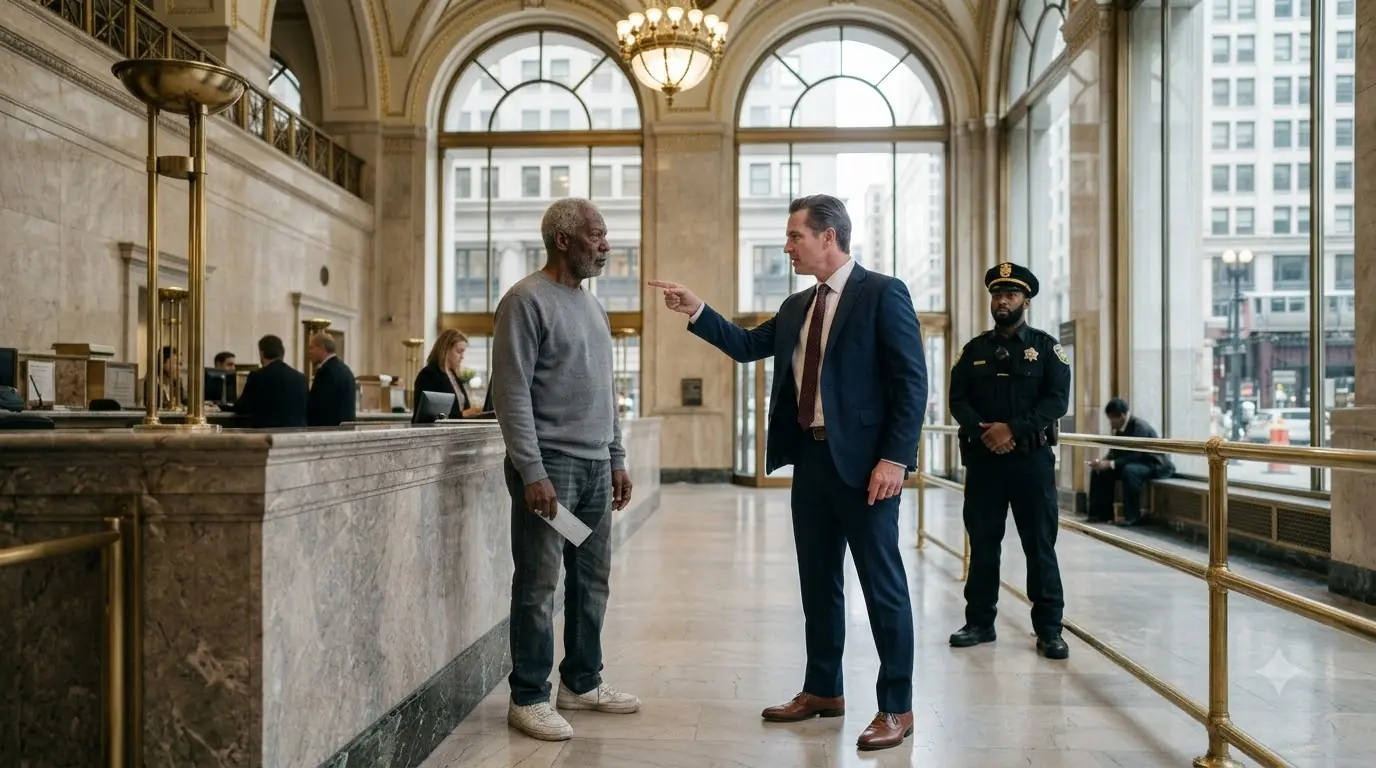
What they did not know was who the old man really was.
Morning came slowly over downtown Chicago, the kind of morning that made the city look cleaner than it really was. Street vendors were lifting their metal shutters. A delivery truck idled near the corner while two pigeons fought over a discarded pretzel beside the curb.
Walking quietly through all of it was an old man named Walter.
He moved carefully, not because he was weak, but because he had learned long ago that rushing rarely got a person anywhere worth going.
Walter wore a plain gray sweatshirt, faded dark jeans, and clean white sneakers that had seen better days. No expensive watch. No briefcase. No tailored coat.
The only thing in his breast pocket was a folded piece of paper.
He stopped in front of a building that occupied nearly half the block.
Pinnacle National Bank.
Twelve floors of glass and steel rose above him. A polished revolving door turned beneath the entrance canopy, and two American flags hung on either side.
Through the glass, Walter could see white marble floors, brass fixtures, thick counters, and rows of tellers in pressed uniforms.
He stood there for a few seconds.
Then he pushed through the door.
The cold air hit him first.
The lobby was cooled so aggressively that stepping inside felt almost like entering a refrigerator. It smelled faintly of carpet cleaner and expensive cologne.
Every surface shone.
Every employee wore a navy-blue uniform with a gold name tag.
And almost every person near the entrance looked at Walter as though he had entered the wrong building.
Walter kept walking.
He approached the customer-service desk near the center of the lobby.
A young woman sat behind it, probably twenty-six or twenty-seven years old. Her name tag read KAYLA.
Her phone rested behind the computer monitor.
Her attention was on the screen rather than on the elderly man standing in front of her.
Walter waited.
Kayla did not look up.
He cleared his throat gently.
“Excuse me, miss.”
Kayla finally raised her eyes.
She looked at Walter the way someone looks at an interruption they have already decided is unimportant.
Her gaze moved from his face to his sweatshirt, then to his faded jeans and worn sneakers.
The inspection lasted perhaps two seconds.
“Tellers are on the left,” she said.
Then she looked back at her phone.
“I’m not here for a teller,” Walter replied. “I need to make a withdrawal. A larger one. I thought I should come to the service desk first.”
That caught her attention.
Kayla put the phone down.
Not because she suddenly respected him.
Because the sentence required more effort to dismiss.
“How large?”
“One hundred fifty thousand dollars.”
The lobby was not particularly noisy, but several nearby conversations stopped anyway.
A man in a suit glanced over.
One of the tellers lifted her head.
Kayla stared at Walter.
One second.
Two.
Three.
Then she laughed.
It was not a small, uncomfortable laugh.
It was open disbelief.
She put one hand over her mouth for a moment as if she were trying to stop herself, then gave up.
“Sir,” she said, using the word without any real respect, “is this some kind of joke?”
“No.”
“You want to withdraw one hundred fifty thousand dollars in cash?”
Kayla leaned slightly forward.
“And you have an account here?”
“I do.”
Her head tilted.
“Sir, with all due respect, I’ve worked here for three years. I know the kind of clients this branch serves.”
Walter remained still.
“Our minimum opening balance for certain personal accounts is twenty-five thousand dollars.”
She paused.
Her eyes traveled over him again.
“The clients who keep that kind of money here usually don’t come in wearing a sweatshirt.”
Walter said nothing.
Kayla leaned back in her chair.
“I’m going to need you not to waste my time. If you have a legitimate account, go to a teller window, show them your identification, and they’ll tell you what your actual balance is.”
She crossed her arms.
“If you don’t have an account, then I’m going to need you to leave.”
“I have a check.”
Walter reached into his pocket.
He unfolded the paper once and placed it flat on the desk.
Kayla did not pick it up.
She looked at it as though touching it might create a problem.
“Take your check to a teller.”
“I’d like you to look at it first.”
She pushed it back toward him with two fingers.
“I don’t process checks. That isn’t my job.”
Walter looked at her.
“Then what is your job?”
Something flickered across Kayla’s face.
Not guilt.
Irritation.
She stood.
“Let me get the branch manager.”
His name was Derek Sims.
He came out of a back office carrying himself like a man who had already decided how the situation would end before hearing a single fact.
He was in his mid-forties, with slicked-back hair and an expensive-looking tie pulled slightly too tight around his neck.
His shoulders were pushed back.
His chin was high.
He had the posture of a man who confused authority with superiority.
Derek stopped in front of Walter and looked him over once.
“I heard there’s a problem.”
“No problem,” Walter said. “I would simply like to make a withdrawal.”
“Kayla said you claimed to have an account here.”
Claimed.
Walter noticed the word.
He did not react.
“I do have an account here.”
Derek crossed his arms.
“Sir, I’m going to be direct with you. From time to time we get people walking in here with stories. Checks that don’t clear. Account numbers that don’t exist. Documents that turn out not to mean what people say they mean.”
Walter listened.
“I’ve seen it all.”
Derek leaned slightly closer.
“I’m not accusing you of anything, but I’m also not allowing my staff to process a one-hundred-fifty-thousand-dollar transaction without proper verification, and looking at…”
He stopped.
For the first time, Derek seemed to realize he was about to say aloud what should have remained inside his head.
Walter finished the sentence for him.
“Looking at me?”
Derek’s jaw tightened.
“I was going to say looking at the situation.”
“No,” Walter replied calmly. “You were going to say looking at me.”
There was no anger in Walter’s voice.
That made the statement land harder.
He sounded like a man who had seen this kind of judgment before and already knew exactly where it came from.
Derek’s patience broke.
“You know what? I don’t need this today.”
He turned toward the security guard stationed near the entrance.
The guard was a broad young man in his early twenties.
“Courtney. Come here.”
The guard approached.
Walter looked back at Derek.
“I would like to speak with someone above you.”
“There is no one above me in this branch.”
“Then I would like to use your phone.”
“You will use nothing in this building.”
Derek stepped closer.
Too close.
“I want you to walk out that door right now, or I’m calling the police.”
“You’re making a mistake,” Walter said.
Derek stared at him.
“Last chance, old man.”
Walter did not move.
Derek nodded toward Courtney.
The guard stepped forward and took Walter firmly by the arm.
It was not brutal.
But it was public.
That was enough.
He guided Walter across the lobby toward the revolving doors while everyone watched.
Tellers.
Customers.
The man in the suit.
Kayla.
Nobody said anything.
The revolving door turned.
A few seconds later, Walter was standing on the sidewalk.
The morning was still bright.
The pigeons were still arguing over the pretzel.
The delivery truck had disappeared.
Chicago continued as though nothing had happened.
Walter stood there for a moment.
Then he reached into his pocket and pulled out an old cell phone.
He dialed a number he knew by heart.
It rang twice.
“Hey, Dad.”
The voice on the other end sounded focused.
Busy.
Behind it were keyboards, muted conversations, and the distant rhythm of a large office.
“I was about to call you. How did the morning go?”
Walter walked to a bench near the edge of the sidewalk and sat down.
To anyone passing by, he looked like nothing more than an elderly man resting his feet.
“I need you to come.”
Silence.
“What happened?”
Walter told him.
Kayla’s laugh.
The comments about his clothes.
Derek’s assumptions.
The threat to call police.
The security guard gripping his arm.
The revolving door.
The sidewalk.
By the time Walter finished, the other end of the line had gone completely quiet.
“Dad.”
His son’s voice had changed.
Whatever businesslike momentum had been there before was gone.
In its place was something slower.
Colder.
“Are you hurt?”
“I’m fine.”
“Are you sitting down?”
“Yes.”
“Stay there.”
Walter looked back at the bank.
“Don’t go back inside. Don’t talk to anyone. I’m coming.”
“You don’t need to cancel whatever you’re doing.”
“I’m coming, Dad.”
The line disconnected.
His son’s name was Jordan.
And Jordan did not merely work in banking.
He owned Pinnacle National Bank.
Not that Chicago branch.
The entire company.
Seventeen branches across four states.
Corporate headquarters in New York.
Regional oversight offices in Atlanta and Denver.
Every marble floor.
Every brass fixture.
Every desk.
Every name tag.
But even that was only half of the story.
Because Pinnacle National Bank had not begun with Jordan.
It had begun with Walter.
Thirty-eight years earlier, Walter had opened a small community bank in a neighborhood most larger institutions had ignored.
There had been no marble.
No glass tower.
No polished brass.
Just four employees, a modest storefront, and Walter’s belief that ordinary working people deserved somewhere safe and dignified to keep their money.
He built it slowly.
One customer at a time.
One branch became two.
Two became five.
The bank expanded beyond Illinois.
Eventually, the company became what stood on the Chicago block now.
Six years earlier, when Walter’s knees began bothering him and he decided he preferred morning walks to morning meetings, he transferred majority control to Jordan.
Walter kept a financial interest and maintained the original account he had opened before the bank became successful.
He had never changed it.
Never changed his address simply to impress anyone.
Never changed how he dressed.
He did not believe a person should have to advertise his bank balance to be treated with dignity.
Until that morning, he had never needed to prove that point inside the institution he created.
Jordan reached Chicago later that day.
He had left New York as quickly as he could arrange transportation.
He wore dark jeans, a plain black hoodie, and running shoes.
No tailored suit.
No expensive coat.
No visible sign that he controlled one of the largest regional banking organizations in the company’s market.
He found his father sitting on the bench outside Pinnacle National.
Walter stood.
Jordan hugged him without saying a word.
He held on for one second longer than usual.
Then he stepped back and studied Walter’s face.
There were no visible injuries.
But Jordan recognized something else in his father’s eyes.
Not sadness exactly.
Something more exhausting.
The feeling of being made to feel insignificant by people who had no right to decide your worth.
“You ready?” Jordan asked.
Walter nodded.
“You sure you want to do this?”
“I’ve never been more sure.”
“They’re going to be embarrassed.”
“That’s the plan.”
Walter almost smiled.
Jordan looked at him.
“Same clothes?”
“Same clothes.”
“Good.”
They walked toward the revolving door together.
Father and son.
Gray sweatshirt.
Black hoodie.
Worn sneakers.
Running shoes.
Kayla saw them immediately.
Her face passed through several expressions within seconds.
Surprise.
Irritation.
Then the same familiar arrogance.
As though she were thinking, here we go again.
Jordan walked directly to her desk.
He did not rush.
“Hi.”
Kayla looked at him.
“We need to make a withdrawal.”
“Sir, your father was already asked to leave this branch.”
“I know.”
Jordan’s expression remained calm.
“We’re back.”
Kayla looked Jordan over exactly the way she had looked at Walter.
Hoodie.
Jeans.
Running shoes.
Then back to his face.
“I’m going to need to call security.”
“Before you do that,” Jordan said, “I’d like you to pull up account number 0001-00038.”
Kayla frowned.
“I don’t process accounts.”
“I know you don’t process transactions.”
Jordan rested one hand lightly on the desk.
“I’m asking you to pull up the account and look at it.”
She hesitated.
“You can do that, can’t you?”
Something about his tone finally made her pause.
Not the words themselves.
The certainty behind them.
The confidence of someone who already knew what she was about to see.
Kayla began typing.
Slowly at first.
Performing reluctance.
Then she stopped.
Her expression changed.
She looked at the computer.
Then Jordan.
Then back at the computer.
“I’d like to get Mr. Sims.”
“Please do.”
Derek came out of his office with the same posture he had worn earlier.
Shoulders back.
Chin high.
Tie too tight.
When he saw Walter standing with Jordan, his face hardened.
“We already told your father…”
Jordan interrupted.
“Pull up account 0001-00038.”
Derek stared.
“Excuse me?”
“The account number.”
Jordan repeated it.
“Pull it up.”
Derek looked toward Kayla.
Something in her expression made him pause.
He walked around the desk.
Then he looked at the screen.
And stopped.
Jordan let him stand there.
Ten seconds.
Fifteen.
Twenty.
Derek slowly turned around.
His posture had changed.
His shoulders were lower.
His chin had dropped.
“Sir.”
This time, the word sounded different.
Jordan looked at him.
“The withdrawal, please.”
Derek swallowed.
“Of course.”
Jordan glanced toward Walter.
“For my father.”
Derek looked at the account again.
The available balance, account history, internal designation, and original opening date were impossible to misunderstand.
“If I could just have a moment to…”
“No.”
Jordan’s voice remained quiet.
“You’ve had enough moments.”
He pulled out his phone.
Then he began making calls.
Regional director.
General counsel.
Head of human resources.
He placed each call on speaker long enough for the people nearby to hear the responses.
“Yes, sir.”
“Of course, sir.”
“We’re ready when you are.”
Jordan ended the final call.
Then he looked at Derek.
“My name is Jordan.”
Derek said nothing.
“My father’s name is Walter.”
Walter stood quietly beside him.
“Walter built this bank.”
The lobby became still.
“I currently control Pinnacle National Bank.”
A teller near the far window lifted one hand toward her mouth.
The man in the suit from earlier had turned completely around now.
Jordan continued.
“And this morning, you humiliated my father inside the institution he spent decades building.”
Derek’s face lost its color.
“Sir, I…”
“You called him an old man.”
Jordan’s voice did not rise.
“You questioned whether he had an account.”
Another pause.
“You threatened him with police involvement before properly verifying anything.”
The lobby seemed smaller with every sentence.
“Then you instructed your security guard to physically escort him out in front of customers and employees.”
Derek tried to speak again.
Jordan raised one hand.
The gesture stopped him.
“I have lobby footage.”
Derek closed his mouth.
“I have timestamps.”
Jordan looked toward Kayla.
“I have employee names.”
Then he looked around the lobby.
“And I know how many people watched it happen without saying a word.”
Derek swallowed.
“I want to apologize.”
“Don’t apologize to me.”
Jordan’s voice became even quieter.
“You’re not sorry because of how you treated the man standing beside me.”
Derek looked at Walter.
“You’re sorry because you discovered who he is.”
Nobody moved.
“That is not the same thing.”
Kayla was called into Derek’s office shortly afterward.
By the time she sat down in the chair across from the desk, she was already crying.
Her hands shook.
Her eyes stayed on the floor.
Jordan sat opposite her.
Walter remained nearby.
“You laughed at him,” Jordan said.
Kayla did not deny it.
“He is seventy years old.”
She wiped her face.
“He walked into this branch with a legitimate request involving an account older than your career, and you decided within seconds that he didn’t belong here.”
Kayla whispered, “I’m sorry.”
Jordan looked at her.
“I’m not ending your employment because you embarrassed my father personally.”
Her eyes lifted.
“I’m ending it because you looked at someone and decided his value in two seconds based on his clothes and appearance.”
Kayla started crying harder.
“That’s bigger than poor customer service.”
Jordan’s expression remained controlled.
“It’s a judgment problem.”
He stood.
“Your employment ends today. Human resources will contact you regarding the proper final procedures. Please return your badge before leaving the building.”
Kayla stared at him.
Jordan turned toward Derek.
“The same applies to you.”
Derek opened his mouth.
Jordan’s eyes stopped him.
Then Jordan looked toward the young security guard.
“You followed an instruction that should never have reached the point it did. Your conduct will also be reviewed immediately, and you will be removed from duty pending that process.”
The guard lowered his eyes.
Jordan walked back into the lobby.
Every teller had stopped pretending to work.
Every employee knew exactly what had happened.
Jordan stood in the center of the marble floor.
“I want everyone here to hear this.”
His voice carried without shouting.
“Several people are facing consequences today.”
Nobody moved.
“But consequences are not the point.”
He let the words settle.
“The point is this.”
Jordan looked from desk to desk.
“Every person who walks through those doors deserves to be treated like a human being.”
He pointed toward the entrance.
“Not according to what they’re wearing.”
Another pause.
“Not according to what car you think they drove here.”
Another.
“Not according to what you assume their bank balance is.”
Employees listened silently.
“Not according to whether they look like the kind of customer you believe belongs in this building.”
Jordan’s voice stayed steady.
“Every person.”
He looked across the entire floor.
“Every time.”
“No exceptions.”
Nobody shifted.
“If you cannot do that, then this is your opportunity to choose a different place to work.”
The silence lasted several seconds.
No one moved.
Jordan turned.
Walter was standing near the wall, slightly apart from everything.
Watching.
He had watched the entire confrontation the way he watched most things.
Carefully.
Quietly.
Without giving away too much.
Jordan walked over and stood beside him.
For a moment, neither spoke.
Then Walter said, “You didn’t have to come all the way out here for this.”
Jordan looked at him.
“Yes, I did.”
“I would have figured something out.”
“I know.”
Walter looked across the lobby.
“You’re too much like your mother.”
Jordan almost smiled.
“She never let anything go either.”
“Good.”
Walter looked back toward the tellers.
The man in the suit eventually left.
Transactions resumed.
The marble floors still shone.
The brass fixtures had not moved.
From a distance, everything looked exactly the same.
But it was not.
Walter reached into his sweatshirt pocket.
He pulled out the folded check.
Then he held it up.
Jordan looked at it.
“You still want this processed?”
Walter nodded.
“That’s why I came.”
They walked together toward one of the teller windows.
A young woman stood behind the glass.
She could not have been more than twenty-two.
She looked at Walter.
Then Jordan.
Her hands were steady.
Her expression was calm.
When she smiled, it looked genuine.
“Good morning,” she said. “How can I help you today?”
Walter slid the check through the opening beneath the glass.
The young woman looked at it.
Then at the account information.
She processed the request professionally.
No comment about his sweatshirt.
No glance at his sneakers.
No assumption about whether he belonged.
Only the transaction.
When everything was finished, Walter thanked her.
She smiled again.
“You’re welcome, sir.”
Walter and Jordan left through the revolving door.
The Chicago morning was still waiting outside.
Warmer now.
The light had shifted.
The sidewalk was busier.
Cars moved through intersections.
People hurried past carrying coffee cups and briefcases.
Chicago continued doing what Chicago always did.
Moving forward.
Walter stood on the sidewalk and took a long breath.
He was not crying.
Not exactly.
But his eyes were bright in the way eyes become when something heavy inside the chest finally finds somewhere to go.
Jordan stood beside him.
“You okay?”
Walter nodded.
“Yeah.”
He turned and looked back at Pinnacle National Bank one time.
Only once.
“You know what your grandfather used to say?”
Jordan smiled faintly.
“Which thing? He said a lot.”
Walter looked down the street.
“He used to say, ‘Son, money tells you what a man has. Behavior tells you what a man is.’”
Jordan listened.
“I always thought he was talking about other people when he said that.”
Jordan waited.
Walter looked at his son.
“He was talking about us.”
“Us?”
“About who we choose to be when nobody is checking.”
Walter placed one hand on Jordan’s shoulder.
Then father and son began walking down the block.
An old man in a gray sweatshirt.
A younger man in a black hoodie.
Two people moving through the crowd like anyone else.
Nobody stopped.
Nobody stared.
Nobody looked twice.
And that was exactly the point.
Account number 0001-00038 was the first account ever opened at Pinnacle National Bank.
Walter had opened it himself thirty-eight years earlier.
He started it with four hundred dollars.
Back then, there had been no glass headquarters.
No marble floor.
No brass fixtures.
Only a tiny branch, four employees, and one simple belief.
Regular people deserved somewhere safe to put their money.
More importantly, they deserved somewhere they would be treated with dignity whether they arrived wearing a tailored suit or a faded gray sweatshirt.
Walter never changed that account.
He never needed to.
Because the number was never important because of how much money eventually sat behind it.
It mattered because it reminded him where everything had begun.
With ordinary people.
And a promise not to forget them.