Henrik Lund ordered a wife the way he ordered everything else.
By mail.
With specifications.
He sat at his rough pine table one cold March evening in 1882, dipped his pen into a bottle of ink that was already thickening at the bottom, and wrote to a matrimonial agency in Chicago with the steady seriousness of a man ordering a plowshare, a length of fencing wire, or a team of oxen.
He wanted a woman between twenty and thirty years of age.
Healthy.
Willing to cook.
Willing to clean.
Willing to keep a homestead.
Preferably quiet.
He paused after writing that last phrase and looked at it for a long moment.
Preferably quiet.
Then he nodded once, as though the page had agreed with him.
The Montana wind pushed against the cabin walls that night like something trying to get in. The fire had burned low in the stove. A tin plate sat on the table beside him, still holding the last hard corner of cornbread he had not bothered finishing. His boots were muddy near the door. His coat hung from a peg, stiff with dried snow along the hem.
Outside, forty head of cattle huddled against the dark.
Inside, Henrik Lund sat alone in a cabin that was too quiet even for a man who claimed to value silence.
He did not write that part.
He did not write that the winter nights had begun to stretch longer than they had any right to.
He did not write that he sometimes spoke aloud just to hear a human voice.
He did not write that the sound of his own chair scraping the floor in the evening could make him feel like the last man left in the territory.
He did not write that he had reached the age of thirty-five and realized that a man could build a life with his hands and still have no one to hand it to.
He did not write that he wanted companionship.
He wrote, instead, that the winters were cold.
That the work was hard.
That a woman who could not tolerate isolation should not apply.
He added that he owned one hundred and sixty acres in Yellowstone County, near the Billings area, with a cabin, cattle, a small barn, a water source, and the intention of improving the property further.
He wrote that he was a Norwegian immigrant.
That he was sober.
That he was Lutheran.
That he was honest.
That he was not seeking a frivolous woman.
He did not mention love.
Henrik Lund did not know what use a word like love had on a frontier where the wind could strip the hide from a man’s face and one bad storm could kill half a herd.
He did not mention tenderness.
He did not mention laughter.
He did not mention music.
He mentioned work.
Then he enclosed a tintype photograph.
In the tintype, he looked stern, clean-shaven, and approximately forty percent more handsome than he actually was.
Not because he had meant to deceive anyone.
Henrik was not vain enough to pose dishonestly.
It was simply that the photographer in Billings had turned his head toward the light, brushed the dust from his coat, and told him not to move. The stillness had sharpened his jaw, the light had softened the weathering around his eyes, and the final image suggested a man of solemn dignity rather than a man who had spent the previous morning wrestling a calf out of a creek.
Henrik sealed the envelope, addressed it carefully, and rode into town the next morning to post it.
He handed it to the clerk without comment.
The clerk read the address and looked up with immediate interest.
“Matrimonial agency?”
Henrik said, “Yes.”
The clerk waited, hoping for embarrassment, explanation, or at least a change in expression.
Henrik gave him none.
The clerk cleared his throat.
“Well. Good luck to you.”
Henrik nodded.
“Thank you.”
Then he left.
That was Henrik Lund.
He did not waste words, not even on shame.
Now, Henrik had come to Montana Territory in 1876 with eighty dollars, a plow, two spare shirts, and the absolute certainty that the frontier was a place where a man could build something with his hands and nobody would bother him about it.
He was right about the building.
He was wrong about not being bothered.
In Norway, he had been the third son of a farmer whose land was too small to divide again without making all the sons poor. His oldest brother would inherit. His second brother had apprenticed as a carpenter. Henrik, solid and stubborn and skilled with animals, had looked across the Atlantic at America and decided distance was preferable to waiting for a future that would never arrive.
He had worked his way west.
First on farms in Minnesota.
Then on a rail crew.
Then hauling freight.
Then finally into Montana, where the sky seemed too large for any church roof and the land looked empty enough for a man to imagine himself remade.
The land was not empty, of course.
No land ever is.
But Henrik, like many men of his time, had arrived with more ambition than understanding. He learned quickly that the frontier did not belong to anyone simply because they were brave enough to suffer on it.
It belonged to weather.
To water.
To debt.
To chance.
To railroad schedules.
To cattle prices.
To neighbors who might help you pull a wagon out of mud one day and sue you over a fence line the next.
He also learned that building a life alone took more from a man than muscle.
By 1882, Henrik had one hundred and sixty acres of good land, though good was a flexible word in Montana. It meant the grass grew well enough if spring came properly. It meant the creek held water most years. It meant the soil did not fight the plow every inch, only every other inch.
He had begun with a sod house that sweated in summer and froze in winter.
After four years, he had graduated to a log cabin, rough but straight, with two rooms, a loft, a proper stove, and a table he had made himself.
He had forty head of cattle, three horses, six chickens, one rooster with a criminal nature, and a loneliness so vast that it had its own geography.
There was the loneliness of morning, when there was no one to speak to before work began.
There was the loneliness of supper, when the chair across from him remained empty no matter how many times he glanced at it.
There was the loneliness of weather, when a storm came down and he had no one to say, “Listen to that wind,” so the wind went unremarked upon, which somehow made it worse.
There was the loneliness of success, the strangest kind of all.
When he repaired the barn roof alone, there was no one to admire the straightness of the line.
When a calf survived a hard birth because he stayed awake through the night with the cow, there was no one to smile at the wobbly little thing in the morning.
When the first spring grass returned after winter, there was no one to stand beside him and feel relief.
A man could get used to hardship.
Henrik had.
But he had not gotten used to having no witness.
That was why he wrote to Chicago.
Not that he would have said so.
He told himself a wife was practical.
Two people could manage a homestead better than one.
A woman could keep the house, tend a garden, preserve food, mend clothing, help with chickens, perhaps make the cabin feel less like a work camp.
A wife was sensible.
A wife was efficient.
A wife was necessary.
That was all.
Three months later, the Northern Pacific rail line brought him Alma Brandt.
And she was absolutely nothing he had ordered.
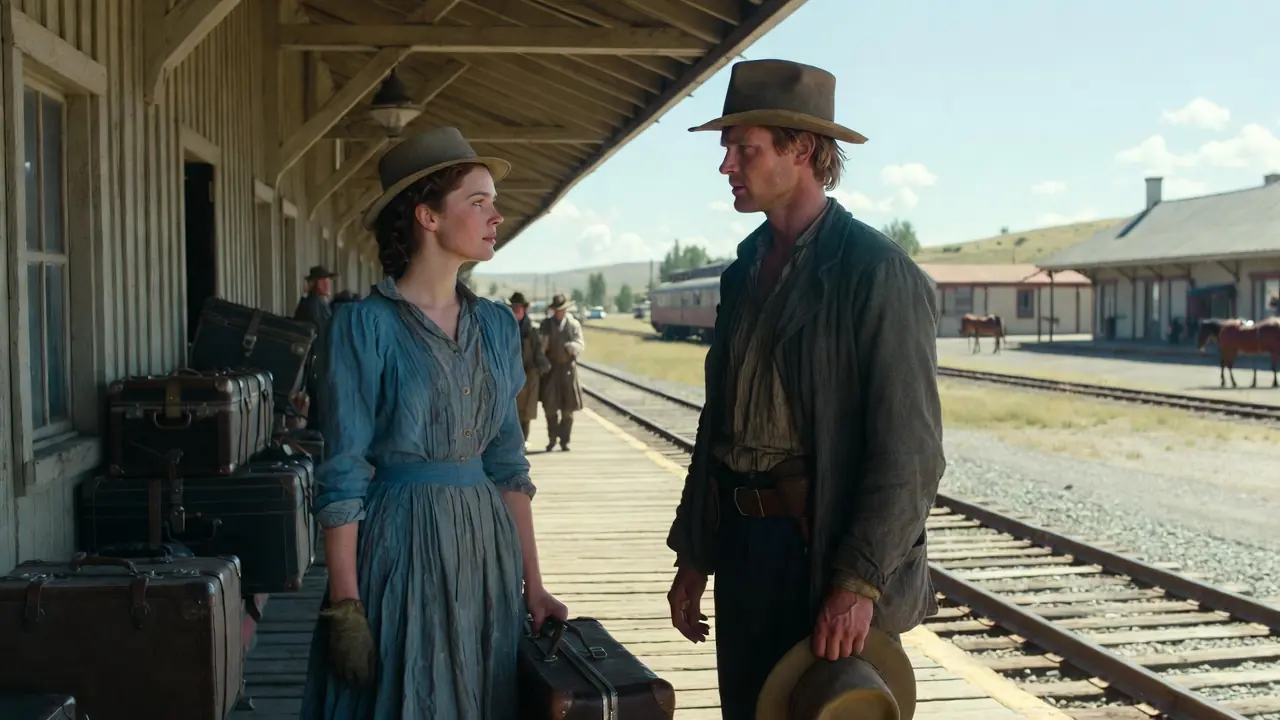
Alma Brandt stepped off the train at Billings Depot on September 14, 1882, wearing a blue traveling dress that was slightly too fine for the surroundings and carrying two suitcases and a violin case.
The dress had once been fashionable in Chicago, though by the time she reached Montana, the hem had gathered dust from three states, and one sleeve cuff had frayed from travel.
She was thirty years old.
Five feet eight.
German-born.
Straight-backed.
Clear-eyed.
Her hair was dark blond, pinned beneath a travel hat that had suffered bravely through wind, coal smoke, and the indignities of rail travel.
Her face was not delicate in the way sentimental men wrote about in magazines. It had too much intelligence in it to be called delicate. Her mouth looked capable of kindness but not obedience. Her eyes were gray-blue and direct enough to make weaker men remember appointments elsewhere.
She stood on the platform, looked around at Billings, and did not appear impressed or frightened.
That alone made people notice her.
The depot was busy in the way frontier depots were busy, with men unloading crates, women gathering children, dogs weaving where they should not, trunks thumping onto carts, and dust rising into the afternoon light.
Henrik stood near the freight office wearing his good coat, clean shirt, and an expression that suggested he was prepared for weather, cattle disease, or marriage with equal stoicism.
He held his hat in his hands.
He saw her before she saw him.
At first, he did not think she could be the one.
She was too tall.
Too composed.
Too observant.
She looked less like a woman arriving to be claimed and more like a magistrate arriving to inspect conditions.
Then her eyes found him.
She looked from his face to the tintype in her gloved hand, then back to his face.
Henrik stepped forward.
“Miss Brandt?”
She looked him over, unhurriedly.
“You are Henrik Lund.”
“Yes.”
She considered him.
“You are shorter than your photograph suggested, but your chin is better in person.”
Henrik blinked.
He had prepared for many possible first sentences.
Good afternoon.
I am pleased to meet you.
The journey was long.
He had not prepared for a critique of his chin.
“I am the same height as always,” he said.
“That may be, but the photograph was ambitious.”
“It was the photographer.”
“I suspected as much.”
She held out her hand.
“Alma Brandt.”
He took it.
Her handshake was firm.
Not ornamental.
A working handshake.
That registered with him.
“Your luggage?” he asked.
“These two suitcases. And the violin.”
“You play?”
“Yes.”
He glanced at the case.
“Will it survive the wagon ride?”
“That depends on how you drive.”
Henrik looked at her.
She looked back.
Somewhere behind them, a porter dropped a trunk and swore.
Alma did not flinch.
Henrik picked up both suitcases.
She picked up the violin case herself.
“I can carry that,” he said.
“I know.”
She walked ahead.
He followed, already aware that the specifications in his letter had not prepared him for the actual woman.
The wagon ride to the homestead took several hours.
The country outside Billings stretched wide and raw, gold grass moving under wind, cottonwoods marking water, low hills rising in the distance, and the sky so large that Alma found herself both unsettled and unwilling to admit it.
She sat beside Henrik on the wagon bench, one gloved hand resting on the violin case between her feet.
Henrik drove in silence.
The horses moved steadily.
The wagon creaked.
After ten minutes, Alma said, “How many acres?”
“One hundred sixty.”
“Water source?”
“Creek. Also a well.”
“Nearest neighbor?”
“Two miles east. Widow Matheson. Four miles west, Hans Keller.”
“Nearest church?”
“Billings.”
“How long by wagon?”
“Depends.”
“On what?”
“Mud. Snow. Horse.”
She looked at him.
“That was almost a complete answer.”
He kept his eyes on the road.
She continued.
“Nearest doctor?”
“Miles City.”
“How far?”
“Ninety miles.”
“That is not near.”
“No.”
“Nearest school?”
“Not built yet.”
“Nearest lending library?”
He gave her a blank look.
“No.”
“No library?”
“No.”
“Any books?”
“Bible. Cattle ledger. Agricultural almanac.”
Alma was quiet for a moment.
Then she said, “This is a cultural emergency.”
Henrik had no answer to that.
After a while she asked, “Do you speak Norwegian still?”
“Yes.”
“German?”
“No.”
“Latin?”
“No.”
“French?”
“No.”
“Do you read newspapers?”
“When I can get them.”
“Do you vote?”
“When permitted.”
“Do you argue politics?”
“No.”
“Religion?”
“No.”
“Anything?”
“Prices.”
She turned to look at him fully.
“You are either very efficient or very boring. I will determine which by Thursday.”
Henrik looked at her then.
Just briefly.
The corner of her mouth had curved.
Not quite a smile.
A challenge.
He faced the road again.
“Today is Friday.”
“Then you have nearly a week to improve.”
He did not smile.
But something shifted in his eyes.
Alma saw it.
She looked away before he could see that she had.
Alma Brandt had not come west because she was romantic.
She had come because Chicago had become too narrow.
She had been born in Bremen and brought to America at the age of eight, when her father found work in a brewery and her mother took in washing. They had lived in crowded rooms, then slightly better crowded rooms, then after her father died, worse crowded rooms again.
Alma had worked since she was thirteen.
Domestic service first.
Then seamstress work.
Then as a companion to an elderly widow who had valued Alma’s ability to read aloud in English and German, and who had left Alma twelve books, one violin, and a small amount of money that was not enough to build a life but enough to leave one.
By thirty, Alma had become a problem to the people around her.
Too old to be easily married.
Too educated to be easily managed.
Too practical to be sentimental.
Too proud to accept a position in a household where she would be treated like furniture.
The matrimonial agency had seemed absurd when a friend first mentioned it.
Then less absurd.
Then possible.
The West, at least, offered room.
And Alma wanted room.
She did not expect love.
She expected work.
She expected difficulty.
She expected a man who would likely be rough, lonely, and convinced that sending for a wife gave him more authority than it did.
On the train, she had made a list of non-negotiable terms in a small notebook.
A room of her own until marriage.
Access to household money for necessities.
The right to refuse marital relations until properly wed and willingly settled.
The right to keep her books and violin.
No physical discipline.
No interference with correspondence.
A garden plot.
A shelf.
She expected to fight.
She was ready.
What she found, sitting beside her on the wagon bench, was not soft.
Henrik Lund was not a man easily bent.
But he listened.
Not warmly.
Not expressively.
But completely.
That was rare enough that Alma did not yet know what to do with it.
They reached the homestead near sunset.
The cabin stood in a shallow draw where cottonwoods shielded it from the worst northern wind. Beyond it lay the barn, a corral, a chicken coop, woodpile, small shed, and the beginnings of a garden plot that looked more hopeful than successful.
The cabin was plain but solid.
The roofline straight.
The chimney well-set.
The yard orderly.
The barn door hung properly.
The woodpile was stacked with practical intention, if not, Alma immediately noticed, optimal airflow.
There was no decorative impulse anywhere.
Not one.
The place looked as though usefulness had conquered beauty and then forgotten to do anything with the victory.
Henrik stopped the wagon.
“This is it.”
Alma stepped down.
She stood in the yard, turned slowly, and took in the land.
The sky had softened toward evening. The grass moved in long waves. Somewhere beyond the barn, cattle shifted and lowed. A wind came down from the north carrying dust, dry grass, and the faint animal warmth of the herd.
It was harsh.
It was lonely.
It was enormous.
Alma felt fear rise, sharp and sudden.
She pushed it down.
Fear was not useful unless it carried information. This fear told her only that she had come very far and could not easily return.
Henrik unloaded her suitcases.
He carried them into the cabin, then stood aside so she could enter first.
That surprised her slightly.
Inside, the cabin smelled of woodsmoke, leather, soap, and dried grass. The main room held a stove, table, two chairs, shelves with crockery, a Bible, the almanac, and a small window facing west.
A second room stood to the left.
“The room is yours,” Henrik said.
Alma looked at him.
“You assumed?”
“You are not my wife yet.”
“No.”
“So the room is yours.”
She said nothing.
The room was small, with a bedstead, a chest, one peg on the wall, and a window with a flour-sack curtain.
Sparse.
But clean.
She set down her violin case.
Henrik placed the suitcases inside.
“Supper?” he asked.
“I will cook.”
“You traveled three days.”
“And you have been living on what smells like boiled beans and resignation. I will cook.”
He looked at her.
She looked back.
Then he said, “There is flour. Salt pork. Potatoes. Onions. Eggs.”
“Fresh herbs?”
“No.”
“Dried?”
“No.”
“Any pepper?”
“Yes.”
“Thank God.”
Henrik went outside to tend the horses.
When he returned, Alma had already taken command of his kitchen.
Not loudly.
Efficiently.
She found every pan, every knife, every jar. She moved like someone reading a room through objects. She noted what was lacking and what could be improved. She washed the cutting board before using it, sharpened the knife on the whetstone without being told where it was, and turned potatoes, onions, salt pork, and eggs into a meal that smelled better than anything Henrik had eaten in months.
They sat at the table.
He took one bite.
Then another.
Alma waited.
“Well?” she asked.
“It is good.”
“That is all?”
“It is very good.”
“Better.”
They ate.
The silence between them was not yet comfortable.
It was not hostile either.
It was simply unmeasured.
After supper, Alma cleared the plates, then sat back down with her small notebook.
“We should discuss terms.”
Henrik looked up.
“Terms?”
“Yes. I have come nearly three thousand miles to marry a man I have never met. This is, before it becomes anything else, a business arrangement. We should discuss it like adults.”
Henrik leaned back slightly.
He had never been negotiated with by a woman.
He had barely been negotiated with by men.
Alma opened the notebook.
“I will keep the house, cook, clean, sew, preserve food, manage household stores, and help with the ranch where I am able. I will not be treated as hired help. I will be your wife if and when we marry, and until then, I will have my own room.”
Henrik nodded.
“I will also require a bookshelf.”
“A bookshelf.”
“Yes.”
“For books.”
“That is generally the purpose.”
“How large?”
“Larger than you think necessary.”
He considered.
“Pine?”
“That is acceptable.”
“What else?”
“The right to say no without explanation.”
Henrik looked at her.
She had expected the air to change then.
Expected offense.
Argument.
The old male belief that a woman asking for autonomy was insulting him.
Instead, Henrik’s brow furrowed as if she had stated something obvious in a needlessly complicated way.
“That right is already yours,” he said.
Alma went still.
“It does not need my permission,” he added.
She studied him.
His face was serious.
No flirtation.
No performance.
No attempt to appear noble.
He simply meant it.
Alma had prepared for resistance.
She had not prepared for respect offered without drama.
“That was the right answer,” she said.
“I know.”
The confidence of it almost annoyed her.
It also relieved her.
She closed the notebook.
“Then we may proceed.”
“To what?”
“To determining whether you are very efficient or very boring.”
Henrik stood and picked up the plates.
“I am both.”
It was the most words he had spoken in a single evening in three years.
And it was only the beginning.
The first week was a series of discoveries, most of them inconvenient.
Henrik discovered that Alma woke earlier than he expected.
On her first morning, he came in from checking the cattle and found coffee already made, bread dough rising near the stove, and Alma kneeling beside the lower shelf, removing everything from it.
“What are you doing?”
“Reorganizing.”
“It was organized.”
“No. It was arranged by a man who knows where things are because he put them there in the first place. That is not organization. That is memory with arrogance.”
Henrik stood in the doorway.
“I could find everything.”
“Could a sick person find everything? Could I? Could a child? Could a neighbor helping during a storm?”
He had no answer.
She continued.
“Exactly.”
By noon, she had rearranged the kitchen.
By evening, she had labeled three jars, cleaned the stove pipe, and made a list of supplies needed before winter.
Henrik took the list.
It was long.
“Too much.”
“It is not too much. It is accurate.”
“Sugar?”
“Yes.”
“Molasses?”
“Yes.”
“Cinnamon?”
“Yes.”
“That is not necessary.”
“Neither is despair, yet you have stocked plenty of that.”
He looked at her.
She looked back.
He bought the cinnamon the next time he went to Billings.
Within a week, Alma had repaired the chicken coop with tools she found in the barn.
The coop had leaned east since spring. Henrik had intended to fix it after haying, then after the last cattle movement, then after the first frost, which is how many necessary tasks became permanent problems.
Alma examined it, fetched hammer, nails, and scrap board, and set to work.
Henrik came around the barn and stopped.
“You are repairing the coop.”
“Yes.”
“I was going to.”
“When?”
He paused.
“Soon.”
“Soon is a room where men store broken promises.”
The hammer struck cleanly.
Henrik looked at the repaired brace.
It was properly angled.
“You know carpentry?”
“I know enough not to let chickens live in a collapsing house.”
The rooster attacked her once.
Only once.
After that, he gave her space.
Alma planted winter kale in a cold frame she built from scrap lumber and an old window sash Henrik had saved without purpose.
She sorted seed.
She inventoried preserves.
She scrubbed the cabin floor until Henrik worried she would remove the boards entirely.
She mended three shirts, two pairs of trousers, and one saddle blanket.
She also discovered his woodpile and took offense.
Henrik came home one evening to find the entire pile restacked.
Not roughly.
Not randomly.
Better.
The base was lifted off the ground with crosspieces. The rows were angled for air movement. The split wood faced the right direction. The whole thing was tighter, drier, and less likely to rot from beneath.
He stood looking at it for a long time.
Alma came around the side of the cabin with an armload of kindling.
“You restacked my wood,” he said.
“Your wood was going to rot from the bottom. Air needs to circulate.”
“It has been fine.”
“It has survived your neglect. That is not the same as fine.”
He said nothing.
She braced for irritation.
Instead, the next morning, after chores, Henrik brought pine boards into the cabin.
He measured the wall in her room.
Then he began building the bookshelf.
Alma stood in the doorway.
“I did not mean immediately.”
“You asked.”
“I did.”
“I said yes.”
The bookshelf took most of the day.
It was pine, hand-planed, with three shelves and a carved edge along the top.
The carved edge served no functional purpose whatsoever.
It was, by the standards of Henrik Lund, an act of wild extravagance.
Alma noticed.
She ran her fingers along the carved line.
“You made it pretty.”
He looked uncomfortable.
“It looked unfinished.”
“No. You made it pretty.”
He picked up a shaving from the floor.
“It is a shelf.”
“Yes,” she said. “And you made it pretty.”
He left before she could thank him too much.
Alma placed the shelf in her room.
She unpacked the twelve books she had brought from Chicago.
A German Bible.
Goethe.
A volume of Tennyson.
A book of Latin grammar.
A battered copy of Jane Eyre.
Two agricultural journals.
A household manual.
A book of essays.
A slim volume of Lutheran hymns.
A novel she would not have admitted to owning if asked by a pastor.
And a notebook of her own writing.
That evening, after supper, she opened the violin case.
Henrik looked up from mending a strap.
The violin was old but well-kept, its varnish warm in the lamplight. Alma tuned it carefully, turning each peg with the expression of someone greeting an old friend.
Then she lifted it beneath her chin and began to play.
The first notes startled Henrik.
Not because they were loud.
Because they filled the cabin in a way nothing ever had.
Music moved into the corners, under the table, along the rafters. It made the walls seem less bare and the night beyond the windows less absolute.
Alma played a German folk song first.
Then something slower.
Then a hymn Henrik knew from childhood, though the melody wore a slightly different coat.
He went very still.
Alma saw it.
She did not stop.
When the song ended, the silence afterward was different from the silence before.
Henrik looked at the stove.
Then the floor.
Then finally at her.
“My mother sang that,” he said.
Alma lowered the violin.
“In Norway?”
“Yes.”
“Do you remember the words?”
He nodded.
“Will you sing them?”
“No.”
She almost smiled.
“Not tonight, then.”
He looked at her.
“Not tonight.”
It was not a refusal.
It was a postponement.
Alma understood the difference.
By November, she was riding with him to check cattle.
She had never been on a horse before Montana, which Henrik discovered with alarm only after she informed him she intended to learn.
“You cannot ride.”
“I cannot ride yet.”
“It is dangerous.”
“So is ignorance.”
“The horse is not a chair.”
“I noticed.”
He gave her the gentlest mare, a dun named Ingrid, who had more patience than beauty and more sense than several men in Billings.
Alma approached the mare with determination.
Ingrid regarded her with skepticism.
The first ride was not graceful.
Alma mounted too stiffly, held the reins too tight, and bounced in the saddle with every step until Henrik finally said, “You are fighting her.”
“I am staying on.”
“Not the same.”
“I am aware.”
“You must move with the horse.”
“I am trying to determine what part of this creature is making decisions.”
“All of it.”
“That is unhelpful.”
She lasted twenty minutes before sliding down with offended dignity.
The second time, she fell off.
Not dramatically.
Ingrid sidestepped unexpectedly, and Alma, who had been congratulating herself on improvement, slowly tipped left and landed in dust.
Henrik dismounted at once.
“Are you hurt?”
Alma lay on her back, staring at the sky.
“My pride is dead.”
“Can you move?”
“I am deciding whether to.”
He held out a hand.
She took it.
Her face was dusty.
Her hair had loosened.
Her eyes flashed.
“Again,” she said.
The third week, she rode beside him in silence for two hours.
The country had gone brown-gold under late autumn. Grass moved in waves. Low hills rose and fell like the backs of sleeping animals. The sky seemed to lean close at the horizon and then climb endlessly upward.
Alma’s seat had improved.
Her hands were better.
Ingrid had stopped judging her quite so openly.
They reached a ridge overlooking a stretch of valley where Henrik’s cattle grazed near the creek.
Alma reined in.
For once, she did not speak immediately.
The wind moved around them.
A hawk turned in the distance.
The light spread across the land in long pale sheets.
“This is the most beautiful place I have ever seen,” Alma said finally. “Why did you not say so in your letter?”
Henrik looked across the valley.
“I did not think anyone would believe me.”
The answer came quietly.
Unplanned.
More personal than he intended.
Alma turned toward him.
His face was still, but not empty.
She saw then that Henrik’s quiet was not absence.
It was depth.
Like water under ice.
Not nothing.
Only covered.
She looked back toward the valley.
“I would have believed you,” she said.
He said nothing.
But the silence beside her warmed slightly.
Winter began early that year.
By late November, frost silvered the grass every morning. The creek skinned over at the edges. The wind became sharper, no longer merely moving through the world but cutting it into pieces.
Alma adjusted quickly because she had decided she would.
She learned to bank the stove at night.
To keep water from freezing.
To wrap cloth around the pump handle.
To judge whether a storm would pass or settle by the pressure in the air.
Henrik learned that Alma sang while kneading bread when she thought he was outside.
He learned that she muttered in German when annoyed.
He learned that she sharpened knives better than he did.
He learned that she read in bed by candlelight far too late and woke anyway before dawn.
Alma learned that Henrik checked the barn latch twice every night.
That he fed the weakest calf first.
That he wrote numbers neatly in the cattle ledger but never wrote down weather, though he remembered it exactly.
That he liked coffee too strong and bread too dark.
That when he was tired, his Norwegian accent thickened.
That he could sit in silence for an hour and still have heard every word said before it.
They were not yet married.
The circuit preacher was expected sometime before Christmas, if weather allowed.
Until then, Alma kept her room.
Henrik kept his.
Their days became a partnership before either of them named it.
This made the house more dangerous.
Not physically.
Emotionally.
A practical arrangement is easy when both people remain strangers.
It becomes more complicated when a man begins building shelves with unnecessary carved edges and a woman begins setting aside the better biscuit without mentioning it.
In early December, Alma fell ill.
At first, she denied it.
She had a headache.
Then chills.
Then a cough.
Then fever.
Henrik found her leaning against the table one morning, one hand gripping the chair back, face pale and shining with sweat.
“You are sick.”
“I am annoyed.”
“You are sick.”
“I have work.”
“You have bed.”
“I do not take orders.”
“You have fever.”
She tried to straighten.
The room tilted.
Henrik caught her before she hit the floor.
She was not unconscious, but near enough.
He carried her to her room.
She protested weakly in German.
He ignored it because he did not understand the words and suspected he would not have obeyed them anyway.
There was no doctor to call.
The nearest one was in Miles City, ninety miles away.
By the time anyone could fetch him, the fever would have broken or taken her.
Henrik knew this with the cold clarity frontier people develop.
So he did what there was to do.
He nursed her himself.
He kept the fire steady.
Boiled water.
Made broth.
Changed cloths.
Measured time by the rise and fall of her fever.
He slept in the chair beside her bed in short, alert pieces.
He spoke to her when she woke disoriented.
Sometimes she answered in German.
Sometimes English.
Once she called him Vater and began crying.
He did not know what memory had taken her, but he held the cup to her lips and said, “You are safe.”
The words felt awkward in his mouth.
He said them anyway.
On the second night, the wind rose and snow struck the window like thrown sand.
Alma tossed under the blanket, murmuring, restless.
Henrik looked at the bookshelf.
Her books stood there in a neat row.
He picked up Tennyson because it was closest and sat beside her.
His English was learned, not natural, and Tennyson was not easy for anyone.
He read haltingly.
Slowly.
Sometimes he stopped and sounded out a word under his breath before continuing.
The poem meant less to him than the act.
Alma grew quieter.
Her breathing steadied.
He kept reading until his voice roughened.
When the fever finally broke on the fourth morning, Alma woke to gray light in the window and the smell of broth warming on the stove.
Henrik was asleep in the chair beside her.
The book lay open on his chest.
His head had tipped slightly to one side.
One hand rested on the edge of her blanket.
Not touching her.
Just near.
Close enough to feel her warmth through the wool.
Alma did not wake him.
She lay there and looked at his face in the thin winter light.
Without the usual sternness, he looked younger.
Tired.
Lonely.
Good.
The word arrived quietly.
Not charming.
Not easy.
Not polished.
Good.
She had come to Montana expecting a transaction.
She had found a person.
Her throat tightened.
When Henrik woke, he sat up too quickly.
“You need water?”
“I need you to stop looking like I died.”
“You did not.”
“No.”
“You almost did.”
“That seems dramatic.”
“It was.”
She studied him.
“You read Tennyson.”
He looked at the book as if it had betrayed him.
“It was there.”
“You hate poetry.”
“I do not hate it.”
“You read it like it offended you.”
“It uses too many words.”
She laughed, then coughed.
He gave her water.
The cup trembled slightly in his hand.
Alma noticed.
So she said nothing.
Some tenderness must be allowed to keep its disguise.
Christmas approached under snow.
Henrik had not celebrated Christmas in six years.
Not properly.
The date passed each year because dates had no power over cattle, weather, or chores.
He sometimes remembered his mother’s kitchen in Norway: the smell of baking, candles, his father’s deep voice, his brothers laughing, straw ornaments, songs he had not sung since crossing the ocean.
The memories had once hurt sharply.
Over time, he had put them away the way he put away tools he did not use.
Alma discovered this when she asked, “Where do you keep Christmas things?”
Henrik looked up from repairing harness leather.
“What things?”
“Decorations.”
“No.”
“Candles?”
“Yes.”
“For Christmas?”
“For seeing.”
She set both hands on her hips.
“You have not decorated?”
“No.”
“Ever?”
“Not here.”
“In six years?”
He returned to the harness.
“There is work.”
“There is always work.”
“Yes.”
“That is not an argument. That is a condition.”
He looked at her.
“I do not understand.”
“You do not have to understand. You will see.”
Alma began preparations secretly, though secretly in a two-room cabin required more confidence than actual concealment.
She sent Henrik out twice on errands that did not strictly require doing.
She cut strips from the red inner hem of an old petticoat.
She gathered pine branches from the woodline.
She saved candle stubs.
She rationed sugar and spices with military seriousness.
Henrik noticed all of it.
He said nothing.
On Christmas morning, he came out of his room before dawn expecting darkness, cold, and chores.
Instead, he stopped in the doorway.
The cabin had been transformed.
Not with store-bought decorations.
There was no store within a day’s ride that could provide such things.
Alma had used what was there.
Pine branches stood in a large crock near the window, tied with red fabric ribbons. Candle stubs had been melted onto jar lids and arranged along the table. Small paper stars, cut from old newspaper margins, hung from thread near the shelf. A strip of cloth covered the table. The stove glowed. The air smelled of spice.
On a plate lay Pfeffernüsse, German spice cookies, small and round, dusted with sugar.
Alma stood beside the table wearing her blue dress, mended at the cuff, her hair braided and pinned.
She looked nervous.
That surprised Henrik most.
Not the candles.
Not the pine.
Not the cookies.
Alma Brandt, who had negotiated terms across his table as if drafting a treaty, looked nervous over Christmas decorations.
Henrik stood very still.
The cabin, which had always been shelter, had become something else.
Warm.
Human.
Remembering.
He looked at the pine branches and the candles and the cookies and the woman standing beside the table, and something inside him that had been locked for six years broke open with a sound only he could hear.
“You did this.”
“It is Christmas,” Alma said. “Even in Montana.”
He swallowed.
His throat had tightened in a way that annoyed him because it was not useful and could not be fixed with work.
“In Norway,” he said, then stopped.
Alma waited.
He tried again.
“In Norway, we have a word. Koselig.”
She repeated it softly.
“Koselig.”
“It means…” He frowned, searching English and finding it poor. “It means the feeling of being warm when the world is cold. Of being home when you are far from home. Of light inside darkness.”
He looked around the cabin.
Then at her.
“This is koselig.”
Alma’s eyes filled.
She had come to Montana expecting a cold man in a cold place.
She had prepared herself for an arrangement without warmth.
And this quiet, stubborn Norwegian farmer who communicated in syllables, built bookshelves with carved edges, and read Tennyson as if wrestling it to the ground had just given her the most beautiful thing anyone had ever said to her.
“In German,” she said, voice soft, “we say Geborgenheit. It means almost the same. The feeling of being protected. Safe inside the warm.”
“Geborgenheit,” Henrik repeated carefully.
His accent wrapped around the word.
Alma smiled through tears.
“Not bad.”
They stood on opposite sides of the table.
They did not touch.
They did not need to.
The word had been said.
The door had opened.
Neither of them would close it.
They ate cookies for breakfast because Alma declared civilization occasionally required disobedience to nutrition.
Henrik drank coffee and ate four.
She pretended not to count.
He noticed.
After chores, she played the violin.
This time, when she began the Norwegian hymn, Henrik sang.
Quietly at first.
So quietly she almost missed it.
His voice was low and rough from disuse.
But it was steady.
He sang the words his mother had sung in a kitchen across the ocean, and Alma played without looking at him because she understood that if she witnessed the moment too directly, he might stop.
When the song ended, Henrik stood by the window for a long time.
Then he said, “Thank you.”
Alma lowered the bow.
“You are welcome.”
He turned.
“I have been alone too long.”
It was not a romantic declaration.
Not by ordinary standards.
But Alma understood Henrik well enough by then to know that he had just opened his chest and placed his heart on the table with both hands.
“So have I,” she said.
The preacher arrived on January 5, half frozen and very pleased with himself for surviving the ride.
His name was Reverend Elias Pritchard, a circuit preacher with a beard full of ice, a voice like cracked leather, and the cheerful stubbornness of a man convinced God had personally assigned him bad roads.
He entered the cabin stamping snow from his boots.
“Well,” he said, looking from Henrik to Alma. “You two still want marrying, or did the winter change your minds?”
Henrik looked at Alma.
Alma looked at Henrik.
“No,” she said. “The winter clarified them.”
The preacher blinked.
Henrik said, “Yes.”
“Good enough.”
They were married the next morning, January 6, 1883.
The ceremony was in the cabin.
The witnesses were Reverend Pritchard, the violin, twelve books on a pine shelf, and a rooster outside who objected loudly during the vows.
Alma wore the blue dress.
Henrik wore his good coat.
The preacher stood by the stove because he claimed God could hear perfectly well from warmth.
“Marriage,” Reverend Pritchard said, “is not for the fainthearted. On the frontier, even less so. You will be cold. You will be tired. You will disagree about matters that seem small until weather makes them large. You will learn that love is not what you feel when rested, fed, and pleased with each other. Love is what remains when you are none of those things and still choose not to leave.”
Alma glanced at Henrik.
Henrik looked at the preacher as if committing the words to practical memory.
When asked whether he took Alma as his wife, Henrik said, “I do.”
Clear.
Steady.
When asked whether she took Henrik as her husband, Alma said, “I do.”
Then she added, “With terms already discussed.”
The preacher coughed.
Henrik almost smiled.
The preacher pronounced them husband and wife.
For a moment, neither moved.
Then Henrik took Alma’s hand.
He did not kiss her dramatically.
He did not pull her into his arms.
He lifted her hand and kissed her knuckles with such careful reverence that Alma’s eyes filled again.
“You are my wife,” he said quietly.
“Yes.”
“I will try to be good at it.”
She smiled.
“I will correct you when necessary.”
“I know.”
Their marriage began not with thunder, but with chores.
The preacher stayed for dinner, ate too many potatoes, slept in the main room, and left the next morning with two spice cookies wrapped in cloth and a warning that marriage required prayer, patience, and occasionally separate opinions kept temporarily separate.
Alma and Henrik watched him ride away.
Then Alma turned to Henrik.
“We need another chair.”
“Why?”
“If guests come.”
“Guests do not come.”
“They will.”
“Why?”
“Because I live here now.”
She was right.
Within months, the Lund homestead changed.
Not suddenly.
Not fancifully.
But unmistakably.
Alma’s cold frame produced greens earlier than any neighbor expected. Her garden expanded. She traded eggs for seeds. She wrote letters to Chicago requesting books, patterns, and practical advice from women who had never seen Montana but had many opinions about it.
Henrik built the second chair.
Then a better pantry shelf.
Then a proper table extension.
Then, after Alma said the cabin needed “one thing with no purpose but beauty,” he carved a narrow wooden panel over the doorway with a simple pattern of wheat and pine.
She stood looking at it for a long time.
“No purpose?” he asked.
“Do not become smug.”
“I am not.”
“You are inside.”
He was.
Neighbors began to visit.
Widow Matheson came first, ostensibly to borrow yeast but actually to inspect Alma.
She stayed three hours.
When she left, she told Henrik, “That woman has more spine than your fence posts. Good.”
Hans Keller came to ask about a bull and left with a jar of pickled cabbage because Alma had declared his digestion “a public concern.”
By spring, Alma had begun teaching two neighbor children letters on Sunday afternoons after church gatherings when weather allowed. She used slate, chalk, Bible passages, newspaper scraps, and ruthless encouragement.
Henrik watched once from the doorway as she corrected a boy twice her size.
“Again,” Alma said.
“I can’t.”
“You can. You are bored, not incapable. There is a difference.”
Henrik stepped away so she would not see him smiling.
Their first serious quarrel came in May.
It was about cattle.
Or so Henrik thought.
He planned to purchase ten more head from a rancher west of Billings. Prices were fair, and he wanted to expand before market conditions changed.
Alma examined the ledger.
“No.”
Henrik looked up.
“No?”
“No.”
“It is a good price.”
“It is a good price if summer rain comes. If it does not, the grass will not support them.”
“The grass will come.”
“You hope the grass will come.”
“I know this land.”
“And I know arithmetic.”
Henrik’s jaw tightened.
“I ran this ranch before you came.”
“Yes. Alone. Which perhaps explains why you think all decisions must fit inside your own head.”
The room went quiet.
Too quiet.
Henrik stood.
Alma stood too.
He said, “You think I cannot make decisions?”
“I think you have made too many alone and call it wisdom because no one was here to challenge you.”
His face hardened.
“I will buy the cattle.”
“Then I will record my objection.”
“This is not a town council.”
“No. It is a marriage. More serious.”
He left the cabin before anger made him say something worse.
Alma let him go.
Then she sat at the table with the ledger and cried for exactly four minutes because rage required ventilation.
Afterward, she made bread.
Henrik rode the property for hours.
At first, he was angry.
Then less angry.
Then annoyed that he was less angry.
Then finally honest enough to admit she might be right.
The grass was late.
The creek was lower than usual.
Ten more head would be profit if rain came.
Risk if not.
He had been thinking like a man alone: take the chance, bear the consequence.
But he was not alone now.
When he returned near dusk, Alma was kneading dough.
He stood in the doorway.
“I will buy five.”
She did not look up.
“Six if the price is low enough and you secure hay before July.”
He entered.
“You already changed the number.”
“Yes.”
“Why?”
“Because five is too cautious if you truly believe the seller needs cash quickly.”
He watched her hands work the dough.
“I was angry.”
“I noticed.”
“You were also angry.”
“I was correct and angry. Women can do both.”
He nodded slowly.
“I am learning.”
She looked up then.
So did he.
The apology, like most things between them, arrived without decoration.
“I should have asked,” he said.
“Yes.”
“I will next time.”
“Good.”
A pause.
Then she said, “The dough is nearly ready.”
He washed his hands and helped shape loaves.
That was marriage too.
Not the absence of anger.
The decision to return after it and make bread.
Summer came green after all, though late.
The six cattle did well.
Alma did not say she had been right.
Henrik appreciated this.
She wrote it in the ledger, which was worse.
By their second winter, the bookshelf had grown to five shelves.
By the fourth, nine.
Books came slowly, by post, by trade, by travelers, by Alma’s relentless correspondence. Agricultural journals. Poetry. German novels. A book on veterinary care. A geography. A volume of Shakespeare missing two plays. A children’s primer. Two hymnals. A history of Rome that Henrik claimed was too concerned with men making poor decisions in sandals.
Alma read aloud in the evenings.
Henrik pretended to listen only sometimes.
He always listened.
Their first child was born in October of 1884, a daughter.
Alma labored for eighteen hours during a storm that made the cabin walls shudder.
Henrik had never been so frightened.
There was no doctor.
Only Widow Matheson, who came through rain with a bag of linens, and Henrik, who was ordered outside twice and refused both times until Alma said, “If you faint, I will never forgive you.”
“I do not faint.”
“You look close.”
“I am thinking.”
“You are turning gray.”
The child arrived just before dawn, red-faced, furious, and alive.
Alma held her and began to laugh and cry at once.
Henrik stood beside the bed, useless and overwhelmed.
“A girl,” Widow Matheson said.
Henrik looked at the tiny child.
His daughter.
He had imagined sons because men often did.
But looking at her, he could not understand why he had imagined anything else.
“What name?” Alma asked, exhausted.
Henrik swallowed.
“My mother was Ingrid.”
Alma smiled faintly.
“My mother was Elise.”
They named her Ingrid Elise Lund.
Henrik held her that afternoon with the grave concentration of a man carrying a lantern through high wind.
“She is very small,” he said.
“She is a baby.”
“She makes angry faces.”
“She is your daughter.”
Alma fell asleep smiling.
Their second child, a son named Thomas Elias, came two years later.
Then Marta.
Then Samuel.
Then Clara, who arrived when Alma was forty and declared herself the loudest member of the household by the age of three days.
Five children.
A ranch.
A garden.
Books.
Cattle.
Music.
Work.
Always work.
The Lund homestead became known not because it was grand, but because it was alive.
On Sunday evenings, if weather allowed, neighbors sometimes gathered.
Alma played the violin.
Henrik sang occasionally, though never when asked directly.
Children sat on the floor.
Men drank coffee.
Women exchanged recipes, remedies, news, warnings, and the sort of information that kept entire communities alive while men believed fences did it.
Alma became the unofficial teacher for half the children within riding distance before a proper schoolhouse was built.
She taught reading, arithmetic, scripture, geography, and what she called “the discipline of asking better questions.”
Henrik taught his children to work before they turned seven.
Not cruelly.
Simply as a fact of life.
Chickens must be fed.
Wood must be brought in.
Water must be carried.
A child who could walk could carry kindling.
A child who could count could count eggs.
A child who could complain could learn to do it while hoeing.
Alma taught them all to read before they turned five.
She insisted on German songs, English poems, Norwegian prayers, and Latin phrases none of them appreciated until much later.
Henrik taught them Norwegian words for weather, tools, cattle, bread, and stubbornness.
Alma taught them German words for safety, longing, and household objects Henrik considered unnecessarily specific.
The house became full of languages.
And laughter.
Henrik learned to laugh more.
Not loudly.
Not often enough for Alma’s satisfaction.
But enough.
The first time one of the children heard a neighbor call him stern, little Marta said, “Papa is not stern. He is just thinking slowly on his face.”
Alma laughed so hard she had to sit down.
Henrik did not deny it.
Years moved the way they do when people are busy: slowly in the days, quickly in memory.
The ranch grew.
Not into an empire, but into something steady.
The original cabin expanded twice.
A proper kitchen was added.
Then a room for the girls.
Then a larger barn.
The cold frame became a garden, then an orchard attempt, then finally three hardy apple trees that survived mostly out of fear of Alma’s disappointment.
The violin played every Sunday evening for as long as Alma’s hands could hold the bow.
When her fingers began to stiffen with age, Clara played instead, having inherited her mother’s ear and her father’s refusal to quit.
Henrik’s hair went from blond to silver.
Alma’s dark blond hair faded to white.
They buried neighbors.
They welcomed grandchildren.
They watched Billings grow.
They saw rail lines bring strangers, goods, news, and problems.
They saw fences multiply.
They saw cattle prices rise and fall.
They saw winters that tested every beam in the house and summers when grass grew so high children disappeared in it.
They argued still.
About money.
About whether Samuel should go to agricultural college.
About Clara marrying a man Alma found charming and Henrik found insufficiently useful.
About whether a new stove was necessary.
About whether Henrik’s old coat was “still good” or “an offense to fabric.”
But the arguments no longer frightened either of them.
They had learned that disagreement was not distance.
It was simply weather.
And they had survived worse.
On Christmas morning in 1912, thirty years after Alma stepped off the train in Billings, Henrik came out of the bedroom and found pine branches on the table, candles in jar lids, red ribbons tied along the shelf, and Pfeffernüsse on a plate.
Every year, Alma recreated that first Christmas.
Every year, Henrik stopped in the doorway.
Every year, she pretended not to wait for his reaction.
But that year, he stood longer than usual.
Alma, now sixty, turned from the stove.
“What is it?”
Henrik looked at the cabin walls, now hidden inside the larger house but still there if one knew where to see them.
He looked at the pine bookshelf, now darkened with age and crowded beyond reason.
He looked at Alma.
“I ordered a quiet woman,” he said.
She raised an eyebrow.
“That was your first mistake.”
“I ordered a woman who would not trouble me.”
“That was your second.”
“I ordered a wife like ordering a plow.”
“That was your worst.”
He nodded.
“Yes.”
Her expression softened.
He walked to the table and touched one red ribbon.
“What came was better.”
Alma’s eyes filled, though she rolled them to disguise it.
“You become sentimental with age.”
“No.”
“Yes.”
“I become accurate.”
She laughed.
He reached for her hand.
His hands were larger, rougher, bent slightly now with work and years.
Hers fit into his as they always had, firm and warm.
“Geborgenheit,” he said.
She smiled.
“Koselig.”
The words had become theirs.
Not Norwegian.
Not German.
Not English.
The language of the life they had built.
Henrik Lund died in 1924 at the age of seventy-seven.
He died in his bed, in the house that had grown around the cabin, with Alma beside him and the winter wind moving softly beyond the walls.
His children had come.
The room was full, though quiet.
He had been failing for weeks, his body finally tired of obeying him.
Alma sat at his side holding his hand.
His eyes opened near evening.
“Alma,” he said.
“I am here.”
“I know.”
His voice was thin but still his.
The children drew closer.
He looked toward the corner where the old pine bookshelf stood.
Nine shelves now.
Overflowing.
“You got your shelf,” he murmured.
Alma laughed through tears.
“You built it too small.”
“Yes.”
A pause.
Then he said, “Good.”
“What is good?”
“That I was wrong.”
She leaned closer.
“About what?”
“What I wanted.”
Alma closed her eyes.
Henrik’s hand tightened faintly around hers.
“I did not know how to ask for you.”
She pressed his hand to her cheek.
“You did not order me, Henrik Lund. I arrived despite your instructions.”
His mouth curved.
The slow smile that had taken her years to earn and a lifetime to keep.
“Yes.”
Those were among his last words.
Alma lived until 1939.
She was eighty-seven years old.
By then, the world had changed beyond what the young woman from Chicago could have imagined. Automobiles passed roads where wagons once bogged in mud. Telephones connected voices across distances that had once taken days. Children she had taught to read had grown old themselves.
But she remained Alma.
Opinionated.
Sharp.
Warm under no one’s command.
She kept the violin as long as she could.
When her hands could no longer hold the bow, she would ask Clara to play and correct her from the chair.
“Not so fast.”
“Mama, I know.”
“If you knew, I would not say.”
The old homestead became the center of a large family.
Children.
Grandchildren.
Great-grandchildren.
Stories.
Noise.
Always someone needing food.
Always someone borrowing a book and not returning it properly.
Alma kept Henrik’s tintype in a small frame beside her bed.
The same photograph he had sent to Chicago.
The one where he looked stern, clean-shaven, and more handsome than truth.
When her granddaughter once asked if she had fallen in love with the photograph, Alma laughed for nearly a minute.
“No,” she said. “I fell in love with the man who built a bookshelf with a carved edge and pretended it was practical.”
She was buried beside Henrik on the hillside above the homestead.
From there, they could both see the land they had built together.
The creek.
The barn.
The house grown from the original cabin.
The garden.
The trees Alma had bullied into survival.
The place where a Norwegian man who thought he wanted quiet and a German woman determined not to be ordered had built something neither of them could have planned.
He ordered a wife.
She arrived determined to be nothing he expected.
And what they built was better than either of them had asked for.
Because the best things in life are rarely the things we order.
They are the things that arrive with their own mind, their own music, their own terms, and refuse to be reduced to our small instructions.
Henrik Lund asked for a quiet woman.
Alma Brandt brought a violin.
He asked for obedience.
She brought a notebook of terms.
He asked for domestic skill.
She brought books, arguments, winter kale, Latin grammar, German cookies, and opinions about cattle breeding.
He asked for someone to help him keep a homestead.
She helped him make a home.
And in the end, that was the great surprise of Henrik Lund’s life.
Not that Alma was different from what he had ordered.
But that she was exactly what he had needed before he had the language to ask.