White steam rolled across the platform at Harland’s Crossing, swallowing the lower half of the locomotive and curling around the battered leather trunk between them. Wade Mercer stood beneath the wooden station awning with the marriage agency’s letter clenched in one hand, while Eliza Hartwell faced him without lowering her eyes. The train that had carried her across half a continent hissed behind her as though impatient to learn whether she would stay or climb aboard again. Neither of them knew that the choice made on that dusty platform would determine the future of his dying ranch, her enormous inheritance, and two lives already scarred by people who had treated love like a transaction.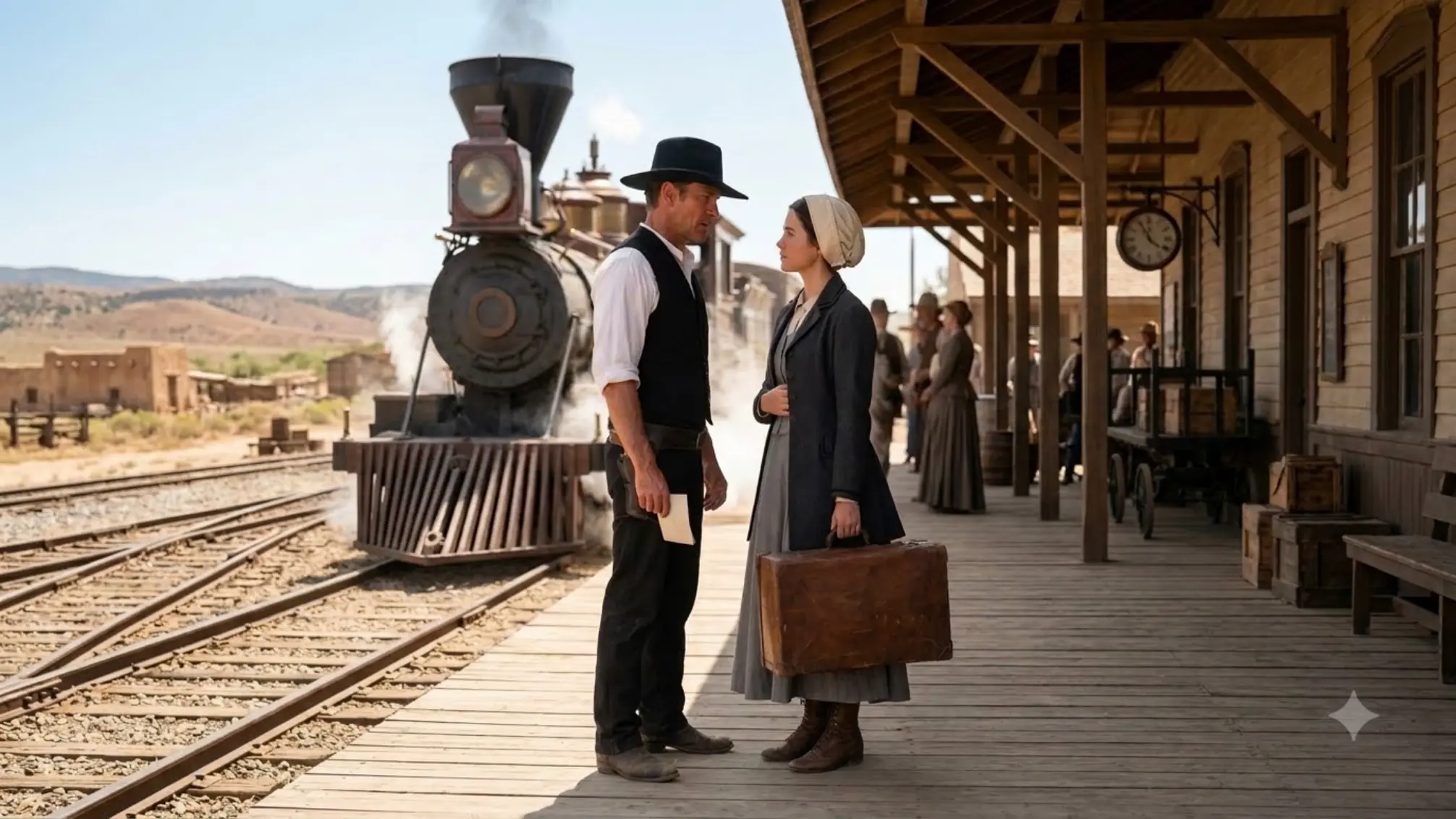
Wade was forty-one, broad through the shoulders, weathered by Texas sun, and dressed like a man who owned nothing he had not repaired himself. His black waistcoat was clean but faded at the seams, his boots carried several seasons of dust, and his expression had settled years earlier into a guarded stillness. Four years had passed since fever buried his first wife beneath a cottonwood tree near the eastern creek. Since then, he had spoken to cattle, hired hands, bankers, and almost no one else.
Eliza was twenty-four and far more composed than the woman he had imagined from the agency’s brief description. Her gray traveling dress was modest, yet the stitching was too fine for poverty, and her cream bonnet framed a face marked more by endurance than innocence. One gloved hand rested on the trunk’s handle. The other remained pressed against the hidden packet inside her charcoal coat, where legal documents named her sole heir to a shipping and rail fortune worth more than every ranch in the county combined.
Wade lowered the letter.
“You came alone?”
“I have been alone for some time.”
“That was not what I asked.”
“It is the truest answer I have.”
Her directness unsettled him. He had expected nervous politeness, perhaps tears, perhaps gratitude that any man had agreed to marry an orphan without family or property. Instead, she looked at him as if they were negotiating terms between equals.
Wade glanced toward the train. “This arrangement was supposed to be practical.”
“So was my journey.”
“I need someone who can keep a house, manage accounts, and endure a difficult winter.”
“And I need a man who understands that marriage does not give him ownership of my thoughts, my past, or my body.”
His eyes sharpened. “You speak as though you have met men who thought otherwise.”
“I have.”
The conductor called for final boarding. The few townspeople beneath the awning pretended not to listen, but Wade could feel their attention pressing against his back. Harland’s Crossing rarely received anything more interesting than missing cattle or a drunken disagreement outside the saloon. A mail-order bride refusing to behave meekly in front of Wade Mercer would feed the town for weeks.
Wade looked down at the trunk.
“That all you brought?”
“All I chose to bring.”
Another answer with a door closed behind it.
He picked up the trunk before he could change his mind. “The wagon is across the street.”
Eliza did not smile, but the tension around her mouth softened slightly. “Does that mean you are not putting me back on the train?”
“It means the train is leaving.”
“That is not the same thing.”
“No,” Wade said, carrying the trunk toward the street. “It is not.”
The twelve-mile road to the Double M Ranch stretched through flat, sunburned land broken by dry creek beds and stubborn cedar. Wade drove without unnecessary conversation. Eliza sat beside him with her hands folded in her lap, studying the fence lines, water channels, cattle trails, and distant windmill with the focused attention of someone reading a ledger.
After several miles, she pointed toward a patch of pale grass. “Your herd grazed there too long.”
Wade turned his head. “You know cattle?”
“I know land that is being asked for more than it can give.”
“That sounds like something from a book.”
“It sounds like something I have seen.”
He waited for an explanation, but none came.
“How many head?” she asked.
“Eighty-three.”
“How many last year?”
“Ninety-six.”
“And the year before?”
“One hundred and twelve.”
“What happened?”
“Winter killed some. Disease took six. A fence break cost me more.”
“Debt?”
Wade’s hands tightened on the reins.
“You ask personal questions quickly.”
“I am being taken to a ranch where I may spend the rest of my life. I prefer facts before promises.”
“There is a note with the bank in Abilene.”
“How large?”
“Large enough.”
“That is not a number.”
“It is the number I am willing to give today.”
Eliza looked ahead. “Fair.”
He glanced at her, surprised she had not pushed.
The Double M appeared near sunset. The ranch house sagged slightly at one end of the porch, the barn roof needed new shingles, and two sections of the eastern fence leaned beneath the weight of neglect. Pete Givens and Tommy Strand, Wade’s hired hands, paused beside the corral to watch the wagon approach. Neither man stared openly, but both had clearly been waiting.
Wade stopped in front of the house.
“This is it.”
Eliza examined the porch, the barn, the thin herd beyond the fence, and the cottonwood trees near the distant creek. Wade expected disappointment. What he saw instead was calculation.
“The house can be repaired,” she said.
“So can most things.”
“Do you believe that?”
He looked at the darkening land. “Some days.”
Inside, the rooms carried four years of dust, silence, and habits designed for one person. The curtains had faded almost white. A woman’s old blue cup remained on a kitchen shelf, untouched but carefully clean. Eliza noticed it and asked no questions.
Wade placed her trunk in the main bedroom.
“You can sleep here. I moved my things to the back room.”
“That was unnecessary.”
“It was decided.”
“By you.”
“It is my house.”
Her eyes met his. “For now.”
Wade almost challenged her, but something in her tone made the corner of his mouth move. It was not quite a smile, though it was closer than he had come in months.
She noticed.
“You find me amusing?”
“I have not decided what I find you.”
“That makes two of us.”
She prepared supper from beans, cornmeal, salt pork, and the last jar of peaches hidden behind flour tins. Wade returned from checking the cattle to find the table set for two. Eliza sat across from him rather than eating alone in the kitchen.
“My first wife ate here,” he said.
Eliza paused. “I did not know you had been married.”
“The agency did.”
“The agency told me only that you were widowed.”
“That is enough.”
“For them, perhaps.”
Wade looked at the old blue cup on the shelf. “Her name was Clara. Fever took her four years ago.”
“I am sorry.”
“I am not asking you to replace her.”
“I would not agree if you were.”
Their eyes held across the table.
Wade ate. The cornbread was better than anything he had made since Clara died, but he did not say so. Eliza noticed that he took a second piece and said nothing.
During the following weeks, the ranch began changing in small, undeniable ways. Eliza reorganized the kitchen, repaired the household ledger, and discovered that Wade had been paying too much for feed because the mill’s invoices contained repeated arithmetic errors. She walked the nearby fence line each evening, marked failing posts, and created a list of repairs in order of urgency.
Wade resented the list until one of the marked posts collapsed during a storm.
After that, he asked to see the rest.
She also transformed the house without trying to erase Clara. The blue cup remained on its shelf. The old curtains were washed rather than thrown away, and when Eliza found Clara’s recipe book inside a drawer, she placed it beside the stove.
“You do not have to preserve all of this,” Wade told her.
“It was here before me.”
“So was the dust.”
“The dust can go.”
By September, Wade began looking toward the house at the end of each workday. He told himself it was because supper would be waiting and the accounts would be current. The truth was less comfortable. Eliza had become the person he wanted to speak to when something went wrong, and the first person he wanted to tell when something unexpectedly went right.
She laughed rarely, but he learned the sound. It was sudden, warm, and completely different from the guarded woman who had stepped off the train. The first time he caused it, he had been cursing a stubborn gate hinge that fell off in his hand after three hours of repair.
“You appear to have fixed it thoroughly,” she said.
“It was weak metal.”
“You removed it from the gate.”
“It cannot squeak if it is not attached.”
Her laugh escaped before she could stop it. Wade stared at her long enough that the laughter faded into an embarrassed smile.
“Do not look so alarmed,” she said.
“I had not heard that sound from you.”
“You may not again if you continue staring.”
The letters began arriving in October.
The first came from Philadelphia. The second carried a New York postmark. The third bore the name of a prestigious law firm in Boston.
Every time Wade brought one home, Eliza’s expression tightened before she carried it to her room. She never left the letters where he could see them, and she never explained who had written them.
Wade kept his questions to himself until Frank Marsh, the local banker, approached him outside the general store.
“That woman of yours has expensive people searching for her,” Marsh said.
Wade turned slowly. “She is not a lost horse.”
“I am trying to help.”
“You are trying to learn something you can use.”
Marsh smiled thinly. “The Hartwell name means money back East.”
“How much?”
“That is the interesting question.”
Wade returned to the ranch before sunset and found Eliza kneeling beside the kitchen garden, pulling dead roots from dry soil. She looked up the moment he approached.
“Marsh has been asking about you.”
Her hand stopped.
“What did he say?”
“That Hartwell means money.”
Eliza stood and brushed dirt from her skirt. “It means several things.”
“Which one are you?”
Her expression closed.
“I told you nothing from my past would harm this ranch.”
“That is not the same as telling me the truth.”
“No.”
“Are you married?”
“No.”
“Running from the law?”
“No.”
“Did you steal the money?”
A flicker of anger crossed her face. “No.”
“Then tell me what is coming.”
She looked toward the house. “Not yet.”
The words struck him harder than he expected.
“You asked me to see you as a person.”
“I still do.”
“You asked for trust.”
“I still need it.”
“Trust without truth is a blindfold.”
Eliza’s eyes glistened, though her voice remained steady. “And truth given to the wrong man is a chain.”
Wade stepped closer, not threatening, but no longer willing to retreat. “Am I the wrong man?”
Her composure broke for one brief second.
“I do not know yet.”
He walked away before anger made him say something permanent.
That night, they ate in silence. Eliza remained at the table after Wade went to his room, listening to the wind push against the walls. She wanted to tell him everything. She also remembered polished drawing rooms where men discussed her inheritance while she sat five feet away, as though she were a decorative seal attached to a financial contract.
Her father had built Hartwell Shipping and Rail from a single river vessel. By the time he died, the company controlled freight routes from Philadelphia to New Orleans. His will left the entire estate to Eliza, with full authority transferring on her twenty-fifth birthday.
Arthur Seldon, her father’s partner, expected to marry her and control it.
Eliza had escaped before he could turn expectation into captivity.
The marriage agency had promised anonymity. Someone had betrayed her.
Winter came early. Ice formed along the water troughs, cattle crowded behind the creek bank, and the ranch’s bank note became more dangerous. Wade told Eliza the full number one night during a cattle watch beneath a sky crowded with stars.
She listened without interruption.
“You will lose the ranch in March,” she said.
“If the winter stays hard.”
“It is manageable.”
“Not by me.”
“You are not standing alone anymore.”
He turned toward her. She sat beside the low fire wrapped in a gray blanket, her face softened by the flames.
“You keep saying things like that,” he said.
“Do they trouble you?”
“They make me believe you intend to stay.”
“I do.”
“Then stop keeping one foot on the train.”
She looked away. “I am trying.”
Arthur Seldon arrived two weeks before Christmas.
He rode into the Double M yard wearing a black eastern coat and gloves too fine for ranch work. His silver-trimmed beard, expensive horse, and easy contempt marked him as a man accustomed to walking into rooms where everyone already knew his importance.
Eliza stepped onto the porch.
“Arthur.”
“You have made your point,” Seldon said. “Now gather your belongings.”
Wade emerged from the barn. “She is not going anywhere.”
Seldon looked him over. “You must be Mercer.”
“You must be the man who mistakes women for property.”
“I am the man trying to prevent a frightened young woman from ruining a commercial empire.”
Eliza came down the porch steps. “The empire belongs to me.”
“Not until March.”
“And after March, you will have no authority at all.”
Seldon’s smile thinned. “Your father intended us to marry.”
“My father intended many things for me without asking.”
“He understood responsibility.”
“He understood control.”
Wade moved beside her. Their shoulders nearly touched.
Seldon noticed.
“Does he know?” he asked.
Eliza went still.
Wade looked at her. “Know what?”
Seldon smiled with satisfaction. “Apparently not.”
“Leave,” Eliza said.
“You came here pretending to be an orphan without means while sitting on a fortune large enough to purchase half this county.”
The yard became silent.
Pete and Tommy had stopped working near the barn. Wade did not look at them. He looked only at Eliza.
“How large?”
She answered quietly. “More than I can spend in one lifetime.”
Wade’s face changed, but he did not move away from her.
Seldon continued. “Her trust is worth millions. Rail shares, shipping interests, warehouses, eastern property. She allowed you to believe she had nothing.”
“I said leave,” Wade repeated.
Seldon’s eyebrows rose. “You are not angry?”
“I am.”
“Then let me take the liar away.”
Wade stepped forward until his hand rested near his gun belt.
“My anger with my wife is not your opportunity.”
Eliza looked at him sharply.
It was the first time he had called her that before another person.
Seldon saw something in Wade’s expression that ended his amusement. He gathered the reins.
“This ranch will be gone by spring,” he said. “Marsh controls the lending committee in Abilene. The moment your note is accelerated, you will understand what her secrets cost you.”
Eliza’s face hardened. “Did you arrange that?”
“I encouraged the bank to protect its interests.”
Wade’s hand moved closer to his revolver.
Eliza caught his wrist.
“Not for him,” she whispered.
Seldon turned his horse and rode away.
Wade remained in the yard after the hoofbeats disappeared. Eliza released his wrist slowly.
“You should have told me.”
“I know.”
“You listened while I told you every humiliating number attached to this ranch.”
“I know.”
“You let me believe we might lose everything while you could have paid the note a thousand times.”
“I needed to know you wanted me without the fortune.”
His eyes flashed. “And how was I supposed to know whether you wanted me when you never let me meet the real woman?”
The accusation landed.
Eliza fought tears. “The woman who cooked at your stove, repaired your accounts, walked your fences, and sat beside you during the cold nights was real.”
“Then why did you think she was not enough to tell the truth?”
She had no answer.
Wade entered the barn and did not return until long after dark.
For four days, they spoke only about necessary work. The ranch house felt quiet again, but it was no longer the old silence Wade understood. This silence had pain inside it because something valuable now existed to lose.
On the fifth day, Eliza found him repairing the north fence.
“I am leaving,” she said.
The hammer stopped.
“When?”
“Tomorrow’s train.”
He continued staring at the fence post. “Seldon win?”
“No.”
“Then why?”
“Because you deserve time to decide whether my deception ruined what we built.”
Wade drove the nail deeper than necessary.
“And what do you deserve?”
“I stopped expecting to deserve anything a long time ago.”
He turned. “That sounds convenient.”
Her eyes filled.
“You get to hide, decide for both of us that the damage is finished, and leave before I choose whether to forgive you.”
“I am trying not to trap you.”
“You keep making decisions for me and calling it freedom.”
Eliza flinched.
Wade dropped the hammer.
“I am angry,” he said. “I may be angry for a while. But anger is not the same as wanting you gone.”
She stared at him.
“You called me your wife.”
“You have been my wife since you stood on that platform and challenged me before learning whether I had the patience for it.”
A tear escaped down her cheek.
Wade stepped closer.
“I do not want your money.”
“I know.”
“I do not want Seldon’s empire.”
“I know.”
“I want the woman who notices broken fence posts, argues over ledgers, and reads by the kitchen lamp until the oil is nearly gone.”
Her breath trembled.
“Ask me to stay,” she whispered.
Wade lifted one rough hand to her face.
“Stay.”
She leaned into his palm.
“For the ranch?”
“For me.”
The bank accelerated the note three days later.
Frank Marsh demanded the entire balance by March first, exactly as Seldon had threatened. Wade prepared to sell cattle, land, and equipment, but even the most brutal calculation left him far short.
Eliza placed the payment documents on the kitchen table.
“I already settled it.”
Wade stared at the papers.
“When?”
“Before Seldon arrived.”
His eyes rose. “You paid my debt before telling me the truth?”
“I knew he would use it against you.”
“You had no right.”
“No,” she admitted. “But I had the power to stop him, and I could not watch him take your home.”
“It is not just my home now.”
The words changed the room.
Eliza sat across from him. “Then let it be ours.”
Wade looked at the cleared note, the restored title, and the woman who had protected his land in the only way available to her. Pride resisted. Love, though he had not yet called it that, answered more quietly and with greater strength.
“No more secrets,” he said.
“No more.”
“No payments made behind my back.”
“Agreed.”
“No eastern men deciding what happens here.”
Her mouth curved into the smallest smile. “Gladly.”
They married legally in February at the judge’s office in Harland’s Crossing. Pete stood in the doorway, Tom Briggs served as witness, and Wade placed his grandmother’s ring on Eliza’s finger. No musicians played. No flowers decorated the room.
When the judge finished, Wade looked at her as if the whole empty country had narrowed to one person.
“You may kiss your wife,” the judge said.
Wade hesitated.
Eliza stepped closer. “Must I arrange that too?”
He kissed her while Tom laughed and the judge pretended to examine his papers.
In March, the Hartwell trust transferred fully to Eliza. She rejected Seldon’s final demand, removed him from every company position he still held, and moved the estate’s western funds to an independent bank beyond Marsh’s influence.
She did not turn the Double M into a palace.
She repaired the porch, strengthened the barns, bought adjoining land with reliable water, and hired two more ranch hands at fair wages. The herd recovered. The ranch survived two later droughts because Eliza had insisted on building reservoirs while the weather was still good.
She also restored an abandoned schoolhouse near the western pasture.
It began with forty books.
Within five years, it became a reading room used by ranch children, laborers, mothers, cowhands, and anyone else willing to enter. Eliza never asked whether they could pay. Wade built shelves when he had time, repaired chairs, and kept the stove burning through winter.
Above the door hung a plain wooden sign:
FOR EVERYONE.
Years later, townspeople told the story as though a wealthy woman had arrived in Texas and rescued a poor rancher. Wade never allowed that version to stand.
“She saved the land,” he would say. “That part is true.”
Then he would look toward Eliza, usually seated near the reading-room window with a book open in her lap.
“But the land was not the thing that needed saving most.”
Eliza had crossed the country because she feared every man would see her fortune before seeing her. Wade had ordered a wife because loneliness had convinced him affection was a weakness he could no longer afford.
Neither received what they requested.
He received a woman with secrets large enough to buy his world, yet brave enough to build a new one beside him.
She received a man who was angry when he learned the truth, but stayed long enough to understand why she had hidden it.
The locomotive had nearly carried her away on the day they met.
Years later, when its whistle drifted across the plains, Wade would sometimes find Eliza standing on the porch, listening.
“Thinking about leaving?” he would ask.
She would turn toward the house, the ranch, the reading room, and the man who had finally asked her to stay.
“No,” she would answer.
“Thinking about how close I came to missing my life.”