I have watched enough of life to understand this.
The people who change us rarely arrive with fanfare. They come quietly, through a letter, a handshake, or a door we were not certain we wanted to open.
The ones who remain are not always the people who made the greatest promises.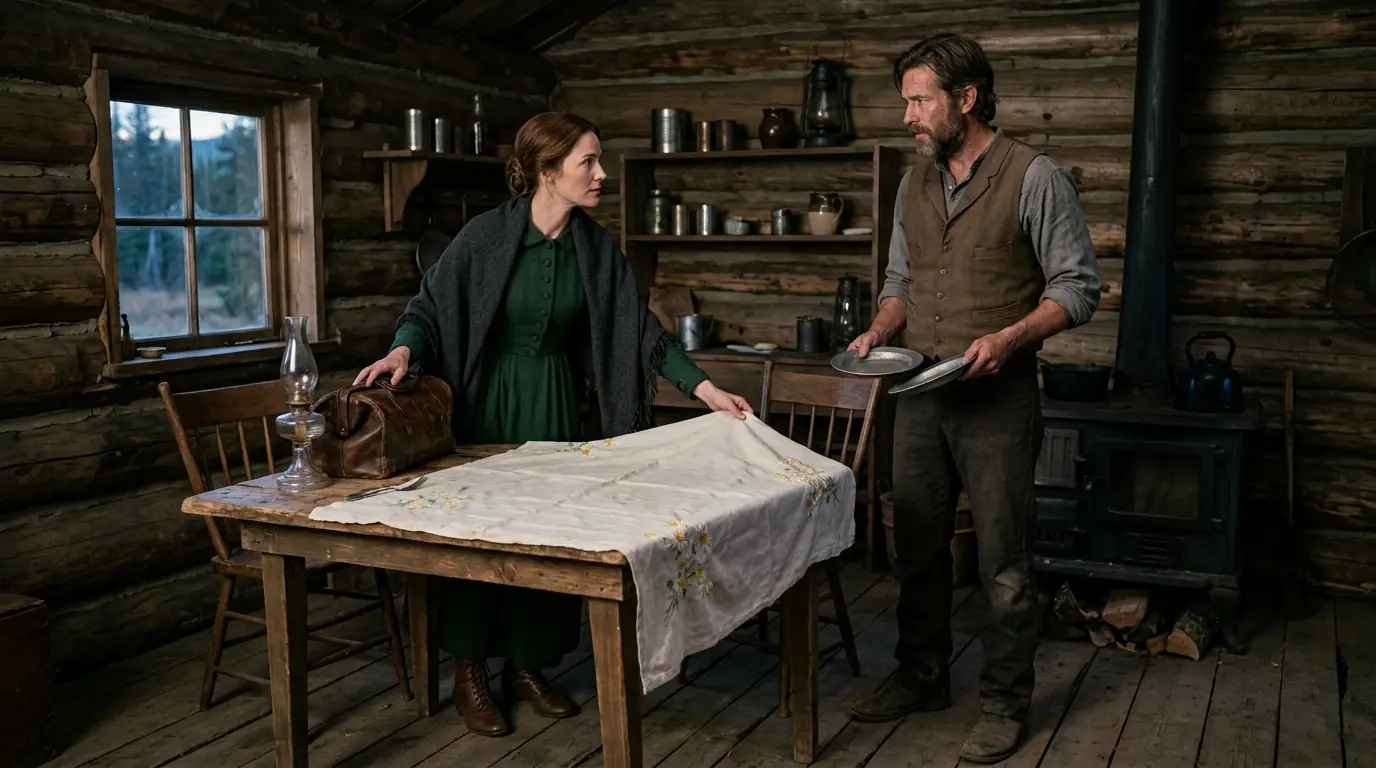
They are the ones who appeared when it mattered.
This is the story of a man who believed he needed no one.
The stagecoach was three hours late.
Silas Cade stood outside the station in Copper Creek with his back against a wooden post, watching the empty road. His fingers had worn the photograph soft, and the woman’s face had begun fading into shades of gray.
Wind cut through his coat.
October in Montana meant winter was close.
Inside the station came laughter and the smell of tobacco. Silas did not go in.
Then dust appeared on the horizon.
The distant groan of wheels followed.
Silas closed his hand around the photograph.
The coach rolled toward the station and stopped. The door swung open, and a woman stepped down carrying one battered valise.
Mud darkened the hem of her dress.
Her eyes found Silas and held him.
She did not smile.
Neither did he.
Two hours later, Clara’s thighs ached from gripping the horse’s flanks. Her arms had grown stiff from holding the cantle behind Silas without touching him.
The wind carried the smell of pine and approaching snow.
Silas had not spoken since they left the station.
The cabin appeared as the sun descended behind the ridge.
Weathered logs.
A smoke-darkened chimney.
One narrow window catching the final orange light of evening.
There was no garden.
No curtain.
No sign that a woman had ever lived there.
Silas swung down from the saddle, tied the horse, and lifted Clara’s valise without looking at her.
She followed him inside.
The door scraped against the floor as it opened.
The cabin consisted of one main room. A cast-iron stove sat cold in one corner, a rough table stood between two chairs, and shelves along the wall held orderly rows of jars and tins.
Everything had been arranged with a precision that felt less like cleanliness and more like defense.
“Your room is through there.”
Silas pointed toward a narrow door.
“I sleep in the loft.”
Clara nodded.
Her fingers found the clasp of her valise.
“You handle the cooking and the house,” Silas continued. “I handle everything outside.”
He was already crouching beside the stove, feeding kindling into its dark belly.
“We do not need to discuss what came before. Not yours or mine.”
The fire caught.
Light crept slowly up the walls.
Clara opened her valise and removed a white linen tablecloth embroidered with yellow daisies. The edges had frayed after years of washing.
Her mother’s hands had stitched those flowers.
Clara spread the cloth across the rough pine table.
Silas stood.
His eyes moved toward the linen.
Something shifted in his jaw. A muscle tightened and then released.
He said nothing.
Neither did Clara.
Supper consisted of beans and hard bread.
They ate facing one another, with the embroidered tablecloth between them like a question neither knew how to ask.
When Silas finished, he stood, rinsed his plate in the bucket beside the door, and climbed the ladder to the loft without speaking.
Clara remained alone at the table.
The fire popped softly.
Wind pressed against the window glass.
Later, lying in the narrow bed, Clara removed paper and ink from her valise.
The letter to her sister in Ohio came easily. Her handwriting remained even, each character formed with the care of someone trained to value precision.
From the loft above, she heard Silas move.
Then he became still.
Clara continued writing.
She did not know that he was watching through a small gap between the floorboards.
Silas studied the movement of her hand across the page.
Steady.
Practiced.
Too exact for the simple widow she had claimed to be.
Two weeks passed in a rhythm Clara learned without being taught.
She rose before dawn, when frost covered the inside of the window glass. She dressed quickly in the cold, pulling on wool stockings first, followed by a heavy skirt and a shawl wrapped twice around her shoulders.
The stove became her first task each morning.
Kindling.
Small logs.
Larger pieces after the fire caught.
By the time Silas climbed down from the loft, the cabin had begun warming and the coffee was ready.
He never thanked her.
He also never left without drinking an entire cup.
Clara learned other things.
Silas hung his coat on the same peg each evening. Always the left one, never the right.
He checked the door latch twice before sitting down for supper.
His hands constantly searched for work when he was not thinking.
Something to repair.
Something to hold.
Something to keep them occupied.
Clara learned when to speak and when to remain quiet.
Mostly, she remained quiet.
The days developed a shape.
Silas left before full daylight and returned when the sun reached the ridge. Clara cooked, cleaned, mended clothing, and kept the fire alive.
They ate together each evening with her mother’s tablecloth spread between them.
The silence remained heavy, but it was no longer hostile.
There were small things.
Clara noticed small things.
Silas never began eating before she sat down.
She tested it once.
Clara stayed at the stove longer than necessary, stirring a pot that did not require stirring.
Silas waited at the table with his fork in one hand and a full plate before him.
He said nothing.
When Clara finally sat, he lifted the fork and began eating.
She did not mention it.
The first real snow arrived in early November.
Clara watched from the window throughout the morning as thick flakes fell steadily, covering the ground, the woodpile, the path, and the outhouse.
By noon, the world had become white.
By mid-afternoon, the wind strengthened, and the snow moved sideways with the force of sand.
Silas had left at dawn to inspect the fence line.
Eight hours had passed.
Clara kept the fire burning.
She swept a floor that did not need sweeping.
She repaired a tear in the spare calico dress she had brought from Ohio.
She ground coffee beans in the hand mill while its crank squeaked with every turn.
The daylight disappeared early.
Clara lit the oil lamp.
She heated water.
Allowed it to cool.
Then heated it again.
A small brass clock sat on the shelf. Clara had discovered it inside a drawer and wound it without asking permission.
The hands reached five o’clock.
Then six.
Then half past six.
The wind screamed against the cabin walls.
Clara stood beside the window.
There was nothing to see beyond the glass.
Only white.
The snow fell so heavily that it erased everything beyond the porch.
She thought about the trail.
The narrow section near the ridge.
The rocks jutting from the ground where a man could lose his footing if he could not see.
She thought about the cold and how it took a body slowly.
Fingers first.
Then feet.
Then thoughts becoming slow and strange.
Clara added another log to the fire.
She reheated the water a third time.
At seven o’clock, the door opened.
Silas entered with a blast of wind and snow. His shoulders were covered in white, and ice clung to his beard.
He stood inside the doorway, breathing heavily, before forcing the door closed against the storm.
Clara pressed both hands flat against her apron.
Silas removed his gloves.
His fingers were red and stiff.
He looked toward the stove.
Then toward the kettle, where steam still rose from the spout.
“You did not need to wait up.”
“I was not waiting.”
Her voice sounded steadier than she expected.
“I was not sleepy.”
Silas made a quiet sound in his throat.
He crossed toward the stove.
That was when Clara noticed the slight hitch in his step.
His right shoulder rested lower than the left.
He was hurting.
Perhaps he had been hurting for longer than that evening.
Clara poured hot water into a tin cup and added the coffee she had ground earlier.
She held it toward him.
His fingers brushed hers.
Both of them became still.
The cup was warm.
Clara had kept it warm.
Three separate times.
Silas looked at her.
Really looked at her for the first time since the station.
His eyes were dark and difficult to read, but something shifted behind them.
A narrow crack in the surface.
He drank slowly, allowing the heat to move through him.
“The coffee is good.”
“It has been on the stove for a while.”
“I know.”
The wind howled outside.
Inside, the fire burned steadily.
Silas sat at the table.
Clara brought the stew she had kept warm, filled a bowl, and placed it before him.
She made her own plate and sat across from him.
Her mother’s tablecloth rested between them as it had every evening.
They ate without speaking.
The silence was different.
Before that night, it had possessed sharp edges.
Now it felt more like breathing room.
When Silas finished, he did not rise immediately.
He remained in his chair, slowly turning the empty cup between his hands while watching the fire through the small stove window.
“Tomorrow,” he said, “I will bring more wood inside and stack it beside the door. Then you will not need to walk to the shed.”
Clara raised her eyes.
“You do not have to.”
“I know.”
Another silence followed.
This one contained something.
Silas stood, rinsed his cup and bowl, and placed them on the shelf.
At the bottom of the ladder, he paused.
“Coffee.”
Clara looked at him.
“In the morning, you will make some?”
“I always do.”
“I know.”
Silas placed one hand on the ladder rung.
“I only meant that I will wait for it before I go outside.”
Clara nodded.
She did not trust her voice.
Silas climbed to the loft.
The boards creaked as he settled above.
Clara remained at the table while the fire burned lower.
She should have gone to bed.
She should not have searched for meaning in small things.
Coffee.
Wood beside the door.
A man saying he would wait.
Still, Clara did not move.
Not yet.
Outside, the storm raged.
Inside, something had changed.
That night, Clara woke to a sound from the loft.
Not footsteps.
Not boards creaking.
Something else.
A voice.
Low and broken.
Speaking in sleep.
A name.
Clara remained still in her narrow bed, staring toward the ceiling.
The voice came again.
Ragged.
Raw.
The sound of a man trapped inside a dream he could not escape.
“Eliza.”
The name hung in the darkness.
A woman’s name spoken like an old wound opening.
Then there was silence.
Only wind and the settling of logs inside the stove.
Clara did not move.
She barely breathed.
She remained awake until gray morning light entered through the window.
Her thoughts returned repeatedly to the name.
To the empty cabin she had entered.
To the precise arrangement of every object.
To the way Silas looked at her mother’s tablecloth that first evening as though he had seen a ghost.
Clara did not ask him about it in the morning.
She rose before dawn, built the fire, ground the coffee, and placed two cups on the table.
When Silas climbed down, his face looked drawn and his eyes hollow.
He sat without speaking.
Clara poured his coffee.
Then she filled a second cup and placed it beside his plate.
Silas looked at the extra cup.
Then at Clara.
“I thought you might want more this morning,” she said. “It was a cold night.”
Something moved behind his eyes.
Not suspicion.
Something else.
He wrapped both hands around the first cup and drank.
Neither of them mentioned the name.
That evening, Clara entered the woodshed and discovered that the heavy logs had been moved.
The largest pieces now rested at chest height, where she could take them without bending or straining.
Clara stood in the cold with her breath rising in white clouds.
She stared at the neat rows.
Silas had not announced what he had done.
He had not asked whether she wanted help.
He had simply moved them.
Clara carried an armful of wood to the cabin.
Her thoughts turned over the details.
The stacked logs.
The coffee.
The way he waited for her to sit before eating.
Small things.
The kind people did without thinking.
Or the kind they did because they were thinking too much and did not know how to speak.
After supper that night, Clara brought out her paper and ink.
The letter to her sister had remained half finished inside the drawer for a week.
She wrote by lamplight.
Her hand formed the same clean, practiced lines.
The handwriting of someone trained to copy documents and prepare legal filings.
No sound came from the loft.
Still, Clara could feel Silas awake above her.
Listening.
She wondered how much he had seen.
How much he had guessed.
For the first time, she wondered whether she was not the only person inside the cabin keeping secrets.
November settled across the mountains as though it intended to remain forever.
Clara learned to read the weather.
She understood the way clouds gathered along the ridge before a storm and the particular color of daylight that promised snow by evening.
She learned to read other things as well.
Things that did not announce themselves.
Silas moved differently on cold mornings.
Clara first noticed it at breakfast when he reached for his coffee with his left hand instead of the right.
Later, at the door, he hesitated before pulling on his coat.
His jaw tightened as he forced his right arm through the sleeve.
She did not ask.
He would not have answered.
Clara only watched.
The cabin had developed its own rhythm.
She rose before dawn, built the fire, and ground the coffee.
Silas descended when the first gray light touched the window.
They ate biscuits and bacon, with eggs when the hens were laying.
The silence between them had softened into something almost comfortable.
Almost.
One morning, Clara watched through the frost-covered window as Silas crossed toward the woodshed.
His right shoulder dropped with every step.
When he bent to lift a log, his entire body shifted to compensate.
Clara turned back toward the dishes.
That afternoon, while Silas inspected the fence line, she entered the shed.
The logs were stacked wherever they had fallen.
Some high.
Some low.
No order.
Clara studied the pile while cold air surrounded her.
Then she began moving the wood.
The work took nearly two hours.
She placed the heaviest pieces at chest height, where Silas could slide them free without reaching upward or bending low.
The medium logs went beneath them.
Kindling went into a basket near the door.
Her back ached when she finished.
Her fingers were raw, with splinters beneath the skin.
Inside the cabin, she washed her hands in the bucket and watched the water become gray with sawdust.
Clara did not mention the work during supper.
Silas returned as the daylight faded, with snow dusting his shoulders.
He hung his coat on the left peg and sat before the stew Clara had prepared.
They ate in their usual silence.
Afterward, Silas went to bring in wood.
Clara kept her attention on the shirt she was mending.
It belonged to him.
The sleeve had torn along the seam.
The needle moved through the cloth while she listened.
Silas had stopped outside.
She knew because no footsteps came from the shed.
No logs shifted.
When he returned with an armful of wood, he did not look at her.
He arranged the logs inside the stove with the same careful precision he applied to everything.
Then he straightened.
“You moved the woodpile.”
“It was disorganized.”
“It was fine.”
Clara pulled the thread through and cut it with her teeth.
“Now it is better.”
A long pause followed.
She could feel his eyes on her but did not raise her head.
“I suppose it is,” Silas said.
He sat beside the fire with a piece of wood and his knife.
The steady scraping sound filled the cabin.
Clara finished repairing the shirt and began working on a stocking worn through at the heel.
The silence remained.
It held differently now.
Later, when Clara stood to bank the fire, her chair shifted beneath her.
The same leg had been uneven since she arrived.
She had grown accustomed to the wobble.
The following morning, it was gone.
Clara sat at the table and felt the chair remain solid beneath her.
She reached beneath the seat and discovered a small piece of freshly cut wood fitted against the short leg.
Silas was already eating with his eyes on his plate.
“The chair is fixed.”
“It was crooked.”
“It was fine.”
Silas did not look up.
“Now it is better.”
Something caught in Clara’s throat.
She swallowed and reached for her coffee.
They continued eating in silence.
The days grew shorter.
The cold deepened.
Clara began measuring time not by the calendar but by smaller things.
The way Silas waited until she poured her own coffee before lifting his cup.
The way he brought the water bucket inside each evening so she would not need to carry it through the morning cold.
One night, while the fire burned low and wind pressed against the cabin walls, Clara asked the question she had been carrying.
“How long have you owned this land?”
Silas’s knife paused over the piece of wood in his hand.
“Twelve years.”
He resumed carving.
“Bought it with my savings. Everything I had from before.”
Clara let the words rest between them.
Twelve years.
Everything from before.
She understood what it meant to leave one life behind.
She had her own possessions abandoned, traded away, or buried in Ohio.
“That is a long time to live up here alone.”
Silas did not answer immediately.
The knife moved again, peeling thin curls of wood onto the floor.
“Long enough,” he finally said.
Clara returned to her sewing.
The fire popped.
Somewhere outside, an owl called through the darkness.
“We will need more flour before the end of the month,” Clara said. “And salt. The barrel is nearly empty.”
“I will ride down next week if the weather holds.”
We.
Clara had used the word without thinking.
Silas had answered in the same way.
Their supplies.
Their needs.
Neither pointed it out.
Something had changed.
It was like the first fine cracks spreading across the surface of a frozen river.
The ice had not broken.
Not yet.
The following morning, Silas was awake before Clara.
She found him at the stove, attempting to handle the coffee pot with one hand.
His right arm hung stiffly beside him.
The shoulder was worse.
“I can do that,” Clara said.
“I have it.”
“No, you do not.”
She crossed the room and took the pot from his hand.
Silas allowed her.
That was the important part.
He allowed her.
Clara prepared the coffee while Silas sat at the table with his jaw tight and his eyes on the window.
The first light touched the ridge, turning the snow pink and gold.
“There is liniment inside my valise,” Clara said. “Camphor and coal oil. My mother’s recipe. It helps with stiffness.”
“I am fine.”
“I know.”
She placed his coffee before him.
“If you decide you want it, it is there.”
Silas did not answer.
Clara returned to the stove and began cooking bacon.
That evening, after she returned from the outhouse, the bottle of liniment rested open on the table.
Half of it was gone.
Clara returned it to her valise without speaking.
Some things did not require words.
November slowly became December.
The snow grew deeper.
The world beyond the cabin narrowed into white silence, interrupted only by wind and the occasional cry of a winter bird.
Silas and Clara settled into patterns.
She cooked.
He chopped wood.
She mended clothing.
He carved.
They ate together and sat near the fire each evening.
The silence between them grew warmer.
Fuller.
It developed weight and texture.
One night, Silas spoke without lifting his eyes from the piece of wood in his hands.
“The letters you write. Where do they go?”
Clara’s needle stopped.
“Ohio. To my sister.”
“That handwriting.”
Silas shaved another curl from the wood.
“Where did you learn to write like that?”
The question remained between them.
Clara could feel him waiting.
He was not demanding an answer.
He was simply waiting.
“I worked in an office before I married,” Clara said carefully. “I copied documents and filed papers.”
“What kind of office?”
She met his eyes.
“A law office in Columbus. I worked there for five years before my husband decided employment was not proper for a wife.”
Something crossed Silas’s face.
Not surprise.
More like a piece of a puzzle falling into place.
“You never told me.”
“You never asked.”
Silas watched her for a long moment.
Then he nodded and returned to his carving.
The question stayed in the air.
What else had he never asked?
What else had she never told him?
Three days before Christmas, Clara found the box.
She was sweeping beneath the ladder leading to the loft.
Until then, she had avoided that corner because it stood too close to Silas’s private space.
Dust gathered where it gathered, and she had run out of excuses.
The broom caught against something.
A small wooden box had been placed where the ladder met the wall.
It was plain pine, darkened by age, and no larger than a loaf of bread.
There was no lock.
No marking.
Clara should have left it untouched.
Instead, she lifted the lid.
Inside rested a photograph inside a brass frame.
The glass had cracked across one corner.
The picture showed a young woman with serious eyes and hair parted through the center.
She was beautiful in the quiet way of someone who had never known it.
Beside the photograph was a thin gold ring.
Worn.
Simple.
The kind a man bought when he had little money but wished to give everything.
Beneath the ring and photograph lay a letter.
The paper had yellowed.
The ink had faded to brown.
It had been folded so often that the creases had begun wearing through.
Clara did not read it.
She closed the box, returned it to the place where she found it, and finished sweeping.
Silas returned later than usual that night.
He ate quickly, keeping his eyes on the plate, and climbed to the loft before the fire had burned low.
The same thing happened the following evening.
And the next.
He knew.
Clara saw it in his shoulders and in the way he angled his body away whenever they passed inside the narrow cabin.
He was not angry.
Clara had learned the shape of his anger.
It appeared through tightness around his mouth and clipped words.
This was different.
A door closing.
A retreat into the place where he had lived before she arrived.
Clara did not pursue him.
She made coffee.
Cooked meals.
Mended clothing.
Cleaned the cabin.
Kept the fire alive.
She gave him the space a wounded creature required.
It was the same space she would have wanted if someone discovered the things she had buried.
On the third night, the silence broke.
Clara sat near the fire, guiding a needle through a tear in Silas’s heavy wool shirt.
It was the garment he wore during the coldest days, smelling of pine sap and wood smoke.
Silas sat opposite her with a whetstone in one hand and a hunting knife in the other.
The rhythmic scraping sound filled the cabin.
Then it stopped.
“Her name was Eliza.”
Clara’s needle paused.
She did not look up.
“February of 1870,” Silas continued. “It was a bad winter. Worse than this one.”
His voice sounded flat.
The words fell like stones into still water.
“She became sick. Fever. A cough that would not stop. I rode into the valley for medicine.”
The fire crackled.
Wind pressed against the glass.
“A storm came while I was down there. It took three days before I could get back up the trail.”
The whetstone rested forgotten in his palm.
“When I reached the cabin, she was…”
Silas stopped.
The knife slipped from his hand and struck the floor.
Clara put down her mending.
She did not speak.
She did not reach for him.
She folded her hands in her lap and waited.
“Twelve years.”
Silas stared toward the fire.
Half of his face remained in shadow.
“Twelve years I have lived up here. I thought if I did not let anyone inside, I could not lose anyone again.”
The words remained in the room.
Clara felt them settle inside her chest.
Heavy.
Familiar.
She knew that reasoning.
She had lived within a different version of it.
“My husband never struck me,” Clara said quietly.
Her eyes remained on the flames.
“He never shouted. He did not drink. He attended church every Sunday, shook the minister’s hand, and lifted his hat to the women in town.”
She paused.
“He simply did not see me.”
The fire popped.
A burning log shifted and sent sparks upward.
“I lived in that house for five years, and he looked through me as though I were made of glass.”
Silas remained silent.
“When he died, he had a fever, like Eliza.”
Clara’s voice remained steady and factual.
“I did not cry. I sat beside his bed and watched him go, and I felt nothing.”
She looked down at her hands.
“Only emptiness. I had been empty so long that I forgot something was supposed to be there.”
Clara picked up the mending again.
The needle passed through the cloth.
In.
Out.
“That is why I answered your advertisement. Not because I needed a roof.”
She kept her eyes on the fabric.
“I thought that somewhere far enough away, I might remember how to be a person again. Someone who occupies space. Someone who is seen.”
Silas remained quiet for a long time.
The fire continued burning.
Wind moved around the cabin.
“I see you.”
Clara’s hands became still.
Silas spoke toward the fire.
“I see the way you moved the wood so I would not need to bend or reach. I see the way you heated the coffee three times while waiting for me to return.”
He shook his head.
“I have tried not to see you.”
His eyes lifted.
“But I do.”
Clara looked at him across the firelit room.
Silas did not look away.
“Why did you answer my advertisement?” he asked. “The truth.”
“Why did you place one?”
A long silence followed.
“I thought I needed help around the property.”
“And I thought I needed somewhere to live.”
“Is that all?”
Clara held his gaze.
“That is all I am willing to say tonight.”
Something resembling a smile briefly appeared on Silas’s face.
“Fair enough.”
He bent, collected the knife from the floor, and slid it into the sheath on his belt.
“Coffee tomorrow morning?”
“I will make it.”
“I will wait before going outside.”
“You always wait.”
“I know.”
Silas placed one hand on the ladder.
“I only wanted you to know that I mean to.”
He climbed into the loft.
The rungs creaked beneath his weight.
Clara remained near the fire with the mending forgotten in her lap.
Her hands trembled.
Not from cold.
Not from fear.
From something she had not experienced in so long that she almost forgot its name.
She thought about the box beneath the ladder.
The photograph.
The ring.
The letter.
The pieces of a life that ended twelve years earlier, kept in darkness and brought out only in dreams.
Silas had not asked Clara to replace Eliza.
He had not asked her to fill the space another woman left.
He had only said that he saw her.
Clara banked the fire, lowered the lamp, and entered her room.
The bed was cold, as always.
That night, she did not mind.
She lay in darkness, listening to the wind, the cabin settling, and the silence from the loft.
In the morning, she would make coffee.
Silas would wait.
Perhaps that was where everything began.
Not with declarations.
Not with promises.
With ordinary things.
Small things.
The quiet actions of two people learning how to share a space.
Clara was nearly asleep when she heard Silas moving above.
He was not settling into bed.
He was standing.
Footsteps crossed the loft.
Then came the creak of the ladder.
Clara remained still, listening.
Silas’s boots reached the floor.
The cabin door opened, allowing a blast of cold air to enter.
Then it closed.
Clara sat upright.
Through the window, she saw his shape crossing the snow toward the ridge.
Toward the fence line he had worried about all week.
Several posts had begun leaning.
It was past midnight.
The temperature had fallen into a brutal cold, the kind that killed.
Silas Cade was walking into it alone.
Clara pulled on her boots without lacing them.
She took her coat from the peg and ran outside.
The cold struck her like a wall.
She gasped as the air burned inside her lungs.
Then she pushed forward through the snow.
Silas’s tracks led toward the ridge.
Dark holes across the white ground, already filling with powder as the wind strengthened.
Clara followed.
The trail wound upward through the pines.
Within minutes, she could no longer see the cabin.
Clouds covered the moon.
She moved more through touch than sight, stretching her hands toward rough tree bark as she passed.
Clara found Silas a quarter mile from the cabin.
He lay at the base of a rocky outcrop, partly covered by snow and loose stone.
A section of the ridge had collapsed.
Raw earth showed where the rocks broke away.
The slide had carried Silas downward.
His right leg was trapped between two boulders and bent at an unnatural angle.
His face looked gray.
His lips had begun turning blue.
His eyes opened when Clara shouted his name.
“Clara.”
The word came weakly.
“You should not be out here.”
She dropped to her knees beside him.
Clara removed her gloves and placed her fingers against his neck.
His pulse was weak and slow.
Still present.
His skin felt like ice.
“Your leg.”
“I know.”
Clara examined the rocks.
One was almost the size of a washtub.
The other was smaller but wedged tightly.
She pressed her shoulder against the larger boulder and pushed.
It did not move.
She tried again.
Her boots dug into the snow.
She strained until her vision blurred.
The rock shifted slightly.
“Again,” Silas said through clenched teeth. “When I count.”
Clara nodded.
“One. Two. Three.”
She pushed with everything she possessed.
Silas pulled his leg.
A low sound escaped him.
Then the leg came free.
The boulder settled back with a grinding impact.
Clara sat on her heels, struggling for breath.
Her arms shook.
Her chest burned.
“Can you stand?”
“No.”
She looked at his leg.
Even through the heavy canvas trousers, she could see the injury below the knee.
The fabric had begun darkening.
“I will need to drag you.”
“Clara…”
“I will have to drag you.”
She moved behind him and placed both arms beneath his shoulders.
Then she pulled.
The first several feet were the most difficult.
The snow had formed a hard crust, and Clara struggled to find a rhythm.
Silas did not cry out.
She felt his body become rigid with every jolt.
His breathing came in short, sharp bursts.
A quarter of a mile.
Clara stopped twice to breathe.
Her lungs burned.
Her legs threatened to collapse.
Cold had numbed her fingers and face, while sweat ran down her back beneath the coat.
Almost two hours passed before they reached the cabin.
Gray light had begun appearing in the east.
Clara’s legs failed at the threshold.
She dropped to her knees in the doorway with Silas half across her lap.
Her entire body shook.
The fire had gone out.
The cabin was freezing.
Clara left Silas near the stove and rebuilt the fire with numb hands.
Kindling.
Small logs.
Larger pieces when the flames became strong enough.
Then she returned to him.
The leg was badly injured.
She knew before cutting the trouser fabric.
The bone had fractured below the knee but had not broken through the skin.
The surrounding flesh was already swollen and deeply discolored.
Silas needed proper splints.
Bandages.
Someone with medical knowledge.
Clara had none of those things.
She had only herself.
The following hours blurred.
She found straight branches in the woodpile and cut them to length with the hatchet.
Her hands repeatedly slipped against the handle.
Clara owned two dresses.
The gray wool dress she wore most days.
The calico dress reserved for Sundays.
She tore the calico into strips.
Clara positioned the branches along Silas’s leg and bound them tightly, attempting to keep the injury aligned while forcing herself not to react to the sounds he made.
She gave him a small amount of laudanum from a bottle inside the cabinet.
Only enough to reduce the worst of the pain.
When the work was complete, Clara sat on the floor beside him with her back against the wall.
Then she allowed herself to shake.
The weeks that followed carved new lines into both of them.
Silas could not stand.
He could not walk.
He could barely sit upright without pain draining the color from his face.
For the first time in twelve years, he was forced to allow another person to do everything.
Clara brought water.
Fed him broth.
Helped him use the tin pot she found in the back of the cabinet when he could not reach the outhouse.
Silas hated every moment of it.
Clara saw the hatred in his posture and heard it in every clipped word.
During the first several days, he repeatedly snapped at her.
“I can do that myself.”
“No, you cannot.”
“Leave me alone.”
“No.”
Clara did not argue beyond that.
She did not explain.
She simply returned with broth, water, clean bandages, and bitter willow-bark tea to help with swelling.
By the second week, Silas stopped snapping.
By the third, he began saying thank you.
Near the end of that third week, Clara woke during the night to the sound of Silas shifting in bed.
She had given him her room because moving him into the loft was impossible.
Clara slept on a pallet beside the fire, close enough to hear if he needed anything.
She went to him without lighting the lamp.
The fire had burned down to glowing embers, leaving enough light to see his face.
Silas was awake.
Pain tightened his features.
One hand gripped the blanket.
“It hurts,” he said.
Only that.
Clara sat in the chair beside the bed.
Without thinking, she reached for his hand.
Silas’s fingers closed around hers.
Rough.
Calloused.
Cold.
Clara did not release him.
She could not tell how much time passed before exhaustion began pulling at her.
She tried to stay awake and continue watching him.
The warmth of the room and the accumulated fatigue of the previous weeks became too much.
Her eyes closed.
When Silas woke before dawn, Clara remained in the chair.
Her head had fallen forward.
Her hand was still wrapped around his.
Silas lay quietly in the dim light and watched her breathe.
The embers cast red shadows across her face, softening the lines of exhaustion and the dark hollows beneath her eyes.
Clara had lost weight.
Her cheeks had become sharper.
Her wrists looked thinner where they emerged from her sleeves.
She had carried everything.
Wood.
Water.
Cooking.
Cleaning.
And Silas.
Something inside his chest ached.
It was not his leg.
That pain had become familiar, almost companionable.
This pain reached deeper.
If Clara left, what would he do?
The thought entered without warning.
Return to the silence?
The empty cabin?
The empty years?
Silas could not.
He understood that now.
He did not release her hand.
Eight weeks after the accident, Silas could stand with the cane Clara carved from an oak branch.
Walking remained slow and painful, but it had become possible.
He spent his days beside the window, watching the snow and waiting for his body to repair itself.
It was late February when they heard horses.
Clara stood at the stove, stirring soup.
Silas sat beside the fire with his splinted leg resting on a stool.
The sound began in the distance.
Hooves muted by snow.
More than one rider coming up the trail.
Silas’s hand moved toward the knife he usually carried.
It was not there.
He looked at the rifle hanging above the door.
Ten feet away.
It might as well have been a mile.
“Clara,” he said quietly. “Bring me the rifle.”
She crossed the room and lifted the Winchester from its pegs.
Clara placed it in his hands without hesitation.
Her hands were steady.
His were not.
Silas braced the stock against his thigh to prevent the barrel from shaking.
His fingers felt weak.
Useless.
Eight weeks earlier, he could have held the rifle with one hand.
Now he could not keep it level for several seconds.
Three riders emerged from the tree line.
They stopped approximately twenty yards from the porch.
Close enough to be seen.
Far enough to remain outside easy range.
The leading man wore a bowler hat and a wool coat too fine for the mountains.
A gold watch chain crossed his vest.
The two men behind him appeared local.
Hired hands.
“Mr. Cade.”
The man in the bowler dismounted.
His boots pressed into the snow as he approached.
“Harlan Crane, Northern Pacific Railroad. I believe you received our letter last autumn.”
Silas remembered the letter.
He had burned it after reading only the first paragraph.
“I am not selling.”
Crane smiled.
There was no warmth behind it.
“I am afraid the matter is not that simple.”
He reached into his coat and removed a folded document.
Thick paper.
Official appearance.
A red wax seal.
“The territorial government has authorized the railroad to acquire rights of way for the new spur line. Your property sits directly along the proposed route.”
“I have documents. The deed is registered with the county.”
“Indeed.”
Crane unfolded the paper and pretended to study it.
“County records can become complicated, particularly for parcels claimed during the homestead period.”
He looked toward the cabin.
Toward Clara standing inside the doorway.
“Especially when the property belongs to a man living alone, without legal heirs or legitimate family ties.”
Silas tightened his hold on the rifle.
The barrel trembled.
He saw Crane notice.
Contempt briefly appeared in the railroad man’s eyes.
“Leave my land.”
“Mr. Cade, I understand that this is difficult, but the law remains the law.”
Crane returned the document to his coat.
“If you cannot produce proper deeds, surveys, federal registration, and proof of continuous residence, the government may reclaim this parcel for public use.”
He moved closer.
His eyes examined Silas.
The cane beside the chair.
The splinted leg.
The tremor in his hands.
“You have lived here alone for twelve years. No wife, no children, and no one to verify the claim.”
Crane paused.
His smile widened.
“In the eyes of the law, you may be little more than a squatter.”
The word struck Silas.
Squatter.
Twelve years.
Twelve years of laboring across this land.
Building the cabin with his own hands.
Burying Eliza behind the woodshed.
Now a soft-handed railroad representative called him a squatter.
Silas attempted to stand.
His injured leg failed.
The cane slipped.
He reached for the window frame and missed.
Silas fell hard.
His knees struck the floor.
The rifle clattered from his hands.
His upper body pitched forward until one palm struck the boards.
Pain moved through his leg with blinding force.
A low sound escaped him.
Then Silas remained on his hands and knees inside his own cabin while Harlan Crane watched from the doorway.
“Perhaps,” Crane said, “you should sit down, Mr. Cade.”
The words remained in the air.
Silas could not move.
He could not lift his eyes.
His arms trembled from the effort of holding his body above the floor.
Heat spread across his face.
Shame.
Anger.
Humiliation.
The emotions became tangled until he could no longer separate them.
For twelve years, he survived on that mountain.
Storms.
Injuries.
Loneliness eating through him like rot.
Now he knelt on the floor while a railroad man looked down at him.
Silas tried to push upward.
His arms failed.
His chest struck the boards, forcing the air from his lungs.
The door opened behind him.
Clara stepped onto the porch.
She still wore her apron.
Flour covered the front of her dress.
Her hair had been pinned back, though several strands had come loose around her face.
Clara looked small.
Slight.
Nothing about her appeared threatening.
Something in her eyes caused Crane’s smile to weaken.
“My husband,” she said, “will stand when he is ready.”
Crane blinked.
“Your husband?”
“Silas Cade. My husband.”
Clara moved toward the edge of the porch.
She did not descend into the snow.
She did not retreat into the cabin.
She remained present.
“We were married in Hamilton County, Ohio, in September of last year. I have the certificate inside if you wish to examine it.”
Crane recovered quickly.
Not quickly enough.
“That will require verification. The railroad requires…”
“The railroad requires proof of legitimate family ties.”
Clara’s voice remained level.
Almost pleasant.
“Those were your words.”
She folded her hands.
“Here I am. His legal wife and heir.”
Clara paused.
“Would you like me to spell the judge’s name for your records?”
Behind her, Silas managed to place one hand against the window frame.
He pulled himself upward.
His leg felt as though it were breaking again.
His pride was in pieces.
Still, he stood.
Barely.
His body swayed.
He remained standing.
Crane looked between them.
The injured man with trembling hands.
The flour-covered woman who had dismantled his argument within thirty seconds.
“This changes nothing.”
The smoothness had disappeared from his voice.
“We will return with verification documents. The railroad will acquire this property, Mrs. Cade, one way or another.”
“Then I suggest you find another way.”
Clara stepped forward, placing herself between Crane and Silas.
“This one is closed.”
The two hired men exchanged glances.
One had already begun reaching for his reins.
Crane remained for another moment with his jaw working.
Then he turned, mounted his horse, and rode down the trail without another word.
The hoofbeats faded.
Silence returned to the snow.
Silas leaned against the doorframe.
His entire body shook.
The injured leg felt filled with broken glass.
His face burned with the memory of lying on the floor while Crane watched.
Silas could not look at Clara.
He could not bear the thought of what she had seen.
“I told you to stay inside.”
“I heard you.”
“And you came out anyway.”
Silas forced himself to look at her.
Flour on the apron.
Loose strands of hair.
The determined line of her jaw.
This woman had dragged him through the snow, bound his broken leg with pieces of her own dress, and confronted a railroad official without raising her voice.
“You did not have to do that.”
“Neither did you.”
Clara held his gaze.
“Twelve years ago, when Eliza needed you. But you stayed too.”
Wind lifted snow from the roof.
Clara moved beside Silas and placed her shoulder beneath his arm without asking.
Her body felt warm and solid against his.
“They will return,” Silas said.
“I know.”
“They will bring lawyers, documents, and men who understand how to twist the law.”
“I know.”
For a moment, Silas remained silent.
The weight of his body pressed against Clara.
She held him without complaint.
“We need to travel into the valley,” he finally said. “Find old Katy Sowers. He witnessed the original sale. His signature is on the deed.”
Silas looked at Clara.
Really looked.
“We need him.”
Something crossed her face.
Surprise.
Perhaps something softer.
Clara did not speak.
She helped Silas into the cabin and lowered him into the chair beside the fire.
Then she returned the rifle to the wall.
Silas stared at the flames.
His hands had stopped shaking.
The humiliation remained inside him.
Beneath it, there was something else.
Something Silas had not felt in twelve years.
He was not alone.
Clara returned with coffee.
She poured him one cup and sat opposite him.
The fire burned between them.
“There is something else,” she said. “Something I should have told you earlier.”
Silas looked up.
“The law office in Ohio. The place where I worked before my marriage.”
She wrapped both hands around her cup and watched the steam.
“We handled land disputes. Property claims. Railroad cases.”
Clara raised her eyes.
“I understand how men like Crane operate.”
She held Silas’s gaze.
“And I know how to stop them.”
The journey to Copper Creek occupied most of the morning.
Silas sat rigidly in the saddle.
His splinted leg extended at an awkward angle, and the cane was secured across his back.
Clara rode behind him on the pack horse.
The saddlebags held the original deed, the survey map, and the marriage certificate she had brought from Ohio.
Eight weeks had passed since the accident.
Silas could ride again.
Barely.
Every movement of the horse sent pain through his thigh.
The cold made it worse.
March had arrived bitterly.
It was the kind of cold that entered the bones and remained there.
Katy Sowers met them at the edge of town.
He was an elderly man with a weathered face beneath the brim of his hat.
Without offering a greeting, he turned his horse and rode beside them.
“They have been busy,” Katy said. “The railroad filed a claim three days ago. The hearing is this afternoon.”
Silas’s jaw tightened.
“That quickly?”
“The railroad has Judge Brennan under pressure. They forced it through faster than anything I have seen.”
Katy spat into the mud.
“Half the town supports them too. They promise employment, commerce, and progress.”
He shook his head.
“People forget what progress costs when they are hungry enough.”
The courthouse was a two-story brick building along the main street.
Its windows reflected the pale sky.
Silas had not entered a building that large in twelve years.
The smell reached him first.
People.
Tobacco.
Ink.
The weight of human presence pressed from every direction.
His chest tightened.
Silas gripped the head of his cane.
Clara briefly touched his arm.
Only the brush of her fingers.
There and gone.
Silas moved forward.
The hearing room was smaller than he expected.
Wooden benches faced a raised platform for the judge.
Harlan Crane sat at a table with two men in city suits.
Railroad attorneys.
They raised their heads as Silas entered.
Their eyes followed his uneven progress along the aisle.
The two hired men from the cabin stood near the rear wall.
One was younger, though hardship had aged his face.
When Silas met his eyes, the young man looked away.
Judge Brennan was thick-necked, with gray muttonchops and eyes that revealed nothing.
He watched Silas reach the front bench.
He watched Clara sit beside him.
He watched Katy settle into the row behind them.
“Mr. Cade.”
Brennan’s voice was flat.
“You are here to contest the railroad’s claim against your property.”
“I am.”
“And you possess documents supporting your ownership?”
Before Silas could answer, Clara stood.
She carried the saddlebag toward the front, placed it on the table, and removed the documents with the efficiency of someone who had done such work before.
“The original deed of sale, dated March 1870, witnessed by Katy Sowers and filed with the county clerk.”
Clara placed it flat.
“The survey map showing the recorded boundaries, and our marriage certificate establishing Mr. Cade’s legal family status as of September 1882.”
Crane leaned back in his chair.
The thin smile returned to his face.
“Your Honor, the railroad’s position is simple. Mr. Cade’s deed was never correctly registered with the territorial land office.”
He folded his hands.
“Under the relevant Homestead Act amendments, a parcel lacking federal registration may revert to the public domain.”
“The deed was registered.”
Clara’s voice interrupted him.
“I examined the county records this morning. The filing is present, dated April 1870, with the clerk’s official stamp and signature.”
“A county filing is not a federal filing, Mrs. Cade.”
“No.”
Clara removed another document.
“But it establishes the prior claim.”
She held up the page.
“This is a copy of the federal registration obtained by telegraph from the Helena office. Mr. Cade’s land was registered in June 1873, after the county filing.”
Something moved in Crane’s eyes.
He reached for the document and read it.
His smile weakened.
“This may be forged.”
“It may be.”
Clara did not move.
“But it matches the Helena records exactly. The clerk confirmed the registration by wire.”
Judge Brennan leaned forward.
“Mr. Crane, do you possess evidence that this document is false?”
Crane opened his mouth.
Then closed it.
One attorney whispered near his ear.
“We require time to verify it.”
“You have had three months since your first communication regarding Mr. Cade’s property,” Clara said. “That appears to be adequate time to examine federal records.”
She paused.
“Unless the railroad never expected any records to exist.”
The hearing room became quiet.
Silas watched Crane’s face.
Sweat had begun forming across his forehead, though the room was not warm.
His eyes moved toward the attorneys, the judge, and the paper in his hands.
“Your Honor, the railroad’s claim is based upon…”
“Based upon what, precisely?”
Clara reached into the saddlebag once more.
“This is the document Mr. Crane presented at our cabin in February.”
She placed it before Judge Brennan.
“The document carrying the alleged territorial government seal.”
Brennan examined the page.
“The seal is blue ink,” Clara said.
The judge looked toward Crane.
“Federal seals have been printed in red ink since 1875. Any clerk accustomed to handling government filings would know that.”
Clara turned directly toward Crane.
“But you were not expecting a clerk.”
Her voice remained calm.
“You expected a man living alone on a mountain. Someone without family, connections, or another person to examine your documents.”
Crane’s face had become gray.
“Your Honor, she is twisting…”
“She is asking a question.”
Brennan’s voice had hardened.
“Where did this document originate, Mr. Crane?”
The silence lengthened.
Silas saw the moment everything shifted.
The younger hired man near the wall had kept his eyes on the floor.
His jaw moved continuously.
His hands were clenched beside him.
Now he looked up.
His gaze moved toward Silas.
Toward the cane.
The splinted leg.
The lines of pain surrounding his mouth.
Something inside the young man gave way.
He stepped forward.
“Your Honor.”
Every person turned.
His hands were shaking.
He gripped the bench before him until his knuckles became white.
“My name is Tom Garvey. I have worked for Mr. Crane for approximately four months.”
He swallowed.
“He paid me to visit the territorial office last month. Gave me a seal and said it was needed for administrative purposes.”
Garvey’s voice weakened.
“He told me to stamp several documents.”
Crane rose from his chair.
“Your Honor, this man is a disgruntled employee.”
“I am not lying.”
Garvey’s voice cracked, but he continued.
“I have three children. Crane paid well, but I cannot…”
He stopped and looked at Silas again.
“My father worked a claim near Helena. We lost it to the railroad when I was twelve.”
Garvey’s voice strengthened.
“They used the same kind of documents and the same promises.”
He tightened his hands around the bench.
“I cannot remain silent and watch it happen to another man.”
The courtroom erupted.
Judge Brennan struck his gavel.
Crane shouted toward his attorneys.
The second hired man moved toward the door, attempting to disappear.
Silas remained frozen with both hands around the cane.
The world narrowed into the gavel, the confusion of voices, and Clara standing at the center.
She had prepared the trap.
Tom Garvey had closed it.
A man with three children and a conscience he had failed to silence.
Brennan finally restored order.
His face had reddened.
His voice was sharp.
“Mr. Crane, I am ordering a complete investigation into the railroad’s land-filing practices throughout this territory.”
He looked toward the attorneys.
“Until that investigation is complete, all pending railroad claims are suspended.”
Brennan faced Silas.
“Mr. Cade, your property remains legally in your possession.”
The gavel came down.
“This hearing is adjourned.”
Crane gathered his documents with shaking hands.
He forced his way past the attorneys and left without looking back.
People later said he did not stop riding until he crossed the county line.
Silas did not remember rising.
He barely remembered leaving the hearing room or feeling the cold air against his face outside.
He was conscious of Clara beside him.
Her hand rested on his arm.
Katy was saying something about the day being worth remembering.
Silas did not want celebration.
He wanted the mountain.
The cabin.
Distance from all those people.
Clara seemed to understand.
She helped him toward the horses and steadied him while he mounted.
They left Copper Creek without looking back.
The trail home felt different from the morning journey.
The sun was approaching the ridge when the cabin appeared.
Silas stopped his horse at the edge of the clearing.
“You knew.”
Clara brought her horse beside his.
“I suspected.”
“The seal?”
“Yes.”
“Why did you not tell me?”
Clara looked toward the cabin.
“Because you needed to witness it.”
She turned toward him.
“You needed to stand in that room and watch someone else fight for you.”
Her expression softened.
“You have been alone so long, Silas, that you forgot what it looks like when another person stands on your side.”
He had no answer.
They rode the remaining distance in silence.
The cabin waited as it always had.
Patient.
Something about it was different.
Silas could feel it.
Clara dismounted first and came to assist him.
Pain moved through his leg when his boot touched the ground.
Her shoulder was beneath his arm.
Solid.
Together, they crossed toward the door.
The cabin was cold.
Clara began building the fire while Silas lowered himself into the chair.
His entire body hurt from the journey, the tension, and the hours spent sitting rigidly inside the courthouse.
Beneath the pain was something else.
The fire caught.
Light moved upward across the walls.
Clara sat opposite him with her hands folded.
“You never told me,” Silas said.
“About the law office?”
“About any of it.”
“You never asked.”
“I am asking now.”
Clara met his eyes.
“Five years. That is how long I worked there.”
She looked toward the flames.
“I began at nineteen, copying documents and filing papers. By the time I left, I was handling portions of cases myself.”
“Land disputes?”
“Land disputes. Property claims. Contract violations.”
“Why did you leave?”
“I married.”
Her voice became flat.
“My husband believed a wife should not work.”
“And after he died?”
“By then, I had forgotten how to be anything except a shadow.”
Clara watched the fire.
“That was what I was searching for when I answered your advertisement.”
She paused.
“Not a husband. Not a home. Only somewhere to remember who I used to be.”
Silas remained quiet.
“And now?”
Clara raised her eyes.
Firelight reflected there.
Not tears.
Something close.
Something that had waited a long time to be acknowledged.
“Now,” she said slowly, “I think I may be someone new.”
April came softly to the mountain.
Clara woke to the sound of water.
Not the familiar dripping of melting ice from the roof.
Something deeper.
A steady murmur.
The creek below the cabin had escaped its winter silence and found its voice again.
Clara remained in bed for a moment and listened.
The light entering through the main window was different.
Warmer.
The gray color of winter had begun giving way to gold.
From the other room came the smell of coffee.
Then something else.
Bacon.
Fat popping inside a pan.
Silas was cooking.
Clara found him beside the stove.
He kept most of his weight on the good leg.
The cane rested against the wall within reach.
He did not require it as often.
The splint had been removed two weeks earlier.
Although he still walked with a limp, it became less noticeable each day.
The bacon was slightly burned along the edges.
The eggs were somewhat undercooked.
He had tried.
“You are awake early,” Clara said.
“I could not sleep.”
Silas did not turn.
“The creek woke me.”
Clara crossed to the window.
The world beyond the glass had transformed.
Snow remained across the highest ridges.
Everywhere else, brown and green earth emerged from beneath the white covering.
“Spring,” Clara said.
“It appears so.”
They ate with her mother’s tablecloth between them.
It had covered the table every morning for six months.
The bacon was crisp where it was not burned.
The eggs were warm.
Small things.
The kind one person learned about another without asking.
After breakfast, Silas went outside to inspect the fence line.
Clara watched him cross the slope.
His figure moved slowly but steadily.
The guarded posture of winter had disappeared.
He moved like a man who expected to return.
Clara spent the morning cleaning.
Not because the cabin required it.
They had kept the place clean throughout winter.
Her hands needed occupation.
A restlessness had developed inside her during the previous several days.
Pressure within her chest that she could not name.
Something was approaching.
Clara sensed it the way she had learned to sense weather across the mountain.
Silas returned at noon.
Mud from the thaw covered his boots.
The climb had brought color into his face.
He sat before the lunch Clara prepared.
Cold meat.
Bread.
The last preserved apples.
They ate quietly.
Silas’s eyes repeatedly found hers across the table.
The afternoon stretched long and golden.
Clara repaired a tear in the curtain she had hung the previous month.
White cotton with a blue border.
They purchased it during their last visit to town.
Silas sat near the fire, carving a piece of wood.
Clara could not see what he was making.
The shadows lengthened.
The sun approached the ridge.
“Walk with me.”
Clara looked up.
Silas stood near the door.
The carving was hidden inside his pocket.
He held the cane in one hand.
“Your leg…”
“It is fine.”
He extended the other hand.
“Walk with me.”
They stepped onto the porch.
The air was cool but no longer bitter.
It carried the smell of damp earth and new growth.
The sky had become peach, pink, and gold, deepening into purple above the eastern ridge.
Silas guided Clara toward the two porch chairs.
They had never used them together.
Not once during all those months.
He lowered himself into one chair, set the cane against the railing, and waited.
Clara sat beside him.
The valley opened below.
Half white.
Half brown.
The creek moved between the trees like a silver thread.
In the distance, the highest mountain peaks held the last light.
“Twelve years,” Silas said.
Clara did not answer.
She watched the colors shift and felt the cool air against her face.
“For twelve years, I sat out here alone and watched the seasons.”
Silas stared toward the valley.
“I told myself it was enough.”
He paused.
“I told myself a man required nothing more than a roof, a fire, and land belonging to him.”
A bird called from the trees.
Another answered.
“I was wrong.”
Clara’s hands remained still in her lap.
She could feel Silas beside her.
The warmth of his body.
The rhythm of his breathing.
“I spent twelve years believing being alone made me strong.”
The words came roughly, each one costing him.
“It turns out I was only afraid.”
He swallowed.
“Afraid of losing another person. Afraid of becoming…”
Silas stopped.
His jaw tightened.
“Becoming what?” Clara asked.
“Weak.”
The word emerged like something breaking.
“Like I was on the floor when that railroad man stood over me. On my knees.”
Silas gripped the arms of the chair.
“That was what frightened me all these years. Not only losing another person.”
He looked toward the darkening valley.
“Losing myself.”
The sun disappeared behind the ridge.
Purple deepened across the sky.
“You stood,” Clara said quietly.
“That day, you stood.”
“Because you were there.”
Silas turned toward her.
His eyes looked dark in the fading light.
“That is what I am trying to say.”
He breathed slowly.
“I believed I was strong because I had no one. But I was not strong. I was afraid.”
Silas reached inside his pocket.
He removed the carving.
A bird.
Small enough to rest in his palm.
The wings were delicate, and its beak curved slightly.
A mountain bluebird.
The first sign of spring on the mountain.
“I am not afraid anymore.”
He offered it to Clara.
His hand was steady.
She took the bird.
The wood felt smooth beneath her fingers, worn soft by hours of careful work.
Clara turned it over and felt the weight.
The care carved into every line.
“I do not have a ring,” Silas said. “I had one once.”
His gaze moved toward the dark ridge.
“I buried it with Eliza.”
He looked at Clara again.
“I am not asking you to replace her. I am not asking you to become anything except what you already are.”
The first stars appeared overhead.
Faint.
Tentative.
“I am asking you to stay.”
Clara looked at the wooden bird.
At the dark mountains.
At the man beside her who had spent twelve years constructing walls and was finally allowing them to fall.
“I have been staying,” she said.
“Since the first night I kept the water warm and waited for you to return.”
Silas drew a small, unsteady breath.
Clara reached toward him and took his hand.
His fingers closed around hers.
Rough.
Calloused.
Warm.
The hand of a man who had built a life alone and had finally chosen to share it.
They remained on the porch while the stars appeared.
The air became colder.
Neither moved.
The creek murmured below.
Wind stirred the pines.
Somewhere, an owl called its question into the night.
Clara remembered the train platform in Ohio.
The valise with its broken clasp.
The photograph of a man who looked older and harder than she expected.
She remembered the first night inside the cabin.
The cold bed.
The woman’s name whispered in sleep.
She remembered coffee heated three times.
A rearranged woodpile.
A chair repaired without a word.
All the small things.
The language they learned together.
“The cabin,” Silas finally said. “It is not only mine anymore.”
“No.”
“It is ours.”
The word remained between them.
Small.
Carrying enormous weight.
“Yes,” Clara said. “It is ours.”
Silas did not kiss her.
He made no grand gesture.
He sat holding her hand in the dark while spring wind descended from the mountains and stars traveled overhead.
The following day would bring work.
A garden to plant.
A fence to finish repairing.
The endless list of tasks required to keep a homestead alive.
That night, there was only this.
Two people on a porch.
A carved bird.
One hand held in darkness.
The wind shifted.
It carried the smell of snow from the higher peaks and something else.
Something green and growing.
The promise of what would come.
Clara rested her head against Silas’s shoulder.
At first, he became rigid.
Then he relaxed.
His cheek came to rest against her hair.
They remained there until the cold forced them inside.
The cabin was warm.
The fire continued burning.
Her mother’s tablecloth still covered the table.
Home.
Not the home Clara left.
Not the one she lost.
Something new.
Something built from silence.
From small kindnesses.
From two people slowly learning to share a life.
Clara released Silas’s hand only long enough to bank the fire.
When she turned, he was watching her.
The same way he had watched her at the station.
Different now.
“Good night,” Clara said.
“Good night.”
She walked toward her room.
The room that had once belonged to Eliza.
The room left empty for twelve years.
The room that had become Clara’s.
At the doorway, she stopped.
“Silas.”
He raised his head.
“Tomorrow morning, I will make the coffee.”
The corner of his mouth lifted.
It was the nearest thing to a full smile Clara had ever seen from him.
“I know,” he said. “I will wait.”
A particular quiet settles after a story like theirs.
Not silence exactly.
Something gentler.
The stillness that follows after walking beside two people who finally stopped running from themselves.
Many people understand what it means to build walls.
To convince themselves that needing no one is the same as strength.
Some have been the person waiting beside a window, keeping coffee warm and wondering whether anyone notices the small things done without being asked.
Others have sat across from someone in a quiet kitchen and felt that careful distance begin to close.
Not all at once.
In pieces.
A repaired chair.
A rearranged woodpile.
A hand offered in darkness.
Some people carry their own cabin on a mountain.
Some still whisper a name when no one is listening.
Those things do not need to be resolved in a single night.
They are allowed to rest.
Some love arrives late.
Some arrives quietly.
Some enters disguised as an arrangement or a necessity, until one morning two people realize they have been building a home without knowing it.