Silvester Hayes left home with an order for French toast and bacon and four children expecting him back soon. When police stopped him, he handed over the card that was supposed to settle who he was. Instead, the encounter became an arrest, and the explanation he kept offering seemed to make no difference. Even when the officers discovered the mistake, his morning did not begin moving backward.
The private family scenes and dialogue in this retelling are reconstructed. Allegations and documented court outcomes are distinguished below.
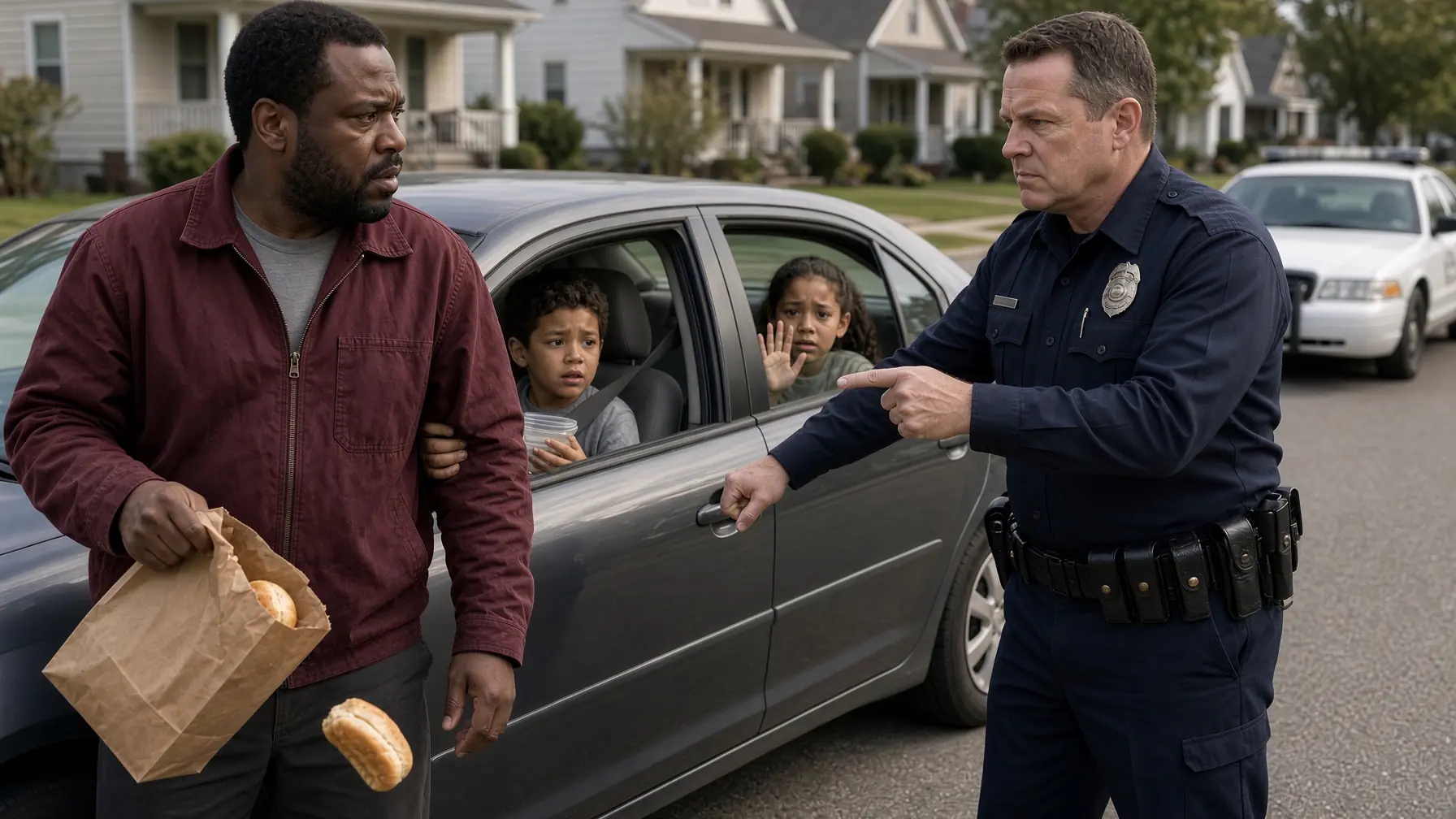
The youngest child was waiting beside the kitchen doorway when Silvester found his keys.
“Can we get the good breakfast?”
He looked at the cereal box on the counter, then back at the child. “What’s wrong with this breakfast?”
The answer came as a pointed finger and an expression so serious that he almost laughed. From the next room, another child added a request for bacon, and within a minute all four were contributing instructions.
One wanted syrup separately. One wanted the toast cut into pieces. The oldest attempted to organize the order and was immediately accused of forgetting something important.
Silvester listened while tying his shoes.
He knew that if he left before repeating everything, somebody would run after him with a correction. He recited the order, waited through two revisions, and finally received four versions of approval.
His cousin watched from the doorway.
“You sure you’ve got all that?”
“I’ve got it.”
“You said that last time.”
“Last time, somebody changed the order after I left.”
The children denied this with enough enthusiasm to make the cousin laugh. Silvester put his keys in his pocket and checked for his wallet.
It was an ordinary morning, full of ordinary work.
At home, dependability meant remembering preferences that changed without warning, keeping track of small necessities, and making decisions before everyone else realized decisions were needed. It meant finding a missing shoe while somebody asked for a drink and another child insisted that a problem happening tomorrow needed attention immediately.
Silvester was a security guard and a young Black father raising four children. He was not always patient, and tiredness sometimes reached his voice before he could stop it.
When that happened, he tried to correct himself. He had learned that being dependable did not mean never making a mistake. It meant returning to the room, admitting when he had been unfair, and doing the next thing properly.
Work demanded a different version of the same effort.
Arrive on time. Stay alert. Check what needed checking even when the shift was quiet and everyone else was ready to believe nothing would happen.
He understood the importance of a careful second look.
That morning, he expected to be gone only a short time. The restaurant was a few blocks away, his cousin was staying with the children, and there was no reason breakfast should become a complicated undertaking.
The youngest followed him to the door.
“Come back fast.”
“I’m only going down the street.”
He touched the child’s head, stepped outside, and drove away with the order repeating itself in his mind.
When the patrol lights appeared, his first thought was that the food would take longer than he had promised.
He looked in the mirror, felt his stomach tighten, and moved toward a place where he could stop. Around him, the neighborhood continued with a Saturday morning that had not yet become unusual.
A vehicle passed. Somewhere nearby, a lawn mower started. Sunlight reached across the road, and a person walking along the sidewalk barely glanced at the cars slowing near the curb.
Silvester put the transmission in park.
Then he thought about his hands.
He wanted them visible before the officer arrived. He wanted every movement to be understandable, every reach to be announced before it could be mistaken for something else.
He rested his hands where they could be seen.
One officer came toward the driver’s window while the other stayed closer to the patrol vehicle. Silvester lowered the glass.
“Morning, officer.”
The greeting did not change the officer’s expression.
He was asked for his license and told that the stop concerned his driving. Later, the court would describe a failure to signal before a left turn as the traffic violation underlying the stop.
At the roadside, Silvester’s attention was on getting through the exchange.
“My license is in my wallet.”
He retrieved it carefully, passed it through the window, and waited. He expected questions, perhaps an unwelcome ticket, and then the chance to continue toward the restaurant.
The officer looked at the card.
Then he looked toward his partner.
Silvester watched the pause grow.
He could not hear everything the officers said to each other. He could see the license change hands and the second officer look from it toward him.
Something had shifted.