Gideon Marsh believed a ranch spoke through the ground before it spoke through paper. At dawn, he could stand on the porch of the main house, taste the dry Texas wind, and know whether the day would be kind or costly. He knew the sound of a loose fence wire before he saw it, the limp of a steer before a ranch hand called it out, and the smell of rain two days before clouds gathered. For ten years, that knowledge had kept him standing over four thousand acres of Panhandle grass.
The Marsh Ranch had belonged to his father, and before that, to a stubborn grandfather who bought dust and turned it into cattle country. Gideon had inherited more than land when his father died. He inherited old debts, old loyalties, a crew that had worked under Marsh men for decades, and the burden of keeping every acre exactly as it had been. He wore that burden like his hat, weathered and permanent.
From the outside, nothing looked wrong. The barn still stood broad against the sky, the windmill still turned above the dry yard, and cattle moved across the pasture in slow dark patches. Men rode out every morning with ropes, rifles, and the same rough humor that had filled the ranch since Gideon was a boy. If neighbors asked how the place was doing, Gideon always said, “Still running,” and that was true enough to pass as strength.
But the ranch was not strong. It was only familiar. Familiar things can decay quietly because no one thinks to question them. Gideon did not know that yet, and if anyone had told him, he would have considered it an insult to his father’s name.
Naomi Marsh arrived on the afternoon train from Amarillo with one trunk, one leather satchel, and a calmness that made the platform seem louder around her. She wore a deep blue dress that did not belong to the dust, her dark hair pinned simply at the back of her head. She was Caleb’s widow, the wife of Gideon’s younger brother, who had died in Denver before ever returning home to claim his share of the ranch. Gideon recognized her from an old photograph Caleb had kept folded in his coat.
He had expected tears. He had expected bitterness. He had expected a woman who wanted a fast payment and a clean escape from land she could not understand. Instead, Naomi stepped down from the train, looked across the flat distance, and measured the world like she had already begun reading it.
“You’re Gideon,” she said.
“I am.”
“Then I suppose this is where I begin.”
Gideon took her trunk without asking, more out of habit than courtesy. The ride to the ranch stretched across forty miles of open country, wagon wheels grinding over dry earth while the late sun made the grass look gold and tired. Naomi sat beside him with her hands folded, asking almost nothing. Gideon liked silence, but hers troubled him because it did not feel empty.
He had prepared an offer before she arrived. Caleb’s share was small on paper but troublesome in practice, and Gideon intended to buy it cheap enough to protect the ranch. A widow from the city would not know the value of grazing land, water rights, or inherited obligation. He told himself the offer was fair, though some part of him knew it was only fair if she did not look too closely.
When they reached the ranch, Naomi stepped down and looked at the house, the barn, the windmill, and the long fence line fading toward the horizon. “It’s larger than Caleb described,” she said. Gideon lifted her trunk from the wagon. “Men tend to make home smaller when they miss it.” Her eyes moved to him then, softer for a second. “He missed it often.”
That night, Gideon left her in the house and rode out to check the north herd. He told himself it was necessary, but truthfully, he did not know what to do with a grieving woman sitting at his table. By the time he returned, the moon was high and the kitchen lamp still burned. Naomi sat alone with the ranch ledgers open before her.
Gideon stopped in the doorway. “You found those.”
“They were in the cabinet.”
“Most folks ask before opening another man’s books.”
Naomi did not flinch. “Caleb’s name is in them.”
That answer irritated him because it was true. He crossed to the stove, poured coffee that had gone bitter, and drank it standing. Naomi’s finger rested on a column of numbers written in his father’s old hand, then in his own rougher script. She studied them not like a guest snooping, but like a doctor listening for a failing heart.
“You found what you needed?” Gideon asked.
Naomi lifted her eyes. “I found something.”
He gave a short laugh. “Numbers worry people who don’t know land.”
“And land ruins people who don’t read numbers,” she replied.
Gideon stared at her, coffee cup still in hand. There was no insult in her face, no challenge thrown for sport. That made the words harder to dismiss. He set the cup down and said, “You’ll see the ranch tomorrow. After that, we’ll talk price.”
Naomi closed the ledger carefully. “I’d rather talk truth first.”
He slept badly that night, though he blamed the wind. By sunrise, Naomi was already dressed and waiting near the barn, her blue dress exchanged for a simpler riding skirt and jacket. Gideon gave her a horse he thought might discourage a woman unused to ranch land, but she mounted cleanly and sat steady. That bothered him more than it should have.
They rode the southern pasture first. Gideon pointed out wells, grazing sections, fence repairs, and the places where flash floods cut hard in spring. Naomi listened, but her questions did not follow the shape he expected. She did not ask how many cattle the land could carry according to pride. She asked what each section cost, how often herds rotated, how much water was drawn, and when he last compared profit against acreage.
“I know what the land can bear,” Gideon said.
“Do you know what it earns?”
He looked out over the grass. “That isn’t the only measure.”
“No,” Naomi said. “But it is one of them.”
By midday, Gideon felt as if he had been riding beside a quiet storm. Naomi did not argue, but every question found a weak board beneath his feet. He could tell when a steer was sick by the way it stood, but he could not tell her exactly what the western section brought in after costs. He knew every man on his crew by name, but he could not say which tasks were duplicated because old habits had never been changed.
They returned at dusk with dust on their clothes and sweat darkening Gideon’s collar. Naomi went straight to the kitchen table and opened the ledgers again. Gideon wanted to tell her to rest, but something in him wanted to know what she had seen. He stood across from her, hat still on, hands braced against the chair.
“These acres,” Naomi said, tapping the ledger, “are costing you more than they bring.”
Gideon’s jaw hardened. “That land has been ours since my father’s time.”
“I know.”
“And his father before him.”
“I know that too.”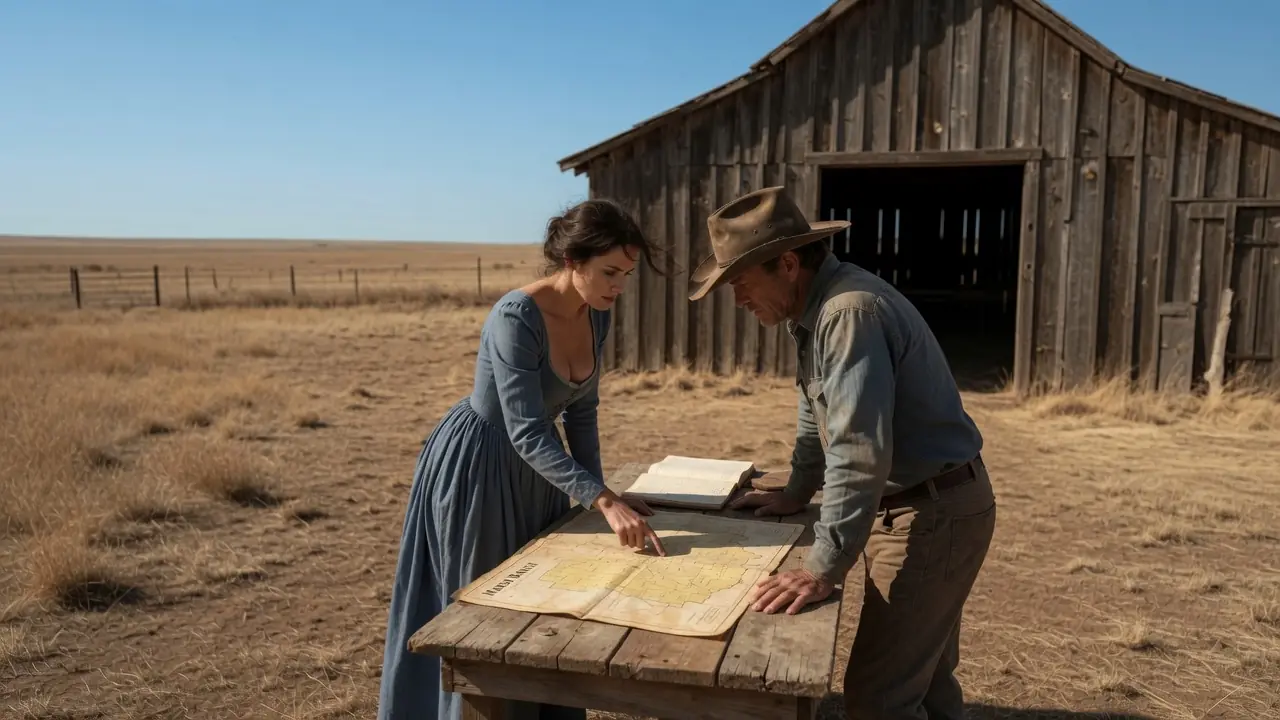
Her calm made him angrier. He leaned over the table, looking down at the figures she had marked. The numbers were plain enough, but Gideon resisted them as if they were strangers trespassing on family ground. Profit and loss did not show how his father had ridden through winter storms to save calves, or how his mother had fed ranch hands when money was thin.
“You’re missing what land means,” he said.
Naomi met his eyes. “And you’re missing what it costs.”
The next morning began not with cattle, but with men. Naomi asked to speak with the crew, and Gideon nearly refused. A ranch hand’s loyalty was not something a widow with ink on her fingers had the right to examine. But he remembered two riders avoiding her questions the day before and found himself calling the men into the yard.
They gathered near the barn, hats low, eyes shifting between Gideon and Naomi. Some looked amused, some offended, some uneasy. Naomi stood before them with a notebook and asked simple questions about routes, hours, repairs, herd rotation, and supplier deliveries. She never raised her voice, but men who had faced storms and stampedes began answering like schoolboys.
By the time the yard emptied, Gideon knew before Naomi spoke that something was wrong. He hated knowing it. He hated seeing old Tom Harris walking too slowly to a horse he should have saddled an hour earlier. He hated noticing that Ben Crowley joked loudly whenever asked about actual work.
Naomi turned the notebook toward him. “You are paying full wages to men who no longer do full work.”
Gideon’s fist tightened. “They earned their place.”
“Yes,” she said. “Years ago.”
“They rode with my father.”
“And now they are resting on his memory.”
The words cut him because they sounded cruel until he looked toward the yard and saw truth standing in broad daylight. Tom Harris had given his body to the Marsh Ranch for thirty years. Ben Crowley had carried Gideon home after a horse threw him when he was sixteen. But neither man could ride hard anymore, and neither had admitted it because Gideon paid them not to.
“They deserve respect,” Gideon said, quieter now.
“Yes,” Naomi replied. “But respect is not the same as pretending.”
That afternoon, Naomi found the feed records. Gideon watched her compare invoices, market rates, delivery weights, and payment histories with a patience that made his skin crawl. Mason Feed had supplied the Marsh Ranch for six years. Mason had been at Gideon’s father’s funeral, hat in hand, voice thick with sympathy.
“He’s overcharging you,” Naomi said.
“No.”
“By nearly thirty percent.”
“Mason wouldn’t do that.”
Naomi slid the invoice toward him. “He already has.”
Gideon read the paper once, then again. His ears rang with the kind of silence that comes after a gunshot. The numbers were not emotional. They did not care that Mason had once shared whiskey with his father, or that he sent Christmas cards signed with a shaky hand. They simply sat there, accusing without effort.
For the first time in years, Gideon felt foolish.
That was worse than feeling angry.
He walked outside and stood in the yard until the sky went purple. The ranch moved around him as it always had: horses shifting, men calling, wind turning the mill with its tired metallic rhythm. Nothing looked different, but everything had changed. Trust, he realized, could become laziness if a man never checked whether it was still deserved.
On the third morning, Gideon did not ride out. He entered the kitchen before sunrise and found Naomi already at the table with papers spread in careful rows. The lamp glowed beside her, making the whole room feel like judgment waiting politely. She looked up when he came in but did not speak first.
“Show me,” he said.
Naomi nodded and turned the main ledger toward him. She had drawn a line dividing the ranch into working truth and inherited burden. One thousand acres showed strong return, good grass, reachable water, and manageable fencing. The remaining three thousand bled money year after year.
Gideon stared at the page. “No.”
Naomi said nothing.
“That land fed this ranch.”
“Some of it did.”
“My father fought to keep every inch.”
“Yes.”
“You’re telling me to sell his memory.”
Naomi’s face softened, but her voice stayed steady. “I’m telling you his memory is not made of acres.”
Gideon stood so abruptly the chair scraped the floor. He walked to the window and looked out at the land as the first light spread across it. Every fence post seemed tied to his childhood. Every dry wash held a story. Every distant ridge carried his father’s voice.
“That land is all I have left of him,” he said.
“No,” Naomi replied softly. “What he built is what you have left. And if you keep losing money to protect the shape of the past, you will lose the ranch itself.”
The words settled deep because they did not attack his love. They separated love from fear. Gideon had thought selling land meant betraying his father, but Naomi was asking whether destroying the ranch through pride was a better tribute. He hated the answer forming inside him.
“What happens if I do it?” he asked.
Naomi took a clean page. “You sell the draining acreage. You keep the thousand that works. You reduce the herd to match the land. You replace Mason Feed. You offer Tom and Ben paid retirement with dignity, not wages for work they can no longer do.”
Gideon listened as she spoke, each sentence removing something he had mistaken for strength. It was not easy. It felt like tearing boards from a house while still living in it. But beneath the pain, he felt something he had not felt in years.
Air.
For one week, the ranch changed faster than it had changed in a decade. Mason rode out red-faced and offended after Gideon confronted him with the invoices, but he did not deny them for long. Tom Harris sat on the porch with Gideon, hat in his lap, and admitted his knees could no longer take twelve-hour rides. Ben Crowley cursed, cried, and finally shook Gideon’s hand when Naomi’s retirement plan gave him enough to leave with pride.
The men watched Naomi differently after that. Not warmly at first, but carefully. She did not take over with noise. She simply placed truth where everyone could see it, then waited for pride to wear itself out against fact.
Gideon found himself watching her too. He noticed how she listened before speaking, how she wrote with a steady hand, how she never used his ignorance to shame him. She could have. He had underestimated her from the beginning, assumed she would sell cheap and disappear. Instead, she had found rot beneath his floorboards and handed him tools.
On the sixth day, Naomi packed her trunk.
Gideon saw it by the door before breakfast and felt something in his chest tighten unexpectedly. The plan was written, letters sent, contracts prepared, and buyers already interested in the three thousand acres. Her work was finished. Caleb’s widow had every right to leave.
He drove her back toward Amarillo under a wide pale sky. This time, the road did not feel empty. They spoke of Caleb first, awkwardly, then honestly. Naomi told Gideon his brother had missed the ranch more than he admitted, and Gideon told her Caleb had always been the better reader of people.
At the station, steam rose from the waiting train. Gideon lifted her trunk down and set it beside her. He wanted to say thank you, but the words felt too small for what she had done. Naomi adjusted her gloves and looked toward the train, her expression unreadable.
“You fixed in one week what I couldn’t see in ten years,” Gideon said.
“No,” she answered. “I showed you where to look. You still have to fix it.”
He nodded. “Do you want me to buy Caleb’s share?”
Naomi turned back to him. “No.”
Gideon frowned. “Why not?”
She looked past him toward the wagon, then beyond it, toward the land they had left behind. “I examined the books, the herd, the men, the land.” Her eyes returned to his. “And the man.”
Gideon did not move.
“The most valuable thing on that ranch is not the cattle,” Naomi said. “It is not even the thousand acres worth keeping. It is a man stubborn enough to stay, but finally humble enough to change.”
The train whistle blew.
Naomi did not reach for her trunk.
“I’m not selling,” she said. “I’m staying, if you’ll have me.”
For a long moment, Gideon stood with the steam drifting around them and the whole world waiting on his answer. He thought of his father, his brother, the ranch, the ledger, and the woman who had walked into his life like quiet weather and revealed the storm already inside it. Then he picked up her trunk and carried it back to the wagon.
Naomi followed.
The train left without her.
By autumn, the ranch looked wounded from a distance. Fences came down where the sold acreage began. The herd was smaller, the crew leaner, the accounts cleaner. Neighbors shook their heads and said Gideon Marsh had lost his nerve, but Gideon no longer cared much for men who judged from the road.
Within a year, the ranch breathed differently. The thousand acres carried the right number of cattle. The new supplier delivered honest weight at honest cost. Tom and Ben visited sometimes, sitting on the porch with coffee, no longer pretending their bodies could do what time had taken. Gideon found peace in that.
Naomi kept the ledgers, but not just the ledgers. She learned the fence lines, the wells, the calving seasons, and the names of horses. Gideon learned numbers, not because he loved them, but because he had learned that love without attention becomes neglect. Together, they built a ranch that honored the past without being buried by it.
One morning, Gideon and Naomi stood beside the western fence, looking over the land that remained. The grass moved in the wind, steady and clean, and the cattle grazed in a line that looked almost peaceful. Gideon removed his hat and held it against his chest. He thought of his father then, not with guilt, but with gratitude.
“You were right,” he said.
Naomi glanced at him. “About which part?”
He looked over the thousand acres, alive and working beneath the open sky. “Dead weight isn’t the dream.”
Naomi smiled faintly. “No. It never is.”
Gideon reached for her hand, and she let him take it. The ranch spread before them, smaller than before, but stronger. For the first time in ten years, nothing beneath his boots felt like it was slipping away.
And Gideon understood at last that saving a legacy did not always mean keeping everything. Sometimes it meant letting go of the parts that were bleeding it dry, so what still lived could finally grow.