A woman’s silhouette appeared through the gray veil of coming snow.
No horse, no supplies, just a threadbare coat and boots worn clean through at the heel.
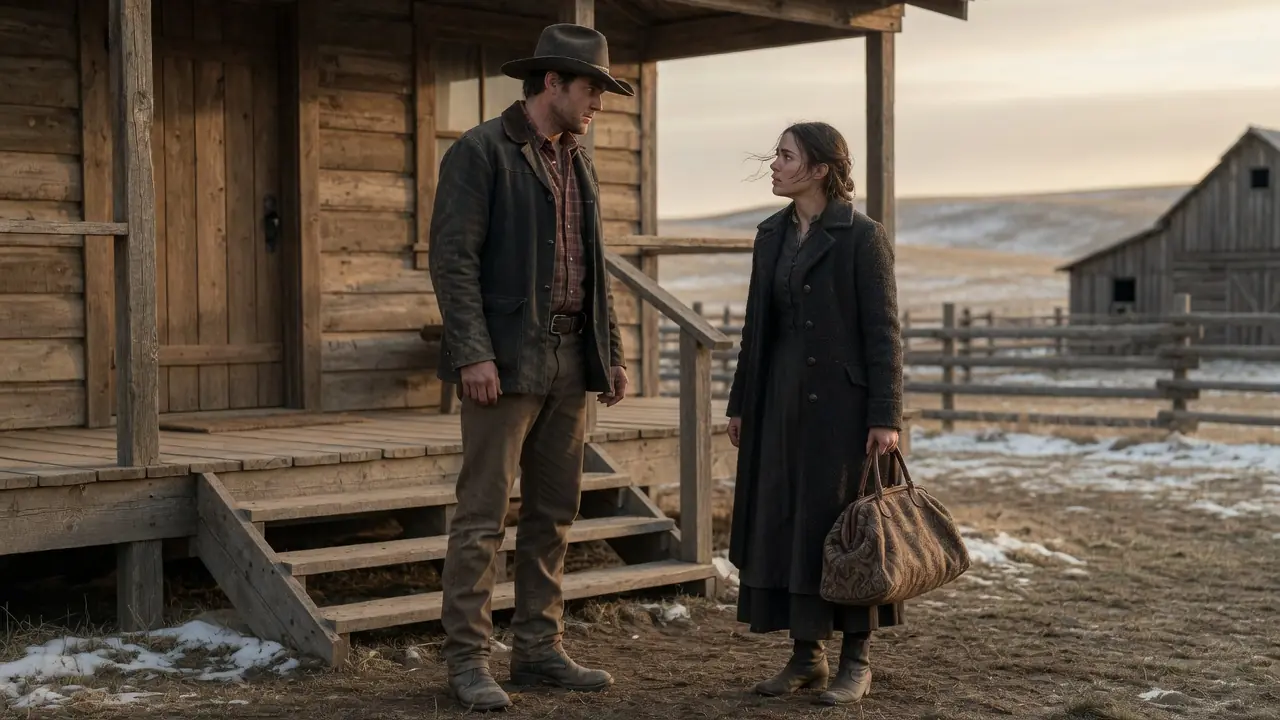
Cole Dawson stood in his doorway, watching her climb the last stretch of ridge toward his ranch.
The wind cut sharp across the Montana grassland, carrying the first real bite of winter.
She didn’t stumble. She didn’t pause to catch her breath. She just kept coming.
When she reached his porch, she knocked three times, firm and even.
He opened the door.
She was younger than he’d first thought. Late twenties, maybe thirty. Dark hair pulled back, severe face winded and lean. Her eyes held something he recognized, the particular exhaustion of someone who’d run out of choices, but not determination.
“I’m looking for work,” she said.
No preamble. No apology for the hour.
“What kind of work?”
“Any kind you’ll give me. I can cook, mend, clean. I learn fast.”
Cole studied her hands. Not soft, but not ranch-hard either. City hands, maybe. Or town hands. Hands that had done some work, but not this kind of work.
“Why here?” he asked.
“Because you’re far enough from town that maybe you need help more than you need gossip.”
That almost made him smile.
Almost.
His housekeeper had quit three weeks back. Said the isolation drove her half mad. Winter was closing in fast, and he needed someone who could handle the house while he handled the stock.
But hiring a strange woman who showed up alone at dusk was asking for trouble.
Still, there was something in the way she stood. Shoulders back despite the exhaustion. Pride without arrogance.
“You’ll find more than wages here,” he said finally. “Work starts before dawn. Days are long, and this land don’t suffer fools. I don’t abide quitting. And I sure don’t abide charity.”
“I don’t take charity,” she replied. “Just honest work for honest pay.”
He nodded slowly.
“Can you handle stock? Chickens?”
“At least I can learn what I don’t know. And I don’t break easy.”
The snow was falling harder now. Thick flakes. That meant business. If he turned her away, she’d never make it back to town before dark.
And even cold Dawson, hard as the land had made him, couldn’t live with that.
“Bunkhouse is out back,” he said. “Stove works. Blankets are clean. We’ll talk terms in the morning.”
She nodded once.
“Thank you.”
“Don’t thank me yet. You might regret this come sunrise.”
He showed her the way, a small building fifty yards from the main house, plain and functional.
One room. One window. One stove.
She stepped inside without complaint and set her small pack on the cot.
“Name’s Cole Dawson,” he said from the doorway.
“Clara Brennan.”
“Well, Mrs. Brennan…”
“It’s just Clara. And I’m widowed.”
He nodded, understanding more than she’d said.
Widowed and alone meant questions. Questions meant judgment. Judgment meant running.
“Just Clara, then. See you at dawn.”
He walked back through the snow to the main house, his boots crunching on the first layer of winter.
Inside, he lit the lamp and stared at the empty kitchen, the table set for one.
He wondered what she was running from.
He wondered if he had just made a terrible mistake.
But mostly, he wondered why her eyes reminded him so much of his own, hollow in all the places grief had carved them out.
Outside, the snow fell harder, covering her tracks like the land was keeping a secret.
She emerged from the bunkhouse in darkness, breath clouding, fingers clumsy on unfamiliar saddle straps.
It was four in the morning, three days since she’d arrived. He hadn’t told her when to start work, just said dawn. Most folks would have slept until sunrise and called that early enough.
But here she was in the dark, trying to figure out which leather strap went where.
He let her struggle for a full minute before stepping into the yard.
“That’s a bridle, not a halter. Horse don’t need it for mucking stalls.”
She turned, startled, but not embarrassed.
“Then I’ll use the halter.”
“Feed’s in the bin by the door. Two scoops per animal. Water troughs need breaking if they’re iced over.”
She nodded and got to work.
Cole returned to his own tasks. Forty head of cattle to check, fence line to walk, hay to distribute before the ground froze solid.
He worked with the efficiency of a man who’d done these things ten thousand times alone.
At noon, he came back to find the stalls mucked, water hauled, and a section of split rail fence mended with wire and determination. Her hands were wrapped in torn strips of cloth, blood seeping through. She was carrying another bucket of water from the pump.
“That’s enough for today,” he called.
“Fence by the north pasture needs attention, too.”
“I said that’s enough.”
She set the bucket down and straightened. Her face was windburned and tired, but she didn’t argue. She just nodded and walked back to the bunkhouse.
That evening, he set two plates, one in the kitchen for her, one in the dining room for himself.
Stew and bread. Coffee strong enough to strip rust.
He left hers on the kitchen table with a clean cloth and went to eat alone.
The division was clear.
He was the rancher. She was the help.
That was how it had to be.
Near midnight, the wolves came.
Cole woke to chickens screaming and scrambled for his boots. He grabbed his rifle, stumbled into the yard, and stopped.
Clara stood by the henhouse in her nightgown and coat, his spare rifle raised, firelight from the barn lantern painting her in orange and shadow.
Three wolves circled in the darkness beyond the fence, eyes reflecting like coins.
She fired a warning shot into the air.
The wolves scattered back but didn’t flee.
They were hungry.
Winter did that. It made predators desperate.
Cole moved beside her without a word, grabbed a torch from the barn, lit it, and hurled it toward the pack.
She fired again, this time closer.
He added his own shot.
Together, they made enough noise and fire to finally drive the pack into the hills.
When the silence returned, they stood side by side in the cold, rifles lowered, breath visible in clouds.
“You know how to shoot,” Cole said.
“My father taught me before he died. Said a woman alone needs to know how to stand her ground.”
He glanced at her.
The nightgown was thin, her feet bare in unlaced boots. She was shaking from cold or adrenaline. Maybe both.
But she hadn’t run. Hadn’t screamed.
Just grabbed the gun and did what needed doing.
“Come hell or high water, those chickens are staying alive,” she said quietly.
That almost made him smile.
Almost.
“Get some rest,” he said. “They won’t be back tonight.”
She nodded and walked toward the bunkhouse, the rifle still in her hands.
Cole stood alone in the yard, watching her go.
Somewhere in the distant hills, the wolves howled, a sound lonely and old as the wind.
He looked at the henhouse, then back at the dark shape of the bunkhouse.
Maybe, he thought, he hadn’t made a mistake after all.
Cole rode into Redemption under a sky the color of old iron, knowing the town’s eyes would be sharper than the wind.
It was Sunday, and he needed supplies before the next storm hit. Flour, coffee, nails, the usual.
He tied his horse outside the general store and stepped into the warmth.
Martha Doyle stood behind the counter, sorting mail. She looked up, smiled briefly, then glanced past him toward the door as if expecting someone else.
“Morning, Cole.”
“Martha,” he said, setting his list on the counter.
“Heard you hired a woman,” she said, her voice carefully neutral. “That true?”
Word traveled fast. Faster than snow. Faster than truth.
“Needed a housekeeper,” Cole said. “She needed work.”
Martha nodded slowly, gathering his items.
“Folks are talking.”
“Folks always talk.”
“You know how it is. A single man, a single woman living on the same property…”
“In separate buildings,” Cole interrupted. “And it ain’t anybody’s business but mine.”
Martha’s mouth thinned, but she didn’t argue. She wrapped his goods in paper and tied them with string.
“Sixty cents.”
He paid, took the bundle, and turned to leave.
Warren Kent stood in the doorway, blocking the exit.
Kent was a banker, thin as a rail, sharp as broken glass. He owned half the mortgages in town and most of the moral outrage.
“Dawson,” Kent said, not moving. “Heard you’ve got a woman up at your place.”
“I’ve got a housekeeper.”
“That what you’re calling it?” Kent smiled without warmth. “She that kind of woman?”
Cole’s jaw tightened.
“She’s the kind that works hard and minds her own business. You might try the same.”
“A man’s reputation matters, Dawson. Especially out here. People talk, and talk becomes truth.”
“Then people should mind what they say.”
Kent stepped aside, but his smile stayed cold.
“Just friendly advice. Wouldn’t want folks getting the wrong idea.”
Cole walked past him into the cold.
He loaded his supplies, then made one more stop.
The dry goods shop.
He bought a woman’s winter coat, medium size, wool-lined and practical. The shopkeeper raised an eyebrow, but said nothing.
Cole rode home under that iron sky, the coat tied behind his saddle.
Back at the ranch, he found Clara in the main house. He’d given her a key for firewood access. She sat at the kitchen table, reading by lamplight. A worn Bible lay open in front of her, pages thin as onion skin.
She looked up when he entered, startled.
“I’m sorry. I didn’t mean to…”
“It’s fine.”
He set the supplies down, then pulled the coat from the bundle.
“First snow’s coming hard. You’ll need this.”
She stared at the coat like it might vanish.
Slowly, she reached out and touched the fabric.
“I can’t pay you back,” she said quietly.
“Didn’t ask you to.”
“Then why?”
Her eyes lifted to his, and he saw something raw there. Confusion. Hope. The barest edge of tears.
“Why are you kind to me when no one else is?”
Cole paused, the words catching in his throat.
“Maybe I know what it’s like,” he said finally. “To need a place that doesn’t ask questions.”
She held the coat against her chest, and for a moment, she looked like she might cry.
But she didn’t.
She just nodded, her throat working.
“Thank you,” she whispered.
He nodded and left her there, retreating to his own room.
That night, lying in the dark, Cole thought about the town’s whispers, about Kent’s cold smile, about the way Martha had looked at him. Pity mixed with judgment.
A man’s word is his bond, his father used to say.
And I gave mine when I hired you.
He’d made a promise when he let Clara stay. Didn’t matter what the town said. Didn’t matter what Kent thought.
Out here, a man handled his own business.
And Clara Brennan was his business now, whether he’d planned it or not.
In the bunkhouse, Clara sat on her cot, the coat still clutched in her hands.
For the first time since leaving Missouri, she felt something other than cold.
The ranch settled into a rhythm older than words. Work, silence, shared meals, the slow thaw of two frozen souls.
Six weeks passed.
November surrendered to December, and the snow stayed.
Clara learned the ranch’s language, the creak of frozen gates, the huff of cattle waiting for hay, the particular silence that meant more snow was coming.
Cole taught her to rope without speaking much. Showed her how to coil the lasso, how to read an animal’s movement, how to throw with her shoulder instead of her arm.
She practiced for hours, missing more than hitting, but never quitting.
One evening, while mending harnesses by lantern light, she began to hum a hymn her mother used to sing. Simple melody, old as dirt.
Cole paused, listening.
“What’s that song?”
“Something my mama taught me. ‘Come Thou Fount,’ it’s called.”
“Sing it proper.”
She did, her voice soft and clear in the barn’s quiet.
When she finished, Cole nodded once.
“Your mama had good taste.”
“She did,” Clara said. “About most things.”
They worked in silence after that, but it was a different kind of silence.
Companionable.
The pipes froze on a Tuesday.
Cole discovered it at dawn. No water in the kitchen. Ice blocking the pump line. He swore under his breath. The repair would take days. Meanwhile, they’d be hauling water from the creek.
Unless.
He found Clara feeding the chickens.
“Main house pipes are frozen solid. I can fix them, but it’ll take time. You’re welcome to use the spare bedroom until it’s sorted. Warmer than the bunkhouse, and the pump in there still works.”
She hesitated, her breath clouding in the cold.
“People already talk.”
“People always talk. Question is whether you freeze to death caring about it.”
“I’m not that kind of woman,” she said quietly.
“I know,” Cole replied. “And I’m not that kind of man. This is about survival, not scandal.”
She searched his face, looking for something. Reassurance, maybe. Or proof of honor.
Whatever she found must have been enough because she nodded.
That evening, she moved into the spare bedroom.
It was small. Simple bed, chair, washstand. But it was inside, with a fire crackling in the main room and warmth seeping through the walls.
They ate supper together at the kitchen table for the first time.
Venison stew, biscuits, coffee.
“This is good,” Cole said.
“You sound surprised.”
“A little bit.”
She almost smiled.
“My mama taught me to cook before she taught me hymns. Said a woman needed to feed bodies and souls both.”
“She sounds like she was wise.”
“She was.” Clara’s voice went soft. “Died when I was sixteen. Fever took her in three days.”
Cole nodded. Loss was a language they both spoke.
After supper, they sat by the fire, not talking. Just listening to the logs crack and settle.
Outside, the wind howled like it wanted in.
“Don’t fence me in with what folks might say,” Cole said after a while. “Out here, we handle our own.”
Clara looked at him across the firelight.
“You really believe that?”
“Have to. Otherwise, we’re just living by other people’s rules in a place they’ll never set foot.”
She nodded slowly.
“I like that.”
They sat until the fire burned low, neither wanting to break the quiet.
When Clara finally rose to go to bed, she paused at the hallway.
“Cole.”
“Yeah?”
“Thank you for letting me stay. For not making me feel like a burden.”
He didn’t know what to say to that.
So he just nodded.
After she left, he sat alone in the dark, staring at the embers.
Something was growing here, something fragile and precious. He didn’t know what to call it. Didn’t know if it had a name.
But he knew it scared him.
Because the last time he’d let himself care about someone, the land had taken her away.
And he wasn’t sure he could survive that again.
Some silences are restful.
Others are full of the names we don’t say aloud.
Christmas week arrived with bitter cold and a stillness that felt like held breath.
Clara baked bread, filling the house with yeast and warmth.
Cole carved a small wooden bird from pine scrap. Simple thing, but his hands remembered the work from years before.
They decorated sparsely. A few pine boughs over the mantle. Candles in the windows.
Neither mentioned the missing stockings, the absent laughter, the names that should have been spoken but weren’t.
On Christmas Eve, Clara set two plates at the table.
Roasted chicken, potatoes, carrots from the root cellar.
They ate quietly.
The meal was good, but haunted.
Afterward, Cole hung the wooden bird on the mantle.
Clara stared at it.
“That’s beautiful.”
“Made one for my daughter,” he said. “Before she was born. Never got to give it to her.”
The words hung in the air like smoke.
Clara’s hand went to her throat.
“I had a daughter, too.”
Cole looked at her and waited.
“Her name was Lily. She was four when the fever took her.” Clara’s voice was steady, but her eyes weren’t. “My husband, he said I didn’t pray hard enough. Said if I’d been a better woman, God wouldn’t have taken her.”
“That’s a damn lie.”
“The town agreed with him. After she died, they looked at me like I was cursed. Like grief was my fault.” She wrapped her arms around herself. “So I left. Walked until I couldn’t walk anymore. And then I found your ridge.”
Cole’s jaw tightened.
He understood now the exhaustion in her eyes.
The way she worked like she was trying to earn back something stolen.
“I had a wife,” he said. “Sarah. She died in childbirth. Baby, too.”
His voice went rough.
“Town said I worked her too hard. Should have gotten the doctor sooner. Maybe they were right.”
“Were they?”
“I don’t know.” He stared at the fire. “I’ll never know.”
They sat with that, two people carrying guilt neither had earned, but both refused to set down.
“Maybe we’re both just trying to outrun what we can’t bury,” Clara said softly.
“Maybe.”
Cole looked at her.
“Or maybe we’re finally in a place where we don’t have to run anymore.”
Her eyes met his, and something passed between them.
Understanding.
Recognition.
The kind of connection that only happens between people who’ve walked through the same darkness.
“Cowboy up,” Cole said quietly. “Grieving’s honest work, but it don’t have to be done alone.”
Clara smiled. Small. Fragile, but real.
“Is that what we’re doing? Grieving together?”
“Maybe. Or maybe we’re just two fools trying to figure out how to live again.”
They stayed by the fire until dawn. Shoulder to shoulder, but not touching. Close enough to feel the warmth, careful not to break the spell.
When the sun rose on Christmas morning, the wooden bird caught the light, casting shadows like wings.
Clara reached out and touched it gently.
“Do you think they’d forgive us for trying to be happy again?”
Cole thought about Sarah. About the promises he’d made and the ones he’d broken. About the way grief could become a prison if you let it.
“I think they’d call us fools if we didn’t try.”
She nodded, wiping her eyes.
Outside, the snow sparkled clean and white, covering everything old and broken with something new.
For the first time in years, Cole felt something other than cold.
He felt hope.
The blizzard came like God’s own fury, white and wild and endless.
It hit three days after Christmas. A storm so fierce it turned day into twilight and erased the world beyond the porch.
Cole knew immediately they were in trouble.
The cattle were stranded in the far pasture, two miles out. If they didn’t bring feed soon, the herd would freeze or starve.
“I’m going,” he told Clara, loading the sled with hay bales.
“Not alone, you’re not.”
“This isn’t your fight.”
“Those cattle feed us both. That makes it my fight, too.”
She grabbed her coat, the one he’d bought her.
“Besides, you taught me to rope. Time to see if I learned anything.”
Cole wanted to argue, wanted to send her back inside where it was safe, but he saw the set of her jaw, the determination in her eyes.
She wasn’t asking permission.
She was stating fact.
“Stay close,” he said. “We lose sight of each other in this, we’re both dead.”
They set out into the white.
The wind hit like fists. Snow so thick Cole couldn’t see his own hands.
They followed the fence line by feel, stumbling, gasping, the cold so sharp it hurt to breathe.
Two hours to reach the pasture. Another hour to distribute the hay. Counting cattle by touch more than sight.
Thirty-eight head accounted for.
Two missing.
Probably dead in a drift somewhere.
On the way back, Clara broke through the ice.
One moment she was beside him.
The next, the snow gave way, and she plunged into the frozen creek water, black and fast beneath the surface.
Cole lunged, grabbed her coat, and hauled with everything he had.
She came up gasping, eyes wide with shock, already shaking violently.
“Move!” he shouted. “Keep moving or you die!”
He pulled her forward, forcing her legs to work.
A half mile to the line shack, a tiny shelter used during calving season.
If they could reach it, they had a chance.
They stumbled through the door as Clara’s lips turned blue. Cole stripped her wet clothes with shaking hands, wrapped her in every blanket he could find, and lit the potbelly stove.
She curled into a ball, shaking so hard her teeth chattered like stones.
He stripped his own wet layers and added himself to the pile of blankets.
Body heat. Last resort, but the only one they had.
“Stay awake,” he said. “Talk to me.”
“Cold.”
“I know. But you’re tougher than cold. Remember?”
She pressed against him, shaking.
He held her, rubbing her arms, her back, anything to generate warmth.
Slowly, agonizingly slowly, the shaking eased.
“I can’t lose someone again,” Cole whispered into her hair.
The words escaped before he could stop them.
Clara’s hand found his in the dark.
“You won’t. I promise.”
They stayed like that through the night, wrapped in blankets and necessity, listening to the storm rage outside.
Nothing improper happened.
But everything changed.
When dawn came gray and bitter, they dressed in silence. The air between them charged with things unsaid.
The trek home took three hours.
They arrived half frozen, exhausted, alive.
The ranch was intact. The chickens safe. The house standing.
But the town’s fury was already building.
Warren Kent had spread the word.
Cole Dawson and that woman alone for days during the storm. Trapped together. Unchaperoned. Scandalous.
The wolves, Cole realized, weren’t always four-legged.
Sometimes they wore suits and carried Bibles and called themselves righteous.
And they were circling close.
Courage, Cole learned, isn’t one big moment.
It’s a hundred small choices.
And he was failing everyone.
Warren Kent arrived at the ranch on a cold afternoon eight days after the blizzard. He rode up with the confidence of a man who believed he owned the moral high ground.
Cole met him in the yard.
“Dawson,” Kent said. He didn’t dismount. “I’m here as a concerned citizen.”
“Concerned about what?”
“Your reputation. The town’s reputation. That woman’s reputation, if she has any left.”
Cole’s hands curled into fists.
“Say what you came to say.”
“You were alone with her for three days during the storm. In a line shack. No witnesses.” Kent’s smile was thin and sharp. “People are talking. The church council is talking. And frankly, unless you do the right thing, you’re going to find yourself with no credit, no trade, and no welcome anywhere in Redemption.”
“The right thing being what?”
“Send her away. Let her work at the hotel in town until spring. For her sake as much as yours.”
Kent leaned forward in his saddle.
“You’re a good man, Dawson. Don’t ruin yourself over a woman nobody knows and nobody trusts.”
The words landed like stones.
After Kent left, Cole stood alone in the yard, the wind cutting through him.
He thought about Sarah, about the promises he’d made to her, about what the town had said when she died, how they’d judged him, blamed him, made him an exile in his own life.
He’d spent three years rebuilding his name.
Three years earning back respect.
And now it was crumbling again.
That night, he found Clara in the kitchen, mending his torn work shirt by lamplight.
“We need to talk,” he said.
She set the needle down, her face guarded.
“Maybe you should go to town,” Cole said, hating the words even as he spoke them. “Work at the hotel until spring. For appearances.”
Clara went very still.
“You’re sending me away.”
“I’m trying to protect your reputation.”
“My reputation died with my daughter.” Her voice was ice. “I thought you understood that.”
“I do, but…”
“But you care more about what they think than what’s true.”
“That’s not fair.”
“Isn’t it?”
She stood, the shirt falling to the floor.
“You told me this place was different. That out here, we handle our own. You said a man’s word is his bond.”
“Clara.”
“And you just broke yours.”
She walked to the spare room and started packing.
Cole stood frozen, torn between fear and something he couldn’t name.
Jasper Kent, Warren’s estranged brother and Cole’s ranch hand, appeared in the doorway. He’d been staying in the barn loft, and he’d heard everything.
“You’re really letting her go?” Jasper asked quietly.
“It’s complicated.”
“No, it’s not.” Jasper’s voice was hard. “You’re scared. You’re letting them win because you’re scared of being alone again.”
“You don’t understand.”
“I understand you’re a coward.”
Jasper turned to leave, then paused.
“Your wife was a good woman. Kind, strong, honest. And if she could see you right now, letting that woman walk away because you’re too afraid to stand up for her…”
He shook his head.
“She’d be ashamed.”
The words hit like bullets.
Jasper left.
Clara finished packing, and Cole sat alone in the empty kitchen, surrounded by the ghosts of everyone he’d failed.
Outside, the wolves howled, distant and hungry and patient.
They always were.
Cole Dawson walked into that church the way a man walks to his own hanging, certain of the outcome, but needing to say his piece first.
It was Sunday morning.
The entire town packed into the small building, wooden pews creaking under the weight of judgment and wool coats.
Reverend Mills stood at the pulpit, mid-sermon about integrity.
Cole entered through the back door.
Every head turned.
He walked down the center aisle, boots loud on the floorboards.
Martha Doyle gasped.
Warren Kent sat in the front row, his face carved from stone.
Cole stopped at the front, then turned to face the congregation.
“I have something to say,” he announced.
Reverend Mills blinked.
“Mr. Dawson, this is highly…”
“You all knew my Sarah. Good woman. Good wife. When she died, you judged me. Some of you still do.”
Cole’s voice carried clear and hard.
“Maybe that was fair. Maybe it wasn’t. But I learned something from it. Judgment’s easier than mercy.”
He looked directly at Warren Kent.
“There’s a woman you’ve been gossiping about. Her name is Clara Brennan. She works harder than any man in this room. She lost everything. Her child, her husband, her home, and she kept going. That’s courage. That’s strength.”
“Mr. Dawson,” Kent stood, his voice oily with false concern. “We’re all sympathetic to her plight, but propriety matters.”
“Does it?” Cole cut him off. “You sit here every Sunday talking about Christian charity, and then you tear apart a woman who’s done nothing wrong except survive.”
The room erupted in whispers.
Cole raised his voice.
“Yes, I hired her. Yes, she lived on my property. And yes, I care for her. If that makes me shameful in your eyes, then judge me, but leave her be.”
He turned to go, then stopped.
“One more thing. We don’t call for the law or the doctor out here. We handle our own, and I’m handling this. Any man has a problem with that, you know where to find me.”
He walked out into the cold sunlight, his heart hammering.
Behind him, the church sat in stunned silence.
Cole rode straight to the hotel and found Clara in the small room they’d given her, barely bigger than a closet, with a window that looked onto an alley.
She stood when he entered, her face unreadable.
“I should have stood sooner,” Cole said. “I should have chosen you over their approval. I was a coward, and I’m sorry.”
“And now?”
Clara searched his face, looking for truth.
“Now I’m choosing you. Every day. Come hell or high water.”
He took a breath.
“Come home. Not as my housekeeper. As my partner in every way that matters.”
“You mean that?”
“I’ve never meant anything more in my life.”
Clara studied him, this man who’d finally found his courage.
Slowly, she nodded.
They rode back together through the winter afternoon.
Side by side.
The future uncertain, but theirs to build.
Behind them, the town buzzed with scandal.
But ahead, the ranch waited, solid and real and home.
Spring came slow, then all at once, the way hope does when you’ve stopped expecting it.
April melted the snow. Green pushed through dead grass. The creek ran clear and cold, no longer a trap, but a promise.
Cole and Clara worked side by side, planting, mending, building.
The town slowly warmed. Some apologized. Some stayed cold.
Martha Doyle came out one Sunday with a pot of stew and an awkward blessing.
Jasper grinned and said he’d known all along.
Warren Kent never apologized, but he stopped talking, and that was enough.
One evening in late April, as the sun painted the hills gold, Cole led Clara to the ridge where they’d first met.
“I buried them here,” he said quietly, gesturing to two simple wooden crosses. “Sarah and the baby. Never gave the baby a name. Didn’t seem right somehow.”
Clara took his hand.
“My daughter’s buried in Missouri,” she said. “I couldn’t say goodbye. Couldn’t go back.”
They stood together in the wind.
Two people haunted by graves they couldn’t visit.
“You think they’d forgive us?” Clara asked. “For choosing to live again?”
Cole thought about Sarah. Her laugh. Her strength. The way she’d loved this land.
About the child he’d never met but mourned every day.
“I think they’d call us fools if we didn’t.”
Clara smiled, tears on her cheeks.
“Then let’s not be fools.”
They married the next week. Simple ceremony. Jasper and Martha as witnesses.
No church. No crowd.
Just vows spoken under open sky with the land as their witness.
“Every good thing worth having comes the hard way,” Cole said, sliding a simple band onto her finger. “And you, ma’am, were worth every hard step.”
Clara kissed him, soft and sure and full of promise.
That night, they stood at the threshold of the main house, the door open wide, golden light spilling onto the greening land.
In the distance, wolves howled. Not a threat anymore, just wilderness singing its old song.
Clara wore the winter coat he’d given her that first week, though it was warm now and she didn’t need it.
She wore it because it meant something.
Because it was the first kindness.
The first crack in the wall.
Cole held her hand, his calloused fingers gentle against hers.
Inside, the wooden bird hung on the mantle, catching the firelight, a symbol of fragile hope that had survived the winter.
They stepped inside together.
Behind them, the door closed soft as a prayer.
Ahead, the future stretched uncertain and beautiful.
A life built log by log, choice by choice, day by hard-won day.
Home earned the way everything worth having is earned.
Through courage.
Through work.
Through standing up when it would be easier to fall.
Through love that refused to quit, even when the whole world said it should.
The ranch settled into evening quiet. Cattle lowing soft in the pasture. Chickens roosting safe. The land breathing easy under a sky full of stars.
Two people who’d been broken had built something whole.
And that, Cole thought as he held his wife close, was worth more than all the judgment in the world.
Spring had come.
And they were home.