A seven-year-old girl had been stalked for three weeks.
The police said it was her imagination.
Her parents could not prove anything.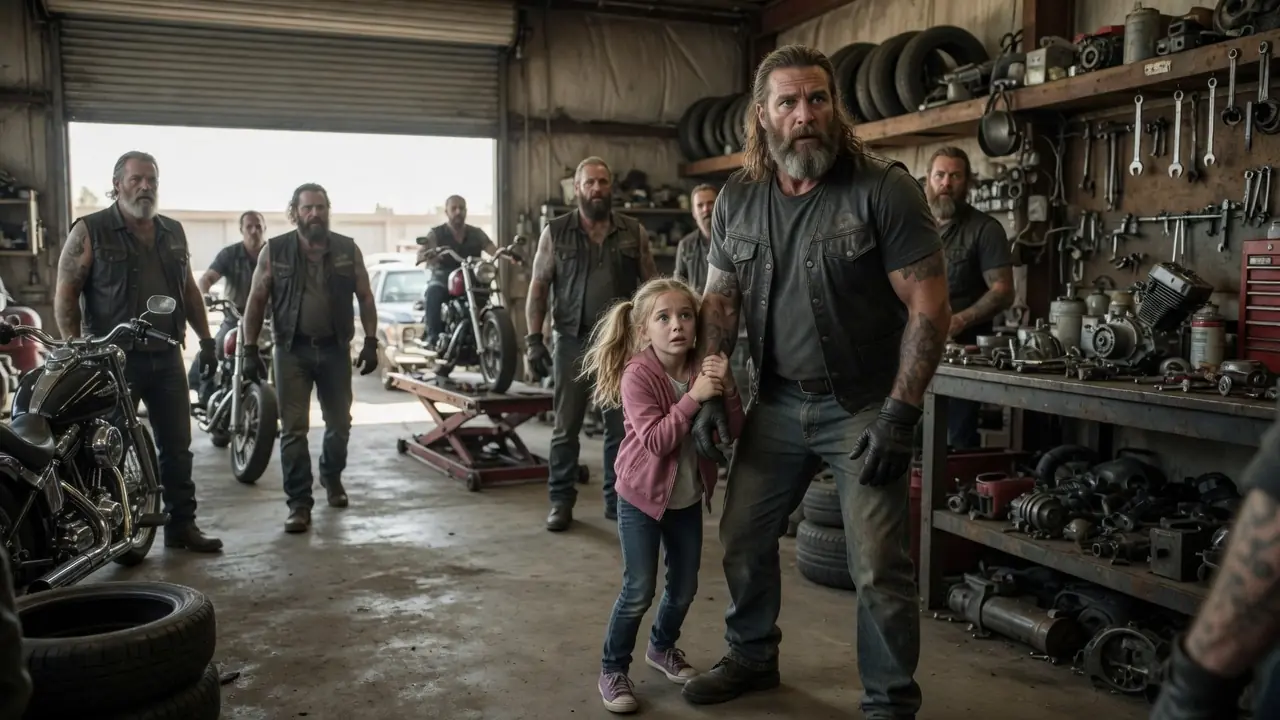
Then she saw him walking toward her in the park.
And the only person nearby was a massive biker covered in tattoos.
She grabbed his hand and whispered, “He’s following me. Please don’t let him take me.”
The biker looked at the man approaching.
Then he looked at the terror in the little girl’s eyes.
And he made a decision that would bring two hundred Hell’s Angels to that city by dawn.
Sarah first saw the man in the blue hat three weeks earlier.
She was leaving school, walking toward her mother’s car, when she noticed him standing across the street.
Just standing there.
Watching.
He was not doing anything obviously wrong. He was not breaking any laws. He was just a man on a sidewalk looking at a school.
But something about him made Sarah’s stomach hurt.
She told her mom that night.
“There was a man watching me today. He had a blue hat.”
Her mother, Jennifer, looked up from the dishes.
“Watching you how, sweetie?”
“Just watching. He didn’t move. He just stared.”
“He was probably waiting for someone. His own kid, maybe.”
“He didn’t have a kid. He was alone.”
Jennifer dried her hands and crouched down to Sarah’s level.
“I’m sure it was nothing, baby. But if you see him again, you tell me right away, okay?”
Sarah saw him again the next day.
Same spot.
Same blue hat.
Same empty stare.
And the day after that.
And the day after that.
By the end of the first week, Sarah was terrified.
The man was not just at school anymore.
He was everywhere.
At the grocery store, pretending to look at cereal while watching her and her mother from across the aisle.
At the park, sitting on a bench while Sarah played on the swings.
At the library, browsing books he never checked out, always in whatever section Sarah wandered into.
She told her parents everything.
They believed her at first.
Then they started to doubt.
“Are you sure it’s the same man, sweetie? Blue hats are pretty common.”
“It’s him, Daddy. I know it’s him.”
“But you said he was at the grocery store on Tuesday. We didn’t go to the grocery store on Tuesday.”
“We did. Mom and I went after school.”
Her father looked at her mother.
Her mother looked uncomfortable.
“Honey, we went on Wednesday, not Tuesday.”
Sarah felt her face burn.
She knew what day it was.
She knew what she had seen.
But suddenly, she was not sure of anything.
“Maybe you’re just noticing people more because you’re scared,” her mother said gently. “Sometimes when we’re worried about something, we see it everywhere.”
“I’m not making it up.”
“We’re not saying you’re making it up. We’re just saying maybe it isn’t what you think.”
Sarah ran to her room and slammed the door.
She was not crazy.
She was not imagining things.
Her parents called the police anyway.
An officer came to the house.
Officer Martinez.
He had kind eyes, a patient smile, and a notebook that stayed mostly empty.
“So, you’ve seen a man in a blue hat?” he said. “Can you describe him?”
Sarah tried.
“Average height. Brown hair. Thin. The blue hat. Always the blue hat.”
“And he’s been following you?”
“Yes. For two weeks now.”
“Has he ever approached you, spoken to you, tried to touch you?”
“No. He just watches.”
Officer Martinez nodded slowly.
“Sarah, I understand this is scary. But without more information, a license plate, a name, a specific threat, there’s not much we can do. There’s no law against being in public places.”
“But he’s following me.”
“I hear you. And I want you to know that if anything changes, if he approaches you, if he says anything, you call 911 immediately.”
He handed her parents his card.
“Keep an eye out. Document what you can. But right now, there’s nothing actionable.”
After he left, Sarah heard her parents talking in the kitchen.
“Maybe she’s going through something at school. Stress can cause—”
“She’s seven, Jennifer. What stress does a seven-year-old have?”
“I don’t know. But the officer said there’s nothing he can do. Maybe we should talk to her teacher or a counselor.”
Sarah put her pillow over her head and screamed into it.
Nobody believed her.
Nobody would help.
She was alone.
The third week was the worst.
Sarah stopped sleeping.
Every shadow became the man in the blue hat. Every creak in the house became footsteps coming for her.
She had nightmares so vivid that she woke up screaming, convinced he was in her room.
Her parents took her to a child psychologist.
The psychologist asked gentle questions, nodded thoughtfully, and used words like anxiety and hypervigilance and age-appropriate fears.
“It’s not uncommon for children her age to become fixated on perceived threats,” she told Jennifer and David afterward. “The mind can play tricks, especially during developmental transitions.”
“So she’s imagining it?” David asked.
“I wouldn’t say imagining. I’d say she’s interpreting normal stimuli through a lens of fear. The man in the blue hat may be real. He may even be the same man. But his presence is likely coincidental. Sarah’s brain is assigning meaning where there may not be any.”
Sarah sat in the waiting room, staring at the fish tank, knowing exactly what they were saying about her.
Crazy.
Scared.
Making things up.
But she was not.
She was not.
The day everything changed was a Saturday.
Sarah’s parents had taken her to Lincoln Park.
A treat, they said.
Fresh air, sunshine, a chance to feel normal.
They were sitting on a blanket near the pond, eating sandwiches, pretending everything was fine.
Then Sarah saw him.
The man in the blue hat.
Walking along the path.
Coming closer.
Her sandwich fell from her hands.
“Sarah, what’s wrong?”
She could not speak.
Could not breathe.
He was here.
Even at the park, miles from home.
He had found her.
He was walking toward them now, slowly, casually, like he had every right to be there.
“Sarah, honey, you’re white as a sheet.”
“I need to use the bathroom.”
She stood up before her parents could respond and walked quickly toward the restrooms near the playground.
Not running.
Running would attract attention.
But fast.
Fast enough to get away.
She glanced back.
The man had changed direction.
He was following her.
Sarah’s heart hammered.
The restrooms were too far.
Too isolated.
If she went there, if he followed, if nobody else was around, she needed help right now.
She scanned the park desperately.
Families on blankets.
Kids on swings.
Dog walkers on distant paths.
And there, on a bench near the oak trees, a man sat alone.
He was massive, covered in tattoos, wearing a leather vest with patches she did not recognize.
He looked like the kind of person her parents told her to stay away from.
The kind of person who appeared in news stories with words like dangerous.
He was also the only adult within reach.
Sarah ran.
Vince “Razor” Duca was having a bad day.
His ex-wife had called that morning with another excuse for why he could not see his daughter that weekend.
Another reminder of every mistake he had ever made.
Every choice that had led him here, alone on a park bench, watching other fathers play with their kids.
He should not have come.
It just made the pain worse.
But he could not stay away.
Two years since he had held Lily.
Two years since she had called him Daddy.
Two years of supervised visits that never happened and promises that were never kept.
He was lost in misery when the little girl appeared.
She was small, six, maybe seven.
Blonde pigtails.
Pink jacket.
Eyes wide with terror.
She grabbed his hand like he was the last solid thing in a dissolving world.
“Please help me. There’s a man following me. The one in the blue hat. He’s been following me for weeks and nobody believes me and he’s right there. Please, please don’t let him take me.”
Vince looked up.
A man was approaching.
Thin.
Brown hair.
Blue baseball cap.
He was maybe thirty feet away, walking with purpose, eyes fixed on the little girl.
Vince had seen predators before.
He knew the look.
That hungry, patient calculation.
The way they moved.
The way they watched.
This man was a predator.
No question.
“What’s your name, sweetheart?”
“Sarah. Sarah Mitchell.”
“Okay, Sarah. I want you to stand behind me. Right behind me. And don’t move until I tell you it’s safe.”
Sarah scrambled behind the bench, pressing herself against his back.
Vince stood up.
He was six foot four, two hundred sixty pounds, with arms like tree trunks and a face that had scared grown men into silence.
The man in the blue hat stopped.
For a moment, they just stared at each other.
Predator and protector.
Calculating.
Measuring.
Then the man smiled.
A cold, empty smile.
He turned and walked away.
“Is he gone?” Sarah whispered.
Vince watched the man disappear down a path toward the parking lot.
“For now.”
He pulled out his phone and made a call.
“Ghost, I need you at Lincoln Park now. And bring everyone you can reach.”
Sarah’s parents found her twenty minutes later.
They had been frantic, searching the park, calling her name, convinced something terrible had happened.
What they found was their seven-year-old daughter sitting next to a terrifying biker on a park bench, eating ice cream from a cart and chatting like old friends.
“Sarah!”
Jennifer ran toward them.
David followed, his face cycling through relief, confusion, and fear.
“Get away from my daughter.”
Vince did not move.
He did not react to the aggression.
“Your daughter came to me for help. There was a man following her. Blue hat. He’s been stalking her for weeks.”
“That’s— We’ve been through this. The police said—”
“The police are wrong.”
Vince’s voice was granite.
“I saw him. I saw the way he looked at her. That man is hunting your daughter, and if you don’t do something about it, he’s going to catch her.”
Jennifer’s face went pale.
“You saw him?”
“Thin guy. Brown hair. Blue baseball cap. Late thirties, maybe early forties. He was walking straight toward Sarah until I stood up. Then he changed course and headed for the parking lot.”
“Oh my God.”
Jennifer’s hands were shaking.
“Oh my God. It’s real. It’s actually real.”
David pulled out his phone.
“I’m calling the police.”
“That’ll take too long.”
Vince stood up.
“I have people coming. They’ll sweep the park, check the exits, try to get a plate number or ID.”
“People?” David asked. “What people?”
As if in answer, the sound of engines filled the air.
Motorcycles.
Dozens of them.
Pouring into the park’s main entrance like a chrome avalanche.
Jennifer grabbed Sarah and pulled her close.
David stepped in front of them both.
“What is this? Who are you?”
“My name is Vince Duca. I’m with the Hell’s Angels.”
He watched his brothers dismount, spreading out through the park with practiced efficiency.
“And nobody hurts kids on my watch.”
The sweep took two hours.
Forty-seven bikers searched every inch of Lincoln Park.
They checked parking lots, recorded license plates, questioned vendors, joggers, and anyone who might have seen a man in a blue hat.
They found his car.
A gray Honda Civic parked in the overflow lot, registered to a P.O. box in Indiana.
Ghost ran the plates through contacts who did not ask questions.
The car was registered to Marcus Webb.
Marcus Webb had warrants in five states.
Marcus Webb was a registered offender who had failed to report an address change.
Marcus Webb had a history of stalking children, grooming them, waiting for the perfect moment to strike.
The police found this information very interesting when Vince’s lawyer presented it to them three hours later.
Officer Martinez looked at the file, then at Sarah’s parents, then at the group of bikers standing outside the police station.
“How did you get this?”
“Does it matter?”
Martinez was quiet for a long moment.
Then he picked up his phone.
“I need to issue a BOLO. Marcus Webb, wanted in connection with stalking and attempted child endangerment.”
He looked at Sarah, who was clutching her mother’s hand.
“I’m sorry we didn’t believe you sooner. That’s on us.”
Sarah did not say anything.
She just leaned against her mother and closed her eyes.
For the first time in three weeks, she felt safe.
They found Marcus Webb two days later.
He was hiding in a motel outside the city, watching the news coverage of his own manhunt.
The police caught him trying to flee through a back window.
In his room, they found photographs.
Hundreds of them.
Children from playgrounds.
Children from schools.
Children from parks.
Children he had stalked across five states.
Sarah was in seventeen of the photos.
Some were from outside her school.
Some were from the grocery store.
Some were from her own backyard, taken through a gap in the fence.
He had been watching her for months.
Not weeks.
Months.
Planning.
Waiting.
Building toward something that never came because a seven-year-old girl had trusted the scariest person she could find.
And that person had answered.
The news broke like a firestorm.
Serial child stalker caught after bikers intervene.
Hell’s Angels save seven-year-old from predator police ignored.
Little girl’s instinct leads to capture of wanted criminal.
The story had everything the media loved.
A vulnerable child.
Authorities who had failed to act.
Unlikely heroes.
A villain with a dark past.
It spread across national news within twenty-four hours.
Sarah’s face was everywhere.
Her parents tried to shield her, but there was no escaping the attention.
The police held a press conference.
Officer Martinez stood at the podium looking uncomfortable.
“We take all reports seriously,” he said, reading from prepared remarks. “In this case, the initial complaint lacked sufficient evidence for actionable intervention. However, thanks to community involvement, we were able to identify and apprehend a dangerous individual.”
Community involvement.
That was what they were calling it now.
Not a motorcycle club did our job for us.
Not we dismissed a terrified child until strangers stepped up.
Community involvement.
Vince watched the press conference from the clubhouse, surrounded by brothers who were alternately laughing and cursing at the screen.
“Community involvement,” Ghost repeated, shaking his head. “That’s rich.”
“At least the guy’s off the streets.”
“For now,” Vince said. “Until some lawyer gets him out on a technicality.”
His jaw tightened.
That was always the fear.
The system was broken, designed to move slowly while predators learned how to exploit every gap.
Men like Marcus Webb knew how to manipulate it, how to slip through cracks, how to disappear and resurface somewhere new.
“We’re not going to let that happen,” Vince said.
“How do we stop it?” Ghost asked.
“We make sure everyone knows who he is and what he did. Every state. Every city. Every jurisdiction.”
Vince stood up.
“And we make sure that little girl never has to be afraid again.”
“How?”
Vince looked at his brothers.
These men who had ridden through the night to hunt a predator.
These men the world called criminals.
“We protect her for as long as she needs us.”
The protection started the next day.
Sarah’s parents were hesitant at first.
Grateful, but hesitant.
Having Hell’s Angels outside their house was not exactly what they had envisioned for their family.
But then Sarah asked a question that changed everything.
“Can Vince come over?”
Jennifer blinked.
“What?”
“Vince. The man from the park. He made me feel safe.”
Sarah looked at her mother with eyes that had seen too much for seven years old.
“Nobody else made me feel safe. But he did.”
Jennifer did not know what to say.
Her daughter had been failed by every system designed to protect her.
Police.
School.
Even her own parents, who had doubted her.
And the only person who had immediately and unconditionally believed her was a man covered in tattoos with a criminal record.
“I’ll call him.”
Vince came that afternoon.
He sat in their living room, this massive biker surrounded by floral pillows and family photos, looking completely out of place.
But Sarah climbed onto the couch beside him like it was the most natural thing in the world.
“Will the bad man come back?”
“No, sweetheart. He’s in jail now.”
“But what if he gets out?”
Vince looked at Jennifer and David, then back at Sarah.
“Then I’ll be here. Me and my brothers. We’re going to make sure you’re safe for as long as you need us.”
Sarah leaned against him, satisfied.
Jennifer felt tears prick her eyes.
This stranger, this supposed criminal, had given her daughter something she could not.
Peace.
“Thank you,” she whispered.
Vince just nodded.
He did not need thanks.
He needed to do what he had not been able to do for his own daughter.
He needed to protect someone who needed protecting.
The arrangement became official within a week.
Two brothers rotated outside the Mitchell house at all times.
Not visible.
Not obvious.
Just present.
Watching.
Making sure nobody got close who was not supposed to.
They walked Sarah to school.
They stood at the corner during pickup.
They checked her route home.
Identified vulnerable points.
Established protocols.
It was not normal.
Jennifer knew it was not normal.
But normal had failed her daughter.
“People are going to talk,” David said one night after Sarah was in bed. “Having bikers around all the time. It looks…”
“It looks like what?”
“I don’t know. Strange. Dangerous.”
“More dangerous than a stalker who took seventeen pictures of our daughter through our fence?” Jennifer’s voice cracked. “More strange than the police telling us our seven-year-old was imagining things while a predator hunted her?”
David had no answer.
“I don’t care what it looks like,” Jennifer continued. “I care that Sarah sleeps through the night now. I care that she’s not afraid to go outside. I care that she smiles again.”
She wiped her eyes.
“If that takes bikers, then it takes bikers.”
David pulled her close.
“You’re right. I’m sorry. I just… I know it’s not what we expected.”
“None of this is what we expected.”
They stood there holding each other, trying to make sense of a world where the scariest people had become their salvation.
The trial was scheduled for four months later.
Marcus Webb faced charges in three states. The evidence was overwhelming.
Photographs.
Testimony.
A pattern of behavior spanning nearly a decade.
His lawyer tried every trick in the book, but nothing stuck.
Sarah was asked to testify.
Her parents agonized over the decision.
She was seven years old.
Facing her stalker in court seemed cruel, traumatic, potentially scarring.
But Sarah wanted to do it.
“He followed other kids, too,” she said. “The police found pictures. What if those kids are still scared like I was? What if telling what happened makes them feel better?”
Jennifer looked at her daughter, this brave, remarkable child who had survived something no child should experience.
“Are you sure, baby? You don’t have to. Nobody will blame you if you say no.”
“I know I don’t have to.”
Sarah sat up straighter.
“But I want to. He made me feel like nobody would believe me. I want him to know that people believe me now.”
The testimony took place on a Tuesday.
Sarah sat in the witness box, looking impossibly small against the wood paneling and legal formality.
Marcus Webb sat at the defendant’s table, watching her with those same empty eyes.
But Sarah was not afraid.
Because in the gallery, taking up an entire row, sat twelve Hell’s Angels in their best-behavior clothes.
Vince was in the center, his eyes never leaving Sarah’s face.
She told her story simply.
Clearly.
Without tears.
“I saw him everywhere. At school, at the store, at the park. I told my parents and the police, but nobody believed me. They said I was imagining things.”
“What happened at Lincoln Park?” the prosecutor asked.
“He was walking toward me. I knew he was going to take me. So I ran to the scariest person I could see and asked him for help.”
“The scariest person? Mr. Vince?”
“He had tattoos and looked mean.”
Sarah glanced at Vince and smiled.
“But he wasn’t mean. He was nice. He believed me right away. He stood up, and the man went away.”
“Why did you choose him specifically?”
Sarah thought about it.
“Because I thought the bad man would be scared of him. And I was right.”
The prosecutor smiled.
The jury smiled.
Even the judge seemed to suppress a smile.
Marcus Webb did not smile.
The verdict came back in less than two hours.
Guilty on all counts.
Twenty-five years to life, with additional charges pending in other states.
When the sentence was read, Sarah looked at Vince.
He nodded once.
It was over.
But the work was not finished.
The Marcus Webb case exposed something that could not be ignored.
The system’s failure to protect children.
To believe them.
To act on their warnings.
Vince could not fix the whole system.
But he could do something.
Three months after the trial, he stood before a gathering of two hundred Hell’s Angels from chapters across the Midwest.
“What happened to Sarah happens every day,” he told them. “Kids in danger. Nobody listening. Predators hunting because they know nobody’s watching. We can’t fix the police. We can’t fix the courts. But we can be there when they fail.”
He outlined the program.
Guardian Angels, they would call it.
Bikers volunteering to escort children in dangerous situations, to stand watch when families were threatened, to be the presence that made predators think twice.
“We are not cops,” Vince said. “We are not vigilantes. We are witnesses. We are deterrence. We show up. We make noise. We let the bad guys know these kids aren’t alone.”
The response was immediate and overwhelming.
Within six months, Guardian Angels chapters had formed in twelve states.
They worked with domestic violence shelters, child advocacy centers, and schools in high-risk areas.
They showed up at custody exchanges where violence was a possibility.
They stood outside homes where stalkers had been reported.
They became the protection that the system could not provide.
And it had all started with a seven-year-old girl who grabbed a stranger’s hand and said, “He’s following me.”
One year after the park, Vince got a phone call.
“There’s someone here who wants to see you.”
He was at the Mitchell house for Sarah’s eighth birthday party when his phone buzzed.
The voice on the other end was Ghost, and his tone was strange.
Uncertain.
“Who?”
“You should probably just come.”
Vince made his excuses to Sarah and her parents and rode to the clubhouse.
He did not know what to expect.
A problem, probably.
Some complication with the Guardian Angels program.
Or a brother in trouble.
What he found was a woman standing in the parking lot.
His ex-wife, Karen.
And beside her, holding her hand and looking up at him with wide eyes, was his daughter Lily.
Vince forgot how to breathe.
“Daddy.”
The word broke something inside him.
Two years since he had heard that voice.
Two years since she had called him anything at all.
“Hey, baby girl.”
Lily let go of her mother’s hand and ran to him.
He caught her, lifting her into his arms, holding her so tight he was afraid he might break her.
“I missed you, Daddy.”
“I missed you, too. God, I missed you so much.”
Karen stood at a distance, arms crossed, looking uncomfortable.
“She saw you on the news,” Karen said finally. “The story about the little girl you saved. She asked if that was really you. If her daddy was a hero.”
Vince could not speak.
He just held his daughter and tried not to fall apart.
“I know I’ve made things difficult,” Karen continued. “I was angry. I had reasons to be angry. But Lily deserves to know her father, especially now that I’ve seen…”
She gestured vaguely at the clubhouse, at the Guardian Angels banner hanging over the door.
“You’ve changed.”
“I’m trying.”
“I know. I can see it.”
She took a breath.
“I want to work out a real custody arrangement. Something consistent. Something Lily can count on.”
Vince looked at his daughter.
At this child he had ached for every day for two years.
“I’d like that.”
“Mommy says you help kids now,” Lily said. “Like a superhero.”
“Not a superhero, baby. Just a guy who tries to do the right thing.”
“The girl on TV said you were nice. She said you made her feel safe.”
“I tried.”
Lily put her small hands on his face, forcing him to look at her.
“Can you make me feel safe, too?”
Vince felt tears streaming down his cheeks.
He did not try to hide them.
“Always, baby. I’ll always keep you safe.”
He looked at Karen over Lily’s shoulder.
His ex-wife was crying, too.
“Bring her to the birthday party,” Vince said. “There’s a little girl there I want her to meet. I think they’d be friends.”
Five years later, Sarah Mitchell was twelve years old.
She stood on a stage in Chicago, addressing a conference on child safety.
Behind her, a screen showed the Guardian Angels logo, a pair of wings wrapped around a child’s silhouette.
“When I was seven, I was stalked by a predator,” Sarah said. “The police didn’t believe me. My own parents doubted me. I spent three weeks convinced I was going crazy, that nobody would help, that he would eventually catch me.”
She paused.
“But then I did something that probably wasn’t smart. I ran up to the scariest-looking person I could find and asked him for help. And you know what? He helped. He didn’t question me. He didn’t dismiss me. He just stood up and made the bad man go away.”
She clicked to a photo of Vince surrounded by children at a Guardian Angels event.
“That man’s name is Vince Duca. He’s a Hell’s Angel, a biker, the kind of person most parents tell their kids to avoid. But he saved my life. And since then, he and his brothers have helped protect hundreds of other children.”
She looked at the audience.
Social workers.
Police officers.
Child advocates.
Parents.
“I’m not here to tell you that bikers are better than police. I’m here to tell you that children need to be believed. When a kid says something is wrong, we need to listen. Really listen. Before it’s too late.”
She clicked to her final slide.
A quote appeared on the screen.
The scariest person in the room might be the one who saves you.
“I was lucky,” Sarah said. “I found someone who believed me. Not everyone is that lucky. That’s why Guardian Angels exists. To make sure no child has to face a predator alone. To make sure there’s always someone willing to stand up.”
She smiled.
“My name is Sarah Mitchell. When I was seven, a biker saved my life. Now I’m working to make sure every child has someone who will do the same.”
The applause was thunderous.
In the front row, Vince sat with Lily on one side and Karen, who had given him a second chance, on the other.
Beside them were Jennifer and David Mitchell, the family who had become his extended family over the years.
Sarah caught his eye from the stage and grinned.
He grinned back.
Five years ago, a terrified little girl had grabbed his hand in a park.
She had trusted him with her life based on nothing but instinct.
That trust had transformed everything.
It had brought his daughter back to him.
It had given him purpose.
It had proven that redemption was possible for anyone willing to reach for it.
All because one child had been brave enough to ask for help.
And one man had been brave enough to answer.
After the conference, Sarah found Vince in the hallway.
“Good speech, kid.”
“Thanks. I was nervous.”
“Didn’t show.”
Sarah leaned against the wall beside him.
She was almost as tall as his shoulder now, growing up so fast.
“Lily is starting middle school next year,” Sarah said. “She told me she wants to volunteer with Guardian Angels when she’s old enough.”
“I know. She talks about it constantly.”
“She looks up to you.”
“She looks up to you, too. You’re her hero, the girl who trusted her daddy when nobody else did.”
Sarah was quiet for a moment.
“Do you ever think about what would have happened if I hadn’t run to you that day?”
Vince had thought about it many times in his darkest moments, when sleep would not come.
“Yeah,” he said. “I do.”
“Me, too.”
Sarah shivered slightly.
“He would have taken me eventually. I know that now. He was getting bolder every week. It was only a matter of time.”
“But it didn’t happen.”
“Because of you.”
“Because of both of us,” Vince said. “You made the choice to ask for help. That took courage.”
“I was terrified.”
“That’s what courage is. Being terrified and doing the right thing anyway.”
Sarah smiled.
“You sound like my therapist.”
“Your therapist is a smart lady.”
They stood in comfortable silence, watching the conference attendees mill around.
So many people working to protect children.
So many people inspired by a story that began with terror and ended with hope.
“Hey, Vince?”
“Yeah?”
“Thanks for believing me. For coming when you did. For everything after.”
Vince put his arm around her shoulders carefully, the way he had learned to do with children who had been through trauma.
“Thank you, Sarah, for trusting me when you had no reason to. For making me want to be the person you thought I was.”
“You were always that person,” she said. “You just didn’t know it yet.”
Maybe she was right.
Maybe redemption was not about becoming someone new.
Maybe it was about finally becoming who you were always meant to be.
Two hundred bikers had answered a call five years ago.
Two hundred bikers had proven that heroes came in all forms.
And one little girl had shown them all that courage was not about never being afraid.
It was about grabbing a stranger’s hand and saying, “Please help me.”