The cruiser lights came on so suddenly that for one confused second Jamal Carter thought they belonged to somebody else.
He was coasting down Hawthorne Lane with one hand loosely on the handlebar of his black bicycle and the other brushing the strap of the canvas bag hanging across his back. It was a bright Saturday afternoon, the kind that made the lawns in Brookdale look freshly varnished. Kids had been shooting basketball three houses back. A woman in gardening gloves was trimming the roses beside a mailbox. Somewhere farther up the street a radio was playing old soul music low enough to drift instead of dominate.
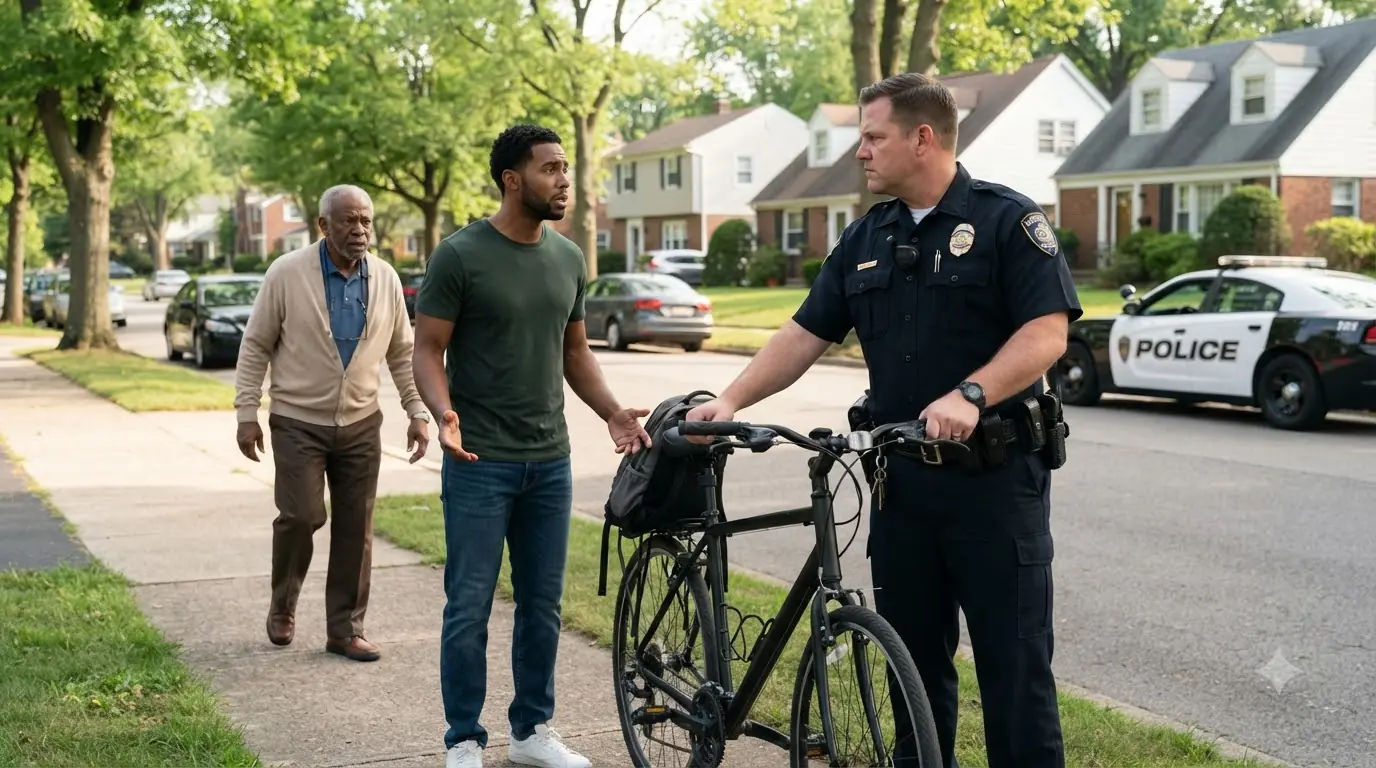
Nothing about the block felt urgent.
Then the blue-and-red flash bounced off a parked minivan and struck him across the chest like a command.
Jamal squeezed the brakes and glanced over his shoulder. The police cruiser had rolled up close behind him, almost too close, and now idled at an angle near the curb. The driver-side door opened immediately.
Officer Wade Mercer stepped out with the heavy certainty of a man who expected the world in front of him to stop moving because he had arrived. He was broad through the shoulders, his navy uniform crisp, his expression already set in that particular hard shape some officers adopted before a word had been spoken, as if suspicion were not a response but a default setting.
Jamal put both sneakers on the pavement and kept his hands where they could be seen.
“Afternoon, officer,” he said, because his mother and his grandfather had both raised him to make politeness the first tool, even when he had no reason to trust the person standing in front of him.
Mercer did not return the greeting. His eyes moved over the bicycle, then to Jamal’s face, then back to the bicycle again. He walked straight up to it and closed one hand over the handlebar.
“Where’d you get this bike?” he asked.
The question was so abrupt that Jamal blinked. “I bought it.”
“From where?”
“From Heritage Cycle on Grant Avenue. About eight months ago.”
Mercer kept his grip on the handlebar. “Got proof?”
Jamal felt the first pulse of disbelief. “You stopping me because of my bike?”
“I’m asking a question,” Mercer said.
“And I’m answering it. I bought it.” Jamal shifted the canvas strap higher on his shoulder. “I can pull up the receipt on my phone if you give me a second.”
Mercer’s face did not soften. “Leave your hands where I can see them.”
Jamal exhaled slowly through his nose. “You just asked me for proof.”
“I said leave your hands where I can see them.”
There it was, the trap hidden inside the exchange. Produce proof, but don’t move. Cooperate, but wait to be told the exact version of cooperation that would not be interpreted as defiance.
Jamal nodded once. “All right. My phone’s in my back pocket. If you want me to get it, I will. If not, I can tell you again where I got the bike.”
Mercer gave him a long look as traffic hissed past at the far end of the block. “ID.”