The first blow landed across Arvand Burlington’s ribs before he had finished taking his second breath beside the cruiser.
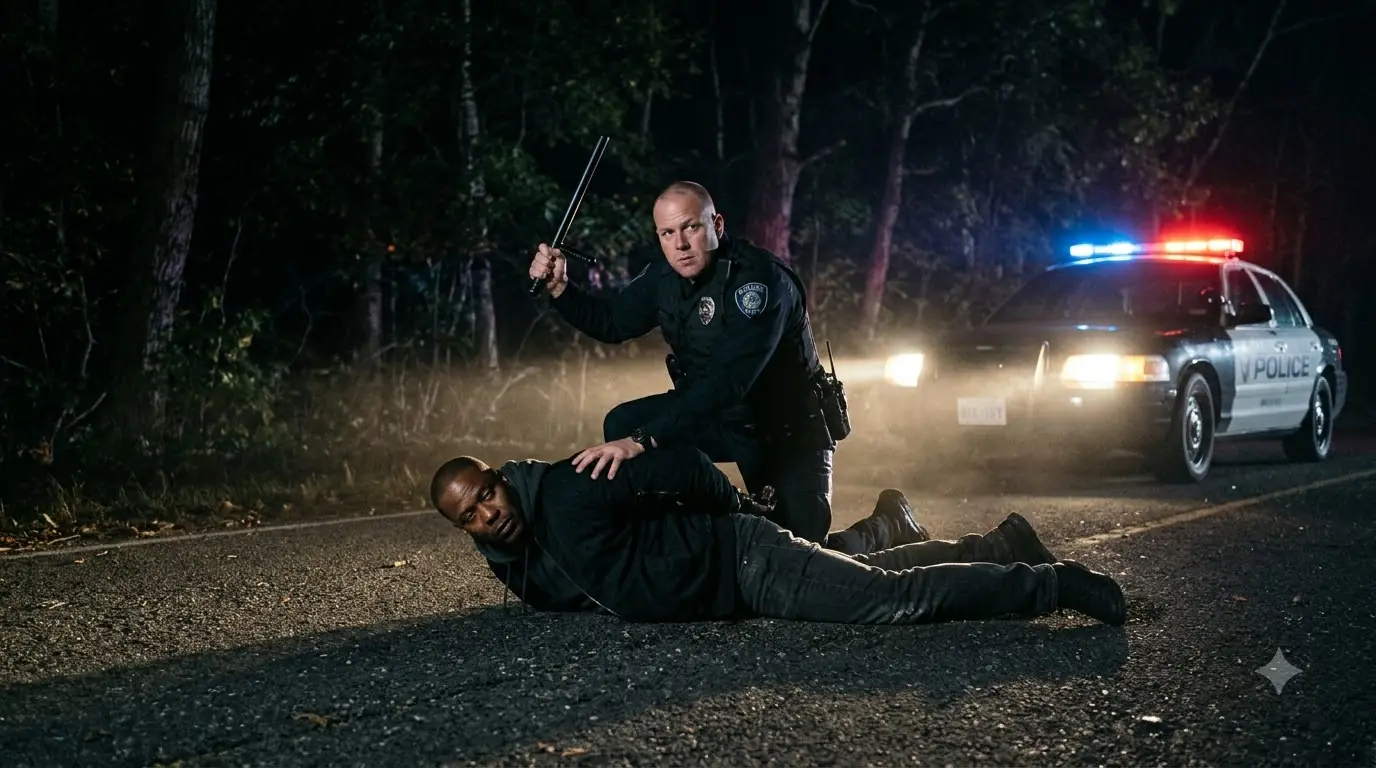
The sound was flat and ugly, wood against cloth and bone, not the sharp crack people expect from movies. Arvand’s body folded sideways against the cold metal of the patrol car, his shoulder striking the rear quarter panel hard enough to send a flare of pain up his neck. Red and blue light washed over the empty road, over the trees, over Officer Tommy Riker’s shaved head and contemptuous grin.
“Out here,” Riker said, close enough that Arvand could smell coffee on his breath, “I decide what happened.”
Arvand raised his empty hands higher.
He did not reach for the officer. He did not curse. He did not tell Riker what he did for a living, who knew where he was, or why he had been walking alone along County Road 18 after ten o’clock on a cold October night. He only watched the officer’s face and forced himself to remember details.
Distance from the cruiser.
Angle of the baton.
Which hand Riker used.
The patrol unit number painted near the rear panel.
The black rectangle of the body camera clipped to Riker’s vest.
And, when Riker leaned in to grab the front of Arvand’s jacket, the four digits stamped beneath the officer’s badge.
4417.
The number mattered.
Arvand made himself hold onto it even when Riker slammed him against the cruiser a second time.
“You deaf?” Riker said. “Hands where I can see them.”
“They are where you can see them.”
The answer was quiet. That seemed to anger Riker more than shouting would have.
“You got an attitude problem?”
“No.”
“Then why are you out here?”
“I was walking.”
“At ten at night.”
“Yes.”
“On a county road.”
“Yes.”
Riker smiled as if Arvand had confessed to something.
The patrol car’s headlights cut a bright tunnel down the asphalt. Beyond that tunnel, the road disappeared into darkness, bordered by wet leaves and narrow strips of grass silvered by the first hint of frost. There were no houses close enough to see clearly, no passing cars, no porch lights, no pedestrians. The nearest gas station was nearly four miles back toward Crestwood. The nearest traffic signal was farther still.
Riker had chosen his geography well.
Arvand knew that now.
Five minutes earlier, he had known only that a marked cruiser had rolled slowly past him, braked, reversed, and pulled onto the shoulder. The officer had stepped out already suspicious, already irritated, already speaking as if the most important fact in the scene was that he had arrived in uniform.
“What are you doing out here?” Riker had asked.
“Walking.”
“You live around here?”
“No.”
“Where’s your car?”
“Not here.”
“You carrying ID?”
Arvand had answered carefully. “Yes.”
“Give it to me.”
Arvand had asked why he was being detained.
That was the moment the night changed.
Not because the question was aggressive. It was not. Arvand’s voice remained even. But Riker’s face tightened as if the act of asking for legal context was itself a refusal to submit.
“Did I say you were detained?” Riker asked.