At 10:07 p.m., on a dark two-lane road at the edge of Crestwood, Connecticut, Officer Tommy Riker pressed one boot between Arvand Burlington's shoulder blades and lifted his baton for a second strike.
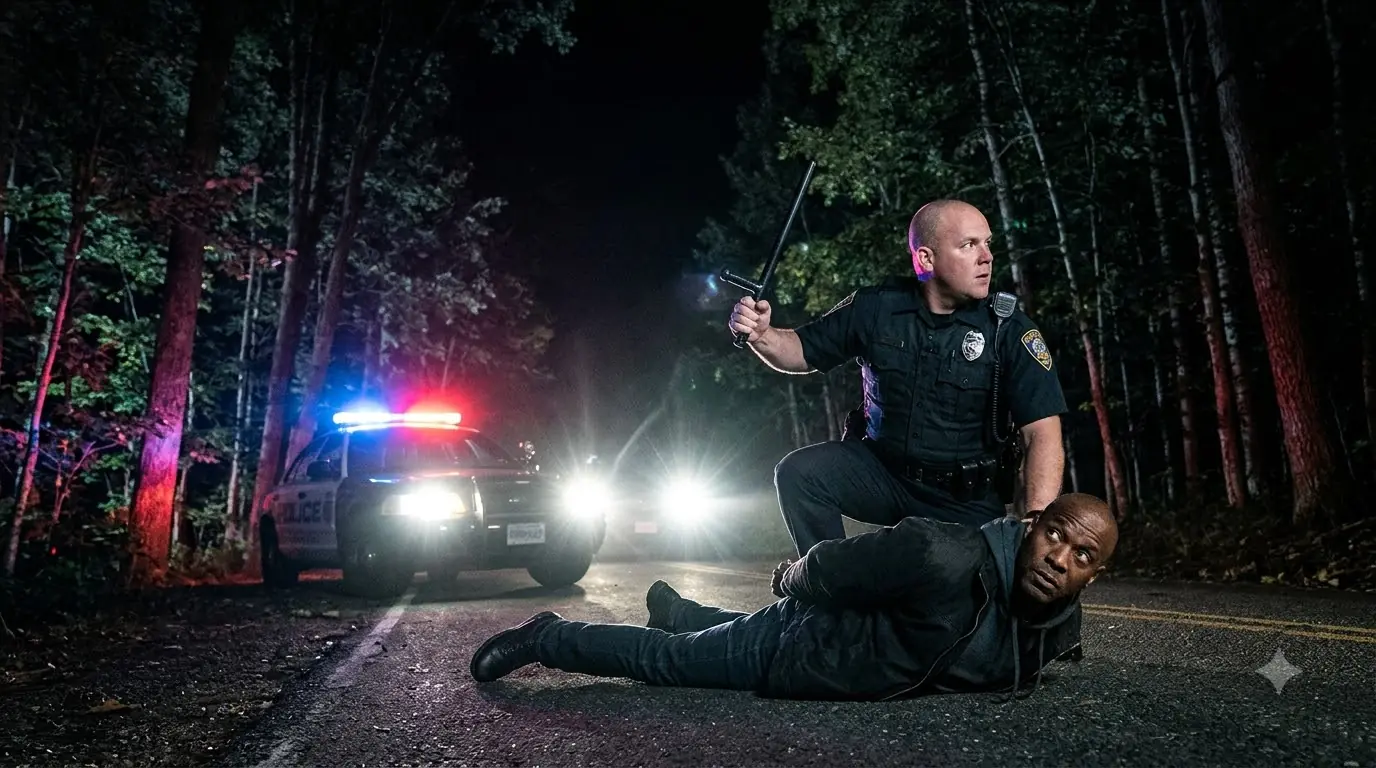
The road was empty except for the cruiser, its red and blue lights washing the trees in hard pulses. Arvand lay facedown on cold asphalt with his wrists cinched behind him, one side of his ribs burning where the baton had already landed. His cheek touched grit. His breathing was shallow, controlled, deliberate. He could taste iron where he had bitten the inside of his mouth when Riker threw him down.
"Out here," Riker said, almost conversationally, "I decide what happened."
Arvand turned his head just enough to look back. He did not pull against the cuffs. He did not kick. He did not curse. His eyes moved once to the badge, once to the cruiser number, once to the position of the body camera on Riker's chest.
Then he said, "Then make sure your story explains the recording."
Riker's expression changed for only a fraction of a second. The contempt returned quickly. He leaned more weight into his boot.
"Nobody knows you're here."
The baton rose.
The radio on Riker's shoulder crackled so sharply that both men heard it over the idle of the cruiser.
"Unit 4417, drop the baton and step away from him. Now."
Riker froze.
Approaching headlights swept through the trees behind him.
For the first time since the stop began, Arvand saw fear enter the officer's face.
It had started less than fifteen minutes earlier with something so ordinary Arvand almost drove past it without remembering.
He had been returning from an evening meeting on the west side of the county, not dressed for work and not driving a government vehicle. He wore dark jeans, a charcoal hoodie under a plain black jacket, and walking shoes. The sedan he had borrowed for the evening was unremarkable, a gray four-door car with clean registration and nothing in the back seat but a paper grocery bag, a folded umbrella, and a file envelope he had deliberately left unopened.
He had spent the day listening to people describe patterns that never looked dramatic when separated into individual incidents. A stop that lasted too long. A search that seemed to begin before consent was asked. A complaint that disappeared into a clerical loop. A report with language that sounded suspiciously similar to three others written months apart. A body-camera file that began after the important part. A supervisor who always seemed to find procedural explanations for the same officer.
Arvand had heard all of it without promising anyone an outcome.
That was one of the first rules he had learned in his profession: never promise what evidence has not earned.
He had also learned a second rule, much earlier and much more painfully.
When a person in authority begins deciding that their memory is more important than everyone else's record, pay attention.