Will Hadley had learned early that wanting too much was a dangerous habit for a poor man. In Crestfall, Wyoming, men like Edward Marsh spoke of land, cattle, and futures as if the world had been waiting for them to claim it. Will owned a livery stable at the south end of Main Street, where he spent his days shoeing horses, mending harness, cleaning stalls, and smelling of leather and hay. He was respected by the town, but respect was not the same as believing he deserved the finest woman in it.
Rose Callahan worked at her father’s general store across the street, and every morning Will saw her through the window before he opened the stable doors. She moved through the aisles with quiet purpose, tying brown paper parcels with twine, measuring flour, counting change, and smiling at children who came in with pennies for candy. She had golden-brown hair she often pinned back loosely, and her beauty had a softness that made men speak more gently around her. But it was not her beauty that troubled Will most; it was the way she looked at him like she had already chosen him and was waiting for him to understand.
For three years, Rose had stopped by the livery almost every afternoon. Sometimes she brought coffee in a tin cup, sometimes a slice of pie wrapped in cloth, and sometimes only a little story from the store to make him laugh. Will told himself she was kind to everyone, because believing otherwise would force him to be brave. He had faced half-wild horses, winter storms, and drunk cowboys with knives at their belts, but Rose Callahan’s patient affection frightened him more than any of them.
The trouble began on a dry August afternoon when the town shimmered under heat and dust. Rose had come by after closing the store for an hour, carrying a small parcel of nails her father had ordered for the livery. She laughed about Henderson’s mare kicking over a water bucket for the third time that week, and the sound caught in Will’s chest before he could defend himself. He leaned against the stable door, tried to make his smile careless, and said, “You’re too beautiful for a man like me.”
He meant it as a joke, or at least that was what he wanted her to think. He expected Rose to roll her eyes, call him foolish, or laugh it away the way she usually did when his pride got clumsy. Instead, she went still, the smile fading from her face as if he had touched an old bruise. A loose strand of hair moved across her cheek in the wind, but she did not brush it aside.
Rose stepped closer, close enough for Will to see flour dust on her sleeve from the store. Her eyes were steady, but there was hurt beneath them, deep and tired from being hidden too long. “But I’ve saved my heart for you,” she said softly. Then, before he could answer, before he could even breathe properly, she turned and walked back across Main Street.
Will stood there with the nails in his hand and the whole street moving around him as if nothing had happened. A wagon rolled past, a dog barked near the saloon, and two boys ran by chasing a hoop with a stick. None of it reached him. The words Rose had spoken stayed in the dust between his boots: I’ve saved my heart for you.
By sunset, every memory he had ignored began to return with cruel clarity. Rose staying after dark so he would have company when his mother was ill. Rose bringing warm bread after his mare died in winter. Rose laughing at his worst jokes and remembering small things nobody else noticed, like how he took coffee without sugar and hated gloves even when his hands froze. For years, she had been speaking without forcing him to answer, and he had mistaken her grace for patience without limit.
That evening, George Alcott found him in the livery, still holding the same piece of harness leather he had been oiling for nearly an hour. George was a short, weathered man who ran the blacksmith shop and considered silence a waste when truth could be used instead. He leaned against a stall door and watched Will avoid his eyes. “You heard Marsh is calling on Daniel Callahan tomorrow?” George asked.
Will’s hand tightened around the leather. “What does that have to do with me?”
George let out a tired breath. “For a man who can calm a spooked horse with one hand, you are blind with both eyes open.” He stepped closer, lowering his voice as the horses shifted behind them. “Edward Marsh is serious. He means to ask for Rose’s hand, and Daniel is not a fool. He knows security when it walks through the door.”
Will looked toward the general store, where the lamps were already lit. “Rose makes her own choices.”
“She does,” George said. “And she has been making one for years while you hid behind that stable door.” He waited for Will to deny it, but Will had no words left. “A woman can save her heart for a man, Will, but she cannot live forever on what he refuses to say.”
Sleep would not come that night. Will lay on his narrow bed above the livery, staring at the dark ceiling while the smell of hay and horses rose through the floorboards. Every excuse he had ever used began to sound cowardly when spoken inside his own head. Rose deserved better than a man who admired her from across the street and called it humility.
The next morning, he watched Edward Marsh ride into town. Marsh sat straight in the saddle, wearing a clean dark coat and a hat with a silver band. He owned the largest cattle spread in the county, had hired men, strong fences, and a reputation for never asking twice. When he dismounted outside the general store, Will felt something cold move through his stomach.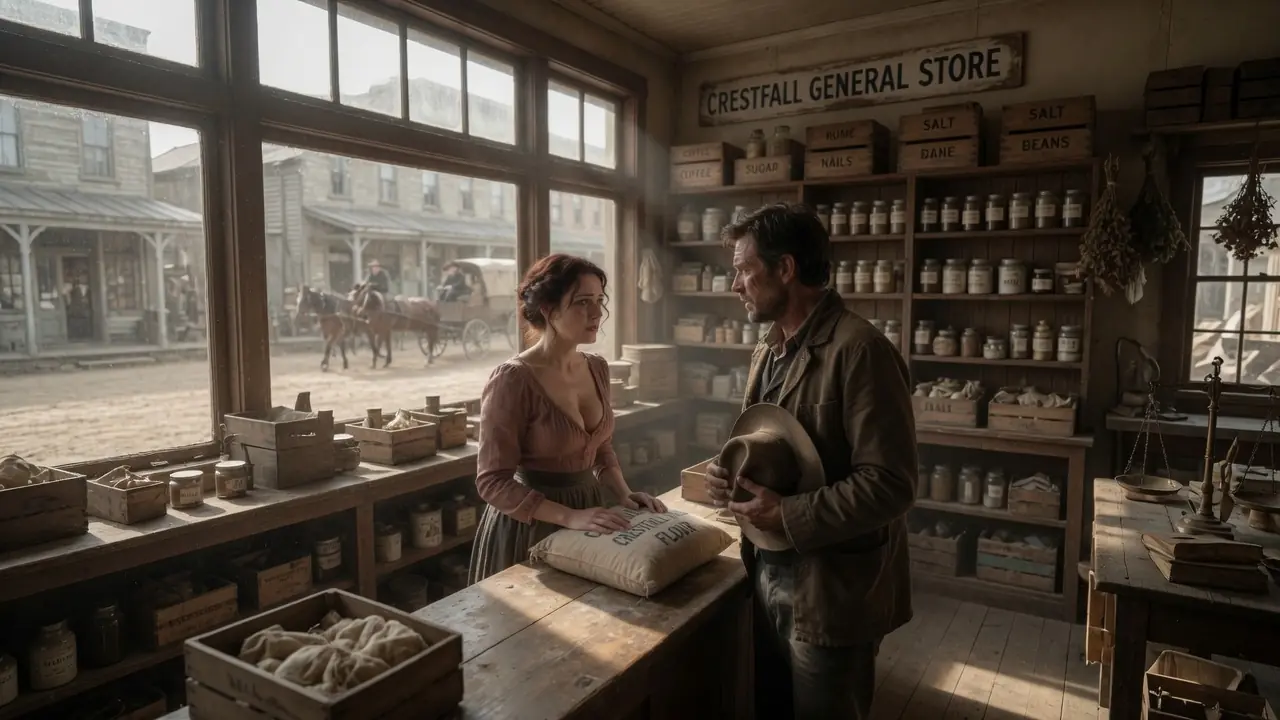
Rose came to the doorway when Marsh entered. She greeted him politely, her face composed, but Will noticed the way her hands clasped together at her waist. The old Will would have turned away, telling himself he had no right to interfere. This time, he walked across the street before fear could settle again.
The bell above the store door rang when Will stepped inside. Rose stood behind the counter while Marsh examined a shelf of coffee tins, though everyone knew he had not come for coffee. Her eyes moved to Will, and nothing in her face softened. That hurt, but he deserved it.
“Miss Callahan,” Marsh said, glancing at Will with mild irritation. “I was just discussing tomorrow evening with your father.”
Will removed his hat. “I need to speak with Rose.”
Marsh’s jaw shifted, but he was too proud to make a scene. “Then I will return when business is less crowded.” He gave Rose a respectful nod and walked out, his boots striking the floor with controlled force. The bell rang again, and the store became terribly quiet.
Rose looked at Will across the counter. “You should not have done that unless you know why you came.”
“I know.”
“Then say it.”
Will swallowed, gripping his hat with both hands. “Don’t answer him yet.”
Her eyes flashed with pain. “You had years, Will.”
“I know.”
“No,” she said, stepping from behind the counter. “I do not think you do. Years are not nothing. Years are mornings and seasons and women learning not to ask for what should be freely given.”
Will lowered his eyes, shame burning through him. “I thought you were too beautiful for me.”
“That was never your choice to make.” Her voice trembled slightly now, but she kept it steady. “You made yourself poor before I ever asked what you had. You decided my heart needed land and cattle when it only wanted truth.”
Will looked up at her then. “I love you.”
Rose closed her eyes for half a second, as if the words hurt because they had come so late. “Say it again.”
“I love you,” he said, stronger this time. “Not because Marsh came. Not because I’m afraid of losing to him. I love you because every morning I look for your face before I look at the day.”
Her fingers pressed against the counter. “Then why did it take another man to make you speak?”
The question was fair, and that made it cruel. Will took a breath that seemed to scrape his lungs. “Because I was certain you would always be here. I was wrong, and I was selfish in thinking waiting cost me nothing when it was costing you everything.”
Rose looked at him for a long moment. Outside, a wagon wheel creaked and someone called for flour from the street. Inside, neither of them moved. Finally, she said, “Marsh will come to my father’s house tomorrow evening.”
“I know.”
“If you mean what you say, come tonight. Speak to my father before Marsh does.” Her voice softened but did not lose its firmness. “I will not marry a man who must be dragged to courage every time love asks him to stand.”
Will placed his hat back on his head. “I’ll come.”
Rose held his gaze. “Do not come with poetry. Come with a plan.”
That evening, Will washed his hands until the dirt beneath his nails faded, changed into his best shirt, and combed his dark hair twice in a cracked mirror. He had no grand estate to offer, no cattle empire, no family name that could fill a bank ledger. But he had the stable, two healthy horses of his own, savings buried under a loose floorboard, and a heart that had finally stopped pretending it was empty. When he walked to the Callahan house, every step felt heavier than the last.
Daniel Callahan sat on the porch with a pipe in his hand, watching Will approach as if he had expected him. Daniel was a widower with a calm face and sharp eyes, a man who had raised Rose to be kind but not foolish. He lowered his chair from its tilted position and nodded once. “You’re early.”
“I didn’t want to be late anymore,” Will said.
Daniel studied him, and something like approval flickered across his face. “She’s in the kitchen.”
Rose stood at the table rolling dough, sleeves pushed to her elbows, with evening light falling across her shoulders. She did not smile when Will entered. That steadied him more than a smile would have, because it reminded him this was not a dream to be won easily. This was a woman asking to be met with truth.
“You came,” she said.
“I said I would.”
She set the rolling pin down. “Then speak.”
Will looked from Rose to Daniel, who had stepped into the doorway behind him. “Mr. Callahan, I love your daughter. I have loved her badly by hiding it, and I have hurt her by deciding what she deserved without asking her. I cannot offer the land Edward Marsh can offer, but I can offer a home built with my own hands, honest work, and a promise that she will never again have to wonder if I choose her.”
Daniel’s expression did not change. “You run a livery, Will. Winters are hard. Horses go lame. Men leave town without paying. Love does not put flour in a barrel by itself.”
“No, sir,” Will said. “That is why I have accounts ready for you to see. The stable is profitable. I have savings enough to add two stalls before winter and a contract with the stage line beginning next month. If Rose marries me, she will not be stepping into riches, but she will not be stepping into hunger.”
Rose’s eyes softened at the word “accounts,” because he had listened. Daniel’s eyes narrowed slightly, but not with anger. “And if she wishes to keep working at the store?”
Will turned to Rose. “Then she keeps working. Or she keeps the books at the stable. Or she does neither if she chooses. I am not asking for a woman to stand behind me. I am asking for Rose to stand beside me.”
The kitchen fell quiet.
Daniel looked at his daughter. “Is this what you want?”
Rose breathed in slowly. “Yes. If he keeps speaking this plainly.”
Will almost smiled, but he did not want to ruin the moment with relief too soon. Daniel nodded and reached for his pipe again. “Then you have my permission to call on her properly. But understand this, Hadley. If you make my daughter feel alone while standing next to you, I will not care how honest your accounts are.”
“Yes, sir.”
The next evening, Edward Marsh arrived at the Callahan house at exactly six o’clock. His coat was clean, his boots polished, and his expression carried the calm certainty of a man accustomed to doors opening. Rose met him on the porch before he could knock twice. Will stood across the street near the livery, not hiding, not interfering, simply waiting.
Marsh removed his hat. “Miss Callahan, I have come to ask you something serious.”
“I know,” Rose said.
“I can offer you stability. Land. A respected name. I believe we would make a sensible life together.”
Rose listened without interrupting, because Edward Marsh deserved respect even if she could not give him her heart. When he finished, she folded her hands and met his eyes. “You are a good man, Mr. Marsh, and I am honored by your regard. But I have already given my answer elsewhere.”
His face tightened, but his voice remained controlled. “To Hadley?”
“To Will.”
For a moment, Marsh said nothing. Then he put his hat back on. “He is fortunate.”
“I hope one day he knows it every morning.”
Marsh nodded once. “Then I wish you well, Miss Callahan.” He walked down the steps, mounted his horse, and rode away without looking back. Will watched him pass, feeling no victory over the man, only gratitude that Rose had been free to choose.
Rose crossed the street toward Will as dusk gathered over Crestfall. She stopped in front of him, her face unreadable. “I told him no.”
Will’s breath left him slowly. “And what will you tell me?”
“That depends,” she said.
“On what?”
“On whether you keep walking toward me after the fear is gone.”
Will reached into his coat pocket and removed a small velvet pouch. His hand shook slightly as he opened it, revealing a simple gold band that had belonged to his grandmother. “Rose Callahan, will you marry me?”
Her eyes filled, but her voice stayed clear. “Yes, Will Hadley. I will.”
When he slid the ring onto her finger, it fit as though it had been waiting longer than either of them had. Rose looked down at it, then up at him, and finally smiled the way she used to smile before waiting had begun to hurt. Will took her hand carefully, still not quite believing he was allowed to hold it. This time, he did not let go.
They married three weeks later in the little white church near the edge of town. Half of Crestfall filled the pews, including George Alcott, who sat with his arms crossed and pretended the dust in his eyes had nothing to do with emotion. Daniel Callahan walked Rose down the aisle, his face proud and sad in the way fathers become when giving away a daughter who is not truly leaving them. Will stood at the front, shoulders straight, eyes fixed on Rose as if looking away would be a sin.
Their vows were simple. Rose promised not to punish him forever for the years he had wasted, but to remind him whenever pride started wearing humility’s coat. Will promised not to decide her worth for her, not to hide behind poverty or fear, and not to let silence do the work love was meant to do. The town smiled at that, though most did not understand how deeply he meant it.
Marriage did not turn life into a song. The livery still smelled of sweat, leather, and difficult horses. Bills still came due, winter still bit hard, and Will still sometimes grew quiet when worry settled on him. But now Rose noticed the quiet before it became a wall, and Will had learned to speak before fear hardened inside him.
Rose kept the books better than Will ever had. Within a year, the stage line contract expanded, and she convinced him to add a small supply counter inside the livery for travelers who needed gloves, straps, and brushes. Men who once came only for horses began stopping because Rose remembered what they needed before they asked. Will joked that she was turning the stable into a store, and she told him someone had to make it profitable.
Two children came in time, first a boy with Will’s stubborn chin, then a girl with Rose’s steady eyes. Their home behind the livery filled with noise, spilled flour, small boots, and arguments over who got to feed the mare. Sometimes Will would come in from the stable and find Rose at the kitchen table, hair loose, sleeves rolled, a child in her lap and account books open beside her. In those moments, he understood how close he had come to losing the shape of his entire life.
Six years after that August afternoon, Will found Rose hanging laundry in the yard while evening light spread over the mountains. She wore an old blue dress, her hair pinned badly because their daughter had tried to help. Will stopped at the gate and watched her, not from fear this time, but from wonder. Rose turned and caught him staring.
“You used to look away,” she said.
“I was a fool.”
“Yes,” she replied, smiling. “But you improved.”
He walked to her and took the basket from her hands. “I almost lost this.”
Rose looked toward the house, where their children were arguing over a wooden horse. “You almost did.”
“I know.”
She touched his face, rough with day-old beard and sun. “But you spoke before it was too late.”
Will leaned his forehead against hers. “And you waited longer than I deserved.”
Rose’s smile softened. “I waited until waiting became less loving than telling the truth. After that, you had to choose.”
He wrapped his arms around her, holding her in the golden Wyoming light. The mountains stood still beyond town, the livery doors creaked in the wind, and Main Street carried on with its wagons, horses, and ordinary noise. But Will no longer listened from a distance.
He had once thought Rose Callahan was too beautiful for a man like him. Now he understood that love had never asked him to be richer, grander, or less afraid. It had only asked him to be honest enough to reach for the heart already offered.
And every morning after, when he opened the livery doors and saw Rose across the yard, he remembered the day she whispered the truth that saved him from himself. He had not won her by becoming another man. He had won her by finally becoming brave enough to stand as the man she had seen all along.