At twenty-three, Nora Lindgren returned to her family’s cattle ranch in Rice County, Kansas, with a green spiral notebook, two years of university research, and an idea nearly every experienced rancher around her considered ridiculous. She was striking in a way that seemed inseparable from the land—sun-kissed skin, sharp brown eyes, and long dark hair usually woven into a thick braid beneath a wide tan ranch hat. Her fitted khaki work shirt, worn jeans, and rugged boots made it clear she had not come home to pose beside the cattle or talk about farming from an air-conditioned office. She had come back to protect the one piece of the ranch everyone else wanted destroyed.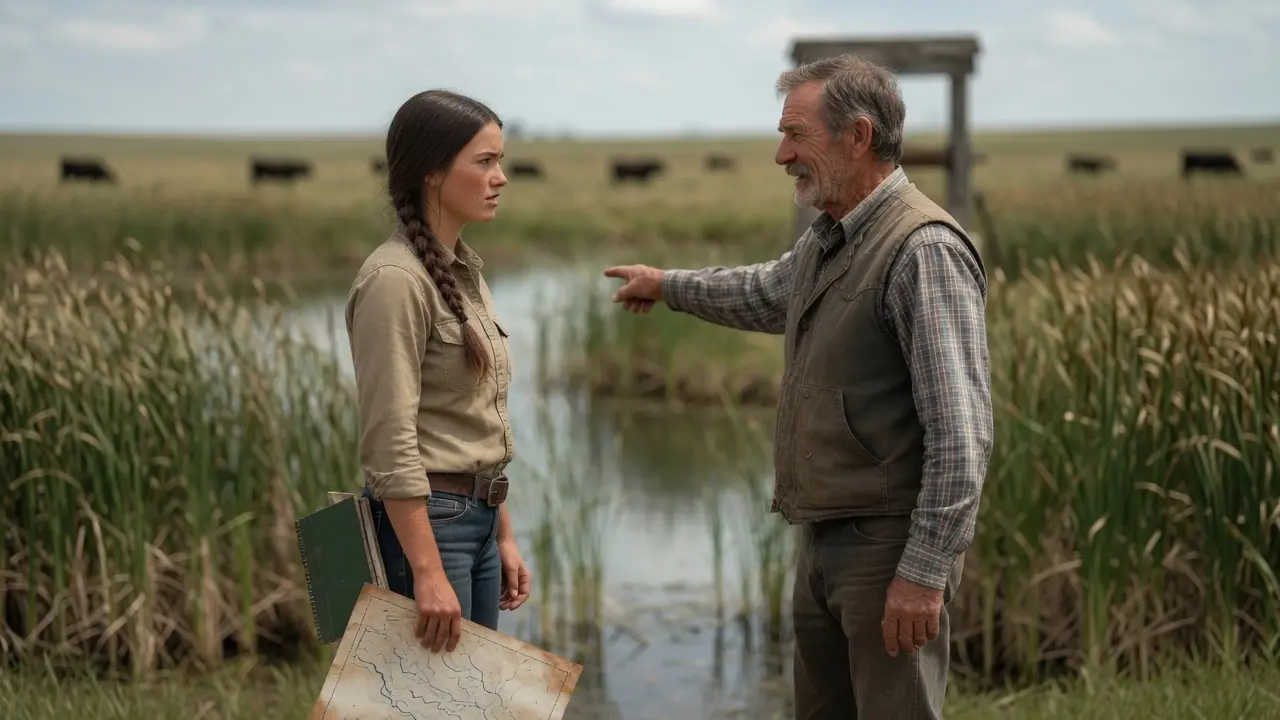
That piece was a fourteen-acre natural slough in the northwest corner of the Lindgren property. Every spring, runoff collected in the low ground, filling it with shallow water bordered by cattails, sedges, and thick wet soil. By midsummer, the visible water usually retreated, leaving patches of mud and tall vegetation that many neighbors considered ugly. To them, the slough was wasted land that could have been drained and converted into additional pasture.
Nora’s father, Emmett Lindgren, had heard that argument for thirty years. Contractors had offered to dig drainage channels and install underground tile, promising to turn the wetland into productive acreage. Dale Crowley, one of the county’s most respected cattlemen, reminded Emmett almost every time they met that a serious rancher could not afford sentiment. Emmett had resisted only because the drainage work was expensive and the ranch was surviving without it.
Nora opposed the project for a different reason.
At Kansas State University, she had studied range management, soil structure, and prairie hydrology. Her professors taught her that a natural wetland did more than hold visible surface water. During the wet months, the slough slowly pushed moisture into the soil below it, replenishing shallow groundwater and preserving moisture beneath surrounding pasture long after nearby ponds appeared dry.
She had read studies from Kansas and Oklahoma comparing cattle ranches with intact wetlands to ranches where low ground had been drained. In normal years, the difference seemed small. During severe droughts, however, pasture surrounding an intact slough remained usable for weeks longer, and nearby shallow wells continued producing when other wells failed.
Those extra weeks could determine whether a family kept its breeding herd or sold it at a loss.
Nora spread her research across the kitchen table three weeks after coming home. Her green notebook contained soil diagrams, rainfall records, estimated water movement, and calculations comparing potential crop income to the value of livestock saved during drought. She had also drawn a map showing the old hand-pump well her grandfather dug in 1951, located less than three hundred feet from the slough’s eastern edge.
Emmett listened for nearly an hour without interrupting. His weathered face revealed little as he examined the numbers, turned several pages, and studied his daughter’s map. Nora’s mother, Diane, sat at the other end of the table with a mug of coffee, watching both of them.
When Nora finished, Emmett closed the notebook.
“I need to think about it.”
He put on his cap and left to check the cattle.
Diane waited until the screen door closed behind him. “You’re right,” she said quietly.
Nora looked up.
“Your father knows it too,” Diane continued. “He just hasn’t decided whether being right is enough to change what he understands.”
Two weeks later, Emmett gave Nora permission to fence a forty-foot buffer around the slough. He did not announce that the drainage plan was canceled. He simply stopped discussing contractors and allowed her to protect the wetland margin from cattle trampling.
For Emmett, that was nearly the same as a public endorsement.
Nora installed the fencing herself. She cleared debris from the old well, repaired the hand pump, and sent a sample to the county office to confirm the water remained safe for livestock. Then she placed a measuring stake near the slough and began recording water depth every Monday morning.
She also measured the well level, rainfall, soil moisture, and grazing conditions in nearby pastures. Every observation went into the green notebook. There were no dramatic discoveries that first year.
The slough filled in spring, retreated during summer, and looked almost exactly as it had throughout Nora’s childhood. The cattle grazed normally, the well produced water, and the surrounding pasture performed about the same as the rest of the ranch. Dale Crowley’s drained ground produced a strong cutting of hay.
Nothing happened to prove Nora right.
That June, Emmett brought her to the Rice County Cattlemen’s Association meeting. More than thirty ranchers sat inside the county extension building while an adviser gave a familiar presentation about grazing rotation and summer feed planning. Nora listened quietly until the open discussion turned toward drought preparation.
Then she raised her hand.
“I’d like to discuss natural wetland retention,” she said after being recognized. “There is evidence that undrained sloughs preserve groundwater and extend usable forage during severe dry periods.”
The room changed.
Men who had been whispering to one another stopped and looked at the young woman standing with a notebook against her chest. Most of them had known Nora since she was a child. They remembered her chasing frogs through the same wetland she now described as a drought-management asset.
Dale Crowley leaned back in his folding chair.
He was fifty-eight, broad, weathered, and accustomed to being the most confident voice in any agricultural conversation. He had drained two wetland depressions on his own property and proudly converted them into hay ground. If Nora’s research was correct, then his improvements might have removed his best natural protection against drought.
He let her finish.
“Ms. Lindgren,” he said, smiling, “I appreciate the enthusiasm. But leaving fourteen acres of standing water and cattails is not drought preparation.”
Nora held his gaze.
“That ground is recharging the well and the surrounding pasture.”
Dale’s smile widened. “That swamp is sentiment, not range management.”
Several men laughed.
Nora did not.
Dale pointed toward her notebook. “When a real drought comes, that wet hole will evaporate, your cattle will eat the surrounding grass bare, and you’ll sell your herd before anyone who used the land properly.”
Nora closed the notebook.
“Come back in August,” she said. “Your empty land will apologize before you do.”
The laughter stopped.
On the drive home, Emmett said nothing for several miles. Nora watched the flat landscape passing outside the pickup window and wondered whether he was embarrassed that she had challenged Dale publicly.
Finally, Emmett spoke.
“You handled yourself fine.”
“I know.”
He glanced at her. “That answer sounds like your mother.”
“Then it’s probably right.”
Another mile passed.
“Manage the northwest pasture however you think is best,” he said. “We’ll see what the numbers say.”
Nora’s work remained unimpressive through most of 2009. She rotated cattle away from the wetland margin, protected the reeds and deep-rooted grasses, and continued recording water levels. Neighbors driving along County Road 14 saw the new fence and assumed Emmett was indulging his daughter’s university experiment.
In 2010, rainfall dropped below normal.
By late July, the southern pastures began turning brown. Grass surrounding the slough remained usable almost three weeks longer, though it was shorter and less productive than during a wet year. The difference was noticeable enough that Emmett stood near the dividing fence one evening, comparing the green-gray northwest grass with the dry southern field.
Nora walked up beside him.
“You see it.”
“I see grass.”
“Grass growing because the soil still has moisture.”
Emmett kept his eyes on the pasture. “One dry year doesn’t prove your whole theory.”
“No.”
She did not push him.
At the end of the season, Nora’s records showed the slough-adjacent pasture had provided nineteen percent more grazing days during the driest part of summer. The nearby well had dropped, but much less than monitored wells elsewhere in the county.
She wrote down the figures and waited.
The following year was drier.
By mid-July, the southern fields had become pale and brittle. The northwest pasture held into early August, and the hand-pump well continued producing clear water. Nora measured a twenty-six-percent advantage in usable grazing days near the slough.
Word began moving through the county.
Nobody made formal announcements. Ranchers simply noticed that Lindgren cattle remained on grass after many neighboring herds had begun receiving expensive supplemental feed. Men mentioned the difference at the cooperative store and grain elevator.
Dale Crowley dismissed the reports as coincidence.
At the autumn cattlemen’s meeting, Nora presented two years of measurements. She showed well depths, soil-moisture readings, grazing records, and comparisons between fields. She did not mention Dale’s laughter or describe the slough as a victory.
She simply read the numbers.
The room listened.
When she finished, Dale said the evidence was interesting but insufficient. He wanted several more years of observation before accepting that one wetland had caused the difference.
His tone was less amused than before.
The county extension adviser, Phil Garrett, approached Nora after the meeting. He asked for copies of her measurements and told her the data was more complete than records collected from many commercial operations. Nora gave him the relevant pages.
She still had nothing resembling final proof.
Then 2012 arrived.
Spring rain failed.
By June, central Kansas entered exceptional drought, the most severe category used by federal monitors. Rainfall remained far below normal, temperatures climbed, and hot wind stripped moisture from exposed ground. Stock ponds shrank rapidly.
Creeks stopped moving.
By July, shallow wells across Rice County began pulling mud and air. Cattle gathered along empty pond banks and bawled for water that was no longer there. Pastures turned from green to yellow, then from yellow to gray.
Dale Crowley’s drained fields produced almost nothing.
His stock ponds became cracked basins, and the wells serving his northern pasture failed one after another. He hauled water for several weeks, but fuel costs and limited truck capacity made the effort impossible. By the first week of August, he began selling cattle.
He was not alone.
Truckloads of breeding cows arrived at auctions across the region. Ranchers who had spent decades building strong herds sold animals into a collapsing market because they had no grass and nowhere to water them. Prices dropped as desperation increased.
At the Lindgren ranch, conditions were also severe.
The slough did not remain beautiful and full. By late July, it had shrunk to less than half its normal size. Mud cracked around the margins, cattails turned pale, and only a shallow pool remained in the center.
Yet water was still moving underground.
The grass surrounding the wetland was stressed but alive. Its roots reached moisture stored deeper in the soil, allowing enough growth to support grazing longer than any other pasture on the ranch. The hand-pump well stood at twenty-six feet and continued producing.
Emmett moved the herd north.
When the southern pasture failed, the cattle entered the slough-adjacent field. When the eastern ground became unusable, they returned to the same northwest corner. Nora adjusted the rotation carefully, preventing the animals from destroying the surviving roots.
They purchased supplemental feed, but they did not need to haul every drop of water from town. The old well provided enough for the herd when combined with a storage tank Nora installed near the fence. Each day that water rose through the pump felt like a quiet answer to every person who had laughed.
By mid-August, Dale had sold more than half his breeding herd.
He drove past the Lindgren ranch one afternoon and slowed near the fence. Nora stood near the well filling the livestock tank while cattle grazed the pale but living grass behind her.
Dale did not stop.
Nora watched his pickup continue north and felt no satisfaction. Seeing another family lose years of work was not victory. She had never wanted the drought to prove her right.
She wanted the county prepared before it arrived.
The Lindgrens survived the summer with their herd intact. Their cattle lost some weight, feed costs rose sharply, and every decision became difficult. But they avoided the emergency liquidation that devastated neighboring operations.
When the first meaningful autumn rain finally arrived, Emmett stood beneath the barn roof and watched the water strike the dry yard.
Nora was wrapping a heifer’s injured leg nearby.
“You were right,” he said.
She finished securing the bandage before looking up.
“I know.”
There was no cruelty in the answer. She had known because the evidence was clear long before the drought.
Emmett removed his cap.
“From now on, you choose the pasture rotation. You decide what we plant, what we protect, and where we move the cattle.”
“All of it?”
“All of it.”
He looked toward the northwest field.
“I nearly drained the reason we still have a herd.”
Nora’s expression softened. “You didn’t.”
“Because you came home.”
He put his cap back on and walked toward the rain.
The county extension office published a drought assessment that November. Phil Garrett compared operations across Rice County and found that ranches retaining natural wetland features maintained water and forage longer than comparable properties where wetlands had been drained. Nora’s three years of measurements became the strongest local data set in the report.
He sent her a copy before publication.
A handwritten note appeared on the first page.
Your methods were sound. Your conclusions were correct. Keep measuring.
Nora placed the note inside her green notebook.
In December, Dale Crowley drove to the Lindgren ranch.
He remained inside his pickup for nearly a minute before stepping out. He wore his good canvas coat and clean ranch hat, as if he had dressed for an important business meeting. Nora met him near the driveway.
“I heard your well held all summer,” he said.
“It did.”
Dale looked toward the frost-covered slough.
“I have an eight-acre low spot on my northern ground. Fills in April and stays wet through June. I planned to drain it next spring.”
Nora waited.
“I want to know what you think I should do.”
She studied him.
“What did you call my research at the meeting?”
His jaw tightened. “Sentiment.”
“You laughed.”
“I did.”
“You told me I’d sell my cattle first.”
Dale lowered his eyes. “I was wrong.”
The apology carried more weight because he did not decorate it with excuses.
“Don’t drain the low ground,” Nora said. “Fence the margin and keep cattle out when the soil is wet. Start measuring your well level in spring. Record it every week.”
Dale nodded.
“Anything else?”
“Come back after summer with the numbers.”
He extended his hand.
Nora shook it.
Within two years, four other ranchers asked for her help. Some had wetlands they intended to drain, while others wanted to restore low ground damaged by old channels. Nora visited their properties, examined the soil, and helped them establish simple monitoring systems.
She never charged them.
The slough’s value did not depend on keeping the knowledge secret.
By 2015, Nora was invited to speak at a state drought-resilience workshop. She stood before extension agents, ranchers, and university researchers wearing her work shirt, jeans, and ranch hat. Her green notebook rested on the podium.
For forty-five minutes, she explained what happened from 2009 through 2012.
She showed the shrinking waterline, well records, grazing comparisons, and the financial cost avoided by keeping the herd. She made clear that the wetland had not created rain or eliminated hardship. It simply preserved water and forage long enough to give the family choices.
When she finished, the audience stood and applauded.
Emmett sat in the third row beside Diane.
He had attended dozens of agricultural meetings without rising for anyone. This time, he stood first.
Nora saw him and understood that she had won something more lasting than an argument. Her father no longer treated her knowledge as an experiment borrowed from university books. He trusted her to guide the land that had defined their family for generations.
Years passed.
Wetland retention became part of drought planning across the region. Ranchers began protecting sloughs they once regarded as useless. Dale’s eight-acre depression remained untouched and helped keep his well operating during later dry summers.
He eventually told the cattlemen’s association how he had laughed at Nora.
Nobody laughed when he told it.
By then, the Lindgren slough had become known throughout Rice County. Visitors expected something impressive, perhaps a deep lake surrounded by perfect pasture. Instead, they found shallow water, muddy edges, reeds, frogs, and a heron standing motionless among the cattails.
Nora always smiled at their disappointment.
The slough’s greatest work happened underground where nobody could see it.
Years later, Nora’s teenage daughter approached the same farmhouse table carrying a notebook and research about restoring soil through winter cover crops. She had mapped three southern fields and calculated how different planting methods might reduce erosion.
Nora studied the pages.
She remembered standing at that table while Emmett told her he needed time to think. She remembered Dale’s laughter and the dry summer when cattle drank from a well everyone assumed would fail.
Her daughter waited nervously.
Nora pushed back the chair.
“Show me what you’re thinking.”
They spread the map across the table together.
Outside, the fourteen-acre slough remained in the northwest corner of the ranch. Spring water rested between cattails while moisture slowly moved into the soil beneath it. The old hand pump stood nearby, ready for another dry year.
People had called the wetland useless.
They had called Nora emotional, inexperienced, and foolish.
Then the drought came.
The ponds failed, the wells emptied, and cattle disappeared from neighboring pastures. But the slough held what everyone else had thrown away.
It held water.
It held the herd.
And because one beautiful young farmer trusted the land more than the laughter surrounding her, it held the future of the Lindgren ranch.