The laughter began before Naomi Carter had finished the first row.
A pickup slowed beside the Carter Orchard while two men leaned through the open windows to stare at the white-painted trunks. One shouted that apple trees were not fence posts. The other asked whether Naomi planned to paint the fruit next. Their laughter followed the truck down the road, loud enough to reach her even after the vehicle disappeared beyond the hill.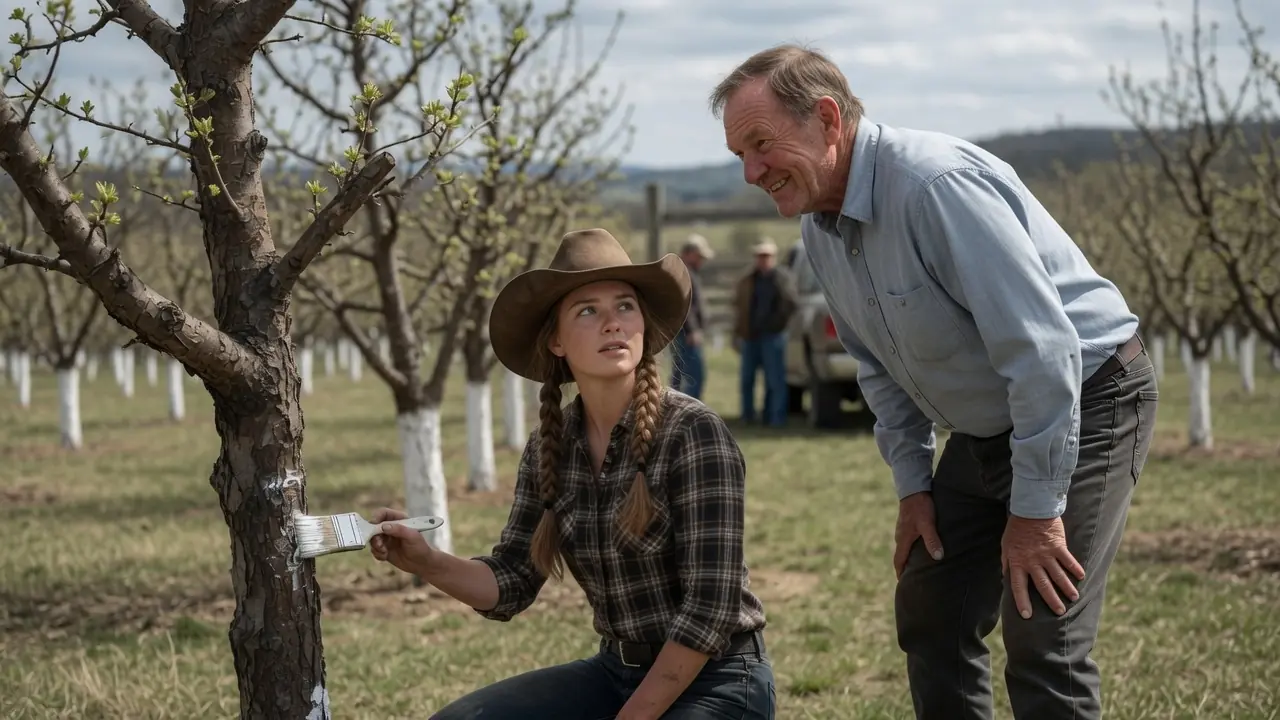
Naomi remained on one knee in the cold soil. A wide brown hat shaded her green eyes, and two long braids rested against her black-and-brown plaid shirt. White paint marked both sleeves, her gloves, and one muddy boot. She dipped the brush into the bucket again and covered the southwest side of the next Honeycrisp trunk.
She had learned not to answer people who laughed before asking questions.
By noon, four vehicles had slowed near the orchard. By evening, someone had posted a photograph of Naomi online with the caption: LOCAL GIRL GIVES TREES A MAKEOVER. The post collected dozens of laughing reactions before dinner. Even people who had known her father for years joined the joke.
Naomi’s mother, Ruth, found her washing brushes behind the barn after sunset.
“You can stop for tonight,” Ruth said.
“I have twenty-three more trees in the north section.”
“It will be dark in thirty minutes.”
“The temperature drops tomorrow.”
Ruth looked across the orchard. White trunks stood in straight rows beneath bare branches, bright against the brown winter landscape. The sight was unusual, but Ruth had watched her daughter study those trees for nearly two years. She knew Naomi was not decorating them.
“You’re sure about this?” Ruth asked.
“No,” Naomi answered. “I’m sure enough to test it.”
That was the difference between Naomi and the men laughing from their trucks. They spoke as though experience made doubt unnecessary. Naomi treated doubt as a reason to measure more carefully.
The Carter Orchard covered eleven acres on the colder side of an Iowa valley. Naomi’s father, Elijah Carter, had planted the first trees twenty-one years earlier. He never became wealthy, but he built a reputation for clean fruit, honest weights, and a willingness to help neighboring growers during harvest.
He died eighteen months before Naomi picked up the paintbrush.
A heart attack took him in the south row while he was inspecting bark damage after a hard winter. Naomi found his pruning shears beneath tree nineteen, his favorite Honeycrisp. She kept them in the top drawer of his desk and had not used them since.
Elijah left behind the orchard, an aging barn, a small farmhouse, and more debt than Ruth had understood. A regional produce company offered to buy the land within two weeks of his funeral. Harlan Pike made his first private offer three days later.
Harlan owned the largest orchard operation in the county. His workers managed more than four hundred acres, and his name appeared on roadside signs, produce boxes, and local agriculture boards. He told Ruth that selling was the sensible choice because Naomi was too young to manage a commercial orchard.
Naomi was twenty-two then.
She refused the offer before her mother could answer.
For the next eighteen months, she worked the orchard while completing agricultural courses online at night. She learned equipment repair from old manuals, negotiated smaller supply contracts, and delivered fruit herself when buyers tried to reduce the price. She also continued the morning habit her father had taught her as a child.
She walked the rows and listened to the trees.
Elijah used to stop beside a trunk and ask what had changed since the previous week. He taught Naomi to notice bud swelling, leaf color, soil moisture, insect damage, branch angles, and the direction of bark cracks. He believed trees repeated warnings long before they failed.
After his death, Naomi began recording those warnings.
She carried a spiral notebook in her back pocket and assigned every tree a number. She marked weak growth, old injuries, soil conditions, and the exact position of each bark split. At first, the notes were a way to feel close to her father. Gradually, they revealed something he had suspected but never fully documented.
The winter damage was not random.
Nearly every serious crack appeared on the southwest side of the trunk. The injuries were most common after bright winter afternoons followed by sudden nighttime temperature drops. Dark bark absorbed the afternoon sunlight, warming the living tissue beneath it. When darkness arrived and the temperature collapsed, the activated tissue froze.
The result was southwest injury, commonly called sunscald.
Naomi found the explanation in old university bulletins and orchard guides. Several recommended diluted white latex paint because the pale surface reflected sunlight, preventing the trunk from warming too quickly. The treatment did not make the tree warmer.
It helped the tree remain cold.
The idea sounded backward until she compared it with her maps. Every detail matched: the side of the trunk, the timing, the long vertical cracks, and the weak spring growth that followed.
Naomi tested the coating on twelve trees during the previous winter. None developed new southwest splits. Ten untreated trees of similar age showed three fresh injuries.
That was not enough data to prove everything, but it was enough to justify a larger trial.
Harlan arrived on the second morning.
He parked his spotless pickup beside the gate and walked into the orchard without asking permission. At sixty-one, he carried his success like another layer of clothing. His pale blue shirt was clean, his boots had never touched Naomi’s wet rows, and his expression suggested he had come to inspect damage rather than speak with another grower.
He picked up one of her paint buckets and read the label.
“Exterior latex,” he said. “You know trees breathe, don’t you?”
“The mixture is diluted.”
“Paint seals bark.”
“Not at this concentration.”
Harlan smiled toward two workers waiting near his truck. “She read a pamphlet, boys. We can all go home.”
Naomi continued brushing the trunk.
Harlan stepped closer. “Your father never painted trees.”
“My father also kept losing them.”
His smile vanished.
“You saying you know more than Elijah?”
“I’m saying he taught me to keep looking.”
Harlan threw the bucket down hard enough to splash white drops across the soil. “When this fails, don’t ask the county to rescue you.”
“I won’t.”
“You’ll lose the orchard.”
“Then why are you so worried?”
He looked toward the farmhouse, then across the rows stretching toward Willow Creek. Naomi understood the answer. Her orchard connected Harlan’s western acreage with a parcel he had recently purchased near the highway. Owning Carter land would give him one continuous operation and direct access to the creek.
He did not want her experiment to fail because he cared about the trees.
He wanted the farm weakened enough to buy.
Before leaving, Harlan pointed at tree nineteen.
“That one’s already finished.”
Naomi looked at the old Honeycrisp. A long scar ran across the southwest side, but the buds remained firm and the upper wood still appeared alive.
“It stays,” she said.
“Sentiment makes poor farming.”
“So does arrogance.”
Harlan’s workers stopped smiling.
He climbed into his truck and drove away, but the confrontation traveled faster than he did. By lunchtime, the diner version had Naomi claiming she knew more than every orchard owner in the county. By evening, someone left an empty paint can beside her mailbox.
Naomi placed it in the barn and recorded the date.
The county orchard adviser arrived three days later. Doyle Prentiss had worked with fruit growers for almost thirty years and spoke with the confidence of a man who rarely expected younger people to challenge him. He walked the orchard with a clipboard, touching the painted trunks and asking Naomi where she found her information.
She showed him the injury map.
He barely glanced at it.
“Winter damage is complicated,” he said. “People find one article and think they’ve solved nature.”
“I don’t think I’ve solved it.”
“Then why treat the entire orchard?”
“Because the test group had less damage.”
“One winter proves very little.”
“I agree.”
Doyle frowned, apparently disappointed that she had removed the argument he intended to make. He examined tree nineteen and recommended cutting it down before spring.
“The cambium is compromised.”
“Only on one side.”
“It will never produce properly.”
“I’m monitoring it.”
Doyle turned toward Ruth instead of Naomi. “Mrs. Carter, I strongly suggest hiring an experienced manager before you lose more value.”
Naomi closed her notebook.
Her mother’s voice remained gentle. “The manager is standing beside you.”
Doyle left without apologizing.
Winter softened unexpectedly in January. For nine days, afternoon temperatures climbed well above normal. Snow melted around the lower trunks, and several young trees showed early bud swelling.
Naomi’s confidence began to weaken.
The white coating could reduce trunk warming from sunlight, but it could not prevent the whole tree from responding to an extended warm period. If growth processes began too early and severe cold returned, the paint alone would not protect the awakened tissue.
The weather forecast changed on a Thursday night.
A polar front was expected to reach the valley within forty-eight hours. Initial predictions suggested temperatures near zero. By Friday morning, the forecast dropped to fifteen below, with high winds and three consecutive nights of deep cold.
Naomi walked the orchard before sunrise and cut several sample twigs. Indoors, she examined the buds and fresh tissue under a magnifying lamp. The trees were not fully awake, but some had moved far enough from dormancy to become vulnerable.
Ruth found her sitting at the kitchen table surrounded by notebooks.
“What does it mean?” she asked.
“The paint protects the trunks from direct warming. It doesn’t protect the youngest wood from this kind of drop.”
“What can?”
Naomi opened another extension guide. “Burlap around the young trunks. More mulch over the root zone. Wind barriers on the exposed rows.”
“Can we afford it?”
“No.”
Ruth sat across from her. “Can we afford not to?”
They used money reserved for equipment repairs. Naomi bought every roll of breathable burlap available at two farm stores, then drove nearly sixty miles for more. She wrapped the youngest trees first, added wood-chip mulch without piling it directly against the bark, and reinforced temporary windbreak fabric along the western edge.
The work lasted two days.
Her hands became stiff from cold. A blister opened beneath her right thumb. She continued because the temperature was already falling.
The trucks returned.
People laughed when they saw the white trunks covered in burlap. One driver shouted that Naomi was dressing the orchard like children for school. Another asked whether the trees needed scarves.
Harlan stopped near the gate but did not enter.
“You’ve doubled down on foolishness,” he called.
Naomi tightened the wrap around a young Fuji tree. “You should check your southwest rows.”
“My trees have survived colder winters than this.”
“Not after nine warm days.”
“They’re trees, not infants.”
“No,” Naomi said. “Infants get help when adults see danger.”
Harlan’s jaw tightened. “You enjoy embarrassing people with books.”
“I’m trying to warn you.”
“You’re trying to prove you belong in a business you don’t understand.”
Naomi stood and faced him.
“I’ll still belong here after the temperature drops.”
Harlan drove away without inspecting his orchard.
The freeze arrived that night.
Wind swept through the valley hard enough to rattle the farmhouse windows. Temperatures fell below ten degrees before midnight and continued dropping. By dawn, metal tools inside the barn burned bare skin on contact.
Naomi entered the orchard with a headlamp and thick gloves. The trees stood silent beneath the cold sky, white trunks glowing faintly between the rows. She checked the youngest trees first, then the exposed western section.
The paint had held.
The burlap remained secured.
The second morning brought colder air. Naomi found minor damage on two young trunks where the wrap had loosened. She corrected it and continued.
On the third morning, she reached tree nineteen.
The old Honeycrisp’s southwest scar had softened beneath the bark. Naomi pressed her fingers against the injured area and felt the tissue give slightly. She closed her eyes.
The tree had survived years of damage, but the warm period and deep freeze had pushed it too far.
She entered the loss in her notebook.
Tree 19: severe cambium injury. Paint reduced surface heating but could not reverse old damage. Monitor through spring.
Beneath that, she wrote another line.
Being right about one cause does not make one solution enough.
The freeze lasted four nights.
When warmer weather returned, farmers across the valley inspected their orchards. At first, the damage appeared limited. Then the bark began darkening.
Harlan’s southwest rows suffered first.
Long splits opened on dozens of trunks. Several young trees showed dead sections above the graft unions. His crews coated wounds and removed damaged limbs, but the injury had already occurred beneath the bark.
The Carter Orchard had damage too.
Naomi lost three young trees and marked eight others for continued observation. Tree nineteen leafed weakly in spring and produced only a few blossoms. The loss hurt, but the rest of the orchard emerged with far less damage than neighboring operations.
The white coating had protected the trunks.
The mulch stabilized the root-zone temperature.
The burlap and windbreaks reduced exposure on the youngest rows.
Naomi had not discovered one miracle. She had built several small protections around evidence.
The laughter disappeared.
People still slowed outside the orchard, but now they studied the white trunks carefully. A few stopped at the gate and asked Ruth whether Naomi was home. Doyle Prentiss returned with a different clipboard and a quieter voice.
He walked the rows beside Naomi, examining the bark.
“Your young trees came through well,” he said.
“Most of them.”
“How many did you lose?”
“Three confirmed. Possibly tree nineteen.”
Doyle touched the scarred Honeycrisp. “I told you to remove it.”
“You were probably right about this tree.”
He seemed surprised by the admission.
Naomi continued. “You were wrong to dismiss the pattern without studying it.”
Doyle looked toward the healthy rows. “That’s fair.”
“No. Fair would have been reading my records before recommending that my mother replace me.”
He lowered the clipboard.
“I owe you an apology.”
“Yes.”
Naomi did not rescue him from the discomfort.
He apologized.
The real reversal came during bloom.
The Carter Orchard opened evenly beneath rows of white trunks. Blossoms covered trees that had survived the freeze, while several surrounding orchards showed thin growth and empty sections. Buyers visited Naomi early, worried that local apple supplies would fall sharply.
One offered a contract nearly twenty percent above the previous year’s price.
Harlan arrived while Naomi was thinning fruit in the center row. He carried no workers, advisers, or confident smile. A small notebook rested in his shirt pocket.
He stopped beside the ladder.
“The paint mixture,” he said. “What ratio did you use?”
Naomi continued working. “You called it foolish.”
“I was wrong.”
“You said you would erase my family’s name from this land.”
Harlan looked toward the orchard floor. “I was angry.”
“You were waiting for me to fail.”
“I have eighty acres with trunk injury.”
“And now you need the clueless little girl.”
His face reddened, but he did not leave.
Naomi climbed down.
She could have refused him. Part of her wanted to let his trees suffer beneath the pride that had prevented him from listening. Then she remembered her father stopping to help neighboring growers during bad seasons, including men who competed against him at market.
Knowledge did not become more valuable when hoarded as revenge.
“The coating was equal parts white interior latex paint and water,” Naomi said. “Avoid oil-based paint. Cover the southwest side from the soil line to the first scaffold branches.”
Harlan opened his notebook.
“For young trees, use breathable wraps during extreme drops, but remove them when conditions improve. Do not trap moisture against the bark.”
He wrote quickly.
“Mulch depth?”
“Three to four inches, but keep it away from the trunk.”
“Brand of paint?”
“Brand matters less than the formulation.”
He finished writing and closed the notebook.
“Your father would have been proud.”
Naomi looked at tree nineteen beyond his shoulder.
“He would have asked what I got wrong.”
Harlan waited.
“I thought the paint would be enough. It wasn’t.”
“But your orchard survived.”
“Because I changed the plan when the evidence changed.”
Harlan nodded once and left.
Tree nineteen failed by midsummer.
Naomi delayed cutting it longer than she should have. She checked the bark every morning, hoping for new growth that never came. In August, she carried her father’s pruning shears and a chainsaw into the south row.
Ruth stood near the barn but did not follow.
Naomi rested one hand against the trunk before starting the saw. The tree had been present in nearly every childhood memory she carried of the orchard. Elijah taught her grafting beneath its branches, measured her height against its trunk, and once tied a red ribbon around it so she could find her way during a snowstorm.
She cut it cleanly.
Afterward, she saved a section of the scarred southwest bark and placed it inside the farm office. Beside it, she displayed the first notebook map showing the pattern that everyone else had missed.
Harvest confirmed the scale of the difference.
Several neighboring orchards lost nearly half their expected crop. Harlan’s damage reduced his production by more than thirty percent. Carter Orchard finished only twelve percent below a normal year.
The surviving fruit was firm, clean, and in high demand.
Naomi paid the seasonal loan, repaired the tractor, and refinanced the remaining orchard debt under better terms. She refused Harlan’s purchase offer when he attempted one final time to acquire the land.
This time, he offered full market value.
“The orchard isn’t for sale,” she said.
“Everything has a price.”
“Then you cannot afford mine.”
The university extension office requested Naomi’s records. Her notebooks included control groups, dates, weather readings, injury maps, paint ratios, wrapping methods, photographs, and the failures she had documented as carefully as the successes.
Researchers established a formal demonstration trial at Carter Orchard.
They confirmed that the white trunk coating significantly reduced southwest bark-temperature swings during bright winter days. The combined protection of paint, mulch, and temporary wraps produced the strongest results in young trees after premature warming.
Doyle insisted Naomi receive public credit for providing the original field records.
Within three years, white-painted trunks appeared throughout the valley. Farm stores began stocking appropriate latex coatings beside pruning supplies. Orchard meetings included sessions on sunscald, dormancy disruption, and rapid freeze protection.
People stopped calling the treatment foolish.
Few admitted they had laughed.
Naomi kept the old social-media photograph of herself kneeling with the brush. She printed it and hung it beside the tree nineteen bark sample. Beneath it, she wrote:
THEY LAUGHED BEFORE THEY LOOKED.
Years later, young growers visited Carter Orchard to learn how she protected the trees. Naomi never presented herself as someone who solved the problem perfectly on the first attempt.
She showed them the three trees she lost.
She showed them tree nineteen’s scar.
She explained that the paint addressed one mechanism, while the severe freeze revealed another weakness. Her lesson was not that books were always right or experienced farmers were always wrong.
Her lesson was that observation deserved respect no matter who made it.
Harlan Pike had spent decades believing knowledge should arrive wearing his age, his reputation, and his authority. Naomi’s painted orchard forced him to confront something colder than winter.
The trees did not care who the county considered an expert.
They responded only to conditions, protection, and evidence.
The frost did not make Naomi intelligent.
It simply made everyone else stop laughing long enough to notice.