The tray hit the stainless-steel table hard enough to send scrambled eggs, fried potatoes, and black coffee across the polished surface.
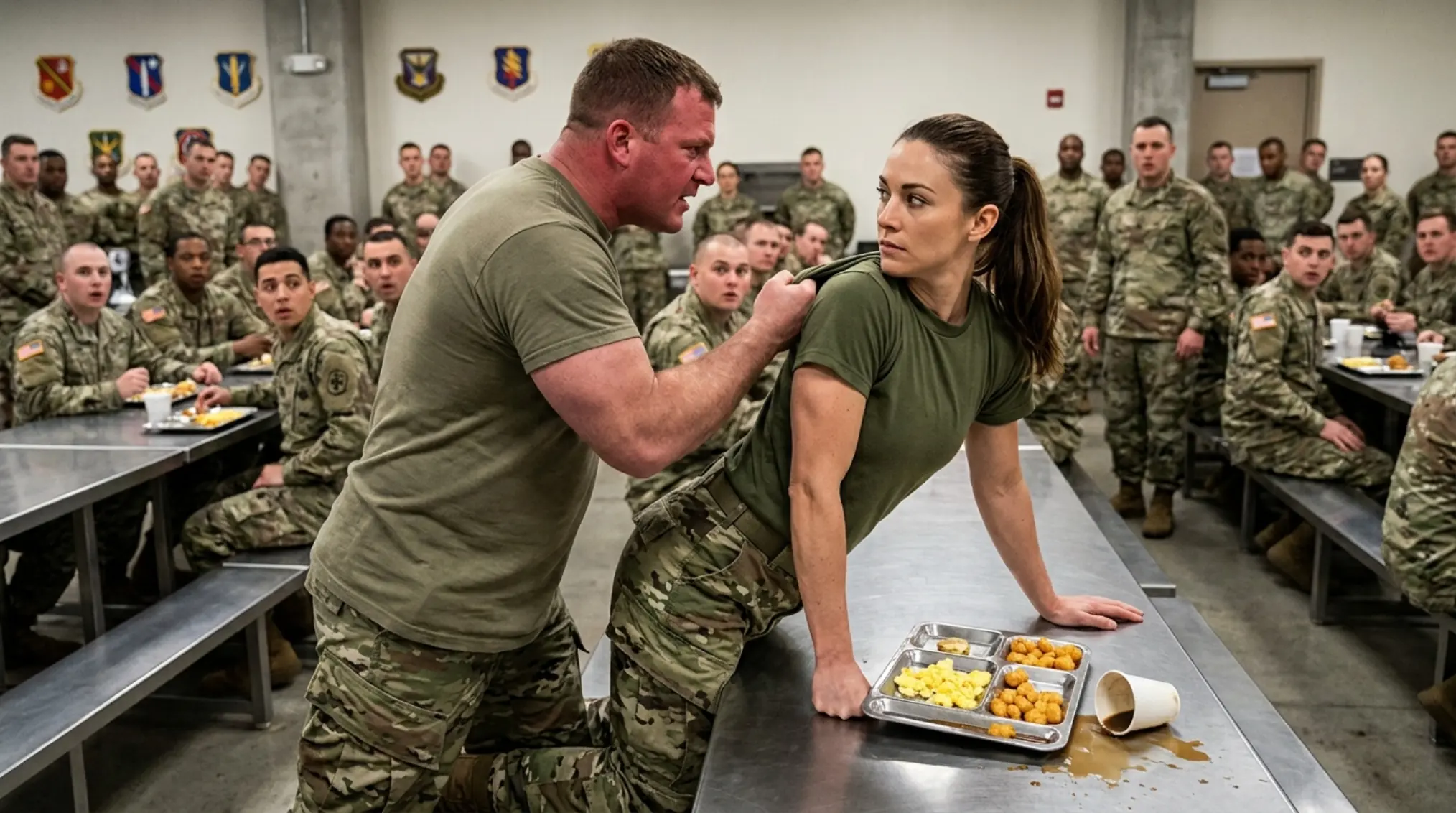
For half a second, nobody in the crowded dining hall moved.
Then Colton Briggs tightened his fist around the back of Maya Carter’s olive-green shirt and shoved her farther over the table.
“People like you eat when the real operators are finished,” he hissed.
Maya planted one palm against the steel.
Her dark-brown ponytail fell over one shoulder. Coffee dripped from the edge of the table onto the floor. Behind her, nearly two hundred employees and trainees at the Redstone Emergency Response Training Center stared from rows of metal tables.
Some looked uncomfortable.
A few had laughed when Briggs first knocked away Maya’s breakfast tray.
Nobody was laughing now.
Maya slowly turned her head.
Her hazel eyes moved first toward Briggs’s fist gripping her shirt, then toward his face.
There was no panic in them.
No embarrassment.
No pleading.
Only calculation.
“Take your hand off me,” she said.
Briggs leaned closer.
He was thirty-eight, broad across the shoulders, physically imposing, and one of Redstone’s most respected senior field instructors. His reputation was built on brutal endurance courses, loud discipline, and an almost theatrical belief that fear produced competence.
He smiled.
“Or what?”
Maya’s expression did not change.
“Or everyone in this room is going to learn something about you that you’re not going to enjoy.”
Several people shifted in their seats.
Briggs tightened his grip.
That was his mistake.
What happened next lasted perhaps two seconds.
Maya rotated one shoulder, shifted her weight half a step, and moved her arm through a short, precise arc.
There was no punch.
No dramatic throw.
No wild struggle.
One moment Briggs had control of her shirt.
The next, his grip was gone.
His balance vanished with it.
He stumbled sideways, struck the edge of another table with his hip, and nearly dropped to one knee before catching himself.
Maya remained exactly where she had been.
One hand still on the table.
Breathing normally.
The entire dining hall went silent.
Briggs stared at her.
“What the hell was that?”
Maya straightened her shirt.
“A release.”
“Nobody in logistics moves like that.”
“I never said I spent my entire career sitting behind a desk.”
Briggs stepped toward her again.
Maya did not move.
That disturbed him more than anything.
He was accustomed to people retreating.
The younger employees under him usually lowered their eyes when he raised his voice. People changed tables when he entered the dining hall. New hires learned quickly that publicly disagreeing with Briggs could mean harder assignments, worse evaluations, or weeks of unnecessary pressure.
Maya simply watched him.
Briggs pointed at the food scattered across the table.
“Clean it up.”
Maya looked at the mess.
Then she looked toward the dining staff already moving from the kitchen with towels and a mop.
“I’ll help them.”
“I said clean it yourself.”
“And I said I’ll help the people responsible for this area.”
“You think you’re too good to pick up your own mess?”
Maya looked at him.
“You created the mess.”
Someone at a nearby table coughed to hide a laugh.
Briggs heard it.
His face darkened.
“You’ve been here four days.”
“Yes.”
“You don’t understand how Redstone works.”
Maya calmly lifted her spilled tray.
“I’m beginning to.”
That sentence traveled through the room faster than a shout.
At a table near the back sat Harold Odom, fifty-six, a senior training supervisor who had worked at Redstone for six years.
He had watched the confrontation from the beginning.
Unlike most people in the dining hall, Odom had noticed Maya before Briggs ever approached her.
He noticed where she chose to sit.
Near a wall.
Clear view of both exits.
No reflective glass behind her.
He noticed the way her eyes moved through the room when she entered, briefly registering doors, personnel clusters, cameras, and traffic patterns.
It was not nervousness.
It was habit.
Then Briggs shoved her.
Maya absorbed the impact without stumbling.
That told Odom more.
But the release confirmed it.
He had seen people with serious close-contact training before.
They did not move dramatically.
They moved efficiently.
Maya Carter had used exactly enough force to remove Briggs’s hand and nothing more.
Odom slowly set down his coffee.
“Well,” he murmured.
At the front of the dining hall, a twenty-one-year-old junior logistics employee named Danny Reyes stood from his seat.
Everyone else remained frozen.
Danny walked to the cleaning station, took a mop, and quietly began helping the dining staff clear the spilled coffee.
Maya noticed him.
She noticed his name badge.
And she remembered it.
Because Colton Briggs was not the reason Maya Carter had come to Redstone.
People like Danny Reyes were.
Her official paperwork identified her as a temporary logistics specialist assigned for a thirty-day process review.
That description was technically true.
It was also incomplete.
Maya worked for a confidential corporate oversight division hired by Redstone’s parent organization after a series of troubling internal complaints.
The complaints did not describe one spectacular scandal.
They described something more difficult to identify.
Employees injured during training exercises that exceeded written limits.
Promising junior staff receiving unusually poor evaluations after challenging senior instructors.
Transfer requests disappearing.
Formal complaints being reclassified as “communication misunderstandings.”
An environment where physically aggressive personalities advanced quickly while quieter, careful employees were repeatedly described as lacking leadership potential.
Redstone’s executives wanted to know whether the complaints represented isolated incidents or a cultural problem.
So they sent Maya.
Her assignment was simple.
Arrive as someone nobody considered important.
Observe.
Document.
Identify who abused authority.
More importantly, identify who quietly resisted it.
She had been doing that kind of work for five years.
The hardest part was not remaining undercover.
The hardest part was watching.
Watching decent people keep their heads down because speaking had consequences.
Watching institutions normalize behavior that would have horrified everyone if it happened all at once.
Bad cultures rarely appeared overnight.
They accumulated.
One laugh.
One ignored complaint.
One manager deciding a confrontation was not worth the paperwork.
One good employee transferring away because fighting felt harder than leaving.
By the end of Maya’s fourth day, Colton Briggs had given her more information than some previous investigations produced in weeks.
But she knew he was only the visible part.
The question was who allowed him to operate that way.
The answer began arriving the following morning.
At 8:40, a man Maya did not recognize appeared at the doorway of the logistics office.
He looked at her.
Then left.
Twenty minutes later, another employee did the same thing.
By lunchtime, three different people had casually asked questions about her previous assignments.
Maya answered politely.
Her cover history had been designed to survive scrutiny.
She gave each person the same accurate information.
Temporary logistics specialist.
Process assessment.
Thirty-day rotation.
No dramatic background.
Nothing interesting.
At 1:30, her department manager, Dennis Calloway, asked her into his office.
Calloway was fifty-two, cautious, polished, and professionally harmless in the way Maya had learned to distrust.
He closed the door.
“Maya, we received an incident complaint.”
“From Briggs?”
Calloway looked surprised.
“You expected it?”
“Yes.”
He pushed a paper toward her.
Briggs alleged that Maya had initiated physical contact in the dining hall and used an unauthorized restraint technique against him.
Maya read the statement.
Then placed it back on the desk.
“He shoved me from behind.”
“He says you escalated the situation.”
“There were nearly two hundred witnesses.”
Calloway rubbed his forehead.
“Briggs has been here twelve years.”
“That does not change what happened.”
“He is highly respected.”
“That also does not change what happened.”
Calloway sighed.
“I’m trying to keep this from becoming larger than it needs to be.”
Maya watched him carefully.
There it was.
Not corruption.
Not cruelty.
Something more common.
Avoidance.
“I’m not going to sign a statement calling it a misunderstanding,” she said.
“I didn’t ask you to.”
“You were about to.”
Calloway looked away.
Maya stood.
“Keeping things small is not always the same as solving them.”
She left.
Outside, a woman was waiting in the corridor.
Patricia Keene ran Redstone’s training operations.
She was forty-six, sharply organized, respected, and difficult to read.
“Walk with me,” Patricia said.
They went outside.
Patricia waited until they were away from the building.
“I saw what happened.”
“So did everyone.”
“No. I mean I saw it.”
Maya turned.
Patricia continued.
“One camera in the dining hall was still recording.”
Maya frowned.
“The system report says those cameras were offline.”
“Two were.”
“And the third?”
“I kept it operating separately.”
“Why?”
Patricia looked toward the training buildings.
“Because eight months ago, an employee under Briggs ended up in the medical unit after an exercise that should have stopped twenty minutes earlier.”
Maya said nothing.
Patricia continued.
“I filed a report.”
“What happened?”
“It disappeared into review.”
“A second complaint?”
“Same.”
“Third?”
Patricia gave a tired smile.
“You understand quickly.”
Maya asked, “How clear is the video?”
“Very.”
“The shove?”
“Clear.”
“The grab?”
“Clear.”
“My release?”
“Clear.”
Maya considered that.
“Do not give it to anyone yet.”
Patricia looked surprised.
“You don’t want it?”
“I want it preserved.”
“That’s different.”
“Very.”
Maya looked directly at her.
“If somebody has been suppressing complaints, handing them evidence before we know how far the suppression reaches simply tells them what needs to disappear.”
Patricia’s expression changed.
“You’re not a logistics specialist.”
Maya smiled faintly.
“I am currently processing logistics.”
Patricia almost laughed.
Then her face became serious again.
“I’ve been waiting eight months for somebody to take this seriously.”
Maya answered quietly.
“Then wait a little longer.”
That evening, someone knocked on Maya’s temporary apartment door.
It was Danny Reyes.
The young employee from the dining hall.
The one with the mop.
He looked nervous.
“I need to tell you something.”
Maya let him inside.
Danny stood awkwardly near the door.
“I heard Briggs talking yesterday.”
“With whom?”
“Marcus Horton.”
Maya knew the name.
Horton was Redstone’s senior operations manager.
He had influence over evaluations, internal investigations, and staffing.
“What did you hear?”
“Horton told Briggs exactly how to write the complaint against you.”
Maya’s expression remained neutral.
Danny continued.
“He told Briggs to file immediately. Said if he established the first official version, management would treat everything else as a response.”
That mattered.
A lot.
“Why are you telling me?”
Danny looked at the floor.
“Because it’s wrong.”
Maya waited.
He looked up.
“And everybody knows it’s wrong.”
“Everybody?”
“People know things.”
“Then why doesn’t anyone speak?”
Danny gave a bitter laugh.
“Because people who speak get moved.”
Maya thought about that.
“Do you know anyone?”
“Felix Mendez.”
The name appeared in one of Maya’s files.
Mendez had filed a safety complaint seven months earlier after a training supervisor ignored an injury.
Three weeks later, his advancement recommendation disappeared.
Then two transfer requests were denied.
Now he worked alone in vehicle maintenance.
“Anyone else?”
Danny shook his head.
“Not personally.”
Maya stepped closer.
“You did the right thing coming here.”
Danny looked doubtful.
“I got a mop yesterday.”
“Yes.”
“That doesn’t make me brave.”
“No. Coming here tonight does.”
He left ten minutes later.
Maya opened her secure notebook.
She wrote one name.
Marcus Horton.
Then another.
Felix Mendez.
The next day, Maya found Mendez eating lunch alone beside a chain-link fence behind the vehicle maintenance building.
She deliberately sat two tables away.
For six minutes they ate without speaking.
Finally Mendez said:
“You’re the woman from the dining hall.”
“Yes.”
“What do you want?”
“Right now? Lunch.”
“Don’t do that.”
Maya looked toward him.
“What?”
“Pretend this is accidental.”
She appreciated the directness.
“Fine. I read your incident report.”
Mendez stopped eating.
“The official one?”
“Yes.”
“Then you didn’t read what happened.”
“That’s why I’m here.”
He stared at her for a long time.
“I’m not filing another complaint.”
“I didn’t ask you to.”
“Then what do you want?”
“The truth.”
Mendez laughed softly.
“That’s expensive around here.”
“I know.”
He looked at her.
“No, you don’t.”
Maya let the sentence remain unanswered.
Eventually he spoke.
Seven months earlier, one of Briggs’s senior instructors had forced a team through a dangerous endurance sequence even after two participants reported symptoms of heat exhaustion.
Mendez stopped the exercise.
The instructor became furious.
Horton was present.
Later, Horton told Mendez that formal complaints created “career complications.”
Mendez filed anyway.
His complaint went nowhere.
Then his transfer requests disappeared.
“Horton threatened you directly?”
“Not in words clean enough to print.”
“What did he say?”
“That people who embarrassed leadership shouldn’t expect leadership to help their careers.”
Maya nodded.
Mendez looked at her.
“There’s something else.”
She waited.
“Horton keeps private files.”
“On whom?”
“People he considers difficult.”
“Do you know names?”
Mendez gave her four.
Two matched old complaints.
One was Patricia Keene.
Maya did not react.
But internally, the investigation shifted.
That evening she met Patricia.
“Horton has a file on you.”
Patricia closed her eyes briefly.
“I know.”
“For how long?”
“Four months.”
“Why?”
“Because I kept filing.”
Maya studied her.
“Would you be willing to give me the camera footage if you cannot control where it goes afterward?”
Patricia looked at her.
“You’re asking me to trust you.”
“Yes.”
“What happens to me?”
“I cannot promise you nothing happens.”
Patricia nodded slowly.
“What can you promise?”
“That the footage will not disappear.”
Silence.
Then Patricia said:
“Yes.”
Maya received the video before sunrise.
She watched it once.
Then again.
Briggs’s shove was clear.
His grip was clear.
Maya’s minimal release was clear.
There was no ambiguity.
She saved three encrypted copies.
Then she continued investigating.
The financial side came from Serena Ruiz, a senior logistics supervisor who had worked at Redstone for three years.
Ruiz approached Maya quietly.
“I flagged irregular expense records eleven months ago.”
“What kind?”
“Medical supply orders connected to training injuries.”
Maya frowned.
“The incidents were reclassified.”
“Yes.”
“But the supply purchases remained.”
Ruiz nodded.
“Bandages, imaging charges, emergency transport reimbursements. You can rename an incident. You can’t make medical supplies un-used.”
Maya almost smiled.
“Do you have your original reports?”
“All of them.”
“How many?”
“Twelve months.”
That was the moment the investigation stopped being about Briggs.
It became about architecture.
Complaints moved into Calloway’s office.
Some disappeared.
Horton coached employees on filing language.
Transfer paperwork stalled.
Patricia’s concerns were contained.
Medical evidence contradicted official incident descriptions.
Then another witness emerged.
Harold Odom.
The quiet supervisor who watched the dining-hall confrontation.
Maya found him alone one evening.
“You knew what I was before anyone else,” she said.
Odom looked at her.
“I knew you were not what your paperwork suggested.”
“Why?”
“You checked the exits before you checked the menu.”
Maya smiled.
Odom did not.
“I’ve documented Redstone for fourteen months.”
Maya’s expression changed.
“Why?”
“Because people kept telling the truth separately.”
He placed a tablet on the table.
“One person complained about Briggs. Another about Horton. Another about Calloway. Nobody compared notes.”
“And you did?”
“I started.”
He slid the tablet toward her.
Dozens of dated entries filled the screen.
Names.
Incidents.
Evaluations.
Transfers.
Complaints.
Patterns.
Maya stared.
“You’ve been waiting.”
“For someone who could use it.”
“You think that’s me?”
Odom looked directly at her.
“I watched you let Briggs humiliate you long enough to understand him before you removed his hand.”
Maya said nothing.
Odom continued.
“You weren’t fighting him.”
“No.”
“You were measuring the room.”
“Yes.”
He nodded.
“Then yes. I think it’s you.”
Three nights later, Maya sat alone with evidence gathered by five different people.
Patricia’s video.
Ruiz’s financial records.
Mendez’s account.
Danny’s testimony.
Odom’s fourteen months of documentation.
And something even more troubling.
Communication logs showed Marcus Horton had repeatedly contacted executive director Richard Page before formal complaints were closed.
The calls were too consistent to dismiss.
Maya submitted her assessment to the oversight board that had sent her.
The response arrived after midnight.
Full intervention authorized. Identity disclosure permitted.
The next morning, Maya entered Richard Page’s office.
He looked irritated.
“You don’t have an appointment.”
“No.”
“Then schedule one.”
“This cannot wait.”
Something in her tone stopped him.
Maya placed an identification card on the desk.
Page picked it up.
Read it.
Then sat down.
“You’re corporate oversight.”
“Senior institutional investigator.”
“How long have you been doing this?”
“Five years.”
“And you’ve been inside Redstone…”
“Six days.”
Page stared at her.
“How much do you have?”
“Enough to initiate an independent review of leadership practices over the past four years.”
His face tightened.
“You cannot understand four years in six days.”
“I didn’t collect four years of evidence.”
She leaned closer.
“Your employees did.”
Maya placed the video evidence on his desk.
Then Ruiz’s reports.
Odom’s documentation.
Mendez’s original complaint.
Danny’s testimony.
Page looked at the pile.
Maya said:
“I assembled what your people have been trying to tell you separately.”
Page looked away.
For the first time, Maya saw something beyond authority in his face.
Fear.
Not fear of losing his job.
Fear of realizing the system he believed he managed had become something else while he kept choosing stability over confrontation.
“What happens now?”
“Briggs is removed from training authority immediately.”
Page nodded slowly.
“Horton?”
“Removed from supervisory control pending review.”
“Calloway?”
“His role in complaint handling is being investigated.”
Page looked toward the window.
“And me?”
Maya did not soften the answer.
“That depends on what you knew and what you did with it.”
Forty-five minutes later, Briggs entered Page’s office.
Horton arrived behind him.
Then they saw Maya.
Not in logistics paperwork.
Not holding a breakfast tray.
Not standing over spilled eggs.
Sitting beside the executive director with her real credentials visible on the desk.
Briggs stopped in the doorway.
Horton’s face went completely still.
Page told them the review had begun.
Horton objected immediately.
“This is premature.”
Page shook his head.
“No.”
He glanced toward Maya.
“It’s overdue.”
Briggs stared at the floor.
Then he said something nobody expected.
“I want to withdraw my complaint against Carter.”
Horton turned sharply.
“Colton.”
Briggs ignored him.
“I was coached.”
Page leaned forward.
“By whom?”
Briggs finally looked at Horton.
“Marcus.”
The room went silent.
Horton stood.
“You need to be extremely careful.”
Maya watched Briggs’s expression.
For the first time since she met him, the man looked less like a bully and more like someone who understood that the people above him had never been protecting him personally.
They were protecting a system.
And now that system was collapsing, loyalty was becoming negotiable.
Briggs continued.
“Horton told me how to phrase the complaint. He told me to file first so my version became the official starting point.”
Horton said nothing.
Page asked:
“Did you shove Maya in the dining hall?”
Briggs closed his eyes briefly.
“Yes.”
“Did she attack you?”
“No.”
“Did she use more force than necessary?”
Briggs looked at Maya.
“No.”
It was not redemption.
But it was truth.
And truth mattered.
The formal review lasted months.
Maya left Redstone after one week because once her identity was revealed, remaining undercover served no purpose.
But the consequences continued.
Briggs lost his training position and faced disciplinary action.
Horton was terminated after investigators documented repeated retaliation, manipulation of complaints, and interference with personnel records.
Calloway was removed from management and later resigned.
Richard Page remained during the investigation but eventually stepped down after the board concluded he had ignored too many warnings.
Redstone changed.
Patricia Keene joined the restructuring committee.
Serena Ruiz became director of logistics compliance.
Felix Mendez received an independent review of his career record and transferred to another division under clean leadership.
Harold Odom helped redesign complaint procedures.
And Danny Reyes?
His promotion evaluation was reconsidered.
The sentence describing him as lacking assertiveness was removed.
In its place appeared a new assessment:
Demonstrates independent judgment and acts ethically without requiring supervision or recognition.
Maya read that line months later.
She smiled.
Because that was the reason she had remembered him.
Not the mop.
The decision.
Two hundred people watched something wrong happen.
One person quietly decided that doing nothing was also a choice.
Years later, employees at Redstone still told the story of the morning Colton Briggs shoved the quiet logistics newcomer into her breakfast.
Most versions exaggerated Maya’s response.
Some claimed she threw him across the dining hall.
She did not.
Others said she threatened him.
She did not.
The truth was simpler.
Briggs grabbed her.
Maya removed his hand.
Then she spent six days discovering why everyone had learned to accept a man like him.
That was what actually changed Redstone.
Not strength.
Not intimidation.
Not a spectacular fight.
Documentation.
Witnesses.
People finally realizing the thing they had each been carrying alone was part of the same story.
Briggs believed the most important moment happened when Maya slipped out of his grip.
Maya knew better.
The most important moment happened thirty seconds later.
When Danny Reyes walked across a silent dining hall, picked up a mop, and did the small right thing while everyone else was still deciding whether doing the right thing was worth being noticed.
That was the kind of person Maya Carter had been sent to find.
And in the end, rebuilding Redstone depended far more on people like him than on people like her.