“I told you to move this damn pipe!” Harold Pritchard shouted.
The short sledgehammer hung beside his right leg, its scarred metal head dark with old rust and fresh dirt. He stood less than six feet from Emily Carter’s exposed water line in the narrow side yard between her brick foundation and the wooden fence, shoulders bunched beneath a faded tan work jacket, breathing too hard for a man who had only walked across one lawn.
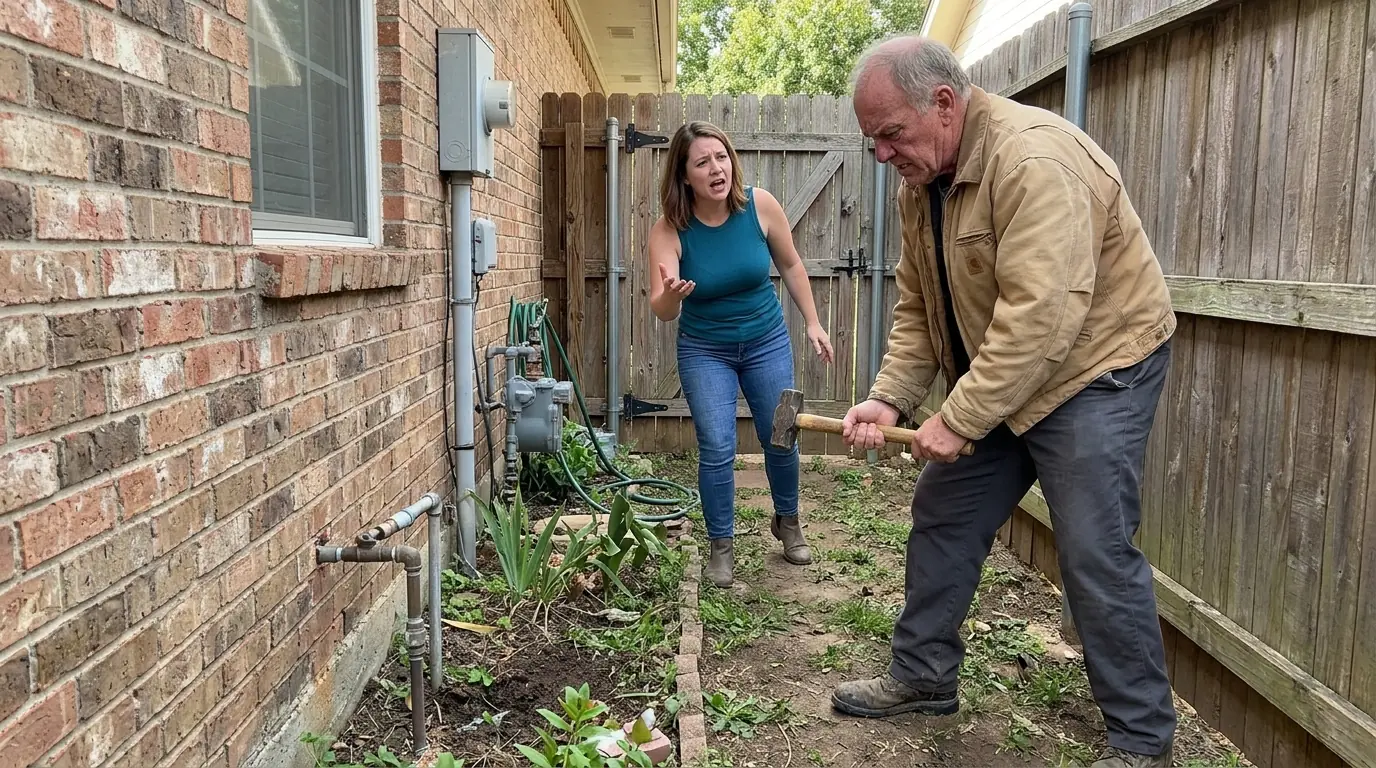
Emily stopped near the open gate with one hand still resting on the latch. “Harold, don’t.”
He looked at her, then at the pipe, then at the city inspector already kneeling beside the meter box.
Luis Ortega had been there less than twelve minutes. He had not yet found anything wrong.
That should have calmed Harold.
Instead, it seemed to make him angrier.
The afternoon was bright enough to turn every object sharp: the gray meter box bolted near the brick wall, the clean copper-colored fitting at the exposed section of line, the damp soil in Emily’s narrow garden bed from that morning’s watering, the open black tool bag beside Luis’s knee, and the white utility vehicle visible through the gate behind them.
Nothing was leaking.
Nothing was cracked.
Nothing was blocked.
Luis had checked the meter, pressure, and accessible fittings while Emily watched. His gloves were still dry.
Harold pointed at the pipe with the hammer handle. “That’s the problem. I’ve been telling her for months.”
Luis turned his head slowly. “Sir, I need you to keep the hammer down while I’m working.”
Harold’s jaw tightened.
Emily knew that look. She had seen it at the fence, at her mailbox, across the driveway, in the middle of a neighborhood barbecue, and once through her kitchen window at seven in the morning when Harold had stood on his side of the property line staring at the meter box as if it had personally insulted him.
But this time there was something else in his face.
Urgency.
Not the stubborn irritation of a neighbor losing an argument.
Urgency like a clock had started somewhere only he could hear.
Luis shifted his weight, one knee in the soil, and glanced at Emily. “You said the pressure issue was intermittent?”
“Yes. Twice in the last month. Both times for maybe twenty minutes.”
“And the city flushing notice covered one of those dates.”
Emily nodded. “Right.”
Luis looked back at the line. “I’m not seeing a fault here.”
Harold barked out a humorless laugh. “Because you’re looking at the outside.”
Luis’s eyes narrowed.
Emily felt a cold pressure settle behind her ribs.
That sentence was not new.
Harold had said versions of it before.
Open it.
Cut it.
You need to see what’s inside.
He had never explained what he meant.
Until that afternoon, Emily had treated the words as the latest mutation of a boundary dispute that had already become ridiculous. Harold had objected to the water line because a short visible section ran near the edge of the garden bed closest to his side of the fence. The line was on Emily’s property. The meter served Emily’s house. The city had confirmed both facts in writing.