“Whatever the kid told you, forget it. He sweeps floors.”
Dale said it without looking away from the tractor. He had one hand resting on the raised hood and the other on a work order carrying an eight-thousand-dollar estimate.
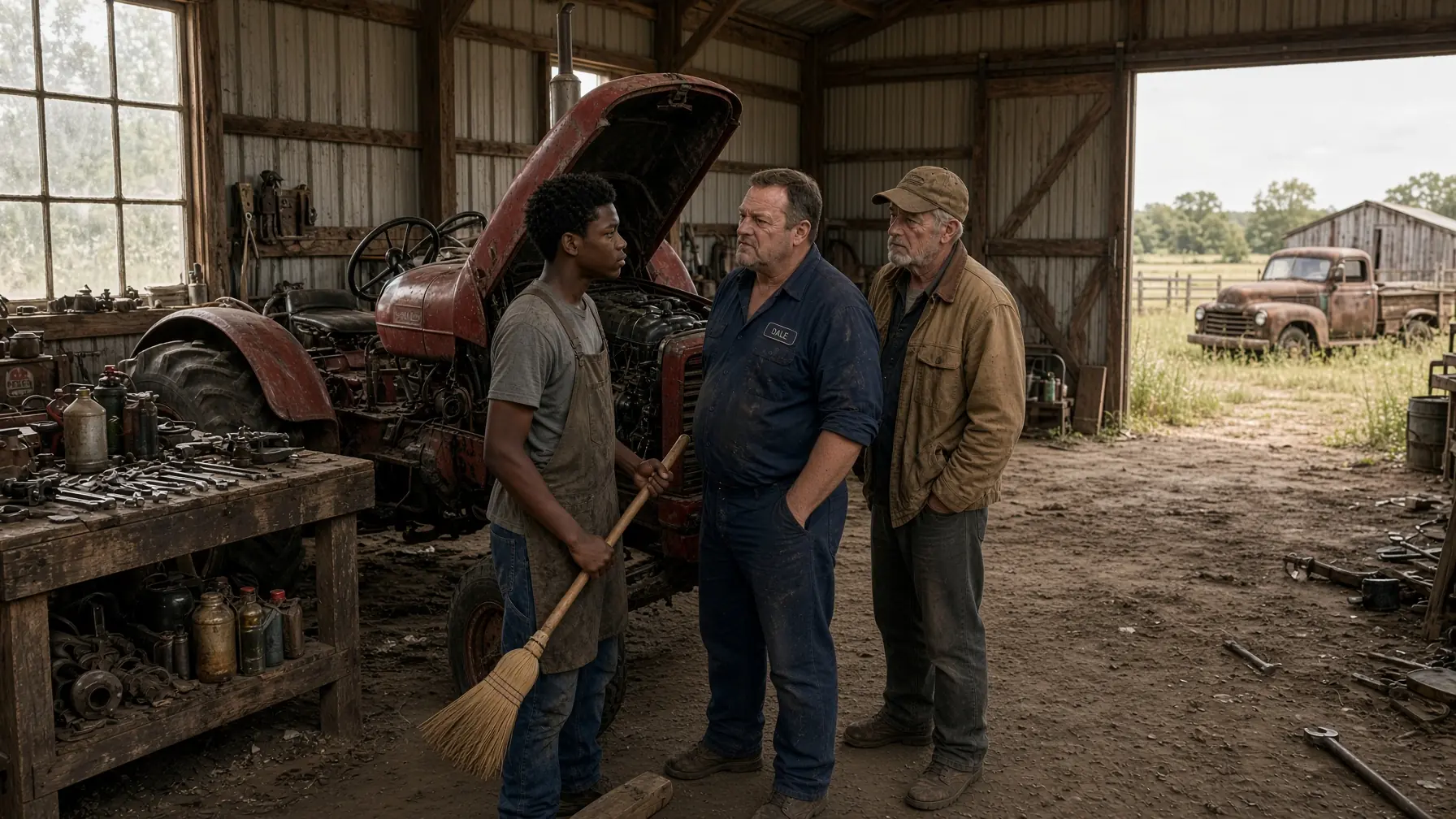
Across the repair bay, seventeen-year-old Malik Carter stood with a broom in his hand. He had been waiting for the conversation to end, hoping the customer would ask one more question before signing.
The customer reached for the pen.
“I don’t think the pump’s the problem,” Malik said.
The pen stopped above the paper.
Dale turned slowly. He had worked on farm equipment for thirty years, and there were three people close enough to hear a boy question his diagnosis.
“You don’t think.”
Malik looked toward the engine. “The way it settled when you eased the linkage—”
“Eight thousand dollars says it’s the pump.” Dale held out the work order. “You got eight thousand dollars, son?”
Malik’s fingers tightened around the broom handle. Near the office door, his uncle Ray lowered an invoice and gave him a small shake of the head.
Malik knew that look. Ray owned Red Creek Farm Repair, but owning the building did not mean he could afford to lose his senior mechanic, an important customer, or another afternoon of billable work.
The old man beside the tractor wore muddy boots, a faded jacket, and a cap pulled low. He had introduced himself as Gideon, explained that the machine had been sitting for years, and listened to Dale’s estimate without bargaining.
Now he set the pen down.
“Let him look.”
Dale’s smile thinned. “It’s your tractor.”
“It is.”
“And if he makes it worse?”
Gideon glanced at Malik. “Do you intend to?”
“No, sir.”
The old man turned back to Dale. “Then let’s find out.”
Dale checked his watch.
“Twenty minutes. Touch the wrong part, you’re paying for it.”
Malik leaned the broom against the wall. He wanted to say that he would not need twenty minutes, but the words caught behind the sudden awareness of everyone watching him.
Instead, he went to the shelf behind the bay and lifted down his grandfather’s steel toolbox.
The handle was polished by years of use. One latch never closed properly unless he pressed the lid near the corner.
Dale watched him carry it toward the tractor.
“After that,” he said, “you’re back to sweeping.”
Malik set the box down carefully. “I heard you.”
Red Creek smelled of hot oil, old rubber, and the damp earth farmers carried in on their tires. Through the open bay door, afternoon sunlight lay across a gravel lot crowded with equipment people needed back before the weather changed.
Bell Creek measured urgency in acres left unfinished and rain approaching from the west. A broken tractor could turn a promising week into a season somebody spent trying to recover from.
Malik understood that kind of urgency. He had spent three years helping Ray keep other people’s machines moving, though most customers remembered him only as the boy clearing mud from the floor.
After school, he changed into the apron hanging beside the office door. He moved tires, cleaned housings, drained oil, and carried parts too heavy for one person to lift comfortably.
When customers asked whether a mechanic was available, he pointed toward Dale.
Sometimes they asked while Malik was standing beside an engine with a tool in his hand.
He had learned to let it pass. Ray paid him what the shop could manage, and the work kept him near machines, which was better than being nowhere near them.
But every month, staying useful began to feel less like a beginning and more like a place he might never leave.
His grandfather had been the first person to put a wrench in his hand and wait for him to figure out what it was for.
Elijah Carter repaired farm equipment wherever it broke: beneath lean-tos, beside fields, in barns where the only good light came through a missing roof panel. He knew which farmers could pay immediately and which needed him to wait until harvest.
He recorded both with the same careful handwriting.
Elijah never told Malik that engines had secrets. He said they had causes, and a mechanic’s job was to keep looking until the explanation matched the evidence.
“Machines talk before they break,” he used to say. “You just have to respect them enough to listen.”
Three years after his death, Malik still heard that voice whenever an engine ran unevenly.
He opened the toolbox and selected a light.
“What happened before you brought it in?” he asked Gideon.
Dale made a small impatient sound. “That’s on the work order.”
“I’d like to hear him tell it.”
The old man studied Malik for a moment.
“Hard starting. Rough running. It wouldn’t settle the way I remembered.”
“Worse cold or warm?”
“Both, though differently.”
“And under load?”
Gideon hesitated. “Enough of a difference to notice.”