Have you ever watched a friendship die in slow motion?
Not because of one enormous betrayal, but because of a thousand small cuts that accumulate until one day you finally say, “Enough.”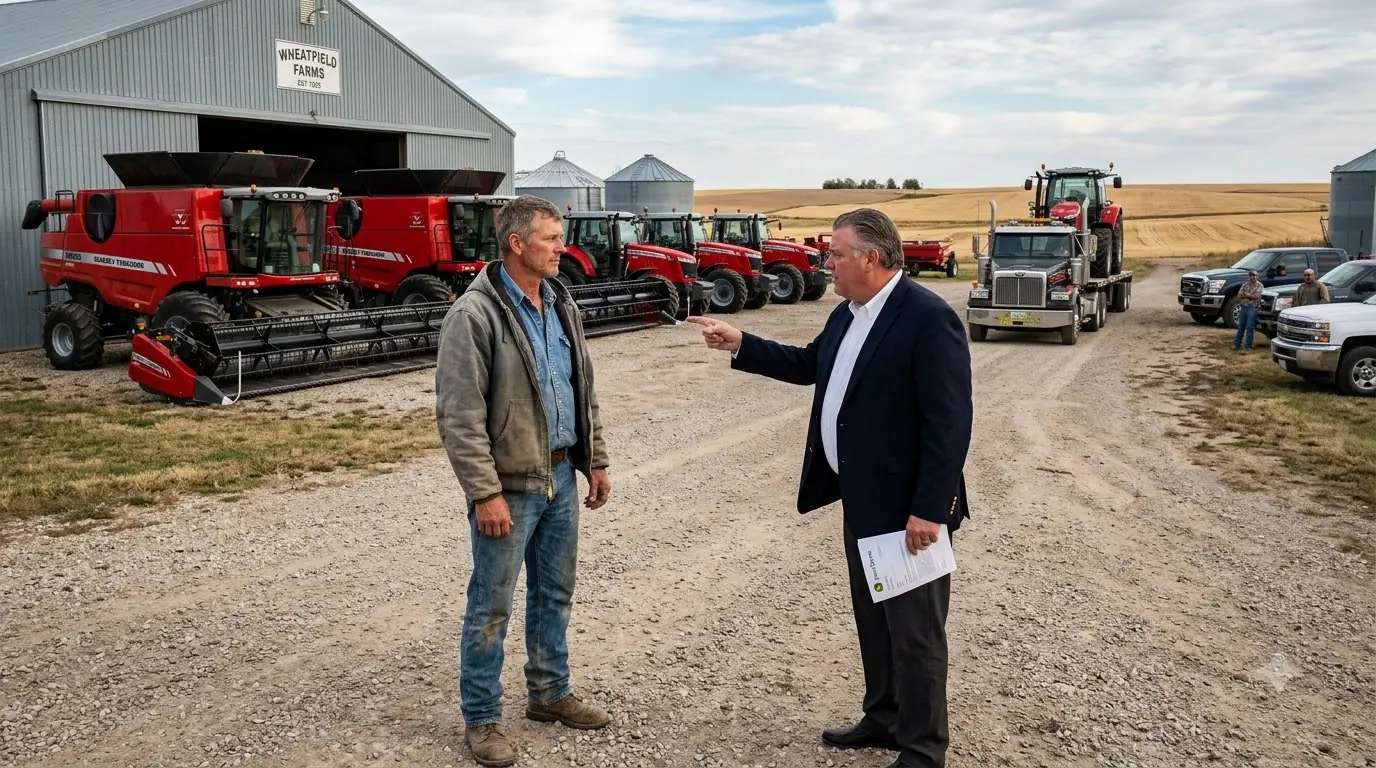
Kenneth Taylor stood at the fence line dividing his property from the county road, watching a Mitchell and Sons service truck roll past without slowing.
The driver knew the farm, just as everyone in Dawson County knew the Taylor operation, yet the truck’s brake lights never flickered.
Twenty-two years earlier, that same service truck would have pulled into the gravel drive simply to check whether Kenneth needed anything. The mechanics would wave, and sometimes they would stop for coffee before continuing toward the next farm.
Nine months earlier, Don Mitchell had called Kenneth one of the cornerstones of the dealership’s business.
Now Kenneth was invisible.
The transformation had not happened overnight. It had accumulated like dust on a piece of equipment nobody bothered to wipe down anymore.
Kenneth turned toward the machine shed, where approximately $3.2 million worth of John Deere equipment stood in carefully organized rows. Green paint gleamed beneath the LED lights, and the familiar leaping deer appeared on every hood.
His grandfather had broken the land in 1954 using a Farmall tractor that coughed blue smoke and seemed to require a prayer before starting each morning. Kenneth’s father began shifting the operation toward John Deere equipment in the late 1970s, convinced that reliability mattered more than inherited brand loyalty.
Kenneth had expanded that philosophy into an agricultural empire.
The Taylor family farm covered 2,400 acres of winter wheat, corn, and soybeans across the Republican River Valley. They also raised 280 head of registered Angus cattle representing decades of careful breeding decisions.
The farm sat fourteen miles outside Lexington, Nebraska, where the plains rolled in gentle waves that turned gold every June when the wheat ripened. It was third-generation land, the kind of operation agricultural magazines featured in articles about sustainable family farming and generational wealth transfer.
Every major piece of equipment carried the John Deere logo.
There were two S-Series combines, four large tractors ranging from approximately 280 to 310 horsepower, three utility tractors for moving hay and feeding cattle, and a complete lineup of planters, tillage equipment, grain carts, and loaders.
Nearly all of it had been purchased through Mitchell and Sons, the family dealership that had sold John Deere equipment in southwestern Nebraska since 1973.
Kenneth did not merely buy machinery from them. His family had helped turn the dealership into what it eventually became.
His father bought one of the dealership’s early John Deere 4020 tractors in 1975, when Don Mitchell’s father still ran the showroom and mechanics worked Saturdays without complaining about overtime. Kenneth purchased his first 8R tractor there in 2011, when Don still called personally to verify delivery schedules and make certain every detail met expectations.
When Mitchell and Sons expanded its service department in 2016, the dealership mounted a bronze plaque in the lobby engraved with the names of fifteen longtime customers.
“Taylor Family, Cornerstone Customer Since 1975.”
Kenneth stood at the dedication ceremony beside his father, who died three years later. Don Mitchell spoke at the funeral and later helped Kenneth’s daughter, Ashley, secure an agricultural business loan when the local bank hesitated to lend money to someone recently out of college.
The plaque still hung in the Mitchell and Sons showroom.
Kenneth had driven past it six times during the previous nine months.
He had stopped going inside.
The first crack appeared in December 2023. It seemed small enough to ignore and easy enough to rationalize.
It was the middle of winter feeding season, when Nebraska cold made hydraulic fluid thick and exposed mechanical weaknesses no summer field demonstration could reveal. Kenneth was operating an 8R 280 tractor pulling a forty-two-foot hay trailer loaded with 850-pound round bales.
The hydraulic pump powering the loader began making a sound no pump should make.
Then it stopped entirely with a mechanical sigh that promised an expensive repair.
Kenneth called Mitchell and Sons at 7:18 that morning. The parts department placed him on hold for eight minutes before someone finally returned.
“We’ll order the pump for you,” the clerk said. “It should arrive Tuesday or Wednesday.”
Kenneth immediately calculated the delay.
Tuesday was four days away. Wednesday meant five.
Cattle did not stop eating because a tractor was broken.
“Can you expedite it?” Kenneth asked. “I have 280 head that need feeding.”
“Everything is expedited this time of year, Mr. Taylor. We’ll get it as soon as we can.”
The pump arrived eleven days later.
Kenneth rented a loader from his neighbor, Gary Lansing, for $200 per day. By the time the replacement part arrived, the delay had cost him $2,200 for a component Mitchell’s inventory system had originally listed as standard stock.
When Kenneth picked up the pump, the young employee behind the parts counter barely looked away from his phone.
Don Mitchell called later with an explanation delivered in his usual smooth voice.
“Supply chain issues, Kenneth. You know how it is. The pandemic disrupted everything, and the effects are still moving through the system. We’re doing the best we can.”
Kenneth accepted the explanation.
Frustration had begun to simmer, but it had not yet boiled over. One incident could not erase twenty-two years of relationship.
The second crack opened wider in March 2024 during pre-planting maintenance season.
Kenneth operated his farm with little tolerance for surprises. He scheduled service appointments three weeks in advance, selecting specific days when technicians could visit the farm, change fluids, inspect hydraulic systems, replace filters, and verify that every machine was ready for planting.
He confirmed the appointment when he booked it and again three days before the scheduled visit.
On the morning Mitchell and Sons was supposed to arrive, Kenneth cleared the shop, positioned all seven tractors for easy access, and laid out his maintenance records with notes describing concerns about each machine.
He set aside the morning from other work. Ashley rearranged her schedule so she could participate in the walk-through and learn more about the equipment she might someday inherit.
Nine o’clock arrived.
No service truck.
At ten, Kenneth called the dealership.
The service manager answered with the professional distance that usually preceded bad news.
“Oh, Kenneth. We had to reschedule you. An emergency call came in from a commercial operation in Custer County. Their irrigation system is down, so we had to prioritize them.”
Kenneth’s jaw tightened.
“I scheduled this three weeks ago.”
“I understand, and we apologize. Let me check the calendar. We should be able to fit you in next week.”
Next week became ten days.
Kenneth completed the maintenance himself, spending sixteen hours beneath tractors, draining oil and fighting with filter housings that required specialty tools he did not own.
Ashley helped him, learning more about tractor maintenance than her agricultural economics degree had prepared her for.
Two weeks later, an invoice arrived from Mitchell and Sons for the service visit that had never happened.
Kenneth called to dispute it.
The dealership removed the charge without argument, which somehow made the situation feel worse. The ease of the reversal suggested that the billing error had been routine, that the Taylor account was no longer important enough for anyone to monitor carefully.
Don Mitchell called again.
“Kenneth, that was a serious mistake on our end. I’ve spoken to the service manager. We’re implementing new scheduling procedures. It won’t happen again.”
Kenneth wanted to believe him.
The alternative meant reconsidering twenty-two years of shared history, and history was supposed to mean something in rural Nebraska. Handshakes still carried weight there, and word of mouth could build or bury a business.
But trust, once cracked, developed fracture lines that spread whenever pressure returned.
The third incident shattered everything.
June 12, 2024, was the second day of wheat harvest. Clear skies stretched from horizon to horizon, humidity held near eighteen percent, and the temperature remained around seventy-two degrees with almost no wind.
It was the kind of fourteen-hour harvesting window that could determine whether a year ended in profit or disappointment.
Kenneth was operating his 2020 John Deere S780 combine through a 340-acre section north of the highway. He was cutting at a steady 4.2 miles per hour, and the grain tank filled approximately every eleven minutes.
The wheat looked exceptional.
Yield estimates were reaching fifty-two bushels per acre, with protein testing near 12.8 percent. Those numbers made the farm’s annual budget projections appear conservative.
At 6:47 that morning, the machine lurched as though someone had dropped an anchor into the drivetrain.
The combine did not slow gradually.
It stopped.
The header froze in the middle of the wheat, stalks jamming against stationary cutting teeth. Every alarm on the cab display activated at once, warning of transmission failure, hydraulic pressure loss, and system shutdown.
Kenneth killed the engine and climbed down, already aware that this was not something he could repair with tools from the cab toolbox.
He opened the side panel covering the continuously variable transmission and saw metal fragments embedded in surfaces that should have been smooth. Fluid leaked through cracks that should not have existed.
The transmission had not gradually worn out.
It had destroyed itself.
Some manufacturing defect had remained hidden inside the housing until the worst possible moment.
Kenneth took out his phone and called the Mitchell and Sons emergency service line.
Voicemail answered.
He left a message while forcing his voice to remain calm.
“This is Kenneth Taylor. I’m in the field with a catastrophic transmission failure on my S780. I need someone here as soon as possible. I still have approximately 1,850 acres standing, and the weather window is narrow. Call me back.”
An hour passed.
Kenneth called again.
Voicemail answered a second time.
At 11:30, almost five hours after the failure, his phone finally rang.
“Kenneth, we received your messages,” the service manager said over the noise of a busy shop. “Sorry for the delay. We are completely overwhelmed right now. Everyone is harvesting. I can probably get someone to you tomorrow afternoon.”
Kenneth had spent hours standing in the field while clouds gradually formed along the western horizon.
“Tomorrow afternoon? I need this repaired today. I have weather moving in and nearly two thousand acres standing.”
“I understand your frustration, but we are running three technicians and have eight emergency calls ahead of you. You are not our only customer dealing with a harvest breakdown.”
The words landed like a slap.
You are not our only customer.
Twenty-two years of loyalty had earned Kenneth nothing more than a place in line behind whoever had called before him.
“I need to speak with Don Mitchell.”
“He isn’t in the office today. He has a family commitment.”
Kenneth ended the call without saying goodbye.
The technician arrived approximately thirty hours after the first message. He drove into the field in a freshly washed service truck while Kenneth’s combine sat covered with dust and frustration.
The mechanic walked around the machine once, inspected the transmission, and gave a low whistle.
“That transmission is completely destroyed. You’ll need a full replacement.”
“How long for the parts?”
The technician opened a tablet and scrolled through several screens.
“Four to six weeks. These units come through an overseas supply chain, and Deere is heavily backlogged. I can place the order, but I cannot guarantee the timeline.”
Kenneth felt the air compress in his lungs.
Six weeks in the middle of harvest.
He still had 1,850 acres of wheat standing and a weather window that would not wait for manufacturing schedules.
“What will it cost?”
“Approximately $54,800 for the transmission. Labor will probably add another $5,200. Call it around $60,000, depending on what else we find.”
Sixty thousand dollars and four to six weeks.
The crop value at risk approached $380,000 if Kenneth could not finish before the weather changed.
That evening, he called Don Mitchell’s personal phone.
Don answered on the third ring.
“Kenneth, I heard about the combine. That is terrible timing.”
“Kenneth, I wish I could help, but we do not control Deere’s supply chain. Those components move through corporate distribution. Regional dealers do not have influence over production schedules.”
“You are a platinum dealer. Your family has sold Deere equipment for more than fifty years. You have relationships.”
“And I’ve used every one of them. Corporate still says four weeks minimum, and that is optimistic.”
Kenneth stared at another bronze plaque hanging inside his own office, presented when he bought the 8R.
“Your family built this dealership,” Don had said during that ceremony. “We do not forget that.”
“What am I supposed to do, Don?”
“We have a used S760 available. I can lease it to you for the remainder of the season.”
“At what rate?”
“Four hundred twenty-five dollars per hour.”
Kenneth performed the calculation immediately.
At his normal harvesting pace, completing the remaining acreage would require approximately 145 hours.
At $425 per hour, the lease would cost more than $61,000, approximately as much as the transmission replacement. At the end of harvest, Kenneth would possess nothing except a stack of receipts.
The rental option did not feel like a solution.
It felt like the dealership was attempting to profit from his emergency.
“I’ll think about it.”
Kenneth ended the call and sat alone in the shop for twenty minutes, surrounded by green equipment that suddenly felt less like assets and more like anchors.
That night, the Taylor family gathered around the kitchen table.
Kenneth sat at one end with his laptop open. His wife, Trish, sat at the other with financial records spread before her.
Ashley sat between them with her phone in one hand and a spreadsheet already open on her computer.
Kenneth broke the silence.
“I’m looking at other options.”
Trish placed her coffee cup down with deliberate control.
“Other dealers or other brands?”
Kenneth’s pause carried more weight than the answer.
“Other brands.”
“Absolutely not. Your father ran Deere equipment his entire life. Your grandfather helped build Mitchell and Sons into what it became. If you change brands, you are not merely replacing tractors. You are telling this entire county that our word means nothing.”
“My word was supposed to mean something when I called Don Mitchell at 6:47 in the morning and received voicemail. What did his word mean when his technician appeared thirty hours later?”
Trish’s knuckles whitened around the cup.
“One bad experience does not erase twenty-two years.”
“It is not one experience.”
Kenneth described the hydraulic pump, the missed maintenance appointment, the incorrect invoice, and the gradual decline in service that had been building for more than a year.
Each incident could be explained individually.
Together, they formed a picture of a dealership that no longer treated the Taylor farm as important.
Ashley had remained quiet while her fingers moved across the keyboard.
“Mom, I’ve been tracking it. Look at this.”
She turned the laptop toward Trish.
The spreadsheet contained twenty-two months of service data.
Average response time had increased from 0.8 days in early 2022 to 2.3 days. Parts delivery had stretched from approximately 3.2 days to 8.7 days.
Service appointment reliability had fallen from ninety-four percent to seventy-three percent.
“The relationship was deteriorating before the combine failed,” Ashley said. “Dad is not reacting to one emergency. He is responding to a pattern.”
Trish studied the numbers. Her accounting background prevented her from dismissing measurable evidence, but her resistance remained.
“And changing brands solves what? We will own machines few people around here service. Parts might not be available locally. Resale values could fall because Massey Ferguson is not as strong in this market.”
“What is the resale value of a combine that sits in the field for six weeks waiting for a transmission?”
The question remained unanswered.
Over the next three days, Kenneth disappeared into research.
He watched videos of Australian farmers operating Massey Ferguson Ideal combines through canola at speeds that seemed impossible. He read forum posts from Eastern European and North American operators who valued mechanical simplicity when excessive complexity created expensive failures.
He studied performance reports from wheat farms in North Dakota showing fuel efficiency figures that made the John Deere system appear heavy and complicated.
Then he found data about parts availability.
According to the sources Kenneth reviewed, a significant majority of commonly required Massey Ferguson Ideal components were stocked within the United States or available through regional suppliers. Many of the major parts used by his Deere combine traveled through longer international supply chains.
When something broke on a Massey Ferguson machine, farmers frequently called suppliers in Kansas, Iowa, or other Midwestern distribution centers.
When something failed on certain Deere systems, they waited for corporate logistics to determine the schedule.
Kenneth read testimonials with the intensity of a man searching for permission to believe that alternatives existed.
Farmers described lower fuel costs, simpler maintenance, and dealers who answered their phones.
But testimonials were not enough.
Kenneth needed perspective from someone who had already walked the same road.
Robert Peterson lived two miles west of the Taylor farm. He had retired from full-time agriculture but kept enough land to justify remaining active.
At sixty-eight, Rob had the weathered appearance of a man who had spent five decades negotiating with Nebraska weather and had learned when to resist and when to yield.
Kenneth found him inside his workshop repairing a Case IH tractor painted red instead of green.
“Heard you had trouble with your combine,” Rob said.
Kenneth leaned against the workbench.
“How did you hear?”
“Gary Lansing mentioned it at the cooperative. Said you waited thirty hours for Mitchell and Sons to send someone.”
“Thirty hours was only the response time. The parts are four to six weeks away.”
Rob placed his wrench down slowly.
“Let me tell you something nobody in this county will say to your face. Brand loyalty is a marketing phrase, not a farming strategy.”
He told Kenneth about the 2007 soybean harvest.
Rob’s Deere combine suffered a rotor-bearing failure on a Saturday afternoon. He called the Mitchell and Sons emergency line and reached voicemail.
He called again Sunday.
Voicemail.
On Monday, the parts department told him the bearing would require at least three weeks. They could not expedite it because corporate controlled distribution.
While Rob waited, a hailstorm destroyed eighteen acres of soybeans. The insurance payment did not cover the true value of the loss.
“That experience taught me that equipment color matters less than dealer response time,” Rob said. “I switched to Case IH the following year. The worst harvest of my life created the best business decision I ever made.”
“Do you ever regret it?”
Rob smiled with the calmness of someone speaking from hard-earned experience.
“Every time something breaks, I call my dealer and somebody answers. That is the only loyalty that pays bills.”
Kenneth drove home with Rob’s words repeating in his mind.
The question was not whether John Deere made good machinery. It did.
The question was whether Mitchell and Sons still treated Kenneth like he mattered.
The evidence suggested that somewhere between corporate pressure and the comfortable assumption that twenty-two years of history guaranteed his business, the dealership had stopped caring.
Two days later, Kenneth sat in his office and searched for Massey Ferguson dealerships.
The closest location was Carson Agricultural, seventy-one miles away in Kearney.
He stared at the phone number for almost five minutes before calling.
A man answered on the second ring.
“Carson Agricultural. This is Steve.”
There was no receptionist and no automated phone tree.
The owner answered himself.
“My name is Kenneth Taylor. I farm outside Lexington. I have a combine problem and I am exploring alternatives.”
“You are not shopping,” Steve replied. “You are drowning.”
The blunt assessment caught Kenneth off guard.
“How do you know?”
“Happy customers do not call competing dealerships in the middle of harvest. What broke?”
Kenneth explained the transmission failure, the thirty-hour wait, the four-to-six-week parts estimate, and the $425-per-hour rental offer.
Steve responded without hesitation.
“I have a 2023 Ideal 9 on the lot. It is a demonstration unit with approximately 280 hours. You can run it through your wheat for three days without charge.”
“What is the catch?”
“No catch. I am betting on performance, and you are betting on whether I keep my word. Bring your daughter if you want a witness. I’ll have it ready tomorrow.”
Kenneth called Trish while driving toward Kearney.
Her voice carried resignation wrapped in warning.
“If you bring that machine home, you are making a public statement.”
“The statement is that I want to finish harvest.”
“The statement is that you no longer trust Don Mitchell.”
“You are right. I don’t.”
Silence stretched across the connection.
Then Trish exhaled.
“Three days. After that, it goes back, and we decide together what happens next.”
Ashley accompanied Kenneth on the seventy-one-mile drive.
They passed fields where other farmers’ green combines moved steadily through wheat Kenneth could not harvest. Every mile felt like movement toward a decision that could not be reversed once crossed.
Carson Agricultural sat off Highway 30.
The facility looked more like a working farm than a corporate showroom. It was clean and organized, but the buildings carried the wear of actual use rather than the polished appearance of spaces designed to impress customers who never got their hands dirty.
Steve Carson met them in the parking lot.
He walked with a slight limp that suggested an old injury earned through work. He wore a Carhartt jacket over a flannel shirt and boots marked with real mud.
At forty-seven, he carried the easy confidence of someone who had proven himself enough times that first impressions no longer concerned him.
“Let me guess,” Steve said. “A dealer could not deliver, and now you are out of options.”
Kenneth shook his hand.
“Is it that obvious?”
“You are the third Deere operator I have spoken with this month who has the same story. Corporate pressures the dealers, the dealers pressure the customers, and farmers like you are the ones who bleed. Let me show you the machine.”
The Ideal 9 stood in the yard like a declaration in red and silver.
It was massive, with aggressive lines and a grain tank larger than the one on Kenneth’s S780. The machine suggested purpose without apology.
Steve walked them through its systems with the efficient delivery of someone who had given the explanation many times but still believed every word.
He described the threshing design, the power system, the transmission, and the reduced number of complex failure points. He explained how components had been arranged for easier access during maintenance.
“Your S780 has limited domestic availability for certain major components,” Steve said.
Ashley checked information on her phone.
“The operator forums estimate around thirty-seven percent for some system categories.”
Steve nodded.
“And when you need something outside that percentage, you wait. This machine has a much stronger regional parts network for commonly replaced components. If something fails, suppliers in Kansas or Iowa can often ship the same day.”
He opened a service manual filled with handwritten flags.
“Here is how I do business differently. Take the combine home and run it in your wheat for three days. If it outperforms your Deere, tell other farmers. If it does not, return it, and I will not charge you for the demonstration.”
Kenneth’s lifetime of dealership experience had trained him to expect hidden conditions.
“What is your angle?”
“My angle is that I worked for John Deere for fourteen years as a master technician. I left in 2015 because corporate began caring more about subscriptions and metrics than uptime. I opened this dealership to prove another model was possible.”
Steve looked directly at him.
“I do not sell machines. I sell the promise that someone answers when you call.”
Ashley leaned closer to her father.
“We should test it.”
Kenneth stepped away and called Trish again.
“He is offering a three-day demonstration with no charge.”
“If you bring it home, everyone in the county will know by morning.”
“I know.”
“And you are doing it anyway.”
“I cannot harvest on hope. I need machinery that works.”
Her response came after another long exhale.
“Three days. Then we decide.”
Steve’s crew loaded the Ideal 9 onto a transport trailer.
Before Kenneth left, Steve handed him an operating manual and a business card with his personal cell phone number written on the back.
“It does not matter whether it is midnight or Sunday morning. You call, and I answer. That is the promise.”
Kenneth and Ashley drove home behind the red combine.
The machine attracted attention from nearly every vehicle they passed. Neighbors slowed, and several people raised phones to take photographs.
By the time Kenneth turned into his own gravel drive, news had already traveled through the invisible rural network that moved gossip faster than cellular data.
Gary Lansing’s truck waited beside the fence.
He climbed out and stared at the Ideal 9 with an expression blending curiosity and betrayal.
“Ken, what is that?”
“An insurance policy.”
“You are testing a Massey Ferguson?”
“For a few days.”
Gary shook his head slowly.
“You know people are going to talk.”
“Let them.”
Gary drove away without another word.
Kenneth turned toward the porch, where Trish stood with her arms crossed.
She looked at the enormous red combine sitting on their land like a flag announcing independence.
“The whole county will know by morning.”
“I know.”
“And you are comfortable with that?”
“I am comfortable with finishing harvest.”
Trish turned and walked inside.
Ashley touched her father’s arm.
“She will come around.”
“Maybe. But we cannot operate this farm on hope.”
That night, Kenneth stood inside the machine shed surrounded by green equipment that had defined his operation for twenty-two years.
The Ideal 9 waited at the far end of the building. Its red paint reflected the overhead lights, a silent witness to a decision that would become irreversible the moment it harvested its first acre.
Kenneth’s phone vibrated.
A message from Don Mitchell appeared.
“Heard you have a demo unit. We should talk.”
Kenneth stared at the screen.
The earlier version of himself would have called immediately, apologized, explained the emergency, and sought permission for considering alternatives.
But the earlier Kenneth had not spent thirty hours watching his harvest window close while waiting for someone to care enough to arrive.
He placed the phone down without answering.
The following morning would reveal whether Steve Carson’s promises held weight or whether Kenneth had exchanged one broken relationship for another.
Either way, the combine would start.
Wheat did not wait for men to settle questions of loyalty.
Kenneth woke at 4:30 the following morning with the pressure of the decision pressing against his chest.
The Ideal 9 sat inside the shop, its red paint alien among the green equipment that had defined the farm since before Kenneth was old enough to drive.
Trish had not come to bed until after midnight. Kenneth heard papers moving downstairs and the quiet clicking of calculator buttons.
When she finally entered the bedroom, she remained on her side of the mattress.
The distance between them was measured in more than inches.
By 5:30, Kenneth had dressed and returned to the shop.
The Ideal 9’s cab sat higher than the one on his S780, and its ladder was positioned differently. Everything about the machine announced that it belonged to another system.
Kenneth climbed inside and studied controls that followed a logic unlike the one twenty-two years of muscle memory had taught him.
Ashley arrived carrying two thermoses of coffee and a notebook opened to a clean page.
“I thought you might need caffeine and a witness.”
Kenneth accepted both.
The coffee burned as he swallowed, providing a shock that matched the purpose of the morning.
The wheat field stretched across 340 acres north of the county road, the same section where the S780 had failed five days earlier.
The stalks stood ready at ideal moisture, with morning dew beginning to lift.
Kenneth started the Ideal 9.
The vibration felt different from what he knew. The engine delivered power with a controlled hum instead of the growl he expected.
He engaged the header and began his first pass.
The controls immediately fought him.
Header-height adjustment worked differently from Deere’s system. A movement his hands expected to raise the platform lowered it instead, driving the cutting teeth into the soil.
Kenneth reacted, overcorrected, lifted the header too high, and missed half the wheat.
Ashley’s voice came through the radio.
“Dad, you are all over the place.”
“I know. Give me time.”
The second pass went worse.
Kenneth attempted to adjust the threshing system and activated the unloading system at the wrong moment. Approximately 150 bushels of wheat spilled onto the ground before he stopped it.
The loss struck him with the sharpness felt by someone raised to believe every bushel mattered.
Kenneth shut down the combine and rested his forehead against the steering wheel.
Frustration tasted like failure.
Ashley climbed into the cab and squeezed into the instructor’s seat.
“Maybe this was a mistake.”
“I promised your mother three days.”
“You promised to test it. You did not promise to torture yourself.”
Kenneth lifted his head and examined the controls again.
He forced himself to stop interpreting everything through John Deere logic.
Once he looked without expectation, the layout began to make sense. Header functions were grouped together, threshing adjustments occupied one area, and commonly used settings were positioned according to the system they controlled.
Different did not mean wrong.
It simply meant different.
Kenneth started the machine again.
This time, his movements were slow and deliberate rather than automatic. When the header began drifting too low, he corrected it before the teeth touched soil.
When the grain tank approached capacity, he unloaded at the proper moment.
By the third hour, something changed.
Kenneth’s hands stopped fighting the controls and began working with them.
The Ideal 9 responded predictably, almost eagerly, like a horse waiting for a rider to learn how to ask the right question.
He increased ground speed to 5.1 miles per hour, faster than he normally operated the S780 through wheat.
The machine remained stable.
Grain flowed into the tank in a clean stream with less chaff mixed among the kernels.
Kenneth checked the fuel gauge.
It had barely moved.
By the sixth hour, he had found a rhythm that felt less like operating machinery and more like forming a partnership.
The combine handled changes in crop density without the constant adjustments his former machine required. The simplified threshing system revealed its value in practice.
Ashley recorded every measurement.
After eleven hours of continuous operation, she called over the radio.
“Dad, you need to see this.”
Kenneth stopped and climbed down, his legs stiff from the long day.
Ashley showed him the spreadsheet.
The Ideal 9 had covered 47.2 acres during a period when the Deere baseline projected approximately thirty-eight. It used thirty-one gallons of fuel compared with an estimated forty-two gallons for equivalent work.
Measured grain loss averaged 0.28 percent compared with the farm’s normal 0.6 percent.
The numbers did not lie.
They suggested a reality Kenneth was not ready to accept.
A machine he had barely known existed a few days earlier was outperforming the equipment he had trusted for most of his adult life.
Ashley called Trish without asking.
“Mom, you need to see this.”
Trish arrived forty minutes later and parked at the edge of the field.
She stood beside the truck holding grain samples in both hands, examining the kernels with the critical attention of someone who had evaluated crop quality for twenty-five years.
Kenneth stopped the combine and walked toward her, aware that the next few minutes might determine whether the demonstration continued.
Trish poured the grain from one palm to the other, testing its weight and moisture.
“It is clean. This might be the cleanest sample I have seen from this field.”
Kenneth waited.
“But one good day proves nothing about long-term reliability.”
“No, but it proves Steve Carson was not lying about performance.”
Trish looked at the red combine sitting against the wheat stubble.
Her expression carried the strain of a worldview beginning to crack.
“Do not become overconfident. You have operated it for one day. Let us see what three days show.”
The second and third days confirmed what the first day had suggested.
Kenneth pushed the Ideal 9 through changing crop conditions, testing how it handled green stems mixed among ripe wheat, variations in terrain, and speeds above what normally felt comfortable.
The combine did not falter.
Once Kenneth learned the controls, there were no operator-induced failures and no mechanical problems.
By the end of the third day, Ashley’s records showed performance differences large enough to demand a complete reconsideration of the farm’s equipment strategy.
The Ideal 9 operated approximately twenty-three percent faster than the projected John Deere pace. It used roughly twenty-six percent less fuel and produced a grain sample Ashley rated significantly cleaner than their historical average.
Downtime consisted only of routine inspections.
That evening, the family returned to the kitchen table.
The demonstration period had ended. The Ideal 9 waited in the shop for a decision that could no longer hide behind the need for additional testing.
Trish spread Ashley’s data across the table and studied numbers that challenged everything she believed about brand loyalty and established reliability.
Finally, she looked at Kenneth.
“Call Steve Carson.”
Kenneth took out his phone.
He understood that this conversation would set events in motion that none of them could fully control.
Steve answered on the second ring.
“How did it perform?”
“It worked. We want to buy the Ideal 9.”
“Excellent. When can you come sign the paperwork?”
Kenneth looked at Trish.
She nodded once.
“We also want to discuss replacing the rest of the fleet.”
Silence followed long enough that Kenneth checked whether the call had disconnected.
Steve returned carefully.
“When you say the rest of the fleet, what exactly do you mean?”
“Two combines, seven tractors, and the primary support equipment.”
“Kenneth, that is approximately a $1.9 million conversation. Are you absolutely certain?”
Kenneth looked at his wife.
For twenty-five years, Trish had protected the operation from reckless choices. Fear remained visible in her eyes, but she nodded again.
“We are certain. Can you do it?”
“Be here tomorrow at nine. Bring the equipment list and your wife. A decision this large should not happen over the phone.”
The family remained at the table after the call ended.
Kenneth opened files containing the purchase documents, service histories, current valuations, and remaining loans for every piece of equipment.
Trish compared them with depreciation schedules and recent auction results.
The John Deere fleet could be reduced to a difficult but clear calculation.
The damaged S780 might bring approximately $130,000 in its unrepaired condition. The S690 backup combine was worth close to $320,000.
The four large tractors carried a combined estimated value near $593,000, while the three utility tractors added approximately $170,000.
With implements and supporting equipment included, the projected liquidation value approached $2.15 million, assuming they found buyers willing to pay fair market prices.
Trish circled the number twice.
“If we sell everything, we may clear around $2.1 million if the market cooperates.”
Ashley displayed Steve’s preliminary replacement estimate.
The proposed Massey Ferguson fleet would cost approximately $1.85 million.
“That leaves us positive by around $250,000,” Ashley said. “But we would be betting the operation on machinery we have not used long-term and a dealer we have known for three days.”
Kenneth leaned back.
“What is the cost if we stay?”
No one answered immediately.
“What happens during the next breakdown? Another six-week wait? Another harvest standing in the field?”
Ashley opened several discussions from farmers across the Midwest.
The stories repeated the same themes. Corporate supply chains prioritized metrics over urgency, dealers were squeezed between manufacturers and customers, and farms became trapped by equipment that failed at critical moments.
Trish walked to the window and looked toward the shop, where red and green equipment stood beside one another like competing arguments.
When she turned, her voice carried the firmness of someone who had made a choice she could not easily reverse.
“I need one promise. If we do this, we commit completely. No regret, no second-guessing, and no saying ‘I told you so’ when the transition becomes difficult.”
“Agreed.”
“We also sell the Deere fleet before committing fully to the new purchase. I want the money secured before we sign final contracts.”
Kenneth nodded.
Trish’s financial discipline had carried them through market crashes and drought years. He was not going to ignore it now.
Sleep came in fragments that night.
At 2:30 in the morning, Kenneth’s phone illuminated with another message from Don Mitchell.
“Kenneth, we need to talk. Corporate approved special handling. We can deliver the transmission within ten days.”
Two weeks earlier, ten days would have sounded like salvation.
Now the offer felt like an insult wrapped in convenience, assistance provided only after the dealership realized it might lose a valuable customer.
Kenneth read the message and placed the phone down without responding.
Some conversations no longer deserved an explanation.
The drive to Kearney the following morning carried the gravity of a funeral procession.
Kenneth, Trish, and Ashley spoke little. Each of them processed private fears about the relationships and traditions they were preparing to leave.
Carson Agricultural looked different during the second visit.
It no longer appeared to be an alternative.
It looked like a commitment.
Steve met them with his finance manager and service manager. The additional personnel signaled that the meeting carried weight on both sides.
They entered a conference room smelling faintly of coffee and machine oil.
Steve sat across from the Taylors and spoke directly.
“Before we discuss pricing, you need to understand what you are doing.”
“We are switching brands,” Trish replied. “We understand.”
“No. You are challenging relationships throughout your county. Your Deere dealer may retaliate. Your bank could question your collateral. Your neighbors will gossip.”
Steve leaned forward.
“Six months from now, when something breaks and people say they warned you, you need to be prepared.”
“We have considered that.”
“Have you considered what happens if I fail? You are betting your farm on my ability to keep promises. If I become overwhelmed or cannot deliver, Mitchell and Sons will not welcome you back. You will be trapped with machinery and a dealer you do not trust.”
The honesty affected Kenneth more deeply than a polished sales presentation would have.
“What can you actually promise?”
“Emergency response within four hours whenever physically possible. Strong same-day parts availability through regional suppliers. Technicians who arrive when scheduled.”
Steve paused.
“I cannot promise Massey Ferguson equipment will never break. I cannot promise your community will support this decision, and I cannot promise you will not wake up six months from now wondering whether you made a mistake.”
Trish’s accounting mind absorbed the risks.
“What is the true downside?”
“The true downside is that I am building my dealership while you are betting your operation on my integrity. If AGCO ever begins playing the same games that drove me away from Deere, you could face the same exposure again.”
The finance manager spread the proposals across the table.
Two Ideal 9 combines were priced at approximately $385,000 each. Three MF 8S.265 tractors were listed at $205,000 per unit.
Two MF 7S.185 tractors were priced at approximately $149,000 each. Two MF 5S.115 utility tractors were priced near $82,000 each.
The total package came to approximately $1.847 million.
Financing was available through AGCO Finance at 4.7 percent over seven years.
Steve also offered to broker the sale of the Deere equipment for a four-percent commission, using a network of dealers and auction companies across five states.
Trish examined every page.
Ashley verified that the proposed machines matched the farm’s operational requirements.
Kenneth watched his wife calculate, aware that the final decision depended on whether the mathematics supported the emotional risk.
Trish finally looked up.
“I want a guarantee written into the contract. If the first major failure requires more than forty-eight hours to repair, you buy back the entire fleet at ninety percent of the purchase price.”
The finance manager nearly choked on his coffee.
“We cannot accept that. The exposure is too high.”
Steve answered before the man finished.
“Yes, we can. Put it in writing.”
“Steve, that is unreasonable from a liability standpoint.”
“I said to write it. If I cannot keep my promises, I do not deserve their business.”
The finance manager recognized that further argument was pointless.
He began drafting the clause.
Steve and Trish shook hands across the table.
Kenneth realized he was witnessing something he had never experienced with Mitchell and Sons.
A dealer was willing to stake his business on his ability to deliver.
Don Mitchell offered sympathy and explanations.
Steve Carson offered accountability with consequences.
The contracts required two hours to complete.
They signed the purchase agreement for the demonstration combine, a letter of intent for the remaining equipment, financing applications, trade authorization documents, and the buyback clause Trish reviewed three times before accepting.
When they left Carson Agricultural at 2:30 that afternoon, Kenneth felt the weight of irreversibility settle across his shoulders.
They had crossed from exploration into commitment.
The moment Mitchell and Sons learned about the paperwork, several relationships would break beyond repair.
Trish stopped beside the truck.
“We just bet the farm.”
“We were already betting it every time we called Don Mitchell and hoped he cared enough to help.”
They drove home in silence.
That evening, Kenneth began listing the Deere equipment for sale.
He photographed each machine with the clinical detachment of someone documenting assets rather than memories.
The damaged S780 received complete disclosure.
“Catastrophic transmission failure. Replacement required. Sold as-is for repair, salvage, or parts.”
The S690 backup combine was listed with full maintenance records and an honest description of wear.
Each tractor listing included photographs of the hour meter, service history, and known defects.
Inquiries arrived from six states within forty-eight hours.
A custom harvester in Oklahoma offered $128,000 for the damaged S780 without seeing it in person. His business involved buying failed equipment, repairing it with salvaged components, and reselling it.
An Iowa farmer interested in expanding his operation flew to Nebraska to inspect the S690. He spent two hours examining every system before offering $312,000 in cash.
Kenneth accepted before the opportunity disappeared.
The tractors sold faster than expected.
Colorado ranchers wanted reliable used equipment. Kansas wheat farmers were searching for alternatives to high new-machine prices, and several Nebraska operators understood that one farmer’s transition created another farmer’s opportunity.
Gary Lansing arrived on the third day of the liquidation.
His truck idled in the driveway while he stared at the empty spaces inside Kenneth’s shop.
“You are actually doing this.”
“It is already done.”
“Don Mitchell called me yesterday. He asked if I knew why you were selling.”
“What did you tell him?”
Gary’s expression blended pity and judgment.
“I told him you were making the greatest mistake of your life.”
He drove away before Kenneth responded.
Kenneth watched the truck disappear and wondered how many similar conversations were taking place across Dawson County.
Don Mitchell called that evening.
Kenneth nearly let the call go to voicemail, then decided avoidance would serve no one.
“Kenneth, let us speak like adults.”
“I am listening.”
“I pulled strings you do not even know exist. Corporate approved expedited handling. The transmission ships tomorrow, with delivery guaranteed in nine days. We can have you running by July second.”
Kenneth recognized the trap.
The offer assumed speed could erase a pattern.
“And what happens next time?”
“There will not be a next time. We are creating emergency response teams and dedicated inventory for our platinum customers. You will never wait like this again.”
“Don, I heard that speech after the hydraulic pump. I heard it after the missed maintenance appointment. It is always about how next time will be different.”
Don’s voice hardened.
“You are making an enormous mistake. Massey equipment will not hold value. That dealer is too small to support your operation. Six months from now, you will call me begging to come back.”
Something that had been building in Kenneth for eighteen months finally broke free.
“Then it will be my mistake. Thank you for calling.”
He ended the conversation.
Trish stood in the doorway, having heard everything.
“That felt good, didn’t it?”
“Honestly, it felt terrible.”
Kenneth looked at the silent phone.
“But it was necessary.”
The coffee shop in Lexington became the center of speculation.
Ashley heard the stories through friends whose families farmed throughout the county.
“Kenneth Taylor sold every piece of Deere equipment.”
“He bought a fleet of red Masseys from a dealer nobody knows.”
“His wife must be furious.”
“Maybe they are having money problems.”
“His father would turn over in his grave.”
What disturbed Kenneth was not the speculation, but the certainty behind it.
People were not asking whether he had made a mistake.
They had already decided that he had, and they were waiting for the failure that would allow them to nod knowingly.
Three weeks into the liquidation, Paul Bridger from First Security Bank requested a meeting.
Kenneth agreed, already knowing what the conversation would involve.
Paul’s office carried the calculated friendliness of a bank that wanted customers comfortable without allowing them to forget who held power.
Kenneth sat across from a loan officer he had known for fifteen years.
Paul had financed equipment purchases and land acquisitions without once questioning Kenneth’s judgment.
Until now.
“Your equipment financing still carries approximately $420,000 in outstanding balance,” Paul said. “The original collateral consisted of John Deere equipment with strong regional resale value.”
“My payment history is perfect. Twenty-two years without one late payment.”
“We appreciate that. However, bank policy requires a collateral review when the equipment profile changes significantly. Deere equipment in this region typically retains a higher percentage of value after three years. Our analysts estimate lower secondary-market strength for Massey Ferguson.”
The numbers were wrapped in corporate language, but Kenneth heard the threat underneath.
“Does Don Mitchell sit on your bank’s board?”
Paul began rearranging papers that did not require movement.
“That is not relevant.”
“It is entirely relevant. This is retaliation presented as policy.”
“We are not attempting to punish you. We are protecting the bank. We can offer two options, either fifteen percent additional collateral or an interest-rate increase of 1.8 percent.”
Kenneth stood.
“I will refinance somewhere else.”
“We would hate to lose your business.”
“Then you should not make keeping it conditional upon the color of my tractors.”
Kenneth walked out while Paul was still forming a response.
By the time he reached his truck, anger had transformed into strategy.
Trish called while he was driving home.
“Paul just called the house. He said you left upset.”
“They want more collateral or a higher rate because Mitchell pressured them.”
Her silence contained its own anger.
“This is exactly what I feared. We are being punished for making a business decision.”
“Then we find another bank.”
“Every lender in this county plays golf with Don Mitchell.”
Ashley’s voice sounded in the background.
“Let me research it. There must be agricultural lenders who do not care which equipment brand we use.”
The solution appeared within forty-eight hours.
Ashley found Farmers Credit Union in Kearney, which specialized in agricultural equipment financing and had experience with AGCO products.
Kenneth submitted an application online.
Approval arrived five days later with terms better than those he held before First Security attempted to change them.
The new rate was 4.4 percent.
Kenneth paid the First Security loan in full, transferred the title documents, and ended the relationship with the precision of someone removing infected tissue.
Paul Bridger called two days later.
“Kenneth, we can make an exception. I spoke with the board, and we are willing to waive the additional requirements.”
“The loan is already paid. We are finished.”
Kenneth hung up before Paul could offer further concessions.
The message needed to remain clear.
Loyalty did not survive weaponization.
September arrived with the kind of weather that made farmers grateful and nervous at the same time.
The new Massey Ferguson fleet arrived in waves, transforming the Taylor operation from familiar to foreign within seven days.
The first day brought the combines.
Two Ideal 9 machines rolled from transport trailers in synchronized motion. Their red and silver bodies gleamed beneath the afternoon sun.
They parked beside each other inside the shop, occupying spaces where green equipment had stood since Kenneth took over from his father.
Half the county seemed to drive past that afternoon.
Trucks slowed along the road. Some stopped entirely.
Gary Lansing’s wife posted a photograph online within an hour.
“Taylor Farm Went Red. Thoughts and Prayers.”
Forty-seven comments appeared before dinner.
Most carried the same themes.
Mistake.
Regret.
“What was he thinking?”
“Give it six months.”
Days two through seven brought the tractors.
Three MF 8S.265 units arrived first, followed by two MF 7S.185 tractors and two MF 5S.115 utility machines.
Each delivery attracted spectators.
The transformation happened too quickly for neighbors to adjust their mental image of the Taylor farm before it was complete.
Kenneth stood inside the shop surrounded by equipment representing both possibility and irreversible commitment.
Trish joined him until their shoulders touched.
“Well, we did it.”
“No going back now.”
“No going back.”
Steve delivered the final utility tractor personally and brought his lead technician for two days of training.
They walked Kenneth and Ashley through the controls, maintenance schedules, troubleshooting procedures, and the differences in operating logic that could confuse drivers accustomed to Deere equipment.
Steve taped a card containing his personal number to the visor of every machine.
“I do not care if it is two in the morning on Christmas. Equipment breaks. You call me immediately. That is not advertising. That is the agreement.”
The contrast with Don Mitchell’s voicemail required no explanation.
October arrived with 850 acres of irrigated corn ready for harvest and forecasts predicting six days of ideal weather.
The farm’s first major test with the new fleet approached like judgment day.
Everything depended on the machinery performing and Steve’s guarantees becoming reality rather than promises.
Older farmers at the cooperative made certain Kenneth heard their predictions.
“Those red tractors always work when they are new.”
“Wait until the first real breakdown.”
“Massey does not have the parts network.”
“By Christmas, he will be trying to sell them.”
Kenneth entered the first Ideal 9 on October 12.
Ashley took the second combine, her agricultural economics degree now supplemented by intensive training on machinery worth nearly $400,000.
Trish parked the farm truck at the edge of the field with binoculars beside her.
She insisted she had bookkeeping to complete and was not watching the harvest.
Kenneth noticed her truck thirty minutes after they started.
The corn came off cleanly.
Both combines operated around 5.4 miles per hour, a pace that initially seemed aggressive until Kenneth realized the machines handled it without strain.
Kernel damage remained minimal, and the fuel gauges moved so slowly Kenneth repeatedly checked whether they were functioning.
Still, he waited for the failure.
Thirty years of farming had taught him that success eventually presented an invoice, usually at the least convenient moment.
On the second day, during the sixth hour, the universe collected.
Ashley’s voice came across the radio.
“Dad, I’m down.”
Kenneth’s stomach tightened.
This was the moment when Steve Carson’s promises would collide with reality.
“What happened?”
“The feeder housing drive belt shredded.”
Kenneth checked his watch.
It was 11:47 in the morning.
He called Steve.
Steve answered on the first ring.
“What broke?”
Kenneth described the belt failure.
“I am seventy-one miles away,” Steve said. “Can you hold for ninety minutes?”
“We do not have a choice.”
“I am already moving.”
Kenneth told Ashley to shut down and wait.
Then he called Trish.
“A belt failed on Ashley’s combine.”
Her exhale carried across the connection.
“So it begins.”
“One belt is not a catastrophe.”
“It is if the dealer does not appear.”
Ninety minutes felt like six hours.
Kenneth occupied himself by running unnecessary diagnostics on his own combine.
Ashley sat inside her cab reading, displaying the forced calm of someone refusing to acknowledge fear.
Gary Lansing passed on the county road.
He slowed when he saw the stopped combine but did not offer assistance. He shook his head in the manner of a man saying, “I warned you,” without speaking.
At 1:14, eighty-seven minutes after Kenneth’s call, Steve Carson’s truck entered the field with a service vehicle following.
They carried the replacement belt, the necessary tools, and a technician who diagnosed the failure as a factory installation problem within ten minutes.
The repair required approximately ninety-one minutes.
Steve refused payment.
“Warranty issue. Factory defect. No charge for the belt or labor.”
Kenneth remembered waiting thirty hours for a Mitchell and Sons technician.
He remembered being offered a rental combine at $425 per hour while his wheat remained standing.
The contrast spoke for itself.
Ashley returned to the field by three that afternoon.
Total downtime was less than three hours.
Harvest continued.
By the sixth day, both combines had completed all 850 acres.
Ashley’s spreadsheet removed doubt through documentation.
Fuel cost totaled approximately $9,180 compared with $12,650 spent on similar acreage the previous year. Grain loss averaged 0.32 percent compared with a historical baseline near 0.68 percent.
Total downtime was 2.9 hours, lower than the eight to twelve hours the farm typically lost during a normal harvest cycle.
That night, Trish reviewed the figures with Kenneth inside the shop.
She did not apologize for her skepticism. That was not her style.
Instead, she offered something more valuable.
“The numbers are good. Steve arrived exactly when he promised. Maybe we did not make a mistake.”
Kenneth pulled her close, the first open affection between them since the ordeal began.
“We made the right choice. It simply took us different amounts of time to believe it.”
By November, conversations at the cooperative shifted from ridicule to curiosity.
Farmers who had predicted disaster began asking different questions.
“Are those combines actually running that smoothly?”
“What is the true fuel economy?”
“How quickly can Carson Agricultural obtain parts?”
Gary approached Kenneth at the feed mill.
“What is your actual fuel cost per acre?”
Kenneth told him.
Gary’s expression changed as he performed the calculation.
“That is around twenty-six percent better than mine.”
“Yes.”
Gary remained silent for half a minute.
“Do you have Steve Carson’s number?”
Kenneth wrote it on the back of a grain-elevator receipt.
Gary folded the paper and placed it in his shirt pocket without comment.
Both men understood the meaning of the gesture.
December brought Arctic weather.
Temperatures fell to sixteen degrees below zero, with wind chills approaching thirty below.
It was the kind of cold that killed calves and exposed every weakness in equipment that had not been prepared correctly.
The Angus herd needed food regardless of temperature.
A mechanical failure during winter feeding could result in animal losses and financial damage.
The skeptics sharpened their predictions.
“Those red tractors have never experienced a Nebraska winter.”
“Wait until the hydraulic fluid turns thick.”
“He will be calling Mitchell by January.”
Kenneth entered the shop at five in the morning on December 18.
His breath crystallized in air cold enough to hurt his lungs.
An MF 8S.265 waited inside, prepared with synthetic fluids and the cold-weather procedures recommended by Steve’s technician.
Kenneth climbed into the cab and turned the key while offering a quiet prayer to whatever force governed mechanical reliability.
The engine cranked twice and started cleanly on the third rotation.
The hydraulics responded immediately.
There was no significant delay and no sluggishness.
Kenneth spent three and a half hours moving hay and feeding cattle.
The loader remained smooth, and the transmission never hesitated.
By the time Kenneth completed the feeding route, Gary Lansing’s Deere 8R remained inside Gary’s shop with gelled fuel despite the block heater.
Preparation mattered more than paint color.
Trish watched from the kitchen window as Kenneth completed the work without incident.
That evening, she found him servicing one of the combines.
“I was wrong about the tractors,” she said. “And I was wrong about Carson. He has earned my respect.”
The admission was small in length but enormous in meaning.
Trish had crossed from skeptical observer to reluctant believer.
Confidence could not be rushed.
It had to be built through accumulated evidence that promises became reality.
January brought calving season and the relentless schedule of a Nebraska cattle operation.
Fourteen-hour days began before sunrise. Subzero nights demanded continuous work, and newborn calves depended upon feed delivery that could not wait.
The MF 7S.185 accumulated 394 hours in twenty-eight days, pulling hay trailers, moving bedding, operating the loader, and performing the unglamorous work that kept 280 Angus cattle alive.
The tractor did not suffer a major failure.
One hydraulic fitting cracked under stress, requiring a replacement hose.
Kenneth called at seven in the morning, and Steve had the part delivered by ten.
Monthly fuel receipts totaled approximately $7,240, compared with $9,880 spent during the previous January for similar work.
Trish entered the figures into her accounting software.
Kenneth saw her pause at the comparison and give a slight nod.
She had stopped searching for reasons to doubt.
The Dawson County Farm Bureau meeting took place on the second Tuesday of February.
Fifty-two farmers gathered in the basement of the Lexington Community Center to discuss crop insurance, commodity prices, legislation, planting preparation, and the constant stream of information that moved through rural social networks.
Kenneth entered at 6:55, five minutes before the meeting began.
The room quieted as though someone had lowered the volume.
Conversations continued, but voices softened while eyes followed him toward the coffee station.
Don Mitchell sat in the third row, staring straight ahead and performing the act of not noticing Kenneth.
The message was obvious.
You burned the bridge. Now stand alone in the ashes.
The meeting proceeded normally for forty minutes.
During the open discussion, Don stood.
The room’s attention shifted toward him.
“I want to speak about something that has been on my mind. Brand loyalty, community support, and what it means to belong to something larger than one operation.”
Don never looked directly at Kenneth.
Everyone else did.
“Mitchell and Sons has served this county for more than fifty years. We financed farmers when banks refused. We located parts during shortages. We supported youth teams, school events, and families experiencing difficult times.”
He paused.
“That is what community means. It means investing in relationships that last generations.”
Don allowed the words to settle.
“Loyalty works both ways. When someone takes business elsewhere, especially to a dealer with no history or investment in this county, that person is not simply making a financial decision.”
His voice remained calm.
“He is saying fifty years of partnership means nothing when another dealer offers a slightly better arrangement.”
Don sat down.
The silence following the statement carried accusations that did not require names.
Kenneth felt dozens of people evaluating whether he would defend himself.
Ashley stood before he made the decision.
At twenty-four, she was the youngest person in the room by nearly a decade. She represented the generation that would inherit the farms and relationships everyone claimed to protect.
“Mr. Mitchell, may I ask you a question?”
Don nodded, apparently unprepared for resistance from that direction.
“Of course.”
“When my father’s combine failed in June, how long did it take your technician to arrive?”
“We were experiencing unusually high call volume during harvest.”
“Thirty hours. How long did you estimate for the transmission?”
“Global supply problems affected every dealership. That was not unique to us.”
“Four to six weeks. Dad had approximately 1,850 acres standing and a weather window closing. What was he supposed to do?”
The room shifted.
Every farmer knew the nightmare of crops standing ready while a machine sat broken.
Ashley continued.
“You are talking about loyalty and relationships, but you are correct that loyalty works both ways. When Dad needed Mitchell and Sons most, you told him to wait or rent a combine at a price that would cost as much as the repair.”
Her voice remained controlled.
“Where was the relationship then? Where was fifty years of partnership?”
Don’s face reddened.
“That is not fair. We did everything possible within the limits of the supply chain.”
“Steve Carson provided a demonstration combine in three days. When a belt failed in October, he drove seventy-one miles and repaired it in approximately ninety minutes without charging us.”
Ashley looked directly at him.
“That was not a slightly better deal. That was the relationship you claim Dad abandoned.”
Robert Peterson stood from the back row.
At sixty-eight, Rob carried the credibility of someone who had farmed through decades of equipment changes and dealer consolidation.
“Don, your father would never have left Kenneth waiting thirty hours during harvest. You know that.”
Don started to answer.
Rob continued.
“I switched from Deere to Case IH sixteen years ago for the same reason. Service deteriorated, parts took too long, and the dealership stopped focusing on keeping farmers operating.”
His tone carried no anger.
It was simply a statement of observed fact.
“This is not about Kenneth being disloyal. It is about whether dealers serve farmers or farmers exist to serve dealerships.”
Several farmers nodded.
“When that balance turns the wrong way, people leave. Not because they want to destroy relationships, but because they cannot afford to drown while waiting for someone to throw a rope.”
The room’s energy changed.
Don’s story about betrayal began to sound less like truth and more like an attempt to avoid a deeper failure.
Don stood again.
“With respect, Rob, those decisions happened years ago. We have improved response procedures and expanded inventory. Kenneth did not give us an opportunity to demonstrate the changes.”
Kenneth finally spoke.
His voice carried the quiet authority of a man who had earned the right to state the truth.
“I gave you eighteen months.”
The room went still.
“In December 2023, a hydraulic pump took eleven days. In March 2024, you canceled a service appointment I booked three weeks in advance and made me wait another ten days. In June, it took thirty hours for a technician to reach my combine.”
Kenneth met Don’s eyes.
“That is not one mistake. It is a pattern.”
Don sat without further argument.
The rest of the meeting continued, but the outcome had already changed.
Kenneth was no longer the cautionary example of a disloyal customer.
He was evidence that the old relationship model had broken.
After the meeting, four farmers approached him in the parking lot.
They did not apologize for gossiping.
Rural culture rarely worked that way.
Instead, they asked practical questions.
“How has parts availability actually been?”
“Do you think Carson would work with a smaller farm?”
“What is your real fuel savings?”
Kenneth answered honestly.
He gave each farmer Steve’s number without exaggerating the benefits or hiding the problems.
Credibility could not be manufactured.
It had to be earned through results that spoke louder than promises.
April brought planting season.
Weather windows opened and closed according to soil temperature and moisture, sometimes changing by the hour.
Kenneth operated the three MF 8S.265 tractors across approximately 2,400 acres of corn and soybean ground.
The continuously variable transmissions allowed adjustments without the lurching gear changes that disrupted precision.
The planters responded accurately to variable-rate programming, placing seed at appropriate depth across soils ranging from sandy loam to heavy clay.
Kenneth completed planting in approximately 14.6 days.
Gary Lansing, still operating Deere 8R tractors, required approximately 18.2 days to finish 1,900 acres.
The difference represented more than pride.
It affected fuel, labor, and the ability to respond before weather windows closed.
Kenneth spent around $11,200 on fuel.
Gary spent approximately $15,800 performing comparable work.
The $4,600 difference became real money that remained inside the operation rather than leaking away through inefficiency.
In May, Gary arrived at Kenneth’s farm carrying fuel receipts and uncomfortable humility.
He found Kenneth inside the shop greasing a planter.
“Can I see your planting fuel records? I am asking honestly. I am not looking for an argument.”
Kenneth wiped his hands and opened the records on his phone.
Gary studied them for a full minute.
“That is a $4,600 difference across similar acreage.”
Kenneth did not mention the predictions, social-media comments, or Gary’s claim that the switch was the greatest mistake of Kenneth’s life.
He simply handed him Steve Carson’s card.
“He is opening a service center in Lexington in July.”
Gary placed the card in his pocket.
“Do not tell anyone yet. I need to think.”
“Your decision.”
Word traveled anyway.
Within two weeks, seven farmers from three counties contacted Steve about Massey Ferguson equipment.
Carson Agricultural’s new-customer activity increased dramatically, attracting corporate attention and forcing Steve to hire two additional technicians.
Steve called Kenneth in late May.
“You changed my business.”
“You proved your model. I only gave you the opportunity.”
“You proved that the model works. Corporate wants to know how a small dealership in Kearney became one of the fastest-growing operations in its region.”
June marked one year since the S780 transmission failure.
Kenneth stood inside the shop looking at two Ideal 9 combines with approximately 1,340 combined hours and only one significant belt failure.
The tractors had accumulated hundreds of hours without major issues.
Ashley’s maintenance records showed annual costs of approximately $8,900 compared with an average of $27,300 during the final three years of Deere ownership.
The savings extended beyond maintenance.
The farm saved approximately $21,300 in fuel, an estimated $34,000 in avoided downtime, and $8,200 through better financing.
Together, the Massey Ferguson fleet generated approximately $72,400 in measurable savings during the first year.
That number did not include the value of reduced anxiety and greater reliability.
Trish reviewed the annual analysis.
“Net income is approximately $524,000. Last year it was $398,000.”
She tapped the spreadsheet.
“That is a $126,000 improvement with average yields and average commodity prices. Most of the difference came from efficiency.”
Ashley added another page.
“We are completing fieldwork approximately twenty-three percent faster, using twenty-six percent less fuel, and spending around sixty-eight percent less on maintenance.”
The numbers compounded.
Kenneth began wheat harvest on June 15.
The two Ideal 9 combines completed the farm’s 2,400 acres in approximately 8.1 days, compared with more than eleven days under the previous system.
Gary Lansing watched from his fence and performed calculations visible in the tightness of his jaw.
In July, Don Mitchell drove to the Taylor farm.
Heat shimmered above the road, and cicadas filled the afternoon with their steady noise.
Don parked farther from the shop than necessary, as though asking permission to approach.
Kenneth was changing oil on one of the combines when Don walked toward him.
“I am not here to argue.”
Kenneth stood and wiped his hands.
“Okay.”
“I came to say something I should have said a year ago.”
Don took a breath that appeared painful.
“You were right. We failed you.”
The admission remained between them.
Kenneth stayed silent, understanding that interrupting might destroy the courage required to continue.
“Corporate pressure, efficiency measurements, quarterly targets. Somewhere in the pursuit of those numbers, we forgot that farmers like you are why the dealership exists.”
Don looked toward the machinery.
“Watching you leave and then succeed forced me to admit we had become part of the problem.”
Kenneth leaned against the combine.
“I appreciate you saying that.”
“I am not asking you to return. I know you will not, and I am not certain I would trust me either after what happened.”
Don wiped sweat from his forehead.
“We have changed. Emergency response is now guaranteed in writing. We doubled parts inventory and created dedicated stock for established customers. Calls route directly to me if the service department does not respond within sixty minutes.”
“Because you do not want to lose another customer the way you lost me.”
“Exactly.”
Kenneth considered the year that had passed.
Don had moved from explanations to public criticism and finally to an honest confession.
Real transformation often required pain.
“Your father helped mine during difficult years,” Kenneth said. “That history matters, but businesses change. What worked in 1980 does not meet the needs of farms today.”
“No, it does not.”
They shook hands.
The gesture carried respect without requiring reconciliation.
Some relationships could not return to their previous form.
The most honest ending was acknowledging the damage and building something different from what remained.
Don drove away.
The conversation represented closure rather than renewal.
The past could not be rewritten.
It could only be studied.
By August, conversations at the cooperative and feed mill had changed.
The skepticism of the previous year had evolved into curiosity and then into genuine interest, supported by Kenneth’s results, Gary’s growing doubts, and several nearby farms testing Massey Ferguson equipment.
Steve opened the Lexington service center in mid-August.
The new location stood thirty miles closer than Kearney and handled routine maintenance while stocking commonly used parts.
Its presence created direct competition inside Mitchell and Sons territory.
Mitchell responded by enforcing the response guarantees and inventory improvements Don had described.
Competition improved service for everyone.
Farmers who remained with Deere benefited from a dealership shocked into remembering why customer support mattered.
Farmers who moved to Massey Ferguson received attention from a dealer hungry enough to maintain high standards.
Kenneth recognized that his decision had changed more than his farm.
It challenged the assumption that farmers owed permanent loyalty to brands and dealerships regardless of performance.
It forced companies to compete through value rather than tradition.
In September, Ashley returned from an agricultural conference in Des Moines carrying luggage and the expression of someone preparing to make an announcement.
Kenneth and Trish sat at the dinner table when she entered.
“I received a job offer. Corporate agricultural office in Des Moines. Eighty-seven thousand dollars per year, benefits, and relocation assistance.”
Kenneth felt succession plans begin to dissolve.
The farm had always been intended as a legacy passed from one generation to the next.
If Ashley entered corporate agriculture, he would eventually need to restructure, sell, or identify another path forward.
Trish’s expression showed pride struggling with disappointment.
“That is wonderful, honey. You worked extremely hard.”
“I am declining it.”
Kenneth responded immediately.
“Why?”
Ashley placed her bag down and sat across from them.
“Because what you did this year taught me more than any corporation could.”
She opened her laptop and displayed the farm’s financial data.
“You made a difficult decision everyone said was foolish. You accepted risk when the safe option was remaining trapped, and the data proved you were right.”
Ashley looked at her father.
“I can study agricultural business theory from a desk in Des Moines, or I can learn how to operate a real farm from you. One path gives me a comfortable career. The other gives me the opportunity to build something that matters.”
Trish began crying before Ashley finished.
Kenneth felt his own eyes fill.
Ashley smiled.
“Besides, somebody has to run this place when you retire. These red tractors are not going to operate themselves.”
The pressure Kenneth had carried for more than a year released at once.
The succession plan remained alive.
The legacy would continue through a leader who understood data, technology, and the truth that equipment color mattered less than the relationships supporting the operation.
October marked fifteen months since the decision to switch brands.
The two Ideal combines returned to the fields where the S780 had failed.
They worked without interruption.
No significant breakdowns occurred.
The crop yielded as expected, demonstrating that agricultural outcomes depended on reliability, operating skill, weather, and management rather than the color of a machine.
Robert Peterson visited during harvest.
He parked where he could watch the two combines moving in coordinated patterns through the wheat.
Rob found Kenneth during a break between loads.
“You did what I did sixteen years ago, but you did it better.”
“How?”
“I changed brands quietly. I did not explain anything. You documented the entire experience and made the results visible.”
Rob looked toward the combines.
“Other farmers now have permission to question what they assumed was permanent.”
“I was not trying to start a movement. I was trying to finish harvest.”
“The strongest movements usually begin that way. Not with ideology, but with someone solving a real problem and showing others another path.”
Rob drove away.
Kenneth considered how private decisions became public examples, whether anyone intended them to or not.
Leadership did not always begin with an attempt to lead.
Sometimes it began with making a choice and refusing to hide when that choice succeeded.
In November, Gary Lansing entered Kenneth’s driveway pulling a trailer carrying his John Deere 8R.
Kenneth walked out, already knowing what the arrival meant.
“I am selling it,” Gary said. “I ordered a Massey 8S from Steve. Delivery is scheduled for next month.”
“Does Don know?”
“I told him yesterday. Do you know what he said?”
Kenneth waited.
“He said he understood.”
Gary climbed down from the truck.
“That is how I knew Mitchell and Sons had truly changed. A year ago, Don would have tried to frighten me or offer temporary promises. This time, he simply understood.”
Gary looked toward Kenneth’s shop.
“I watched you for a year. You worked faster, spent less, and broke down less. Everyone predicted you would fail, but the data kept proving them wrong.”
The conversation validated that Kenneth’s experience was not an isolated accident.
The difference between dealer philosophies was measurable and repeatable.
In December, the Lexington service center faced another test.
An MF 7S developed a hydraulic leak on a Sunday afternoon while Kenneth was feeding cattle.
He called Steve’s emergency number at 3:30, half expecting voicemail despite every earlier promise.
Steve answered on the second ring.
“What broke?”
Kenneth described the leak.
A technician reached the farm within ninety minutes with the correct hose and fittings.
The tractor was operating again by 5:45.
Steve charged only for the component.
“The labor is covered under warranty.”
That response would have been impressive on a weekday.
On Sunday, it represented the kind of commitment that justified every risk the Taylor family had taken.
Kenneth mentioned the incident to Rob the following morning.
“Steve sent someone Sunday afternoon and repaired it within ninety minutes.”
Rob smiled.
“That is what farmers are paying for. Not only the machine, but the response when it fails.”
He looked at Kenneth.
“Massey, Deere, Case IH, they all build good equipment. The difference is who answers the telephone and how quickly they appear.”
January 2026 brought another Farm Bureau meeting.
Kenneth entered with less anxiety than the previous year.
The room’s opinion had changed, even among farmers who remained loyal to John Deere.
During the open discussion, Don Mitchell stood again.
This time, his voice carried a different tone.
“I want to acknowledge something publicly.”
The room quieted.
“Last year, I spoke about loyalty and community. I used those words as weapons against a customer our dealership had failed.”
Don looked toward Kenneth.
“That was wrong.”
No one moved.
“Kenneth Taylor did not abandon Mitchell and Sons because he lacked loyalty. He left because we stopped providing the service his farm required.”
Don continued.
“Watching him succeed forced us to examine how corporate pressure had changed our dealership and damaged the relationships my father spent decades building.”
He drew a breath.
“We spent the past year creating improvements that should have existed long ago. I cannot undo what happened, recover the customers we lost, or restore every damaged relationship.”
His voice remained steady.
“But I can promise that Mitchell and Sons will become the dealership this community needs, whether or not every farmer here chooses to work with us.”
The room received the admission with respectful silence.
Afterward, Don approached Kenneth in the parking lot.
“I meant every word.”
“I know. That required courage.”
“It required losing you first.”
“Sometimes change demands that kind of cost.”
They shook hands once more.
The relationship had already reached its ending, but the gesture completed the final chapter.
February brought the eighteen-month financial review.
Ashley compiled every measurable result.
Annual fuel expense had fallen approximately twenty-four percent. Maintenance costs were down sixty-eight percent.
Downtime had decreased by roughly ninety-one percent.
Parts and service response averaged approximately 3.2 hours instead of the multi-day waits that had become common under Mitchell and Sons.
Trish reviewed the calculations.
“We are approximately $142,000 ahead of where projections show we would have been if we had remained with the previous fleet.”
She pointed toward a separate column.
“That does not include the value of reliability or the reduction in stress.”
Kenneth studied the figures.
“We proved something larger than machine performance. We proved that a farmer does not have to tolerate deteriorating service merely because change feels dangerous.”
Ashley looked at him.
“You gave other farmers permission to value results over tradition. That is leadership, whether you intended it or not.”
The observation made Kenneth uncomfortable.
He had never wanted to become a pioneer or public example.
His original goal was simple.
Finish harvest after the combine failed and the dealership did not help.
Everything else had grown from one decision to choose differently.
Impact did not require intention.
Sometimes the strongest statements came from people solving their own problems without caring whether anyone noticed.
It made Kenneth wonder how many people remained loyal to jobs, businesses, relationships, or institutions because fear made departure appear more dangerous than continued disappointment.
How long did someone continue supporting an organization that had stopped supporting them?
When did tradition stop being a foundation and become a trap?
March brought the second planting season with no Deere equipment remaining.
The Massey Ferguson controls now felt natural. Maintenance procedures had become routine, and Kenneth no longer thought of the machines as red or unfamiliar.
They were simply tools selected for performance.
Gary’s Massey 8S arrived near the end of the month.
Kenneth spent an afternoon helping his neighbor understand the control system and continuously variable transmission.
The role felt strange.
Eighteen months earlier, Kenneth had been the confused operator fighting unfamiliar controls.
Now he was the experienced farmer guiding someone else through the transition.
That transfer of knowledge represented community in its practical form.
It was not the abstract loyalty Don had once used as a weapon.
It was one neighbor helping another succeed regardless of brand.
By April, nine farming operations across three counties had switched some or all of their equipment to Massey Ferguson.
Carson Agricultural grew beyond Steve’s original projections, forcing him to hire additional staff and expand both the Kearney dealership and Lexington service center.
Steve called Kenneth one Tuesday evening.
“I need to thank you for something larger than the business you brought.”
“What is that?”
“You showed me that integrity actually matters in agricultural dealerships. Treating customers well is not only ethical. It is good business.”
Steve paused.
“Every farmer who changes brands tells the same story. They felt abandoned, and then they saw what happened with you.”
The gratitude felt strange.
Kenneth had not attempted to prove a theory about business ethics.
He had been trying to harvest wheat.
But results extended beyond intentions.
A personal decision had created space for changes benefiting people who might never know how the story began.
In May, Kenneth received a call from an unfamiliar Iowa number.
He answered while greasing equipment inside the shop.
“This is Kenneth.”
“Mr. Taylor, my name is Michael Harris. I farm near Des Moines. My combine failed yesterday, and the dealership estimates at least three weeks for the transmission.”
Kenneth placed the grease gun down.
Recognition moved through him.
“You have crops standing and a narrow weather window.”
“Exactly. Gary Lansing gave me your number. He said you might understand.”
Kenneth smiled at the completion of the circle.
“I understand perfectly. Let me tell you what I learned.”
For thirty minutes, he explained the research, the demonstration period, the financial calculations, the learning curve, and the realistic risks.
He gave Michael Steve’s number without attempting to sell him anything.
He shared experience rather than demanding imitation.
When the call ended, Kenneth realized he had become an informal adviser for a transformation he had never intended to begin.
Leadership sometimes worked that way.
It did not always come from seeking authority.
Sometimes it came from making a choice visible enough that others could learn from the successes and failures.
June 2026 marked two full years since the S780 transmission failure.
The annual cycle returned to the same point where everything had changed.
Kenneth stood inside the shop surrounded by machinery that now felt as natural as breathing.
The two Ideal 9 combines had accumulated approximately 2,840 combined hours and required only two significant repairs over twenty-four months.
The seven tractors had accumulated more than six thousand combined hours, showing ordinary wear rather than catastrophic failures.
Ashley entered carrying a laptop.
“Two-year comparison. We are approximately $267,000 ahead of the projected cost of remaining with Deere.”
She displayed the calculations.
“That includes fuel, maintenance, financing, and downtime.”
Trish followed with her own analysis.
“And that does not include the value of sleep.”
Kenneth looked at her.
“Two years ago, you woke at three in the morning wondering whether the machinery would work. When was the last time you did that?”
Kenneth could not remember.
Somewhere between green and red, the constant fear of mechanical failure had weakened.
Not because Massey Ferguson equipment was indestructible. The belt and hydraulic hose proved otherwise.
The anxiety disappeared because Steve answered the phone, arrived when promised, and treated breakdowns as urgent rather than inconvenient.
The difference between manufacturers mattered less than the difference between dealership philosophies.
Quality machinery existed across brands.
Dealers who valued response more than corporate measurements remained rare enough to transform a farm when one was found.
Kenneth began wheat harvest on June 10.
The two combines completed 2,400 acres in approximately 7.8 days, the fastest harvest the farm had ever achieved.
Ideal weather helped.
So did machines that operated without drama, systems that performed as expected, and equipment that did not surprise the operator with hidden failures.
Gary finished his wheat three days after Kenneth.
They met at the cooperative, both covered with harvest dust and wearing the mixture of exhaustion and satisfaction familiar to farmers after a successful season.
“My fuel cost was twenty-two percent lower than last year,” Gary said.
“That is consistent with our experience.”
Gary studied Kenneth.
“Do you ever regret it? Switching brands, the gossip, the bank trouble, all the relationships?”
Kenneth considered the question honestly.
He weighed the friendships damaged, the social pressure, and the uncertainty against the money saved and the fear removed.
“Not once.”
The certainty surprised even him.
Two years of evidence had transformed a risky choice into conviction.
The logo on a machine mattered less than the person who answered when it failed.
Legacy meant little if preserving it required tolerating service that endangered the farm.
Loyalty without reciprocity was not loyalty.
It was exploitation wrapped in tradition.
In July, Kenneth, Trish, and Ashley walked through harvested wheat stubble at sunset.
The crop was safely stored. Another season had ended successfully with machinery that proved itself through repeated performance rather than advertising.
Ashley stopped.
“I have been thinking about why this worked when everyone predicted failure.”
Kenneth waited.
“It was not only because Massey Ferguson builds good equipment or because Steve answers his phone.”
She looked across the fields.
“It worked because you questioned something everyone else treated as unchangeable. You realized loyalty to a brand or dealer could not be more valuable than the results they delivered.”
Trish added her own conclusion.
“You were willing to endure social consequences to solve an operational problem. Most people do not have that kind of conviction.”
Kenneth looked at his wife and daughter standing in a field that would carry another crop the following year.
“I only wanted to finish harvest. Everything else happened because I refused to accept that waiting six weeks for a part was normal.”
Sometimes the greatest transformations began when one person solved a personal problem and refused to pretend the solution did not exist merely because it required changing something everyone else considered permanent.
Evening light stretched their shadows across the field.
In the distance, red combines and tractors rested inside the shop.
They stood as quiet evidence that different choices produced different outcomes and that tradition only carried value when it served the people it claimed to honor.
Kenneth’s phone vibrated.
A message from Steve appeared.
“A farmer from Kansas is asking about your experience. May I give him your number? Another operator who has had enough.”
Kenneth replied immediately.
“Absolutely. I’ll be glad to help.”
The story continued spreading one frustrated farmer at a time.
Each one discovered that alternatives existed for those with enough courage to look beyond what everyone else treated as inevitable.
Inside the Mitchell and Sons showroom, the bronze plaque still carried the Taylor family name.
It represented history that mattered and relationships that had once built strong foundations.
It also represented the moment when history became an obstacle rather than an asset, when a dealership confused tradition with entitlement and forgot that cornerstone customers had the right to expect the structure above them to carry its share of the weight.
Kenneth walked away from the plaque and everything it represented.
In exchange, he gained machinery that worked, a dealer who answered, and the freedom that came from understanding that loyalty was an agreement requiring both sides to honor their obligations.
The sun fell below the horizon, turning the red equipment almost black in the fading light.
Tomorrow would bring more work, more uncertainty, and the endless cycle that defined agricultural life.
Kenneth would face it with tools he trusted and relationships built on performance rather than guilt.
That was the only kind of loyalty that paid the bills.
It was the only kind that allowed a farmer to sleep without wondering whether the next emergency call would reach someone who still cared whether his farm survived.
Kenneth Taylor did not switch to Massey Ferguson to make a statement.
He switched because he could no longer afford not to.
In doing so, he learned one of the hardest lessons agriculture could teach.
The logo on a machine did not harvest the wheat.
The dealer who answered the telephone helped make certain it could.
Sometimes the most expensive decision a person could make was remaining loyal to something that had stopped being loyal in return.