The deputy believed the old man would give up if he made the courthouse steps difficult enough. He had already said no, and now his hand was closed around an olive cardigan while visitors watched from the courtyard. When the wooden cane struck the concrete, nobody immediately moved to retrieve it. Then a metallic click sounded above them, and the deputy looked toward the brass doors with the expression of a man expecting someone to support him.
“I told you. You’re not going inside.”
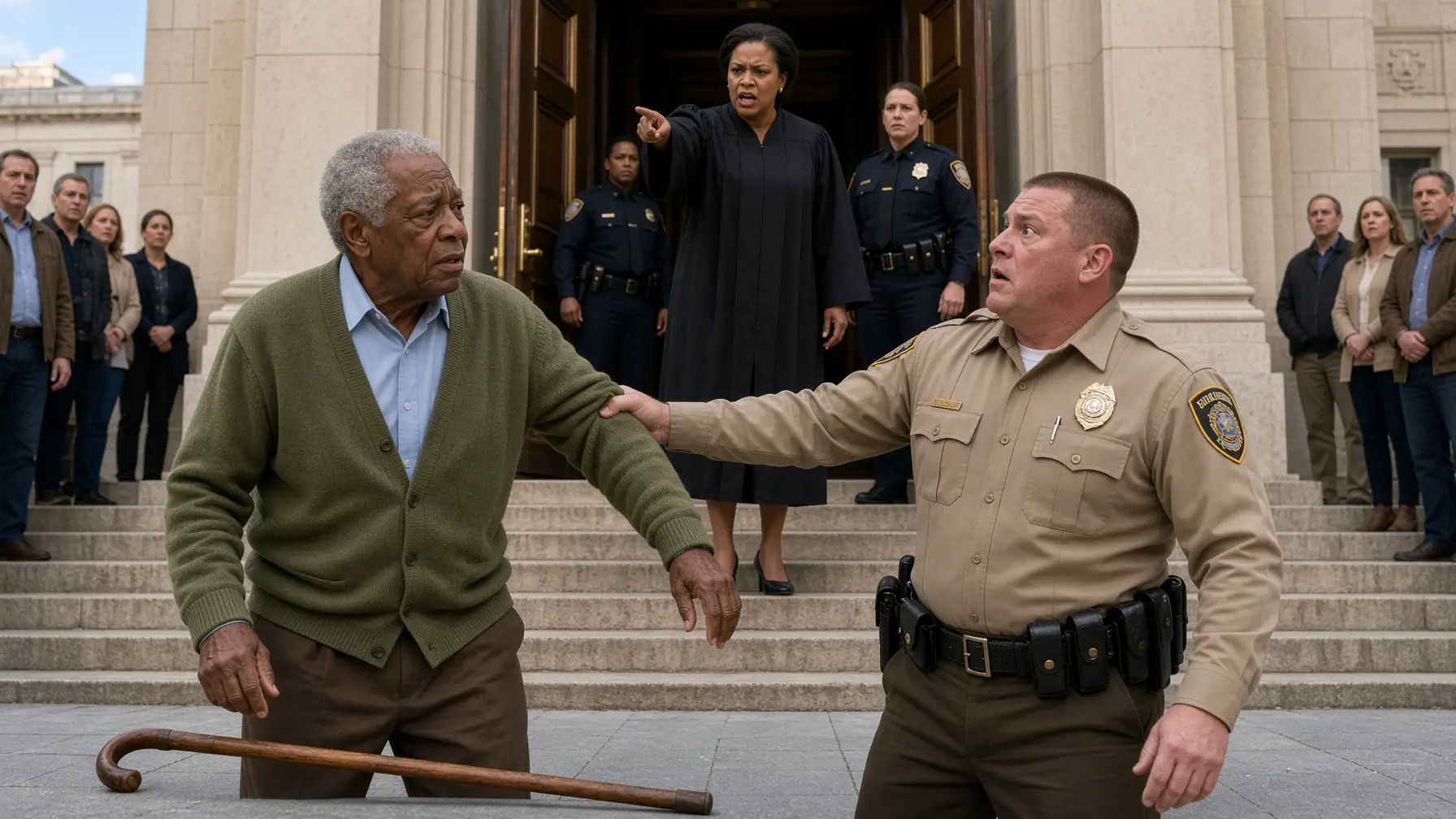
The deputy’s fingers gathered the elderly man’s sleeve just above the elbow. He held the fabric tightly enough that moving forward would mean pulling against him.
The old man stopped.
His wooden cane remained planted on the step below, and his other foot was searching for a secure place on the higher stair. For a moment, he had to think about balance before he could think about the words.
Then he looked up.
“Let go. I have business here.”
The deputy was thirty-eight, broad through the shoulders, with cropped brown hair and a tan sheriff’s uniform that looked freshly pressed. He stood squarely across the old man’s path, as if the steps were an extension of his own authority.
Several visitors had stopped in the courtyard.
A woman holding a document folder watched from near the handrail. A young man in a gray jacket stood beside her, looking between the deputy’s hand and the elderly man’s cane.
Nobody spoke.
The old man was seventy-six.
His gray hair had been combed carefully that morning. His olive cardigan lay over a pale blue shirt, and his brown trousers had a crease that softened at the knees.
He had dressed slowly because he wanted to arrive looking like himself.
Now the deputy was wrinkling the sleeve he had smoothed before leaving home.
The old man looked down at the grip.
“Your hand,” he said. “Take it off.”
The deputy’s mouth tightened.
Behind them, a car door closed along the street. Somewhere in the courtyard, a phone rang and was silenced.
The old man could hear both sounds clearly.
He wished he could hear an answer.
Instead, the deputy pulled him backward.
The morning had begun with the old man sitting at the edge of his bed, waiting for his legs to become ready.
That was how he thought of it.
Not waking up.
Not recovering.
Becoming ready.
At seventy-six, certain movements required a negotiation he had once performed without noticing. He could still rise, dress, and move through the house on his own, but rushing transformed ordinary tasks into problems.
So he did not rush.
He placed both feet flat on the floor and sat until the stiffness in his knees eased. His cane leaned against the bedside table within easy reach.
The handle was worn smooth where his palm rested.
He had tried a newer cane once.
It had been lighter, adjustable, and recommended by someone who meant well. He had used it for a week before returning to the wooden one.
The newer cane had been practical.
The old one felt familiar.
Familiarity mattered when an object accompanied every step.
He rose, steadied himself, and walked toward the bathroom.
There was no one in the house to tell him to hurry.
That pleased him most mornings.
Today, it made him pay closer attention to the clock.
He had somewhere to be.
The pale blue shirt hung from the back of a chair where he had placed it the night before. Beside it lay the cardigan, the trousers, and a pair of socks he had checked for thin places at the heels.
He had chosen everything deliberately.
The shirt was comfortable at the collar.
The cardigan was easy to remove if the building was too warm.
The trousers allowed him to bend his knees without the fabric pulling.
None of the decisions had been complicated when he was younger.
Now they formed the quiet groundwork of leaving home.
In the kitchen, he made toast and let the kettle finish before reaching for it.
He carried the cup to the table with his free hand.
On the table lay a small envelope.
He opened it, checked the paper inside, and returned it to the envelope without folding it further. He had done the same thing the previous evening.
He knew where he was going.
He knew why.
He simply wanted to make sure that everything he intended to take remained where he could find it.
His telephone rested beside the cup.
He considered making a call.
Then he decided against it.
The arrangements had already been made. Calling again would not make the morning easier, and he did not want someone to decide that a routine trip required assistance merely because he sounded his age.
He had accepted help when he needed it.
He was still learning how to refuse it without making the refusal sound like a grievance.
The toast cooled while he looked through the kitchen window.
A neighbor was putting a rubbish bin at the curb. Across the street, a child hurried toward a waiting car, dragging one sleeve of a jacket behind him.
The old man watched the child climb inside.
Then he finished his breakfast.
He rinsed the cup, checked that the stove was off, and put the envelope in his cardigan pocket.
At the front door, he paused to inspect the rubber tip of the cane.
It was secure.
He had replaced it recently, after noticing that the old one had worn unevenly. The replacement looked darker than the wood and slightly out of place, but it held the ground well.
He preferred that to appearances.
Before leaving, he glanced at himself in the narrow mirror beside the doorway.
Gray hair.