“Cover that trash, or I’ll pull your inspection badge.”
Major Grant Cavanaugh’s gloved finger stopped less than an inch from the faded tattoo on Rachel Mercer’s upper arm.
Rachel did not flinch.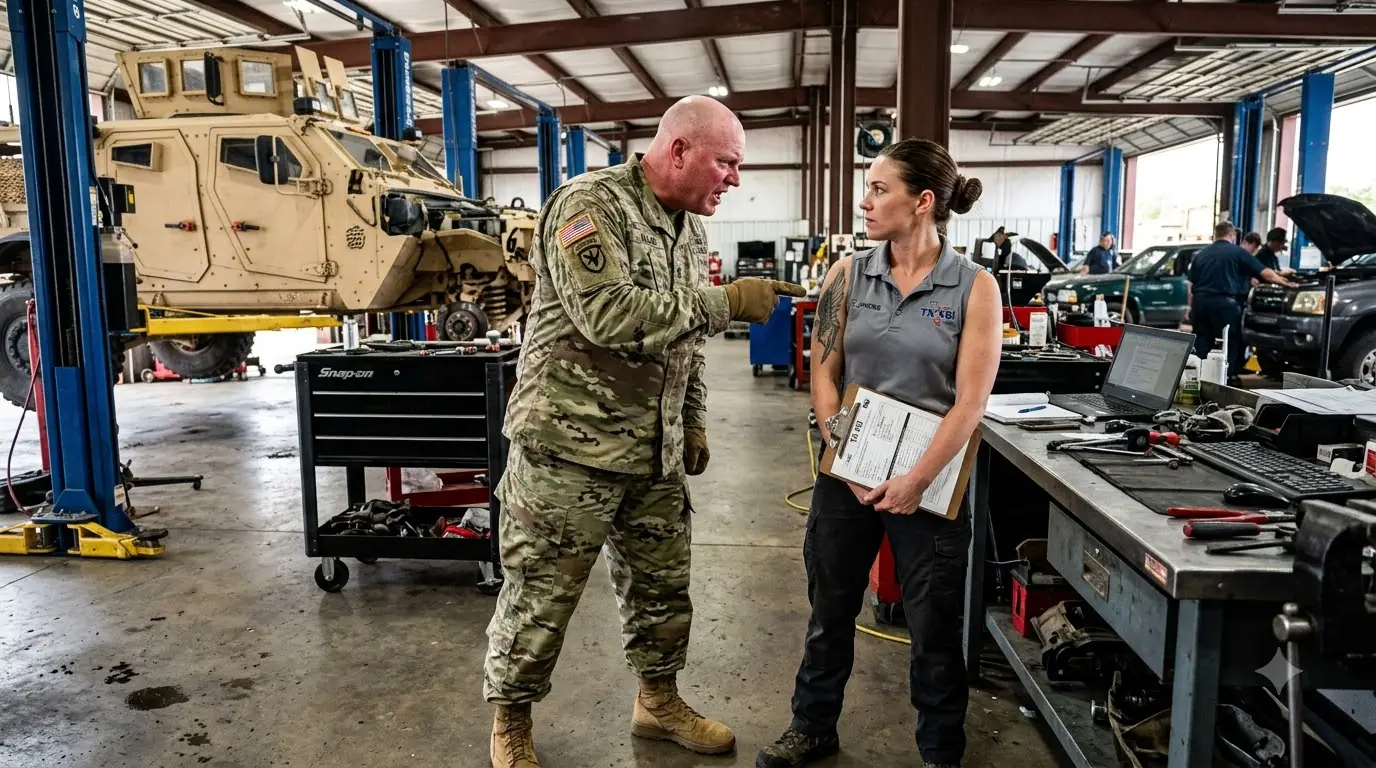
She was thirty-four, a civilian vehicle-safety inspector assigned to the sprawling Texas motor pool for a scheduled fleet review, and she had spent enough years around angry supervisors to know that volume did not make bad measurements disappear.
The crooked black mark on her arm looked unimpressive.
A fractured wing.
A narrow blade.
Uneven lines.
Faded edges.
Someone seeing it for the first time might have assumed it had been drawn badly in someone’s garage after too many drinks.
Cavanaugh clearly had.
Rachel pressed her brown clipboard against her chest and met his stare.
“Pull it,” she said. “Your whole fleet still stays parked.”
The two technicians standing beside the hydraulic station stopped working.
One slowly lowered his wrench.
Cavanaugh’s jaw tightened.
Behind Rachel sat the reason for the confrontation: a tan armored utility vehicle with a bright red inspection tag hanging from its driver-side door.
It had been scheduled for certification that afternoon.
According to the paperwork, it was ready.
According to the vehicle itself, it was not.
Rachel had found excessive steering play before lunch.
Then contamination in the hydraulic fluid.
Then a hairline fracture near a load-bearing mounting point underneath the chassis.
Each issue alone required further inspection.
Together, they made certification impossible.
Cavanaugh had spent twenty minutes telling her she was overreacting.
When that failed, he moved closer.
When that failed, he attacked her credibility.
When that failed, he noticed the tattoo.
Now his anger had become personal.
“You walked in here wearing a civilian badge and started grounding vehicles like you own the place,” Cavanaugh said.
Rachel placed her clipboard on the metal tool cart.
“I don’t own the place.”
She tapped the red tag.
“I own my signature.”
Cavanaugh stepped directly into her path.
“You think that piece of plastic makes you untouchable?”
“No.”
Rachel glanced at the vehicle.
“The inspection standard does.”
Cavanaugh gave a short laugh.
“You people always hide behind regulations.”
Rachel’s expression stayed neutral.
“Regulations are what you call measurements when you don’t like the answer.”
One of the younger technicians looked down quickly to hide his reaction.
Cavanaugh noticed.
His face reddened.
He pointed again toward Rachel’s tattoo.
“You show up dressed like this, carrying that garbage on your arm, and expect my people to treat you like some kind of authority?”
Rachel’s breathing slowed.
She had learned long ago that anger became useful only after you stopped giving it away for free.
“Major,” she said, “the steering assembly exceeds tolerance, the hydraulic sample is contaminated, and the support bracket needs imaging before this vehicle moves.”
“I have a certification deadline.”
“You have a damaged vehicle.”
“I have an operational schedule.”
“You have a red tag.”
Cavanaugh leaned closer.
“I can have your access revoked before dinner.”
Rachel did not move.
“Then whoever replaces me will find the same fracture.”
A voice came from behind him.
“Where did you get that mark?”
The entire bay went quiet.
Rachel’s eyes shifted past Cavanaugh.
A gray-haired man had entered through the open service doors with two staff members several moments earlier.
Lieutenant General Marcus Vale was sixty-two, leaner than Cavanaugh but somehow larger in the room.
He wore authority differently.
Cavanaugh demanded attention.
Vale received it without asking.
His gaze was not on the red inspection tag.
It was fixed on Rachel’s left arm.
Rachel’s throat tightened.
For the first time all afternoon, her expression changed.
“Thirteen years ago, sir.”
Vale stopped walking.
Nobody else understood the answer.
He did.
Cavanaugh looked between them.
“General, this is just a civilian inspector refusing to—”
Vale raised one hand.
Cavanaugh stopped talking.
Vale walked toward Rachel.
His eyes never left the tattoo.
The broken wing.
The crooked blade.
The small uneven line crossing the lower edge.
He knew every mistake in that design.
Because he carried them too.
Vale reached for the cuff of his left sleeve.
Slowly, deliberately, he rolled it upward.
Once.
Twice.
Past the elbow.
The technicians stared.
Cavanaugh stared harder.
On Vale’s upper arm was another faded tattoo.
A fractured wing.
A narrow blade.
The same crooked lower line.
The same proportions.
The same imperfect angle.
For several seconds, nobody said anything.
Cavanaugh’s pointing hand dropped.
Rachel looked at Vale’s arm and was no longer standing in a hot Texas maintenance bay.
She was thirteen years younger.
Cold.
Exhausted.
Sitting against stone.
Waiting in darkness.
Trying to convince five frightened people that morning was still possible.
Vale looked at her.
“Mercer?”
Rachel nodded.
“Yes, sir.”
Vale exhaled slowly.
“I thought you left public service.”
“I did.”
“And came back inspecting vehicles.”
“I like machines better than committees.”
For the first time, a faint smile touched Vale’s face.
“That sounds like you.”
Cavanaugh looked increasingly confused.
“Sir, if I may explain—”
Vale turned toward him.
The smile disappeared.
“What were you explaining before I arrived?”
Cavanaugh hesitated.
Rachel said nothing.
Vale glanced toward the red-tagged vehicle.
Then toward Rachel’s clipboard.
“Inspection sheet.”
Rachel handed it to him.
He read the first page.
His eyes moved more slowly over the second.
“Excessive steering play?”
“Yes.”
“Hydraulic contamination?”
“Yes.”
“Structural fracture?”
“Preliminary visual indication. It needs nondestructive testing.”
Vale looked toward the vehicle.
“Was it scheduled for service tomorrow?”
Cavanaugh answered immediately.
“Yes, sir, but the vehicle passed internal maintenance—”
Vale raised the inspection sheet.
“It apparently did not.”
Cavanaugh swallowed.
“Our technicians signed it off.”
Rachel spoke calmly.
“That is part of the problem.”
Vale looked at her.
“What do you mean?”
Rachel reached for another folder.
“I compared the maintenance sheet with the measurements I took this morning.”
She opened it.
“Three torque values are identical down to the final decimal across four separate vehicles.”
One technician looked toward Cavanaugh.
Vale noticed.
Rachel continued.
“That could happen.”
She turned a page.
“But those values also match the manufacturer’s example worksheet.”
Vale stared at the paper.
“Exactly?”
“Exactly.”
The bay became very quiet again.
Rachel pointed to another line.
“The steering free-play measurement is also copied.”
Cavanaugh stepped forward.
“You have no proof anyone falsified anything.”
Rachel looked at him.
“I didn’t say falsified.”
She tapped the folder.
“I said copied.”
That distinction mattered.