A twelve-year-old boy pressed a pair of binoculars against a frozen window.
Across the street, leather-clad men with battle scars and thousand-yard stares guarded a clubhouse most neighbors crossed the road to avoid.
Nobody watched the Iron Vultures closer than Eli Mercer.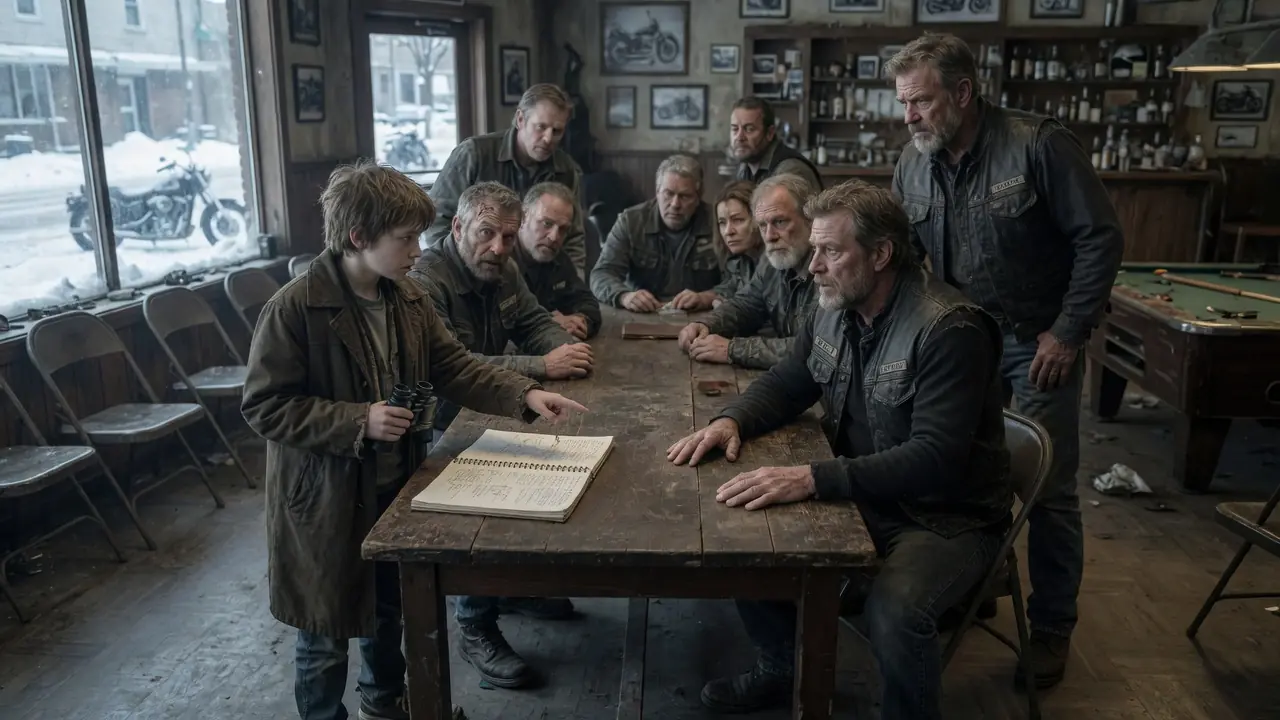
Nobody listened to Eli Mercer at all.
But tonight, on the coldest night the town had seen in years, Eli witnessed something that would tear a brotherhood apart from the inside.
A betrayal so quiet, so calculated, that men who lived by loyalty never heard it coming.
And the only person who could prove it was a boy the entire world had already decided did not matter.
The binoculars were older than Eli Mercer.
Scratched lenses. Cracked rubber grip. A focusing ring that stuck unless he twisted it with both hands.
His grandfather had used them for birdwatching before dementia took everything, including the old man’s name.
Now they sat on Eli’s windowsill every night, aimed not at the sky, but at the low-slung building across Garfield Street.
The Iron Vultures Motorcycle Clubhouse.
It had a rusted corrugated roof and a hand-painted vulture sigil above the door that looked like it had been bleeding into the wood for decades.
Eli pressed his forehead against the cold glass.
His breath fogged a circle on the window, and he wiped it with his sleeve without thinking.
Habit.
He had been doing this for two years, ever since his mother moved them into the upstairs apartment of the duplex his aunt owned.
Two years of watching men in leather cuts come and go.
Two years of memorizing which Harley belonged to which rider by the sound of the exhaust alone.
He could tell you that Roach, the sergeant-at-arms, always parked crooked because his left knee was fused from a combat injury he never talked about.
He could tell you that the prospect they called Nickel smoked exactly four cigarettes during his gate shift, spacing them forty-five minutes apart like a man counting down a prison sentence.
He could tell you that the vice president, Cade, never entered through the front door.
Always the side.
Always alone.
Always carrying something heavy that had nothing to do with his hands.
Nobody asked Eli these things.
Nobody asked Eli anything.
At Ridgemont Middle School, his teachers had long since filed him under a category that required no further investigation.
Quiet.
Odd.
Possibly on the spectrum.
Definitely not worth the energy.
He sat in the back row of every class and filled spiral notebooks with observations so detailed they read like surveillance reports.
Mrs. Hargrove, his English teacher, had once confiscated one and flipped through it during lunch.
She found six pages describing the exact sequence of events at a gas station robbery Eli had witnessed from a bus window.
The color of the getaway car.
The limp in the driver’s left leg.
The fact that the passenger had bitten his fingernails down to raw skin.
Mrs. Hargrove wrote overactive imagination on a sticky note, returned the notebook, and never mentioned it again.
The police report later confirmed every detail Eli had recorded.
Nobody connected the dots.
Nobody ever did.
His mother, Jolene, worked double shifts at a packaging facility fourteen miles outside town.
She left before Eli woke up and came home after he had already made himself a peanut butter sandwich and gone to bed.
On her days off, she sat in the kitchen with the lights low, drinking coffee that had gone cold hours ago, staring at a spot on the wall like she was trying to decode a message only she could see.
Eli had learned not to talk to her during those times.
He had learned not to talk to her during most times.
Jolene was not cruel.
She was just somewhere else.
Some internal geography Eli could not reach.
A place carved out by a husband who had left without warning and a life that kept demanding payments she could not afford.
So Eli watched the bikers instead.
There was something about their world that made sense to him in a way his own never had.
The Iron Vultures operated on a system of rituals and hierarchies that Eli could map and predict.
Church meetings every Thursday at seven.
Runs every other Saturday unless the weather dropped below twenty degrees.
Prospects handled the grunt work: cleaning, gate duty, hauling supplies.
Full-patch members moved through the clubhouse with a gravity Eli recognized as earned, not given.
These men did not smile often.
But when they did, it meant something.
Their silences were not empty.
Their silences were architecture.
Tonight was different.
Eli noticed it first in the parking pattern.
On a normal Thursday, the bikes lined up along the east wall of the building, chrome catching whatever light leaked from the single sodium lamp at the corner of the lot.
But tonight, two slots were empty.
Roach’s Indian Chief was missing.
Unusual, because Roach never missed church unless he was in the hospital or in county lockup.
The second empty slot belonged to a bike Eli knew better than any other in the lineup.
Cade’s 1998 Road King.
Flat black, with a hand-stitched leather seat Cade had rebuilt himself over the course of three winters.
Eli adjusted the focus ring.
The cold had made the mechanism even stiffer than usual, and his fingers ached as he forced the image into clarity.
The clubhouse door was shut.
A thin line of light escaped from beneath it, yellow and warm against the frozen concrete.
No one was outside.
The prospect’s folding chair sat empty by the gate, a cigarette still smoldering in the tin can beside it.
Something was wrong.
Eli felt it the way animals feel earthquakes.
Not in his mind, but in his chest.
A tightening that had no name.
He checked the time.
11:47 p.m.
Church should have ended hours ago.
On a normal night, the last bikes would have cleared out by ten. Stragglers, usually Deacon and a quiet rider everyone called Glass, might stay until ten-thirty, nursing beers in the back room.
But by midnight, the clubhouse was always dark.
Tonight, it was lit up like a holding cell.
Then the side door opened.
Eli’s breath stopped.
He pressed the binoculars harder against his eye sockets, ignoring the pain where the rubber bit into bone.
A figure stepped out.
Not one of the regular members.
This was someone Eli had seen before, but not often.
A visitor.
Tall, lean, moving with the kind of deliberate calm Eli had learned to distrust.
The man wore a dark jacket, no cut, and he carried himself like someone who knew exactly where every camera was and had already calculated the blind spots.
Eli had cataloged this man three times over the past month.
Once at a barbecue the club had thrown in late October, where the man stood at the edge of the crowd with a beer he never drank.
Once on a Tuesday afternoon, arriving in a pickup truck and spending forty minutes inside before leaving without speaking to anyone in the parking lot.
And once, this was the detail that had lodged in Eli’s brain like a splinter, the man had been given the side door code by Cade himself.
Eli had watched Cade punch in the numbers while the man stood beside him.
Even from across the street with shaking binoculars, Eli had caught the sequence.
The man now used that code.
The keypad’s tiny light blinked green, and the side door opened from the inside.
He slipped into the lot and moved directly toward the row of parked motorcycles.
Not his own vehicle.
He had come in the pickup.
Eli could see it parked a block east under the dead elm tree, where the streetlight had been out since September.
The man walked past three bikes without slowing.
Then he stopped at the fourth.
Cade’s Road King.
Eli’s hands began to tremble.
Not from cold.
From recognition.
From the nauseating clarity of witnessing something no one was supposed to see.
The man crouched beside the Road King. His hands moved with practiced efficiency.
Eli could not see exactly what he was doing. The angle was wrong, the shadows too thick.
But the body language was unmistakable.
This was not admiration.
This was not maintenance.
This was acquisition.
Ninety seconds later, the engine turned over.
Not with a roar.
The man had done something to muffle the exhaust. A temporary fix that reduced the Harley’s signature thunder to a low, guttural moan.
The sound was wrong.
Eli knew the voice of every bike on that lot the way a musician knows individual instruments in an orchestra.
This was a note played through cloth.
Suffocated and deceitful.
The man rolled the Road King out of the lot, past the empty prospect chair, through the open gate, and into the street.
He did not accelerate.
He kept the speed just above idle, letting the bike coast down the slight grade of Garfield Street toward the intersection with Route 11.
At the corner, he turned right and disappeared into a darkness so complete it looked intentional.
Eli lowered the binoculars.
His hands were shaking badly now.
His heart hammered against his ribs like something trying to escape a cage.
He looked at the clubhouse.
Still lit.
Still closed.
Nobody had come out.
Nobody had heard.
He grabbed his notebook from the nightstand and began writing.
The time.
The physical description.
The jacket: dark navy, no patches, zippered pockets.
The boots: square-toed, not motorcycle boots. Work boots.
The way the man favored his right hand.
The code he used.
The direction he went.
The color of the pickup truck still parked under the dead elm: dark green, maybe black in the bad light, rust along the rear wheel well, a dent in the tailgate shaped like a fist.
Eli wrote for twenty minutes without stopping.
When he finished, he read it back.
Every detail locked in place.
Every observation precise.
Then he closed the notebook and sat on his bed and did nothing.
Because who was he going to tell?
The question sat on his chest like a stone.
He was twelve.
He had no phone. Jolene could not afford one.
The school counselor had once suggested Eli might benefit from social skills intervention, which was a clinical way of saying nobody wanted to be his friend and the adults had given up trying to fix it.
His aunt downstairs watched television until two in the morning and answered every knock with suspicion and a baseball bat.
He could call the police.
But the last time Eli had tried to report something, a man in a gray sedan following a girl from the bus stop three blocks over, the dispatcher asked to speak to his mother.
Jolene had not been home.
The dispatcher told him to have an adult call back.
No adult ever did.
Eli watched the gray sedan return twice more before it finally stopped coming.
He never found out what happened to the girl.
The system had a word for kids like Eli.
Unreliable.
Which was the cruelest lie the world had ever told.
Because Eli was the most reliable witness in the entire neighborhood.
He just happened to be twelve and small and quiet and poor.
In a world that measured credibility by volume and authority, Eli possessed neither.
He lay in bed and stared at the ceiling.
The wind outside pressed against the window like something trying to get in.
He could hear the distant rumble of a freight train passing through the railyard three miles south, its horn cutting through the frozen air with the lonely persistence of something calling out to no one.
Sleep did not come.
It never did on nights like this.
Eli’s mind would not release the image.
The man’s hands on Cade’s bike.
The muffled engine.
The casual precision of a theft that had been rehearsed.
This was not some desperate man grabbing an opportunity.
This was planned.
This was someone who knew the codes, knew the schedule, knew which bike to take, and knew when the prospect would be away from the gate.
This was inside.
That word sat in the dark like a lit fuse.
Inside.
Dawn came gray and bitter.
Eli had not slept.
He stood at the window with the binoculars and watched the clubhouse wake up the way he had watched it a hundred times before.
The front door opened.
A prospect came out to sweep the steps.
Cigarette smoke curled into air so cold it barely moved.
Except today, the rhythm was off.
The prospect was not sweeping.
He was standing still, staring at the row of bikes.
Even from across the street, Eli could read the posture.
Confusion hardening into alarm.
The prospect went inside.
Thirty seconds later, the door burst open and three men came out fast.
Boots hitting concrete.
No one spoke.
They moved to the bike line and stood where the Road King should have been, looking at the empty space the way you look at a wound you cannot explain.
Then more men came.
Eli counted seven in total, all wearing cuts, all moving with the controlled urgency of men who understood that panic was a luxury they could not afford.
One of them, Deacon, the club president, a thick-necked man with a gray beard and hands like excavator buckets, stood apart from the others, arms crossed, scanning the lot with eyes that missed nothing.
Except they had missed everything.
That was the part Eli could not stop thinking about.
These men who lived by vigilance, who trusted no one outside their circle and very few inside it, had been robbed in their own house by someone they had let through the door.
Eli watched for another hour.
He saw Cade arrive.
Not on a bike, because his bike was gone, but in a borrowed truck that pulled up to the curb with an exhaust rattle that sounded like a cough.
Cade got out slowly.
He was a tall man in his early forties, with a face that looked like it had been carved from wood and then left in the rain.
His eyes were set deep beneath a brow that seemed permanently furrowed, and he carried himself with the careful stillness of someone who had learned long ago that movement attracted attention, and attention attracted pain.
Eli knew fragments of Cade’s history from overheard conversations and careful observation.
Two tours overseas.
A marriage that ended the way most military marriages end, not with an explosion, but with a slow leak that drained everything until there was nothing left to hold.
A daughter somewhere in another state whom Cade mentioned only when he had been drinking, and even then only in half sentences that trailed off into silence.
The Road King was not just a motorcycle.
Eli understood that.
It was the last thing Cade had built with his own hands that had not fallen apart.
And now it was gone.
Eli dressed.
Jeans. Two sweatshirts layered under a coat that was too thin for the weather. Sneakers with the left sole separating at the toe.
He put the notebook in his back pocket.
He stood at the top of the stairs for a full minute listening.
His aunt’s television murmured through the floor.
A morning talk show. Canned laughter. The smell of instant coffee seeping up through the heating vents.
He went downstairs and out the front door without saying a word to anyone.
The cold hit him like a wall.
His eyes watered immediately, and he shoved his hands into his pockets and crossed Garfield Street with his head down, walking directly toward the Iron Vultures clubhouse for the first time in his life.
The prospect at the gate saw him coming.
A young guy, maybe twenty-two, with a patchy beard and a neck tattoo of a compass rose.
His name was Dill, and Eli had watched him fumble through gate duty for the past four months with the anxious determination of someone who knew this was his only shot at belonging somewhere.
“Hey, kid. Wrong street.”
Eli stopped.
He looked up at Dill and felt the full weight of what he was about to do settle over him like a net.
Every instinct told him to turn around.
Every experience he had ever had with adults told him this would go badly, that he would be laughed at, dismissed, sent home, forgotten.
The pattern was so familiar it had its own gravity.
But the notebook was in his pocket, and the truth was in the notebook.
If Eli turned around now, the truth would stay there, trapped in a spiral-bound prison where no one would ever read it.
Cade would never know what happened to the last thing he had ever built.
“I need to talk to someone,” Eli said.
His voice came out smaller than he wanted.
He hated that.
“About what?”
“About the bike. The one that’s missing.”
Dill’s expression changed.
Not softened.
Sharpened.
His eyes narrowed, and he straightened from his slouch against the gate post with a speed that suggested the subject had turned every nerve in his body to wire.
“What do you know about that?”
“I saw who took it.”
Dill stared at him.
Eli could see the calculation happening behind the prospect’s eyes.
The disbelief colliding with desperation.
The instinct to dismiss a twelve-year-old warring with the reality that nobody else had any answers.
“Wait here.”
Dill disappeared inside.
Eli stood in the cold, his sneakers soaking through on the frozen concrete, his breath coming in short white bursts that dissolved into nothing.
He counted sixty seconds.
Then ninety.
At two minutes, the side door opened and Deacon walked out.
Up close, the club president was even more imposing than he appeared through binoculars.
He moved with the deliberate economy of a man who had learned that wasted motion was wasted energy.
And at his age, Eli guessed late fifties, energy was a resource he managed carefully.
His eyes found Eli and held him with a gaze that felt less like scrutiny and more like an X-ray.
“You’re the kid from across the street.”
It was not a question.
“Yes, sir.”
“Dill says you saw something.”
“I saw who took Cade’s Road King last night. Eleven forty-seven.”
Deacon’s jaw tightened.
He did not speak for a long time.
Behind him, through the open door, Eli could see the inside of the clubhouse for the first time.
Dim light. Wood-paneled walls. A bar along the far side. Men sitting at tables with the coiled stillness of people waiting for a reason to move.
“Come inside,” Deacon said.
The clubhouse smelled like engine oil and old leather and coffee that had been on the burner too long.
Eli’s sneakers squeaked on the concrete floor as he followed Deacon past the bar, past a pool table with a torn felt surface, past a wall covered in framed photographs of men on motorcycles.
Some laughing.
Some stoic.
Some no longer alive.
The air was thick with something Eli could not name at first.
Then he could.
Grief.
Not the loud, performative kind.
The kind that sits in a room like humidity, invisible but impossible to ignore.
Seven men watched him cross the room.
Eli felt their eyes like heat lamps.
He was the smallest person in the building by a factor that felt almost comical, and he understood with absolute clarity that if he stumbled over his words or got a single detail wrong, these men would write him off and he would never get another chance.
Cade sat at a table near the back wall.
A coffee mug sat in front of him, untouched.
His hands were flat on the table, palms down, fingers spread, the posture of a man holding himself in place.
“Sit down,” Deacon said, pulling out a chair.
Eli sat.
He pulled the notebook from his back pocket and placed it on the table.
He did not open it.
He did not need to.
Everything in it was already in his head, organized and indexed and ready to deploy with the mechanical precision of a kid who had spent his entire life watching because no one had ever invited him to participate.
“Last night at 11:47 p.m.,” Eli began, “a man exited the clubhouse through the side door using the keypad code 4721. He walked directly to the fourth motorcycle in the east row, the flat black Road King with the hand-stitched seat. He disabled or muffled the exhaust system, started the engine, and rolled the bike out through the open gate. He turned right on Route 11, heading south. The prospect chair was empty at the time.”
No one spoke.
Eli continued.
“The man drove a dark green pickup truck with rust on the rear wheel well and a dent in the tailgate. The truck is still parked under the dead elm on the east side of Garfield, one block from this building.”
The silence that followed was so complete Eli could hear the coffee maker ticking on the counter behind the bar.
Every man in the room was looking at him now.
Not with amusement.
Not with dismissal.
With something Eli had never experienced before in his twelve years of life.
The terrified recognition that this small, shivering kid in a too-thin coat might be telling a truth none of them were ready to hear.
Cade’s hands had not moved from the table, but his knuckles had gone white.
“The side door code,” Cade said, his voice low and stripped of everything except the question. “How do you know the side door code?”
“I watched you give it to him,” Eli said. “Three weeks ago, Tuesday afternoon. You punched it in while he stood next to you. 4721.”
“Watched from where?”
“My bedroom window. Second floor. Across the street.”
Cade looked at Deacon.
Something passed between them.
A communication that bypassed language entirely, built on years of shared silence and mutual understanding.
Eli saw it and cataloged it.
Fear.
Not of him.
Of what his words meant.
Because if the thief had the side door code, the thief was not a stranger.
The thief was someone Cade had personally trusted enough to stand beside while he entered the club’s security.
And there was only one person Cade had done that for in the past month.
Cade’s mouth opened, then closed.
His jaw worked like he was chewing something that would not break down.
The coffee mug sat untouched in front of him, and steam no longer rose from it.
It had gone cold while the room held its breath.
“The man you saw,” Cade said, each word landing like a footstep on thin ice. “Describe him again.”
Eli did not blink.
“Tall. Lean. Dark navy jacket. No patches. Square-toed work boots, not riding boots. Favors his right hand. Moves like he already counted the cameras.”
Across the table, a man Eli recognized as Glass, mid-thirties, shaved head, with a scar running from his left ear to his collar, leaned forward and spoke for the first time.
“That’s Wyatt.”
The name landed in the room like a grenade with the pin already pulled.
Nobody moved.
Nobody breathed.
The coffee maker ticked.
Somewhere outside, a gust of wind rattled the corrugated roof, and the sound was so lonely it hurt.
Cade’s hands finally moved.
They curled into fists slowly, deliberately, the way a man closes a door he knows he will never open again.
His eyes stayed fixed on the table, but Eli could see something behind them collapsing.
A structural failure happening in real time.
Load-bearing walls giving way inside a man who had already lost more than most people ever carry.
Wyatt Cross.
The name Eli had never known, but the face he had recorded three times in his notebook.
The man Cade had personally vouched for.
The man Cade had let stand beside him at the side door while he punched in the code that was supposed to keep the brotherhood safe.
Deacon stood up.
His chair scraped against the concrete floor, and the sound cut through the silence like a blade.
“Everyone out,” the president said. “Except Cade and the kid.”
The room emptied in seconds.
Boots on concrete. Leather creaking. The side door opening and closing with a finality that made the walls shudder.
Then it was just three of them.
An old biker with a gray beard and hands that could crush stone.
A broken man staring at his cold coffee.
And a twelve-year-old boy in wet sneakers who had just detonated a truth that no one in this building had been prepared to survive.
Deacon sat back down.
He looked at Eli with an expression Eli would spend years trying to decode.
Respect, sorrow, and something close to apology, all compressed into a single glance from a man who had long since abandoned the luxury of showing what he felt.
“Kid,” Deacon said quietly, “do you understand what you just walked into?”
Eli looked at Cade’s fists on the table.
He looked at the wall of photographs behind the bar.
The dead men. The gone men. The men who had worn the patch and paid the price.
He looked at the vulture sigil painted above the door, its wings spread wide, its eyes empty, its talons gripping something invisible.
“Yes, sir,” Eli said. “I do.”
Outside, the wind picked up.
Snow began to fall.
Not gently, but with the hard, angular determination of a winter that had no intention of showing mercy.
Somewhere under a dead elm tree one block east, a dark green pickup truck sat cooling in the cold, its tailgate dented, its owner gone, and the truth of what it meant ticking like a bomb that had already started its countdown.
Inside the clubhouse, Cade Mercer unclenched his fists, looked up from the table, and spoke the words that would change everything.
“Wyatt Cross is the closest thing I’ve had to a brother in fifteen years.”
His voice cracked on the last word.
Not dramatically.
The way real things break quietly in the middle of an ordinary sentence without warning or witnesses.
Except tonight there were two.
An old man who had seen too much.
And a boy who had never been allowed to see anything at all.
Deacon did not respond.
He did not need to.
The answer was already in the room, hanging in the air between the three of them like smoke from a fire no one had the courage to name.
The question was not whether Wyatt Cross had stolen the Road King.
The question was what Cade Mercer was willing to destroy to get the truth.
And whether the boy sitting across from him, the boy no one had ever believed, was ready for what came next.
The silence after Cade’s confession lasted eleven seconds.
Eli counted.
Counting was what he did when the world became too heavy to process any other way.
Reduce everything to numbers.
To sequence.
To data points that did not carry emotional weight.
Eleven seconds of Cade Mercer staring at his own fists like they belonged to someone else.
Eleven seconds of Deacon sitting motionless, his breathing so controlled it barely moved his chest.
Eleven seconds of the coffee maker ticking on the counter like a metronome, keeping time for a song nobody wanted to sing.
Then Deacon spoke.
“How long have you known Wyatt?”
Cade did not look up.
“Since Fallujah.”
The word landed differently than Wyatt’s name had.
Not like a grenade.
Like a door opening onto a room that had been sealed for years, and the air coming out was stale and toxic and full of things that should have been buried.
“He pulled me out of a vehicle,” Cade said.
His voice had flattened into the register Eli recognized from men who talked about pain the way mechanics talked about engine failure.
Clinical.
Detached.
Describing damage without acknowledging the thing that had been destroyed.
“IED took the front axle. Driver was already gone. Wyatt dragged me sixty yards across open ground while people were shooting at both of us.”
Deacon’s jaw tightened.
“I know the story, Cade.”
“Then you know why I gave him the code.”
“I know why you thought you had a reason. That’s not the same thing.”
Eli sat perfectly still.
He understood, with the intuition of a child who had spent his life reading rooms instead of living in them, that he was witnessing something private.
A conversation between two men who had built their trust on a foundation of shared damage, and that foundation was now showing cracks neither of them knew how to repair.
Cade finally looked up.
His eyes were dry, but something behind them was flooding.
“You’re asking me to believe that a man who carried me across a kill zone stole my bike.”
“I’m not asking you to believe anything,” Deacon said. “The kid is.”
Both men turned to Eli.
He felt their attention like a change in atmospheric pressure.
The room getting heavier. The air getting thinner. Everything contracting around the small, cold center of his wet sneakers on the concrete floor.
“Tell me again,” Cade said.
“The jacket was dark navy. No patches. Zippered pockets, not buttoned. The zipper pulls were silver-toned, not brass. Boots were square-toed work boots, not riding boots. Brown, maybe tan. Hard to tell under the sodium light. Worn heels. He walks with his weight on the outside edges of his feet.”
Cade closed his eyes.
Eli watched the muscles in his jaw work beneath the skin, a grinding motion that looked involuntary, like the man’s body was trying to chew through something his mind refused to swallow.
“That’s Wyatt’s boots,” Cade said without opening his eyes. “He’s got flat feet. VA wouldn’t cover orthotics, so he wears those square-toed Ariats because they’re the only ones that don’t wreck his knees.”
Deacon leaned back in his chair.
The wood creaked.
Outside, a gust of wind hammered the corrugated roof, and somewhere in the parking lot, a loose chain rattled against a fence post with a sound like teeth chattering.
“We need to bring this to the table,” Deacon said.
Cade’s eyes opened.
“No.”
“This isn’t a request.”
“You bring this to the table and twelve men decide Wyatt’s fate based on the word of a kid none of them know. That’s not justice, Dee. That’s a firing squad.”
Eli flinched.
Not at the words.
At the way Cade said the word of a kid without looking at him.
Like Eli had already become evidence.
Like the moment he crossed Garfield Street and opened his mouth, he stopped being a person and became a weapon someone else would decide how to aim.
Deacon noticed the flinch.
His eyes moved to Eli and stayed there, and something in the old president’s face shifted.
A softening so subtle it would have been invisible to anyone who had not spent two years studying human expressions through scratched binoculars.
“What’s your name, son?”
“Eli. Eli Mercer.”
Deacon’s eyebrows rose.
He looked at Cade.
“Mercer?”
Cade shook his head.
“No relation. I asked around when they moved in. Different Mercers. Small world, small street.”
Deacon turned back to Eli.
“Eli, I need to ask you something, and I need you to answer honest. Not brave. Honest. You understand the difference?”
Eli nodded.
“Are you one hundred percent certain the man you saw was the same man Cade brought here three weeks ago? Not ninety. Not probably. One hundred.”
Eli thought about it.
He thought about the way Mrs. Hargrove had written overactive imagination on a sticky note without ever checking whether his observations were accurate.
He thought about the police dispatcher who had asked to speak to an adult.
He thought about every time the world had given him an off-ramp, a way to soften his certainty into something more palatable, more dismissible, more comfortable for the people who did not want to hear what he had to say.
“One hundred percent,” Eli said. “Same height, same build, same jacket, same boots, same gait, same right-hand dominance. And he used the code Cade gave him. Nobody else has done that in the time I’ve been watching.”
“How long have you been watching?”
“Two years.”
Deacon stared at him.
Then, very slowly, the club president did something Eli did not expect.
He laughed.
Not loudly.
Not warmly.
A short, dry exhalation through the nose that carried no humor and all recognition.
The laugh of a man who had just realized the most reliable intelligence asset in the neighborhood was a twelve-year-old insomniac with a pair of broken binoculars.
“Two years,” Deacon repeated.
He rubbed his face with both hands, pulling the skin downward, aging himself ten years in a single gesture.
“Kid’s been running surveillance on us for two years, and none of us caught it.”
“I wasn’t surveilling you,” Eli said quietly. “I was watching. There’s a difference.”
“Enlighten me.”
“Surveillance is looking for something specific. Watching is just paying attention to everything and remembering what you see.”
Deacon dropped his hands.
He looked at Eli the way Eli had seen him look at the photographs on the wall.
The dead riders.
The brothers who had carried the patch to their graves.
With the particular sorrow of a man who recognized something valuable and already knew the cost of protecting it.
“Cade,” Deacon said, not taking his eyes off Eli, “we’re bringing this to the table. That’s not a discussion.”
Cade stood up.
The chair scraped backward.
His full height unfurled in the low-ceilinged room like something being released from compression.
For the first time, Eli saw the vice president not as a figure through binoculars, but as a physical presence.
Broad-shouldered.
Thick-armed.
Carrying the kind of mass that was not built in gyms, but forged through years of manual labor and controlled violence.
His shadow fell across the table and covered Eli completely.
“Then I’m finding Wyatt first,” Cade said. “Before the table. Before the vote. Before anyone in this club decides that fifteen years of brotherhood gets erased by a kid with a notebook.”
He was gone before Deacon could answer.
The side door opened and closed, and through the wall Eli heard boots on gravel.
Then the starter of the borrowed truck coughed to life.
Tires ground against frozen asphalt as Cade pulled away from the clubhouse with the desperate acceleration of a man outrunning a verdict he was not ready to face.
Deacon sat in the empty room with Eli.
The coffee maker had stopped ticking.
The overhead light buzzed, a fluorescent tube on its last cycle, throwing a thin pulsing glow that made everything look slightly unreal.
“Is he going to hurt him?” Eli asked.
Deacon considered the question with a seriousness that surprised Eli.
Most adults would have deflected.
Don’t worry about it.
That’s grown-up stuff.
The polite dismissals Eli had come to understand as the sound of people closing doors.
“I don’t know,” Deacon said. “And that’s the honest answer.”
“Will you stop him if he tries?”
“That depends on what Wyatt says when Cade finds him.”
Eli absorbed this.
The logic was conditional, branching, dependent on variables Eli could not observe from across the street.
He felt the edges of his understanding strain against the weight of what he had set in motion.
The sudden, dizzying realization that telling the truth was not the end of a process, but the beginning of one.
Once the truth was loose, you could not control where it went or what it destroyed.
“You should go home,” Deacon said. “Your mother know where you are?”
“She’s at work.”
“Who’s watching you?”
“Nobody.”
The word hung in the air.
Deacon looked at Eli the way you look at a wound you cannot dress.
Acknowledging the damage without having the tools to fix it.
“Stay here if you want,” Deacon said. “I’ll have Dill make you something to eat.”
Eli did not go home.
He sat at the table in the Iron Vultures clubhouse and ate a grilled cheese sandwich that Dill burned on one side and undercooked on the other.
He watched the members filter back inside one by one, each of them casting glances at the boy in the corner like he was an equation they had not been asked to solve.
Glass sat down across from him without being invited.
Up close, the scar from his ear to his collar was deeper than Eli had estimated through binoculars.
Not a clean cut, but a tearing, the kind of wound that suggested something had been pulled rather than slashed.
Glass set a mug of hot chocolate in front of Eli.
It was made from a packet.
Too much powder. Not enough water.
But the heat of it in Eli’s hands was the warmest thing he had felt all day.
“You know what you did, right?” Glass said.
Eli looked at him.
“You walked into a room full of men who’ve been lied to by professionals. Cops. Lawyers. Ex-wives. Government. And you told them a truth they didn’t want to hear. Most adults can’t do that.”
Eli took a sip of the hot chocolate.
It was too sweet and slightly gritty.
“Most adults don’t watch.”
Glass almost smiled.
Almost.
The scar pulled at the left side of his face and turned the expression into something asymmetrical and vaguely painful.
“You know anything else about Wyatt?” Glass asked. “Anything besides what you told Deacon?”
Eli thought.
He flipped through his mental archive.
The three sightings. The behavioral patterns. The details he had recorded.
Then something surfaced.
A detail he had not included because it had not seemed relevant until this moment.
“The second time I saw him,” Eli said slowly. “The Tuesday visit six days ago. He came in the pickup and stayed forty minutes.”
“Yeah?”
“When he came out, he wasn’t alone.”
Glass went still.
The mug in front of him stopped its slow rotation between his palms.
“Who was with him?”
“I don’t know his name. Shorter. Heavy build. Bald. He was wearing a cut, but I couldn’t read the patch. He got into a different vehicle, a white SUV parked on the north side of the lot. They didn’t speak to each other outside, but they left within thirty seconds of each other. Same direction.”
Glass stared at him for a long moment.
Then he pushed back from the table and walked to the bar where Deacon was standing with Roach.
The sergeant-at-arms had arrived sometime in the last hour, limping on his fused knee, his face set in the permanent grimace of a man who experienced pain as background noise.
Eli watched Glass lean in and speak to Deacon in a voice too low to carry across the room.
He watched Deacon’s face change.
He watched Roach straighten up from the bar, his hand moving unconsciously to his belt where a knife used to hang before he had given it up three years ago.
Another detail Eli had cataloged without understanding its significance until now.
Something was happening.
Something Eli’s new information had triggered.
A connection the bikers were making that he could not see because he did not have the inside knowledge to complete the circuit.
Deacon walked to the center of the room.
He did not raise his voice.
He did not need to.
Every man in the building oriented toward him the way compasses orient toward north, automatically and without thought, because the direction had been established long before any of them arrived.
“Church,” Deacon said. “Now. Everyone.”
The room rearranged itself in seconds.
A heavy wooden table in the back was cleared.
Bottles. Ashtrays. A disassembled carburetor someone had been cleaning.
Chairs were pulled into a rough circle.
Eli counted nine men, including Deacon and Roach.
Cade was missing.
Two others were apparently unreachable.
The prospect, Dill, positioned himself by the door in the posture Eli recognized as sentry mode.
Feet apart.
Back straight.
Eyes on nothing and everything.
“Kid stays,” Deacon said before anyone could object.
Two men who had opened their mouths to protest closed them.
Eli sat outside the circle against the wall in a metal folding chair that wobbled on the uneven floor.
He kept his hands around the mug of hot chocolate, his mouth shut, and his eyes open.
“We have a problem bigger than one stolen bike,” Deacon began.
He spoke without preamble, without softening, the way a surgeon describes what he is about to cut.
“The kid saw Wyatt Cross exit this building using the side door code at 11:47 last night. Wyatt took Cade’s Road King. The kid’s descriptions match. Clothing, boots, behavior, vehicle. Wyatt’s truck is still parked a block east under the dead elm. I sent Nickel to confirm. The truck is there.”
A murmur moved through the circle.
Not loud.
The sound of nine men recalibrating.
“But that’s not the full picture,” Deacon continued. “The kid also observed Wyatt leaving this building six days ago with a second individual. Short. Heavyset. Bald. Wearing a cut. Drove a white SUV. Left within thirty seconds of Wyatt, same direction.”
The murmur died.
In its place came a silence Eli recognized from his mother’s kitchen on her worst nights.
The silence of someone realizing the thing they had been afraid of had already happened, and they had missed it.
A rider Eli had not cataloged before, thin and wiry, with nicotine-stained fingers and a voice like gravel dragged through a pipe, spoke first.
“That’s Borco.”
Eli did not know the name, but he watched the effect it had on the room.
Every man shifted, not away from the name, but toward it, like they were tightening around a wound.
“Marcus Borco,” the wiry rider continued. “Rode with the Ninth Street Razors out of Kennett. Got patched over last year when the Razors folded. He’s been trying to get chartered with three different clubs since.”
Roach’s voice came thick, almost swollen.
“Cade brought him in. Said Wyatt vouched for him.”
The layers multiplied.
Eli could feel them stacking.
Each revelation adding weight to a structure that was bending toward collapse.
Wyatt had vouched for Borco.
Cade had vouched for Wyatt.
The chain of trust ran backward from theft, through friendship, through war, through a vehicle burning in a desert on the other side of the world.
Every link in that chain was now suspect.
“Has anyone reached Cade?” Deacon asked.
“Phone’s off,” Roach said. “Has been since he left.”
“Where would he go to find Wyatt?”
Roach and Glass exchanged a look.
Eli caught it.
A brief, loaded glance that contained an entire conversation neither man was willing to have out loud.
“Wyatt’s been staying at the Shady Brook Motel off Route 11,” Glass said carefully. “Room 14. Cade set it up for him when Wyatt came through town three months ago. Paid the first two weeks himself.”
Another layer.
Another thread of generosity twisted into a noose.
Cade had not just trusted Wyatt.
He had housed him, funded him, opened every door the club had, and Wyatt had walked through those doors and taken the one thing Cade had left.
Deacon stood.
“Roach. Glass. Get to the Shady Brook now. Find Cade before he does something we can’t unfold.”
The two men moved without hesitation.
Boots on concrete. Leather creaking. The side door opening into a blast of cold air that reached all the way to Eli’s folding chair.
Then they were gone.
The sound of two Harleys firing up outside rattled the windows in their frames.
Deep, throttled snarls vibrated through the floor and up through Eli’s feet and into his chest, where they mixed with his heartbeat and became indistinguishable from it.
Deacon turned to the remaining men.
“Nobody moves. Nobody reaches out to Wyatt. Nobody contacts Borco. We don’t know what we’re looking at yet, and until we do, this stays inside these walls.”
He turned to Eli.
The look on his face was something new.
Not the X-ray scrutiny from before.
Not the grudging respect.
Something more complicated.
Concern, maybe.
Or the recognition that a twelve-year-old boy was now sitting inside a situation that men twice his age and four times his size were struggling to navigate.
“You did right, Eli,” Deacon said quietly. “But I need you to understand something. The truth doesn’t stop working just because you let go of it. It’s out there now, and it’s going to do what it does.”
Eli nodded.
He did not fully understand what Deacon meant, but he understood the weight behind it.
The gravity in the old man’s voice.
The weariness of someone who had watched the truth dismantle things he loved before and knew exactly how the process went.
The next two hours passed in a kind of suspended animation.
The men who stayed in the clubhouse barely spoke.
They sat in chairs, leaned against the bar, or stood by the windows looking out at the parking lot, smoking cigarettes whose smoke curled up toward the water-stained ceiling tiles and hung there in thin blue layers.
Someone turned on a radio.
Old rock, low volume, more static than music.
The sound filled the room the way white noise fills an empty apartment.
Not comforting.
Just less quiet.
Eli did not leave his chair.
He watched the men the way he always watched, cataloging postures, counting cigarettes, noting how each man carried fear differently.
The wiry rider with the gravel voice, whose name turned out to be Hatchet, sat with his elbows on his knees and his head down, picking at the stitching on his cut with a thumbnail bitten to the quick.
A man called Spur, big and bearded, with a faded combat medic tattoo on his forearm, stood by the front window with his arms crossed, scanning the street with the methodical patience of a man who had spent years watching desert horizons for movement that should not be there.
Dill remained at his post by the door, his patchy beard making him look even younger than he was, his eyes darting between the men at the tables and the boy in the folding chair with the confused loyalty of a dog caught between two owners.
At 2:17 p.m., Eli’s stomach growled.
He realized he had not eaten anything since the lopsided grilled cheese three hours ago.
He did not ask for food.
He did not ask for anything.
Twelve years of being the kid nobody noticed had trained him to exist without making demands.
To occupy space so quietly that the space forgot he was there.
But Spur heard the growl.
The big man turned from the window, crossed the room, disappeared behind the bar, and came back with a bag of pretzels and a can of soda that he set on the table next to Eli without a word.
No eye contact.
No conversation.
Just a man who had spent twenty years learning to identify need without being asked to meet it, applying that skill to a boy whose hunger was the least complicated problem in the room.
Eli ate the pretzels slowly and tried not to think about what was happening at the Shady Brook Motel.
At 3:04 p.m., the side door opened.
Every man in the room turned.
The air pressure changed the way it had when Eli first walked in, contracting, thickening, the room shrinking around whatever was about to happen.
Roach came through first.
His limp was worse than when he had left. The cold had stiffened his fused knee into something that barely functioned as a joint, and he moved with the lurching determination of a man who refused to acknowledge that his body had stopped cooperating with his intentions years ago.
Behind him came Glass, his face unreadable, that asymmetric scar pulling his expression into something between anger and exhaustion.
Between them, held upright more by their grip than by his own legs, was Cade.
The vice president looked like he had been dismantled.
Not beaten.
There were no visible bruises, no blood.
But taken apart internally.
The structural components that held a man together removed one by one until what remained was just the shell.
His eyes were open but focused on nothing.
His arms hung at his sides.
He walked where Roach and Glass directed him, pliant and empty.
When they guided him into a chair at the heavy wooden table, he sat without resistance and placed his hands flat on the surface in exactly the posture Eli had seen hours earlier.
Palms down.
Fingers spread.
A man holding himself in place.
“He was at the motel,” Roach said to Deacon. “Room 14. Door was open. Room cleared out.”
“And?” Deacon’s voice was still wrapped in patience.
“Cade talked to the motel clerk,” Glass said. “Wyatt checked out at six this morning. Paid cash. Loaded a motorcycle into the bed of a rented box truck, not his green pickup.”
“A rental.”
“The clerk remembered because Wyatt asked for a receipt made out to a different name.”
“What name?”
Glass hesitated.
He looked at Cade, and for the first time Eli saw something in the scarred man’s face that he had not seen before.
Pity.
Raw, undisguised pity for a man who was about to hear something that would finish what the morning had started.
“Mercer,” Glass said. “He used the name Mercer.”
The room tilted.
Eli felt it, not physically, but psychologically.
The axis of everything shifting sideways as the word he had heard his entire life, the name on his mailbox and his school records and his mother’s pay stubs, came out of Glass’s mouth attached to a crime and a betrayal.
A man had used it like a stolen key.
Cade’s fingers curled on the table slowly, one by one, like a door closing for the final time.
“He used my name,” Cade said.
His voice was barely audible, a frequency below speech.
“He used my name to rent the truck that carried my bike.”
Nobody spoke.
The radio played a song Eli did not recognize through static that made it sound like it was coming from underwater.
The fluorescent light pulsed.
Snow continued to fall outside the windows, visible now as white streaks against the darkening afternoon sky, each flake descending with the patient inevitability of something that had already decided where it was going.
Deacon moved to the center of the circle.
He placed both hands on the table and leaned forward until his face was level with Cade’s.
“Brother,” Deacon said, “I need you to hear me. Not as your president. As the man who stood next to you when we buried Griff. As the man who drove your ex-wife to the airport when you couldn’t do it yourself. As the man who has watched you carry more weight than any one person should carry and never once asked you to set it down.”
Cade looked at him.
The flooding behind his eyes had reached the surface.
Not tears.
Eli did not think Cade had tears left.
Something else.
The visible evidence of a man watching the last bridge between his past and his present collapse in real time.
“Wyatt played you,” Deacon said, each word placed with surgical precision. “He played your loyalty. He played your history. He played the thing you did for each other in the desert. And he turned it into a skeleton key that opened every lock in this club. The code. The access. The trust. And when he took your bike, he signed the receipt with your name because he wanted you to know this wasn’t just theft, Cade. This was a message.”
Cade’s breathing changed.
Shallow, rapid, the respiration of a man whose body was preparing for something his mind had not authorized.
Eli recognized the pattern.
He had seen it in his mother on her worst nights.
The physical prelude to a kind of internal collapse that looked from the outside like calm.
“What message?” Cade asked.
“That he could,” Deacon said. “That everything you gave him, the trust, the code, the room, the door, he could take it all and walk away. And there was nothing you could do to stop him because you let him in. You opened the gate.”
The silence that followed was the longest Eli had ever measured.
He did not count this time.
Some silences were beyond numbers.
Cade stood up.
The chair did not scrape this time.
He rose slowly, unfolding upward with the deliberate control of a man who understood that if he moved too fast, something inside him would break so completely it could never be reassembled.
He looked around the table.
Nine faces looking back at him.
The prospect by the door.
The boy against the wall, small and still, holding an empty pretzel bag in hands that had not stopped trembling since he crossed Garfield Street that morning.
“I’m going after him,” Cade said.
“No,” Deacon said.
That was not a request and not a suggestion.
“You’re not going after him alone. You’re not going after him angry. And you’re not going after him at all until we know who Borco is and what Wyatt is actually running.”
“I don’t care what he’s running. He took my bike and used my name.”
“Exactly. He wants you angry. He wants you alone. He wants you making decisions with your chest instead of your head. And right now, you’re giving him everything he wants.”
Cade’s hands were fists again.
His knuckles had gone past white into something translucent, the bones visible beneath the skin like rebar showing through cracked concrete.
His breathing was audible now, rough and ragged, the sound of a man fighting himself in real time.
“The kid put himself on the line for you,” Deacon said. “Walked into a building full of strangers and told the truth when every adult in his life has taught him that nobody listens. You want to honor that? Then don’t turn his courage into a casualty. Don’t make this about Wyatt. Make it about the fact that someone finally told you the truth, and now you have to decide what kind of man responds to it.”
Cade looked at Eli.
Eli looked back.
In that moment, across the scarred wooden table in a room that smelled like engine oil and cold coffee and the accumulated weight of a dozen men’s unspoken damage, something passed between the forty-three-year-old combat veteran and the twelve-year-old boy that neither of them could name.
Not trust.
Trust was too clean a word for what this was.
Recognition, maybe.
The mutual acknowledgement of two people who understood what it cost to see clearly in a world that rewarded blindness.
Cade unclenched his fists.
It took visible effort, each finger releasing individually, the tendons in his forearms standing out like cables under strain.
He sat back down.
He put his hands flat on the table, palms down, fingers spread, holding himself in place.
“Fine,” Cade said.
His voice was scraped raw, emptied of everything except the decision itself.
“We do this your way. We find out who Borco is. We find out what Wyatt’s running. We do it disciplined.”
Deacon nodded once.
“But when we find him,” Cade continued, and his eyes moved from Deacon to the table, to the wall of photographs behind the bar, the dead men, the gone men, the brothers who had carried the patch into the ground, then back to Deacon with a look that contained no anger at all.
Only the cold, absolute certainty of a man who had finally stopped negotiating with his own grief.
“When we find him, I’m the one who looks him in the eye. Not you. Not Roach. Not the law. Me.”
Deacon held his gaze for a long time.
The radio crackled.
The snow fell.
The fluorescent light pulsed its dying rhythm above them all.
“Agreed,” Deacon said.
Outside, the wind shifted direction.
It came from the north now, carrying the kind of cold that does not just lower the temperature, but changes the quality of the air itself, making it thinner, sharper, harder to breathe.
The dead elm tree where Wyatt’s green pickup still sat threw its bare branches against the sky like fingers reaching for something that was not there anymore.
Inside the clubhouse, Eli Mercer sat in his folding chair against the wall, an empty pretzel bag in his trembling hands, and understood for the first time in his life that telling the truth was not an ending.
It was a detonation.
And the blast radius was still expanding.
Forty minutes later, Glass came back from the bar with a laptop that looked like it had survived a war.
Cracked case. Missing keys. A screen held at the correct angle by a wedge of folded cardboard.
He set it on the table and turned it toward Deacon.
What came up on the screen drained the remaining color from every face in the room.
Marcus Borco was not a drifter looking for a charter.
Marcus Borco was a name attached to a string of vehicle thefts stretching across four states.
Motorcycles, specifically.
High-end builds and vintage restorations targeted with the kind of precision that required inside knowledge of the motorcycle community.
Clubs.
Shops.
Private collections.
Someone was feeding Borco information about which bikes were worth taking and where they were kept.
That someone needed access.
Real access.
The kind you do not get from surveillance or social media stalking.
The kind you get from standing inside a clubhouse, shaking hands, drinking beer, learning the codes.
The kind Wyatt Cross had been building for three months.
Eli watched the men process this.
He watched the realization move through the room like a wave.
Not crashing.
Rising.
Lifting each man off whatever ground he had been standing on and setting him down somewhere less certain.
Cade’s Road King was not just a personal betrayal.
It was inventory.
A line item in a business model built on weaponized trust.
Cade sat motionless.
His face had gone beyond expression into something geographical.
A landscape after a fire, everything stripped to mineral and ash, the features still recognizable but fundamentally altered.
He did not speak.
He did not move.
He sat with his palms flat on the table and stared at the laptop screen with the focused emptiness of a man reading his own obituary.
Deacon closed the laptop.
He looked around the table.
Every man met his eyes.
Nine faces.
Nine histories.
Nine collections of scar tissue and bad decisions and moments of courage nobody else would ever know about, all converging on a single point in time.
A stolen motorcycle.
A broken trust.
A boy in a folding chair.
And the question none of them could avoid any longer.
“We find Wyatt Cross,” Deacon said. “We find Marcus Borco. We find every bike they’ve taken and every club they’ve burned, and we do it clean. No revenge. No blood. We bring evidence to the law and let the system do what we can’t.”
He paused.
His eyes moved to Cade.
“And if the system fails,” Deacon said, “we’ll be standing right there to make sure it doesn’t fail twice.”
Cade did not respond.
He did not need to.
The answer was in his hands, still flat on the table, still spread, still holding himself in place.
But something had changed in the pressure of his fingers against the wood.
A readiness that had not been there before.
The stillness of a man who was no longer waiting for permission.
The stillness of a man who had already decided.
Across the table, Eli Mercer, twelve years old, invisible, unreliable, the boy no one listened to, sat with his notebook in his back pocket and his empty mug on the table.
A cold certainty settled into his bones.
He was no longer watching from across the street.
He was inside now.
There was no window between him and whatever came next.
The laptop screen had gone dark, but the information it carried was still alive in the room, circulating through the cigarette smoke and fluorescent flicker like a virus looking for a host.
Nine men sat at the table.
One boy sat against the wall.
The silence between them had changed texture.
No longer the silence of men processing shock.
The silence of men calculating cost.
Deacon broke it first.
“Glass. What else do we know about the theft ring?”
Glass pulled a chair closer to the laptop and opened it again.
The screen stuttered to life, the cracked display splitting the image into two slightly offset versions of the same ugly truth.
“The pattern goes back eighteen months,” Glass said. “Mostly custom builds. Baggers, choppers, a couple of vintage restorations. All stolen from inside, meaning the thief had access to the property, knew the security, knew the owner’s schedule. Three clubs hit in Pennsylvania, two in West Virginia, one private collector in Virginia lost a sixty-two Panhead worth sixty thousand. Law enforcement scattered the reports across jurisdictions. Nobody connected the dots because each theft looked isolated. Different states, different departments, no central database flagging motorcycle-specific theft patterns. Borco’s name shows up once, as a person of interest in a case out of Wheeling that went cold six months ago.”
Deacon drummed his fingers on the table.
One.
Two.
Three.
Four.
Then he stopped.
“So Wyatt’s the scout,” Deacon said. “He finds the target, builds trust, gets access. Borco handles logistics. Rental trucks, movement, buyers.”
“That’s how I’d run it,” Roach said.
His voice carried the flat authority of a man who understood operational structure, not from crime, but from combat.
The architecture of coordinated action.
The division of labor between intelligence and execution.
“Wyatt’s got the personality for it. Charming when he wants to be. Knows the culture. Speaks the language. He can walk into any clubhouse in the Mid-Atlantic and have a beer in his hand inside ten minutes.”
“He walked into ours,” Cade said.
The words landed like a body hitting the floor.
Every man at the table felt the impact.
Cade had not spoken in twenty minutes, and his voice had undergone a transformation during that silence.
Stripped of anger.
Stripped of grief.
Stripped of everything except a precision so cold it made the air in the room feel warm by comparison.
“He walked into ours,” Cade repeated, “because I held the door open.”
Deacon started to speak, but Cade raised one hand, palm out, fingers straight.
The gesture of a man who was not asking for comfort and would not accept it if offered.
“I need to know something,” Cade said.
He looked directly at Deacon, and the look contained a question that went deeper than anything the laptop could answer.
“Did he come here for the bike, or did he come here for us?”
The distinction mattered.
Eli understood it from his folding chair, even if he could not have articulated it.
Stealing a motorcycle was a crime.
Infiltrating a brotherhood, spending three months sharing meals, standing in garages, learning names and histories and vulnerabilities, was something else.
That was a violation so intimate it bordered on something the English language did not have a clean word for.
Deacon considered the question.
“Both,” he said finally. “The bike was the objective. We were the means.”
“No.” Cade shook his head slowly. “If the bike was the only objective, he could have taken it two months ago. He had the code. He knew the schedule. He waited. Why?”
Glass closed the laptop.
The click of it shutting was the loudest sound in the room.
“Because he wasn’t done,” Glass said.
The temperature in the clubhouse dropped.
Not literally.
The space heater in the corner was still blowing its rattling inadequate heat against the December cold.
But something in the room contracted, drew inward, the way a body pulls itself tight before impact.
“Explain,” Deacon said.
Glass opened a drawer behind the bar and pulled out a worn leather ledger.
Not a notebook.
An actual bound book, the kind used for accounting before software made paper obsolete.
He set it on the table and opened it to a page marked with a bent paper clip.
“I’ve been keeping a side log,” Glass said. “Visitors, vehicles, plates, timestamps. Not because anyone asked me to.”
He let the sentence sit without explanation.
Eli felt a jolt of recognition so sharp it was almost physical.
The sudden, breathless realization that Glass did the same thing Eli did.
Watched.
Recorded.
Cataloged the world not because it was his job, but because his brain would not let him stop.
“Wyatt’s been here fourteen times in three months,” Glass continued, running his finger down a column of handwritten entries. “First four visits were social. Bar, conversation, the barbecue in October. But starting visit five, the pattern changes. He arrives earlier, stays longer. And on three of those visits, visits seven, nine, and twelve, he arrived when most of the club was out on a run or at an event. The clubhouse was nearly empty.”
“What was he doing?”
“I don’t know. I wasn’t here for those visits. But Dill was.”
Every head in the room turned to the prospect by the door.
Dill’s face went pale beneath his patchy beard.
His mouth opened, then closed, then opened again.
The mechanics of speech failing under the sudden weight of nine men’s attention.
“Dill,” Deacon said.
The name was a command.
“He asked to see the garage,” Dill said.
His voice came out thin and ready to break, the voice of a man who understood that what he was about to say might cost him everything he had spent four months trying to earn.
“He said Cade told him he could use the lift to work on his truck. I didn’t— I mean, Cade vouched for him, so I—”
“The garage,” Roach cut in.
His voice had changed.
The flat combat authority was gone, replaced by something Eli had never heard from the sergeant-at-arms before.
Fear.
“He was in the garage alone?”
Dill nodded.
He looked like he was going to be sick.
Roach was already moving.
He crossed the room in four strides, his fused knee forgotten, and threw open a door at the back of the clubhouse that Eli had not noticed.
A heavy steel door with a deadbolt that took two hands to turn.
Cold air rushed in, carrying the smell of motor oil and frozen metal.
Roach disappeared into the darkness beyond.
Thirty seconds of silence.
Eli counted each one.
Then Roach’s voice came from the garage, and the sound of it made every man at the table stand.
“Deacon. Get in here now.”
They moved as a body.
Eli stayed in his chair for two seconds, then followed.
Not because he had been invited, but because the gravitational pull of whatever was happening in that garage was stronger than any instruction to stay put.
The garage was large.
Four bays. Two lifts. A concrete floor stained with decades of oil and hydraulic fluid.
Fluorescent tubes hung from the ceiling on chains, and Roach had flipped the switch so the entire space was flooded with harsh blue-white light that turned everything it touched into evidence.
Along the back wall, seven motorcycles sat in various states of assembly or repair.
Tools lined pegboards.
A welding rig sat in the corner under a canvas tarp.
The air was freezing.
The garage had no heat, and the cold had settled into the concrete like it had been living there for years.
Roach stood at a workbench against the east wall.
The bench was covered with tools, rags, and a coffee can full of bolts, but Roach had pulled away a section of particle board that formed the back panel of the bench, revealing a space between the bench and the wall.
A space that should have held nothing except dust and spiders.
It held a camera.
Small.
Wireless.
Matte black.
Mounted to the wall stud with a bracket that had been screwed in with careful precision.
The lens was aimed at the garage floor, covering all four bays and every motorcycle in the building.
A tiny green light blinked on its housing, steady and patient.
The heartbeat of something that had been watching them for weeks.
Nobody spoke.
The green light blinked.
The fluorescent tubes hummed.
Outside, the wind threw a sheet of snow against the garage door with a sound like sand hitting glass.
Deacon reached out and touched the camera without removing it.
His fingers moved over the surface, feeling for seams, ports, identifying the make.
“Wireless,” he said. “Battery-powered. Stores to a cloud server or a remote device. Range is probably two hundred feet with a clear signal, more with a repeater.”
“He was cataloging the bikes,” Glass said.
The words came out flat, but his hands were shaking.
The first time Eli had seen the scarred man show any physical sign of the pressure that had been building since morning.
“Every build, every custom, every restoration in this garage. He was sending photos or video to Borco, who was lining up buyers before the bikes were even stolen.”
“The Road King was just the first,” Roach said.
His voice had gone hollow.
“He was planning to come back. Or send someone.”
Eli stared at the camera.
The green light blinked at him with the steady indifference of a machine that did not care what it was recording or who it hurt.
Something cold moved through him that had nothing to do with temperature.
The recognition that the thing he had witnessed last night was not an ending.
It was a beginning.
A proof of concept.
Wyatt had taken Cade’s Road King not just because it was valuable, but because it was personal.
A demonstration that the system worked.
That the trust was sufficiently compromised.
That the operation was viable.
The other bikes in the garage were next.
“How many cameras?” Deacon asked.
They spent the next forty minutes searching.
Eli helped.
His eyes were sharp, and he noticed things the men missed.
A second camera behind a ventilation grate near the ceiling, aimed at the main floor.
A third tucked behind a fire extinguisher bracket in the hallway between the clubhouse and the garage, covering the door and the keypad.
Each one identical.
Each one blinking its patient green light.
Each one a small, silent witness to the daily operations of the Iron Vultures MC.
Their bikes.
Their security.
Their movements.
Their vulnerabilities.
Wyatt Cross had not just stolen a motorcycle.
He had wired the entire building for surveillance.
He had turned the brotherhood’s home into a display case.
And somewhere on the other end of those signals, Marcus Borco, or whoever Borco worked for, was browsing the inventory like a catalog.
The men gathered back at the table.
The cameras sat in the center.
Three small black devices arranged in a row.
Their green lights still blinking, batteries still charged, still transmitting to whatever server or device was waiting for the signal.
Deacon had not disconnected them yet.
He wanted the men to see them.
He wanted the reality to be physical, tangible, impossible to minimize or explain away.
“We’ve been compromised,” Deacon said.
The word dropped into the room like an anchor.
Not robbed.
Compromised.
“Every bike in that garage is on someone’s list. Every security protocol we have, codes, schedules, personnel, has been observed and transmitted. We don’t know how long. We don’t know to whom. And we don’t know if Borco is the end of the chain or just another link.”
Cade sat at the table with his hands flat on the surface.
The same posture.
The same spread fingers.
But something in the architecture of his body had changed.
A rigidity that was not about control anymore.
It was about containment.
The difference between a man holding himself in place and a man holding himself together.
Eli could see the seams where those two things met.
The hairline fractures running through Cade’s composure like cracks in a dam that was running out of time.
“I brought him in,” Cade said.
His voice was quiet.
Too quiet.
The volume of a man speaking from the bottom of something deep.
“I gave him the code. I paid for his room. I stood next to him in this garage while he looked at every bike on that floor, and I thought he was—”
He stopped.
His jaw worked.
The muscles in his forearms stood out like cables.
“I thought he was my brother.”
The word brother carried a specific charge in a room full of men who called each other that.
Electrical.
Chemical.
The kind of energy that could light a room or burn it down depending on which direction it traveled.
Right now, it was traveling through Cade Mercer like current through a broken wire, sparking at every junction, scorching every connection.
“This isn’t on you,” Deacon said.
“Don’t.”
Cade’s voice snapped.
Not shouting.
The opposite of shouting.
A compression so severe the words came out as shrapnel.
“Don’t tell me it’s not on me. I am the vice president of this club. I vouched for him at the table. I gave him access I wouldn’t give my own daughter if she walked through that door tomorrow. And he used it, all of it, to turn our house into a warehouse.”
Silence.
The cameras blinked.
The wind outside moaned against the garage door.
Somewhere in the distance, far enough to be a memory and close enough to be a reminder, a Harley engine growled through the frozen streets, its exhaust note carrying through the cold air with the clarity of a voice calling out in an empty room.
Eli spoke.
He did not plan to.
The words assembled themselves somewhere below conscious thought and came out before the part of his brain that managed self-preservation could intervene.
“He didn’t use you because you were stupid,” Eli said. “He used you because you were loyal. Those aren’t the same thing.”
The room went still.
Nine men and a prospect looked at the twelve-year-old boy in the folding chair, and for a moment, Eli saw himself through their eyes.
Small.
Underdressed.
Alone.
Out of place.
Sitting in a room full of damaged men like a single clean page in a book full of scrawled corrections.
He wanted to take the words back.
He wanted to disappear into the wall.
He wanted to be back in his bedroom with his binoculars, watching from the safe distance where observation did not require courage and truth did not carry consequences.
But Cade was looking at him.
And the look on Cade’s face was something Eli had never seen directed at him by any adult in his life.
Not by his mother.
Not by his teachers.
Not by the counselors or dispatchers or caseworkers who had rotated through his world like interchangeable parts in a machine designed to process children without noticing them.
The look was gratitude.
Not the performative kind.
The raw, bleeding kind.
The gratitude of a man who had been drowning and heard, for the first time, someone acknowledge that the water was real.
Cade nodded once.
Small.
Almost invisible.
Then he turned back to Deacon.
“What do we do with the cameras?”
“We leave them running,” Deacon said.
Every man at the table reacted.
Heads turned.
Mouths opened.
The instinctive rejection of a strategy that felt like surrender.
But Deacon raised his hand, the same palm-out gesture Cade had used earlier.
The universal semaphore of men who led by authority earned through endurance rather than volume.
“If we kill the feeds, Wyatt and Borco know we found them. They disappear. New names, new operation, new targets. We never find the Road King. And they do this to another club next month. So we leave them watching us.”
Hatchet’s gravel voice scraped the air.
“We control what they see.”
“We move the bikes tonight,” Deacon said. “Every one of them. Out of the garage into storage locations only we know about. We leave the garage looking exactly the same. Tools in place. Lifts in position. Maybe we park a couple of junkers in the bays so the cameras show something. But the real inventory vanishes. And while Wyatt and Borco think they’re still watching a stocked showroom, we track their signal back to wherever it’s going.”
Glass was already nodding.
“The cameras transmit on a standard frequency. With the right equipment, I can trace the receiving device. If Borco’s within range, or if he has a repeater nearby, we can find him.”
“How long?”
“I need to get equipment. A day, maybe two.”
“You’ve got until tomorrow night.”
The men dispersed into organized motion.
Eli watched them move.
No panic.
No wasted energy.
The choreography of men who had lived through enough crisis to know that efficiency was the only antidote to fear.
Roach coordinated the bike extraction, calling in members who had not been at church, speaking in coded shorthand Eli could not decipher but could map.
Each call produced a response.
Each response generated an action.
The network expanded in real time like a nervous system waking up.
Spur approached Eli.
The big man crouched down, bringing his face level with the boy’s.
Eli noticed for the first time that Spur’s eyes were different colors.
One brown.
One hazel.
A detail the binoculars had never been good enough to catch.
“Your mom gets home when?” Spur asked.
“Ten. Sometimes later.”
“You eating dinner?”
Eli shook his head.
Spur stood up.
“Come on. There’s a diner two blocks east. I’ll buy you a burger and bring you home before your mom gets back.”
“I want to stay.”
“I know you do. But this next part isn’t for you. Not because you can’t handle it. Because you’ve already handled more than enough for one day. Fair?”
The word fair sat in the air between them.
Eli turned it over in his mind the way he turned observations, examining it from every angle, checking it for authenticity, testing it against the accumulated evidence of his experience.
In twelve years, very few things had been fair.
But the way Spur said it, without condescension, without deflection, with the simple directness of a man stating a boundary he was willing to defend, felt different.
“Fair,” Eli said.
The diner was called Kessler’s, and it occupied the ground floor of a brick building that had been old when Eli’s mother was born.
The booths were patched with duct tape.
The windows were fogged with grease vapor.
A jukebox in the corner played nothing because it had been broken since before the current owner took over, and nobody had bothered to remove it because its presence, even silent, was more comforting than its absence would be.
Spur ordered two burgers, fries, and a milkshake for Eli without asking what flavor.
It came out chocolate.
Eli did not mention that he preferred vanilla.
The fact that someone had ordered him a milkshake at all was novel enough that the flavor was irrelevant.
They ate in silence for a while.
Spur consumed his burger with the mechanical efficiency of a man who had spent years eating meals in places where food was fuel and the act of eating was measured in minutes rather than enjoyed.
Eli ate slower.
His mind was still back at the clubhouse, still processing the cameras, the implications, the look on Cade’s face when he said the word brother.
“Can I ask you something?” Eli said.
Spur looked at him, chewing, waiting.
“When Deacon said, ‘If the system fails, we’ll be standing right there to make sure it doesn’t fail twice,’ what did he mean?”
Spur set down his burger.
He wiped his hands on a paper napkin that disintegrated under the pressure of his fingers.
He looked out the fogged window at the street where snow was still falling with the relentless patience of something that had nowhere else to be.
“He meant we’ve been where you are,” Spur said. “Every man in that room. We’ve been the person the system wasn’t built for. The guy the cops don’t believe. The guy the courts don’t protect. The guy who does everything right and still ends up on the wrong side of a locked door.”
He paused.
His mismatched eyes came back to Eli.
“The club exists because the regular world doesn’t have a place for men like us. Not because we’re criminals. Because we’re the ones the machine chews up and spits out. Veterans the VA forgot. Workers the factory replaced. Fathers the court decided weren’t necessary. We built something that works for us because nothing else ever did.”
“Is that why you don’t want revenge on Wyatt? Because you know what it’s like to be the person the system comes after?”
Spur stared at him.
Then he laughed.
A real laugh.
Short and surprised.
The kind that escapes before a man can catch it.
“Kid, you’re twelve. You’re not supposed to understand that.”
“I’m not supposed to understand a lot of things I understand.”
Spur’s laugh faded into something quieter, something that sat on his face like an old scar.
Not painful anymore.
Permanent.
“Yeah,” he said. “I believe that.”
They finished eating.
Spur drove Eli home in a pickup truck that smelled like dog and motor oil, and Eli climbed the stairs to the apartment and sat on his bed in the dark, looking through the binoculars at the clubhouse across the street.
The garage door was open.
Men were moving inside, shadows against the fluorescent light.
The silhouettes of motorcycles being rolled out through the back and loaded into vehicles Eli could not see from his angle.
The operation was quiet, disciplined, the kind of organized motion Eli associated with military footage he had watched on the internet at the school library.
They were emptying the garage.
Leaving the cameras running.
Setting a trap inside their own home.
Eli lowered the binoculars.
His hands were steady now.
The trembling that had started when he crossed Garfield Street that morning had stopped somewhere between the third camera and the chocolate milkshake.
In its place was something harder.
Something that sat in his chest like a stone that had been there all along and was only now making itself known.
He opened his notebook.
He wrote the date.
He wrote the time.
8:47 p.m.
Then he wrote something he had never written before.
Not an observation.
Not a physical description.
Not data.
He wrote:
I mattered today.
He looked at the words for a long time.
Then he closed the notebook, put it under his pillow, and lay in the dark listening to the sound of Harley engines rolling through the frozen streets.
They carried the Iron Vultures’ inventory to safety while three small cameras blinked their green lights in an empty garage, transmitting images of a room that no longer contained anything worth stealing.
Somewhere on the receiving end of those signals, someone was watching.
Someone who did not know the game had changed.
Someone who still believed they were looking at a target when they were actually looking at a trap.
Eli fell asleep to the sound of engines.
For the first time in months, he did not dream about being invisible.
He dreamed about the green light.
The next morning, Eli woke to a sound he did not recognize.
Not the usual silence of the apartment.
Not his aunt’s television bleeding through the floor.
Something closer.
Something in the room.
He opened his eyes, and his mother was sitting on the edge of his bed.
Jolene Mercer looked like she had been crying, but the tears were old, dried on her cheeks in tracks that caught the gray morning light from the window.
She was still wearing her work clothes.
Her hands were folded in her lap, the knuckles raw from the cold walk home.
She smelled like packing tape and industrial cleaner and the particular exhaustion of a woman who had been running on empty for so long that empty had become her fuel.
“The school called,” she said.
Eli’s stomach dropped.
Not because of what the school might have said.
He had been absent yesterday. That much was obvious.
But because his mother was sitting on his bed.
She never sat on his bed.
She stood in doorways. She spoke from the kitchen. She existed in transitional spaces, always between one place and another, never fully arriving.
“You weren’t in school yesterday,” she said.
“No.”
“Where were you?”
Eli hesitated.
He ran through the possible answers the way he ran through observational data.
Sorting.
Filtering.
Weighing each option against its probable consequences.
The truth was complicated.
The truth involved bikers, stolen motorcycles, hidden cameras, and a chocolate milkshake bought by a man with mismatched eyes.
The truth would require more explanation than his mother had energy for.
“Across the street,” Eli said.
Jolene’s face changed.
The exhaustion was still there.
It was always there, baked into the architecture of her features like a permanent filter.
But something else moved underneath it.
Fear.
“At that clubhouse?”
“Yes.”
“Eli.”
Her voice cracked.
Not loudly.
The way Cade’s had cracked on the word brother.
A structural failure hidden inside an ordinary word.
“You cannot go over there.”
“They’re not—”
“They’re dangerous.”
“You don’t know that.”
“I do know that. I’ve been watching them for two years.”
Jolene stood up.
The motion was sharp, sudden, propelled by a panic that had been coiling in her chest since the school’s phone call and was now finding its outlet in movement.
She paced to the window and looked out at the clubhouse the way she looked at everything from a distance, through glass, with the particular suspicion of a woman who had learned the world took things from you if you got too close.
“Your father,” she said.
Then stopped.
Eli waited.
His mother never talked about his father.
The man existed in their apartment as an absence.
A negative space shaped like a person, defined by everything he was not rather than anything he had been.
No photographs. No belongings. No name spoken aloud.
Just the outline he left when he walked out the door.
A shape Jolene navigated around every day the way you navigate around a hole in the floor.
“Your father ran with a club,” Jolene said.
Her back was to Eli.
Her voice was directed at the window, at the clubhouse, at the iron vulture painted above the door across the street.
“Not that one. A different one, down south. Before you were born.”
The air in the room changed.
Eli felt it.
A shifting.
A realignment.
The sensation of a piece of information snapping into a slot he had not known existed.
His mother’s fear of the clubhouse.
Her refusal to discuss their neighbors.
The way she drew the curtains on Thursday nights when the bikes were lined up and the engines were running.
It was not ignorance.
It was not prejudice.
It was memory.
“What happened?” Eli asked.
“He chose them over us,” Jolene said, still facing the window, still not looking at her son. “He chose the road and the bikes and the brotherhood and the leather and the noise. And when I told him he had to choose, his family or his club, he didn’t even hesitate.”
She turned around.
Her eyes were dry now, but the damage was visible.
Etched into the lines around her mouth, buried in the hollows beneath her cheekbones, woven into the gray that had started threading through her hair years ahead of schedule.
“I’m not going to watch you walk the same road, Eli. I won’t.”
“Mom, they’re not the same.”
“They’re the same. Every single one of them. They’ll make you feel like you belong, like you matter, like you’re part of something bigger. And then the minute you need them to be something real, the minute you need them to show up at a school play or sit at a kitchen table or just be present for five minutes without checking their phone or looking at the door, they’re gone. Because the club always comes first. Always.”
Eli sat on his bed with his notebook under his pillow and the weight of his mother’s history pressing down on him from above.
He understood something he had not understood before.
Jolene’s emptiness was not apathy.
It was scar tissue.
A thick protective layer built over years of abandonment, designed to keep the wound from reopening.
And Eli’s trip across the street had torn through it with the precision of a surgeon and the carelessness of a child.
“I’m sorry,” Eli said.
Not for going.
For not understanding why it would hurt.
Jolene looked at him, and in her eyes Eli saw something he recognized from the clubhouse.
The same drowning.
The same structural failure.
The same moment of a person realizing the walls they had built to protect themselves had also sealed them in.
“Promise me,” she said. “Promise me you won’t go back.”
Eli opened his mouth.
The promise sat on his tongue like a coin.
Small. Round. Easy to deliver. Easy to carry.
But across the street, three cameras were still blinking their green lights.
A man named Wyatt Cross was somewhere out there with a stolen motorcycle and a catalog of future targets.
A brotherhood of wounded men was preparing to defend itself against a betrayal that went deeper than any of them had imagined.
And Cade Mercer, a man who shared Eli’s last name by coincidence and his damage by design, was sitting in a clubhouse with his palms flat on a table, waiting for a boy who had already proven that his word was the most reliable thing in the room.
“I promise,” Eli said.
He said it clearly.
He said it looking his mother in the eyes.
And he meant it the way a twelve-year-old means anything, completely, desperately, with every fiber of his being.
He knew, as the words left his mouth, that he was going to break it.
Because at 3:47 that afternoon, while Jolene was at work and Eli was sitting in his bedroom pretending to do homework, his binoculars caught something that made every other consideration irrelevant.
A white SUV pulled up to the dead elm tree.
The same white SUV Glass had described from Eli’s earlier observation.
The driver got out.
Short. Heavyset. Bald. Wearing a dark jacket.
Marcus Borco.
He walked to Wyatt’s green pickup truck, still parked where it had been since the theft.
He did not get in.
He circled it once slowly, then stopped at the driver’s door and looked, not at the truck, not at the street, not at the clubhouse, but at Eli’s window.
The binoculars shook in Eli’s hands.
His breath stopped.
His heart hammered so hard he could feel it in his teeth.
Borco was looking directly at the second-floor window of the duplex on Garfield Street.
Even across the distance, even through the scratched lenses and the fading afternoon light, Eli could see the expression on the man’s face.
He was not surprised.
He was not searching.
He was confirming.
Borco knew.
He knew about the boy in the window.
He knew who had been watching.
Now he was standing on Eli’s street, looking at Eli’s building with the calm, measured attention of a man making a decision about what to do with a problem he had just identified.
Eli dropped below the windowsill.
His back hit the cold plaster wall.
His notebook fell from the bed to the floor with a sound like a heartbeat stopping.
Outside, the white SUV’s engine idled in the December air, patient and steady, while Marcus Borco stood beneath the dead elm and looked up at the window where the only witness to his operation had just disappeared from view.
Eli did not breathe.
His back pressed against the wall beneath the windowsill, knees pulled to his chest, binoculars clutched in both hands like a weapon he did not know how to use.
His heartbeat filled the room.
Not in his chest.
Everywhere.
In his skull.
In his fingertips.
In the floorboards beneath him.
A rhythm so loud he was certain Borco could hear it through the glass.
He counted to ten.
Then he raised himself slowly, an inch at a time, his cheek grazing the cold plaster, until one eye cleared the bottom edge of the window frame.
Borco was gone.
The white SUV was still there, engine running, exhaust curling into the frozen air like a question mark.
But the sidewalk beneath the dead elm was empty.
Wyatt’s green pickup sat where it had been for thirty-six hours, collecting a thin layer of snow on its windshield.
The street was quiet in the way streets are quiet when something is about to happen.
Not peaceful.
Held.
Then Eli heard the downstairs door open.
Not his aunt’s door.
The building’s front door.
The one with the broken lock his aunt had been asking the landlord to fix since August.
The one anyone could push open with a shoulder.
Footsteps.
Heavy.
Measured.
Climbing the stairs.
Eli’s body made the decision before his mind caught up.
He was off the floor and moving, not toward the door, but away from it, toward the back of the apartment.
Through the narrow kitchen where his mother’s cold coffee still sat on the counter.
To the window above the fire escape.
His fingers found the latch.
The metal was frozen and would not turn.
He wrapped both hands around it and twisted with everything his twelve-year-old arms could produce.
The latch screamed in protest, gave way, and the window slid upward three inches before jamming in its track.
Three inches.
Not enough for his body.
Barely enough for his voice.
The footsteps reached the top of the stairs.
They stopped outside the apartment door.
Eli heard breathing.
Not fast. Not panicked.
The breathing of a man in no hurry because he had already determined that the variable he was managing was a child.
A knock.
Three deliberate strikes.
Patient.
Almost polite.
“Hey, kid.”
The voice was low, conversational, carrying the false warmth of a man who had practiced making threats sound like invitations.
“I just want to talk.”
Eli’s hands were shaking.
The binoculars clattered against the window frame, and he shoved them into the pocket of his sweatshirt to silence them.
He looked at the three-inch gap in the window.
He looked at the fire escape beyond it, rusted, narrow, dropping into the alley behind the building where the dumpsters sat and stray cats gathered.
Nobody ever went there because there was nothing worth going to.
“I know you’re in there,” Borco said through the door. “I saw your light on. It’s okay. I’m a friend of the guys across the street. We just need to straighten something out.”
Eli did not answer.
He gripped the window frame with both hands and pushed upward with his legs, using the leverage of his entire body weight against the jammed track.
The window resisted.
His sneakers slipped on the linoleum floor.
His shoulders burned.
The wood groaned.
The doorknob rattled.
The window shot up six inches.
Then eight.
Then enough.
Eli went through the gap head first.
The frame scraped his back through two layers of sweatshirt, his hands catching the fire escape railing on the other side.
The cold hit him like a slap.
Twenty degrees, maybe less.
The wind cut through his clothes with surgical precision.
He had no coat.
He had no time.
Behind him, inside the apartment, he heard the door give way.
Not a crash.
A click and a push.
The sound of a man who knew his way around cheap locks and did not need force when skill would do.
Eli ran down the fire escape.
The metal steps were coated with ice, and his wet sneakers found no traction.
He half ran, half slid, catching himself on the railing at each landing, his palms burning against the frozen steel.
Two floors.
Then the drop ladder at the bottom, the kind that extends with your weight.
Eli grabbed the top rung and swung himself onto it.
The mechanism released with a shriek that echoed through the alley like a scream.
He hit the ground hard.
His left ankle twisted on a patch of black ice, and pain shot up his leg like an electric current.
He stumbled, caught himself against a dumpster, and looked up.
Two floors above, Borco’s shape appeared in the kitchen window.
The man’s bald head caught the gray afternoon light, and even from this angle, Eli could see him calculating distance, direction, probability.
The calm, mechanical assessment of a man who solved problems for a living.
Eli ran.
He ran down the alley, limping on the twisted ankle, breath coming in ragged white bursts that dissolved into the cold before they had time to form.
He ran past the dumpsters, past the chain-link fence with the gap at the bottom that stray cats used, past the vacant lot where broken glass crunched under his sneakers like frozen teeth.
He did not look back.
Looking back was a waste of time.
The only direction that mattered was forward.
And forward meant one thing.
Across the street.
Through the gate.
Into the clubhouse.
He broke the promise in sixty seconds.
Eli came through the Iron Vultures’ front door at full speed.
The momentum carried him three steps past the threshold before his twisted ankle buckled and he went down on the concrete floor in a heap of frozen limbs and gasping breath.
The fall knocked the binoculars from his pocket.
They skittered across the floor and stopped against a table leg, cracked lenses facing the ceiling.
The room exploded into motion.
Dill was at the door first.
Then Spur, rising from a chair with a speed that contradicted his size.
Then Hatchet.
Then two men Eli did not know by name.
All converged on the entrance with the organized urgency of men who had trained themselves to respond to disruption as a unit rather than as individuals.
“Kid. Hey, kid.”
Dill’s hands were on Eli’s shoulders, trying to lift him.
“What happened? Are you hurt?”
“Borco.”
The word came out in pieces, broken by breathing, by fear, by the physical reality of a body that had been running on adrenaline and was now running out.
“He’s at my building. He came to my door. He knows. He knows I’m the one who—”
He did not finish.
He did not need to.
Spur was already moving toward the door, and the look in the big man’s mismatched eyes was something Eli had never seen.
Not anger.
Not panic.
A cold, focused intensity that rearranged his entire face into the architecture of a man who had spent years in places where hesitation was measured in body counts.
“Dill, lock the gate. Hatchet, call Deacon now.”
“Deacon’s at Roach’s place. They’re working on the signal trace.”
“Then get him here. Tell him the kid’s compromised.”
Eli sat on the floor with his back against a table leg and his ankle throbbing with each heartbeat.
The terrible, exhilarating weight of that word settled over him like a blanket made of lead.
Compromised.
The same word Deacon had used about the clubhouse.
Now it applied to Eli.
He was no longer an observer.
No longer a witness sitting safely across the street behind glass and binoculars and the thin fiction of anonymity.
He was a target.
Spur crouched in front of him.
“Did he touch you?”
“No. I went out the fire escape before he got in.”
“He got into your apartment?”
Eli nodded.
Spur’s jaw tightened.
He looked at the men behind him.
Something passed between them.
Not words.
A communal shift.
A collective crossing of a line Eli felt even without understanding its full implications.
A man had entered a child’s home.
Whatever restraint the Iron Vultures had been exercising, whatever discipline Deacon had imposed, whatever commitment to process and evidence and letting the system work, all of it was now being weighed against the image of a bald man standing in a twelve-year-old’s kitchen with the door forced open behind him.
“My mom gets home at ten,” Eli said.
His voice was steadier than he expected.
The fear was still there, but it had been pushed aside by something more immediate.
The practical, logistical urgency of a mind that processed crisis through data rather than emotion.
“If Borco comes back—”
“He won’t,” Spur said. “Not while we’re here.”
Deacon arrived fourteen minutes later.
Eli timed it.
The old president came through the door with Roach behind him and Glass behind Roach, and the three of them carried an energy that changed the room the way a storm changes a landscape.
Not gradually.
All at once.
The pressure dropping, the light shifting, everything realigning around a new center of gravity.
Deacon did not speak to Eli first.
He went to the window, looked out at the street, and stood there for thirty seconds, hands at his sides, breathing controlled.
The white SUV was gone.
Eli had noticed its absence from inside the clubhouse, but had not mentioned it.
The vehicle’s departure did not mean Borco’s departure, and Eli had learned enough about predators to know visibility was a choice, not a constraint.
“Tell me everything,” Deacon said, turning from the window.
Eli told him.
The white SUV.
Borco looking at his window.
The footsteps on the stairs.
The voice through the door.
The escape down the fire escape.
The twisted ankle.
He told it the way he always told things.
Chronologically.
Precisely.
With the observational detail of a court transcript and the emotional flatness of a boy who had learned facts were taken more seriously when they were not wrapped in feelings.
Deacon listened without interrupting.
When Eli finished, the president pulled a chair close and sat down, bringing himself to Eli’s level.
Not looming.
Not towering.
Positioning his body as an equal rather than an authority.
“You did right,” Deacon said. “Coming here. That was the right call.”
“I promised my mom I wouldn’t.”
“I know. And I know what that cost you. But you’re safe here. That’s what matters right now.”
“She’s at work. She doesn’t know he was in our apartment.”
Deacon looked at Roach.
The sergeant-at-arms nodded once, a nod that contained an entire conversation, pulled out his phone, and stepped to the far side of the room.
“We’ll handle your mom,” Deacon said. “Glass, what did you find on the signal trace?”
Glass dropped a canvas bag on the table.
From it, he produced a device Eli did not recognize.
Rectangular. Matte gray. Covered in ports. A small antenna. A screen that glowed green in the dim light.
“The cameras transmit to a repeater mounted on the power pole behind the pharmacy on Route 11,” Glass said. “From there, the signal bounces to a receiving unit. I traced it to a location three miles north. Industrial park off Millstone Road. Unit 7. Storage facility. I drove past but didn’t stop. There’s a box truck parked outside.”
“What?”
“White commercial plates. And a motorcycle in the open bay.”
The room went still.
“What kind of motorcycle?”
Cade’s voice came from the back of the room.
Eli had not seen him arrive.
The vice president stood in the shadow by the hallway door, leaning against the frame, arms crossed over his chest.
He looked like he had not slept.
His eyes were recessed, darkened, set deep in a face that had aged five years in two days.
But his voice was steady.
The cold precision from yesterday had settled into something permanent, a new operating temperature, stripped of heat, efficient and unyielding.
Glass looked at him.
“Black custom. Could be a Road King. I was too far to confirm.”
Cade pushed off the doorframe.
He walked to the table and stood over the canvas bag and the signal tracing device, looking down at them with an expression Eli would remember for the rest of his life.
Not rage.
Not grief.
The absolute, devastating clarity of a man who had passed through both and come out the other side into something quieter and more dangerous than either.
“Then we go,” Cade said.
“We call the police,” Deacon said.
“And tell them what? That we found a hidden camera in our clubhouse and traced the signal using equipment a civilian isn’t supposed to own? They’ll impound Glass’s gear, spend three weeks processing paperwork, and by the time they get a warrant, the storage unit will be empty and Borco will be in another state.”
“Cade—”
“This man came to a child’s home.”
Cade’s voice did not rise.
It descended lower, denser, compressed into a frequency that vibrated in the floor.
“He climbed the stairs and broke the lock and stood outside a twelve-year-old’s bedroom door. In what world do we call the police and wait?”
The question hung in the air.
Eli watched it land on each man differently.
Dill by the door, shifting his weight, his young face caught between the prospect’s obligation to follow orders and the human impulse to act.
Hatchet with his gravel voice and bitten nails, nodding slowly, the nod of a man who had stopped believing in systems long before this conversation.
Spur by the window, mismatched eyes moving between Deacon and Cade, weighing authority against necessity.
Deacon stood.
He was shorter than Cade by two inches but wider by a foot.
When the two men faced each other across the table, the tension between them was architectural.
Two load-bearing structures pushing against each other, neither willing to give.
The building they had constructed together groaned under the strain.
“We go to the storage unit,” Deacon said slowly. “We confirm the bike. We document everything. Photographs, video, GPS coordinates. And then we call the police with evidence they can’t ignore in a location they can act on immediately. We don’t touch Wyatt. We don’t touch Borco. We get the proof and let the law finish it.”
“And if they’re there when we arrive?”
“Then we hold. We watch. We wait. The same way that kid across the street watched and waited until he had enough to walk through our door. We do it his way.”
Deacon looked at Eli.
The boy on the floor with the swollen ankle and the cracked binoculars.
The notebook under a pillow in an apartment that was no longer safe.
The boy whose way, watching, recording, telling the truth to people who did not want to hear it, had brought them here.
Cade followed Deacon’s gaze.
Something moved behind his eyes.
A tectonic shift.
Plates of anger and grief and guilt sliding against each other and settling not comfortably, but into a configuration that could hold weight.
“His way,” Cade said.
The words came out rough, scraped against the inside of his throat like gravel through a pipe.
But he said them.
And Eli heard in those two syllables something no adult had ever given him before.
The acknowledgment that his way, the quiet way, the watching way, the way of a boy who had been invisible for twelve years, was not just valid.
It was valuable.
Worth following.
Worth fighting for.
“Roach. Glass. Spur. With me,” Deacon said. “Cade, you ride with Roach. Hatchet, you stay here with the kid. Nobody in or out until we call.”
“I’m going,” Cade said.
“I know you are. That’s why you’re riding with Roach. Because Roach will stop you from doing something you can’t undo.”
Cade and Roach exchanged a look that carried fifteen years of brotherhood in a single glance.
The mutual recognition of two men who had kept each other from the edge more times than either could count.
Men who understood that the function of a brother was not to agree.
It was to hold.
“Move,” Deacon said.
They moved.
Four men through the side door into the December darkness.
Eli heard the engines start.
One.
Two.
Three.
Four.
Each Harley adding its voice to a chord that vibrated through the walls and the floor and the folding chair where Eli sat with his ankle wrapped in a bag of frozen peas Hatchet had found in the clubhouse’s ancient refrigerator.
The sound built, layered, until the vibration was not something Eli heard, but something he felt in his teeth, in his ribs, in the damaged cartilage of his twisted ankle.
Then the engines rolled one after another out of the parking lot and down Garfield Street, their headlights cutting twin lines through the falling snow.
Hatchet sat across from Eli at the table.
The wiry man lit a cigarette and smoked it without speaking, his nicotine-stained fingers holding the cigarette in a manner that suggested the act was less habit than ritual.
A structured interval of silence within an unstructured world.
The smoke curled upward toward the water-stained ceiling tiles, joining the layers already deposited there by years of men sitting in this room processing things they could not say out loud.
“You okay?” Hatchet asked after the cigarette was half gone.
“My ankle hurts.”
“I meant the other kind of okay.”
Eli considered this.
The other kind of okay.
The kind that had nothing to do with bones and tendons and everything to do with the fact that a grown man had broken into his home and stood outside his door saying, I just want to talk, in a voice that meant the opposite.
“I don’t know,” Eli said.
Hatchet nodded.
He finished the cigarette, crushed it in the tin can on the table, and immediately lit another.
“That’s the right answer. Anybody who’s okay after what you went through is either lying or broken in a way that doesn’t show.”
They sat in silence.
The clock on the wall, a plastic promotional clock from an auto parts store, had a yellowed face and a second hand that ticked with the deliberate pace of something that had given up rushing.
Ten minutes passed.
Fifteen.
Twenty.
At minute twenty-three, Hatchet’s phone buzzed.
He looked at the screen.
His face did not change.
He set the phone on the table, screen down.
“What?” Eli asked.
“They found the storage unit. Door was open. Two box trucks inside. Seven motorcycles.”
“Seven.”
“Seven.”
Eli’s mind raced.
Seven motorcycles.
Seven clubs or collectors or private owners who had been infiltrated the same way the Iron Vultures had been infiltrated.
Trust built.
Access gained.
Security compromised.
Inventory cataloged and removed with the quiet efficiency of a man who had turned betrayal into a business model.
“Was Cade’s bike there?”
Hatchet picked up the phone again and checked the screen.
“Yeah. The Road King’s there. Untouched.”
Something released in Eli’s chest.
A pressure he had not realized he was carrying.
The weight of possibility.
The chance that the bike had already been sold or dismantled or shipped to some buyer three states away, and Cade would never see it again.
The Road King was there.
The last thing Cade had built with his own hands, still whole.
“What about Wyatt? Borco?”
Hatchet did not answer immediately.
He smoked his cigarette, looked at the phone, looked at Eli.
The hesitation was uncharacteristic.
Hatchet struck Eli as a man who dealt in direct statements the way mechanics dealt in torque specifications.
Precision.
No embellishment.
“Borco’s there,” Hatchet said finally. “In the unit, working on one of the trucks.”
“And Wyatt?”
Hatchet’s jaw tightened.
He crushed the second cigarette.
“Not there. But his stuff is. Clothes, bags, a laptop. Looks like he’s been using the storage unit as a base, so he’s coming back.”
“Looks that way.”
Eli’s ankle throbbed.
The frozen peas had gone soft, leaking condensation through the plastic bag and onto his jeans, creating a cold, wet patch that spread across his knee like a stain.
He shifted the bag and winced.
The pain sent a bright clarifying signal through his nervous system that cut through the fear and fatigue and residual adrenaline of the fire escape.
“They’re waiting for him,” Eli said.
Not a question.
Hatchet looked at him.
“Deacon called the cops. Anonymous tip. Storage unit address. Description of stolen property. Number of vehicles. Police are on the way.”
“And the bikers?”
“Holding position. Watching from the road. Making sure Borco doesn’t leave before the law arrives.”
Eli closed his eyes.
Behind his lids, he saw the sequence unfolding.
Four Harleys parked in the darkness a block from the industrial park.
Engines off.
Riders sitting in the cold with collars turned up and breath clouding the air, watching the open bay of Unit 7 the way Eli had watched the clubhouse for two years.
From a distance.
With patience.
Without the satisfaction of action, but with the discipline of men who understood the right outcome sometimes required the hardest thing of all.
The willingness to stand still while everything inside you screamed to move.
His way.
They were doing it his way.
The phone buzzed again.
Hatchet read the message.
This time, his face changed.
The weathered lines around his mouth deepened, and his nicotine-stained fingers tightened on the phone until the plastic case creaked.
“What?” Eli asked.
Hatchet set the phone down.
He looked at Eli with an expression the boy recognized from years of reading faces.
The expression of a man about to deliver information that would change the shape of everything after it.
“Wyatt showed up,” Hatchet said. “Two minutes ago. Drove in from the south in a rental car. Parked right next to the unit. He’s inside now with Borco.”
Eli’s heart rate spiked.
He felt it in his throat, in his temples, in the damaged ankle that had started throbbing in time with his pulse.
“The police?”
“Seven minutes out.”
Seven minutes.
An eternity measured in heartbeats and idling engines and four bikers sitting in the frozen dark, watching the two men who had gutted their brotherhood from the inside unload stolen motorcycles under fluorescent lights.
“Cade,” Eli whispered.
Hatchet did not answer.
He did not need to.
The silence said everything.
Somewhere in the darkness outside a storage facility three miles north, a combat veteran with empty hands and a full heart was sitting on the back of a borrowed Harley, staring at the man who had carried him across a kill zone and then used that debt to steal everything he had.
Seven minutes.
Eli counted every second.
At minute three, the phone buzzed.
Hatchet read it.
His face went gray.
“Cade got off the bike.”
“What?”
“He got off Roach’s bike. He’s walking toward the unit.”
Eli grabbed the edge of the table.
“Deacon said hold.”
“He said, ‘I know what Deacon said.’”
Hatchet was already standing, already moving toward the door, his body responding to information his mind was still processing.
“Roach went after him. Deacon and Glass are holding the perimeter. The police are four minutes out.”
Four minutes.
Cade Mercer was walking through the snow toward a lit storage bay where two men and seven stolen motorcycles waited.
Eli knew, with absolute bone-level certainty, the way only a boy who had spent his entire life watching people could know, that Cade was not walking toward confrontation.
He was walking toward an answer.
The answer to the question he had not been able to ask since the moment Glass said the name Wyatt Cross and the room went silent.
Not why.
Not how.
The question underneath those questions.
The one that had been burning in Cade’s chest since a desert road and a burning vehicle and sixty yards of open ground under fire.
Did any of it mean anything?
The rescue.
The bond.
The years between then and now.
Was any of it real?
Or had Wyatt Cross been performing brotherhood the way a con man performed sincerity, with enough skill to fool everyone, including the man who owed him his life?
Eli sat in the clubhouse with his swollen ankle, his cracked binoculars, and his broken promise, waiting for the phone to tell him what happened when a man who had been betrayed by everything he believed in walked into a room and asked the only question that mattered.
The phone did not buzz for two minutes.
Those two minutes were the longest Eli had ever experienced.
He counted each second, all one hundred twenty of them, and each one carried the weight of everything he did not know.
Whether Cade had reached the bay.
Whether Wyatt had seen him coming.
Whether Roach had caught up.
Whether police sirens were audible yet over the wind and snow and silence of an industrial park at night.
Then the phone lit up.
Not a buzz.
A call.
Hatchet answered, listened for ten seconds, and the transformation that crossed his face was something Eli would carry in his memory like a photograph.
The sudden, violent release of tension.
The muscles around his eyes and mouth letting go all at once.
The exhale that came from somewhere deeper than his lungs.
“They got them,” Hatchet said.
Eli’s hands unclenched.
He had not realized they were clenched.
“Police rolled in just as Cade reached the bay. Roach was ten steps behind him. The cops found Borco and Wyatt standing next to seven motorcycles with serial numbers matching theft reports from four states. Borco tried to run. Didn’t get far. Ice in the parking lot. Went down hard.”
“And Wyatt?”
Hatchet paused.
He held the phone against his chest.
“Wyatt didn’t run. He saw Cade and just stopped. Stood there. The cops had to walk around both of them to get to the bikes because neither one moved.”
“Did Cade say anything to him?”
“Roach says Cade looked at him for about fifteen seconds. Didn’t speak. Then the cops stepped in, and it was over.”
Fifteen seconds.
Eli tried to imagine them.
Two men standing face to face in the fluorescent light of a storage bay, surrounded by stolen motorcycles and falling snow and the approaching wail of sirens.
Between them, the entire weight of a shared history one of them had honored and the other had weaponized.
Fifteen seconds of silence that said more than any conversation could have carried.
Eli leaned back in his chair.
The frozen peas had melted completely, soaking through the bag and pooling on the floor beneath the table.
His ankle had swollen to the size of a grapefruit.
His hands were raw from the fire escape.
His back was scraped where the window frame had bitten through his sweatshirts.
But his eyes were clear.
His breathing was steady.
When Hatchet looked at him across the table with the phone still pressed against his chest and the cigarette smoke still hanging in the air between them, the wiry biker saw something on the twelve-year-old’s face he had not expected.
Not relief.
Not triumph.
Not the uncomplicated satisfaction of a child who had been proven right.
Sadness.
The quiet, bone-deep sadness of a boy who understood because understanding was the only thing he had ever been good at.
Justice and healing were not the same thing.
The police had arrested two men, recovered seven motorcycles, and closed a theft ring that spanned four states.
None of it would undo the damage.
Not for the clubs that had been infiltrated.
Not for the collectors who had lost machines they had spent years building.
Not for Cade, who would get his Road King back, but never get back the fifteen years of trust Wyatt had burned in a single calculated act.
Not for Eli, who had broken a promise to his mother, fled his own home through a frozen fire escape, and discovered that telling the truth was an act of violence as much as it was an act of courage.
The truth did not just reveal damage.
It created new damage.
And the only honest response to that was grief.
“You did good, kid,” Hatchet said quietly.
Eli looked at him.
The clock on the wall ticked.
The cigarette smoke drifted.
Outside, somewhere between the clubhouse and the storage facility on Millstone Road, four Harleys were starting their engines, and the sound of them traveled through the frozen December air like a pulse.
Steady.
Insistent.
Alive.
Carrying the Iron Vultures home through the snow and the dark toward a clubhouse where a boy who had never been listened to was sitting at a table, waiting with nothing left to prove and everything left to feel.
“I know,” Eli said.
For the first time, saying it did not feel like a lie.
The Harleys came home at 9:41 p.m.
Eli heard them before he saw them.
A low gathering rumble that started as vibration in the floor and built until it filled the clubhouse like a second heartbeat, layered and deep, the sound of four engines rolling down Garfield Street in formation.
Hatchet stood and went to the window.
Eli stayed in his chair.
His ankle had gone numb beneath the melted bag of peas, which was a mercy.
His hands had finally stopped shaking, which was a different kind of mercy, the kind that comes not from the absence of fear but from its exhaustion.
The body’s quiet admission that it has run out of the chemicals required to sustain alarm.
The side door opened.
Cold air entered first.
Then Roach.
Then Glass.
Then Spur.
They came in single file, shedding gloves and pulling scarves from their faces.
Their leather cuts were darkened with snow, their boots leaving wet prints on the concrete floor in a trail that looked like the footsteps of men returning from a place they had not expected to survive.
Deacon came last.
He moved slower than the others.
Not from injury.
From the particular weariness of command, the weight of decisions made under pressure settling onto his shoulders now that the pressure had passed.
Gravity reasserting its claim on a man who had been holding it at bay through sheer force of will.
Cade was not with them.
Eli noticed immediately.
His eyes swept the group, counted four, needed five, came up short.
The absence hit him with a force disproportionate to the number.
One missing man.
But it was the man who mattered most to the story.
The man whose stolen motorcycle had started everything, and his absence from the returning group was a silence louder than the engines that had just shut down outside.
“Where’s Cade?” Eli asked.
Deacon pulled off his gloves.
He set them on the bar.
He poured a cup of coffee from the pot that had been sitting on the burner since morning, twelve hours old, thick as motor oil, the kind of coffee that existed not for taste, but for the act of holding something warm.
He drank half of it in one swallow.
Then he turned to Eli.
“Cade stayed at the impound lot. The police are processing the bikes as evidence. He wanted to be there when they cataloged the Road King.”
“Is he okay?”
Deacon considered the question with the same seriousness he brought to everything.
Not rushing past it.
Not softening it.
Giving the words the weight they deserved.
“No,” Deacon said. “He’s not okay. He won’t be okay for a while. But he’s standing. And right now, standing is enough.”
Glass dropped into a chair at the table and began disassembling his signal tracing equipment with methodical care.
His hands moved with precision, disconnecting cables, wrapping antennas, securing the matte gray box in its canvas bag.
Eli watched him the way he watched everything, cataloging the movements, reading the story they told.
Glass’s hands were steady.
Whatever had been shaking in them earlier was gone, replaced by the calm that comes after crisis.
The particular stillness of a body that has burned through its reserves and found something quieter underneath.
“Kid needs a doctor for that ankle,” Spur said from the doorway.
He had not fully entered the room.
He stood with one boot inside and one on the step outside, as if he was not ready to commit to being indoors, as if part of him was still at the storage facility, still watching, still waiting for a threat that had already been neutralized.
“I’m fine,” Eli said.
“You’re twelve and you can’t walk. That’s not fine in any language.”
Roach pulled out his phone.
“I’ll call the urgent care on Route 11. They’re open until eleven.”
“My mom,” Eli said.
The words came out with a weight that surprised him.
He had been operating for hours in a space where his mother did not exist, where the only relevant adults were bikers and thieves and a bald man who had climbed the stairs to his apartment.
Now, as the adrenaline receded and the reality of what had happened began to solidify around him, Jolene’s face surfaced in his mind with a clarity that hurt more than the ankle.
She would be home in nineteen minutes.
She would find the apartment door forced open, the kitchen window shoved up, her son gone.
She would experience, in the space between those discoveries, every fear she had ever carried about men and motorcycles and the road and the club and the husband who had chosen leather over family.
All of it confirmed.
All of it validated.
All of it crashing down on a woman who had spent twelve years building walls specifically designed to prevent this exact moment.
“I need to go home,” Eli said. “Before she gets back. She can’t come home to that door.”
Deacon looked at Spur.
Spur looked at Roach.
Roach was already moving.
“I’ll handle the door,” Roach said. “Got tools in my saddlebag. Twenty minutes. It’ll look like nothing happened.”
“I’ll take the kid home,” Spur said. “Get him upstairs. Get the window closed. Get the apartment straight.”
“And the ankle?” Deacon asked.
“Tell his mom he slipped on the ice outside. It’s not even a lie. There’s ice on every sidewalk in this town.”
Deacon looked at Eli.
The look contained a question that was not about logistics or alibis or emergency medicine.
It was about the nature of what they were offering.
A conspiracy of protection.
A coordinated effort to shield a twelve-year-old boy from the consequences of his own courage, built on the same foundation of loyalty and silence that defined everything the Iron Vultures did.
“Is that what you want?” Deacon asked. “Or do you want to tell her the truth?”
Eli thought about this.
He thought about the notebook under his pillow, the meticulous record of observations, timestamps, physical descriptions, the entire architecture of truth he had built because truth was the only currency he owned.
He thought about Cade’s face when Glass said the name Wyatt Cross.
He thought about the look in his mother’s eyes when she said, Promise me.
“Fix the door,” Eli said. “I’ll tell her the truth when I’m ready. But not tonight. Tonight, she needs to come home and find everything the way she left it.”
Deacon nodded.
Not approval.
Acknowledgment.
The recognition that Eli had earned the right to manage his own truth on his own timeline, and that the men in this room would respect that right even if they did not fully agree with the decision.
They moved fast.
Roach crossed the street with a tool bag and was inside the duplex before Eli had gotten his coat on.
Or rather, before Spur had draped a coat over Eli’s shoulders, because Eli did not have a coat.
He had run out of his apartment in two sweatshirts and wet sneakers.
The coat Spur gave him was a heavy canvas work jacket that hung past Eli’s knees and smelled like dog and motor oil and the particular warmth of a man who generated heat like a furnace and distributed it without thinking.
Spur carried Eli across the street.
Not asked.
Carried.
Scooped him up with one arm under his knees and the other behind his back, the way you carry a child who has fallen asleep in a car.
Eli was too tired, too hurt, and too hollowed out by the day’s events to protest.
He let himself be carried.
He let his head rest against Spur’s shoulder.
He let the big man’s steady heartbeat fill his ear as they crossed Garfield Street in the snow.
For thirty seconds, the time it took to cover the distance between the clubhouse and the duplex, Eli experienced something he had no memory of ever experiencing before.
The feeling of being held by someone who was not going to drop him.
Roach had already fixed the door.
The lock was replaced.
The frame repaired.
The splinters swept into a dustpan and deposited in the trash.
The kitchen window was closed and relatched.
The apartment looked exactly the way Jolene had left it that morning.
Coffee mug on the counter.
Lights off.
The particular stillness of a space waiting for its occupant to return.
Spur set Eli on his bed.
He wrapped the ankle in a compression bandage from a first aid kit he had brought from the clubhouse.
His thick fingers worked with a gentleness that seemed impossible given their size.
The precision of a combat medic who had spent years treating wounds under conditions that required both speed and care, and who had carried those skills into civilian life like a tool he could not put down.
“Ice it tonight,” Spur said. “Stay off it tomorrow. If it’s still swollen in two days, you need an X-ray.”
“Okay.”
Spur straightened up.
He looked around Eli’s bedroom.
The binoculars on the windowsill.
The spiral notebooks stacked on the desk.
The window that faced the clubhouse across the street.
His mismatched eyes took in the details the way a man takes in a landscape, not studying individual elements, but absorbing the whole, understanding the terrain.
“You’ve been watching us a long time,” Spur said.
“Yes.”
“What did you see?”
Eli thought about the two years of observations, the thousands of details recorded in notebooks that nobody had ever read.
The patterns.
The routines.
The small human moments the rest of the neighborhood missed because they were too busy being afraid.
“I saw men who take care of things,” Eli said. “Bikes. Buildings. Each other. I saw Roach sweep the steps every morning, even though his knee makes it hard. I saw Deacon sit in the parking lot alone after everyone left and just breathe. I saw Cade rebuilding his bike in the garage for three winters, working with his hands like he was trying to fix something bigger than an engine.”
Spur was quiet for a moment.
The kind of quiet that comes from hearing yourself described by someone who paid attention when you thought no one was looking.
“Get some sleep, kid,” he said.
He left.
Eli heard his boots on the stairs, then the front door closing properly this time.
The new lock caught with a clean click that sounded like a promise being kept.
Then the street was quiet.
The snow continued to fall, and Eli lay in his bed with his ankle wrapped, Spur’s canvas jacket still draped over his shoulders, the notebook under his pillow, and the binoculars on the windowsill.
He waited for his mother.
Jolene came home at 10:07 p.m.
Eli heard her key in the lock.
The new lock, which she would not notice because Roach had matched the hardware.
He heard her footsteps in the hallway, the sound of her coat being hung on the hook by the door, and the click of the kitchen light.
Then silence.
The silence of a woman standing in her kitchen, holding still, reading the room the way prey animals read a clearing, checking for disturbance, for anomaly, for subtle signs that something had entered and left.
She found nothing.
Roach’s work was precise.
The apartment was exactly as she had left it, minus the twelve-year-old boy in the bed pretending to be asleep.
Jolene came to his doorway.
She stood there for a long time.
Eli kept his eyes closed, his breathing measured, performing sleep with the same attention to detail he brought to everything.
He heard her breathing.
He heard the particular quality of her silence.
Not empty.
Not hostile.
Searching.
The silence of a mother standing over her child in the dark, looking for damage she could not name.
She went to bed.
The apartment settled into its nighttime sounds.
Heating vents ticking.
Refrigerator humming.
His aunt’s television murmuring through the floor.
Eli opened his eyes.
Through the window, the clubhouse was dark.
The parking lot was empty except for the row of Harleys along the east wall, chrome catching the sodium light.
Their shapes were familiar and strange at the same time.
The same motorcycles Eli had cataloged a hundred times, but different now.
Because Eli was different now.
The distance between his window and the building across the street had collapsed into something that could never be reestablished.
He slept.
Not well, but deeply.
The sleep of a body that had used everything it had and needed time in the dark to rebuild.
Three days passed.
On the first day, Eli stayed home from school with his ankle elevated on a pillow and his mother hovering in the doorway before work, her face tight with the particular anxiety of a woman who sensed something she could not identify.
She brought him soup from a can, crackers from a box, and the small portable television from the kitchen.
She stood in the doorway too long looking at him before she left.
Eli watched her go and felt the weight of the truth he was carrying settle deeper into his chest, compressing against his ribs like something growing roots.
On the second day, the swelling in his ankle went down.
He could walk on it carefully, with a limp that would take another week to disappear.
He sat at his window and watched the clubhouse.
The garage door stayed closed.
The cameras, he assumed, were still running, still blinking their green lights in an empty garage, transmitting images of nothing to a server that would never be checked again because the men who built the operation were in county lockup waiting for arraignment.
On the third day, Eli was sitting at the kitchen table eating cereal when someone knocked on the front door.
Not the way Borco had knocked.
Deliberate. Predatory. Loaded with false warmth.
This was different.
Two knocks.
Light.
Almost apologetic.
Eli opened the door.
Cade Mercer stood on the landing.
He looked like a man who had walked through a fire and come out the other side.
Not unburned.
Alive.
The damage was visible in the new lines around his eyes, the deeper set of his jaw, and the way he held his shoulders slightly lowered, the posture of someone who had set down something heavy and had not yet adjusted to the absence of its weight.
He was holding a box.
“Can I come in?” Cade asked.
Eli stepped aside.
Cade entered the apartment the way he entered every room, carefully reading the space, cataloging the exits.
His eyes moved across the kitchen, the hallway, the window above the fire escape Eli had climbed through three days ago.
He did not comment on any of it.
He set the box on the kitchen table next to Eli’s cereal bowl and stood with his hands at his sides.
“I owe you something,” Cade said.
Eli looked at the box.
It was a shoebox.
Old. Creased.
The brand name faded but still legible on the side.
“Open it,” Cade said.
Eli lifted the lid.
Inside, sitting on a bed of tissue paper, was a pair of binoculars.
Not new.
Not the kind you buy at a sporting goods store with a credit card and a gift receipt.
These were quality optics.
Heavy in the hand, the rubber grip worn smooth by years of use, but the lenses clear and sharp.
The focusing ring turned with a precision that made Eli’s breath catch.
Military specification.
The kind of glass that turned distance into detail and made the invisible visible.
“Those got me through two tours,” Cade said. “Carried them in every vehicle, every patrol, every night watch. They’re the only piece of equipment I brought home that I didn’t want to burn.”
Eli held the binoculars.
They were warm from Cade’s hands.
The weight of them was different from his grandfather’s pair.
Heavier.
Denser.
The weight of something built to survive conditions that would destroy anything less.
“I can’t take these,” Eli said.
“You already did. The moment you looked through those cracked lenses and saw what none of us could see, you earned them. I’m just making it official.”
Eli raised the binoculars to his eyes.
The apartment kitchen jumped into focus.
The coffee mug on the counter.
The clock on the wall.
The crack in the ceiling his aunt had been complaining about since July.
Every detail rendered with a clarity that felt almost violent, as if the world had been slightly out of focus his entire life and he was seeing it properly for the first time.
He lowered them.
Cade was watching him with an expression Eli recognized, but had never experienced from this direction.
The look of a man watching someone receive something they deserved.
The particular satisfaction of a debt being paid, not in currency, but in recognition.
“How’s the ankle?” Cade asked.
“Better. I can walk on it.”
“Good.”
Cade paused.
He looked at the kitchen, the cold coffee, the dim light, the particular emptiness of a space inhabited by people who had learned to take up as little room as possible.
“Your mom home?”
“At work.”
Cade nodded.
He reached into his jacket pocket and produced a folded piece of paper.
He set it on the table next to the shoebox.
“That’s my number. Deacon’s number. Roach’s. Spur’s. If anyone comes to this door, anyone, you call day or night. Doesn’t matter. Borco’s in jail. Borco had a network. We don’t know how deep it goes. Until the trial’s done and the books are closed, you have eyes on you. Ours.”
Eli looked at the folded paper.
Four phone numbers.
A lifeline written in the blocky handwriting of a man whose hands were better suited to wrenches than pens.
“There’s something else,” Cade said.
He pulled out a chair and sat down.
The first time he had sat in Eli’s apartment.
The first time he had positioned himself in the boy’s space as an equal rather than a visitor.
“Deacon wants you to come by the clubhouse this weekend. Not for business. Not for testimony.”
Cade stopped, and something moved across his face that might have been a smile in another life.
“He said the kid who ran surveillance on us for two years has earned the right to see the place with the lights on.”
Eli almost smiled.
Not quite.
The muscles in his face attempted the expression but could not fully commit.
There was too much behind it, too many layers of everything that had happened pressing against the surface, making room for the smile but not yet allowing it to arrive.
“What about Wyatt?” Eli asked.
Cade’s face changed.
Not dramatically.
The way a landscape changes between seasons.
The same features rearranged by a force too slow to watch, but too powerful to ignore.
The anger was gone.
The cold precision was gone.
What remained was something Eli did not have a word for.
Older than grief.
Quieter than acceptance.
The particular expression of a man who had looked into the face of his betrayer and found not a monster, but a person.
A broken, calculating, irredeemable person, but a person nonetheless.
“Wyatt will go to trial,” Cade said. “The DA is charging him and Borco with organized theft, breaking and entering, interstate transport of stolen property. Glass’s evidence, the cameras, the signal trace, the storage unit. It gives them enough for a conviction.”
“And the other clubs? The collectors who got robbed?”
“The police are contacting them. Seven bikes recovered. Seven owners who will get their property back.”
Cade paused.
“Because a kid with broken binoculars decided that what he saw mattered.”
He stood up.
He moved toward the door, then stopped.
His hand rested on the door frame.
The same gesture Eli had seen his mother make a thousand times.
Standing in transitional spaces, hovering between arrival and departure.
But Cade’s version was different.
He was not hovering.
He was deciding.
“Your mom,” Cade said. “When you’re ready to tell her, if you want me there, I’ll be there.”
“Why?”
“Because she needs to hear it from someone who understands what this world is. Not the version she’s afraid of. The real one.”
“She was married to a biker. She knows the real one.”
“She knows her version. That’s not the same thing.”
Cade looked at Eli, and in that look was something Eli would spend years unpacking.
The acknowledgment that Jolene’s fear was real and valid and earned through suffering.
That the Iron Vultures’ reality was also real and valid and earned through suffering.
That those two truths existed simultaneously without canceling each other out.
And that the only bridge between them was honesty applied with patience over time.
“Think about it,” Cade said.
He left.
His boots sounded on the stairs.
The front door closed.
The new lock clicked.
Then silence.
Eli sat alone at the kitchen table with a pair of military binoculars, a piece of paper with four phone numbers, and a bowl of cereal going soggy in milk that had gone warm.
That Saturday, Eli crossed Garfield Street for the third time.
This time, he was not carrying a notebook full of evidence.
This time, he was not running from a man who had broken into his home.
This time, he walked slowly, still limping, wearing Spur’s canvas jacket because his mother had not bought him a new coat yet.
The jacket fit him like a tent, but it kept the wind out, which was all any coat needed to do.
The gate was open.
Dill stood beside it, and when Eli approached, the prospect did something Eli did not expect.
He stepped aside and nodded.
A small, formal gesture of acknowledgment that carried more weight than any greeting could have.
The clubhouse was different in daylight with the lights on and the door open.
Warmer.
The wood-paneled walls glowed amber.
The bar along the far side was clean, bottles arranged, the coffee maker producing something that actually smelled good.
The pool table had been refelted, green now instead of the torn gray Eli had seen on his first visit.
The photographs on the wall caught the light differently when you could see them properly.
Not just shapes.
Faces.
Not just history.
People.
Seven men were inside.
They did not make a fuss.
No ceremony.
No speeches.
No awkward attempts to treat a twelve-year-old like an adult.
They were just there, drinking coffee, talking quietly, working on things.
Roach sat at a table cleaning a set of spark plugs with a rag that had been cleaned three engines ago.
Glass was at the bar reading something on his phone, his scar less severe in the warm light, almost invisible unless you knew to look for it.
Hatchet sat in a corner smoking, his nicotine-stained fingers wrapped around a mug, his gravel voice murmuring to Spur about something mechanical and unimportant.
Deacon met Eli at the door.
The president extended his hand.
Not downward.
Not the condescending reach of an adult accommodating a child’s height.
Straight out.
Horizontal.
The way men shake hands when they recognize each other as equals, regardless of age or size or the number of years separating them.
Eli shook it.
Deacon’s grip was firm, but not crushing.
Controlled.
Deliberate.
Communicating respect through pressure and duration.
Three seconds of contact that transmitted more than any speech could carry.
“Welcome,” Deacon said.
That was all.
One word.
Then the club president stepped aside and let Eli walk into the room on his own terms, at his own pace, limping slightly on an ankle that would heal but not forget.
Cade was in the garage.
Eli found him there standing next to the Road King, which had been returned from the impound lot the day before.
The motorcycle sat in the first bay under the fluorescent lights, its flat black paint gleaming, its hand-stitched leather seat unmarked, its engine untouched.
Seven stolen motorcycles had been recovered from that storage unit.
Every one of them had been returned to its owner.
The Road King was home.
Cade was running his hand along the gas tank.
Not checking for damage.
Touching.
The way you touch something you thought you had lost and cannot fully believe you are holding again.
His fingers moved over the metal with the careful reverence of a man relearning the shape of something that had been part of him so long it had become invisible.
Losing it had made it visible again.
Now every curve and weld and imperfection was precious in a way it had not been before.
“She’s okay,” Cade said without looking up.
“I know.”
“Not a scratch.”
“I know.”
Cade straightened.
He looked at Eli.
Then he did something Eli had never seen him do in two years of watching through binoculars.
He smiled.
Not a big smile.
Not the kind that rearranges a face or lights up a room.
A small, damaged smile.
The smile of a man who had been to the bottom and found not hope exactly, but the raw material from which hope could eventually be reconstructed.
“Come on,” Cade said. “Spur brought donuts. If you don’t get in there soon, Roach will eat every last one.”
They walked back into the clubhouse together.
Cade shortened his stride to match Eli’s limp.
Neither of them mentioned it.
The gesture was so small and so automatic it could have been mistaken for coincidence by anyone who was not paying attention.
But Eli was always paying attention.
He recognized in that adjusted stride the fundamental grammar of the Iron Vultures.
The language of men who protected not through declarations or grand gestures, but through the accumulation of small, consistent, almost invisible acts of care.
Eli ate a donut.
He sat at the table with seven men who wore leather cuts and carried scars and drank bad coffee and spoke in the shorthand of people who had earned the right to leave words out.
Nobody asked him to perform gratitude.
Nobody made him retell the story.
Nobody treated him as a mascot or a curiosity or a project.
They treated him as someone who was there.
Present.
Counted.
Seen.
Glass handed Eli a cup of hot chocolate.
Made the same way as before.
Too much powder.
Not enough water.
Slightly gritty.
Exactly right.
Deacon reached under the bar and produced something flat and dark.
He set it on the table in front of Eli.
A cap.
Black.
Embroidered.
The Iron Vulture sigil stitched across the front.
The vulture with its wings spread, its talons gripping something invisible, its eyes that Eli now understood were not empty, but watchful.
“Not a patch,” Deacon said. “Not membership. Not a promise of anything you’re not ready for.”
“Then what is it?”
“Proof that you were here. That you mattered. That a twelve-year-old kid with a pair of busted binoculars did what a building full of grown men couldn’t do. He watched, he remembered, and he told the truth when it was the hardest thing in the world to do.”
Eli picked up the cap.
The fabric was stiff, new, the embroidery sharp against his fingertips.
He put it on.
It was too big.
It sat low on his forehead, covering his eyebrows, making him look even younger and smaller than he was.
But the weight of it felt right.
The weight of something given, not earned through suffering, but through the stubborn, relentless act of paying attention in a world that rewarded looking away.
He adjusted the brim.
He looked up.
Seven faces looked back at him.
Not smiling.
Not solemn.
Present.
The particular expression of men who had been through enough to know the most important moments do not announce themselves.
They arrive quiet and unadorned.
The only appropriate response is to be there when they do.
Later, Eli walked home across Garfield Street with the cap on his head, the new binoculars in Spur’s jacket pocket, and the sound of Harley engines idling behind him.
Not revving.
Not roaring.
Just idling.
The mechanical equivalent of a heartbeat at rest.
He stopped on the sidewalk in front of his duplex and turned around.
The clubhouse sat across the street the way it always had.
Low-slung.
Rusted roof.
The hand-painted vulture above the door bleeding into the wood.
The parking lot was full.
Chrome caught the December sunlight.
Smoke rose from inside.
Cigarette smoke, coffee steam, the accumulated warmth of men occupying a space they had built because nobody else had built one for them.
Eli raised the new binoculars.
The military optics turned the world into something crystalline.
Every detail sharp.
Every shadow defined.
The distance between here and there collapsed into something that felt less like space and more like connection.
Through the lenses, he could see the window of the clubhouse.
And through the window, he could see Cade sitting at the table with his palms flat on the surface, fingers spread, holding himself in place.
But the posture was different now.
Not containment.
Not compression.
Not a man keeping himself from flying apart.
Rest.
A man at rest.
Eli lowered the binoculars.
He went inside.
He climbed the stairs to the apartment where his mother would be home in eight hours.
Where the new lock held firm.
Where the kitchen window was closed and the coffee mug on the counter was cold and the ceiling crack was still spreading.
None of it was fixed.
But all of it was his.
He sat on his bed.
He opened the notebook.
He turned to the last entry.
I mattered today.
Below it, in handwriting steadier than it had been three days ago, he wrote two words.
Still do.
He closed the notebook.
He set it on the desk next to the stack of filled volumes.
Two years of observations.
Thousands of details.
The entire record of a boy who had survived invisibility by turning it into a skill.
Then, when the moment demanded it, he had traded that invisibility for something harder and more frightening and infinitely more valuable.
A voice.
Outside, the Harleys rumbled.
Not as sounds of danger.
Not as warnings or threats or the aggressive territorial announcements the neighbors heard and crossed the street to avoid.
To Eli, they were something else entirely.
They were the sound of men who had been broken and rebuilt, who carried their damage openly and without apology, who looked at a twelve-year-old boy in wet sneakers and a too-thin coat and saw not a child to dismiss, but a person to protect.
They were the heartbeat of a brotherhood that had almost been destroyed by trust and had been saved, in the end, by truth.
Through the window, through military-grade lenses that could turn distance into detail and strangers into family, the Iron Vultures clubhouse sat in the December light.
Battered.
Imperfect.
Scarred.
Standing.
The same as the boy who watched it.
The same as every man inside.