The road was so quiet that the sound of paper tearing carried farther than it should have.
Officer Daniel Hargrove held the young woman’s driver’s license between both hands, looked at her through the open window of the dark blue sedan, and ripped it once down the middle.
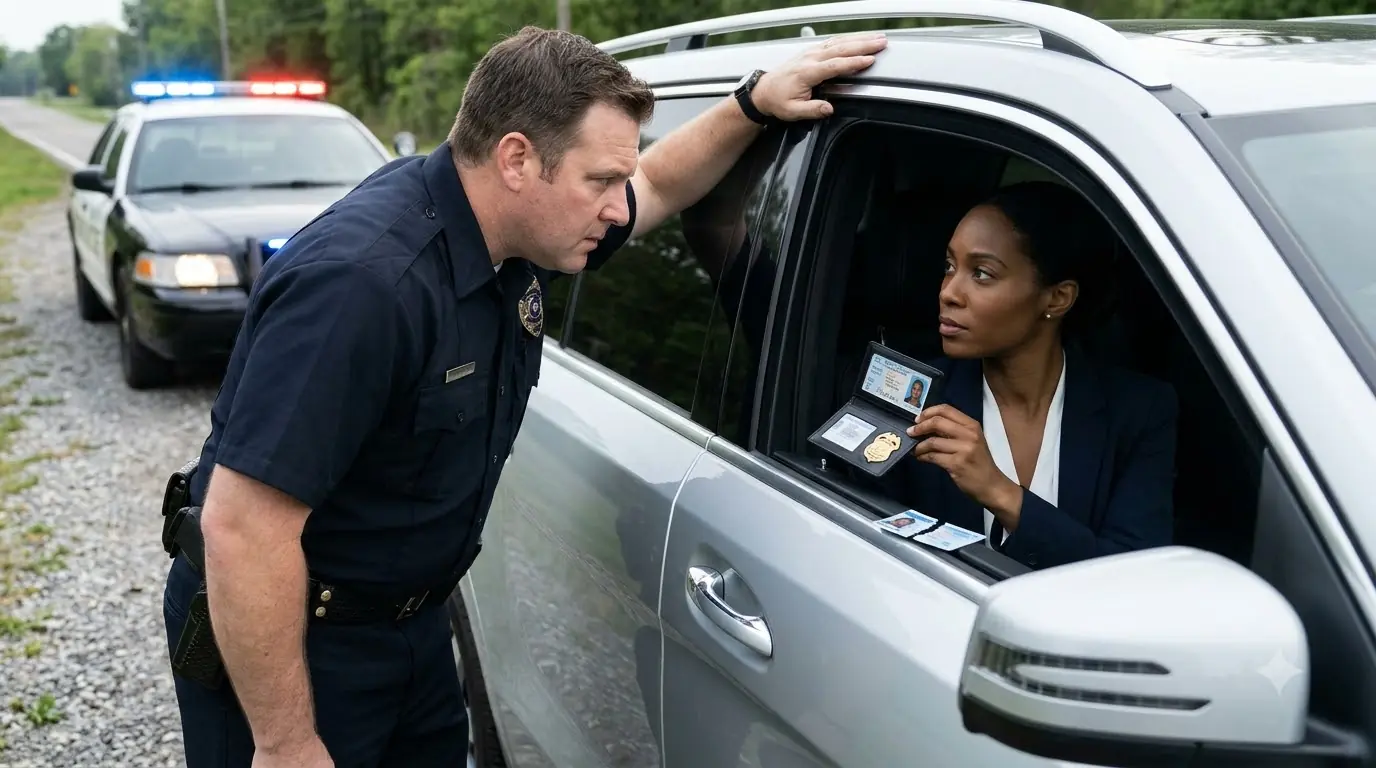
Then he ripped it again.
Four pieces fluttered from his fingers and landed against the edge of the door.
“Well,” he said, smiling, “now you don’t have a driver’s license anymore.”
For half a second, even he seemed pleased by the line.
The woman behind the wheel did not move.
She was in her late thirties, maybe forty, with dark hair drawn neatly back at the nape of her neck, a calm face, and the kind of stillness people often mistook for submission when they had never learned the difference between stillness and control. She wore a plain charcoal jacket over a light blue blouse. No uniform. No visible badge. No ribbons, patches, pins, or insignia. Nothing about her appearance announced rank, office, wealth, or influence.
Her hands rested where Hargrove had ordered them, one on the steering wheel and one open near her lap.
She looked down at the pieces of the license.
Then she looked back at him.
No tears.
No raised voice.
No accusation.
That was when his smile hesitated.
Hargrove had expected anger. He was used to anger. Anger made traffic stops easier for him because anger could be recategorized as resistance, hostility, noncompliance, or officer-safety concern depending on what the next ten seconds required. A crying driver made him feel powerful. A shouting driver gave him material. A frightened driver usually apologized for whatever tone he chose to use.
This woman did none of those things.
She simply watched him.
“What?” Hargrove asked.
She reached slowly toward the glove compartment.
His hand moved toward the holster on his right side.
“Don’t,” he snapped.
Her hand stopped.
“You told me to provide identification,” she said.
“I already had your identification.”
Her eyes shifted briefly to the torn pieces on the door.
“So you did.”
Something about the sentence irritated him. Maybe it was how gently she said it. Maybe it was the fact that she had not given him the emotional reaction he thought he had earned.
“What are you doing now?” he asked.
“Retrieving another credential.”
“Slowly.”
She moved exactly as instructed. No sudden motions. No exaggerated obedience. She opened the glove compartment and removed a small black leather wallet.
Hargrove’s expression changed a fraction.
Not fear yet.
Recognition of shape.
Government people carried wallets like that. Investigators. Military officers. Federal employees. Security people. Sometimes retirees trying too hard to look current.
The woman opened it.
She removed a laminated credential and raised it only high enough for Hargrove to read.
He leaned in.
The smile left his face.
The color followed.
His eyes moved from the photograph to the printed name, then to the title line, then back to her face.
The woman waited.
Hargrove swallowed.
“Wait.”
Her voice did not change.
“Commander. United States Armed Forces.”
His gaze dropped to the torn pieces of paper lying against the door.
“You just destroyed official military credentials,” she said.
“That was a state driver’s license.”
“It was issued through a military transition program and tied to an active duty mobility file.”