The cafeteria at the Coronado Federal Response Center was designed to make everyone look temporary.
Stainless-steel tables stretched beneath harsh white ceiling panels, plastic cups stood beside identical trays, and floor-to-ceiling windows exposed a bright California afternoon that felt strangely distant from the exhausted people eating inside. Everyone wore some variation of dark training clothes, carried the same laminated identification cards, and moved with the nervous efficiency of people who knew every interaction might somehow become part of an evaluation.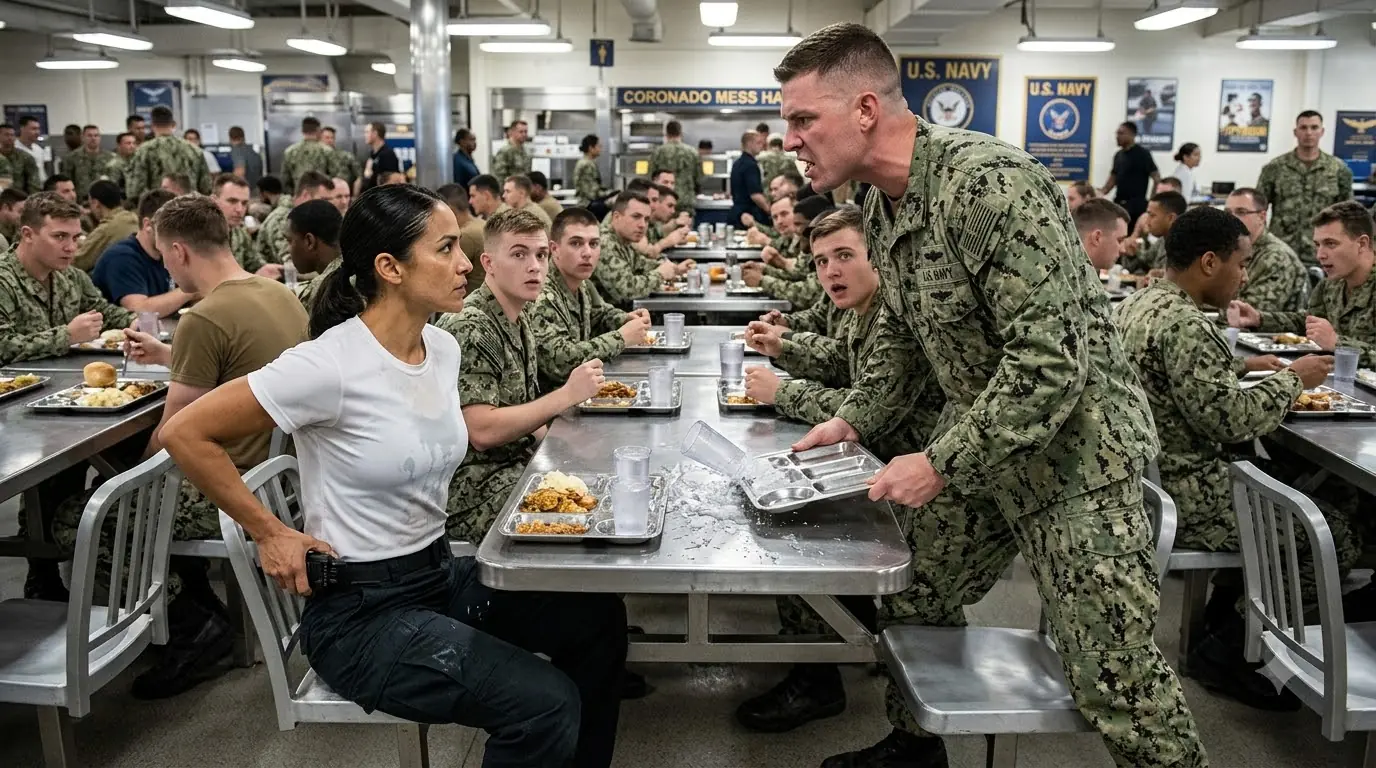
Evelyn Quinn had been sitting there for twenty-three minutes when she became certain the written complaints had understated the problem.
She had entered wearing a plain white athletic shirt, dark tactical pants, old running shoes, and no visible identification beyond the generic visitor credential clipped near her waistband. Her dark hair was tied into a low ponytail, and nothing about her appearance suggested that she supervised investigations across six federal training facilities.
That was intentional.
For the previous thirty hours, Evelyn had been reviewing documents inside a temporary office three floors above the cafeteria.
There had been twelve formal complaints.
Seven informal statements.
Three anonymous reports.
Two requests for transfer.
And, most troublingly, evidence that at least three additional reports had been created inside the local digital system but never reached headquarters.
Each disappeared somewhere between initial submission and central review.
That was not supposed to happen.
The center had safeguards.
Automatic backups.
Time stamps.
Multiple levels of review.
Someone had learned how to work around them.
The complaints themselves were remarkably consistent.
Female trainees described being mocked as “quota selections.”
Younger staff reported being pressured to laugh along when senior trainees targeted weaker performers.
One candidate claimed his locker had been emptied into a shower after he reported unsafe behavior.
Another said a supervisor advised him to “develop thicker skin.”
A woman who later transferred wrote one sentence Evelyn had read six times.
The worst part is not what they say. The worst part is knowing somebody higher up keeps making it disappear.
That sentence had brought Evelyn downstairs.
She could have summoned everyone into conference rooms.
She could have arrived with legal counsel, internal auditors, cameras, and official badges.
That would have produced perfect behavior.
People like Mason Rourke understood authority.
They simply did not respect people they believed had none.
So Evelyn removed the authority from sight.
And Mason noticed her within five minutes.
He sat two tables away with four younger trainees.
Hayes Moreno, twenty-four, quiet, observant.
Tyler Bishop, twenty-three, eager to impress.
Ryan Carter, twenty-two, visibly uncomfortable whenever the conversation became cruel.
And Noah Daniels, twenty-five, who laughed more loudly than everyone else but almost never started the jokes himself.
Mason dominated the table.
He was thirty-one, more experienced than the others, physically imposing, and widely considered one of the center’s strongest field candidates. His performance history looked impressive on paper—high scores, strong endurance results, excellent simulation evaluations, and repeated praise for decisiveness under pressure.
Buried deeper inside his file was a different pattern.
Three supervisors had noted difficulty adapting to organizational changes.
Two had mentioned dismissive behavior toward junior staff.
One wrote that Mason’s influence over younger trainees could become either “an asset or a liability depending on how he chooses to use it.”
No formal discipline followed.
Mason apparently interpreted that as validation.
“The whole standard is changing,” he told the younger men while Evelyn ate quietly nearby.
Bishop nodded.
Moreno said nothing.
Mason continued.
“Used to be performance mattered.”
Carter looked uncomfortable.
“It still does.”
Mason laughed.
“Does it?”
He glanced toward Evelyn.
She knew instantly he had chosen her as an example before he even spoke again.
“Look around.”
He lowered his voice just enough to make the insult feel private while ensuring she could still hear.
“People get pushed through now because headquarters wants the right pictures for reports.”
Evelyn kept eating.
Daniels smiled weakly.
Bishop laughed.
Carter stared at his tray.
Mason noticed Evelyn’s lack of reaction.
That bothered him.
Men who performed dominance usually required acknowledgment.
Fear worked.
Anger worked.
Even visible discomfort worked.
Indifference did not.
Mason leaned slightly toward her table.
“You disagree?”
Evelyn did not look up.
“I wasn’t part of your conversation.”
“You heard it.”
“Yes.”
“So?”
She took another bite.
“So nothing.”
Bishop glanced toward Mason.
The answer had embarrassed him more effectively than an argument.
Mason pushed his chair backward.
The metal legs scraped against the floor.
Conversation across several nearby tables softened.
Evelyn continued eating.
Mason picked up his tray.
Then walked toward her.
By the time he reached her table, the younger trainees had stopped pretending not to watch.
He stood beside her.
“Move your bag.”
Evelyn’s small black bag sat beneath the table, nowhere near the aisle.
She looked toward it.
“It isn’t blocking anything.”
Mason’s expression tightened.
“I said move it.”
Evelyn finally looked up.
“There’s nothing wrong with where it is.”
For one second, Mason simply stared.
Then he smiled without warmth.
“You visiting?”
“Yes.”
“Contractor?”
“No.”
“Candidate?”
“No.”
He frowned.
“What are you?”
Evelyn returned to her meal.
“Hungry.”
Someone nearby coughed to hide a laugh.
Mason heard.
His face hardened.
He placed his tray down violently against the edge of Evelyn’s table.
A plastic cup jumped.
Ice water spilled across her meal.
Then across the front of her white shirt.
Several people gasped.
Mason looked at the water.
Then at Evelyn.
No apology.
“Maybe now you’ll understand when somebody tells you to move.”
Evelyn stared at him.
Cold water soaked through the fabric.
Rice and vegetables floated across the metal tray.
Her fork lay on the floor.
The entire cafeteria had gone quiet.
This was the moment Mason enjoyed.
The audience.
Not simply winning.
Being seen winning.
Evelyn picked up a napkin.
She wiped water from the table.
Mason leaned closer.
“Get out.”
She slowly raised her eyes.
“What?”
“You heard me.”
He pointed toward the doors.
“You’re not part of this group.”
“You’re sitting in space people here actually use.”
“Get out.”
Evelyn stood.
Mason smiled.
He thought she was obeying.
Instead, she looked directly at him.
“You hit my table.”
“You were blocking the aisle.”
“No.”
Her voice remained calm.
“You were careless.”
His smile disappeared.
“You need to watch your tone.”
Evelyn glanced toward the spilled water.
Then back.
“You should learn to control yours.”
The room seemed to shrink.
Mason stepped closer.
He stood well over six feet, broad enough that his body blocked much of the overhead light.
Evelyn did not move.
“Do you know who I am?”
There it was.
The question powerful people often asked when they felt their power being ignored.
Evelyn almost smiled.
“No.”
That was technically true.
She knew his file.
His scores.
His complaints.
His conduct.
She did not know him.
Mason’s jaw tightened.
“I’m the senior candidate in Team Seven.”
“Congratulations.”
Another quiet laugh somewhere behind him.
Mason turned slightly.
Nobody claimed it.
He looked back.
“Leave.”
“No.”
His face changed.
“What did you say?”
“I said no.”
Evelyn reached behind her waist.
For the first time, uncertainty appeared in Mason’s eyes.
She pulled out a compact encrypted radio.
Everything around them changed.
The younger trainees at Mason’s table stopped breathing.
Evelyn held down the transmission key.
“Quinn to central review.”
Immediate response.
“Central review standing by.”
Evelyn looked at Mason.
“Begin live documentation inside the main cafeteria.”
A pause.
Then the voice returned clearly enough for half the room to hear.
“Copy. Documentation active. Standing by, Director Quinn.”
A chair scraped backward.
Somebody whispered:
“Oh, hell.”
Mason’s face lost color.
Evelyn placed the radio beside the overturned tray.
Then she pointed toward the bench across from her.
“Sit down.”
Mason stared.
“I didn’t know you were—”
“No.”
Evelyn cut him off.