Larkspur Junction, Kansas, 1885.
The Atchison, Topeka and Santa Fe Railway had been running through Larkspur Junction for four years. During that time, the station platform had developed the particular character of a place used hard and maintained only well enough to remain functional.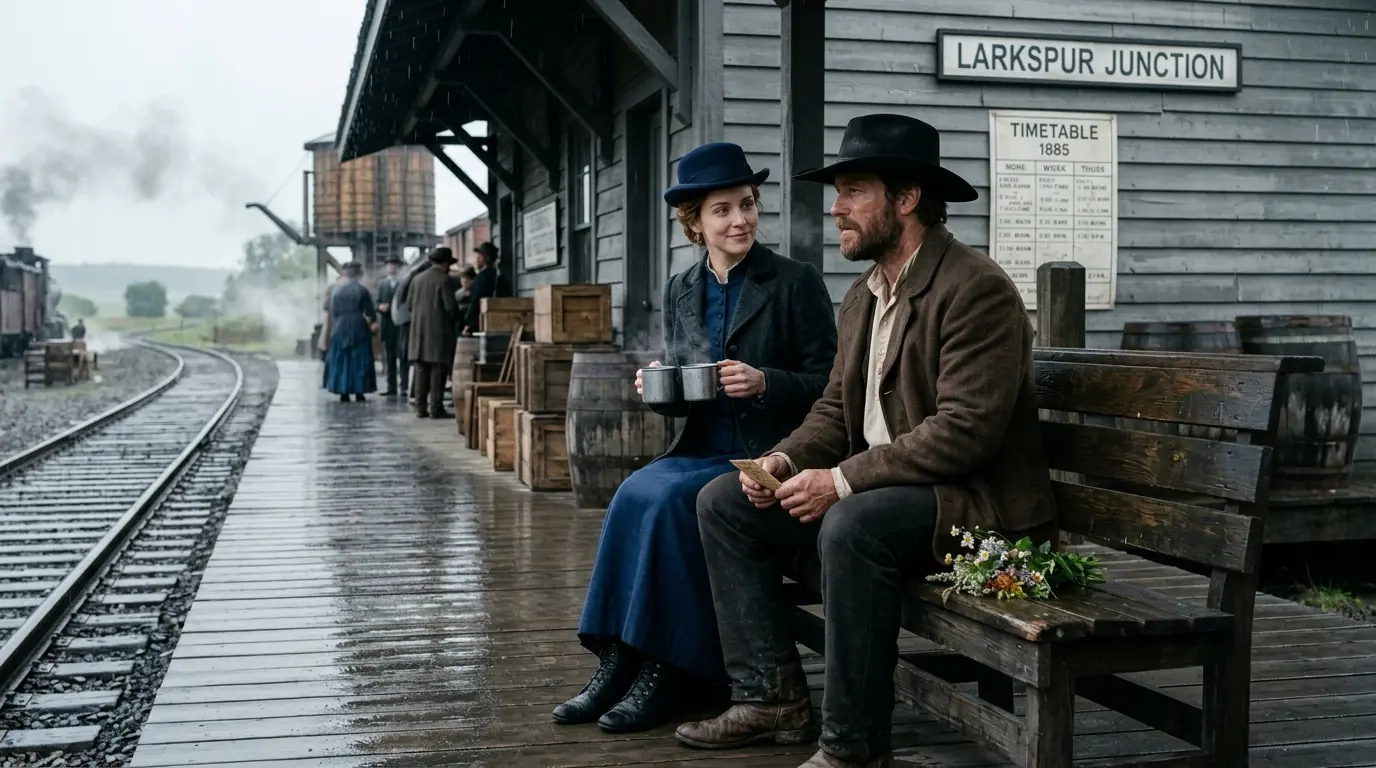
The cedar siding had faded to gray beneath years of Kansas weather. The iron rails retained the day’s heat long after the sun disappeared, and the platform boards had been worn smooth beneath thousands of boots, trunks, freight carts, and hurried farewells.
Whenever the locomotive arrived, a Baldwin 4-4-0 burning Kansas coal, black smoke rolled backward across the passenger cars. The train filled the station with the smell of hot metal and creosote from the treated oak ties.
It was a smell that settled into clothing and refused to leave.
Wilson Kincaid did not appear to mind it.
Every Friday, several minutes before four o’clock, Wilson tied his horse to the post outside the station. He entered the ticket office and purchased a platform ticket for five cents, the standard Atchison fare charged to anyone entering the loading area without boarding a train.
The railroad enforced the rule to keep the platform clear of idlers and people looking for unattended cargo.
Wilson always carried the exact change.
He wore his best shirt every Friday.
Sometimes he brought wildflowers.
Not every week and never according to a schedule. He gathered them only on Fridays when flowers grew beside the southern fence along his route into town and bringing them seemed right.
After purchasing the ticket, Wilson walked onto the platform and sat on the second bench from the eastern end.
The eastbound train arrived at 4:12.
Wilson watched every passenger step down.
Women in traveling dresses.
Men carrying cases.
Families struggling with trunks, restless children, and parcels tied with string.
He studied every face with the patient concentration of someone who knew precisely whom he was looking for.
When the last passenger had descended and the final car rolled away, Wilson remained on the bench for several minutes.
He watched the tracks extending east until they curved around the hill and disappeared.
Then he placed his hat on his head, returned to his horse, and rode home.
Nobody in Larkspur Junction asked him why.
This was not because nobody had noticed.
A man who purchased a platform ticket every Friday for three years without ever boarding a train was noticed.
Wilson had ranched in the county for fifteen years. His operation stood twelve miles south of town and supported approximately three hundred head of cattle on decent land.
People knew him.
They understood, in the way small communities understand things without discussing them, that the bench, the ticket, and the occasional wildflowers were not theirs to question.
The new ticket clerk had worked at Larkspur Junction for six weeks before she began paying particular attention to him.
Her name was Mara Ellison.
She had come from Wichita after burying both parents during the same winter.
Her father died in January.
Her mother followed in March.
The losses had occurred so close together that the grief blurred into something Mara was still learning how to carry.
She accepted the position at Larkspur Junction because it was available. Being somewhere nobody knew her had seemed easier than remaining among people who remembered exactly who she had been before the funerals.
Mara sold tickets, recorded passenger arrivals, maintained the schedule board, and kept the station’s books in order.
She watched people arrive.
She watched them leave.
The man on the second bench caught her attention on her first Friday.
By the fourth Friday, Mara had found his name inside the platform-ticket ledger.
She had begun watching for him without making a conscious decision to do so.
Wilson arrived at 3:52.
He purchased his ticket with exact change.
He thanked Mara without quite looking at her, the way passengers often thanked clerks automatically, without offering real attention.
Then he sat on the second bench.
He watched the eastbound train arrive and empty.
He watched the tracks after the train departed.
Then he rode home.
The fifth Friday brought rain.
Wilson arrived at 3:52 wearing his best shirt, which was already becoming wet.
There were no flowers in his hand. The rain had begun before he reached the southern fence line.
He purchased his platform ticket and walked outside.
Wilson sat on the second bench in the rain.
He remained there while the eastbound arrived, while the passengers descended, and while the train pulled away beneath a cloud of smoke and steam.
Afterward, he continued sitting for his customary few minutes, looking toward the wet tracks.
Mara watched through the ticket-office window.
Mara made a decision.
She closed the ticket window.
Then she walked onto the platform and sat beside him.
“Who are you waiting for?”
Wilson did not answer immediately.
Mara had watched him for six weeks and already understood that Wilson Kincaid considered his words before speaking them.
It was not because he thought slowly.
He appeared to understand that words were not neutral. Once spoken, they had weight, and Wilson did not seem like a man who placed weight carelessly.
He reached inside his coat.
Wilson removed a platform ticket, but it was not the ticket he had purchased that afternoon.
The paper had become soft along its creases after years of being folded and unfolded. It was the kind of object a person carried as a talisman rather than as evidence of anything.
Wilson held the ticket.
He did not give it to Mara.
“My wife,” he said.
Mara waited.
“Her name was Evelyn. When we first married, she traveled to Salina to care for her mother.”
Wilson looked down at the ticket.
“Her mother was ill for fourteen months. Every Friday, Evelyn took the eastbound train home for the weekend.”
His eyes moved toward the tracks.
“I came here to meet her. I always sat on this bench.”
“The train was often late,” he continued. “Evelyn said she could see me through the window before it stopped. She always knew where to look because I was always sitting in the same place.”
Mara remained quiet.
“When her mother died,” she said, “Evelyn came home permanently?”
“Yes.”
Wilson carefully folded the old ticket.
“But we kept returning on Friday afternoons. We sat here and watched the trains together.”
A faint change passed through his expression.
“She said this was the place where she first understood that somebody was waiting for her.”
He returned the ticket to his coat.
“She died three years ago. Fever. Twelve days.”
Wilson looked toward the tracks.
“I kept coming.”
Mara sat beside him in the rain.
The locomotive had left the smell of coal smoke and creosote across the platform. Water ran down the gray cedar siding and gathered in the spaces between the boards.
She thought about what it meant to have someone waiting on the same bench at the same time, week after week, for years.
Then she thought about what it cost to return to that bench alone.
“You understand that she will not be on the train,” Mara said.
“I understand.”
“Then why do you continue coming?”
Wilson was silent for a long time.
“Because this is the last place where I can remember her running.”
Mara looked at him.
“She always ran the last part of the platform,” Wilson said. “Evelyn said walking was too slow after she had spent three hours on a train.”
His eyes remained on the wet rails.
“I can still see her here. At the ranch, I cannot always see it anymore.”
Mara looked down the platform.
She imagined a woman running the final twenty yards toward a man seated on the second bench. She imagined Wilson returning every week to stand inside the space where that running had once existed.
“I am sorry,” Mara said.
She did not say it because sympathy was expected.
She said it because she meant it completely.
Wilson nodded.
They remained beside each other in the rain for another minute.
Then he placed his hat on his head, walked toward his horse, and rode home.
Mara returned to the ticket office.
She sat in the chair beside the window and looked toward the timetable board.
Her thoughts remained with a folded platform ticket carried inside a coat pocket for three years.
They remained with the particular kind of faithfulness that required.
The following Friday, Mara placed a cup of coffee on the bench before Wilson arrived.
She had prepared it on the small stove in the station’s back room.
For four days, she considered whether she should do it.
Eventually, Mara concluded that coffee was a small thing.
Small things either mattered or they did not.
Wilson arrived at 3:52.
He saw the cup.
Then he looked toward the ticket window.
Mara was helping a passenger and did not meet his eyes directly.
Wilson purchased his ticket and sat on the bench.
He drank the coffee.
The eastbound arrived.
Passengers descended.
The locomotive pulled away.
After Wilson had remained for his customary few minutes, he carried the empty cup to the window.
“Thank you.”
“It becomes cold while you are waiting,” Mara said, keeping her eyes on the schedule board.
Wilson held the cup for another moment.
“How did you know how I drink it?”
“I guessed.”
“You guessed correctly.”
He left.
Mara carried the cup into the back room and placed it beside the stove.
Wilson took his coffee without sugar.
She had guessed correctly the first time because she had paid enough attention to understand that he did not appear to be a man who added sweetness where he believed none was required.
Coffee appeared on the bench every Friday after that.
Mara did not immediately sit beside him again.
She gave Wilson the platform, the bench, and the coffee without asking him to share the space.
On the third Friday after the coffee began, she noticed that he remained several minutes longer after the train left.
He still looked toward the tracks.
He looked differently.
Less like a man waiting for something to return.
More like a man remembering what had once arrived.
Those were not the same thing.
Mara did not know that something had shifted at Wilson’s ranch during the days before that Friday.
Three days earlier, his foreman had reported that forty head of cattle were showing symptoms of the lung sickness moving through county herds.
The illness came as a consequence of the brutal cold building farther north, part of the same severe winter that would devastate cattle operations from Kansas to Montana before it ended.
Wilson rode through the southern pasture at dawn.
He counted the animals at risk.
Then he performed the calculations of a man who had carried a ranch alone for three years and knew exactly how narrow the margins had become.
He brought those calculations with him to the station on Friday.
The coffee was waiting.
It was hot.
Someone had prepared it for him without being asked.
Wilson drank it.
He sat on the bench.
For the first time in three years, the tracks did not feel like a place defined only by absence.
They had become a place where someone knew he would arrive.
Mara had never explained her own Fridays.
She was not deliberately concealing anything.
Her version of loneliness seemed smaller beside Wilson’s grief, and she therefore considered it unworthy of equal attention.
Mara had spent most of her adult life in her parents’ house in Wichita.
Her father’s health began declining when she was twenty-four.
By the time Mara was thirty-three, both parents were dead.
She stood alone inside the house they left behind and realized that she had organized every year of her adult life around the needs of people who no longer needed anything.
She sold the house.
Then she accepted the Larkspur Junction position because it was available.
Every Friday, Mara sold tickets to people going somewhere.
She watched them board trains.
At the end of her shift, she returned to her room at Mrs. Patterson’s boarding house and ate supper alone.
Mara was entirely capable of continuing that way indefinitely.
Capability, she had learned, was not the same as sufficiency.
One November evening, Mara walked home from the station while wind crossed the Kansas plain and cut through her coat.
She stopped on the boardwalk and looked down the street.
Larkspur Junction was a cattle town in transition.
The great cattle drives were ending. Barbed wire and wheat fields were changing the range faster than many ranchers wanted to admit.
The feed store remained busy.
So did the blacksmith.
The hotel had recently received a fresh coat of paint.
Life continued.
Mara felt as though she were moving beside it without becoming part of it.
She returned to Mrs. Patterson’s.
She ate supper.
Mara was thirty-three years old.
She had a bench and a man who came to it every Friday.
For the first time since her parents died, there was something on Friday afternoons she anticipated.
The ticket window where she stood all day was no longer merely a window.
It had become a specific vantage point from which she watched a specific person.
That frightened Mara.
It mattered to her at the same time.
She went to sleep without resolving the contradiction.
Mara began sitting with Wilson again in November.
There was no rain that first week.
Wilson simply arrived and took his usual place.
Mara completed the ticket-window work early, prepared two cups of coffee, and carried them onto the platform without ceremony.
She sat beside him.
Wilson did not suggest that she return inside.
They watched the eastbound arrive together.
Only three passengers disembarked that Friday.
Wilson examined each face with the same patient attention.
Then the train left.
He looked down the tracks.
Mara looked beside him.
“Evelyn was twenty-six when I met her,” Wilson said.
“Here?”
“Here.”
He held the warm cup between both hands.
“She carried too many bags for the platform. I helped her with them.”
A memory softened his expression.
“She thanked me in the manner of someone who disliked needing assistance and was determined not to show it.”
Wilson looked toward the tracks.
“I thought about that for the entire ride home.”
“Did you return the next Friday?”
“Yes.”
“Before you knew whether she would be on the train?”
“Before I knew.”
Mara held her coffee.
Coal smoke from the locomotive remained in the cold, clear Kansas air.
“Did Evelyn know that you had continued coming before she did?”
Wilson almost smiled.
His smiles arrived slowly.
“Eventually.”
He looked at the cup.
“She told me the most frightening thing about me was that I was the kind of man who showed up without a guarantee.”
Wilson became quiet.
“She had never known anyone who showed up for her that way.”
Mara looked toward the tracks.
She thought about what it meant for a man to arrive on consecutive Fridays before there was any reason to expect a particular outcome.
Then she thought about her own life.
Mara had organized it around the needs of others. She had rarely appeared for possibilities because the probability of receiving anything in return always seemed too small.
She looked at Wilson again.
Here was a man sitting on a cold bench because a woman had once run toward him across a platform.
He continued appearing because returning to the place where it happened was the most honest thing he knew how to do.
The November platform grew colder as the light faded.
They sat beside one another in the quiet manner of two people considering the same thing without having agreed to consider it together.
The cattle sickness took eleven animals from Wilson’s southern pasture before the cold stopped its spread.
He came to the station on the first Friday in December carrying the specific expression of a man who had absorbed a loss and had no intention of discussing it unless required.
Wilson purchased his platform ticket.
He sat on the bench.
He drank the coffee Mara left for him.
After the train departed, she came outside and sat beside him.
“It was a difficult week,” Mara said.
“I lost eleven head to the lung sickness.”
Mara had worked at the ticket window long enough to understand what eleven cattle represented to a three-hundred-head operation.
She did not minimize it.
“Will the ranch survive the winter?”
“Yes.”
Wilson looked across the empty platform.
“It will cost me, but the ranch will survive.”
They sat in the December cold.
Farther down the platform, the stationmaster argued with a freight handler about a misrouted crate.
The locomotive idled in the yard and released steam before beginning its next movement.
“Wilson.”
“Yes?”
“What do you do during the rest of the week?”
He looked toward the rails.
“The ranch occupies most of it.”
“I do not mean the ranch. I mean the evenings.”
Wilson considered the question.
“I eat supper. I read when I can. Then I sleep.”
He paused.
“I used to discuss the accounts with Evelyn after supper. She understood numbers better than I did.”
Wilson looked down at his hands.
“Now I simply do them.”
Mara examined those hands.
They belonged to a man who had completed the ranch accounts alone for three years.
He ate supper inside a house built for more than one person.
Then he slept there alone.
Mara looked at her own hands, dry from paper, ink, and hundreds of tickets.
She had spent her adult life standing at windows.
The window of her father’s sickroom.
The window beside her mother’s bed.
The boarding-house window.
The ticket window.
Mara had watched life happen to other people from one side of glass.
Wilson appeared to be doing the same thing from another direction.
He returned to the station each week hoping the shape of someone lost would remain visible.
Mara understood that completely.
The understanding entered her chest and stayed there.
She said none of it aloud.
Mara finished her coffee and returned to the office.
Wilson rode home.
That night, for the first time in eight months, Mara sat at the small desk inside her boarding-house room.
She wrote nothing.
She made no decision.
Without asking permission, something entered the space where loneliness had been.
A letter from Salina arrived in February.
Salina Junction was a larger railway operation with a full staff.
The position offered permanent employment and a salary thirty percent higher than the amount Mara earned at Larkspur Junction.
A former acquaintance in Wichita had recommended her.
The railroad requested an answer within three weeks.
Mara read the letter twice.
She thought about December.
She thought about the accounts Wilson completed alone.
She thought about a man who had shown up on consecutive Fridays before there was any promise that Evelyn would appear.
Then Mara thought about herself.
For years, she avoided hope because the probability of disappointment seemed high.
She had now spent eight months standing beside a possibility and pretending not to recognize it.
Mara wrote to Salina Junction.
She accepted the position.
She told nobody.
Mara worked her final three Fridays without mentioning the letter.
She prepared the coffee.
She sat beside Wilson on the bench.
She listened while he spoke about cattle, the coming spring calving, the ranch accounts, and the work waiting after winter.
A quiet laugh had begun appearing more often since November.
Mara decided the laugh had nothing to do with her.
On the final Thursday, she packed her bag.
The following afternoon, Mara carried it to the station.
Her plan was practical.
She would complete her shift, purchase a ticket on the eastbound to Topeka, and connect from there to Salina.
Mara intended to be gone before Wilson arrived.
A clean departure.
The sensible decision.
She stood on the platform beside her bag when she heard Wilson’s horse entering the station yard.
He was late.
It was 3:58.
Not 3:52.
Six minutes should not have mattered.
Wilson entered the station and stopped.
He saw the bag.
Then he looked at Mara.
Behind her, the eastbound train moved toward the platform.
The Baldwin locomotive released a column of black smoke, and the smell of coal reached both of them.
Mara had not planned for this.
She had planned for an empty platform, an uncomplicated exit, and a train that carried her away before anyone could speak words that made a sensible decision difficult.
Wilson stood ten feet away.
The train had arrived.
This was the part Mara had not prepared for.
He crossed the distance between them.
Wilson did not say her name.
He did not immediately ask about the bag.
He looked at Mara with the green eyes that had watched the eastern tracks for three years.
For the first time, she allowed herself to see something inside them that she had deliberately ignored for months.
Wilson was late because part of the southern fence required immediate attention.
For several minutes, he considered missing Friday entirely.
He came anyway.
He came because it was Friday.
Friday was what it was.
Somewhere during the previous months, Friday had stopped belonging only to Evelyn.
The conductor called for final boarding.
“Wilson,” Mara said. “I accepted a position in Salina.”
He looked toward the train.
“I should have told you.”
Wilson looked at her bag.
Then he looked at Mara.
“I spent three years waiting for a woman who could not return.”
Mara became very still.
“I do not want to spend the rest of my life missing one who could have stayed.”
The locomotive waited at the platform, holding steam.
The conductor examined his watch.
Mara stood with both hands around the handle of her bag.
She looked at the man who had brought wildflowers to an empty bench.
A man who purchased a platform ticket every week for three years.
A man who had arrived on consecutive Fridays before he possessed any guarantee.
During Mara’s eight months in Larkspur Junction, Wilson never asked her for anything she was not ready to give.
She thought about the Salina letter.
The clean exit.
The sensible decision.
Mara remembered her mother’s window and her father’s window.
Every window where she stood and watched life happen elsewhere.
She remembered Wilson describing a woman running the final twenty yards of a platform because walking was too slow.
Mara put down her bag.
The conductor looked at the bag resting on the platform boards.
He looked at Wilson.
Then he looked at Mara.
The conductor shrugged and repeated the final boarding call.
The eastbound departed without her.
Spring arrived across the Kansas plain in the way it often did.
Bluntly.
It followed a winter that had seemed determined never to leave.
Mara remained in Larkspur Junction.
The Salina position went to someone else.
The ticket window stayed hers.
Mrs. Patterson made no comment when Mara returned with the unpacked bag.
Silence was Mrs. Patterson’s form of approval.
In April, Wilson came to ask whether Mara would like to visit the ranch.
“Yes,” she said before he completed the question.
The ranch was everything Mara had imagined during eight months of Friday conversations.
It was also more.
The property was solid and well maintained.
The house had been built for more people than currently occupied it.
Wilson showed Mara the barns, pastures, well, and outbuildings.
He took her through the house.
He showed her the kitchen last.
Evelyn had organized it according to a specific logic.
Certain tools rested near certain work areas.
Frequently used ingredients occupied the most accessible shelves.
Every item had been placed in relation to something else.
Wilson had never changed the arrangement.
It was not because he could not change it.
The system worked.
Some things remained because they continued to serve their purpose.
Mara stood inside the kitchen doorway.
Then Wilson took her outside to the garden.
Evelyn planted it during their first spring on the ranch.
Kitchen herbs grew along the southern edge.
Flowering plants followed the northern wall.
In the center, new shoots were beginning to rise beneath the April sun.
They were plants that returned every year because Evelyn had chosen things capable of returning.
Wilson stood with Mara at the garden’s edge.
For a moment, he said nothing.
“She had good judgment,” Mara said.
“About the garden?”
“About the garden.”
Wilson looked at the plants.
“About most things.”
Mara studied what was growing.
She considered what it meant to care for something begun by another woman.
Not replacing it.
Not erasing it.
Understanding it well enough to continue the work correctly.
That was its own form of love.
Different from beginning something new.
Not lesser.
“I would need to learn what she planted,” Mara said. “Before I could help care for it.”
Wilson looked at her.
“I can tell you what I know.”
He glanced toward the garden.
“It is not everything.”
“That is all right.”
Mara looked at the emerging plants.
“We can discover the rest.”
They stood together inside the April garden.
Kansas light rested across everything.
That was enough for the day.
Wilson returned to the station bench alone on a Friday in May.
Mara knew he intended to go.
He told her the previous evening without offering an explanation.
Mara said she would see him afterward.
Wilson walked to the station.
He purchased a platform ticket using exact change.
Then he sat on the second bench from the eastern end.
He had brought wildflowers.
The eastbound arrived at 4:12.
Passengers stepped down.
A man carrying a case.
Two women in traveling clothes.
A family with a child who ran ahead along the platform in the way children run after sitting still for too long.
Wilson watched them all.
The train pulled away.
He looked along the tracks until they curved around the hill and disappeared.
Wilson removed the old platform ticket from his coat.
He had carried it for three years.
The paper was soft at every crease.
He held it for a long time.
Wilson thought about Evelyn.
Not the absence of her, which he had studied every Friday for three years.
The presence of her.
That was different.
It had been around him the entire time.
Evelyn remained inside the kitchen she organized.
She remained in the garden she planted.
She remained in Wilson’s habit of appearing without a guarantee because she had loved that quality in him.
Her love had shaped the man he became.
She existed inside everything Wilson continued doing because of her.
He placed the wildflowers on the bench.
Not in the manner of a person putting something down.
In the manner of someone leaving an object in trusted hands.
Wilson remained seated for another moment.
He looked toward the eastern tracks.
Then he placed his hat on his head and stood.
He walked to the ticket window, where Mara was finishing her shift.
Wilson waited for her to come outside.
He waited the way he had always waited at a particular place and a particular time.
Without reservation.
Mara emerged from the station.
She looked toward the bench.
Then she looked at Wilson.
Mara did not mention the wildflowers.
Wilson did not mention them either.
They walked together through the Larkspur Junction evening toward the life they were beginning to build.
It was a life with room for everything that came before.
That was the only honest way to build it.
Wilson and Mara married in September.
They chose a Saturday because Friday belonged to the station, and neither of them wished to change what Friday had become.
The ceremony was simple.
The reverend stood before them.
People from town filled the small church.
Mrs. Patterson sat in the third row wearing the expression of a woman who had observed something developing for nine months and found the conclusion satisfactory.
Mara wore a dress the color of the Kansas sky in September.
Wilson wore his best shirt.
It was the shirt he had worn every Friday for four years.
He wore it again on the Saturday he married.
Mara noticed.
She said nothing.
Some things were simply what they were.
After the ceremony, they walked to the station.
There was no particular reason.
No train awaited them.
No passenger was expected.
They went because everything between them had begun there.
The platform stood empty beneath the September afternoon.
The timetable board listed the next eastbound at 6:14.
Nothing rested on the second bench from the eastern end.
No wildflowers.
No folded ticket.
Only gray cedar boards made smooth through years of use.
Mara sat down.
Wilson sat beside her.
They watched the tracks continue east until they curved around the hill and disappeared.
The smell of coal from the afternoon train remained in the air.
Late sunlight caught the iron rails.
“Wilson.”
“Yes?”
“Evelyn knew.”
Wilson looked toward Mara.
“She knew what kind of man you were.”
Mara rested both hands in her lap.
“She knew you would appear without a guarantee. She understood it from the beginning.”
Wilson looked back toward the tracks.
“Yes,” he said. “She did.”
Mara placed her hand over his on the bench.
Wilson held it.
September afternoon surrounded them.
The light became gold.
The tracks continued east.
Larkspur Junction went about its ordinary business around the small station where a man sat on the same bench for three years and a woman eventually asked the correct question at the correct time.
The bench belonged to them now.
Not instead of what it had been.
In addition to it.
Wilson Kincaid had gone to the Larkspur Junction station every Friday for three years.
He had not truly expected Evelyn to return.
He understood she would never step from the eastbound again.
Wilson sat in the last place where he could clearly remember her running.
The final twenty yards of the platform.
Walking was too slow after three hours on a train.
That was what he needed from Fridays.
What Wilson did not understand was that Evelyn did not exist only inside the space she left behind.
She was inside the kitchen she organized.
Inside the garden she planted.
Inside the way Wilson continued appearing without a promise of reward because she had once loved him for it.
Evelyn remained part of the man Mara met.
She had been there the entire time.
The people we love do not disappear completely when they die.
Their presence changes form.
Mara Ellison arrived in Larkspur Junction believing her opportunity to build a life of her own had passed.
On a rainy Friday, she sat beside a man carrying three years of grief.
She asked whom he was waiting for.
Mara did not ask because she expected an answer that would change her life.
She asked because it was the right question at the right moment.
She was the kind of woman who still asked such questions.
Sometimes, that is enough.
A cup of coffee left on a bench.
Two people looking down the same tracks.
A bag placed on the platform instead of carried onto the train.
A garden planted by one woman and tended by another.
A man learning that moving forward did not require abandoning what came before.
A woman discovering that being capable of living alone did not mean she was required to do so.
Wilson had spent three years returning to a place where he remembered being loved.
Mara did not take that place away from him.
She sat beside him.
Together, they made room for memory and possibility on the same bench.