Larkspur Junction, Kansas, 1885.
The Atchison, Topeka and Santa Fe Railway had been running through Larkspur Junction for four years, and in that time the platform had developed the particular character of a place that was used hard and maintained just enough.
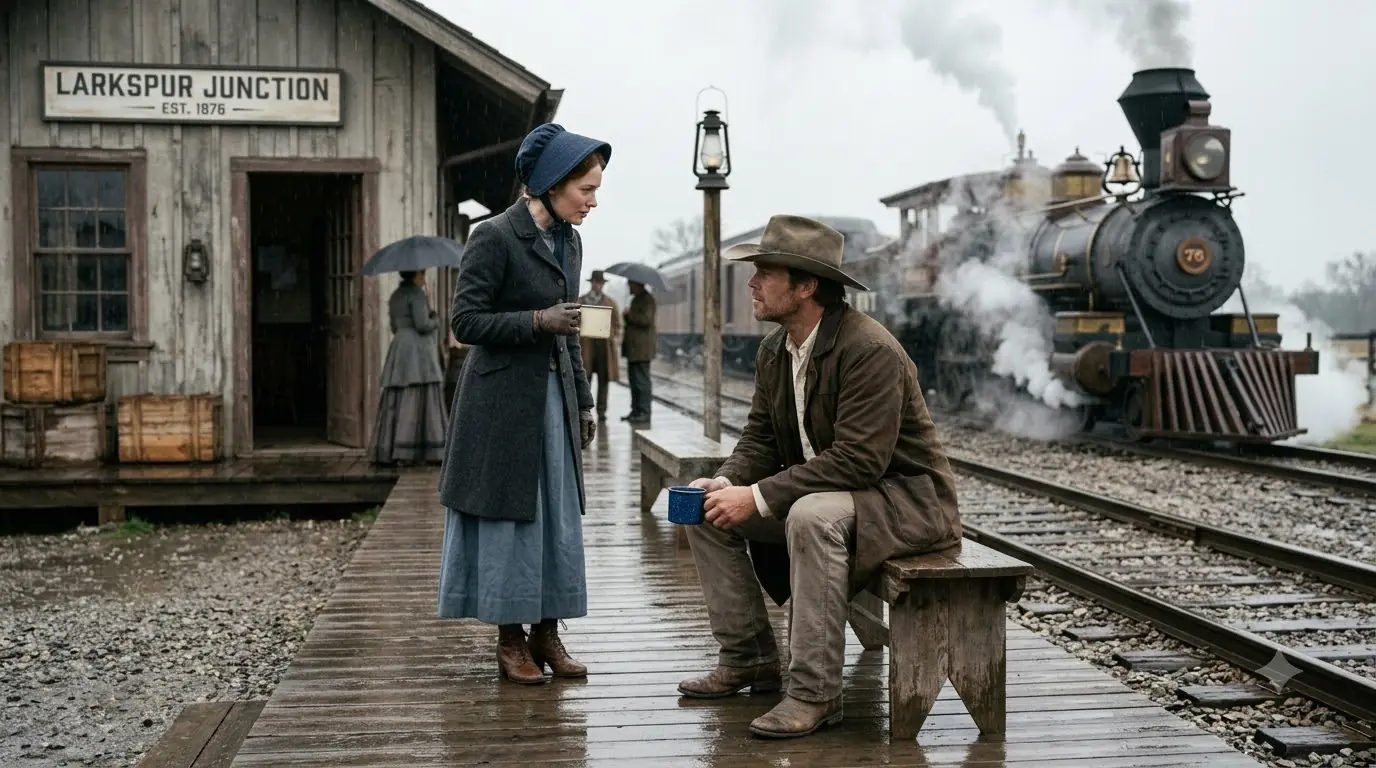
The cedar siding had gone gray from weather. The iron rails held the day's heat long after the sun dropped.
When the locomotive came in, a Baldwin 4-4-0 burning Kansas coal, black smoke rolling back over the cars, it filled the platform with the smell of hot metal and creosote from the treated oak ties. It was a smell that settled into clothing and did not leave.
Wilson Kincaid did not seem to mind the smell.
Every Friday, a few minutes before four o'clock, he tied his horse at the post outside the station and bought a platform ticket for five cents, standard Atchison fare for non-passengers and a practice the railroad enforced to keep the loading areas clear of idlers and would-be cargo thieves.
He always had the exact change ready. He wore his best shirt.
He sometimes brought wildflowers, not always and not on a schedule, just on the Fridays when they were growing along the south fence on his way to town and it seemed right.
He sat on the second bench from the east end of the platform. The eastbound arrived at 4:12.
He watched every passenger step down, women in traveling clothes, men with cases, families navigating trunks and children. He watched each of them with the patient attention of someone who knows what face he is looking for.
When the last car pulled away, he sat a few minutes more. He looked at the tracks going east until they bent around the hill and disappeared.
Then he put his hat on and rode home.
Nobody in Larkspur Junction asked him about it. This was not because nobody had noticed.
A man who buys a platform ticket every Friday for three years without boarding a train is noticed. But Wilson Kincaid had ranched in this county for fifteen years.
His operation sat twelve miles south, three hundred head on decent land, and people knew him. They knew, in the way small communities know things without saying them, that the bench and the ticket and the flowers were not their business to question.
The new clerk had been at the Larkspur Junction ticket window for six weeks when she started paying attention to him.
Her name was Mara Ellison. She had come from Wichita after burying both parents in the same winter, her father in January and her mother in March.
Two losses so close together had blurred the grief into something she was still working out how to carry. She had taken the position because it was available and because being somewhere nobody knew her seemed, at the time, easier than staying somewhere they did.
She sold tickets, logged arrivals, and kept the schedule board current. She watched people come and go.
The man on the second bench she noticed on her first Friday. By the fourth, she knew his name from the ledger and had started watching for him without deciding to.
He arrived at 3:52. He bought his platform ticket with exact change.
He thanked her without quite looking at her, the way people thank clerks automatically, without real attention. He sat on the bench.
He watched the eastbound arrive and empty. He watched the tracks after it left.
He rode home.
Then the fifth Friday brought rain.
Wilson arrived at 3:52 in his best shirt, which was getting wet, carrying no flowers because the rain had started before he reached the fence line.
He sat on the bench in the rain. He watched the eastbound arrive and empty in the rain.
He sat for his few minutes afterward and looked at the wet tracks.
Mara watched all of this from the window. She made a decision.
She closed the window, walked out to the platform, and sat down beside him.
"Who are you waiting for?" she asked.
He did not answer immediately. She had been watching him for six weeks and understood without being told that Wilson Kincaid was a man who considered what he said before saying it.
Not because he was slow, but because he understood that words were not neutral.
He reached into his coat and took out a platform ticket, not the one he had bought that day, but an old one. The paper was soft at the creases from years of folding and unfolding.
It was the kind of ticket you kept as a talisman, not as evidence. He held it, but did not hand it to her.
"My wife," he said.
Mara waited.
"Her name was Evelyn. When we first married, she went to care for her mother in Salina.
Her mother was sick fourteen months. Every Friday she took the eastbound home to me for the weekend."
He looked at the ticket.
"I came here to meet her. This bench.
The train was always late, and she said she could see me from the window before it stopped. She always knew which bench because it was always the one."
"When her mother died?" Mara asked.
"She came home for good. But we kept coming Friday afternoons, sitting here watching trains.
She said it was the place she first understood someone was waiting for her."
He folded the ticket and put it back.
"She died three years ago. Fever.
Twelve days."
He looked at the tracks.
"I kept coming."
Mara sat in the rain beside him and looked at the wet platform boards. A Baldwin locomotive had left its creosote smell on everything.
The station's cedar siding was dark with water. She thought about what it meant to have had someone waiting on a specific bench at a specific time week after week for years, and what it cost to keep coming to that bench alone.
"You know she won't be on the train," she said.
"I know," he said.