The slap cracked across the ballroom before the orchestra finished its final note. Champagne trembled inside Dr. Vivian Cole’s glass, but not a single drop touched the white sleeve of her evening gown. Across from her, twenty-seven-year-old Celeste Harrington stood with one jeweled hand still raised, her sapphire dress glowing beneath the chandeliers. Nearly four hundred wealthy guests watched the Black woman slowly turn her face back toward the heiress who believed she had just defended her family’s name.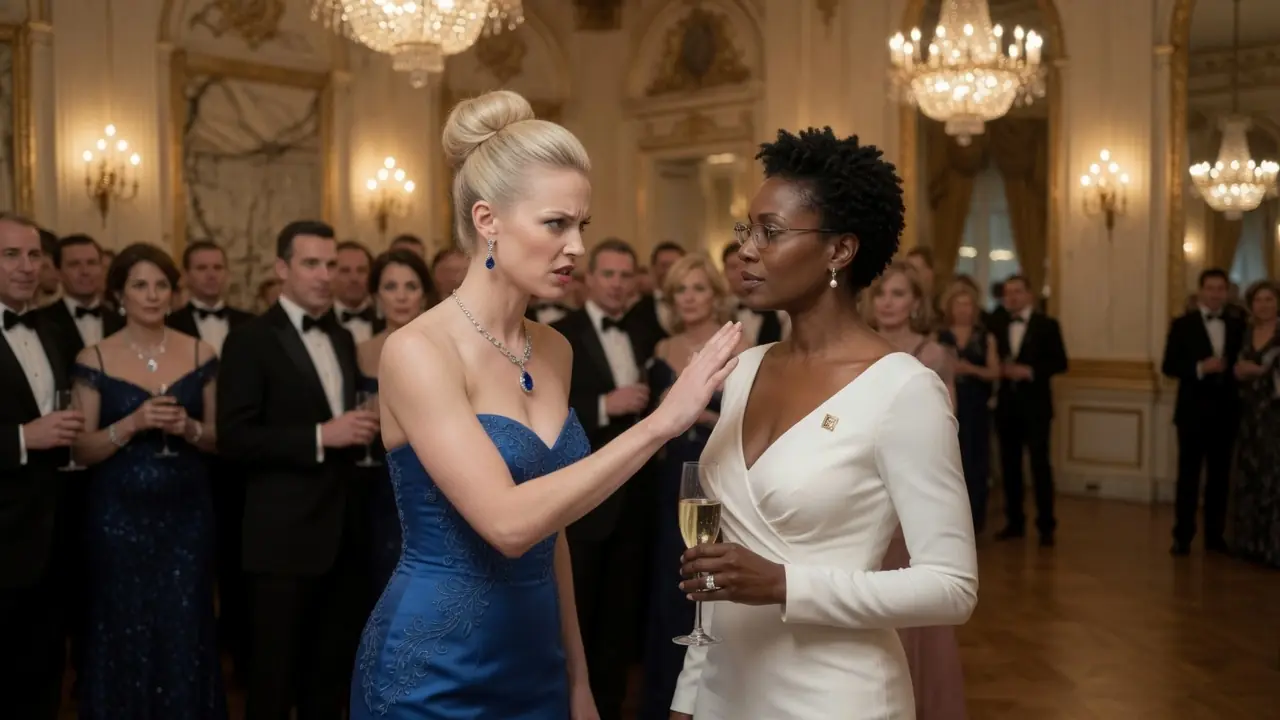
Celeste had expected tears, anger, or security rushing forward to remove the woman she had chosen to humiliate. Instead, Vivian’s dark eyes remained calm behind rimless glasses, and her posture carried the quiet authority of someone who had survived rooms far more dangerous than this one. The faint red mark on her cheek made the surrounding silence feel even heavier. Celeste lowered her hand only after realizing every phone in the ballroom was pointed toward her.
“You’re really standing at my family’s table like you belong here?” Celeste demanded.
Vivian adjusted the pearl earring loosened by the strike. “Keep your hand raised—the room deserves to see who you are.”
A nervous murmur moved through the guests. Celeste glanced toward her friends near the stage, expecting encouragement, but even they seemed uncertain now. She stepped closer, lifting her chin as though physical distance could restore the power she had just lost.
“Say one more word, and I’ll throw you into the street myself.”
Vivian looked beyond her toward the ballroom entrance. “Call your father over—he’s about to explain why he bows to me.”
Celeste laughed sharply.
Her father, Theodore Harrington, bowed to no one.
He was the founder and chairman of Harrington Global, a luxury hospitality and property empire with hotels in twelve countries. His name appeared on hospital wings, university buildings, museum galleries, and the gold lettering above the gala stage. Politicians waited for his calls, banks competed for his accounts, and men twice Celeste’s age stood when he entered a room.
Celeste turned toward the entrance with a smile already forming, prepared to watch Theodore order Vivian removed.
Her smile vanished.
Theodore Harrington had entered beside two attorneys and the president of the Harrington Family Foundation. At seventy-one, he usually moved with the reserved confidence of a man accustomed to being welcomed everywhere. Tonight, he crossed the ballroom faster than his age suggested, his face drained of color as his gaze moved from Vivian’s reddened cheek to Celeste’s trembling hand.
He stopped directly before Vivian.
For one long moment, nobody spoke.
Then Theodore lowered his head.
It was not a casual nod.
He bowed from the waist before the woman his daughter had just slapped.
A collective breath passed through the ballroom.
“Dr. Cole,” he said, his voice unsteady, “I am ashamed this happened beneath my name.”
Celeste stared at him. “Dad, what are you doing?”
Theodore remained facing Vivian. “Asking forgiveness from the woman who saved this family.”
Celeste’s knees weakened.
She caught the edge of a banquet table before she fell, sending two champagne flutes sliding toward the floor. One shattered near her silver heels. Her father had not merely defended Vivian.
He had bowed to her.
Vivian placed her untouched glass on the table. “Stand up, Theodore. Your daughter deserves to hear this with both of us looking her in the eye.”
Theodore straightened slowly.
Celeste looked between them. “Who is she?”
Vivian’s expression did not change, but the question landed harder than the slap. Her name had appeared in the printed gala program, on the foundation’s annual reports, and in documents Celeste had signed without reading. Yet Celeste had noticed only a Black woman standing near the family table in a white dress.
Theodore’s voice became colder. “She is Dr. Vivian Cole, chairwoman of the Cole-Harrington Preservation Trust.”
Celeste frowned. “I’ve never heard of it.”
“That is because you have never once read the documents governing your inheritance.”
The ballroom remained silent enough to hear the broken glass settling beneath the tablecloth.
Fifteen years earlier, Harrington Global had stood days from collapse. Theodore expanded too quickly, borrowing heavily to acquire luxury properties across Europe just before a financial crisis froze credit markets. Banks prepared to seize the company’s hotels, thousands of employees faced unemployment, and the Harrington family estate had already been pledged as collateral.
Vivian Cole was forty-eight now, but at thirty-three she had been one of the youngest restructuring specialists ever appointed to lead a major private equity rescue. She did not arrive with inherited wealth or a famous surname. She entered finance after working her way through medical school, public health research, and an investment program focused on preserving hospitals and community businesses threatened by predatory acquisitions.
She saw value inside Harrington Global that the banks ignored.
The hotels were profitable, but Theodore’s debt structure was destroying them. Vivian assembled a coalition of pension funds, minority-owned investment firms, and employee trusts. Her plan protected the properties, preserved nearly eighteen thousand jobs, and prevented the Harrington family from losing everything.
She required one unusual condition.
The Harringtons would not retain unrestricted control.
A permanent preservation trust would hold thirty-eight percent of the company’s voting power. The trust’s chairperson could block any family succession, asset sale, or leadership appointment that threatened employees, charitable commitments, or the company’s ethical standards.
Theodore agreed because he had no alternative.
Over time, Harrington Global recovered and became more valuable than ever. Most people assumed Theodore had performed a remarkable turnaround. He rarely corrected them publicly, but inside the family archives, every document carried Vivian’s signature.
Celeste’s inheritance depended on the trust’s approval.
Vivian controlled that approval.
“You gave her power over us?” Celeste whispered.
Theodore looked at his daughter with an exhaustion deeper than anger. “She gave us something to have power over.”
Celeste’s face hardened as embarrassment became rage. “So this is why she came? To inspect me?”
Vivian answered calmly. “I came because your father invited me to deliver the foundation’s annual toast.”
“This is my gala.”
“It is a charity gala funded through a trust you do not understand.”
“You stood at our table without introducing yourself.”
“My name was printed on the place card in front of you.”
Celeste glanced toward the table. A small cream card sat beside Vivian’s chair.
DR. VIVIAN COLE — CHAIRWOMAN, COLE-HARRINGTON PRESERVATION TRUST.
Celeste had moved it earlier because she wanted the chair for one of her friends.
Her mistake had begun before Vivian raised the champagne glass.
That evening’s gala celebrated a new maternal health initiative serving low-income women across New York. Vivian had designed the program after losing her younger sister to complications that could have been prevented with timely care. She had spent two years securing hospital partnerships and arranging funding.
Celeste knew none of that.
She had treated the gala as her public introduction before becoming president of the Harrington Family Foundation. Her dress had been photographed for three magazines, her makeup team occupied an entire hotel suite, and her publicist prepared a speech emphasizing compassion, generational leadership, and social responsibility.
Vivian had watched from the family table as Celeste arrived forty minutes late.
She saw the heiress ignore volunteers, criticize a server’s accent, and demand that an elderly donor be moved because his wheelchair interfered with photographs. When Vivian quietly returned the man to his assigned table, Celeste assumed she was a staff member overstepping her role.
The conflict escalated when Vivian approached the microphone for the foundation toast.
Celeste blocked her path.
“You don’t speak until my family speaks,” she said.
Vivian explained that Theodore had asked her to present the initiative.
Celeste looked her up and down, noticed the simple white gown and rimless glasses, and decided she was lying. Several guests tried to intervene, but the heiress interpreted their concern as hesitation to challenge her publicly.
She slapped Vivian before anyone could stop her.
Now the entire ballroom understood who had truly failed to recognize whom.
Theodore turned toward the orchestra. “The gala is suspended.”
Celeste grabbed his sleeve. “You cannot shut down my event because she embarrassed me.”
Vivian’s eyes sharpened. “I did not raise your hand.”
Celeste released her father and faced her again. “You baited me.”
“By standing at a table bearing my name?”
“You knew I didn’t recognize you.”
“I learned that when you asked whether I had stolen the invitation.”
A few guests lowered their eyes. They had heard Celeste say it and remained silent.
Theodore looked around the room. “Who witnessed the entire exchange?”
Dozens of hands rose.
Several people held recordings.
Celeste’s breathing quickened. “Make them delete the videos.”
Her father stared at her. “That is your concern?”
“You know what this will do to me.”
“No,” Vivian said. “You are finally learning what you did to yourself.”
Celeste turned toward the security team stationed near the stage. “Remove her.”
Nobody moved.
The head of security looked toward Theodore, but Theodore looked toward Vivian.
She shook her head. “No one is being removed.”
The restraint surprised Celeste more than retaliation would have. She expected powerful people to use humiliation the way she did. Vivian’s refusal to punish her immediately created a different kind of fear.
Vivian opened the dark portfolio she had carried into the ballroom.
Inside were succession documents, foundation performance reports, employee complaints, and the final recommendation concerning Celeste’s appointment as foundation president. The slap was not the first issue threatening her inheritance.
For eighteen months, Vivian’s trust had reviewed Celeste’s conduct.
The report documented charity funds spent on private travel, foundation employees ordered to perform personal errands, and donations redirected toward events that generated publicity rather than measurable impact. Celeste had used a housing initiative’s operating budget to pay for a fashion photographer because she claimed stronger images would attract donors.
The photographs cost eighty thousand dollars.
The housing initiative later closed one of its shelters for lack of funds.
Celeste also pressured hotel managers to provide free suites to friends, threatened employees who complained, and removed community representatives from foundation meetings because she found their criticism “ungrateful.”
The trust planned to recommend delaying her promotion for one year while she completed ethics and governance training.
The slap changed that recommendation.
Vivian removed a single sheet and handed it to Theodore. “The succession review is suspended indefinitely.”
Celeste’s lips parted. “You cannot do that.”
“I already did.”
“My shares belong to me.”
“Your future voting rights remain inside the preservation trust until you turn thirty-five or receive leadership approval.”
“My grandfather left those shares to me.”
“Your grandfather nearly lost them before you were born.”
Celeste looked toward Theodore. “Fix this.”
He read the document and closed his eyes.
For years, he had protected his daughter from consequences. When she insulted hotel staff, he transferred them. When she damaged relationships, he sent apologies through assistants. Every rescue taught Celeste that power meant never carrying the full weight of her actions.
Theodore finally understood that his protection had become another form of harm.
“I cannot fix what you refuse to acknowledge,” he said.
“You choose her over me?”
“This is not a choice between two women. It is a choice between truth and another excuse.”
Celeste’s face twisted. “She wants our company.”
Vivian almost smiled. “I could have owned your company fifteen years ago for less than the value of one hotel.”
Theodore confirmed it. “She refused.”
During the financial crisis, Vivian’s investors could have forced the Harrington family out entirely. Instead, she built an employee trust and preserved a minority family stake. She believed institutions survived best when power was shared rather than seized.
Her decisions allowed Celeste to grow up in estates, attend private schools, and enter ballrooms believing her surname opened every door.
“You owe every room you’ve ever entered to the woman you just struck,” Theodore said.
The words shattered something inside Celeste.
She stepped backward and sat heavily in the chair she had taken from Vivian’s place setting. For the first time, she looked less like an heiress and more like a frightened young woman who had discovered the story of her own importance was incomplete.
The guests remained uncertain whether to leave.
Vivian turned toward the stage. “The maternal health initiative should not lose its evening because of this.”
She asked the orchestra to resume and invited the hospital partners to join her near the microphone. Theodore stood beside the foundation director, but Celeste remained alone at the table.
Vivian delivered the toast she had been prevented from giving.
She spoke not about Harrington wealth, but about women whose lives depended on receiving care before emergencies became tragedies. She described nurses working overnight, clinics operating without enough equipment, and mothers choosing between medical appointments and hourly wages.
She did not mention the slap.
She did not need to.
The mark remained visible on her cheek as she raised the glass.
“To dignity,” she said, “especially when power forgets that everyone possesses it.”
The ballroom responded with a standing ovation.
Celeste did not stand.
By midnight, recordings of the confrontation had spread online. Commentators focused on the moment Theodore bowed and the instant Celeste learned Vivian controlled her succession. News outlets requested interviews, while sponsors demanded explanations from the Harrington Foundation.
Celeste’s publicist advised her to release a statement claiming emotional distress.
She drafted one accusing Vivian of creating a misunderstanding.
Theodore refused to approve it.
Vivian rejected requests to appear on television. She issued one sentence through the trust:
Accountability should produce repair, not entertainment.
The following morning, Celeste arrived at Harrington headquarters expecting support from senior executives who had known her since childhood. Instead, her access badge opened only the lobby doors.
Her foundation credentials had been suspended.
The board convened without her.
She called Theodore seventeen times. He answered once and told her to read Vivian’s report from beginning to end before contacting him again.
Celeste threw the report across her apartment.
Hours later, she picked it up.
The first page contained an employee statement from Maria Santos, a foundation coordinator Celeste had fired after Maria questioned the fashion photography expense. Maria described losing her health insurance while caring for a sick mother.
Another statement came from a hotel housekeeper forced to clean a suite after Celeste’s friends caused thousands of dollars in damage. The woman was disciplined because Celeste claimed the room had already been dirty.
Page after page transformed incidents Celeste barely remembered into consequences other people still carried.
She finished reading near sunrise.
For three days, she remained inside her apartment while the world debated whether she deserved forgiveness. Friends who laughed beside her at the gala stopped answering. Brands removed her photographs, and a magazine postponed a profile titled The Compassionate Face of a New Generation.
On Friday morning, Celeste went to Vivian’s office alone.
She wore no diamonds, no designer gown, and no makeup team had prepared her face. Vivian’s assistant asked whether she had an appointment.
“No,” Celeste said. “I can wait.”
She waited four hours.
When Vivian finally invited her inside, Celeste stood near the door and struggled to speak.
“I came to apologize.”
Vivian removed her glasses. “To regain your inheritance?”
Celeste looked down. “At first, yes.”
“And now?”
“I read the report.”
“That was required.”
“I found Maria Santos.”
Vivian’s expression remained guarded.
“I apologized to her,” Celeste continued. “She said an apology does not restore the months she spent without insurance.”
“She is correct.”
“I paid her lost wages and medical bills.”
“Money repairs only the part money damaged.”
Celeste nodded. “She told me that too.”
Vivian studied her for a long moment. “What are you asking from me?”
“Nothing today.”
It was the first useful answer Celeste had given.
Vivian did not restore her position.
Instead, she offered a path that contained no guarantee of inheritance. Celeste would spend one year working inside the maternal health initiative without a title, private office, or publicity. She would report to clinic administrators, complete the same shifts as ordinary staff, and receive a salary equal to the lowest-paid program coordinator.
If she used her surname to demand special treatment, the placement would end.
Celeste accepted.
Her first assignment involved organizing transportation for pregnant women living far from participating hospitals. The work was repetitive, frustrating, and invisible. Drivers canceled, forms contained errors, and patients sometimes shouted because fear left no room for politeness.
Nobody bowed to her.
For the first month, she hated it.
During the second, she began listening.
She met women who lost jobs for attending medical appointments and nurses who purchased diapers with their own money. She saw how a delayed ride could turn an ordinary pregnancy concern into an emergency.
The gala’s blue gown remained sealed inside a storage box.
Celeste never wore it again.
A year later, the trust reviewed her progress. Vivian entered the meeting carrying the original succession file, but she did not immediately recommend reinstatement. Improvement was not proof of transformation, and one year of decent behavior could not erase a lifetime built without consequences.
Celeste surprised everyone.
“I’m not ready to lead the foundation,” she said.
Theodore looked at her carefully. “Why?”
“Because I only recently learned how much I didn’t see.”
Vivian closed the file.
Celeste asked to remain with the health initiative for another year. She also requested that Maria Santos be considered for a senior foundation role, acknowledging that Maria possessed the judgment Celeste had punished her for using.
The trust approved both requests.
Celeste eventually regained access to part of her inheritance, but not because Theodore pleaded for her or Vivian forgot what happened. She earned limited voting rights after years of documented work and independent reviews from employees who had no reason to flatter her.
The slap never disappeared from the internet.
For a long time, Celeste wished it would.
Later, she understood that the recording forced her to confront the person everyone else had been too frightened to challenge. It showed the raised hand, the contempt in her face, and the woman standing before her with dignity she could not strike away.
Vivian never called Celeste a friend.
Their relationship became something more demanding.
It became honest.
At the fifth anniversary gala for the maternal health initiative, Celeste stood near the back of the ballroom while Vivian prepared to give the toast. The program had expanded to eleven cities and helped thousands of women receive early care.
Before Vivian reached the stage, Celeste approached carrying two champagne glasses.
She offered one without speaking.
Vivian accepted it.
Celeste glanced toward the family table. “Your name card is still there.”
“I noticed.”
“No one moved it this time.”
Vivian looked at her. “People learn.”
“Some of us take longer.”
The orchestra quieted.
Vivian stepped toward the microphone, and Celeste moved aside without needing to be asked. There was no bow, public forgiveness, or theatrical embrace.
Only respect.
Years earlier, Celeste believed the Black woman in the white gown needed her family’s permission to belong in the room. The truth was that Vivian had preserved the room, the family name above it, and the fortune that paid for every chandelier.
Theodore’s bow exposed that truth.
What happened afterward determined whether his daughter was finally humble enough to live with it.