“Dad, I am here now. You do not have to worry anymore. I will save you.”
The courtroom became completely silent when the doors opened.
Every reporter inside had already written the story in his or her mind.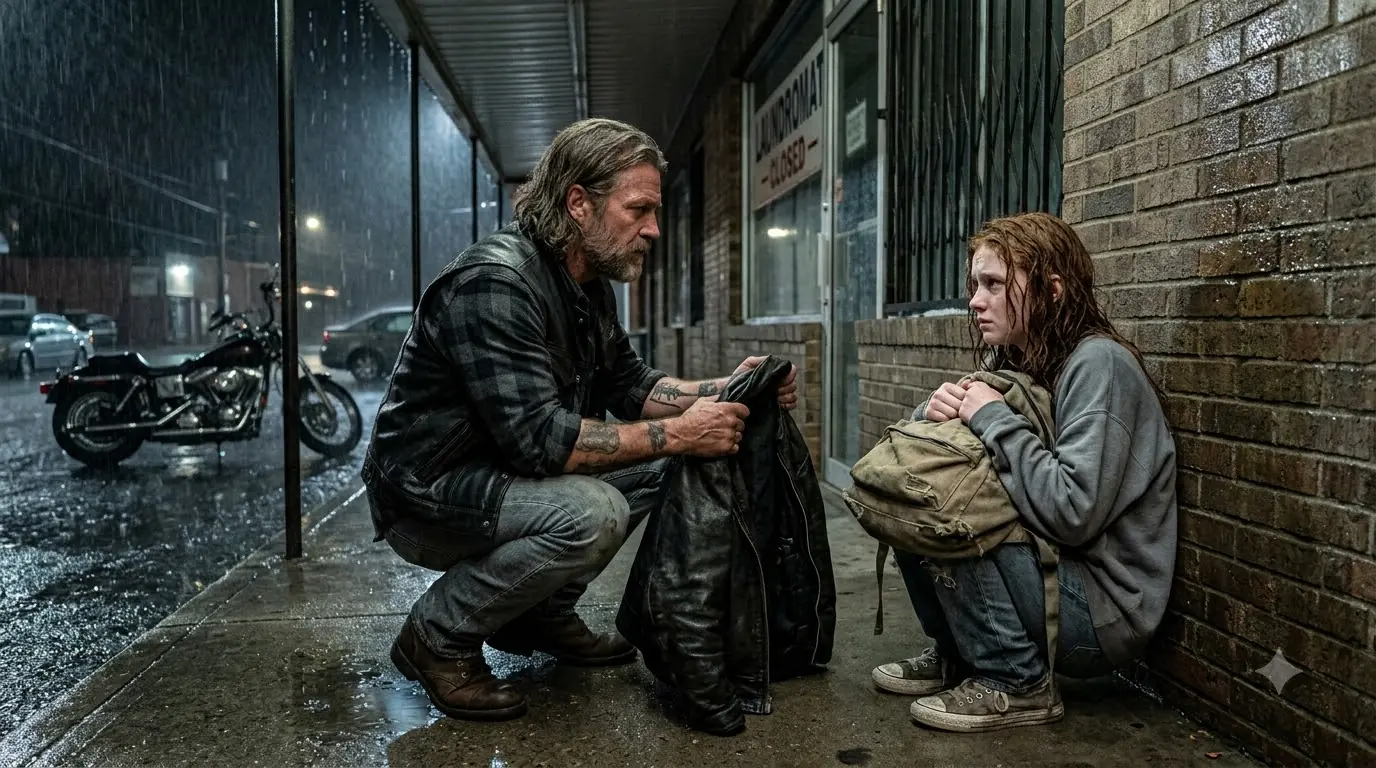
The elderly biker seated at the defense table was guilty.
That was what they believed, what the evidence appeared to show, and what sixty years of leather, scars, and road miles seemed to prove to people who had already made their decision.
Then a young woman entered carrying nothing but a leather briefcase.
The old man’s eyes filled with tears before she spoke a single word.
What she was about to reveal would tear the entire case apart.
Duke Callahan did not look like a man anyone expected to see cry.
He was sixty-three years old, with a chest covered in faded ink and knuckles that had been broken more times than he could count. A leather vest still hung inside his closet, although he had not worn it on a motorcycle run in nearly a decade.
Duke lived alone near the edge of town in a narrow house that still contained two coffee cups in the cabinet, even though only one was ever used.
His wife had been gone for a long time.
Cancer took her slowly, the way the disease sometimes did when it wanted a family to feel every part of the goodbye.
Afterward, Duke spoke less.
He had never been the loudest voice at the clubhouse table. He was simply the person everyone trusted, the man who arrived when another member’s roof collapsed or when a widow needed someone to mow her yard.
That kind of quiet loyalty did not always appear inside a courtroom.
It did not photograph well beneath a newspaper headline.
Money became difficult in the years after Duke stopped traveling regularly with his former motorcycle club. His pension barely covered food and utilities, so he accepted work that some younger members of the old crew might have mocked.
He became a night security guard.
Five evenings each week, Duke walked cold corridors inside a company called Hullbrook Industries, wearing an identification badge clipped to a plain jacket instead of a leather vest.
He did not mind the work.
The silence suited him.
During those long hours, alone at three in the morning with only his footsteps for company, Duke thought about many things.
Most often, he remembered a night fifteen years earlier.
Freezing rain had battered the city. Beneath the awning of a closed laundromat, Duke found a teenage girl curled against the wall with nowhere else to go.
She carried an expression he recognized from the hardest years of his own life. She was too proud to ask for help and too frightened to trust anyone offering it.
Duke had traveled enough difficult roads to recognize a person trying not to break.
Something about the girl stopped him.
He had a spare bedroom then, reliable employment, and a heart still raw from losing his wife. Duke did the only thing that made sense to a man like him.
He told the girl to step out of the rain.
Her name was Emma.
Within a year, she was no longer a frightened teenager Duke had helped for one night.
She was his daughter.
Duke never described his decision as charity because it had never felt like charity.
He worked double shifts so Emma could remain in school. He stayed awake with her on evenings when she studied until two in the morning, keeping coffee warm and pretending he understood the textbooks spread across the table.
He learned, more slowly than he liked to admit, how to become someone’s father.
Emma had spent years learning that trusting people led to pain. Duke showed her, one ordinary day at a time, that some people remained after the crisis ended.
Emma was sharp, determined, and every bit as stubborn as the man raising her.
She repaid his faith in the only way she knew.
She finished at the top of her class.
Later, she earned a scholarship to study law overseas at a university whose name Duke could barely pronounce correctly.
He drove her to the airport himself.
Duke stood beside the terminal window long after her aircraft became a distant point in the sky. He told himself that the ache inside his chest was pride rather than loss.
That was what a father was supposed to feel when his child became strong enough to leave.
For a while, Duke believed it.
The following years were generous to Emma and quiet for him.
Emma disappeared into the exhausting work of becoming an attorney. It was the kind of work that consumed a person and produced someone sharper, more disciplined, and sometimes farther away from the people who had known her before.
Their telephone conversations became shorter.
Then they became less frequent.
Neither Duke nor Emma said it aloud, but something between them loosened. Their bond resembled a rope becoming slack because nobody remained close enough to hold both ends.
He told himself Emma was living exactly the life he had wanted for her.
A real father did not measure love through the number of telephone calls he received.
Duke continued reporting to Hullbrook five nights each week. He left the porch light on, more from habit than expectation, and grew older the way dependable men often did.
Quietly.
Without many people noticing.
Then came the night that changed everything.
At the time, it felt like nothing.
It was a slow shift filled with empty offices and cold hallways.
During the middle of his rounds, Duke passed the records room, the secure archive where Hullbrook stored valuable designs and corporate information.
He tested the handle as he always did.
It was locked.
Duke continued walking.
He thought nothing about it because there was nothing yet to think about.
By morning, everything had changed.
Sensitive files had disappeared.
The stolen designs were valued at several million dollars.
Hullbrook’s leadership was not interested in careful questions. They looked at the elderly security guard who had walked the corridors alone throughout the night.
They saw a man with limited money, no family living nearby, no private attorney, and nobody obvious to defend him.
They decided Duke Callahan was exactly the kind of person no one would fight for.
What they did not know was that someone remained half a world away.
Someone who was about to prove them wrong.
Hullbrook did not want the matter resolved quietly.
That was the first indication of how serious the situation would become for Duke.
The company’s chief operating officer, Richard Hale, was a polished and image-conscious executive. He wanted the loss explained in a way clients, investors, and corporate partners could observe.
A private settlement would not accomplish that.
A public trial would.
Within one week, the order came from senior leadership.
Hullbrook Industries would prosecute Duke Callahan, and the company would make certain everyone watched.
At first, one employee appeared to stand beside Duke.
Kevin Doyle worked inside the archive division. He was in his mid-thirties, friendly, and always prepared with a joke inside the employee break room.
On the occasional nights when their schedules overlapped, Kevin greeted Duke respectfully.
During the first difficult days after the theft, many employees suddenly refused to meet Duke’s eyes.
Kevin remained one of the few people who still treated him like a human being.
Duke appreciated it.
When an entire workplace turned away overnight, one apparently decent person could feel like solid ground.
Kevin was also the first person to mention the proposed agreement.
He introduced it gently and almost reluctantly, as though delivering news he sincerely wished were not true.
According to Kevin, Hullbrook might allow the matter to disappear without a trial.
No public humiliation.
No lengthy legal battle.
No imprisonment.
Duke only needed to sign a statement accepting responsibility.
One signature, followed by silence, and he could return home.
Duke understood exactly what he was being offered.
It was a path out of the storm, provided he agreed to spend the remainder of his life carrying a name he had not earned.
Thief.
Duke carried the proposed confession home.
He sat before it at the kitchen table until the lamp burned low.
The unsigned document rested beneath the light like a loaded weapon.
Duke thought about how easy signing would be.
He considered how few people might ever believe the truth, even if he fought the accusation and somehow won. Most people had already decided what kind of man he was.
He thought about how many years remained in his life and how little he wanted to spend them being called a criminal by executives who had never asked him one honest question.
Then Duke thought about Emma.
Not the successful attorney working on the other side of the world, buried in legal files and different time zones.
He remembered the teenage girl he raised.
Duke had taught her one lesson more insistently than any other.
“Your name is the only thing in this life that belongs completely to you. You can lose money, health, and comfort and remain whole. The moment you sign your name to a lie about who you are, you surrender something nobody can return.”
He had expected Emma to live by those words.
Duke could not betray them himself, even to save his freedom.
When the company representative arrived to collect the confession, Duke pushed the unsigned pages across the table.
His hands trembled slightly.
His voice was quieter than he intended.
“I will not sign my name to something I did not do.”
The representative reminded him what he risked.
Duke did not change his answer.
“I would rather enter a courtroom and lose than purchase my freedom with a lie.”
Richard Hale was not pleased.
Word returned that Duke’s refusal had strengthened the company’s determination.
If the old man wanted a trial, Hullbrook would provide one.
They would also make certain it was public.
The official notice arrived through the mail.
Duke read his name printed in cold legal language while evening pressed against the kitchen windows.
He could not afford private representation.
The public defender assigned to him was overworked, direct, and honest about the odds.
The case would be an uphill fight.
The hill was steep.
Duke listened without reacting.
He had made his choice at the kitchen table, and he was not the kind of man who reversed a decision simply because it became difficult.
He did not yet understand how difficult it would become.
The local newspaper published the story quickly.
It told the events in the way stories of this kind were often told, with the conclusion quietly decided before the opening sentence.
A company identification photograph showed Duke wearing his security jacket. Beneath it was a headline describing him as the aging guard accused of stealing valuable corporate secrets.
The article never directly called him guilty.
It did not need to.
The facts were arranged so readers would reach that conclusion themselves.
Duke read the article once.
He never read it again.
At Hullbrook, the silence around him became heavier.
Coworkers who once nodded in the hallway suddenly found reasons to look elsewhere.
The break room became quiet whenever Duke entered.
One man he had known for years crossed to the opposite side of a corridor rather than pass him closely.
Duke told himself they were afraid.
Fear could turn ordinary people into cowards.
He tried not to hold it against them.
That did not make his walk home feel any warmer.
Throughout everything, Kevin Doyle remained kind.
He asked how Duke was coping and gently reminded him that the confession remained available if he wanted the ordeal to end.
Duke never suspected that the hand resting sympathetically on his shoulder belonged to the same person who had placed the knife against his back.
Half a world away, inside a city running twelve hours ahead of Duke’s, Emma Brooks scrolled through news from home between meetings.
It was a habit of homesick people who refused to admit they were homesick.
Duke’s photograph stopped her before she fully understood the headline.
Emma knew that face.
She had memorized it across a kitchen table, inside the front seat of an old truck, and in the doorway of the bedroom he had given her when she possessed nothing.
Now strangers were calling him a thief.
Emma read the article twice.
The second reading made even less sense than the first.
The man described in the article as desperate, opportunistic, and capable of theft did not exist.
Emma had lived beneath Duke’s roof.
She once watched him give his final twenty dollars to a stranger and quietly go without lunch for the following week rather than mention the sacrifice.
Beneath her shock came something worse.
Shame.
Emma counted the months since she had last held a genuine conversation with Duke. Not a hurried call between meetings, but an actual conversation in which she listened.
The number made her stomach turn.
By the time Emma stood from her desk, her decision had already been made.
She simply did not yet understand how little time remained to save him.
Emma did not cry.
That was not her way, and it had never been Duke’s.
She walked directly into the supervising partner’s office and explained that an urgent family matter required her immediate departure.
Nothing in her tone invited negotiation.
It carried the flat certainty of someone who had already stopped waiting for permission.
Within hours, Emma reserved the first available flight home.
She packed one bag before the sky outside her apartment became completely dark.
Emma did not sleep during the flight.
She sat beside the window while the cabin lights dimmed and remembered the man who found her in the rain.
She remembered how Duke never looked at her as though she required pity.
He treated her like someone who needed one fair opportunity.
Emma remembered every dinner he stretched to provide enough food for two. She remembered the countless times Duke chose her comfort over his own without ever allowing her to feel like a burden.
Somewhere above the dark middle of the ocean, Emma stopped remembering and began working.
Grief would not help Duke.
A plan might.
She removed a legal pad and began constructing his defense from thirty thousand feet.
Emma knew almost exactly where Duke would have been during the night of the theft.
He maintained the same rounds and habits he had followed for years.
She checked her own telephone records.
There it was.
A call from Duke during the precise period when Hullbrook claimed the files disappeared.
Emma began drafting the legal requests she would submit immediately after landing.
She listed records the exhausted public defender had not pursued and backup systems a corporation of Hullbrook’s size almost certainly maintained without most employees knowing they existed.
By the time the aircraft landed, Emma had lost an entire day to the distance between continents.
She did not waste another hour feeling sorry for herself.
Emma did not travel immediately to the courthouse.
That was the difficult part.
Entering without evidence would accomplish nothing.
Instead, she used the limited time available to turn her plan into material a judge could actually consider.
Emma confirmed telephone timestamps and contacted Hullbrook’s technology contractors. She pushed through multiple channels to obtain raw security backups the company had never disclosed.
Most Hullbrook employees did not know the surveillance system automatically copied its recordings to a redundant storage network.
Emma discovered it.
Pursuing that evidence consumed the hours that caused her to reach the courthouse only as closing arguments had already begun.
The trial moved quickly.
Far more quickly than a case of this seriousness should have moved.
Hullbrook had designed the matter to appear uncomplicated, and every participant understood the company wanted a rapid conclusion.
Its attorney, Gerald Foster, was experienced and unhurried.
He presented the story simply.
A night guard possessed keys to every door.
Valuable records disappeared in darkness.
The accused man had no one to confirm his location.
It was a clean story with a clean villain.
That apparent cleanliness made it dangerous.
Duke sat through the proceedings wearing a borrowed suit.
The fabric hung loosely from a body built for leather jackets, motorcycles, and physical work rather than courtrooms.
When Duke was finally permitted to speak, he said only that he was innocent.
He walked his rounds exactly as he always did.
He had entered no archive and taken no documents.
It was plain truth without decoration because plain truth was all Duke possessed.
Inside a room constructed for skilled arguments, the quiet statement of an elderly biker sounded weak against the polished certainty of a large company.
Duke could feel that weakness.
He could feel the room deciding.
Richard Hale watched from Hullbrook’s side with the calm expression of a man who considered the outcome settled.
Judge Margaret Ellison listened with the neutral attention of someone permitted to weigh only the evidence placed before her.
Everything presented seemed to point in the same direction.
Seated at the defense table, Duke understood something with complete clarity.
Nobody inside the room would save him because nobody had any reason to.
He entered alone.
He had known he would.
Duke chose truth over the convenient lie and did not regret it.
Still, he was honest enough to recognize where that decision appeared to be leading.
Near the conclusion of the arguments, Judge Ellison asked whether the defense had anything further to present.
The courtroom seemed to hold its breath.
Duke’s public defender searched through a thin file and found nothing new.
Duke lowered his eyes toward his hands.
They were scarred and worn by road miles.
Those hands had repaired engines and defended men in fights.
More importantly, they had once steadied the shaking shoulders of a teenage girl during the worst night of her life.
Duke understood this was the point where hope was expected to end.
Oddly, he did not think about imprisonment or ruin.
He thought of Emma.
Duke felt something close to relief that she remained far away and would not have to witness his destruction.
At least he had protected her from that.
It was the final comfort he believed he had.
What Duke did not know was that Emma landed hours earlier.
At that exact moment, she climbed the courthouse stairs two at a time, carrying everything she had assembled during the flight.
Inside, the judge prepared to end the proceeding.
Duke had built his entire response around one belief.
Keeping Emma away was the same as protecting her.
That belief was about to collapse before a room filled with people who had already decided he was guilty.
Judge Ellison drew a breath.
The courtroom settled into the particular silence that came before something became final and irreversible.
Duke closed his eyes and prepared himself to hear the worst.
Then the doors at the back of the courtroom opened.
The sound cut through the silence like a sudden impact inside an empty church.
Every head turned.
A young woman entered wearing a sharply tailored dark suit.
She was composed and moved without hurry, carrying only a leather briefcase tightly at her side.
Emma walked down the center aisle as though she had every right to be there.
She passed reporters who forgot to continue writing.
She passed Richard Hale, whose polished calm fractured for the first time since the trial began.
Emma stopped near the front and respectfully requested permission to join the defense.
Duke turned toward her voice.
For one moment, his mind refused to believe what his eyes showed him.
Years had passed since he last saw Emma in person.
The woman standing before him was older, sharper, and steadier than the girl he watched board an aircraft.
Duke still knew her.
He would have recognized her inside any room, at the end of any road.
His breath caught.
Tears filled his eyes before he could stop them.
Everything Duke endured to keep Emma away from the ordeal collapsed into one unbearable fact.
She was there.
The courtroom became completely silent when Emma turned toward him.
Her professional composure softened into an expression intended only for Duke.
She looked at the man who rescued her from freezing rain fifteen years earlier.
The man who surrendered his own comfort and expected nothing in return.
The father who chose to endure the entire nightmare alone rather than burden her.
Emma spoke in a voice steady enough to reach every corner of the courtroom.
“Dad.”
For a moment, nobody seemed to breathe.
The single word remained between the elderly biker and the young attorney.
Everyone present understood that they had witnessed something deeply private opening inside a public room.
Duke gripped the edge of the table to steady himself.
Emma held his eyes long enough to communicate what she did not yet say aloud.
I am real.
I came.
You are not finishing this alone.
Gerald Foster recovered first.
He rose and objected that the defense could not be joined at the final moment by a stranger who had walked in from the street.
Emma was prepared before he finished speaking.
She stated her full name and professional qualifications. She confirmed that she had already filed an appearance to assist existing defense counsel.
Emma did not conceal her relationship with Duke.
She told the court directly that the defendant was the man who raised her.
She placed that fact openly before the judge rather than hiding it.
Judge Ellison studied Emma for a long moment.
The request was unusual, but a defendant facing serious consequences deserved whatever competent assistance was legally available.
The judge explained that Emma’s relationship with Duke could affect how the court evaluated her statements, but it did not automatically prevent her from assisting counsel.
Emma would be permitted to proceed on one condition.
She needed to present evidence rather than sympathy.
Emma nodded.
Sympathy was not why she crossed an ocean.
She brought something stronger.
Emma began not with an accusation, but with a fact the prosecution had conveniently minimized.
Hullbrook offered Duke Callahan a written confession that would have ended the entire case.
Duke refused.
“A person with something to conceal accepts a quiet exit when it is offered,” Emma said. “He does not knowingly enter a public trial he expects to lose unless he truly has nothing to confess.”
Foster rose.
“A refusal to confess is not an alibi.”
“On that narrow point, counsel is correct,” Emma replied.
She opened the briefcase.
“So I brought an alibi.”
Emma removed a copy of Duke’s telephone records.
She displayed a single entry from the night of the theft.
The timestamp fell directly within the period when Hullbrook claimed the files were removed.
It was a call to Emma on the other side of the world.
An ordinary late-night conversation between a father and the daughter he missed.
“A person cannot carefully remove sensitive material from a secure archive while standing inside a stairwell speaking to his daughter overseas,” Emma said.
The detail affected the courtroom differently from Duke’s earlier statement.
It did not ask anyone to trust his character.
The record simply existed.
Richard Hale leaned toward Gerald Foster and whispered something.
For the first time during the trial, certainty on the company’s side displayed a visible crack.
Emma noticed.
She did not slow down.
Duke had taught her a long time ago that when the truth finally began moving in your direction, you did not stop to admire it.
You continued pushing.
The telephone record placed Duke away from the archive during part of the critical period.
Emma understood it might not eliminate every doubt.
She had not traveled so far to leave the court with doubt.
Next, she addressed the security recordings.
Hullbrook relied heavily on the absence of footage from the corridor camera. According to the company, the camera had malfunctioned during the precise period when the theft occurred.
Hullbrook treated that gap as another shadow hanging over Duke.
“A missing recording is not evidence of guilt,” Emma told the court. “It is a question.”
She looked toward the company representatives.
“Nobody at Hullbrook appears to have asked that question.”
Emma had.
During the hours after landing, she discovered the building maintained a redundant surveillance system.
The primary feeds automatically copied themselves to a separate backup network.
Most employees did not know it existed.
Hullbrook had not produced those copies.
The backup recordings had not been damaged.
What they contained contradicted the company’s entire case.
Emma requested that the preserved footage be entered as evidence and viewed by the court.
Judge Ellison’s interest had visibly sharpened.
She allowed it.
The courtroom became silent as the screen activated.
The recording showed Duke Callahan completing his patrol exactly as he had described from the first day.
He passed through the parking structure.
He walked down the corridor.
He checked doors.
He never entered the secure archive.
Duke carried nothing beyond the same items visible when his shift began.
The man on the screen did nothing except his job.
The video timestamp aligned precisely with the telephone call already resting on the evidence table.
Two independent records.
Neither record knew of the other.
Both communicated the same truth.
Foster attempted to slow the momentum.
He argued that Duke’s absence from the archive did not establish who actually entered it.
Emma agreed it was a fair question.
She also had the answer.
“If the original corridor recording was deliberately described as corrupted, someone needed that recording to disappear,” she said.
Emma looked toward the archive employees seated behind Hullbrook’s legal team.
“Someone with technical knowledge and genuine access to the archive systems was far better positioned to arrange that than a night guard unfamiliar with the building’s data infrastructure.”
She asked the court to consider who held the necessary access, system knowledge, and motive.
Then Emma began narrowing the possibilities.
The backup recordings did not only preserve Duke’s route.
At the edge of another camera’s view, after Duke had already passed through the corridor and moved toward the parking area, a second person approached the archive.
The picture was not perfect.
It was clear enough.
The figure was not Duke.
It was an employee from the archive division.
Someone who knew exactly which cameras mattered and never expected the redundant feed to surface.
The man was Kevin Doyle.
Duke felt the name strike him like a heavy tool falling against his chest.
He remembered Kevin inside the break room.
The sympathetic expressions.
The reassuring hand on his shoulder.
The gentle voice repeatedly encouraging him to sign the confession and make the problem disappear.
The only person who appeared to remain beside Duke had actually been directing him toward destruction from the first day.
Kevin stayed close, not from loyalty, but to observe whether the false accusation continued holding together.
His kindness had been a performance.
The hand on Duke’s shoulder belonged to the person holding the knife.
Emma explained the evidence without unnecessary cruelty.
That restraint made the betrayal land harder.
Kevin Doyle used his access and the confusion surrounding the night shift to remove the files.
He immediately understood that an isolated older security guard with a rough appearance and limited resources offered the perfect target.
Kevin reported the corridor footage as damaged because it was the one camera system most likely to expose him.
He encouraged Duke to sign the confession because a voluntary admission would have buried the real theft permanently.
Every element that made Hullbrook’s case appear airtight had been quietly arranged by the person most employees trusted.
Richard Hale’s confidence disappeared in real time.
He sat rigidly on the company’s side of the courtroom as reporters observed the case he publicly supported collapse around him.
Hullbrook had not captured a thief.
It had nearly manufactured one.
Gerald Foster set his documents down.
There was little a responsible attorney could continue arguing against when video timestamps and telephone records confirmed one another.
He was too experienced to continue defending a case that no longer possessed a foundation.
The courtroom had leaned toward Duke’s guilt throughout the entire trial.
Now it shifted in the opposite direction almost at once.
Judge Ellison suspended the proceeding so the new evidence could be properly authenticated and examined.
When the court resumed, the outcome was no longer seriously disputed.
The backup footage was genuine.
The telephone records were genuine.
Once investigators knew where to look, the evidence connected to Kevin Doyle unraveled quickly.
That was often what happened after someone pulled the first honest thread from a carefully constructed lie.
Within days, Kevin was taken into custody.
The theft that nearly destroyed an innocent man was finally placed where it belonged.
Judge Ellison then delivered the ruling that mattered.
Duke Callahan was found innocent of every charge.
He was completely cleared.
His name was returned to him inside the same public room where it had nearly been permanently taken.
For several seconds, Duke did not react.
Some part of him seemed unwilling to trust an outcome he had desired but never truly expected to receive.
Hullbrook Industries was forced to answer publicly for its actions.
Richard Hale stood before the same reporters who once printed Duke’s employee photograph beneath accusations of theft.
He delivered a controlled corporate apology, the kind designed partly to acknowledge harm and partly to protect the company.
Duke accepted it quietly.
He had never wanted Richard Hale humiliated.
He only wanted his own name returned.
Standing there free and vindicated, Duke realized something unexpected.
The verdict was not what filled his chest most completely.
The relief was real.
Beneath it existed something larger.
What finally broke Duke’s remaining composure was the sight of Emma standing beside him.
The girl he found beneath an awning fifteen years earlier.
The daughter he raised using a night guard’s salary and a widower’s stubborn hope.
Emma crossed half the world and entered a courtroom to place herself between Duke and everything attempting to destroy him.
She had not forgotten him.
She had only been far away.
When the courtroom began emptying, Duke and Emma stepped into the corridor together.
They moved away from the reporters, the legal arguments, and the machinery surrounding the trial.
Inside the quiet hallway, the years of distance disappeared.
Duke reached toward Emma the way a man reached for something he had feared he would never hold again.
Emma entered his arms.
They stood wrapped around one another in the center of the courthouse corridor while people continued moving on both sides.
For a moment, Duke and Emma seemed to be the only still point inside the building.
Duke had spent years believing that keeping his difficulties away from Emma protected her.
He nearly allowed that belief to cost him the one person those difficulties could never truly drive away.
Emma told him softly that she was sorry it required a crisis to bring her home.
Duke answered just as quietly.
“You came. That is all that matters.”
Nothing remained to forgive.
The distance had never been the result of indifference.
It came from two people who loved each other and trusted too completely that more time would always be available.
Standing there, exhausted by everything the previous weeks had taken from him, Duke understood one plain and difficult truth.
The time was now.
He would not waste more of it.
Emma decided to remain.
She did not stay only for the few obligatory days a daughter might offer following a crisis.
Emma remained long enough to begin recovering some of what they had both allowed to slip away.
She had constructed a career on the other side of the world.
The career would continue or change.
For the first time, Emma did not care which.
What mattered was the man who surrendered much of his own life to build hers.
She wanted the overdue opportunity to remain near him while she still could.
During the following weeks, Duke’s days softened around the edges.
He returned to work temporarily because honest work had always steadied him.
It had carried him through every difficult period since he was young enough to believe the open road could repair anything.
Coworkers who once looked away inside the corridor still struggled to meet Duke’s eyes.
Now the reason was shame.
Duke did not punish them.
He had never kept a detailed account of other people’s failures. He was too grateful for the outcome to spend that gratitude maintaining resentment.
The greatest change occurred inside the silence.
For years, Duke’s narrow house near the edge of town had held the shape of a life constructed for one person.
It began making room for two again.
Emma visited every weekend.
Rooms that had remained quiet filled with ordinary sounds.
Shared dinners.
Late conversations.
The slow and unhurried exchanges of people who no longer needed to ration their time together.
Duke had forgotten how comforting ordinary companionship could feel.
He did not intend to forget again.
Occasionally, Duke and Emma returned to the place where their story began.
The laundromat remained closed.
The awning still extended above the spot where a widowed biker found a frightened teenager with nowhere left to go.
On a freezing night, Duke had ignored every practical instinct and made one decision that changed both of their lives.
They sometimes sat nearby without speaking.
The location said enough.
Its meaning was written inside the simple fact that fifteen years later, they remained beside one another.
Duke never regretted his decision.
One afternoon, while seated with Emma near the old storefront, he finally understood something he had circled throughout his life without clearly recognizing.
The most important thing he ever did was not simply inviting Emma out of the rain.
Generous as that first act had been, the true gift was everything that followed.
Years of quiet and unrewarded care.
Meals stretched far enough for two people.
Late nights beside schoolbooks.
Work shifts accepted without complaint.
Every ordinary sacrifice Duke made without expecting repayment.
He gave because giving was right.
Duke never imagined that the love would travel across an ocean and return in time to save his life.
It did.
What Duke planted inside Emma had grown strong enough to return when he needed it most.
Genuine kindness did not always repay a person according to a schedule he could see.
For decades, Duke believed his decency had purchased him nothing.
During the worst weeks of his life, it even appeared to have failed him.
The love Duke gave away had never actually left the world.
It had continued growing quietly inside the person who received it, waiting until the precise day it became necessary.
Anything offered from the whole of a person’s heart eventually found its way back.
Family, Duke understood with a certainty no legal verdict could have given him, was not defined by blood.
It was not written exclusively inside birth certificates or shared surnames.
Family was built by the people who refused to leave when leaving would have been easier.
The people who crossed oceans and entered courtroom doors at the last possible moment because remaining away was never truly an option.
For fifteen years, Duke Callahan believed he had been the rescuer.
In the end, he learned that love given honestly rescued everyone it touched, in whatever order the world decided it was needed.