"Dad, I'm here now. Don't worry anymore."
"I'll save you."
The courtroom went silent the moment the doors opened.
Every reporter in that room had already written the story in their heads: the old biker sitting at the defense table was guilty.
That was what they believed. That was what the evidence seemed to say, and that was what sixty years of leather, road miles, and a rough past apparently proved to them.
Then a young woman walked in carrying nothing but a briefcase. The old man's eyes filled with tears before she said a single word.
What she was about to say would tear the whole case apart.
Duke Callahan did not look like a man anyone expected to see cry. He was sixty-three years old, with a chest full of faded ink, knuckles that had been broken more times than he could count, and a leather cut hanging in his closet that he had not worn to a run in almost a decade.
He lived alone now at the edge of town in a house that still had two coffee cups in the cabinet, even though only one of them ever got used. His wife had been gone a long time, taken slowly by cancer in a way that forced him to feel every part of the goodbye.
After that, Duke did not talk much. He had never been the loudest voice at the clubhouse table anyway, just the one everybody trusted.
He was the man who showed up when a brother's roof caved in or a widow needed her yard mowed. That kind of quiet loyalty did not always show up in a courtroom, and it certainly did not photograph well for a headline.
Money had gotten tight in the years since he stopped riding regular routes with the club. His pension barely covered groceries, so he had taken a job most of the younger guys in his old crew would have laughed at.
Night security. He walked cold hallways at a company called Hullbrook Industries, a badge clipped to a jacket instead of a cut.
He did not mind it. The quiet suited him.
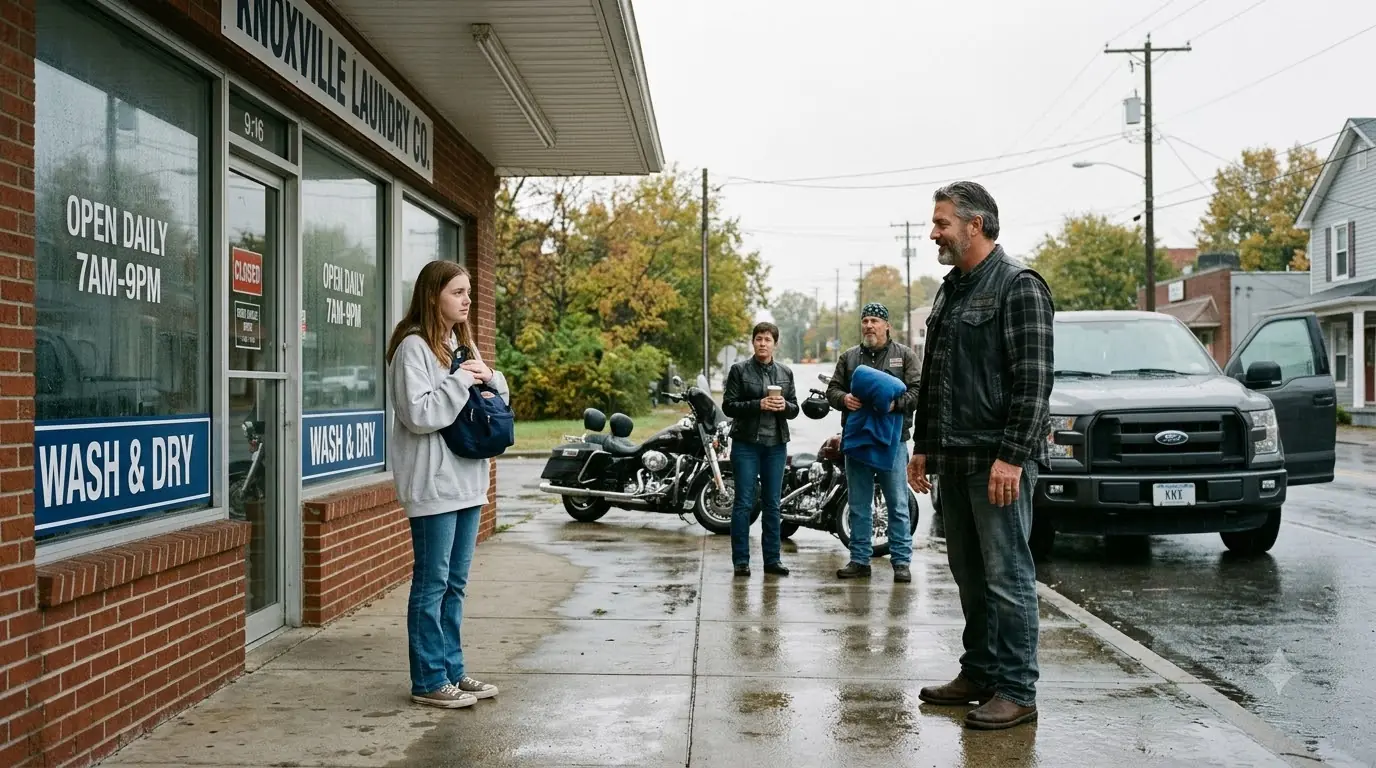
At 3:00 a.m., with nothing but his own footsteps for company, he thought about a lot of things. Mostly, he thought about a freezing night fifteen years earlier when rain hammered the city and a girl huddled beneath the awning of a closed laundromat with nowhere else to go.
She had the look he recognized from his own hardest years: too proud to ask for help, too scared to trust anyone who offered it. Duke had seen enough hard roads to recognize someone standing at the edge of one.
He had a spare room back then, steady work, and a heart still raw from losing his wife. So he did the only thing that made sense to a man like him and told her to get out of the rain.
Her name was Emma. Within a year, she was not just some kid he had taken pity on; she was his.
He never called it charity because it never was. He worked doubles so she could stay in school and sat up with her on the nights she studied until 2:00 a.m.
He learned, slower than he would have liked to admit, how to be somebody's father when the girl in question had spent years learning that trusting people got you hurt. Emma, sharp as a blade and stubborn as her old man, paid him back the only way she knew how.
She finished at the top of her class. Then she left the country on a scholarship to study law somewhere with a name Duke could barely pronounce.
He drove her to the airport himself and stood at the window long after her plane had become a speck in the sky. He told himself the ache in his chest was pride, not loss.
That was what a father was supposed to feel when his kid became strong enough to leave. For a while, he believed it.
The years that followed were kind to her and quiet for him. Emma buried herself in the brutal grind of becoming a lawyer, the kind of work that eats a person whole and spits out someone sharper, colder, and farther away.
Calls got shorter, then rarer. Neither of them said the word out loud, but something between them had loosened the way a rope goes slack when nobody is left holding both ends.
Duke never blamed her. He told himself she was living the life he wanted for her, and a real father did not measure love by the phone bill.
So he kept clocking in at Hullbrook five nights a week, kept the porch light on more out of habit than hope, and grew older the way steady men often do, without anybody much noticing.
Then came the night that changed everything, and at first it did not feel like anything at all. It was a slow shift, cold halls, empty offices.
Somewhere near the middle of his rounds, Duke walked past the records room, the archive where Hullbrook kept its most valuable secrets. He checked the handle, the same as always, and kept walking.
By morning, everything had changed. Files were missing, including designs worth millions of dollars.
The company was not interested in careful questions. They looked at the old guard who had walked those halls alone all night and decided he was exactly the kind of man nobody would fight for.
He had no family nearby, no private lawyer on retainer, and no one in the building with enough influence to stop the story from hardening around him. What Hullbrook did not know was who was still out there half a world away.
The company did not want the matter handled quietly. That was the first sign of how bad things were about to become for Duke.
Hullbrook's chief operating officer, Richard Hail, was sharp, image-conscious, and determined to account for the loss in a way clients and partners could see. A quiet internal review would not do that; a public trial would.
Within a week, the decision came down from the top. Hullbrook would take Duke Callahan to court, and they would make sure everyone watched them do it.
There was one man at the company who seemed, at first, to be in Duke's corner. Kevin Doyle worked in the archive division, was in his mid-thirties, and always had a joke ready in the break room.
On the rare nights their shifts crossed, Kevin had always nodded at Duke like he meant it. In those first raw days after the theft, when half the building suddenly could not look Duke in the eye, Kevin was the one face that still seemed human.
Duke was grateful for it. When the whole world turns its back on you overnight, one decent face can feel like solid ground.