“Dad, I’m here now. Don’t worry anymore. I’ll save you.”
The courtroom went dead silent the moment the doors opened.
Every reporter in that room had already written the story in their heads.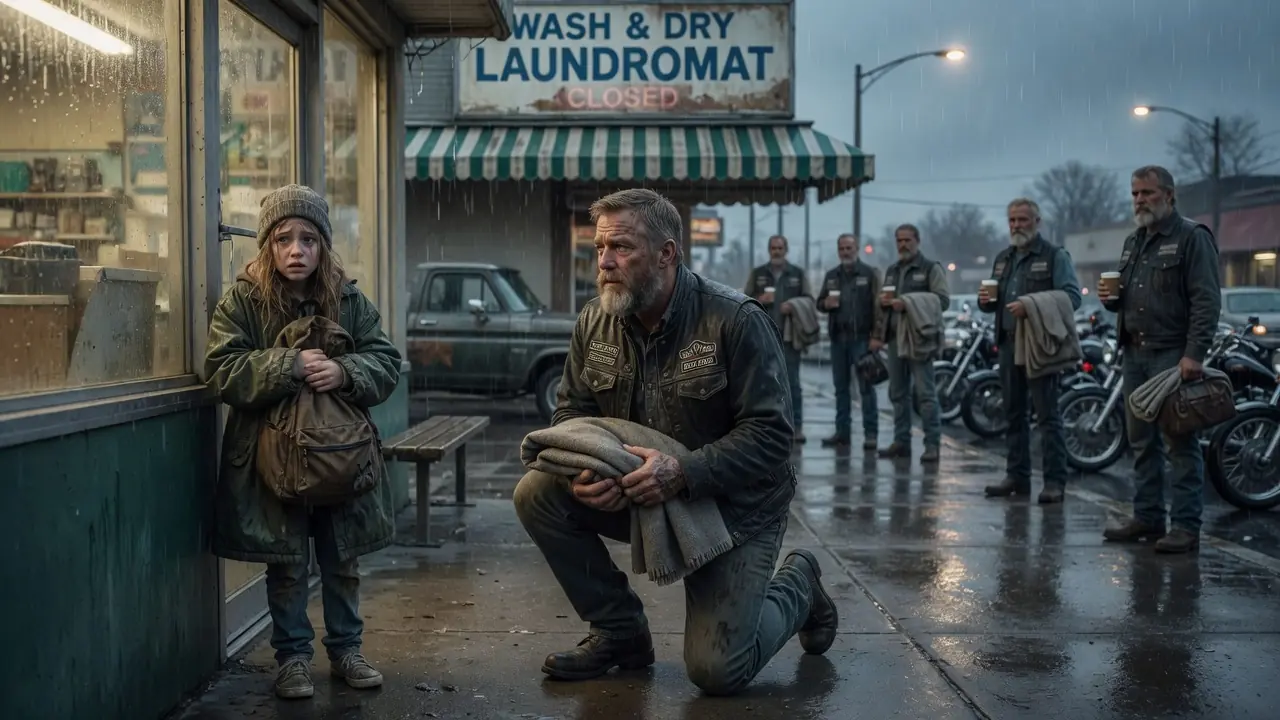
The old biker sitting at the defense table was guilty. That was what they believed. That was what the evidence seemed to say. That was what sixty years of leather, ink, road miles, and loneliness apparently proved to people who had never bothered to know him.
Then a young woman walked in carrying nothing but a briefcase. The old man’s eyes filled with tears before she said a single word. What she was about to say would tear the whole case apart.
Duke Callahan did not look like a man anyone expected to see cry. He was sixty-three years old, with a chest full of faded ink, knuckles broken more times than he could count, and a leather cut hanging in his closet that he had not worn to a run in almost a decade. He lived alone now at the edge of town in a house that still had two coffee cups in the cabinet, even though only one of them ever got used.
His wife had been gone a long time. Cancer took her slowly, the way it does when it wants a person to feel every part of the goodbye. After that, Duke did not talk much. He had never been the loudest voice at the clubhouse table anyway. He had simply been the one everybody trusted.
He was the man who showed up when a brother’s roof caved in, when a widow needed her yard mowed, or when somebody’s truck died on the wrong side of town. That kind of quiet loyalty does not always show up in a courtroom. It does not photograph well for a headline.
Money had gotten tight in the years since he stopped riding regular routes with the club. His pension barely covered groceries, so he had taken a job most of the young guys in his old crew would have laughed at. Night security. Cold hallways. A company called Hullbrook Industries. A badge clipped to a jacket instead of a cut.
He did not mind it. The quiet suited him. Alone at three in the morning, with nothing but his own footsteps for company, he thought about a lot of things.
Mostly he thought about a night fifteen years back, when freezing rain hammered the city and a girl huddled under the awning of a shut-down laundromat with nowhere else to go.
She had that look he recognized from his own hardest years. Too proud to ask for help, too scared to trust anyone who offered it. Duke had seen plenty of hard roads in his life, and something about that girl refusing to break stopped him cold in his tracks.
He had a spare room back then, steady work, and a heart still raw from losing his wife. So he did the only thing that made sense to a man like him. He told her to get out of the rain.
Her name was Emma.
Within a year, she was not just some kid he had taken pity on. She was his.
He never called it charity because it never was. He worked doubles so she could stay in school. He sat up with her on the nights she studied until two in the morning. He learned, slower than he liked to admit, how to be somebody’s father when the girl in question had spent years learning that trusting people got you hurt.
Emma was sharp as a blade and stubborn as her old man. She paid him back the only way she knew how. She finished at the top of her class. Then she left the country on a scholarship, off to study law somewhere with a name Duke could barely pronounce.
He drove her to the airport himself. He stood at the window long after her plane was only a speck in the sky, telling himself the ache in his chest was pride, not loss.
That was what a father was supposed to feel, wasn’t it? When his kid got strong enough to leave?
He believed that for a while. It was even true.
The years that followed were kind to Emma and quiet for him. She buried herself in the brutal grind of becoming a lawyer, the kind of work that eats a person whole and spits out someone sharper, colder, and farther away.
Calls got shorter, then rarer. Neither of them said the word out loud, but something between them had loosened, the way a rope goes slack when nobody is left holding both ends.
Duke never blamed her. He told himself she was living the life he wanted for her. A real father did not measure love by the phone bill.
So he kept clocking in at Hullbrook five nights a week. He kept the porch light on more out of habit than hope. He grew older the way steady men usually do, without anybody much noticing.
Then came the night that changed everything, and it did not feel like anything at the time.
It was a slow shift. Cold halls. Empty offices. Somewhere near the middle of his rounds, Duke walked past the records room, the archive where Hullbrook kept its most valuable secrets. He checked the handle, same as always, and kept walking.
He thought nothing of it.
There was nothing yet to think.
By morning, everything had changed.
Files were missing. Millions of dollars in stolen designs. Hullbrook was not interested in careful questions. They looked at the old guard who had walked those halls alone all night, the man with no family close by, no lawyer on retainer, and no one to speak up for him, and they decided he was exactly the kind of man nobody would fight for.
The company did not want this handled quietly. That was the first sign of just how bad things were about to get for Duke.
Hullbrook’s chief operating officer, a sharp, image-conscious man named Richard Hail, wanted the loss accounted for in a way clients and partners could see. A quiet settlement would not do that.
A trial would.
Within a week, the decision came down from the top. Hullbrook would take Duke Callahan to court, and they would make sure everyone watched them do it.
There was one man at the company who seemed, at first, to be in Duke’s corner. Kevin Doyle worked in the archive division. He was in his mid-thirties, friendly, the kind of guy who always had a joke ready in the break room. On the rare nights their shifts crossed, Kevin had always nodded at Duke like he meant it.
In those first raw days after the theft, when half the building suddenly could not look Duke in the eye, Kevin was the one face that still seemed human.
Duke was grateful for it. When the whole world turns its back on you overnight, one decent face feels like solid ground.
It was Kevin, in fact, who first mentioned the deal.
He brought it up softly, almost reluctantly, the way a man delivers news he claims he wishes was not true. The company, he said, might let the whole thing quietly disappear. No trial. No headlines. No prison. If Duke would just sign a statement taking responsibility.
One signature.
Then silence.
Then he could go home and be done with it.
Duke understood exactly what he was being offered. A way out of the storm, if he was willing to spend the rest of his life wearing a word he had not earned.
He carried that paper home and sat with it at his kitchen table until the lamp burned low. The unsigned confession lay there like a loaded gun.
He thought about how easy it would be. He thought about how few people would ever hear the truth, even if he fought and won. He thought about how many had already made up their minds.
He thought about how many years he had left, and how little he wanted to spend them being called a thief by men in suits who had never asked him a single honest question.
Then he thought about Emma.
Not the woman on the other side of the world now, buried in casework and time zones, but the girl he had raised. The one thing he had drilled into her harder than anything else came back to him.
Your name is the only thing in this life that is really yours.
You can lose your money, your health, your comfort, and still be a whole person. But the day you sign your name to a lie about who you are, you have given away something nobody can hand back to you.
He had asked her to live by that.
He was not about to break it himself, not even to save his own skin.
So when the company’s man came to collect the confession, Duke slid the blank pages back across the table. His hands shook just slightly, but his voice was steady enough when he said he would not sign his name to something he had not done.
He would rather stand in a courtroom and lose than buy his freedom with a lie.
Richard Hail was not pleased.
Word came back that the old man’s refusal had only hardened the company’s resolve. If Duke wanted a trial, they would give him one, and they would make sure it was public.
The notice arrived by mail, his name printed in cold official type. Duke read it alone in his kitchen with the evening pressing against the windows.
He could not afford real counsel. The public defender assigned to him was overworked, blunt, and did not sugarcoat the odds. This would be an uphill fight, and the hill was steep.
Duke listened without flinching. He had made his choice at that kitchen table, and he was not the kind of man who unmade a choice just because it turned out to be hard.
He had no idea how much harder it was about to get.
The local paper ran the story fast, and they told it the way these stories always get told, the ending already decided before the first sentence. A photo of Duke in his security jacket, pulled from some company badge file, sat under a headline calling him the aging guard accused of stealing his employer’s secrets.
Nobody wrote the word guilty.
They did not need to.
They just arranged the facts so the reader would land there on their own.
Duke read it once. Never again.
At work, the silence around him thickened. Co-workers who used to nod at him in the hallway suddenly found reasons to look elsewhere. The break room went quiet when he walked in. A man he had known for years crossed to the far side of the corridor rather than pass close by.
Duke told himself people were scared. Fear makes cowards out of ordinary folks, and he tried not to hold it against them.
It did not make the walk home any warmer.
Through all of it, Kevin Doyle kept being kind. He kept asking how Duke was holding up. He kept reminding him gently that the offer still stood if he ever wanted out.
Duke never once suspected the hand resting on his shoulder was the one that had put the knife there in the first place.
Half a world away, in a city running twelve hours ahead of his, Emma Brooks was scrolling through news from home between meetings, the way homesick people do when they will not admit they are homesick.
The photograph stopped her cold before the headline even registered.
She knew that face.
She had memorized it across a kitchen table, in the front seat of an old truck, in the doorway of a room he had given her when she had nothing.
And now strangers were calling him a thief.
She read the article twice, and both times it made less sense than the last. The man in that article — tired, opportunistic, desperate enough to steal — did not exist. She had lived under his roof. She had watched him hand his last twenty dollars to a stranger and go without lunch for a week rather than mention it.
Beneath the shock came something worse.
Shame at herself.
She counted back the months since she had really talked to him. Not a rushed call between meetings, but a real conversation. The number made her stomach drop.
By the time she stood up from her desk, the decision was already made. She just did not know yet how little time she had left to save him.
She did not cry. That was not Emma’s way, and it had never been Duke’s either.
Instead, she walked straight into her supervising partner’s office and told him a family matter had come up, one that could not wait. There was nothing to negotiate in her voice, only the flat certainty of someone who had already stopped listening for permission.
Within hours, she had booked the first flight home and was packing a single bag before the sky outside her window had gone fully dark.
She did not sleep on that flight. Not for one minute of it.
She sat by the window with the cabin dimmed around her and thought about the man who had found her in the rain. She remembered the way he never looked at her like she needed pity, only like she needed a chance.
She remembered every dinner he stretched thin so there would be enough for two. Every time he chose her comfort over his own without once making her feel like a burden.
Somewhere over the black middle of the ocean, she stopped remembering and started working. Grief was not going to help him.
A plan might.
She pulled out a legal pad and began building the case from thirty thousand feet.
She knew almost to the hour where her father would have been that night. Old habits. Same rounds. Same routine he had kept for years.
She checked her own call history and found exactly what she suspected would be there.
Then she drafted the requests she would send the second she landed. Records the overworked public defender had not chased. Backup files a building that size almost certainly kept without most employees even knowing it.
By the time the wheels touched down, she had lost a full day to the distance between continents. She did not waste a single hour of what was left feeling sorry for herself.
She did not go straight to the courthouse.
That was the hard part, the discipline of it.
Walking in empty-handed would have meant nothing. So instead, she spent what little time she had turning her plan into something a judge could actually use. She confirmed phone timestamps. She pushed through channels for the raw security backups Hullbrook had never turned over.
Most employees did not even know the system mirrored its footage.
She did.
Chasing that lead cost her the hours that meant she reached the courthouse only as closing arguments were already underway.
The trial had moved fast, faster than a case like this ever should have. It was not complicated, at least not in the shape Hullbrook had built it, and both sides seemed to understand the company wanted this over quickly.
Their attorney, a seasoned, unhurried man named Gerald Foster, laid it out simply.
A night guard with keys to every door.
Valuable files gone in the dark.
A man with no one to vouch for him.
Clean story. Clean villain.
Clean was exactly what made it dangerous.
Duke sat through it in a borrowed suit that hung loose on a frame built for leather and road miles, not courtrooms. When he was finally given the chance to speak, all he said was that he was innocent.
He had walked his rounds like always. He had taken nothing.
Plain truth, no embellishment, because plain truth was all he had.
But plain truth from a quiet old biker in a room built for argument sounded thin against a company’s polished certainty.
He could feel it landing weak.
He could feel the room deciding.
Richard Hail watched from Hullbrook’s side with the calm of a man who already considered this settled. Judge Margaret Ellison listened with the neutral attention of someone who could only weigh what was placed in front of her, and everything placed in front of her pointed one direction.
Sitting there, Duke understood something with total clarity.
No one in that room was going to save him, because no one in that room had any reason to.
He had walked in alone, and he had known he would.
He had chosen truth over the easy lie, and he did not regret it, but he was honest enough with himself to see exactly where it was leading.
Near the end of arguments, Judge Ellison asked whether the defense had anything further to offer. The room seemed to hold its breath.
Duke’s public defender flipped through a thin file and found nothing new inside it.
Duke looked down at his own hands, scarred, road-worn hands that had turned wrenches and thrown punches, and more than either of those things, had held a shivering teenage girl’s shoulders steady on the worst night of her life.
He understood this was the point where hope was supposed to run out.
Oddly, he did not think of prison. He did not think of ruin.
He thought of Emma, and felt something close to relief that she was far away and would not have to watch this happen.
He had spared her that much, at least.
It was the last comfort he had left.
What he did not know, what he could not have known, was that she had landed hours earlier. She was climbing the courthouse steps two at a time at that very moment, arms full of everything she had built at thirty thousand feet, while the judge prepared to bring the whole thing to a close.
He had built this entire ordeal around one belief: keeping Emma out of it was protecting her.
That belief was about to come apart completely in front of a room full of people who had already made up their minds.
Judge Ellison drew a breath to move the proceeding toward its end. The room settled into that particular heavy quiet that comes right before something becomes final and unchangeable.
Duke closed his eyes and made himself ready to hear the worst.
Then the doors at the back of the courtroom opened.
The sound cut through the stillness like a gunshot in an empty church.
Heads turned before anyone understood why.
A young woman stepped through the doorway in a dark, sharply tailored suit, composed and unhurried, carrying nothing but a single leather briefcase held tight at her side.
She walked up the center aisle like she had every right to be there, past reporters who forgot to keep writing, past Richard Hail, whose polished calm cracked for the first time since the trial began.
She stopped at the front of the room and calmly asked the court’s permission to join the defense.
Duke turned toward the sound of her voice, and for a moment his mind refused to believe what his eyes were telling him.
It had been years since he had seen her in person. The woman standing there was older, sharper, steadier than the girl he had watched board a plane.
But he knew her.
He would have known her anywhere, in any room, at the end of any road.
His breath caught. His eyes filled before he could stop them. Everything he had endured to keep her far from this moment collapsed into one simple, unbearable fact.
She was here.
The room went dead silent as she turned toward the old man at the defense table. Her composure softened into something meant only for him.
She looked at the man who had pulled her out of the freezing rain fifteen years ago, who had given up his own comfort and asked for nothing back, who had chosen to sit through this entire nightmare alone rather than trouble her with it.
In a voice steady enough to carry to every corner of that hushed room, she said the only thing she had ever really called him.
“Dad.”
For a moment, nobody in that courtroom seemed to breathe.
The word hung there between the old biker and the young attorney, and everyone present understood without being told that they had just watched something private break open in a very public place.
Duke gripped the edge of the table to keep himself steady.
Emma held his gaze long enough to tell him without words: I’m real. I came. You’re not finishing this alone.
Gerald Foster recovered first, rising to object that the defense could not simply be joined at the eleventh hour by a stranger walking in off the street.
Emma was ready for him before the words finished leaving his mouth.
She stated her name, confirmed her bar standing, confirmed she had filed her appearance to assist existing counsel, and she did not hide the rest of it either.
She told the court plainly that the defendant was the man who had raised her. She laid that fact on the table like a card she had chosen to lead with, not one she was hiding in her sleeve.
Judge Ellison studied her for a long moment, weighing the irregularity against the plain fact that a man on trial deserved whatever competent help he could get.
The relationship, the judge noted, would go to the weight of Emma’s testimony, not her right to speak. She would be allowed to assist, provided she stuck to evidence, not sympathy.
Emma nodded.
Sympathy was not what she had crossed an ocean for.
She had brought something harder.
She opened not with an accusation, but with a fact the prosecution had conveniently left out. Duke Callahan had been offered a signed confession weeks earlier that would have made this entire case disappear, and he had refused it.
A man with something to hide takes the quiet exit when it is handed to him. A man does not walk knowingly into a public trial he expects to lose unless he genuinely has nothing to confess.
That refusal was not sentiment.
It was conduct.
And conduct was evidence.
Foster countered that a refusal was not an alibi.
On that narrow point, he was right.
So Emma gave the court an alibi.
She pulled a phone record from her briefcase, Duke’s call log from the night of the theft, and pointed the court to a single entry timestamped inside the exact window Hullbrook claimed the files had gone missing.
A call to her half a world away.
The ordinary check-in of a father thinking about his kid at a strange hour.
A man could not clean out a secure archive with care while he was standing in a stairwell talking to his daughter overseas.
The detail landed differently than anything Duke had managed to say on his own behalf because it did not ask to be believed.
It simply was.
Richard Hail leaned toward Foster and murmured something low. For the first time all trial, the certainty on the company’s side of the room showed a crack.
Emma saw it and did not slow down.
She had learned that from the man beside her a long time ago.
When a fact finally starts moving in your favor, you do not stop to admire it.
You keep pushing.
The phone call put Duke somewhere he could speak from, but Emma knew a call alone still left room for doubt, and she had not come this far to leave any room at all.
She turned next to the security footage.
The same footage Hullbrook had leaned on the entire trial.
The corridor camera had conveniently corrupted during the exact window the theft occurred. The company had treated that gap like one more shadow hanging over the old biker.
“A gap is not proof of guilt,” she told the court. “A gap is a question. And nobody at Hullbrook bothered to ask it.”
She had asked it.
In the hours since landing, she had tracked down the building’s redundant backup system. Copies most employees did not even know existed, sitting untouched while the primary feed conveniently failed.
Those backups had not been corrupted.
What they showed did not match a single word of the story Hullbrook had walked into that courtroom with.
She asked that the preserved footage be entered and reviewed.
Judge Ellison, her interest now plainly sharpened, allowed it.
The room went quiet as the screen came to life.
The footage rolled, and the whole courtroom watched Duke Callahan move through his rounds exactly as he had claimed from the very first day.
Past the parking structure.
Down the corridor.
Never once stepping into the archive.
Never once carrying anything he had not carried in on his own two shoulders.
The old man on the screen was doing nothing but his job.
The timestamp lined up second for second with the phone call still sitting open on the evidence table.
Two records.
Neither one knowing about the other.
Both saying the exact same thing.
Foster tried to slow it down, arguing that Duke’s absence from the archive did not prove who had gone in.
Fair question, Emma agreed.
And she already had the answer waiting.
If the corridor footage had been quietly written off as corrupted, somebody had needed it gone. Somebody with real access to the archive systems was far better positioned to arrange that than an old road captain who could barely work the break room microwave.
She asked the court to consider who in that building actually held the keys, the technical access, and the motive.
Then, carefully, she started narrowing the circle.
The preserved backups had not only caught Duke’s route. At the edge of another camera’s frame, well after Duke had passed through and moved on toward the lot, a second figure entered the archive.
The image was not perfect, but it was clear enough.
It did not belong to the old man in the borrowed suit.
It belonged to someone in the archive division.
Someone who knew exactly which cameras mattered and never imagined the wrong feed would ever surface again.
It belonged to Kevin Doyle.
Duke felt the name hit his chest like a dropped wrench.
He thought of the break room, the sympathetic head shakes, the gentle voice that kept nudging him week after week toward signing that confession and making it all disappear.
The one man who had stood beside him the whole time had been steering him toward ruin from the very first day.
Staying close, not out of loyalty, but to watch how well the frame was holding.
The kindness had been a performance.
The hand on his shoulder had been the one holding the knife.
Emma laid it out for the court plainly, without cruelty, which somehow made it land harder.
Kevin Doyle had used the chaos of that night and his own access to the archive to take the files. He understood immediately that an isolated old security guard with a rough past made the perfect place to set the blame.
He had reported the corridor feed as corrupted because he was standing in the one part of the building it should never have missed. He had pushed the confession because a signed admission from Duke would have buried the real theft forever.
Every piece that had made the case against Duke look so airtight had been arranged quietly by the one man everybody in that building had trusted.
Duke Callahan found out what it felt like to have someone smile at him while quietly working against him the whole time, and he found it out in front of a packed courtroom.
Richard Hail’s certainty drained out of him in real time. He sat rigid on the company’s side of the room, watching a case he had staked his own name on come apart in front of reporters he had once trusted to make him look strong.
He had not caught a thief.
He had very nearly manufactured one.
Foster set his papers down.
There was little left to argue against timestamps and phone records that agreed with each other, and he was too experienced a lawyer to keep swinging at a case that no longer had legs.
The whole room, which had leaned toward Duke’s guilt for the entire trial, tilted the other way all at once.
Judge Ellison called a halt to let the new evidence be properly examined.
When proceedings resumed, the outcome was no longer in question.
The footage held.
The phone record held.
Once investigators finally knew where to look, the trail behind Kevin Doyle unraveled fast, the way these things always do once somebody pulls the first honest thread.
Within days, he was in custody, and the theft that had nearly cost an innocent man everything was placed at last exactly where it belonged.
Then Judge Ellison delivered the ruling that mattered.
Duke Callahan was found innocent of every charge, cleared completely.
His name was handed back to him in the very same public room where it had almost been taken for good.
For a moment, he did not react at all, like some part of him could not quite let itself believe a thing he had hoped for without ever really expecting it.
Hullbrook was made to answer for it.
Richard Hail himself stood in front of the same reporters who had once printed Duke’s badge photo under suspicion and delivered a stiff, carefully worded public apology, the kind of language a company uses to protect itself as much as to make amends.
Duke accepted it quietly.
He had never wanted anyone’s humiliation.
He had only ever wanted his name back.
But standing there cleared and vindicated, Duke realized something strange.
The verdict was not what filled his chest.
The relief of getting his name back was real. But it sat beneath something bigger.
What finally broke him, what brought the tears he had held back through the entire ordeal, was the sight of Emma standing right there beside him.
The girl he had found shivering under an awning fifteen years ago. The one he had raised on a night guard’s paycheck and a widower’s stubborn hope.
She had crossed half the world and walked straight into a courtroom to stand between him and everything trying to break him.
She had not forgotten him.
She had only been far away.
When the room finally began to empty, the two of them stepped into the corridor together, away from the reporters, away from the ruling, away from all the machinery of it.
There, in that quiet hallway, the years of distance simply fell away.
Duke reached for her the way a man reaches for something he was afraid he would never get to hold again.
Emma went to him, and they stood there wrapped around each other in the middle of that hallway while the noise of the world kept moving past on either side, like the two of them were the only still point in the whole building.
He had spent so long trying to shield her from his troubles that he had almost let it cost him the one person those troubles could never actually touch.
She told him quietly that she was sorry it took all this to bring her home.
He told her just as quietly that she had come, and that was all that mattered.
There was nothing left to forgive between them. The distance had never been coldness. It had only ever been two people who loved each other, trusting maybe too much that there would always be more time.
Standing there, worn down by everything the past weeks had taken from him, Duke understood something plain and hard.
The time was now.
He did not intend to waste any more of it.
Emma decided to stay.
Not the few obligatory days a daughter gives after a crisis, but a real stretch, long enough to make up for some of what they had both let slip through their hands.
She had built a career on the other side of the world, and it would keep, or it would change, and she found she did not much care which.
What she cared about was the man who had given up his own life to build hers, and the simple, overdue chance to be near him while she still could.
In the weeks that followed, Duke’s days softened at the edges.
He went back to work for a while because that was who he was, and honest work had always steadied him, same as it had steadied him through every hard season since he was young enough to still believe the road could fix anything.
The co-workers who had once turned away from him in the corridor could not quite meet his eyes now either, just for a different reason.
Duke did not hold it against them.
He had never been a man who kept a ledger of other people’s failures, and he was too grateful for how things had turned to spend that gratitude on grudges.
What changed most was the quiet.
The narrow house at the edge of town, which had held the shape of a life built for one for so many years, made room again for two.
Every weekend Emma came by, and the rooms that had gone silent filled back up with the ordinary sounds of company. A shared meal. A long conversation that ran too late. The small, unhurried talk of people who no longer had to ration their time together.
Duke had forgotten how good that kind of ordinary could feel.
He did not plan on forgetting it again.
Now and then, the two of them drove back to the spot where it had all started, the shuttered storefront where a widowed old biker had once found a shivering stranger with nowhere left to go and decided, against every practical instinct, to change both their lives in one night.
They would sit there together in the open air, saying little because the place said enough on its own.
It was written plainly in the simple fact that they were both still there, side by side, fifteen years later.
Duke never once regretted his answer that night.
Sitting on that bench one afternoon, he finally understood something he had spent his whole life circling without quite landing on.
The most important thing he had ever done was not the act of taking Emma in.
Generous as that night had been, it was everything that came after.
The years of quiet, unrewarded care he had poured into her without ever expecting a single thing back.
He had given it simply because it was right to give.
He never once imagined it would travel all the way back across an ocean to save his life.
But it had.
What he had planted in her had grown large enough and strong enough to come home when it mattered most.
Genuine kindness does not always pay a person back on any schedule they can see.
Duke had gone decades believing his decency had bought him nothing. He had watched it seem to fail him completely in the worst weeks of his life.
But the love he had given away with both hands had never actually left the world.
It had only been waiting, growing quietly in the one person he had given it to, until the exact day it was needed most.
What is offered from the whole of a person’s heart always finds its way back.
Family, Duke understood now with a certainty no verdict could have handed him, was never only about blood. It was never written only in birth certificates or shared last names.
It was built by the people who refuse to leave when leaving would be so much easier.
The ones who cross oceans and walk through courtroom doors at the last possible second because staying away was never really a choice they had in them.
Duke Callahan had spent fifteen years believing he was the one who had done the rescuing.
In the end, he learned that love given honestly rescues everyone it touches, in whatever order the world decides it is needed.