Vanessa Whitmore slammed the coffee mug onto Karen Whitfield’s kitchen table hard enough to make the spoon inside it jump. The sound cracked through the warm morning light like a small gunshot, sharp and ugly in the room Karen had spent thirty-one years making peaceful. Julian sat beside his wife with his shoulders bent, staring down at his phone as if the glowing screen could save him from the shame sitting across the table. Karen sat very still in her pale blue cardigan, her hands folded over the cloth napkin she had ironed the night before for a birthday dinner that had not even happened yet.
“No dinner,” Vanessa said coldly. “We need your birthday money for my parents’ trip.”
Karen looked at the mug first, not at Vanessa. It was Edward’s mug, cream-colored with a faded blue stripe around the rim, the one her husband had used every Sunday morning while reading the paper and pretending not to steal bites from whatever cake she had cooling on the counter. Vanessa had picked it from the cabinet that morning without asking, filled it with coffee Karen had bought, and now used it like a gavel to announce that Karen’s sixtieth birthday belonged to someone else. For one strange second, Karen almost expected Edward to walk in from the hallway and say, “Now, wait just a minute.”
But Edward had been gone two years.
Vanessa leaned back in her chair, her green blouse smooth and expensive-looking beneath the soft kitchen light. She had the polished expression of a woman who believed cruelty sounded better when delivered calmly. “My parents are flying to Maui next week,” she continued, lifting her chin. “The hotel is right on the beach, and prices are ridiculous, so we’re going to have to use the money you set aside for Saturday.”
Julian cleared his throat.
Karen turned her eyes to her son, and for one heartbeat, she let herself hope. He was thirty-five now, but she still saw the boy who used to run into this kitchen with muddy sneakers and ask if there were biscuits left. She saw the teenager Edward taught to fix a leaky faucet, the young man who cried into her shoulder after his first serious breakup, the son she had loved so fiercely that loving him had sometimes made her foolish. He looked at her, then at Vanessa, then back down at his phone.
That was when something inside Karen went still.
Not broken. Not numb. Still.
Vanessa mistook that stillness for surrender. “I knew you’d understand,” she said, her mouth curving into a thin smile. “Honestly, Karen, it’s just a birthday. Sixty isn’t exactly special anymore. People live forever now.”
Karen almost laughed at that.
People did not live forever. Edward had not lived forever. He had gone upstairs after dinner one rainy Thursday night, kissed Karen’s forehead, complained that the plumber still had not called, and never opened his eyes again. People left in the middle of ordinary things, and sometimes the people left behind had to watch others walk through their house as if grief had made them ownerless.
Vanessa lifted the mug again. “Besides, you don’t even like attention.”
The words were true enough to sound harmless, which made them more cruel. Karen had never liked being the center of a room, but that did not mean she wanted to be erased from it. She had spent her life remembering everybody else’s days, baking cakes, mailing cards, saving receipts, making sure Julian never felt forgotten even when money was tight. She did not need applause, but she did need to be treated like a person in her own kitchen.
“Mom,” Julian finally said, his voice low. “It’s just this one thing.”
Karen looked at him for a long moment.
It was never just one thing. It was the electric bill he forgot to help with, the groceries Vanessa added to Karen’s list, the upstairs apartment they had promised to rent only “temporarily,” and the credit card Vanessa borrowed for an emergency that somehow became hair appointments and restaurant meals. It was two years of Karen pretending generosity was still generosity after people stopped saying thank you.
When Julian and Vanessa moved into the upstairs apartment after Edward’s funeral, Karen had believed the house needed voices again. The apartment had a small kitchen, two bedrooms, and a sitting room where her mother once watched old westerns before she passed. Karen charged them no rent at first because Julian had lost his job, and Vanessa said they only needed a few months to recover. Two years later, their recovery looked a lot like Karen paying for heat, groceries, repairs, and patience.
Vanessa had not yelled much in those two years. Yelling would have been too easy to confront. She worked with quiet pressure instead, polished remarks, fake concern, soft insults wrapped in manners. She asked if Karen still felt safe driving at night, suggested the kitchen might be “too cluttered for someone your age,” and once told Julian that older women sometimes became attached to useless things.
The useless things had been Karen’s recipe box, Edward’s work jacket, and the rooster cookie jar he bought her in Vermont.
Karen picked up the pale blue napkin from her lap and placed it neatly on the table. “I see,” she said.
Vanessa smiled. “Great. I’ll call the bakery and cancel the cake. The deposit from the private dining room should go back to your card, right? I’ll need you to transfer it when it does.”
Karen stood slowly and carried her empty cup to the sink. Her hands did not shake. She rinsed the cup, placed it in the drying rack, and watched the water circle down the drain. Then she turned off the faucet.
“No,” she said.
Vanessa blinked. “Excuse me?”
“No,” Karen repeated. “I’ll handle my own refund.”
Vanessa’s smile tightened. “Karen, we’re all trying to make this work.”
“Are we?”
The kitchen fell silent.
Julian finally looked up, and Karen saw fear in his eyes, not for her, but for himself. He had become a man who avoided storms by letting his mother stand in them. That realization hurt more than Vanessa’s voice, more than the canceled dinner, more than the stolen money. Karen had raised him better, but somewhere along the way, comfort had softened his spine.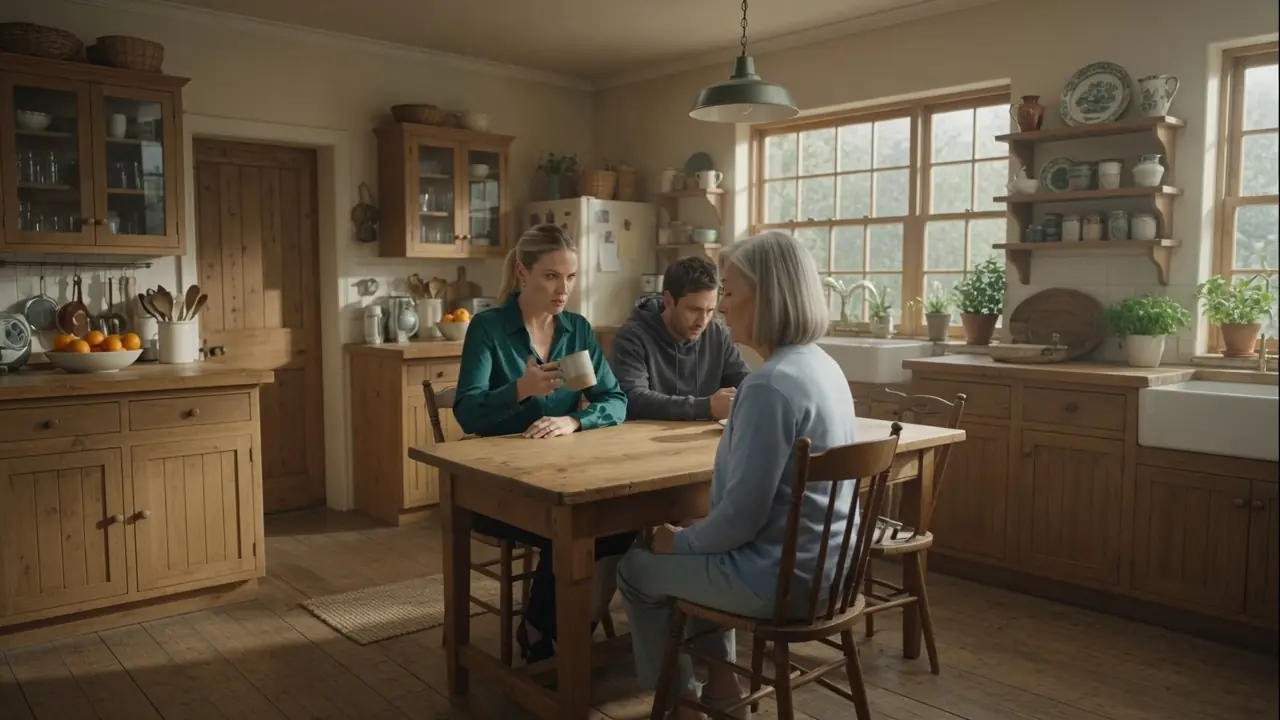
Before Vanessa could answer, Karen’s phone buzzed in the pocket of her cardigan.
She pulled it out and saw the name Marcus Bell.
Vanessa noticed the name and frowned. She knew Marcus only as “some old office friend,” because that was what she had decided he was. In Vanessa’s mind, Karen was a lonely widow living on widow’s benefits, coupons, and whatever remained in a modest checking account. She had no idea Karen had spent forty years learning money the way other people learned music.
Karen answered calmly. “Good morning, Marcus.”
Marcus Bell’s voice came through the speaker because Karen had accidentally tapped it. “Morning, boss. The closing packet is ready. The attorney wants your signature before three, and the downtown lease is waiting on your approval.”
Julian’s head lifted.
Vanessa’s fingers tightened around Edward’s mug. “Boss?” she mouthed, barely making sound.
Karen kept her eyes on the kitchen window. “Thank you, Marcus. Send everything to my secure folder. I’ll review the lease terms this afternoon.”
“Of course,” Marcus said. “One more thing. The Whitmore account called again. They’re requesting another rent extension before their renewal meeting.”
Vanessa’s face lost color.
Karen turned slightly, looking at her daughter-in-law now. “Which Whitmore account?”
Marcus paused, hearing the change in her voice. “Richard and Elaine Whitmore’s travel agency. The beachfront vacation specialists. They rent Suite 204 in the Mercer Building.”
The mug slipped in Vanessa’s hand and hit the saucer with a dull clink.
Karen did not smile. “I’ll call you back in ten minutes, Marcus.”
“Yes, ma’am.”
She ended the call and placed the phone on the table.
No one spoke.
Outside, morning light fell across the old wooden floor. The refrigerator hummed softly, and somewhere upstairs a pipe ticked in the wall Edward had once promised to replace. Karen looked at Vanessa, then at Julian, and for the first time in two years, she let them see exactly how little they had understood her.
Vanessa recovered first. “What was that about?”
Karen folded her hands. “Business.”
“What business?”
“My business.”
Julian swallowed. “Mom, what downtown lease?”
Karen turned to him, and the sadness in her face made him look away again. “The Mercer Building. Three floors, retail on the first, offices above. I signed the purchase agreement last month. Today is closing.”
Vanessa laughed once, sharp and disbelieving. “You bought a building?”
“Yes.”
“With what money?”
Karen looked at Edward’s mug in Vanessa’s hand. “Mine.”
The word landed hard.
Julian’s mouth opened slightly. Vanessa set the mug down as if it had become hot. For two years, they had treated Karen’s money like a shallow dish they could keep scraping from. They had never imagined there was more beneath the surface, carefully saved, invested, and protected long before either of them thought to take it.
Karen sat back down, not because she felt weak, but because she wanted this conversation to happen at her table. “Your parents’ travel agency rents from the building I now own,” she said to Vanessa. “They have missed two rent deadlines, requested one extension already, and are now asking for another while planning a Maui vacation.”
Vanessa’s cheeks flushed. “That has nothing to do with us.”
“You just canceled my birthday dinner to help fund their trip,” Karen said. “So it seems to have something to do with me.”
Julian rubbed his forehead. “Mom, can we just slow down?”
Karen looked at him. “I have been slow for two years, Julian. I was slow when you stopped paying utilities. I was slow when Vanessa charged groceries to my card. I was slow when you both treated my upstairs apartment like an inheritance you had already received.”
His face tightened. “That’s not fair.”
“No,” Karen said softly. “It isn’t. But not in the way you mean.”
Vanessa stood, her chair scraping the floor. “I don’t appreciate being spoken to like this.”
Karen looked up at her. “And I don’t appreciate being told my sixtieth birthday dinner is less important than your parents’ beach hotel.”
Vanessa’s eyes flashed. “My parents deserve a vacation. They’ve worked hard their whole lives.”
“So have I.”
The simple sentence stopped Vanessa for half a second.
Karen continued, voice steady. “I worked as a payroll clerk when Julian was little. Then I studied at night, became a bookkeeper, then a financial manager, then helped small businesses restructure debt for twenty-two years. Edward and I bought this house when the roof leaked and the kitchen floor sagged. I saved every bonus, every tax refund, every dividend, because I knew one day I might have to stand alone.”
Julian’s eyes grew wet, but Karen did not soften yet.
“I did not tell you everything I had,” she said, “because I wanted to know whether you loved me when you thought I had little.”
That silence was worse than shouting.
Vanessa looked insulted, but beneath it was panic. “So what? You were testing us?”
“No,” Karen said. “You tested yourselves.”
Julian pushed back from the table and stood. “Mom, I didn’t know Vanessa was going to say it like that.”
Karen looked at him with a grief so calm it frightened him. “But you knew she was going to say it.”
His silence answered.
Vanessa crossed her arms. “This is ridiculous. It’s a birthday dinner. We can reschedule.”
Karen nodded slowly. “Yes. I can reschedule dinner. I cannot reschedule two years of being treated like an old woman whose only purpose is to pay bills quietly.”
Vanessa’s lips parted, but no words came.
Karen picked up her phone again and tapped Marcus’s contact. This time, she did not put it on speaker by accident. She did it deliberately.
“Marcus,” she said when he answered, “please prepare three documents for me.”
“Of course, boss.”
Vanessa stared.
Karen continued. “First, a formal rent agreement for the upstairs apartment, beginning the first of next month. Market rate, with utilities split fairly.”
Julian flinched. “Mom—”
Karen held up one hand, and he stopped.
“Second,” Karen said, “a thirty-day notice if the agreement is refused. Third, inform the attorney that I want the Whitmore travel agency lease reviewed for late payment penalties and renewal conditions before any extension is granted.”
Vanessa’s face went pale. “You can’t do that to my parents.”
Karen looked at her evenly. “I am not doing anything to them. I am asking adults to meet the terms of the agreements they signed.”
Marcus’s voice came through, calm and professional. “I’ll have everything drafted within the hour.”
“Thank you.”
Karen ended the call.
Vanessa grabbed her purse from the chair. “You are unbelievable.”
“No,” Karen said. “I am awake.”
The words seemed to echo through the kitchen.
Julian sank back into his chair, elbows on the table, his face in his hands. Vanessa stood over him, furious, waiting for him to defend her. But something in Julian had finally cracked under the weight of his own cowardice. He looked at the mug, then at his mother, then at the woman he had allowed to humiliate her.
“Vanessa,” he said quietly, “why are your parents going to Maui if their business is behind on rent?”
She stared at him. “Are you serious right now?”
“Yes,” he said, his voice stronger. “I’m serious.”
Vanessa laughed bitterly. “So now you’re on her side?”
Julian looked at Karen, and shame covered his face. “I should have been on her side from the beginning.”
For the first time that morning, Karen’s eyes stung.
Vanessa grabbed Edward’s mug and carried it to the sink so roughly Karen almost rose from her chair. But then Vanessa stopped, looked at the mug, and seemed to realize even she had crossed too many lines in one morning. She set it down carefully and turned away.
“I’m going upstairs,” she snapped.
“No,” Karen said.
Vanessa froze.
Karen stood. “You will sit down. We are not finished.”
Something in her voice made both Vanessa and Julian obey.
Karen took a folder from the sideboard drawer. She had placed it there the night before, not because she expected this exact conversation, but because some part of her knew the time for waiting was over. Inside were printed records: unpaid utilities, credit card charges, grocery receipts, repair costs, and the original agreement Julian had signed promising to contribute after three months.
She placed the folder on the table.
“I did not keep these to punish you,” she said. “I kept them because facts matter when people rewrite kindness as obligation.”
Julian opened the folder with shaking hands. Vanessa did not look at it.
Page after page showed the quiet cost of their living. Seven hundred dollars here. Two hundred there. Insurance, groceries, upstairs plumbing, streaming subscriptions charged to Karen’s card because Julian had “forgotten” to switch them. By the time Julian reached the last page, his face had crumpled.
“Mom,” he whispered. “I didn’t know it was this much.”
“You didn’t want to know.”
He closed his eyes.
Vanessa stood again, but this time her anger had desperation in it. “Fine. We’ll pay something. But dragging my parents into it is low.”
Karen shook her head. “Your parents dragged themselves into it when their rent extension became more important than my birthday dinner. If they can afford Maui, they can afford rent. If they cannot afford rent, they should not be asking a widow to sacrifice her birthday so they can pretend they are doing better than they are.”
Vanessa looked as if she wanted to slap the table again, but her hand stayed at her side.
The doorbell rang.
All three of them turned.
Karen glanced at the clock. It was too early for Marcus, too late for the mail, and too sharp a ring to be a neighbor. Julian walked to the front door and opened it. A moment later, Richard and Elaine Whitmore stepped into the kitchen like people arriving at a hotel where staff had failed to prepare properly.
Richard wore a linen jacket despite the cool Seattle morning. Elaine had sunglasses perched on her head and a handbag that probably cost more than Karen’s canceled dinner. Vanessa’s eyes widened with relief and alarm.
“Mom,” she said. “Dad. What are you doing here?”
Elaine looked annoyed. “You weren’t answering your phone. We need the transfer today if we’re confirming the oceanfront upgrade.”
Karen almost admired the timing.
Richard glanced at Karen with his usual polite disregard. “Good morning, Karen. I hope this isn’t a bad time.”
Karen sat down again. “Actually, Richard, your timing is perfect.”
Elaine frowned, noticing the tension. “What’s going on?”
Vanessa moved toward her mother. “Nothing. Karen is just being difficult.”
Julian looked up sharply. “Don’t.”
Everyone turned to him.
His voice shook, but he continued. “Don’t talk about her like that. Not in her house.”
Karen felt something in her chest loosen, just a little.
Richard narrowed his eyes. “Julian, I don’t think this concerns you.”
“It concerns all of us,” Karen said. “Especially since I understand you requested another rent extension on Suite 204.”
Richard’s expression changed so quickly it would have been funny in another life. “How do you know that?”
Karen met his eyes. “Because I bought the Mercer Building.”
Elaine’s lips parted. “You?”
“Yes,” Karen said. “Me.”
Richard gave a short laugh, but it sounded thin. “There must be some misunderstanding.”
“There isn’t.”
“I have dealt with the previous owner for years.”
“And now you will deal with me.”
Elaine slowly removed her sunglasses from her head. Vanessa looked between her parents and Karen, realizing the room had shifted beyond her control. Richard’s confidence faltered, then hardened into offense.
“Our agency has had a difficult quarter,” he said. “But we are valued tenants.”
“You are late tenants,” Karen replied.
Richard’s jaw tightened. “That is a temporary cash flow issue.”
Karen looked at Elaine’s designer luggage tag still attached to her handbag from some recent trip. “Then perhaps Maui can wait.”
Elaine flushed. “Our personal travel is none of your business.”
Karen nodded. “Correct. Until my birthday money was assigned to pay for it at my kitchen table.”
Richard looked at Vanessa. “What is she talking about?”
Vanessa said nothing.
Karen did not raise her voice. She did not need to. “This morning your daughter canceled my sixtieth birthday dinner and informed me the money would be used for your Maui trip. She did this while drinking from my late husband’s mug, in the house where she and my son have lived rent-free for two years.”
Elaine’s face flickered with embarrassment, but Richard only looked angry.
“That sounds like a family matter.”
Karen smiled slightly, though there was no warmth in it. “So is respect. Yet everyone seems to have misplaced it.”
Vanessa’s eyes filled with angry tears. “You’re humiliating us.”
Karen turned to her. “No, Vanessa. I am returning what you handed me.”
Julian stood, breathing hard. “Mom, I’m sorry.”
Karen looked at him, and this time she let the tears show. “I needed you to say that before today.”
“I know,” he whispered.
“No,” she said softly. “You don’t. But maybe you will.”
Richard stepped toward the table. “Karen, let’s be reasonable. Business is business, and family is family.”
Karen picked up the folder and closed it. “That is exactly what I’m saying.”
He paused.
“Your lease will be handled as business,” Karen said. “Julian and Vanessa’s living arrangement will be handled as business. My birthday, my home, and my dignity will no longer be treated as family resources available for withdrawal.”
Elaine sat down slowly, as if her legs had weakened. Vanessa looked cornered. Julian looked devastated. Richard looked like a man who had just learned the quietest person in the room owned the floor beneath him.
Karen stood and walked to the cabinet. She took Edward’s mug from the counter, washed it gently, dried it with a clean towel, and placed it on the highest shelf where Vanessa would not reach it casually again.
Then she turned back to them.
“My birthday dinner is Saturday,” she said. “I am not canceling it.”
No one answered.
“I have already paid the deposit,” Karen continued. “The cake will be picked up at four. Marcus, two women from my old office, Mrs. Chen from next door, and Reverend Paul will be there. Julian, you may come if you come as my son, not as someone waiting for his wife’s permission to love his mother.”
Julian wiped his face. “I’ll be there.”
Vanessa stared at him in disbelief. “Julian.”
He looked at her with exhausted clarity. “No. I’m done.”
The words were quiet, but they carried two years of silence breaking.
Karen did not ask what that meant for their marriage. That was their upstairs storm to weather. Her work was not to rescue Julian from every consequence. Her work now was to stop disappearing.
Saturday came with cold rain and a sky the color of pewter. Karen almost expected the dinner to feel awkward, but it did not. The private room at the restaurant on Maple Street glowed with candles, pale blue napkins, and flowers Marcus had insisted on ordering. Mrs. Chen brought a card signed by half the neighborhood. Reverend Paul told a story about Edward fixing the church basement sink and flooding the storage room.
Julian arrived alone.
He wore the navy sweater Karen had given him three Christmases earlier, and he carried a small box wrapped badly in silver paper. When he saw her, he stopped at the door like a boy afraid he was too late to come home. Karen did not rush to him. She let him cross the room.
“Happy birthday, Mom,” he said, voice thick.
“Thank you.”
He handed her the box. Inside was Edward’s old pocket watch, repaired and polished. Karen covered her mouth.
“I found it in the upstairs drawer,” Julian said. “The clasp was broken. I should have fixed it a long time ago.”
Karen held the watch in her palm, feeling the weight of years. “Your father loved this.”
“I know.” Julian looked down. “I’m sorry I forgot what mattered.”
Karen touched his cheek, and for a moment, he was five years old again with jam on his chin and trust in his eyes. “Then start remembering.”
He nodded.
Vanessa did not come to the dinner. Richard and Elaine did not go to Maui. The travel agency paid one month of overdue rent after Marcus sent the formal notice, and the oceanfront upgrade quietly disappeared. Upstairs, Vanessa spent several days behind a closed door, making phone calls in a voice that moved from outrage to worry.
By the first of the next month, Julian signed the rent agreement. Vanessa refused at first, then signed when Karen made it clear refusal meant moving out. It did not fix everything. Real change never arrived like a movie scene with music swelling and everyone suddenly kind.
But the house changed.
Julian began buying groceries without being asked. He came downstairs on Sundays to repair things Edward used to handle. Vanessa stopped touching Karen’s belongings without permission, though her apologies came slowly and tasted more like pride than remorse. Karen accepted only the ones that sounded real.
On the morning after her birthday dinner, Karen sat alone in the kitchen with Edward’s mug, now safely back in her own hands. Sunlight fell across the wooden table, bright and clean. The pale blue napkins were folded in the drawer. The cake box sat half-empty on the counter.
Her phone buzzed.
Marcus had sent a message: Closing complete. Mercer Building is officially yours. Happy birthday, boss.
Karen smiled.
For years, she had thought peace meant keeping everyone comfortable. Now she understood peace sometimes began with making the wrong people uncomfortable enough to stop taking. She had not ruined her family by drawing a line. She had given it the first honest boundary it had known in years.
Karen lifted Edward’s mug and looked around the kitchen she had paid for, cleaned, cried in, prayed in, and finally reclaimed.
Sixty was not the end of her usefulness.
It was the beginning of her refusal to be used.