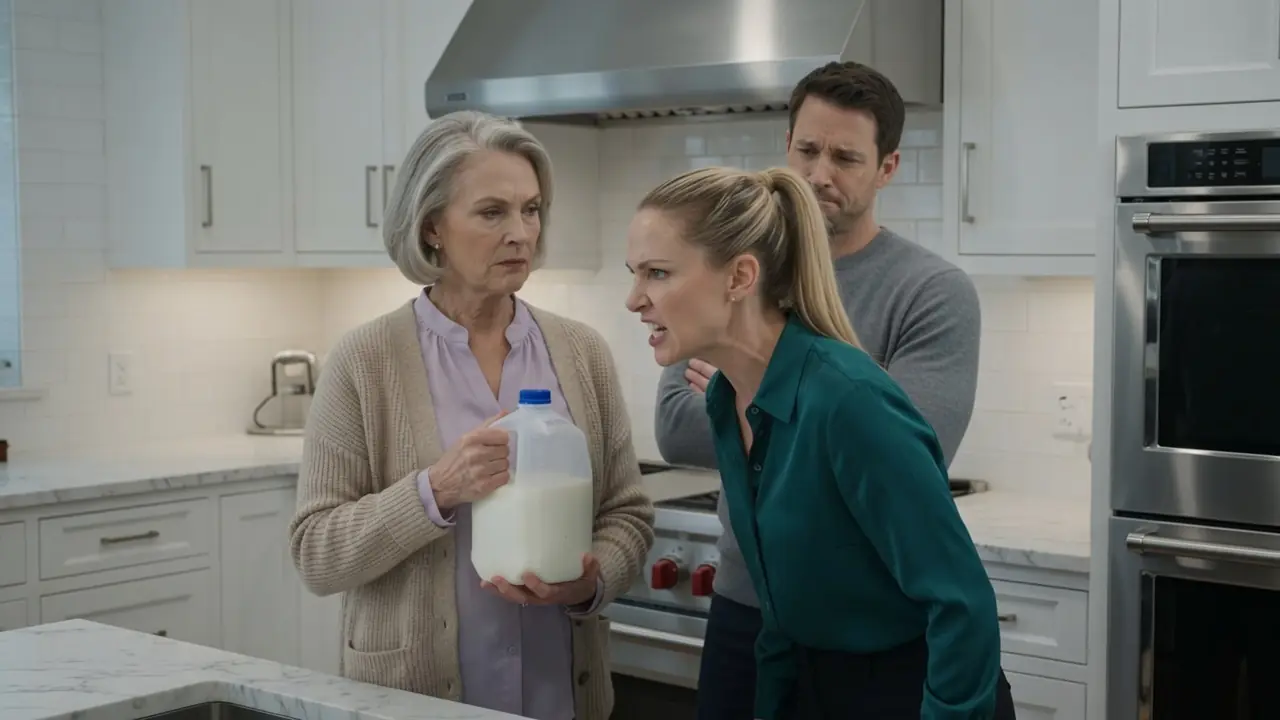
My daughter-in-law said it while standing under lights I had paid to keep on. She stood beside a refrigerator I had filled that morning, in a kitchen where I had cooked, cleaned, budgeted, and swallowed my pride for nearly two years. My son Brian stood near the coffee maker with his arms crossed, looking at the floor like the tiles had suddenly become very interesting. Jenna looked straight at me and said, “Hand over your savings, Ruth, because you live here for free.”
For a moment, I heard nothing but the low hum of the refrigerator. That hum felt almost insulting, because I had paid the electric bill two weeks earlier when the shutoff notice arrived in red print. My hands were wrapped around a gallon of milk, and the plastic handle pressed into my fingers until it hurt. I set the milk down gently because I had learned a long time ago that a woman should never waste good groceries on anger.
“My savings?” I asked. Jenna folded her arms, her wedding ring flashing under the kitchen light. “Yes, your savings. You sold your house, you don’t pay rent here, and we’re tired of pretending this arrangement is fair.” Brian shifted beside her, but he still did not look at me.
I looked at my son and waited for him to say something. He could have said, “Jenna, stop.” He could have said, “Mom has helped us more than enough.” He could have said anything that sounded like the boy I raised, the boy whose fever I cooled with wet cloths, whose lunch money I found even when Henry and I had almost nothing left until payday. Instead, Brian cleared his throat and said, “Mom, Jenna only thinks you should contribute fairly.”
There are sentences that do not sound loud when they are spoken, but they break something all the same. That one broke the last soft place in me. I had made excuses for Brian for months, then years, telling myself he was tired, stressed, caught between his wife and his mother. But a son who lets his wife call his mother a burden has already chosen a side, even if he is too cowardly to admit it.
I did not cry. That surprised me more than it surprised them. I thought I would, because I had cried when I sold my little ranch house, when I boxed Henry’s flannel shirts, and when I erased my name from the mailbox where it had sat for thirty-eight years. But in that kitchen, with Jenna waiting for me to fold and Brian hiding behind silence, my eyes stayed dry.
“You believe I live here free?” I asked. Jenna lifted her chin. “You have a room, meals, heat, water, electricity, a roof. Most people would be grateful.” I looked around the kitchen, at the new faucet I had paid the plumber to install, at the pantry full of food I bought every Thursday, at the calendar where I had written every due date because neither of them remembered. Then I reached into my purse.
Jenna’s eyes narrowed when I pulled out the envelope. It was thick, cream-colored, and worn at the corners from being opened and closed many times. I placed it on the counter between us and untied the string slowly. Brian finally looked up when I removed the first stack of receipts.
“This is the electric bill from July,” I said, laying it flat on the counter. “Four hundred and twelve dollars, paid from my account when the shutoff notice came.” I placed another beside it. “This is the water bill from September, paid after Jenna said you two would handle it next week.” I added three grocery receipts, then two car insurance confirmations, then a pharmacy receipt for Brian’s blood pressure medication.
“Mom,” Brian whispered. I held up one hand, and he stopped. It was the same hand that had signed his school forms, packed his lunches, mailed his college applications, and written checks for things he never knew we could barely afford. “No, Brian. You were both speaking. Now I will.”
Jenna’s cheeks flushed. “You kept records?” I looked at her, and for the first time, I let her see the steel Henry always said I kept hidden behind my soft voice. “A woman who survives on coupons always keeps receipts, Jenna.” Her mouth opened, but no words came out. That silence was the first honest thing she had given me all day.
I opened the second pocket of my purse and took out the spare-room key. It was attached to a little plastic tag Jenna had labeled “guest room,” even though I had lived in that room for almost two years. I placed it on top of the receipts. The sound was small, just metal touching paper, but Brian flinched as if I had slammed the door already.
Then I reached into my cardigan pocket and pulled out the brass key. It was new, warm from my hand, and tied with a little blue ribbon because the real estate agent had handed it to me that way. Jenna stared at it first. Brian stared next.
“This,” I said, holding it up, “is the key to the little home I bought three weeks ago.” Brian’s face went pale. Jenna’s eyes widened. I watched understanding arrive too late, like rain after the house has already burned.
“You bought a house?” Brian asked. His voice sounded young then, almost frightened, and that almost hurt me more. I nodded. “A small one. Two bedrooms, a porch, a kitchen window that faces east, and a pantry door where nobody’s child has measured his height yet.” My throat tightened, but I did not let my voice break. “Paid in full, with the savings your wife wanted me to hand over.”
Jenna gripped the edge of the counter. “Ruth, don’t be dramatic. Nobody said you had to leave today.” I looked at her carefully. “You did.” Her lips pressed together. I repeated her words softly so she could hear how ugly they sounded. “Hand over your savings or start packing.”
Brian stepped forward. “Mom, we can talk about this.” I almost laughed, but there was no humor left in me. “We had two years to talk, Brian.” He stopped, wounded by the sound of his name in my mouth. I had said it with love all his life, and now it came out like a door closing.
I picked up my purse and slipped the brass key back into my pocket. “You let her call me a burden in a house I kept alive, so today I’m leaving with my savings, my receipts, and the home I already bought.” Brian’s eyes filled with tears. Jenna looked between us, suddenly uncertain whether her power had ever been real. I turned to my son and said the truth he had earned. “You didn’t lose your mother because I walked out. You lost me every time you stayed silent.”
I had already packed most of my things. Neither of them knew because neither of them had been inside “the spare” long enough to notice what disappeared first. My recipe tin was gone, Henry’s photograph was gone, my winter coats were gone, and the little cedar box where I kept letters from my husband had been moved the week before. All that remained were two suitcases, one laundry basket, and the quilt Jenna said made the living room look dated.
Brian followed me down the hall. “Mom, please, slow down.” I opened the spare-room door and looked at the room I had tried so hard to make peaceful. There was a bed Jenna bought online and complained about assembling, a lamp I had paid for, and a tiny dresser where I had folded my life into three drawers. It had never been my room, not really.
I lifted one suitcase, but Brian reached for it. “Let me help.” I pulled it back gently. “No.” His face crumpled. “Mom, I didn’t know you felt this bad.” I looked at him and felt a lifetime of motherhood ache inside my chest.
“You didn’t ask,” I said. He looked away, and I saw the boy who used to hide broken things behind his back because he was afraid I would be disappointed. But this was not a cracked vase or a failed math test. This was my heart, and he had stood by while someone stepped on it.
Jenna appeared in the hallway, arms crossed again, though the posture no longer fit her. “So what, you’re just abandoning us?” I paused with my hand on the suitcase handle. “No, Jenna. I am returning responsibility to its rightful owners.” Her eyes flashed, but fear sat beneath the anger now. “You know we can’t cover everything at once.”
“I know,” I said. That was all. I did not apologize for knowing. I did not apologize for leaving.
Brian followed me to the front door while Jenna stayed in the hall, too proud to beg and too frightened to insult me again. Murphy, their old beagle, came padding from the living room and pressed his gray muzzle against my leg. That nearly broke me. I bent down, rubbed his ears, and whispered, “You be good, sweetheart.”
Brian’s voice shook. “Mom, what about Murphy? What about my medicine? What about the bills this month?” I stood slowly and looked at him. The questions told me everything. Even now, as I was leaving, he was counting what I did for him instead of what he had done to me.
“You are forty-three years old,” I said. “You have a wife, a job, a house, and a calendar.” He wiped at his eyes with the heel of his hand. “I’m your son.” I nodded. “Yes. And I am your mother, not your emergency fund.”
He flinched as if I had slapped him. Maybe I had, but some truths need to leave a mark before they are remembered. I opened the front door and stepped onto the porch. The afternoon sun was bright, ordinary, and almost rude in its calmness.
My new home was fifteen minutes away, on a quiet street with maple trees and a mailbox shaped like a little barn. It was smaller than the house Henry and I had raised Brian in, but it was mine. When I pulled into the driveway, my hands finally started to tremble. Not from fear. From the strange, overwhelming feeling of entering a life no one else could vote me out of.
The house smelled faintly of fresh paint and old wood. The living room was empty except for a secondhand armchair, two boxes of books, and a small table where I had already placed Henry’s photograph. I set my purse down, took out the brass key, and placed it in a blue ceramic bowl by the door. Then I sat in the armchair and cried harder than I had cried in years.
I cried for the butter-yellow house Henry and I sold too soon. I cried for the son I had raised to be kinder than he had become. I cried for every grocery bag I carried into a house where gratitude slowly turned into expectation. Most of all, I cried because freedom can feel like grief before it feels like peace.
The first night, I ate toast and tomato soup from a chipped bowl. There was no beagle snoring by the table, no Jenna sighing at the smell of onions, and no Brian asking where his clean work shirts were. The silence felt enormous, but it did not feel cruel. I slept under my old quilt and woke at dawn to pale light crossing the floor.
By eight o’clock, my phone had twelve missed calls. Six from Brian, four from Jenna, and two from an unknown number that I guessed belonged to a bill collector. I made coffee and did not call back. Then I walked through my little house and wrote a list of things I wanted, not things anyone needed from me.
Curtains for the kitchen. Basil for the window. A better lock for the back door. A small table for the porch. Maybe a dog, someday, if loneliness stayed too long.
Three days later, Brian came to my door. He looked tired, unshaven, and younger than his years. I saw him through the front window before he knocked, standing on my porch with his hands in his pockets and shame all over his face. For a moment, I considered staying quiet and letting him feel what waiting felt like.
But I opened the door. “Hello, Brian.” His eyes moved over my shoulder, taking in the clean little living room, Henry’s photograph, the curtains I had already hung, and the blue bowl holding the brass key. Something in his face shifted when he realized I was not visiting this home. I belonged there.
“Mom,” he said, voice rough. “Can I come in?” I stepped aside, but not far. He entered carefully, like a man walking into a church after breaking a window. I did not offer coffee right away because old habits are hard to break, and I needed to teach my hands not to serve before my heart was respected.
He stood in the living room, turning in place. “It’s nice.” I nodded. “It is.” He looked at Henry’s photograph on the table and swallowed. “Dad would have liked it.” That was unfair, whether he meant it or not, because he knew Henry’s name could soften almost anything in me.
I sat down in the armchair and pointed to the wooden chair across from me. “Sit, Brian.” He sat. For the first time in years, he looked like a son visiting his mother, not a man waiting for her to fix his life.
“I’m sorry,” he said. I waited because apologies often come out clean before the truth catches up. He rubbed his palms on his jeans and tried again. “I’m sorry I let Jenna talk to you that way.” I still did not answer. His face tightened. “I’m sorry I made your help feel like something we were owed.”
That was closer. I folded my hands in my lap. “Why did you stay silent?” He looked down at the floor. “Because it was easier.” His voice broke on the last word. “Because if I challenged her, we fought. If I let you absorb it, the house stayed quiet.”
The honesty hurt, but I preferred it to excuses. “You used my pain as insulation for your marriage,” I said. Brian closed his eyes. “Yes.” A tear slipped down his cheek. “I didn’t think of it that way, but yes.”
I looked at my son and remembered him at eight years old, running into the kitchen with a scraped knee, trusting me to make pain temporary. Now he was grown, and the scrape was in his character. I could comfort him, but I could not heal him by returning to the place that wounded me.
“Are you here because you miss me,” I asked, “or because the bills arrived?” Brian’s face reddened. “Both,” he admitted. That answer, painful as it was, kept me from closing the door completely. A liar would have said only the first.
“Jenna wants you back,” he said. I lifted one eyebrow. He winced. “Not like that. She says she wants to apologize.” I smiled faintly. “Does she want to apologize, or does she want the electric bill paid?” Brian looked away again.
There it was. The truth, small and ugly, sitting between us. I felt no surprise. That saddened me more than anger would have.
“Brian,” I said, “I love you. I will always love you.” His shoulders dropped with relief too soon, so I kept speaking. “But love is no longer permission.” He looked up. I leaned forward, letting him see every line grief and motherhood had carved into my face.
“I will not move back,” I said. “I will not pay your bills. I will not be your calendar, your cook, your buffer, your bank, or your unpaid forgiveness.” His face crumpled again, but I did not stop. “If you want a relationship with me, you may visit me here with respect. You may call me because you miss my voice, not because something is overdue.”
He nodded slowly, crying openly now. “I don’t know how to fix this.” I looked toward Henry’s photograph and imagined what he would say. Probably something simple, because Henry never wasted words when the truth would do. I turned back to Brian.
“You start by telling Jenna the truth,” I said. “You tell her I did not live there free. You tell her you failed me when you stayed quiet.” His mouth trembled. “And then?” I held his gaze. “Then you learn to be uncomfortable without making your mother pay for it.”
Brian stayed for twenty minutes. I gave him coffee after fifteen, not because he deserved it, but because I wanted some and had made too much. When he left, he hugged me at the door, and for a second I felt the little boy in him again. I hugged him back, but I did not let the hug become a promise I had not made.
Jenna did not come for two weeks. When she finally did, she stood on my porch holding flowers from a grocery store, the price sticker still on the plastic wrap. I almost laughed at that, not because it was funny, but because I had bought enough groceries in my life to know when someone grabbed the first apology-shaped thing near checkout. I opened the door and waited.
“I was wrong,” she said. It came out stiffly, like a sentence she had rehearsed but not yet believed. I looked at the flowers, then at her face. “About what?” Her lips pressed together. I had learned from my own pain not to accept vague apologies from people who had been specific with their cruelty.
Jenna swallowed. “About saying you lived there free.” I nodded once. She continued, slower now. “About asking for your savings. About treating you like you were in the way when you were helping us.” Her eyes flickered with something that might have been shame. “About making Brian choose silence.”
“No,” I said gently. “You did not make Brian choose silence. He chose it.” Her face changed. Maybe she had hoped I would blame only her, but I had no use for easy villains anymore.
I let her in, but I did not make tea. We sat in the living room with the flowers on the floor between us. Jenna looked smaller away from her kitchen, away from the house where she had practiced being queen over borrowed stability. “Everything has been falling apart,” she admitted. “The bills, the groceries, Murphy, the house. I didn’t realize how much you did.”
“I know,” I said. She winced. “That sounds terrible.” I nodded. “It was.”
For the first time, Jenna cried in front of me. I did not rush to comfort her. Some tears are grief. Some tears are guilt. Some tears are frustration that consequences have arrived. I watched carefully until I could tell which kind hers were.
“I was jealous,” she whispered. That surprised me. She looked down at her hands. “Brian trusted you with everything. He asked you where things were, what to do, what was due. I felt like a visitor in my own house.” She wiped her cheek. “So I tried to make you feel like one.”
It was an ugly truth, but it was a truth. I respected that more than another polished lie. “You should have asked me to step back,” I said. “You did not need to push me out.” Jenna nodded. “I know.”
We did not become friends that day. Life is not that clean. But we became honest, and honesty is a door even if it opens only a crack. Before she left, Jenna asked if she could bring Murphy to visit sometime because he kept sleeping outside my old room.
That nearly undid me. “Yes,” I said. “Murphy can visit.” Then I added, because I had learned my lesson, “But you must bring him and take him home.” Jenna nodded. “I will.”
Months passed. My little house became warmer one choice at a time. I hung curtains with tiny blue flowers, planted basil in the kitchen window, and bought a porch table just big enough for coffee and a library book. I adopted an old terrier named Daisy from the shelter, because apparently I had room for another creature with gray hair and opinions.
Brian visited every Sunday afternoon. At first, he came with guilt sitting beside him like a third person. Slowly, that changed. He learned to bring pie because he wanted to share it, not because he needed something sweetened before asking for help.
Jenna came sometimes too. She was careful with me now, almost too careful, but I preferred awkward respect to comfortable cruelty. She and Brian started handling their own bills, badly at first, then better. Their house did not collapse without me, but it did reveal every weak place my labor had been covering.
One Sunday, Brian stood in my kitchen drying dishes after lunch. He looked at the little blue bowl by the door where my brass key still rested. “Do you ever regret leaving?” he asked. I looked at him, then out the window at Daisy sleeping in a patch of sunlight.
“No,” I said. He nodded, but I saw the sadness in his face. I touched his arm gently. “I regret that I had to.” His eyes filled, and he whispered, “Me too.”
That was enough for that day. Healing rarely arrives like fireworks. Sometimes it comes as a grown son drying a plate in his mother’s kitchen, finally understanding that love cannot survive where respect is optional.
On the first anniversary of the day I left, I found the old envelope of receipts in my desk drawer. I had not looked at it in months. I spread the papers across the table, seeing the evidence of the woman I had been, the woman who believed giving more would eventually make people love her better. Then I placed the spare-room key beside them one last time.
I did not throw the receipts away. Not yet. They were not bitterness to me anymore. They were proof that I had not imagined my own exhaustion.
I kept one grocery receipt, the electric bill, and the little plastic tag that said “guest room.” The rest I sealed in a new envelope and wrote three words across the front: Never Again, Ruth. Then I put it in the bottom drawer beneath my stationery, where reminders belong when they no longer need to sit on the counter.
That evening, I sat on my porch with Daisy at my feet and the brass key resting in my palm. The maple trees moved softly in the breeze, and the porch light glowed above me because I had paid the bill myself, on time, from my own account. No one inside was waiting to call me a burden. No one was measuring my worth by what I cooked, covered, or carried.
I thought of Henry then, and I smiled. He would have liked this porch. He would have said the railing needed sanding and then spent Saturday fixing it before I asked. He would have been proud of me, not because I left angry, but because I finally understood what he spent forty years trying to show me.
A home is not the place where you are most useful. It is the place where your presence is welcome even when your hands are empty.
I still loved my son. I even found a small, cautious peace with Jenna. But I loved myself differently after that day, with fewer apologies and better locks.
My name is Ruth Bennett. I am sixty-eight years old, widowed, careful with coupons, and no longer confused about the difference between being needed and being loved.
And the brass key in my hand opens a door where I am never again called free.