Dorothy Mitchell had been home from hip surgery for only seven days when the phone rang in her quiet Toledo bungalow. She was sixty-eight, still dizzy from pain medication, and leaning heavily on a walker the hospital had sent home with tennis balls on the legs. Her doctor had ordered rest, short walks, and no sudden stress, which sounded almost funny to Dorothy because family never checked discharge papers before demanding something from you. When Ashley’s name flashed across the screen, Dorothy already knew peace was about to leave the room.
Ashley did not say hello. Her voice came bright and sharp through the phone, the way it always did when she had already made a decision and expected everyone else to obey it. “You’re home doing nothing anyway,” she said. “I’m bringing the kids over for the week. Kevin and I need a break.” Before Dorothy could answer, the call ended.
Dorothy sat there with the phone in her lap, staring at her reflection in the dark screen. Her gray hair had not been combed properly since the hospital, her cheekbones looked sharper than usual, and purple-yellow bruises from medical tape still marked her arm. She wanted to call her son Kevin and ask if he knew about this, but something stopped her. For too many years, Kevin had been letting Ashley speak first, decide first, and explain later.
At exactly 2:30 that afternoon, the doorbell rang. Dorothy slowly pushed herself upright, gripping the walker as pain pulled at her hip like a tight wire. Through the lace curtain, she saw Ashley on the porch in cream-colored clothes and oversized sunglasses, holding two black trash bags stuffed with children’s belongings. Behind her stood Emma, twelve, Jake, nine, and little Lily, six, all three of them looking less like children ready for a visit and more like passengers abandoned at the wrong station.
Ashley pushed through the door before Dorothy fully opened it. “Here they are,” she said, dropping the bags onto the sofa so hard one split open. Clothes spilled out, along with a stuffed rabbit, a plastic hairbrush, and a school folder bent nearly in half. Dorothy looked from the bags to the children, then back at Ashley’s perfectly polished face.
“Ashley, I just had surgery,” Dorothy said quietly. “I can barely make tea for myself right now.” Ashley removed her sunglasses and rolled her eyes. “Please, Dorothy. You’re not helpless. You’re home all day.” Emma looked down at the floor, Jake moved a little closer to Lily, and Lily gripped the rabbit with one hand and her brother’s shirt with the other.
Dorothy tightened her hands around the walker. “I am not saying I don’t love them,” she said. “I am saying this is not safe, and you should have asked.” Ashley’s expression hardened in an instant. She stepped forward, grabbed one side of the walker, and shoved it aside as if it were furniture in her way.
Dorothy gasped as her balance shifted. She stumbled backward and landed heavily on the edge of the sofa, not badly hurt, but shocked enough that her breath caught in her throat. The room went silent. Even Ashley seemed to realize, for half a second, that she had crossed a line no apology could smooth over.
Then Ashley lifted her chin. “See?” she said coldly. “You’re sitting now. Perfect.” Dorothy stared at her daughter-in-law, one hand pressed to the couch cushion, the other trembling slightly against her knee. The pain in her hip was sharp, but the insult cut deeper.
Emma whispered, “Grandma?” Dorothy looked at the children and saw three frightened faces waiting to see what kind of adult she would become in that moment. She did not shout. She did not cry. She slowly reached for her walker, pulled it back in front of her, and stood with more dignity than her body wanted to allow.
“Ashley,” Dorothy said, her voice low and steady, “you pushed a woman who just had surgery.” Ashley laughed once, but it sounded forced. “Don’t be dramatic.” She grabbed her purse from her shoulder, pointed vaguely toward the bags, and said, “Emma knows the routine. Kevin and I will be back Sunday.”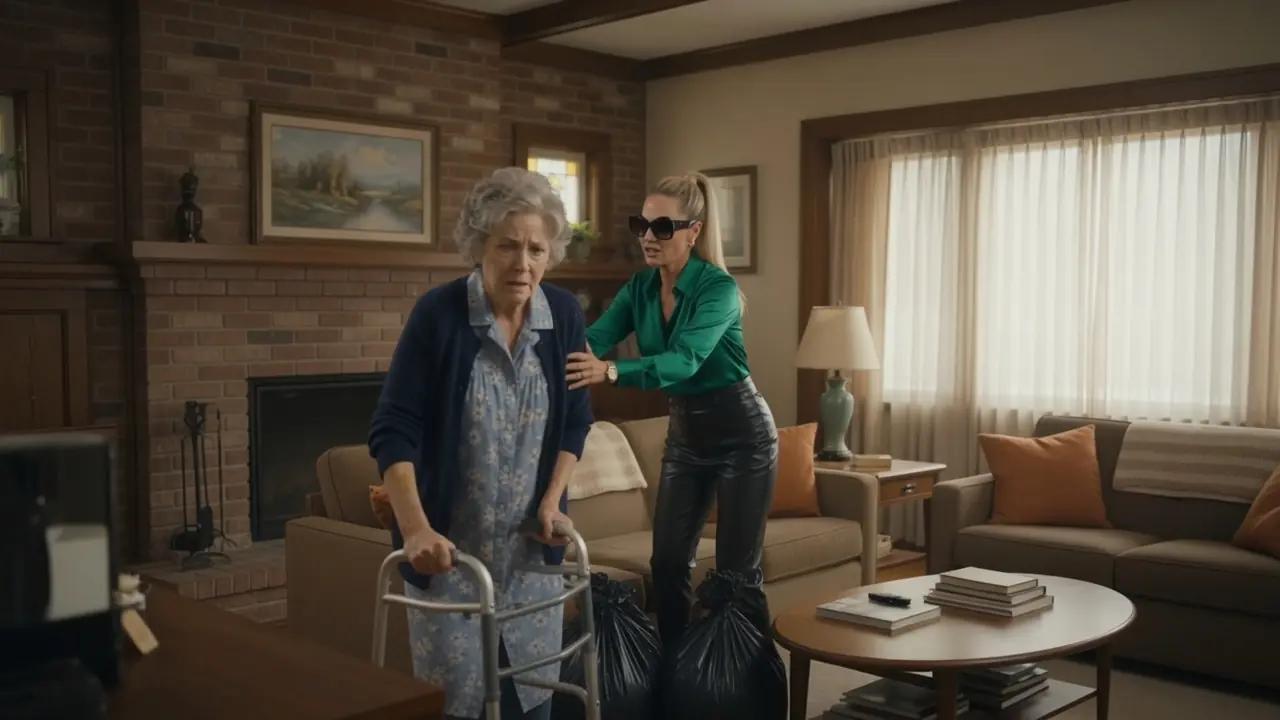
The front door closed behind her with a careless bang. For a few seconds, no one moved. Dorothy looked at the children, then at the trash bags on her couch, then at the walker Ashley had shoved aside. Something cold and clear settled inside her.
“Well,” Dorothy said softly, “I suppose we are roommates for the week.” Lily’s face crumpled first. Jake tried to put an arm around her, but his own eyes were shiny. Emma stood rigid, as if she had been trained not to need comfort until everyone younger had received it.
Dorothy lowered herself carefully onto the sofa and opened her arms. Lily came first, climbing gently beside her, not onto her hip. Jake followed, sitting at the edge of the cushion like he was unsure whether he was allowed. Emma remained near the doorway until Dorothy reached out one hand and said, “You too, sweetheart.”
That was when Dorothy began to see what she had not been allowed to see clearly before. Emma’s uniform was wrinkled and too tight at the waist. Jake had a faint yellow mark on his forearm in the shape of a hard grip. Lily’s hair was tangled, and the skin around her thumb looked raw from constant sucking.
Dorothy had been a pediatric nurse for forty-three years before retirement. She knew the difference between messy children and neglected children. She knew the look of a child who had learned to stay quiet, finish quickly, and not ask twice. Her house, which had felt empty for three years since her husband Frank died, suddenly filled with more truth than she was ready to hold.
First came food. Dorothy moved slowly, but she directed Emma like a gentle assistant instead of a substitute parent. Tomato soup went into a pot, grilled cheese sandwiches browned in a pan, and apple slices were placed on a plate because color mattered when children had been living on whatever was easiest. The children ate with the wary hunger of those who expected food to disappear.
After supper, Dorothy made them all wash their hands and faces. She found clean towels, soft pajamas from an old guest drawer, and three blankets that still smelled faintly of lavender. Lily fell asleep before the first bedtime story ended. Jake stayed awake watching the hallway, while Emma quietly gathered dishes without being asked.
“No, honey,” Dorothy said. “You are a child in this house.” Emma froze with a plate in her hand. “I always help.” Dorothy reached for the plate carefully. “Helping is one thing. Carrying everyone is another.”
That night, after the children were asleep, Dorothy took out a yellow legal pad and began writing. Date, time, Ashley’s phone call, exact words, the forced drop-off, the push, the condition of the children, what they ate, what they said, what they did not say. Her nurse training returned with precision. Pain made her hand shake, but anger made her memory sharp.
The next morning, Dorothy called Sharon Peterson, an old friend who had spent thirty years in child welfare before retiring. “I need your eyes,” Dorothy said. “Not gossip, not emotion. Professional eyes.” Sharon’s voice changed immediately. “How soon?” Dorothy looked toward the kitchen where Emma was already trying to pour cereal for Lily. “Today.”
Then Dorothy called Edith Henderson next door. Edith was eighty, wore flowered housecoats, and owned a pair of binoculars she pretended were for birdwatching. “Edith,” Dorothy said, “I need you to write down who comes and goes near my house this week.” Edith did not ask unnecessary questions. She only said, “I’ll make coffee and start a notebook.”
By noon, Sharon arrived with a cardigan, a calm voice, and eyes that missed nothing. She greeted the children warmly, asked permission before sitting near them, and did not rush a single answer. Emma spoke first in careful fragments. Jake added details only after Emma nodded. Lily mostly drew circles on paper and watched every adult movement in the room.
Dorothy sat in the recliner pretending to rest while listening from across the room. She heard phrases that made her chest tighten. “Mom gets mad if we wake her.” “Emma makes breakfast.” “Jake helps Lily change sheets.” “Dad works late.” “If we stay quiet, it’s easier.”
Sharon documented everything gently. She took photos only with Dorothy’s permission and explained to the children that pictures were not punishment. They were proof. A photo of Jake’s arm, one of Lily’s tangled hair, one of the split garbage bag, one of Dorothy’s walker sitting crooked where Ashley had pushed it. Dorothy added each item to a folder that night with trembling hands.
Kevin called on Wednesday. His voice sounded tired, distracted, and relieved. “Mom, Ashley said the kids are doing great with you.” Dorothy looked through the kitchen doorway at Emma teaching Lily how to fold napkins while Jake quietly set the table. “They are safe,” Dorothy said. “That is not the same as great.”
Kevin went quiet. “What does that mean?” Dorothy closed her eyes for a moment. She still loved her son, and that made her angrier, not less. “It means you need to come here and look at your children with your own eyes.”
“I’m in meetings all week,” Kevin said. “Ashley really needed this break.” Dorothy’s hand tightened around the phone. “Kevin, your mother was pushed onto a couch seven days after hip surgery, and your first concern is Ashley’s break?” Silence came through the line like a confession. Then he whispered, “She pushed you?”
Dorothy did not raise her voice. “Yes.” Kevin breathed hard once. “I didn’t know.” Dorothy looked at the family photo on the mantel, Kevin at eight years old smiling beside Frank. “That has become the problem, hasn’t it? You don’t know too many things happening inside your own family.”
Thursday brought more evidence. The school counselor called Dorothy back after receiving permission to speak. Emma had been late twenty-two times that semester. Jake’s lunch account was negative. Lily had cried at school twice after sudden loud sounds, then insisted she was fine.
Dorothy wrote it all down. Red folder for health. Blue folder for school. Green folder for photos. Yellow folder for statements. She had once organized medical charts during night shifts with three crying babies and two doctors shouting orders, so one spoiled daughter-in-law did not frighten her.
The house began changing around the children. Emma slept past six for the first time and woke up panicked because she had not made breakfast. Dorothy gently told her breakfast was already handled. Jake asked three times if it was okay to take seconds. Lily followed Dorothy’s walker like a tiny shadow, one hand hovering near it as if she could protect the grandmother who had protected her.
On Friday, Dorothy called Barbara, Ashley’s mother. They had never been close. Barbara was elegant, proud, and skilled at making excuses for her daughter. But Dorothy had reached the point where pride no longer mattered.
“Barbara,” Dorothy said, “your grandchildren are not okay.” Barbara sighed. “Dorothy, Ashley says you exaggerate.” Dorothy opened the green folder and looked at the photos. “Then come see them yourself, or I send everything to my lawyer without you.”
Barbara arrived the next morning in a pressed blouse, pearl earrings, and visible doubt. That doubt lasted until Lily ran to hide behind Emma when Barbara raised her voice too quickly while greeting them. It lasted until Jake asked if he was allowed to eat the muffin on his plate. It vanished completely when Emma quietly said, “Grandma Dot lets us sleep.”
Barbara sat down at Dorothy’s dining table and covered her mouth with one hand. “Oh my God,” she whispered. Dorothy slid the folders across the table. “This is what I have.” Barbara read in silence, and with every page, her face lost more of its polished certainty.
“I sent Ashley money for school clothes,” Barbara said finally. “She told me they needed new uniforms.” Dorothy pointed toward the laundry basket where Emma’s skirt sat patched at the seam. “Then the money did not reach them.” Barbara’s eyes filled, but Dorothy did not soften the truth. “We cannot cry so long that we forget to act.”
Together they called Harold Greene, Dorothy’s lawyer. He was patient, methodical, and old enough to understand that family cases were rarely as clean as people wanted them to be. Dorothy explained the post-surgery push, the abandoned children, the evidence from Sharon, the school concerns, and Kevin’s absence through work. Harold listened and then said, “Temporary emergency guardianship may be possible if the parents fail to provide safe care.”
Dorothy felt the weight of the week settle into her bones. She had not wanted a fight. She had wanted tea, rest, physical therapy, and maybe an afternoon watching old movies in Frank’s chair. Instead, Ashley had shoved her walker aside and unknowingly pushed the whole family into the truth.
Sunday arrived with gray light and nervous children. Emma helped Lily brush her hair, Jake folded the blankets, and Dorothy made pancakes because some mornings needed sweetness before war. At 1:45, Edith called from next door. “Ashley’s car just turned onto the street,” she said. “Kevin is with her.”
Dorothy thanked her and placed the folders on the coffee table. Barbara sat in the armchair near the window. Sharon stood by the kitchen doorway, present as a witness, not an attacker. The children waited in the backyard where they could hear birds instead of shouting.
Ashley entered first, sunglasses on her head, mouth already open. “Hope they weren’t too much trouble,” she said. “Kevin, grab the bags.” Kevin stepped in behind her and froze when he saw Barbara, Sharon, and the folders. “Mom,” he said slowly, “what’s going on?”
Dorothy stood behind her walker, her shoulders straight despite the ache in her hip. “A different conversation.” Ashley laughed. “No, we’re not doing some dramatic grandma lecture. Kids, get your things.” Dorothy did not move. “The children are not leaving with you today.”
The color left Kevin’s face. Ashley’s eyes narrowed. “Excuse me?” Dorothy touched the top folder. “This contains documentation from the past week. Photos, school reports, statements, care notes, and witness observations.” Ashley stepped forward. “You had no right.”
Dorothy met her stare. “You gave me the right when you dumped three children here and shoved my walker aside after surgery.” Kevin turned sharply toward Ashley. “You pushed my mother?” Ashley waved one hand. “She stumbled. She’s making it sound worse.”
Barbara stood then. “I saw the documentation.” Ashley looked at her own mother with disbelief. “You’re taking her side?” Barbara’s voice broke, but it held. “I am taking the children’s side.”
Ashley lunged toward the folder, but Sharon stepped between them. “Copies are already with the lawyer,” Sharon said calmly. “Do not make this worse in front of witnesses.” Ashley’s face twisted with rage. Kevin looked at the photos Dorothy handed him, and something inside him seemed to collapse.
He saw Emma’s tired eyes. Jake’s bruise. Lily’s raw thumb. The school counselor’s notes. The timeline of meals, sleep, fear, and responsibilities no child should carry.
“Emma makes breakfast?” Kevin whispered. Dorothy nodded. “And lunches. And bedtime. And comfort. And excuses for both of you.” Kevin sat down as if his knees had failed. He pressed one hand over his eyes. “I thought Ashley had it handled.”
Ashley snapped, “Don’t you dare blame me alone.” Dorothy’s voice turned colder. “No one is blaming you alone. That is why Kevin is hearing the truth too.” Kevin lowered his hand, his eyes red. “Where are the kids?”
“In the backyard,” Dorothy said. “Safe.” Kevin looked toward the window where Emma stood partly behind the curtain, watching with the careful expression of a child waiting to learn whether adults would fail her again. That look did more than any folder could.
“I want them to stay here,” Kevin said hoarsely. Ashley spun toward him. “What?” He stood slowly. “Until I figure out how to fix what I ignored.” Ashley’s mouth opened, but no words came at first. Then she said the wrong thing, the thing that revealed the heart beneath every excuse. “So now I’m the villain because I needed one week away from those kids?”
Silence filled the room. Dorothy saw Kevin hear it. Really hear it. Not the polished version, not Ashley’s tired-mother story, but the resentment underneath. Barbara closed her eyes. Sharon wrote one sentence in her notebook.
Dorothy took one step closer with the walker. “Ashley, you did not need a break from parenting. You needed someone else to carry the children you stopped seeing.” Ashley’s face hardened, but for the first time, she looked afraid. “You’ll regret this,” she said.
“No,” Dorothy answered. “I regretted staying quiet.” Kevin opened the back door and called the children in gently. Lily ran to Dorothy first, not to her mother. Jake stood beside Emma. Emma looked at Kevin as if asking whether he was finally awake.
Kevin knelt, his voice shaking. “I’m sorry,” he said to them. “I should have seen it.” Emma’s chin trembled, but she did not run to him. “Are we going back?” she asked. Kevin looked at Dorothy, then at Sharon, then back at his daughter. “Not today.”
The legal process took time, but the first step happened quickly. Temporary placement was granted to Dorothy while Kevin cooperated with the investigation and began arranging a separate home. Ashley was ordered into supervised visitation and parenting evaluation. She called it betrayal, but the judge called it necessary caution.
Dorothy’s recovery did not become easier with three children in the house, but it became meaningful. Physical therapy happened in the living room while Lily counted each step like a coach. Jake learned to make scrambled eggs without fear of being yelled at. Emma slowly stopped waking before dawn to check if everyone else was fed.
Kevin came every evening after work. At first, the children were careful with him. Then Jake started showing him homework again, Lily let him brush her hair, and Emma finally said, “You have to prove it longer than one week.” Kevin nodded through tears. “I know.”
Ashley fought loudly, then bitterly, then from a distance. She told anyone who would listen that Dorothy had stolen her children. But documents have a way of outlasting performance. Sharon’s reports, school records, Barbara’s statement, and Edith’s notes created a wall of truth Ashley could not push aside like a walker.
One month later, Dorothy sat on the porch with a blanket over her lap while Emma read beside her. Jake and Lily drew chalk houses on the sidewalk, each one with flowers, windows, and people standing close together. Kevin arrived with groceries and a tired but real smile. He kissed Dorothy’s cheek carefully, the way a son asks forgiveness without demanding it.
Dorothy looked at the children laughing in the yard and thought about the moment Ashley shoved her walker aside. At the time, it had felt like humiliation, weakness, and pain. Now she understood it had also been the moment Ashley revealed exactly who she was in front of the wrong grandmother. Dorothy had been pushed down onto a couch, but she had risen with evidence.
That quiet Toledo house never returned to silence after that. It filled with school papers, soup bowls, physical therapy bands, bedtime stories, and arguments over who used the last clean towel. It became crowded, imperfect, and loud. Dorothy often thought Frank would have loved every inch of the chaos.
And when people later asked how a grandmother one week after surgery managed to protect three children, Dorothy only smiled. “She pushed my walker,” she would say. “But she forgot I spent forty-three years learning how to stand back up.”