“This is for you, Mom,” Alexander Morgen said, kneeling beside his mother’s chair with an envelope trembling in his hand. His voice cracked on the last word, as if he had carried that envelope through years of guilt before finally finding the courage to give it to her. Helga Morgen looked down at her son, at the fine suit he wore, at the tired shame in his eyes, and for one soft second, she saw the little boy who used to wait for her by the window after her night shifts. Then Bianca snatched the envelope before Helga’s fingers could even touch it.
“No,” Bianca said coldly, standing tall in her fitted white dress, pearls shining at her throat. “My parents need this more than your mother does.” She turned toward Ewald and Lydia, her parents, and placed the envelope in front of them like a trophy won from an old woman too weak to fight back. Alexander froze on one knee, his face drained of color, while Helga sat perfectly still in her yellow dress. Bianca smiled as if she had just restored order to the room.
The dining room of Bianca’s villa was bright, expensive, and heartless. Sunlight fell through tall windows onto polished floors, crystal glasses, white plates, and a long table decorated with flowers that looked too perfect to smell real. Helga sat at the center like an unwanted guest at her own trial, her thin hands folded on her lap, her gray-blond hair pinned neatly behind her ears. She had worn the yellow dress because Alexander had bought it for her twenty years earlier with money from his first summer job.
Bianca had noticed the dress the moment Helga arrived. “How brave,” she had said, kissing the air near Helga’s cheek without touching her. “Yellow is such a difficult color after a certain age.” Helga had smiled politely, because she had survived far worse than a rich woman’s insult wrapped in perfume. But Alexander had heard it too, and he had looked away. That had hurt more than Bianca’s words.
Helga had not always been invited into rooms like this. For forty years, she had cleaned them, scrubbed them, emptied their trash, and polished their silver while people slept upstairs or argued in offices behind closed doors. She had worked in banks, hotels, law firms, and private homes, moving silently through other people’s wealth while her own knees burned and her fingers cracked from chemicals. She did it because Alexander needed school clothes, math tutors, university fees, and a future that did not smell like bleach. Every time her back hurt, she told herself her son would one day stand straight because she had bent for him.
He had become an engineer, then a consultant, then a director at a company that gave him a corner office and a salary Helga never dared to imagine. For a while, he called her every Sunday, brought flowers on her birthday, and still asked for her potato soup when life felt heavy. Then he married Bianca. After that, the calls became shorter, the visits became rarer, and Helga began hearing her own life described as a burden.
Bianca came from a family that treated money like a bloodline. Her father, Ewald, bragged about investments he did not fully understand, and her mother, Lydia, wore gold chains and spoke in the soft voice of someone used to having servants hear insults without reacting. They never said Helga was beneath them directly. They only asked questions about her pension, her small apartment, her “comfort level,” and whether a woman her age should still live alone. Bianca learned cruelty at a table where cruelty wore good manners.
That Mother’s Day lunch had been Bianca’s idea, though Helga knew Bianca did not do anything without calculation. Alexander called three days earlier, sounding nervous and tired, and asked his mother to please come. His voice carried a plea beneath the invitation, the kind only a mother could hear. Helga had looked at the small black recording device on her desk, the one Marcus Bell had given her, and decided the time had finally come.
Marcus Bell had been Helga’s secret for nearly fifteen years. He was not an old office friend, as Bianca believed, and he was certainly not a charity worker helping an elderly woman manage paperwork. He was Helga’s financial advisor, legal representative, and the closest thing she had to a second son. Years earlier, after cleaning offices for wealthy men careless enough to throw financial memos in ordinary trash bins, Helga had learned to study money. She learned debt, liens, property auctions, silent partnerships, and the strange truth that people who looked rich were often only borrowing confidence.
She had started small, buying shares in local cleaning companies and renting storage units to contractors who paid on time. Then she bought one distressed apartment, sold it, and bought two more. She never spent loudly, never moved from her modest home, and never told Alexander because she wanted his love free from calculation. By the time Bianca entered their lives, Helga owned pieces of three commercial buildings, two laundromats, and a quiet but powerful stake in a private lending group. She did not look wealthy because she had learned that invisibility was sometimes the safest vault.
Bianca and her parents had a different relationship with money. They wore it before they earned it, borrowed against it before they secured it, and spoke of it like a servant who would always return when called. Ewald and Lydia’s villa was not fully theirs. It belonged to a chain of loans, refinancing agreements, and overdue obligations that Helga’s investment group had quietly purchased six months earlier. Marcus had warned her that the debt was unstable, but Helga had smiled and said, “Then let us hold the rope before they realize they are falling.”
The lunch began with soup no one praised and a roast Bianca claimed to have cooked, though Helga recognized the catering label still stuck to the bottom of a serving tray. Ewald talked about his “international position,” Lydia described a retirement resort where “women of Helga’s background” could be comfortable, and Bianca corrected Alexander every time he tried to speak warmly to his mother. Helga listened, nodded, and let the little black device inside her handbag record every word. She was not collecting gossip. She was collecting proof.
Then Alexander stood, pale but determined, and asked everyone to wait before dessert. He walked to Helga’s chair and knelt beside her like a man asking forgiveness without knowing how. “This is for you, Mom,” he said, holding out the envelope. “Twenty-five thousand dollars, for Mother’s Day, and for every year you gave me everything when you had nothing.” Helga’s throat tightened, not because of the amount, but because for one moment her son remembered the truth.
Bianca’s hand shot out before Helga could take it. The room went still as she ripped the envelope from Alexander’s fingers. “No,” she said, smiling with cold certainty. “My parents need this more than your mother does.” She walked to Ewald and Lydia and placed the envelope before them, then turned back as if she expected applause. “Your mother is old, Alexander. At her age, money only sits in an account until someone else has to sort it after the funeral.”
Alexander rose slowly, his mouth opening in shock. “Bianca, stop,” he whispered. “That was meant for my mother.” But his whisper was not enough, and everyone knew it. Bianca looked at him the way a trainer looks at a disobedient dog. “Don’t embarrass me in front of my parents,” she said.
Helga stared at the envelope on the table. She saw the years inside it, not the dollars. She saw Alexander’s school shoes, his lunch boxes, his university deposit, his feverish face when she sat beside him after double shifts, and every dream she had scrubbed floors to give him. Then she began to laugh.
It was not loud at first. It was soft, almost tender, but it grew enough to make Bianca’s face sharpen with confusion. Ewald frowned, Lydia pulled her shoulders back, and Alexander stared at his mother as if laughter was the last sound he expected from her. Helga wiped one tear from the corner of her eye, though it was not a tear of defeat. “Oh, Bianca,” she said gently, “that envelope was never the real gift.”
Bianca’s fingers tightened on the back of a chair. “What are you laughing at?”
Helga opened her handbag and removed the black recording device. She placed it on the table between the crystal glasses and folded her hands beside it. “At you,” she said calmly. “Because while you were stealing twenty-five thousand dollars from an old cleaning woman, I was buying the loan on your parents’ villa.” The silence that followed was so complete that even the air seemed to stop moving.
Ewald stood first. “That is absurd.”
“No,” Helga said. “Absurd is pretending to own a house that has been refinanced four times in six years.” She turned to Lydia, whose gold chains suddenly looked heavy against her pale throat. “Absurd is discussing retirement suites for me while your own bank statements are bleeding.” Then she looked back at Bianca. “And absurd is stealing from a mother in front of her son while the lender who controls this house is sitting at your dining table.”
Alexander gripped the back of Helga’s chair. “Mom, what are you saying?”
Helga looked up at him, and her face softened for the first time. “I am saying I was never helpless, Alexander. I was only quiet.” She reached into her bag again and removed a folder Marcus had prepared that morning. Inside were copies of the loan assignment, default notices, and documentation connecting Ewald and Lydia’s villa to the private lending group now under Helga’s control. She slid the folder toward the center of the table.
Ewald grabbed it with shaking hands and flipped through the pages. His face changed with every line. Confidence drained from him first, then anger, then fear. Lydia leaned over his shoulder, and her lips parted when she recognized the address, the lender, and the amount past due. Bianca stared at the papers as if they had been written in a language she had never expected poor people to understand.
“This cannot be legal,” Bianca said.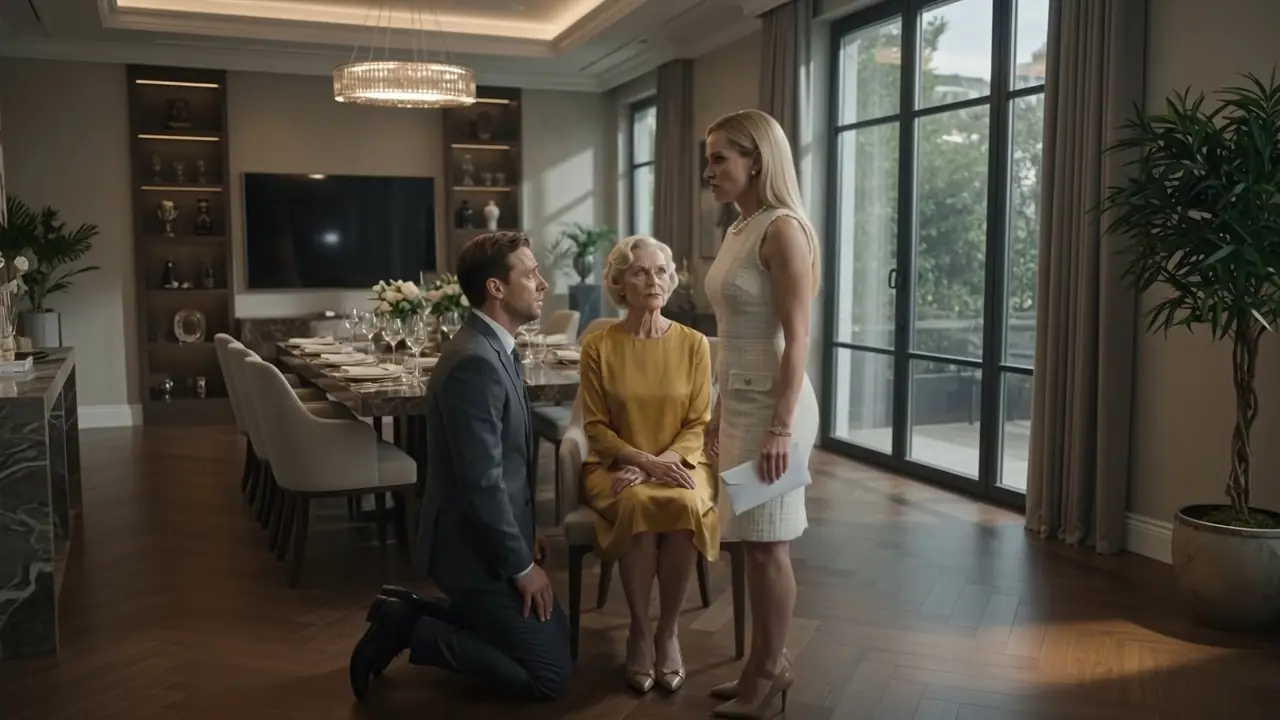
“It is very legal,” Helga replied. “Your parents borrowed against a lifestyle they could not maintain. The lender sold the debt. My group bought it. I signed final control papers yesterday morning.” She tapped the recording device lightly. “And today, you were kind enough to provide evidence of financial coercion and elder abuse in your own home.”
Bianca went red. “Elder abuse? Don’t be dramatic.”
Helga’s eyes hardened. “You took money from my son’s hand before I could receive it. You said it would be wasted on me because I am old. You gave it to your parents while they sat there accepting it.” She turned to Ewald and Lydia. “No one at this table misunderstood what happened.”
Lydia tried to recover her dignity. “Helga, surely we can speak as family.”
Helga smiled without warmth. “Family does not discuss where to store old women when they become inconvenient.”
Alexander looked at Bianca, then at her parents, then at his mother. His face had gone gray with shame. “Mom,” he said, voice breaking, “how long have you known?”
“About the debt?” Helga asked. “Six months.” She looked at Bianca. “About the way she speaks of me when she thinks I am too old or too poor to matter? Much longer.”
Bianca laughed harshly, trying one last time to make Helga seem ridiculous. “So this was a trap.”
“No,” Helga said. “It was a mirror.”
The words landed harder than shouting.
Alexander stepped toward his wife. “Did you know your parents were in trouble?”
Bianca’s jaw tightened. “Every family has private matters.”
“You took my gift to my mother.”
“You were being sentimental.”
“I was being grateful,” Alexander snapped, his voice finally rising. “For once, I was trying to do something right.”
Bianca looked startled, as if she had never heard him speak to her that way. Helga watched him carefully, not with triumph, but with the weary hope of a mother who had waited years for her son to remember his own voice. Alexander turned to Ewald and Lydia. “Did you ask her to take it?”
Ewald adjusted his cuff, but his hand trembled. “We understood there might be resources available.”
Helga almost laughed again. “Resources. That is what people call other people’s sacrifice when they want to spend it without guilt.”
Lydia pressed a hand to her chest. “We never meant harm.”
“No,” Helga said. “You meant entitlement. Harm was only the result.”
Bianca snatched the envelope from the table and pushed it toward Alexander. “Fine. Take it. Give it to her. Make everyone happy.”
Alexander did not touch it. Instead, he picked it up and placed it gently in Helga’s lap, exactly where it should have gone the first time. “I’m sorry, Mom,” he said. “Not just for today. For all of it.”
Helga looked at him for a long moment. She wanted to forgive him instantly, because mothers are trained by love to reach for their children before protecting themselves. But age had taught her that forgiveness given too quickly can become permission. So she placed one hand over the envelope and said, “I believe you are sorry. Now I need to see who you become after sorry.”
Alexander nodded, tears forming in his eyes.
Bianca’s face twisted. “This is humiliating.”
Helga turned to her. “No, Bianca. Humiliation is what you planned for me. This is consequence.”
Ewald sat down heavily, still holding the papers. “What do you want?”
There it was. Not apology. Not regret. A negotiation.
Helga leaned back in her chair. “First, the missing payments on the villa debt will be settled according to the legal schedule Marcus Bell will send tomorrow. No more extensions based on social standing or empty promises.” She looked at Lydia. “Second, you will return every euro, dollar, or favor taken from Alexander under false urgency for the last twelve months. Marcus has records, and he is very patient.”
Lydia looked offended. “You cannot demand—”
“I can demand repayment on documented transfers tied to a debt negotiation,” Helga said. “And if you prefer court, I have spent enough years cleaning lawyers’ offices to know which ones enjoy winning.”
Ewald went silent.
Helga turned to Bianca. “Third, you will stop using my son as a bank, shield, or ladder. What happens in your marriage is between you and him, but what happens with my name, my money, and my dignity now belongs to me.” Her voice stayed calm, but the room bent around it. “If you ever again call me a burden, a charity case, or an old cleaner with nothing, you had better remember who holds the paper on this roof.”
Bianca’s eyes filled with rage, but fear held her tongue.
Alexander knelt beside Helga again, not with an envelope this time, but with both hands empty. “Come home with me tonight,” he said. “Please. Let me drive you. Let me talk to you without all this.”
Helga touched his cheek. “You may drive me, but I will not carry you. Not anymore.”
His tears fell then. “I know.”
After that, the lunch ended without dessert. Bianca’s parents disappeared into a side room with the folder, speaking in frantic whispers. Bianca stood by the window, rigid and furious, her perfect dress unable to hide the collapse of the world she thought she controlled. Alexander helped Helga with her coat, and for the first time in years, he did not look embarrassed to be seen caring for his mother. Outside, the afternoon air smelled of rain.
In the car, Alexander cried the way he had not cried since he was a boy. He apologized for the missed calls, the cold holidays, the times he let Bianca make jokes about Helga’s work, and the terrible silence that had allowed other people to shrink the woman who raised him. Helga listened without interrupting. When he finished, she looked out the window and said, “I scrubbed floors so you could stand tall, Alexander. Do not make my life’s work a waste.”
He pulled the car to the side of the road because he could not drive through his tears. “I won’t,” he said. “I promise.”
Promises were easy, but this one began to grow roots. Over the next weeks, Alexander moved into a guest room at a colleague’s house while he and Bianca separated. He began therapy, not because Helga demanded it, but because he finally understood that silence was not peace. He visited his mother every Sunday again, but this time he cooked, cleaned, listened, and asked questions about her life instead of assuming he already knew it. Slowly, painfully, the son she had loved began returning from beneath the man who had been managed into cowardice.
Bianca fought hard at first. She accused Helga of manipulation, threatened lawsuits, and told anyone who would listen that an old woman had destroyed her family out of jealousy. But Marcus Bell was, as Helga had said, very patient. He sent documents, recordings, account histories, and formal notices with the gentle precision of a man who enjoyed letting facts speak. Bianca’s story weakened every time evidence entered the room.
Ewald and Lydia sold jewelry, canceled memberships, and quietly abandoned the fantasy that prestige could pay debt. The villa was not taken immediately, because Helga was not cruel for sport. She offered them a repayment plan with strict terms and no room for performance. When Lydia asked why Helga was not simply destroying them, Helga replied, “Because I know what it means to lose a home. I would rather teach you respect than become you.”
The $25,000 remained untouched for months. Helga kept it in a separate account labeled Alexander’s Gift. Not because she needed the money, but because she needed to decide what kind of meaning it should carry. On her seventy-third birthday, she used part of it to start a small scholarship for children of janitors, cleaners, and night workers. The first award went to a girl whose mother cleaned hospital rooms and whose father drove buses before dawn.
At the scholarship ceremony, Alexander stood beside Helga, proud and quiet. When Helga spoke, she did not mention Bianca, the villa, or the stolen envelope. She spoke about invisible work, about hands that clean messes they did not make, about parents who come home exhausted and still help with homework. She told the students that dignity does not come from the floor you walk on, but from the person who paid the price for you to stand there. Alexander cried openly in the front row.
Later that evening, Helga returned to her small home and hung the yellow dress carefully in her closet. It was no longer only the dress Alexander had bought with pocket money. It was the dress she had worn the day the room learned her silence had never been weakness. She made tea, sat by the window, and watched rain shine under the streetlights.
Her phone buzzed with a message from Marcus.
The Whitmore payment cleared. Also, three more scholarship applications arrived. You were right, boss. This is going to grow.
Helga smiled.
For most of her life, people had mistaken her bent back for defeat and her rough hands for poverty. They saw a cleaner, a widow, an old mother waiting politely for whatever scraps of respect others chose to give. They never understood that a woman who spends decades removing dirt learns exactly where dirt hides. They never understood that ghosts hear everything.
On Mother’s Day, Bianca stole an envelope and thought she had taken Helga’s power. Instead, she revealed what Helga needed everyone to see. The gift was never the $25,000. The gift was the truth, finally dragged into daylight.
Helga lifted her tea, looked at the quiet room, and laughed softly to herself.
Not because she had won.
Because after seventy-two years of being underestimated, she had finally allowed the world to find out who had been holding the keys all along.