The morning my son thought he became rich, I was standing barefoot in my own kitchen, watching pancake batter bubble in an old iron skillet.
The house smelled of butter, coffee, and warm maple syrup. Outside, a soft Savannah rain tapped against the windows, the kind of rain my husband, Arthur, used to call “good sleeping weather.” The kind that made the whole world feel slower, softer, kinder.
But kindness was already leaving that house.
I just did not know it yet.
My name is Lorraine Whitmore. I was sixty-three years old that spring, a widow for nearly ten years, and the legal owner of a two-story cream-colored house on Briar Lane in Savannah, Georgia. Arthur and I bought it when Mason, our only son, was five.
Back then, the yard was nothing but dry grass and stubborn weeds. Arthur planted the first rosebushes with his own hands. I painted the kitchen cabinets pale yellow while Mason sat on the floor with crayons, drawing crooked suns and stick-figure houses.
“This place is going to hold us together,” Arthur told me once, standing on the porch with paint on his shirt and sweat on his brow.
For a long time, it did.
Then Arthur passed away.
And the house became too quiet.
I still set out two coffee mugs every morning for the first year after his funeral. I knew it made no sense, but grief does not always speak the language of sense. Sometimes grief is simply a second mug, untouched, waiting across the table.
Seven years before the lottery, Mason came back to that house in the middle of a storm.
He was thirty-two then, pale from stress, rain dripping from his hair. Behind him stood his wife, Belle, five months pregnant, one hand on her belly and the other gripping a suitcase.
“Mom,” Mason said, his voice breaking. “I lost the job. We lost the apartment. I didn’t know where else to go.”
I did not ask how long they needed.
I did not ask what they could pay.
I opened the door wider and said the words I would later regret giving so freely.
“This house always has room for you.”
Belle cried that night. She hugged me, pressed her cheek to mine, and whispered, “I don’t know what we’d do without you, Lorraine.”
I believed her.
I made them hot soup. I gave them the downstairs bedroom with the east-facing window because Arthur always said morning light was good for the soul. When Ava was born, I stayed awake through the nights, rocking her so Belle could rest. When Micah came three years later, I did it all over again.
I paid the power bill when Mason could not.
I bought groceries when Belle said they were short.
I covered school fees, medicine, shoes, birthday cakes, gas cards, repairs, insurance, everything that kept a young family from falling apart.
For a while, I told myself this was what mothers did.
A mother holds the roof up.
Even when no one looks up to see her arms shaking.
At first, Belle was grateful in small, pretty ways. She called me “Mom Lorraine.” She posted pictures online of my Sunday dinners and wrote captions about family blessings. She told neighbors I was “a lifesaver.”
But gratitude has a shelf life when it is not rooted in character.
By the third year, she stopped thanking me.
By the fourth, she started correcting me.
“Lorraine, don’t give Ava sugar before school.”
“Lorraine, fold the towels like this.”
“Lorraine, please don’t tell the kids old stories at dinner. They get overstimulated.”
“Lorraine, could you move some of your things out of the living room? It makes the house look cluttered.”
It was always said lightly, with a smile, as if I were being included in decisions instead of slowly removed from my own home.
Then came the attic.
Belle said she needed a private office downstairs.
“It’s just temporary,” she said. “You’ll have more quiet upstairs anyway. You deserve peace.”
Peace, I learned, was what people called exile when they wanted to sound kind.
I moved into the attic room under the slanted roof. In summer, heat gathered there until the walls seemed to breathe. In winter, cold crept through the floorboards. I told myself I was lucky to have a roof at all.
Ava and Micah still climbed the stairs to visit me sometimes. Ava would bring drawings. Micah would bring broken toys and ask me to fix them.
But Belle did not like it.
“Don’t bother Miss Lorraine,” she would call up. “She needs her rest.”
Miss Lorraine.
Not Grandma.
When I asked her about it, Belle laughed.
“Oh, don’t be sensitive. Grandma sounds so old. Miss Lorraine is sweeter.”
That night, I cried in the bathroom with the faucet running so no one would hear.
Mason saw some of it. I know he did.
But Mason had a talent for looking away from anything that required courage.
“She’s just stressed, Mom,” he would say whenever Belle hurt me. “You know how she gets.”
Yes.
I knew exactly how she got.
She got comfortable.
That was the trouble.
She became comfortable living in my house, spending my money, eating my food, letting me raise her children, while speaking of me as if I were a burden she had inherited.
And still, I stayed.
Because love can turn an intelligent woman into a quiet fool if she keeps calling her pain “family.”
Then came Ava’s tenth birthday.
Ava had wanted a turquoise bicycle for nearly a year. She had seen it in the window of Finley’s Sporting Goods, with a white basket, silver handlebars, and streamers that shimmered when the store fan moved.
“Grandma,” she whispered the first time she saw it, pressing both hands to the glass, “if I had that bike, I would ride it everywhere.”
The bike cost two hundred dollars.
For Belle, two hundred dollars was a hair appointment, a new handbag, or one dinner with friends.
For me, it was almost everything left from my pension after utilities, groceries, and school expenses.
Still, I bought it.
I saved quietly for weeks. I stopped buying almond milk. I mended my old cardigan instead of replacing it. I walked to the grocery store when I could so I would spend less on gas.
The young clerk wrapped the handlebars with a white bow.
“She’s going to love it,” he said.
“I hope so,” I answered.
That night, I hid it in the garage beneath an old quilt and went to bed smiling for the first time in weeks.
On Ava’s birthday morning, I woke before sunrise. I made heart-shaped pancakes with strawberries and whipped cream. I hung a paper banner in the kitchen. I put a vase of white roses on the table because Ava liked anything that looked “fancy.”
She came running downstairs in her pajamas, hair loose around her face.
“Grandma! You remembered!”
“As if I could forget my favorite girl turning ten.”
She threw her arms around me.
For one beautiful minute, the whole house felt like mine again.
Then Belle walked in.
She looked at the pancakes, the roses, the banner, and frowned as if joy had made a mess on her floor.
“What is all this?”
“It’s Ava’s birthday breakfast,” I said gently.
Belle poured herself orange juice and leaned against the counter.
“Mason and I already decided this year would be simple. We’re teaching Ava about gratitude and restraint.”
Ava’s smile faded.
I kept my voice calm.
“It’s just breakfast.”
Belle’s eyes narrowed.
“And the present?”
“A small surprise.”
“Lorraine.”
She said my name like a warning.
“I hope you didn’t buy something expensive.”
I should have stopped then. I should have walked away and returned the bike before it became another battlefield.
But Ava was standing there, eyes full of hope.
So that afternoon, I took her to the garage.
When I pulled the quilt away, she gasped.
“Oh, Grandma.”
She touched the white basket first, then the shiny handlebars, then the streamers.
“Is it really mine?”
“Yes, sweetheart. Happy birthday.”
Ava screamed with joy and hugged me so tightly that my old bones ached.
Then Belle appeared in the doorway.
Her face changed slowly, from disbelief to anger.
“What,” she said, “is that?”
“A birthday gift,” I answered.
“I told you no expensive gifts.”
“It’s a bicycle, Belle. Not a diamond necklace.”
“That is not the point.”
She marched forward and grabbed the handlebar.
“The point is you do this on purpose. You undermine me. You make me look like the bad mother while you play generous grandmother.”
“That is not true.”
“Of course it is. You always have to be the saint. The one who sacrifices. The one everyone loves.”
Ava began to cry.
“Mommy, please. I’ll take care of it. I promise.”
Belle crouched in front of her, voice sweet but cold.
“Sweetheart, this bike is not staying. Grandma will return it, because Grandma needs to learn that parents make the rules.”
I looked at Mason, who had just come in from work.
“Mason?”
He looked exhausted. He looked ashamed.
But he did not look brave.
“Maybe we should just keep the peace, Mom,” he muttered.
Keep the peace.
I had kept the peace until there was nothing left of me but silence.
That evening, I walked the turquoise bicycle back to Finley’s Sporting Goods in a light rain.
The white bow drooped.
The streamers clung wetly to the handlebars.
The same young clerk looked confused.
“Was something wrong with it?”
“No,” I said. “Nothing was wrong with it.”
I signed the refund slip with a shaking hand.
When I left the store, the rain had grown heavier.
I did not want to go home yet.
So I walked to Benny’s Corner Mart, the little convenience store Arthur and I used to visit on Friday nights when he bought root beer and I bought lottery tickets with the same numbers I had played for twenty years.
Birthdays.
Arthur’s. Mine. Mason’s. Ava’s. Micah’s.
The jackpot sign blinked near the register.
$85 MILLION
I looked at it and laughed softly.
“One ticket,” I told Benny, the owner. “Same numbers.”
He printed it and slid it across the counter.
“Maybe tonight’s your night, Miss Lorraine.”
I took Arthur’s old pen from my purse and signed the back before I even left the store.
Lorraine Whitmore.
Arthur always insisted on that.
“Sign everything that belongs to you,” he used to say. “People can forget promises, but paper remembers.”
I tucked the ticket and receipt into my coat pocket.
At home, I set the ticket on the kitchen table while I hung my coat to dry.
Then I went upstairs.
I did not know Belle would find it before I came down in the morning.
I woke to screaming.
“Mason! Get down here! Mason!”
I sat up in bed, heart pounding.
Belle’s voice rose again, high and wild.
“We won! Oh my God, Mason, we won!”
I stepped onto the stairs.
Below me, Belle stood in the kitchen, clutching my lottery ticket with both hands. Mason was beside her, staring at the numbers on his phone.
“No,” he whispered. “No way.”
“Yes way!” Belle cried. “Eighty-five million dollars!”
They jumped. They laughed. Belle kissed the ticket, then kissed Mason.
The children came running in, confused and excited.
“We’re rich,” Belle shouted. “We are finally rich.”
I stood halfway down the stairs.
Waiting.
Waiting for one of them to ask where the ticket came from.
Waiting for Mason to say, “Mom, is this yours?”
Waiting for Belle to turn and see me.
She did see me.
But she did not ask.
She simply smiled.
And there was something in that smile that frightened me more than anger ever had.
By noon, three neighbors had already come over after Belle posted online.
A miracle for our family. Dreams do come true.
She posed on the porch with Mason and the kids. She called reporters. She FaceTimed friends. She spoke of “our ticket,” “our future,” and “our blessing.”
I stayed upstairs.
Not because I was afraid.
Because I wanted to see how far greed would walk before it realized the bridge was gone.
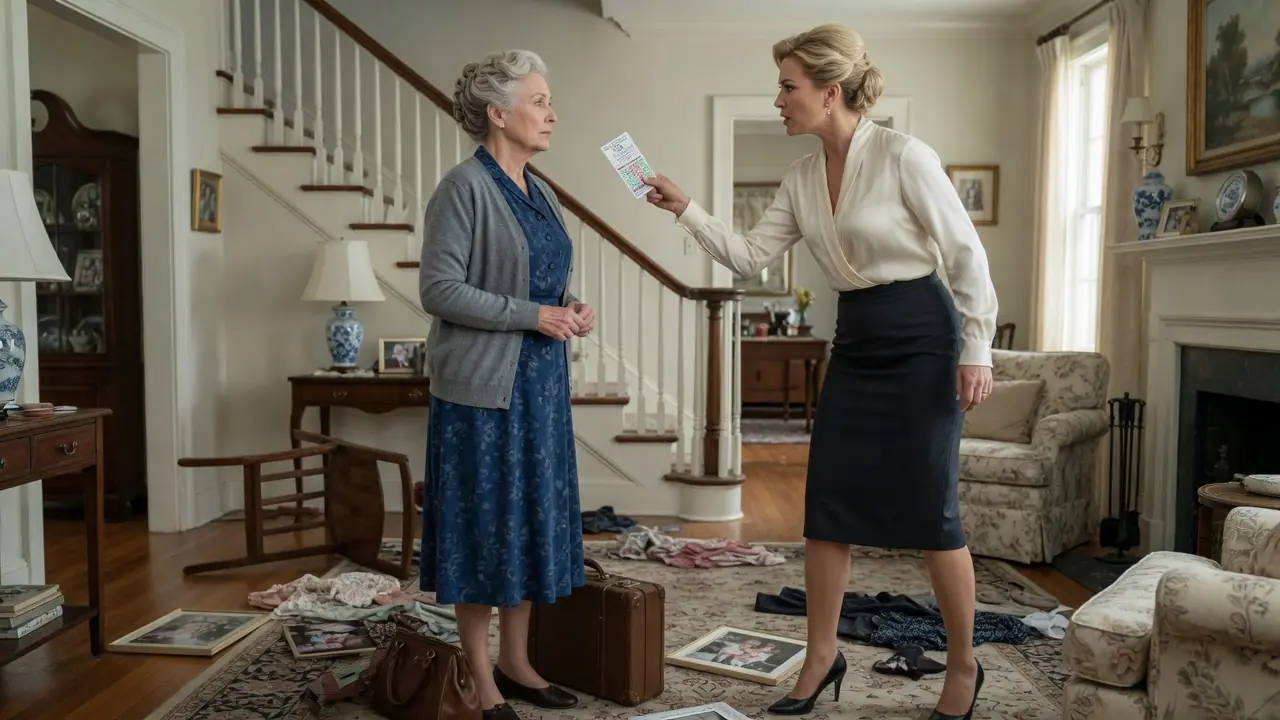
At twelve-thirty, Belle knocked on my attic door.
Hard.
Before I could answer, she opened it.
She stood there in a silk blouse, phone in hand, eyes bright with triumph.
“Start packing.”
I looked at her.
“What?”
“We’re moving. Obviously. Mansion, private school, new cars, everything. And we’re not dragging you along.”
I slowly stood.
“Belle, this is my house.”
She laughed.
“Oh, Lorraine. Not this again.”
“This house is in my name.”
“For now,” she said. “But let’s be honest. You’ve been living off us emotionally for years. It’s time for everyone to have a clean start.”
I stared at her.
“Living off you?”
She walked to my closet and began pulling out dresses.
“You’re old. You need care. Mason and I are not going to spend our new life babysitting you.”
She threw my clothes toward the open window.
“Belle, stop.”
She did not.
A dress went out first.
Then a pair of shoes.
Then the quilt Arthur’s mother made.
My wedding photo hit the window frame, cracked, and fell into the yard below.
I heard glass break.
That sound entered me like a knife.
Neighbors gathered outside.
Mason appeared in the doorway.
“Belle,” he said weakly. “Enough.”
But he did not move toward her.
She turned toward the window and shouted so loudly the whole street could hear.
“We don’t need to do charity for you anymore! Go die old in a nursing home!”
The yard went silent.
Even the rain seemed to stop.
I walked past her.
Down the stairs.
Out the front door.
My wedding photo lay in the grass, the frame shattered, Arthur’s face still visible beneath cracked glass. I bent down, picked it up, and brushed dirt from the corner.
Penelope Banks, my neighbor of thirty years, hurried across the street.
“Lorraine, honey.”
“I’m all right,” I said.
But I was not all right.
I was simply finished.
I put my clothes into an old suitcase. I saved Arthur’s ring, my notebook, and the broken wedding photo.
Then I walked to the gate.
Belle stood on the porch, arms crossed, chin lifted.
Mason stood behind her, pale and silent.
I looked at him one last time.
“You have nothing to say?”
His mouth trembled.
“Mom, Belle got carried away.”
“No,” I said. “Belle revealed herself. And you let her.”
Then I turned to Belle.
“Did you read the name on the back of the ticket?”
Her smile froze.
Only for a second.
But I saw it.
“What are you talking about?” she snapped.
I did not answer.
A yellow cab pulled up. Penelope must have called it.
I put my suitcase in the trunk and told the driver, “Somewhere cheap and quiet.”
As the cab pulled away, I looked back.
Mason stood on the steps like a man watching a train leave with the last good part of him inside it.
Belle was already on the phone.
But her shoulders had gone stiff.
She knew.
Even if she did not yet understand.
I rented a room above a Chinese restaurant on Whitaker Street. It smelled of frying oil and old wood. The bed dipped in the middle. The curtains were thin. The bathroom sink leaked if you turned the handle too far.
But no one insulted me there.
No one told me which cabinet was mine.
No one called me dead weight.
That first night, I sat at the little table beneath the window and opened my purse.
The receipt was there.
Benny’s Corner Mart.
Friday, April 12.
7:43 p.m.
One lottery ticket.
The ticket itself was not with me, of course. Belle had it. But I had signed it before she ever touched it.
And I had the receipt.
I also had something Belle did not consider.
Benny’s security cameras.
I took out my notebook and wrote:
Day one after being thrown out.
They think they won because they held the ticket.
They forgot ownership is not the same as possession.
The next morning, my phone rang.
“This is Grant Holloway, counsel for the Georgia State Lottery. Am I speaking with Lorraine Whitmore?”
“Yes.”
“Mrs. Whitmore, we are contacting you regarding a winning lottery ticket bearing your signature.”
I closed my eyes.
There it was.
Truth, knocking politely.
“I bought that ticket,” I said.
“We believed so. The signature on the back reads Lorraine Whitmore. The purchase record appears to match your usual numbers from prior transactions at Benny’s Corner Mart. However, a Belle Whitmore has contacted our office claiming the ticket was a family gift.”
“A gift?”
“She also suggested you may not be mentally competent to manage financial matters.”
I laughed softly.
Grant paused.
“Mrs. Whitmore?”
“I’m sorry,” I said. “It’s just that people call older women confused when they are afraid we remember too much.”
He was quiet for a moment.
“Do you have the purchase receipt?”
“Yes.”
“Identification?”
“Yes.”
“Can you come to our office tomorrow?”
“Yes.”
“Until then, please do not speak publicly. Do not sign anything from your son or daughter-in-law. And Mrs. Whitmore?”
“Yes?”
“You are the lawful claimant unless evidence proves otherwise.”
I looked around that small, shabby room and smiled.
“They have no evidence,” I said. “Only appetite.”
That afternoon, Belle called.
I let it ring six times before answering.
“Lorraine,” she said, syrup-sweet. “We need to clear up a misunderstanding.”
“What misunderstanding?”
“The ticket. Obviously, you left it on the table for the family. Mason and I are willing to take care of you, but we need you to sign a simple statement confirming you gifted it.”
“No.”
The silence on her end sharpened.
“No?”
“No.”
Her voice changed.
“You are being selfish.”
“I am being accurate.”
“You don’t need eighty-five million dollars.”
“And you do?”
“We have children.”
“Yes,” I said. “Children you used as props while you threw their grandmother into the yard.”
She inhaled sharply.
“You’re making this uglier than it has to be.”
“No, Belle. You did that when you threw Arthur’s photograph out a window.”
“You old—”
She stopped herself.
I almost admired the restraint.
Almost.
“Did you read the name on the back?” I asked again.
No answer.
So I hung up.
For the next three days, Belle performed.
She went online in cream dresses and gold jewelry she had no business buying yet. She called herself blessed. She told reporters I had “stepped away for privacy.” She said I was “fragile” and “easily overwhelmed.”
Mason sent me one text.
Mom, please. Let’s talk. Belle is panicking.
I replied:
Good. Panic means the truth has entered the room.
Penelope watched the house for me. She called every evening with reports.
“They bought a luxury SUV,” she said one night.
“They ordered new furniture.”
“They had a real estate agent over.”
“Belle told Mrs. Cooper you promised them the money.”
Each report made me sadder.
Not angrier.
Sadness is deeper than anger. Anger burns hot and fades. Sadness sits down beside you and stays.
On the fourth day, Mason called.
This time, I answered.
“Mom,” he said.
He sounded hollow.
“Yes.”
“Did you buy the ticket?”
I looked at Arthur’s broken photograph on the table.
“Yes.”
A long silence.
Then his breath broke.
“Oh God.”
“Yes,” I said. “Oh God is right.”
“I didn’t know.”
“You didn’t ask.”
“I thought Belle—”
“You let Belle think for you. That has been your life for seven years.”
His voice shook.
“She’s spent money already. Deposits. A car. A house reservation. She told people the funds would clear soon.”
“That is unfortunate.”
“Mom, please.”
“Come here at two o’clock,” I said. “Alone. If you want to speak to your mother, come as my son, not Belle’s messenger.”
At exactly two, he knocked.
When he entered the rented room, his face changed. He saw the stained ceiling, the narrow bed, the cracked window, the suitcase on the floor.
He saw where his silence had put me.
“I’m sorry,” he whispered.
I gestured to the chair.
“Sit.”
He sat.
I poured tea.
For a while, we did not speak.
Then I placed my notebook in front of him.
“Seven years,” I said. “Every bill. Every school fee. Every repair. Every grocery receipt I remembered to write down. I never kept it to collect from you. I kept it because Arthur taught me that facts matter when memory is inconvenient.”
Mason opened the notebook.
His eyes moved over the pages.
Electric bill.
Water bill.
Roof repair.
Insurance.
Groceries.
Ava’s tuition.
Micah’s medicine.
He started crying before he reached the third page.
“Mom.”
“No,” I said gently. “Keep reading.”
He read.
When he finished, his hands covered his face.
“I let this happen.”
“Yes.”
“I let her treat you like that.”
“Yes.”
“I don’t know how to fix it.”
“At last,” I said, “an honest sentence.”
He looked up.
“Can you forgive me?”
I sat back.
“Mason, forgiveness is not a door you knock on when consequences arrive. Forgiveness is work. You want it, you build toward it.”
“I’ll do anything.”
“Then start with the truth.”
He nodded.
“Belle threw your things out. Belle called you dead weight. Belle lied about the ticket. And I stood there like a coward.”
His voice cracked on the last word.
I did not comfort him.
There are moments when comfort becomes interference. Sometimes a man must sit with the full weight of his own reflection.
“Tomorrow,” I said, “I claim the prize legally. After that, I will create education trusts for Ava and Micah. No adult will touch that money. Not you. Not Belle. Not me.”
He nodded quickly.
“And you?” he asked.
“I will buy a small house by the water. I will plant roses. I will sleep without hearing your wife’s footsteps above my head.”
He winced.
“As for you,” I continued, “if you want help from me, there are conditions.”
“Name them.”
“You move out of my house and find a place you can afford.”
“Yes.”
“You apologize publicly to the neighbors who watched you let your wife humiliate me.”
His eyes closed.
“Yes.”
“You attend counseling and learn how to be a father without teaching your children that silence is manhood.”
A tear slipped down his cheek.
“Yes.”
“And you stop letting Belle use fear as a leash.”
He opened his eyes.
“I don’t know if my marriage can survive this.”
“Mason,” I said softly, “the question is whether your children can survive it.”
That struck him harder than anything else.
He was still sitting there when Belle arrived.
She knocked once, then entered without permission.
She was dressed perfectly, as always, but panic had begun to crack the polish. Her lipstick was too sharp. Her smile too tight.
“Oh,” she said, glancing around the room. “How cozy.”
“It is,” I said. “No one lies here.”
Mason stood.
“Belle, I told you not to come.”
She laughed.
“And let your mother poison you alone?”
I folded my hands.
“Belle, I’ll be brief. The ticket is mine. The lottery knows it. The lawyer knows it. The store camera knows it. The signature knows it.”
Her eyes flashed.
“You left it on the table.”
“I left my handbag on the table many times too. Did that make it yours?”
Mason looked down.
Belle pointed at me.
“You planned this.”
“No. I signed my name. Those are different things.”
“You’re going to destroy your son over money?”
“No,” I said. “I am going to save my grandchildren from people who think money excuses cruelty.”
Her face hardened.
“I’ll sue.”
“Do.”
“I’ll claim mental incapacity.”
“Try.”
“I’ll tell everyone you abandoned us.”
I smiled.
“Belle, you threw my belongings into the yard in front of three porch cameras.”
For the first time, real fear crossed her face.
Penelope’s porch camera had captured everything.
Belle looked at Mason.
“Say something.”
Mason took a breath.
“You need to leave.”
The words seemed to shock him as much as they shocked her.
“What?”
He looked at me, then back at Belle.
“You need to leave. I’m not doing this anymore.”
Belle’s mouth opened.
Nothing came out.
For seven years, she had mistaken his quietness for permanent surrender.
But even weak men can wake up when the cost becomes their children.
“You’ll regret this,” she whispered.
“No,” Mason said. “I already regret everything else.”
She left without slamming the door.
That frightened me more.
The next day, Grant Holloway met me at the Georgia Lottery office.
I wore a navy dress Arthur always liked. I pinned my silver hair back. I carried the receipt, my identification, and a steadiness that felt older than fear.
The verification took less than an hour.
Signature match.
Purchase receipt.
Store footage.
Identity confirmation.
The official slid a document across the table.
“Congratulations, Mrs. Whitmore. You are the legal winner of the eighty-five-million-dollar jackpot.”
I looked at the paper.
Lorraine Whitmore.
There it was again.
My name.
Still mine.
“I’d like to set up a trust,” I said.
Grant smiled.
“I thought you might.”
We created the Arthur and Lorraine Whitmore Trust. A portion for my own life. A protected education fund for Ava and Micah. A charitable wing for older adults facing financial abuse or family abandonment.
“Most winners ask about mansions first,” Grant said.
“I already had a house,” I replied. “I want a life.”
Belle filed suit a week later.
She accused me of manipulating Mason. She claimed I had promised the ticket to the family. She submitted a statement questioning my mental capacity.
Unfortunately for Belle, she also attached a medical note that my doctor never wrote.
That mistake changed everything.
Grant filed a formal response.
Penelope submitted her footage.
Benny’s Corner Mart submitted the purchase video.
My bank records showed seven years of payments supporting Mason’s household.
Belle’s own social media posts contradicted her timeline.
By the time we entered Judge Meredith Shaw’s courtroom, Belle’s perfect face looked drawn and brittle.
The hearing lasted two days.
Penelope testified first.
“I watched Lorraine pay for that family and get treated like an unwanted guest in her own home,” she said.
Benny testified next.
“Mrs. Whitmore bought the ticket. Same numbers she always played. Signed it right there at the counter.”
Then the video played.
Belle’s voice filled the courtroom.
We don’t need to do charity for you anymore.
Go die old in a nursing home.
The room went still.
Mason cried silently.
Belle stared at the table.
Judge Shaw’s expression did not change, but her voice became colder when she spoke.
“Mrs. Whitmore, did you give this ticket to your son or daughter-in-law?”
“No, Your Honor.”
“Did you authorize them to claim it?”
“No.”
“Did you leave your home voluntarily?”
I looked at Belle.
Then Mason.
Then the judge.
“I left with dignity after being shown I was no longer safe there.”
Belle began to cry when her lawyer spoke of stress, misunderstanding, family pressure.
Judge Shaw did not soften.
“Stress does not create ownership. Misunderstanding does not erase a signature. Family pressure does not excuse elder abuse.”
The ruling was clear.
The ticket belonged to me.
Belle’s claim was dismissed.
Her forged medical document was referred for further review.
And because of her behavior toward me and the instability she had created at home, the family court granted Mason primary residential custody of Ava and Micah while Belle was ordered into counseling before unsupervised visitation could resume.
Afterward, we stood on the courthouse steps in bright afternoon light.
Reporters waited below, but Grant guided them away. I had requested privacy.
Mason stood beside me.
“I’m sorry,” he said again.
“I know.”
“Is it too late?”
I looked at him.
“For what?”
“To be your son.”
That question nearly broke me.
I touched his cheek, the way I had when he was small.
“No,” I said. “But you will have to learn how.”
He nodded.
“I will.”
That summer, I moved to a small house near Seabrook Bay.
It had cream walls, a wide porch, and enough land for roses. Not a mansion. Not a palace. Just a home that greeted me gently when I opened the door.
I planted red climbing roses along a trellis because Arthur loved roses with scent, not just beauty.
“Anything can be pretty,” he used to say. “But the things worth keeping leave something sweet behind.”
Ava and Micah came every Saturday.
The first time Ava saw the turquoise bicycle waiting on my porch, she covered her mouth with both hands.
“Grandma?”
“Yes, sweetheart.”
“For me?”
“For you.”
Her eyes filled.
“Mom said I didn’t deserve it.”
I knelt carefully in front of her.
“Listen to me. Never let anyone teach you that love must be earned by shrinking.”
She hugged me hard.
Then she rode that bicycle around my yard until sunset, streamers flying, laughter ringing across the bay.
Micah helped me water the roses. Mason learned to cook Arthur’s chowder. He burned the onions the first time and added too much pepper the second, but by the third attempt, the whole kitchen smelled like memory.
“You’re getting there,” I told him.
He smiled.
“I’m trying.”
Trying.
That word mattered now because his actions finally followed it.
He went to counseling. He found full-time work. He rented a modest house ten minutes from mine. He learned to pack lunches, braid Ava’s hair poorly but lovingly, and listen when Micah talked about dinosaurs for forty minutes straight.
Belle came by once in September.
She stood at my gate in the rain, holding an umbrella that had turned inside out.
The woman who had once thrown my belongings into the yard looked tired, frightened, and much older than her years.
“What do you need?” I asked from the porch.
She swallowed.
“Help.”
I did not invite her inside.
But I did invite her onto the porch.
Boundaries are not cruelty. They are doors with locks that you choose when to open.
She sat in the wooden chair Penelope had painted blue.
“I lost the house deposit,” she said. “The car dealer is suing. My lawyer dropped me. Mason won’t take my calls unless it’s about the kids.”
I poured her mint tea.
“I’m sorry you’re suffering.”
She looked up quickly, hopeful.
“But I won’t give you money.”
Her face fell.
“I figured.”
“I will give you contacts. Counselors. Legal aid. Employment resources. If you want to rebuild, start with truth.”
She stared into the tea.
“I was awful to you.”
“Yes.”
“I was jealous.”
“I know.”
“I thought if I made you small, I’d feel bigger.”
I said nothing.
She began to cry.
“I’m sorry, Lorraine.”
I watched the rain drip from the porch roof.
“I hear you,” I said. “And I hope one day your apology becomes behavior.”
She nodded.
“Can I see the kids?”
“When the court says you can. When Mason agrees. When you are safe for them emotionally.”
“That may take time.”
“Most things worth repairing do.”
She left with a paper full of addresses and no cash.
That night, Ava asked if her mother would ever be good again.
I took a long breath.
“People can change,” I said. “But change is not something they announce. It is something they practice.”
Micah looked up from his soup.
“Like riding a bike?”
I smiled.
“Yes. You wobble first. Then you keep trying.”
Ava nodded solemnly.
“Grandma wobbled, but she didn’t fall.”
I laughed softly.
“Oh, sweetheart. I fell many times.”
“But you got up.”
“Yes,” I said. “That part matters most.”
By winter, the Arthur and Lorraine Whitmore Trust had helped its first three women find safe housing after being financially exploited by relatives. Penelope joined me as a volunteer coordinator. Mason helped with paperwork. Ava made welcome cards. Micah drew pictures of houses with giant suns over them.
One evening, after everyone had gone home, I sat alone on the porch with a cup of tea.
The roses were sleeping for the season. The bay was dark and silver. The house behind me was quiet, not empty.
Quiet.
There is a difference.
I opened my notebook and wrote:
I used to believe love meant giving until nothing was left.
Now I know love without respect becomes a debt someone else keeps spending.
Money gave me comfort, but truth gave me freedom.
Justice gave me back my name.
And peace gave me back myself.
I closed the notebook.
Above the mantel inside, Arthur’s photo smiled in the lamplight.
I touched my wedding ring and whispered, “I signed my name, just like you told me.”
The wind moved through the porch roses.
For one impossible second, I almost heard his laugh.
The next Saturday, Mason came early with the children.
Ava rode her turquoise bike up the driveway.
Micah carried a basket of biscuits Mason had made himself.
“They’re not burned,” Mason said proudly.
“That is progress,” I said.
We ate chowder in the kitchen while rain tapped the windows. Ava told me about school. Micah spilled milk and cleaned it without being asked. Mason washed the dishes.
Small things.
Beautiful things.
The kind of ordinary happiness I once thought I had lost forever.
After dinner, Ava curled beside me on the porch swing.
“Grandma?”
“Yes?”
“Are you still sad about the old house?”
I looked toward the bay.
For a long time, I thought of the cream-colored house on Briar Lane. Arthur’s roses. Mason’s childhood drawings. The kitchen cabinets I painted yellow. The attic where I learned the shape of loneliness.
Then I looked at my granddaughter, safe and warm beside me.
“No,” I said. “A house is only a house. What matters is whether love is allowed to live there.”
“Does love live here?”
I kissed the top of her head.
“Yes, sweetheart. But so does respect. And that is why love can stay.”
She seemed satisfied with that.
Inside, Mason laughed as Micah tried to teach him the correct way to stack biscuits.
Rain softened the world.
The bay breathed in the dark.
And I, Lorraine Whitmore, once thrown out of my own home by people who thought I had nothing left, sat beneath my porch light with my family near, my name restored, and my heart finally quiet.
I had not won because of eighty-five million dollars.
I had won because I stopped begging to be valued by people who benefited from my silence.
I had won because I signed my name.
I had won because I walked away with dignity before the truth walked back with power.
And if there is one thing I know now, it is this:
Never mistake a gentle woman for a weak one.
Sometimes she is only quiet because she is gathering evidence.
Sometimes she is only patient because she still hopes you will choose love before consequences arrive.
And sometimes, when she finally asks one calm question, the whole lie begins to fall apart.
Did you read the name on the back?