“Mom should move out before the baby comes. I need peace and quiet. She’s too much.”
Nora Whitfield heard her daughter-in-law’s voice drifting in from the living room while she stood at the kitchen counter spreading butter on a slice of toast.
The knife froze halfway across the bread.
For a moment, Nora did not move. She only stood there in the kitchen she had cooked in for nearly forty years, listening to the quiet betrayal unfolding one room away.
Her son, Caleb, did not argue.
He only murmured something gentle, the way a man speaks when he is trying to soothe his wife instead of stand up for his mother.
Nora placed the knife down carefully.
It made the smallest sound against the plate.
A soft click.
Small sounds can sometimes hurt more than loud ones.
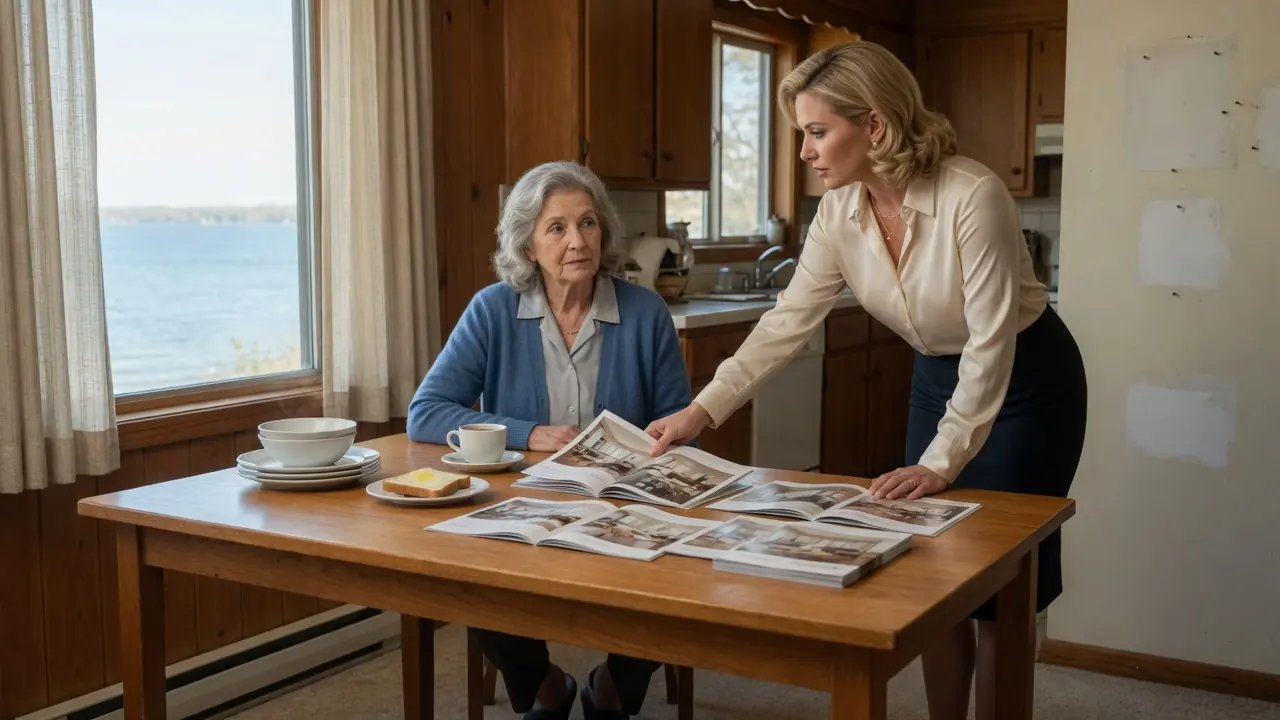
Moments later, Caleb appeared in the doorway holding a neat stack of brochures. He looked uncomfortable, but not ashamed enough to stop himself. On top of the stack, written in Aubrey’s smooth handwriting, were the words:
For Nora.
Nora looked at the brochures.
Maple Ridge Senior Living.
Peaceful apartments by the lake.
A fresh chapter begins here.
Caleb cleared his throat.
“Mom,” he said softly, “Aubrey and I were thinking maybe this could be good for you. Somewhere quiet. No stairs. No yard work. People your age really like places like this.”
People your age.
Nora looked around the kitchen that used to be hers in every visible way.
The curtains were new, pale beige instead of the deep blue ones she and her late husband, Edris, had chosen during their last autumn together. The old ceramic dishes had vanished from the open shelves, replaced by glossy white plates Aubrey called cleaner. The framed family photographs that once lined the breakfast nook were gone.
Her wedding picture was gone.
Edris’s portrait was gone.
Even the little framed drawing Caleb had made in second grade, a crooked picture of their house with smoke coming from the chimney, had disappeared.
Nora smiled.
It was not a warm smile.
It was the smile of a woman who had worked too long in emergency rooms to panic when something ugly finally showed its face.
“I’ll think about it, sweetie,” she said.
Caleb looked relieved.
Aubrey, standing just behind him with one hand resting on her round belly, smiled like she had won something.
That night, after the house went quiet, Nora went into Edris’s old office and opened the safe.
Inside were the documents she had never bothered to show anyone because she had never imagined she would need to defend her right to exist in her own home.
The deed.
The title insurance.
The property tax records.
The homeowner’s insurance.
The updated will.
Nora laid them across the desk one by one.
On every page, the truth sat in clean black letters.
Owner: Nora Elaine Whitfield.
No co-owner.
No transfer.
No lien.
No shared interest.
The house on Lakewood Drive, the two-story wood home overlooking the Michigan water, belonged to her alone.
Nora touched the deed with two fingers.
Edris had built the porch railing himself. She had painted the kitchen cabinets while Caleb napped in a laundry basket beside her. Together, she and her husband had replaced floors, repaired the roof, planted the oaks, and carried every piece of furniture through the front door with their own hands.
And now, after Edris had been gone eight years, Aubrey thought she could remove Nora from the house the way she had removed the blue dishes.
Quietly.
Gradually.
With a smile.
Nora closed the safe.
Then she opened a leather journal and wrote on the first clean page:
March 12. Aubrey says I should move out before the baby. Caleb agrees. Begin documenting.
She underlined the final word.
Documenting.
A nurse learns early that panic wastes time. Blood, fear, pain, confusion, families screaming in waiting rooms, doctors shouting orders, patients begging for answers. None of it changes what must be done.
You observe.
You record.
You act.
Nora did all three.
The next morning, she brewed coffee and added a pinch of cinnamon, the way Edris used to do. Aubrey came into the kitchen wearing a pale robe and carrying a green smoothie.
Nora sipped her coffee.
“Yes.”
“And?”
“I’m considering them.”
Aubrey’s eyes shone with satisfaction.
“That’s wonderful. I really think you’ll love Maple Ridge. It’s peaceful. You deserve a place where you don’t have to worry about us.”
Us.
The word was doing a lot of work.
Nora smiled.
“That’s thoughtful of you.”
Aubrey did not hear the edge beneath the word thoughtful. She only heard surrender, because that was what she wanted to hear.
Later that day, Nora started her incident log.
March 13. Aubrey asks about senior apartments again. Mentions baby needing quiet.
March 15. Blue ceramic dishes missing from kitchen shelves. Aubrey says they were stored to make space.
March 16. Wedding photo no longer on hallway wall. Aubrey says she moved it to prevent dust.
March 18. Caleb says Aubrey’s doctor recommends a quiet environment. Avoids eye contact.
March 20. Aubrey tells friend on phone, “Once she has her own place, the house will finally feel like ours.”
Nora recorded conversations on her phone when she could. She installed a doorbell camera and told Aubrey she was worried about porch theft. She placed a small recorder inside a living room cabinet where Aubrey often took calls.
She moved slowly.
Carefully.
Without accusation.
The house changed around her as if it were being rewritten.
Aubrey rearranged shelves, repainted small corners, and began referring to rooms as if they had already been assigned in her imagination. The upstairs bedroom became “the nursery.” Edris’s office became “the future guest room.” The living room became “our family space.”
Nora noticed the missing word every time.
Mine.
Aubrey never said it.
Caleb drifted between them like a man afraid of choosing a side and too foolish to understand that silence was already a choice.
One morning, Nora called her sister in Chicago. The conversation lasted eleven minutes.
When she hung up, Aubrey came downstairs with a hand on her belly.
“Mom,” she said gently, “could you maybe keep phone calls to your room? I was trying to rest.”
“At ten in the morning?”
“The doctor said I need calm.”
Nora folded the dish towel in her hands.
“Of course.”
That night, she wrote:
March 22. Aubrey says phone call at 10 a.m. disturbed pregnancy rest. Uses doctor as authority. Tone gentle, controlling.
A week later, Nora was trimming lavender along the fence when Mildred Parker, the neighbor across the street, came over with a covered dish.
“Nora,” Mildred said carefully, “I hope I’m not speaking out of turn, but Aubrey told some of the ladies at church that you’ve been having a hard time adjusting to the baby.”
Nora kept her pruning shears still.
“Did she?”
Mildred looked uncomfortable.
“She said she worries you’re overwhelmed. That maybe you’d be happier somewhere with care.”
Nora nodded.
“Thank you for telling me.”
Mildred touched her arm.
“I didn’t like the way she said it.”
That went into the journal too.
March 25. Aubrey spreading narrative to neighbors: I am overwhelmed, difficult, needing care.
By the end of March, the pattern was clear.
Aubrey was not only preparing the house for Nora’s absence.
She was preparing the town for it too.
A selfish old mother-in-law.
A fragile pregnant wife.
A tired son caught in the middle.
A senior apartment framed as kindness.
It was a clean story.
Too clean.
Nora had seen enough human behavior in hospital hallways to know that the cleanest stories often hid the dirtiest motives.
On Monday morning, Nora drove to the office of Alan Mercer, the attorney who had handled probate paperwork after Edris died.
Alan was in his early sixties, careful and plainspoken, with a habit of listening longer than most people found comfortable.
He read through the property documents, checked the county database, and printed a notarized confirmation.
Then he looked at Nora over his glasses.
“You are the sole owner. No question. No complication.”
“I know.”
“Do they know?”
Nora smiled faintly.
“They are about to remember.”
Alan leaned back.
“Do you want them removed?”
“Not yet.”
“Why not?”
“Because Caleb is my son. I want him to see the truth before he loses the chance to choose it.”
Alan studied her.
“And your daughter-in-law?”
“She already chose.”
Alan nodded slowly.
“Then we prepare, but we wait.”
Nora placed a hand on the folder.
“I want everything lawful. No shortcuts. No rage.”
“That is usually the strongest way.”
“It is the only way that lets me sleep.”
Alan prepared copies of the deed, a notice template, and instructions for documenting unauthorized changes to the property. He also advised Nora to record dates, preserve digital evidence, secure valuables, and avoid confrontation until she was ready to act.
“People like this often make mistakes when they feel close to winning,” he said.
Nora thought of Aubrey’s bright smile over the Maple Ridge brochure.
“She already does.”
That afternoon, Nora returned home with the notarized deed tucked safely inside her purse.
Aubrey was in the living room measuring the wall where Edris’s portrait used to hang.
Nora paused in the doorway.
“What are you doing?”
Aubrey turned too quickly.
“Oh, just planning. I thought this wall would look lovely with a soft cream finish. Something calmer for the baby.”
Nora looked at the measuring tape.
“And my husband’s portrait?”
“I put it away.”
“Where?”
Aubrey smiled.
“Safe.”
Nora held her gaze.
“That word is often used by people who have already taken something.”
Aubrey blinked.
Then she laughed.
“Oh, Mom. You’re so dramatic sometimes.”
Nora smiled too.
“No,” she said. “Not yet.”
That night, while Caleb claimed he needed to stay late at work, Nora heard unfamiliar laughter downstairs.
A man’s voice.
Low.
Confident.
She came down halfway and stopped where the shadows hid her.
Aubrey was in the living room wearing a silk robe. Across from her sat a man in a navy suit with a bright silver watch. He held a glass of wine like he owned the room.
Aubrey leaned toward him.
“I’m scared she’ll find out.”
The man chuckled.
“She won’t. Just keep playing the exhausted wife. Caleb already believes you. Once she moves out, the house is one step closer.”
Aubrey touched her belly.
“And the baby?”
The man’s voice softened.
“I’ll take care of you and our baby.”
Our baby.
Nora’s hand tightened on the banister.
The words did not explode inside her.
They froze.
Aubrey’s pregnancy, the sacred excuse for everything, might not even be Caleb’s child.
Nora went back upstairs without making a sound.
Five minutes later, she opened the doorbell camera app.
At 11:47 p.m., the man in the navy suit had entered the house.
At 12:36 a.m., he left.
The camera captured his face clearly.
His car too.
A black Lexus.
Nora saved the video.
The next morning, while Aubrey hummed in the kitchen and Caleb looked exhausted over his coffee, Nora searched the man’s name from an event card she had seen fall from Aubrey’s coat pocket days earlier.
Graham Pierce.
Pierce Financial Group.
Forty-two.
Regional investment consultant.
Married once.
Divorced.
Known for charm, sharp suits, and money that seemed cleaner from a distance.
Nora created a new folder on her laptop.
CRESCENT.
She saved the doorbell footage there.
Then the audio.
Then a screenshot of Graham’s company profile.
Then her notes.
April 4. Graham Pierce entered house while Caleb absent. Aubrey refers to baby as “our baby.” Graham says to keep playing exhausted wife.
For three more nights, Nora watched and waited.
She caught the Lexus twice.
She recorded another conversation.
She photographed Aubrey accepting a shopping bag from Graham on the porch.
Then the final piece arrived from Paula Delaney, the neighbor on the right.
Paula came over with apples and a troubled face.
“Nora,” she said, “I saw Aubrey at the Crescent Inn yesterday.”
Nora kept her expression steady.
“With Caleb?”
Paula shook her head.
“With a man in a dark suit. They were holding hands. I called her name, but she acted like she didn’t hear me.”
Nora accepted the apples.
“Thank you, Paula.”
That night, she wrote:
April 8. Paula Delaney saw Aubrey and Graham Pierce at Crescent Inn. Hand-holding. Aubrey ignored witness.
Nora did not hate Aubrey.
Hate required a kind of intimacy Nora no longer wished to give.
What she felt was colder and cleaner.
Recognition.
Aubrey was not a confused young wife under pressure. She was a woman building a lie out of pregnancy, pity, Caleb’s weakness, and Nora’s home.
And Graham was helping her.
The confrontation began by accident, though Nora believed later that truth has a way of choosing its own hour.
It was a Saturday morning, and Nora came home early from the flower shop carrying pink tulips. The driveway was full of cars. Music spilled through the windows. Balloons bobbed in the living room.
A sign hung above the mantel.
BABY SPRINKLE.
Celebrating Mommy-to-Be Aubrey.
Nora stood in the doorway with tulips in her hand.
No one had told her about the party.
No one had asked permission to use her home.
The family photographs had been removed again. Edris’s portrait was gone from the wall. In its place were ultrasound frames, pastel ribbons, and a wooden sign that read:
Welcome, Little Pierce Whitfield.
Nora stared at the name.
Pierce.
Not Caleb’s middle name.
Not a Whitfield family name.
Graham’s name.
Aubrey came out of the kitchen in a white lace dress with a pink sash across her chest.
MOM TO BE.
“Mom!” she said brightly. “You’re home early. We wanted to surprise you.”
“You did.”
Aubrey’s smile flickered.
Nora lifted her phone.
“Let me take pictures. It’s quite a day.”
She moved through the room slowly, capturing everything. The missing photos. The decorations. The guest list. The ultrasound frame. The name. Aubrey’s friends smiling beside the cake.
Then she saw Graham in the kitchen.
He was giving Aubrey a white envelope.
Aubrey tucked it quickly beneath the sash.
Nora stepped closer, pretending to look for plates.
Graham’s voice was low.
“After the baby is born, I’ll handle the rest.”
Aubrey whispered, “What if she finds out?”
“She won’t,” Graham said. “Old women see what they want to see.”
Nora pressed record.
Then she entered the kitchen with a pleasant smile.
“Sorry,” she said. “I thought I might help with plates.”
Graham turned sharply.
Aubrey’s face lost color.
“Mom,” Aubrey said, “this is Graham. He works with Caleb.”
Nora looked at him.
“Of course,” she said. “I’ve heard enough.”
Graham’s eyes narrowed.
Only for a second.
But Nora saw it.
By evening, the guests were gone. Balloons sagged. Cake crumbs clung to the tile. The house smelled of perfume and sugar and something rotten underneath.
Nora sat in Edris’s office and backed up every photo and audio file to two external drives.
Then she emailed Alan Mercer.
We have enough. Prepare step one.
His reply came quickly.
Stage ready.
The next morning, Nora sat at the dining table with a yellow envelope in front of her.
Caleb came in with Aubrey and two of Aubrey’s friends, Cara and Melissa, who had arrived to plan a larger baby shower.
Aubrey stopped when she saw Nora already seated.
“Oh,” she said. “You’re up early.”
“I am.”
“We’re just going over a few baby shower things.”
“That’s perfect,” Nora said. “I have something to go over too.”
The smile on Aubrey’s face stiffened.
Nora opened the envelope and removed the notarized deed.
She placed it in the center of the table.
“This,” she said calmly, “is the ownership record for 112 Lakewood Drive.”
Caleb frowned.
“Mom?”
Nora turned the document toward him.
“This house is in my name alone. No co-owner. No lien. No transfer. No shared right of ownership. Every porch board, every window, every patch of soil under the garden belongs legally to me.”
Cara shifted awkwardly.
Melissa looked down.
Aubrey laughed.
It came out too brittle.
“Mom, why are you acting like this? Nobody said the house wasn’t yours.”
“No,” Nora said. “You only behaved as if it wasn’t.”
Aubrey’s face flushed.
“That’s unfair.”
“So is planning a nursery in my bedroom.”
Caleb looked at Aubrey.
“What?”
Aubrey turned toward him quickly.
“Babe, she’s twisting things.”
Nora slid a printed screenshot across the table.
Aubrey’s group chat.
End of this month. I’m clearing the mother-in-law’s room for the nursery.
Caleb read it.
His jaw tightened.
Aubrey snatched the paper.
“You went through my messages?”
“No,” Nora said. “Someone sent it to me. Apparently, not everyone enjoys watching an old woman be pushed out of her home.”
Cara stood abruptly.
“We should go.”
Melissa was already reaching for her purse.
Within a minute, the front door closed behind them.
Caleb remained seated, staring at the deed.
Aubrey stood behind him with one hand on his shoulder.
“Don’t listen to her,” she said. “She’s trying to turn you against me.”
Caleb did not answer.
Nora gathered the documents and locked them in the buffet drawer in full view.
“Now,” she said, “there will be no more misunderstandings.”
Caleb stood slowly.
“I need air.”
He walked out.
Aubrey watched him leave, then turned to Nora.
Her sweetness was gone.
“You think you won?”
Nora looked at her.
“No. I think I finally started speaking your language.”
That afternoon, Alan Mercer sent the formal notice.
Thirty days to vacate.
Reasons listed clearly: unauthorized occupancy beyond permission, unauthorized alteration of property, emotional distress, and documented attempts to pressure the sole owner into leaving.
Nora printed the notice and placed it on the kitchen table.
When Aubrey opened it, her face went white.
“I’m pregnant,” she said. “You cannot throw a pregnant woman out.”
Nora folded her hands.
“Pregnancy is not a license to take what does not belong to you.”
Aubrey whispered, “People will think you’re cruel.”
“People may think what they like.”
Nora leaned forward.
“I have evidence.”
The word did what anger could not.
It silenced her.
That evening, Caleb came home with a face full of questions he was afraid to ask.
“Mom,” he said, “please wait until after the baby is born.”
Nora dried her hands on a towel.
“Do you believe the baby is yours?”
The room went still.
Caleb looked as if someone had struck him.
“What?”
Nora’s voice stayed soft.
“Do you know that child is yours? Or do you need it to be true so badly that you’ve stopped asking questions?”
Caleb opened his mouth.
No words came.
His silence was the first honest answer he had given in months.
Two nights later, Nora received a text from an unknown number.
You should see this.
Three photographs followed.
Aubrey and Graham outside the Crescent Inn, holding hands.
Graham’s hand resting on Aubrey’s belly.
Graham at the front desk handing over a key card while Aubrey stood beside him smiling.
The message beneath the photos read:
He’s paying for both her and the baby.
Nora checked the metadata.
April 18.
11:46 p.m.
Crescent Inn.
She cross-checked her journal. Caleb had been sleeping at the office that night. Aubrey had left the house at 10:40 p.m. and returned after one.
Everything matched.
Nora saved the photos, backed them up, printed them, and placed them in a file.
Then she called Alan.
“We have photographs.”
“Witness?”
“Unknown sender, but metadata is intact. Paula also saw them earlier.”
“Then choose your moment carefully,” Alan said. “Truth is strongest when no one can walk away from it.”
The moment arrived sooner than expected.
Aubrey arranged a dinner to “restore family peace.”
She invited two of Caleb’s coworkers, claiming she wanted everyone to feel normal again. Nora understood the strategy immediately. Aubrey wanted witnesses to see her as graceful and pregnant, Caleb as protective, Nora as difficult.
So Nora accepted.
Friday night, the dining room glowed with candlelight. Aubrey wore a soft blue dress and moved around the table like a hostess in a magazine. Caleb sat stiffly, barely touching his food.
The guests chatted politely.
After dessert, Nora placed her spoon down.
“Before coffee,” she said, “I’d like to share something.”
Aubrey’s smile froze.
Nora set her phone in the center of the table and tapped the screen.
Photo one.
Aubrey and Graham holding hands at the Crescent Inn.
Photo two.
Graham touching her belly.
Photo three.
Graham at the front desk with the key card.
No one spoke.
The candle flames trembled.
Caleb stared at the screen.
“Aubrey,” he said, his voice barely steady. “What is this?”
Aubrey blinked rapidly.
“It’s nothing. Graham is a friend. He was comforting me.”
Nora tapped again.
The audio began.
Graham’s voice filled the room.
“After the baby is born, I’ll handle the rest.”
Aubrey’s voice followed.
“What if she finds out?”
“She won’t. Just keep playing the exhausted wife.”
One of Caleb’s coworkers stood.
“I think we should leave.”
The others followed quickly.
The front door closed.
The house held its breath.
Caleb turned to Aubrey.
“Is the baby mine?”
Aubrey’s eyes filled with tears.
But there was no answer in them.
Only calculation.
“Caleb,” she whispered, “don’t do this.”
“Is the baby mine?”
She looked toward Nora.
“You did this.”
Nora shook her head.
“No. I only turned on the light.”
Aubrey’s face twisted.
“You never wanted me here.”
“I welcomed you into this house.”
“You judged me.”
“I trusted you.”
Caleb stood.
“Answer me.”
Aubrey’s voice broke into anger.
“Fine. I don’t know.”
The sentence split the room open.
Caleb stepped back as if the words had a physical force.
“You don’t know?”
Aubrey wiped her tears angrily.
“You were never home. You were always working. Graham was there for me.”
Caleb laughed once.
It was a broken sound.
“He was there for you in my mother’s house?”
Aubrey grabbed her bag.
“I deserve a life where I’m not treated like a prisoner.”
Nora looked at her calmly.
“No one imprisoned you. You just mistook hospitality for ownership.”
Aubrey screamed then.
Not words at first, only fury. Then accusations. Cruelty. Jealousy. Control. She said Nora had poisoned everyone, that Caleb was weak, that Graham understood her, that the house should have been hers because she had brought the future into it.
Nora listened until Aubrey ran out of breath.
Then she said, “The notice still stands.”
By midnight, the black Lexus arrived.
Graham stepped out, opened the trunk, and loaded Aubrey’s suitcases.
Aubrey left without looking back.
Caleb watched from the living room window.
His face looked hollow.
When the Lexus disappeared, Nora made peppermint tea and set a mug in front of him.
“How long did you know?” he asked.
“Long enough.”
“Why didn’t you tell me sooner?”
“Because you weren’t ready to hear me.”
He lowered his head.
“I let her treat you like you didn’t matter.”
“Yes.”
He flinched.
Nora did not soften the truth.
Not this time.
“I am your mother, Caleb. But I am also a person. You forgot that.”
Tears gathered in his eyes.
“I’m sorry.”
“I know.”
“I don’t know how to fix this.”
“You start by not asking me to make your pain easier.”
He nodded slowly.
Then he sat there in the quiet, holding the tea with both hands like a man learning how cold he had become.
The next morning, Nora began putting the house back.
She rehung Edris’s portrait above the mantel. She returned the blue ceramic dishes to the shelves. She brought the family photographs up from the basement, where Aubrey had packed them into boxes marked “old items.”
The nursery decorations came down.
The crib was dismantled, cleaned, and stored.
The walls were repainted a warm sand color, the shade Edris once loved. Nora set up a guest bed, crisp sheets, and a vase of lavender.
The room was no longer a symbol of being replaced.
It became a room of welcome.
Caleb helped without being asked.
He tightened loose hinges. Changed bulbs. Repaired the stair rail. Carried boxes to the garage. Each small task seemed to give him back a piece of himself.
By afternoon, he stood in the kitchen with paint on his hands and looked around.
“The house feels different,” he said.
Nora placed the last blue plate on the shelf.
“No,” she said. “It feels like itself again.”
The legal process took weeks.
Aubrey did not contest the notice after Alan Mercer sent copies of the deed, the recordings, the photographs, and the timeline. Graham Pierce soon became the subject of a financial fraud investigation connected to several clients at his firm. Aubrey vanished from Lakewood before the thirty days ended, leaving behind boxes of décor, unpaid bills, and a reputation too damaged to rescue with tears.
Caleb requested a paternity test through his attorney after the baby was born.
The child was Graham’s.
Caleb did not celebrate the answer.
He only sat at Nora’s kitchen table for a long time and whispered, “At least now I know.”
Nora touched his hand.
“Truth hurts. But confusion rots.”
He began therapy.
He moved into a small apartment nearby and visited every Sunday. Some visits were quiet. Some were awkward. Some ended with long apologies that Nora did not rush to accept or reject.
She loved him.
But love did not require her to pretend.
One afternoon, Caleb looked at her across the porch table.
“Do you think you’ll ever trust me again?”
Nora watched sunlight move across the lake.
“I think trust is like this house,” she said. “It can be repaired, but not by wishing. You show up. You do the work. You stop breaking what you want to keep.”
He nodded.
“I can do that.”
“Then do it.”
The house became quiet after that.
At first, Nora welcomed it.
Then she noticed the guest room stayed empty.
The room smelled of fresh paint and lavender. Sunlight rested on the clean sheets every afternoon. It was peaceful, yes, but it also felt unfinished.
One morning, Nora read a small notice in the local paper.
Lakewood Women’s Center seeks temporary safe housing for women in transition. Short-term community hosts needed.
Nora stared at the notice for a long time.
Then she called.
Three days later, Janelle arrived.
She was forty-two, with tired eyes, dark hair pulled into a loose knot, and one plastic bag containing everything she had managed to leave with. She stood at Nora’s doorway as if expecting to be judged.
Nora did not ask questions.
She showed her the kitchen, the bathroom, the laundry room, and finally the guest room.
“This key is yours while you’re here,” Nora said. “No one enters without knocking.”
Janelle looked at the key in her palm.
“For how long?”
“Thirty days, unless we arrange otherwise.”
Janelle swallowed.
“And what do you need from me?”
“Respect the house. Rest if you can. Eat when you’re hungry.”
Janelle’s eyes filled.
That night, Nora found her in the kitchen at midnight, startled over a mug of tea.
“I’m sorry,” Janelle whispered. “I didn’t mean to wake you.”
Nora pulled out a chair.
“You don’t have to apologize for existing here.”
Janelle stared at her for a long moment.
Then she sat down.
Three weeks later, Janelle left a note on the bed.
Mrs. Whitfield,
I am leaving because I am ready, not because I am afraid. Thank you for giving me a room where no one asked me to disappear. You gave me back air.
Nora read the note twice.
Then she sat on the edge of the bed and cried.
Not from grief.
From recognition.
The room had saved someone.
Or perhaps it had simply given someone enough quiet to save herself.
After Janelle came Mariah and her two-year-old son, Ollie.
Then Trina, a grocery clerk escaping a man who controlled every dollar.
Then Elise, an older woman who had nowhere to go after her adult children sold the house she had lived in for thirty years.
Nora set clear rules.
Thirty days.
Respect the home.
No lies.
No stealing.
No one had to tell their story before they were ready.
On Friday nights, whoever could cook made dinner. Sometimes it was soup. Sometimes rice. Sometimes toast and eggs. Sometimes Caleb came and fixed things around the house while Ollie followed him with a toy wrench.
The house filled with sounds Nora had almost forgotten.
Footsteps.
Kettle whistles.
Soft laughter.
A child’s small voice asking for more jam.
Women speaking carefully at first, then more freely, as if their voices had been locked away and needed practice.
Nora made a small wooden sign and hung it near the front door.
WHITFIELD ROOM
A 30-Day Bridge
Caleb stood beside her when she hung it.
“You turned the room she wanted to steal into a shelter,” he said.
Nora stepped back to make sure the sign was straight.
“No. I turned it back into part of my home.”
He looked at her.
“I’m proud of you.”
She smiled.
“I know.”
One year after Aubrey placed the senior apartment brochures on the kitchen table, Nora stood on the porch with a cup of cinnamon coffee in her hands.
Lakewood shimmered under the morning light. The oaks moved gently in the breeze. Lavender grew thick along the fence.
Inside, Mariah was making pancakes with Ollie. Caleb was repairing the porch step. Janelle had come back for tea, stronger now, her smile steadier. The house smelled of coffee, butter, wood, and lake air.
Edris’s portrait hung above the mantel again.
The blue dishes sat in their proper place.
The family photographs lined the wall.
Nothing was exactly as it had been.
But Nora no longer wanted the past returned untouched.
The house had survived a lie.
So had she.
Caleb joined her on the porch, wiping sawdust from his hands.
“Mom,” he said, “I used to think peace meant nobody argued.”
Nora looked at him.
“And now?”
“Now I think peace means nobody has to disappear to make someone else comfortable.”
Nora smiled.
“That is a good start.”
He looked toward the little wooden sign.
“Do you ever regret letting us move in?”
Nora thought about it.
About Aubrey’s soft voice in the living room.
The brochures.
The missing photographs.
The deed on the table.
The recordings.
The pain in Caleb’s face when truth finally reached him.
“No,” she said at last. “Regret wastes good lessons.”
Caleb nodded.
Then he reached for her hand.
This time, Nora let him take it.
Not because everything was healed.
Because healing had begun honestly.
That night, after everyone had gone to bed, Nora sat alone in the living room. Rain tapped lightly on the windows. The lake was dark beyond the glass. The house glowed softly around her, not with perfection, but with life.
She opened her leather journal to the final page of that chapter.
Then she wrote:
I was not pushed out of my home. I pushed the darkness out of it.
She closed the journal.
Above the mantel, Edris’s portrait seemed to watch over the room with that patient half-smile she had loved for forty years.
Nora lifted her tea toward him.
“You were right,” she whispered. “Winning never came from shouting.”
Outside, the rain moved through the trees.
Inside, the house breathed.
And Nora Whitfield, the woman they had tried to send away for peace and quiet, finally had both.
But this time, the quiet belonged to her.