At 6:11 in the morning, Clara Bennett stood barefoot in the security line at Charlotte Douglas Airport, holding her folded navy cardigan in one arm and watching the gray plastic bin roll away from her. Her phone, scarf, and reading glasses were still inside the bin, sliding toward the scanner with the calm rhythm of airport routine. She had been thinking about her brother’s funeral in Houston, about the hymns he used to hum badly, about whether she would be able to stand beside his casket without falling apart. Then her daughter’s hand reached across the table and took the passport from her fingers.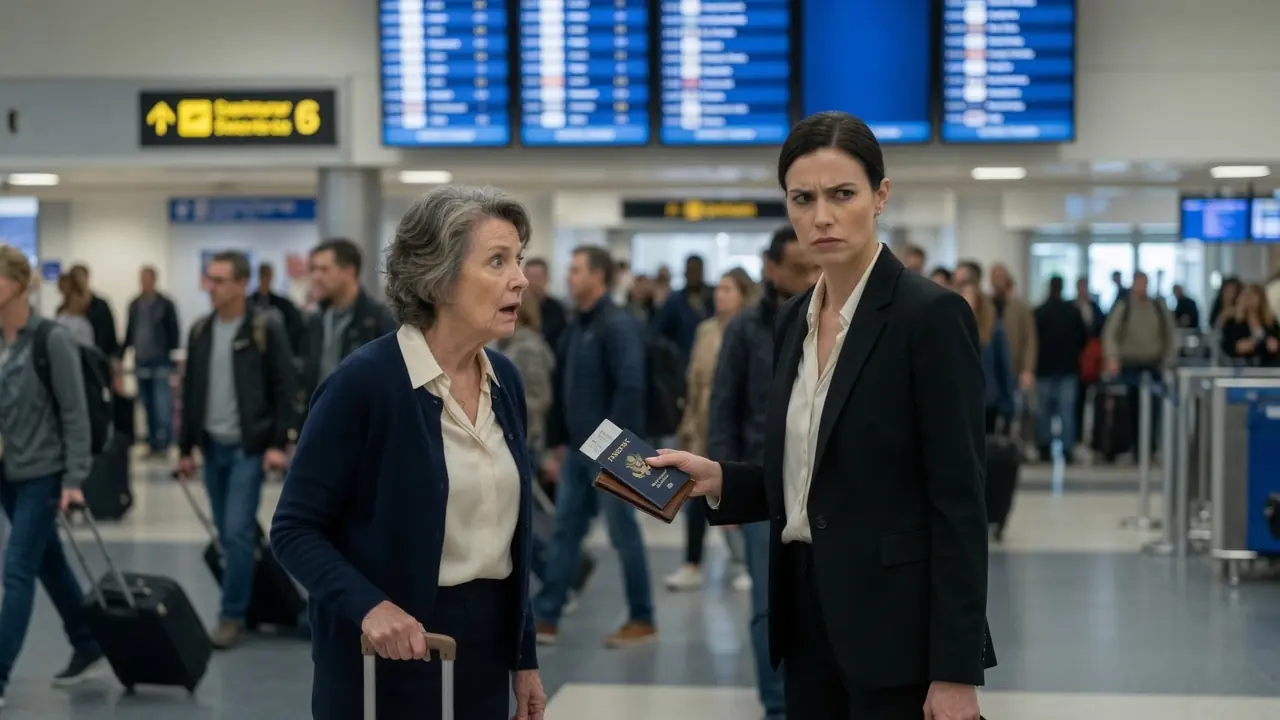
Clara turned, confused at first, because Megan had driven her to the airport and walked her all the way to security as if she wanted to be helpful. Megan Croft looked polished in a black blazer and white blouse, her hair smooth, her handbag hanging from one shoulder like she was on her way to a business meeting instead of betraying her mother. Clara saw her wallet in Megan’s other hand, the brown leather one with the little crease near the corner. Before Clara could understand what was happening, Megan looked her straight in the eye and said, “Have a nice life.”
For a moment, Clara did not move. The terminal kept breathing around her, shoes squeaking on the polished floor, boarding announcements echoing overhead, coffee machines hissing from a kiosk nearby. A traveler behind her sighed impatiently because the line had stalled, and a TSA agent asked if everything was all right. Clara opened her mouth, but nothing came out.
Megan stepped back into the crowd, walking quickly toward the concourse with Clara’s passport and wallet pressed against her side. Clara reached for her, but her shoes were already off and her carry-on was still on the belt. She felt suddenly small, exposed, and ridiculous standing there in her socks while strangers looked past her. She was sixty-three years old, traveling to bury her brother, and her own daughter had just walked away with her identity.
“Ma’am,” the TSA agent said gently, though her expression had sharpened with concern. “Do you have your identification?” Clara looked down at her empty hands. She had a boarding pass she could not use, a suitcase she could not check, and a phone that was already running low on battery.
“My daughter took it,” Clara whispered. The words sounded unbelievable even to her. The agent leaned closer, perhaps thinking she had misheard. Clara swallowed hard and forced herself to speak louder. “My daughter just took my passport and my wallet.”
The line slowed. A supervisor came over, wearing the practiced expression of someone who had seen panic, anger, and confusion in every possible form. He asked Clara to step aside, then guided her to a bench near the end of the screening area. Clara’s bin emerged from the scanner, and an agent brought her phone, scarf, and glasses over as if returning pieces of a life that no longer fit together.
Clara sat down with the phone in her lap and stared toward the direction Megan had gone. Her daughter’s words kept replaying in her mind with terrible calm. Have a nice life. Not screamed, not cried, not spoken in a moment of heat. Planned, prepared, delivered like a final line.
The supervisor asked questions, and Clara answered them slowly. Her name was Clara Bennett. She was traveling to Houston for her brother Harold’s funeral. Her daughter Megan Croft had driven her to the airport that morning. Megan had taken her passport and wallet from her hand at exactly 6:11 a.m., then left the security area.
When Clara said the time, the supervisor wrote it down carefully. “That timestamp matters,” he said. Clara did not yet understand how true that would become. She only knew she felt ashamed, even though she had done nothing wrong. Shame has a cruel way of landing on the person left behind instead of the person walking away.
An airport security officer arrived and asked Clara to describe Megan. Clara gave the details with a numb precision that surprised her. Black blazer, white blouse, brown handbag, dark hair, gold watch, beige suitcase. She could describe her daughter’s face better than anything else, but that was the detail that hurt too much to say.
While the officer wrote, Clara’s phone buzzed in her hand. The battery showed fifteen percent. She thought of calling Megan, but something stopped her. Maybe it was pride, maybe shock, or maybe a quiet instinct that told her not to hand her daughter another chance to lie.
The officer took Clara to a small airport security office near lost and found. The room smelled like old carpet, paper, and recycled air. A woman behind the desk checked the system while Clara sat with her hands folded around the phone. The woman paused, frowned, then looked up.
“Someone called lost and found at 6:17,” she said. “They asked if we had received a navy passport belonging to an elderly female traveler in Terminal D.” Clara felt the room tilt slightly. “That was six minutes after she took it,” she said.
The woman nodded. “The caller did not give a name, but the number had an Atlanta area code.” Atlanta. Clara’s son-in-law, Julian Croft, worked in Atlanta as a hospital administrator. He was smooth, successful, always perfectly polite, and Clara had never trusted the way he smiled without warmth.
That was the first crack in the story Megan might have told herself. This was not a daughter making one cruel choice in anger. Someone else had been waiting to see if the theft worked. Someone had known exactly when and where Clara would be stranded.
The lost and found clerk printed a call log showing the time, the area code, and the description of the request. Clara folded it carefully and placed it in her jacket pocket, the same pocket where her wallet should have been. “Keep that,” the clerk said quietly. “Sometimes the smallest paper becomes important.”
Clara thanked her and walked back into the terminal with legs that felt heavier than before. Her phone dropped to eight percent. She plugged it into a charging station near a row of gray chairs and watched the battery climb slowly while travelers rushed past with coffee cups, backpacks, and ordinary problems. She had never envied ordinary problems more than she did in that moment.
A woman called her from a number Clara did not recognize. “Mrs. Bennett, my name is Susan Vance,” the woman said. “I’m an attorney with Legal Aid of Mecklenburg County. I heard what happened at the airport. I can help, but I need you to listen carefully.”
Clara almost hung up. A stranger offering help after her own daughter had just betrayed her felt impossible to trust. But Susan’s voice was steady, not sweet, and Clara found herself holding the phone closer. “Do you have an incident number yet?” Susan asked.
“No,” Clara said. “Then get one before you do anything else. Ask for a TSA incident report, an airport security report, and copies of any call logs they can legally release. Do not confront your daughter. Do not accuse your son-in-law. Document everything.”
The instructions gave Clara something to hold on to. She went where Susan told her to go, asked for what Susan told her to ask for, and signed a sworn statement about the theft. A young agent named Leo helped her apply for temporary travel clearance so she could still board the delayed Houston flight. When he handed her the emergency document, he lowered his voice and said, “I’m sorry this happened to you.”
Those words almost broke her. Not because they were grand, but because they were kind. She had spent the morning surrounded by strangers, yet a young airport agent showed more compassion than her own child. Clara nodded, unable to answer for a moment.
The flight to Houston was delayed until early afternoon, giving her enough time to charge her phone, drink water, and sit quietly near the window. She kept the folder of documents pressed against her chest like a shield. TSA incident report. Lost and found call log. Temporary travel clearance. A boarding pass stamped with the delay.
On the plane, Clara watched clouds slide beneath the wing and tried to understand the woman her daughter had become. Megan had once held Clara’s hand crossing parking lots. Megan had once cried when Clara left her at kindergarten. Somewhere between childhood and that airport security line, love had been twisted into control, or perhaps Clara had simply refused to see what had been growing.
The funeral in Houston felt like walking into a room where her name had already been erased. Relatives who had known her for decades looked past her or gave careful smiles that did not reach their eyes. Megan stood near the front of the chapel in black, composed and tearful, accepting condolences as if she were the family representative. Julian stood beside her, one hand at her back, the perfect image of concern.
Clara sat alone in the back pew. She heard fragments of whispers. “She’s been confused lately.” “Megan is handling things now.” “It’s probably for the best.” The words moved through the chapel like cold air.
Clara wanted to stand and say, I am not confused. I am right here. But Susan’s warning echoed in her mind. Do not confront. Document. Observe. Let them think you are defeated.
After the service, a woman Clara barely knew slipped a business card into her hand. She was older, with silver hair and the direct gaze of someone who had survived her own private storms. “Call Susan Vance tonight,” the woman whispered. “They track elder financial exploitation across state lines.”
Clara looked down at the card after the woman walked away. Same name. Same number. The first stranger had not been random at all; there was a quiet network of people who knew what betrayal looked like when it wore a family face.
That night, in a budget hotel near the airport, Clara called Susan again. The funeral clothes lay folded over a chair, and the room smelled faintly of cleaning spray and old curtains. Susan did not waste time with pity. “Read me the incident number,” she said.
Clara read it. Susan was silent for a moment, likely writing it down. “Good,” she said. “That is your foundation. Everything else builds from there.”
Over the next half hour, Susan explained what Clara needed to do. Request phone records. Preserve every message. Pull copies of any powers of attorney, beneficiary documents, and medical authorization forms. Check whether Megan had access to any accounts. Clara wrote everything on hotel stationery until her hand ached.
“Right now they think you are too shocked to fight,” Susan said. “That is your advantage.” Clara had never thought of silence as power. She had thought silence was what happened when no one believed you. But that night, silence became strategy.
When Megan texted later asking, “Mom, are you okay? You seemed distant at the service,” Clara did not answer with anger. She took a screenshot, saved it, and wrote the time in her notebook. Then she replied, “I’m fine. We’ll talk soon.” Three calm words, no accusation, no warning.
Back home in Winston-Salem, Clara began building the paper trail. She requested records, printed emails, organized receipts, and called the accountant who had helped manage her late partner’s pension paperwork. Carol, the accountant, sounded concerned as soon as Clara explained what had happened. Two days later, Carol called back with the first major discovery.
A beneficiary change had been filed electronically through a hospital administrative portal in Atlanta. The request named Megan as the new primary beneficiary. The timestamp was 6:29 a.m. on the morning of the airport theft, just eighteen minutes after Megan took Clara’s passport.
Clara sat at her kitchen table staring at the printout Susan emailed her. The time glowed from the page like an accusation. 6:29 a.m. Julian’s administrator login. Atlanta hospital system. Eighteen minutes after Clara had been left barefoot and humiliated in the Charlotte security line.
“He used his work access,” Susan said during their video call. “And the timing shows coordination.” Clara wrapped both hands around her coffee mug, though the coffee had gone cold. “They planned this,” she said.
“Yes,” Susan replied. “But planning leaves trails.”
More trails appeared quickly. A draft power of attorney had been created on Julian’s home computer the night before Clara’s flight. The signature line was blank, but two witness names were typed beneath it, both employees from Julian’s department. One witness later admitted he had signed because Julian said it was a family emergency, even though he had never met Clara.
Then Maya, Susan’s paralegal, found Megan’s false alibi. Megan had posted an airport selfie at 6:34 a.m. tagged as Raleigh-Durham International. But the photo metadata showed the original location was Charlotte Douglas. The edit history showed Megan had tried several locations before settling on Raleigh.
“She tried to build distance,” Maya explained. “But the original data stayed.” Clara looked at the screenshot of her daughter smiling into the camera minutes after stealing her passport. That smile hurt more than any legal document.
The smallest piece of evidence came from Clara’s jacket pocket. A crumpled vending machine receipt for a Diet Coke purchased in Terminal D at 6:15 a.m. She had almost thrown it away. Susan held it up during their next meeting as if it were gold.
“This proves your location four minutes after the theft,” Susan said. “It matches the TSA report, the credit card charge, and your statement. Small receipts can become anchors.” Clara stared at the tiny slip of paper and thought about her mother’s old advice: keep something they don’t know you have. Her backup credit card, tucked in a separate jacket pocket, had bought that soda and accidentally preserved the truth.
Susan filed for an emergency freeze order in Mecklenburg County. The motion asked the court to pause all estate, beneficiary, and power of attorney changes connected to Clara until the documents could be reviewed. Clara signed the petition at 4:47 p.m. Susan filed it electronically four minutes later.
The next morning, Susan texted one word first: Granted. Then the full message followed. All Georgia filings paused pending review. Clara sat on the edge of her bed and read it three times.
For the first time since 6:11 a.m., Clara breathed without feeling like the floor might disappear beneath her. She was still hurt, still betrayed, still grieving her brother and the daughter she thought she knew. But she was no longer helpless.
The strongest evidence came two weeks later. Airport Wi-Fi logs showed Julian’s laptop connected to Charlotte Douglas public Wi-Fi at 5:58 a.m. on the morning of the theft. His work calendar claimed he had a 6:30 meeting in Atlanta, but his devices told a different story. A rental car receipt showed he had rented a car from the Charlotte airport location before dawn and returned it at 7:34 a.m.
“He was there,” Clara said, staring at the screen in Susan’s office. “He was watching.” Maya nodded. “Near enough to coordinate. Far enough to pretend he wasn’t involved.” Clara felt the old humiliation flare up again, but this time it had a different shape. It was no longer helpless shame. It was anger with documents.
Susan advised patience. “We do not need to shout,” she said. “We need to let the timeline speak.” Clara followed that advice until the family meeting arrived.
The invitation came through a courier. Family estate information session. All stakeholders welcome. Clara knew immediately it was a trap. Megan and Julian were trying to gather relatives, present their version first, and paint Clara as unstable before anyone could hear the truth.
So Clara went with a folder and a USB drive. The meeting was held in a community center in South Atlanta, a plain brick building with folding chairs and a projector screen. Megan stood at the front in navy, Julian beside her in gray, both dressed like professionals delivering a responsible presentation. Clara slipped into the back row ten minutes late and listened.
Julian spoke about care management, financial protection, updated beneficiary protocols, and necessary family oversight. Megan added soft comments about how difficult everything had been. Clara watched relatives nod with concern, and she recognized the same pity she had seen at the funeral.
When Julian asked if there were questions, Clara raised her hand. Megan went pale. Julian’s expression tightened. Clara walked to the front calmly, connected the USB drive, and opened the first slide.
The TSA incident report appeared on the screen. April 11th. 6:11 a.m. Charlotte Douglas Airport. Daughter identified as removing passport and wallet from traveler at security line. No one spoke.
The second slide showed the lost and found call log. 6:17 a.m. Atlanta area code asking about a navy passport before it had been reported missing. The third slide showed the 6:29 beneficiary change filed through Julian’s hospital login. The fourth showed the airport Wi-Fi logs and rental car receipt. The fifth showed Megan’s social media metadata and the false location edits.
Clara did not shout. She did not cry. She simply stood beside the screen and let each timestamp do what her voice could not. Every lie Megan and Julian had polished began to crack under the weight of time.
An uncle in the third row stood slowly. “Clara,” he said, his voice rough. “We didn’t know.” Clara looked at him and nodded. “Now you do.”
Julian stepped into the hallway, already on his phone. Megan remained frozen at the front of the room, her hands shaking at her sides. For a second, Clara saw not the child she had raised, but a woman who had believed her mother would never fight back. That belief was gone now.
Nine days later, Susan received an email from Julian’s attorney. All pending filings would be withdrawn. The beneficiary changes would be reversed. The power of attorney draft would be abandoned. They offered a settlement for expenses and emotional harm.
Clara did not care most about the money. She cared about her name. Susan understood before Clara even said it. “You want a public acknowledgement,” she said.
“Yes,” Clara replied. “They humiliated me in front of the family. They can correct it in front of the family.”
At Easter dinner in Winston-Salem, Julian read a short statement before thirty relatives. He admitted that estate planning actions had been pursued without Clara’s proper consultation or consent. He stated that all filings had been withdrawn and corrected. He apologized for the distress caused.
The apology was careful, legal, and incomplete. But it was public. That mattered. Clara sat at the table with a cup of coffee in her hand while the relatives who had avoided her in Houston now looked at her with shame, respect, or both.
Megan and Julian left before dinner. Later, Clara found a white envelope on the hall table with her name written in Megan’s handwriting. Inside were her navy passport, her wallet, her license, her cards, and a folded note.
I’m sorry. I was wrong.
Six words. Not enough to mend everything. Enough to prove Megan knew exactly what she had done.
Clara drove home at sunset with the envelope on the passenger seat. The passport felt different now. Once it had been stolen proof of who she was. Now it was just one document among many. Clara had learned that identity did not live only in a passport, a wallet, or a daughter’s approval.
At home, she placed every document in order. TSA incident report. Lost and found call log. Vending receipt. Temporary travel clearance. Phone records. HR portal logs. Instagram metadata. Witness statement. Wi-Fi logs. Rental car receipt. Freeze order. Settlement agreement. Easter acknowledgement.
She labeled each folder carefully and placed everything in a fireproof box under the guest bed. Not revenge. Protection. Evidence that her story had not been erased.
Months later, Clara began volunteering at Legal Aid two afternoons a week. She was not a lawyer and never pretended to be. She sat with people whose hands shook the way hers had, people betrayed by sons, daughters, nieces, nephews, and spouses who thought love made paperwork easier to steal. Clara told them what Susan had taught her.
Write down the time. Keep the receipt. Screenshot the message. Do not confront too soon. Let the timeline speak.
One afternoon, a woman named Diane sat across from Clara, crying because her son had taken her checkbook at a restaurant. Clara handed her a tissue, then a notepad. “Do you remember what time you paid for parking?” she asked.
Diane blinked. “I think I have the receipt.” Clara smiled gently. “Then we start there.”
That evening, Clara returned home, made coffee in her chipped mug, and sat on the porch while a neighbor’s child rode a bike in slow circles. Her phone was quiet. Her house was quiet too, but not empty in the same way anymore. The silence no longer felt like abandonment. It felt like peace.
The navy passport sat in her kitchen drawer beside grocery coupons and a spare key. The replacement passport rested beside it. One represented the morning someone tried to erase her. The other represented the woman who learned to write herself back into the record.
Clara never forgot 6:11 a.m. But it stopped being only the moment of betrayal. It became the moment the timeline began, the first mark in a chain of evidence that led her back to her own name. Her daughter had walked away with a passport and wallet, believing she had taken everything. She had not known that airports had cameras, phones had metadata, receipts had timestamps, and quiet women could become very dangerous when they finally began keeping proof.