Helen Carter woke at five in the morning on her sixtieth birthday and listened to the silence inside her son’s house. For a few precious minutes, no one demanded breakfast, clean clothes, a packed lunch, or an explanation for why something had not been finished. The date circled in red on the kitchen calendar waited downstairs where everyone could see it. Helen allowed herself to believe that perhaps Ryan and Megan had noticed and were pretending to forget because they had planned a surprise.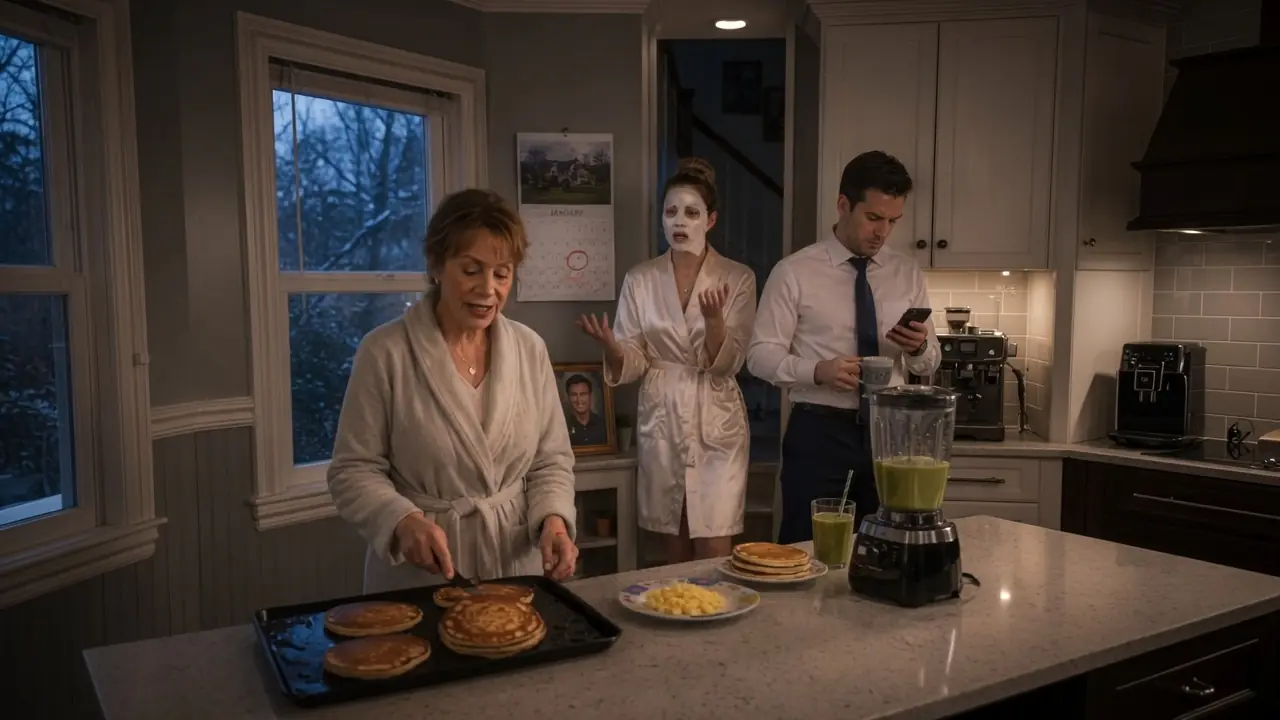
She slipped into the faded cream robe her late husband Arthur had given her during their final Christmas together. A stubborn grease mark remained near the pocket where Arthur had once hidden a chocolate bar and forgotten it before helping repair their car. Helen touched the stain and remembered him laughing as melted chocolate spread across the fabric. Five years after his death, the memory still hurt, but it also reminded her that she had once lived in a house filled with affection rather than instructions.
The modern kitchen downstairs looked nothing like the room she and Arthur had built. Megan had replaced the blue tile, painted the cabinets white, and removed nearly every object she considered outdated. Only Helen’s cast-iron skillet remained, hidden in a lower cabinet because Megan disliked seeing it. Helen took it out and began preparing three different breakfasts before anyone else woke.
Ryan wanted fresh pancakes and strong coffee. Megan required a green smoothie blended immediately before she drank it because she insisted the nutrients vanished if it waited. Seven-year-old Leo demanded scrambled eggs with finely chopped cheese, crustless toast, and strawberries cut lengthwise. Helen had performed this routine every morning for five years, and her hands moved automatically even while her mind remained fixed on the red circle across the calendar.
Footsteps sounded upstairs just as the first pancake touched the skillet.
Megan appeared in the doorway wearing an ivory satin robe and a white facial mask. Her brown hair was twisted into a high bun, and she looked annoyed before she had even fully entered the room. She waved one hand in front of her face as if Helen had filled the kitchen with smoke.
“What is that smell?”
“Breakfast.”
“I know it’s breakfast. Why does it smell so oily?”
“I’m making Ryan’s pancakes.”
Megan crossed her arms. “Open a window before the smell gets into my suit.”
“It’s twenty-eight degrees outside.”
“Then use the exhaust fan.”
Helen lowered the heat even though the pan was not smoking. Megan peeled the mask from her face and tossed it onto the counter beside the cutting board. She did not notice the calendar directly behind Helen.
“Today is my—” Helen began.
“Who cares what date it is?” Megan interrupted. “I have an important meeting at nine, and I cannot go to work smelling like fried food.”
Helen looked at her daughter-in-law for several seconds. She had imagined the words Happy birthday arriving in many ways that morning, but she had never prepared for contempt before she could finish the sentence. She turned back to the stove and lifted the pancake onto Ryan’s plate.
“The plumber is coming this afternoon,” Megan continued. “You need to stay home.”
“I thought I might visit the community center.”
“You can do that another day.”
Helen glanced at the red circle on the calendar.
Megan followed her gaze, looked directly at the words HELEN’S 60TH BIRTHDAY, and showed no reaction. Instead, she inspected her reflection in the dark microwave door. “My parents are coming tonight, so make lobster, shrimp scampi, grilled salmon, and something Leo will eat.”
Helen’s fingers tightened around the spatula.
“Are they coming for my birthday?”
Megan laughed quietly. “No. Dad wants to discuss Ryan’s investment project. We can put candles on the dessert if you need attention that badly.”
Ryan entered the kitchen while fastening the watch Helen had given him the previous Christmas. He wore a gray suit and stared at his phone as if the messages there mattered more than the people in front of him. He walked past his mother without greeting her.
“Where’s my coffee?”
“Almost ready.”
“I’m running late.”
Helen poured it into his travel mug. “Ryan, do you remember what day—”
“Mom, please don’t start a long conversation right now.”
“I only wanted to tell you—”
“Did you iron my white shirt?”
“It’s hanging in your closet.”
“Good.”
He took the coffee without thanking her.
Megan lifted her smoothie and complained that it contained too much spinach. Ryan told Helen to buy extra seafood because Megan’s father preferred large lobster tails. Neither looked at the calendar.
Leo arrived moments later and climbed into his chair.
“Where are my eggs, old thing?”
Helen froze.
The phrase had come from Megan during an argument the previous week. Hearing it repeated casually by her grandson hurt more deeply than any adult insult.
“You should not call Grandma that,” Helen said.
Leo shrugged. “Mom does.”
Megan did not correct him.
By seven thirty, the house was empty except for Helen. She stood before a sink overflowing with plates, pans, glasses, and green smoothie residue. The birthday she had secretly hoped would begin with flowers or a family breakfast had given her extra errands and a menu large enough for a banquet.
She cleaned the kitchen, waited for the plumber, and spent forty minutes on her knees holding a flashlight while he repaired a pipe beneath the sink. As he prepared to leave, he noticed the calendar.
“Happy birthday, ma’am.”
The kindness of a stranger nearly broke her.
“Thank you.”
“Sixty is worth celebrating. Your family taking you somewhere tonight?”
“We’re having dinner here.”
“I hope they spoil you.”
The door closed behind him, and Helen sat alone at the kitchen table. Tears came before she could stop them. She cried for Arthur, for the years she had surrendered, and for the humiliating truth that only a plumber had remembered her birthday.
After Arthur died, Ryan asked Helen to move in for one year. Megan had returned to work after Leo’s birth, and they needed help with childcare. Helen sold the small house she and Arthur had owned, placed most of the proceeds into savings, and moved into the guest bedroom at the end of Ryan’s hallway.
One year became five.
At first, Ryan and Megan thanked her. Then gratitude became expectation, and expectation became entitlement. Helen’s pension paid for groceries when they claimed money was tight, although new furniture, vacations, and expensive clothes appeared regularly.
She cooked, cleaned, babysat, waited for repair workers, collected deliveries, and rearranged her life around theirs. Each time she considered leaving, Ryan reminded her that families helped one another. Megan warned that independent living would be dangerous at Helen’s age.
Helen had begun believing them.
She climbed upstairs and retrieved a framed photograph of Arthur from the wooden box in her closet. In it, he stood beside their old station wagon with his sleeves rolled above his elbows. His smile was aimed directly at the woman holding the camera.
During his final weeks, Arthur had made Helen promise something.
“Do not disappear inside Ryan’s life after I’m gone,” he had told her from his hospital bed. “You spent forty years holding everyone else together. When I leave, you have to live for yourself.”
Helen had promised.
Then grief made dependence feel like love, and she broke that promise almost immediately.
“I’m sorry,” she whispered to the photograph.
At noon, Megan sent a message asking whether the salmon had been cooked for her lunch. She had not returned home and had not mentioned Helen’s birthday. Helen deleted the message without responding.
For the first time in years, she cooked only for herself. She made a simple bowl of noodles, sat beside the window, and ate slowly. No one complained about the seasoning or asked why the meal was late.
That afternoon, Helen walked to the market.
The shortest route passed a community park where older men and women danced in loose rows near a pavilion. Their movements were imperfect, and one man repeatedly turned in the wrong direction, but everyone laughed instead of criticizing him. A silver-haired woman wearing red sneakers waved toward Helen.
“Come join us.”
Helen almost stepped through the gate.
Then Ryan’s message appeared on her phone.
Make extra shrimp tonight. Frank doesn’t like small portions. Also get a good bottle of wine.
No please.
No thank you.
No happy birthday.
Helen slipped the phone into her pocket and continued toward the market.
Near the seafood counter, someone called her name.
Ruth Campbell had worked beside Helen at the textile mill for more than twenty years. At sixty-five, she wore bright blue glasses, comfortable walking shoes, and a red scarf that made her look more alive than anyone inside Ryan’s house.
“Helen! Happy birthday.”
Helen stared at her. “How did you remember?”
“Facebook reminded me, but I remembered before I checked.”
Ruth looked into Helen’s basket filled with lobster, shrimp, salmon, butter, herbs, and dessert ingredients.
“Are you feeding a wedding?”
“Ryan’s in-laws are coming.”
“On your birthday?”
“They’re discussing business.”
Ruth’s expression changed. “Did your son plan anything for you?”
“They may have something planned later.”
“Helen.”
The concern in her friend’s voice removed the last strength from Helen’s practiced smile.
“They forgot.”
Ruth took her hand. “Then why are you cooking all this?”
“Because they asked.”
“No. They ordered.”
Helen looked away.
Ruth had once lived with her oldest son, who tried to control her pension and criticized every independent choice she made. Ruth had moved into an independent senior community called Willow Creek and refused to return until he learned to speak respectfully.
“I thought you were being too harsh,” Helen admitted.
“So did everyone else.”
“Were you afraid?”
“Terrified.”
“Then how did you do it?”
Ruth smiled. “I became more afraid of disappearing than leaving.”
She handed Helen a card for Willow Creek.
“I have my own apartment, a balcony, classes, trips, and friends who knock before entering. The community kitchen needs someone who understands real cooking.”
“Ryan would never agree.”
“Why does Ryan need to agree?”
“He’s my son.”
“And you are his mother, not his employee.”
Helen placed the card inside her purse.
As she walked home, Arthur’s words returned.
Your life is yours.
She began cooking at four.
The familiar movements continued, but obedience no longer guided them. Helen measured each demand against the years she had already given away. Five years of unpaid childcare, endless meals, household labor, and pension money had allowed Ryan and Megan to build a comfortable life while convincing her she could not survive without them.
At six thirty, the front door opened.
Ryan, Megan, and Leo entered without greeting her. Megan carried shopping bags containing a new dress and shoes. Ryan asked whether the wine had been chilled.
At seven, Megan’s parents, Frank and Deborah, arrived. They entered laughing, handed Ryan an expensive bottle of whiskey, and praised the aroma coming from the kitchen.
“Helen’s been cooking all day,” Megan said as if describing a household appliance.
No one asked why.
No one noticed the date on the calendar.
Helen arranged lobster, shrimp scampi, grilled salmon, roasted vegetables, soup, fresh rolls, and chocolate cake. The table held enough food for a birthday celebration, yet there were no candles, flowers, or card bearing her name.
Ryan called from the dining room.
“Mom, is dinner ready? We’re starving.”
“Almost.”
Megan entered the kitchen wearing a fitted green dress. She examined the platters and frowned.
“Why haven’t you started serving?”
“I just finished.”
“My parents have been waiting.”
“They arrived eight minutes ago.”
Megan’s mouth tightened. “Do you want everyone to starve?”
Ryan appeared behind her and checked his watch.
“Mom, if you’re still able to cook, then hurry.”
Helen looked at her son.
He had forgotten she was sixty until her age could be used to question her usefulness. Something inside her became perfectly calm.
She reached toward the hook beside the pantry and fastened the apron Arthur had given her. Across the faded fabric were the words:
HELEN’S KITCHEN—LOVE SERVED DAILY
Megan returned to the dining room.
Ryan followed without offering to carry anything.
Helen opened the bottom drawer beside the stove. At the back rested Arthur’s old digital voice recorder. During his final months, he had used it to record account numbers, property instructions, and messages he feared he would not live long enough to say again.
That afternoon, Helen had replaced the batteries.
She pressed the record button.
“Mom, what’s taking so long?” Ryan shouted.
Helen slipped the recorder into her apron pocket.
“Coming.”
For thirty minutes, she carried food into the dining room while everyone remained seated. Frank opened the wine, Deborah discussed vacation plans, and Leo played a game beneath the table. Megan occupied the chair Arthur had once used.
When the final dish arrived, Ryan smiled for the first time that day.
“Looks good, Mom.”
Helen glanced around the table.
No place had been prepared for her.
Two empty chairs remained. Megan’s handbag occupied one, and Frank’s coat covered the other.
Megan followed Helen’s gaze.
“Oh, we thought you would eat in the kitchen. There isn’t enough room.”
Helen looked at the two empty chairs.
Then she untied the apron.
She folded it slowly and placed it beside the lobster platter. From her pocket, she removed Arthur’s recorder and set it in the center of the table.
Ryan frowned. “What is that?”
“My birthday gift to myself.”
Megan laughed. “What are you talking about?”
Helen removed six envelopes from the kitchen drawer and placed one beside every plate. Ryan’s name appeared on the first. Megan’s parents exchanged uneasy looks.
“Mom,” Ryan said, “what did you do?”
“Eat while it’s warm.”
No one touched the food.
Ryan opened his envelope.
Inside was a detailed statement showing how much of Helen’s pension had been spent on the household over five years. It included groceries, repairs, school costs, utility bills, and the monthly payments Ryan claimed were contributions toward “family expenses.”
Megan opened hers.
Her envelope contained a formal notice ending Helen’s unpaid childcare, cooking, cleaning, and financial support. It also included an invoice from an accountant calculating the fair market value of five years of full-time household labor.
Frank’s envelope held a copy of the property deed.
The house they were sitting in still belonged legally to Helen.
Arthur and Helen had purchased it years earlier as a rental investment. After Arthur’s death, Ryan moved in and convinced Helen to use the sale of her smaller home to refinance it. He repeatedly spoke as if the property had become his, but no transfer of ownership ever occurred.
Deborah’s envelope contained a signed listing agreement.
The house would be placed on the market within thirty days.
Megan stared at the paper. “You cannot sell our house.”
Helen remained standing.
“It is not your house.”
“We’ve lived here for five years.”
“So have I.”
Ryan pushed back his chair. “Mom, you’re emotional. We can discuss this tomorrow.”
“I have spent five years discussing my life only when you allowed it. Tomorrow, I will be busy.”
He opened the final document in his envelope.
It confirmed Helen had reserved an apartment at Willow Creek beginning the following week.
“You’re moving into a facility?” he asked.
“An independent community.”
“You can’t live alone.”
“I will not be alone.”
“You’ll change your mind.”
“No.”
Megan stood abruptly. “This is ridiculous. You are punishing us because we forgot one birthday.”
Helen looked at her.
“You did not forget me for one day. You forgot me every day until something needed cooking.”
Frank cleared his throat. “Perhaps everyone should calm down.”
Helen pressed the playback button on Arthur’s recorder.
His voice filled the dining room.
It was older and weaker than Helen remembered, but still unmistakably his.
“Helen, if you are listening to this, remember what I told you. The house is yours. The money is yours. Your life is yours. Do not let anyone convince you that love means giving away all three.”
Every face at the table froze.
Ryan stared at the recorder as though his father had entered the room.
Arthur’s voice continued.
“Ryan, if you hear this someday, take care of your mother. Not because she is weak, but because she spent her life making you strong. If you ever make her feel like a burden inside her own home, then you have forgotten everything I tried to teach you.”
Ryan lowered his eyes.
Megan reached for the recorder, but Helen picked it up before she could touch it.
“You recorded us?” Megan demanded.
“Yes.”
“That is a violation of our privacy.”
“You shouted your demands through a house that belongs to me.”
Megan turned toward Ryan. “Tell her she cannot do this.”
Ryan said nothing.
For the first time, his mother’s usefulness could not rescue him from the consequences of his choices.
Leo looked up from beneath the table.
“Grandma, are you leaving because Mom calls you old?”
The innocent question shattered the remaining pretense.
Megan’s face flushed. “Leo, go upstairs.”
“No,” Helen said. “He should hear the answer.”
She knelt beside her grandson.
“I am leaving because people should not stay where they are treated badly.”
“Will you still be my grandma?”
“Always.”
“Will you still make pancakes?”
“Sometimes, when I choose to.”
Leo considered this distinction.
Then he hugged her.
Ryan finally stood.
“Mom, please. Selling the house will destroy us.”
“You both earn good salaries.”
“We have debts.”
“You also have new clothes, vacations, private school tuition, and restaurant dinners.”
“We thought you were helping.”
“I was. You decided help was something you owned.”
Megan’s anger turned desperate.
“Where are we supposed to go?”
Helen looked around the dining room.
“That is a decision for the adults who have spent five years telling me I cannot make decisions.”
She returned to the kitchen and served herself one plate. Then she carried it upstairs to her room.
Behind her, nobody ate.
The following morning, Ryan knocked gently on her door. It was the first time he had knocked in years.
“Can I come in?”
Helen opened the door but did not invite him farther than the entrance.
His face looked exhausted.
“I’m sorry.”
“For forgetting my birthday?”
“For everything.”
Helen waited.
Ryan admitted that after Arthur died, he became afraid of losing his mother too. Asking her to move in initially came from love, but convenience soon replaced gratitude. Every meal and favor became invisible because Helen always provided it.
“I let Megan speak to you that way,” he said.
“Yes.”
“I spoke to you that way too.”
“Yes.”
“I don’t know when I became this person.”
Helen looked at the son who once saved his allowance for glitter-covered birthday cards.
“You became him one small permission at a time.”
Ryan began crying.
“Can you forgive me?”
“I love you.”
“That isn’t what I asked.”
“No. Forgiveness may come. Trust will take longer.”
“Will you cancel the sale?”
“No.”
The answer hurt him, but Helen did not soften it.
Consequences were not cruelty.
Over the next week, Helen packed only what belonged to her. Megan avoided her, alternating between anger and silent disbelief. Ryan helped carry boxes but stopped asking her to stay.
Ruth drove Helen to Willow Creek.
Her new apartment was small, with one bedroom, a sunny balcony, and a kitchen where no one entered without permission. The first evening, neighbors invited her to dinner. Helen instinctively began clearing plates afterward.
A woman gently took them from her hands.
“You cooked nothing tonight. Sit down.”
Helen sat.
The unfamiliar feeling almost made her cry.
Within a month, she joined the community kitchen and taught a Saturday cooking class. People thanked her, paid for the ingredients, and helped clean afterward. She also returned to the park and joined the line-dancing group despite turning in the wrong direction repeatedly.
Her house sold three months later.
Ryan and Megan rented a smaller home. Without Helen’s money and labor, they had to divide chores, arrange childcare, and confront the true cost of the life they had taken for granted.
Megan did not apologize immediately.
She blamed stress, work, and Helen’s sensitivity. Then Ryan insisted they attend counseling after Leo began ordering other adults around using the same language he heard at home.
Months later, Megan visited Willow Creek alone.
She stood outside Helen’s apartment holding a birthday cake.
“It isn’t your birthday,” Helen said.
“I know.”
“Then why bring cake?”
“Because I never gave you one.”
Helen did not invite her inside immediately.
Megan looked down. “I treated you like unpaid staff because it made my life easier. Then I told myself you preferred being needed.”
“I preferred being loved.”
“I know that now.”
The apology did not repair five years, but it was the first sentence Megan spoke without defending herself.
Helen accepted the cake.
She did not offer immediate forgiveness.
A year after her sixtieth birthday, Helen hosted a small dinner in the Willow Creek community room. Ruth attended, along with the dancers from the park, several neighbors, Ryan, Megan, and Leo.
This time, everyone helped.
Ryan set the table.
Megan washed vegetables.
Leo carried napkins and asked before taking anything from the kitchen.
When the food was ready, Helen entered the dining room and found a chair waiting at the head of the table. A handmade card rested on the plate.
HAPPY 61ST BIRTHDAY, GRANDMA. THANK YOU FOR COMING.
Helen sat down.
No one asked her to serve.
No one complained that the meal was late.
Ryan lifted his glass.
“To Mom, who taught us that love is not service and family is not ownership.”
Helen looked toward Arthur’s photograph standing near the cake.
She had spent her sixtieth birthday believing her life had disappeared inside other people’s needs. In truth, it had remained where Arthur said it was, waiting for her to claim it.
The house had been hers.
The money had been hers.
Most importantly, the years ahead still belonged to her.
Helen served herself first.