Snow fell in thick, restless sheets across the railroad platform at Durango as the black locomotive released a long column of smoke into the storm-darkened sky. Catalina Becerra stood beside the tracks with both hands locked around the worn handle of a heavy traveling case, her knuckles pale beneath her gloves. Her beige plaid jacket strained slightly across her shoulders, and the long brown wool skirt beneath it had already gathered mud along the hem. Every passenger remaining beneath the station roof watched her father present her to a stranger as though she were livestock being transferred between owners.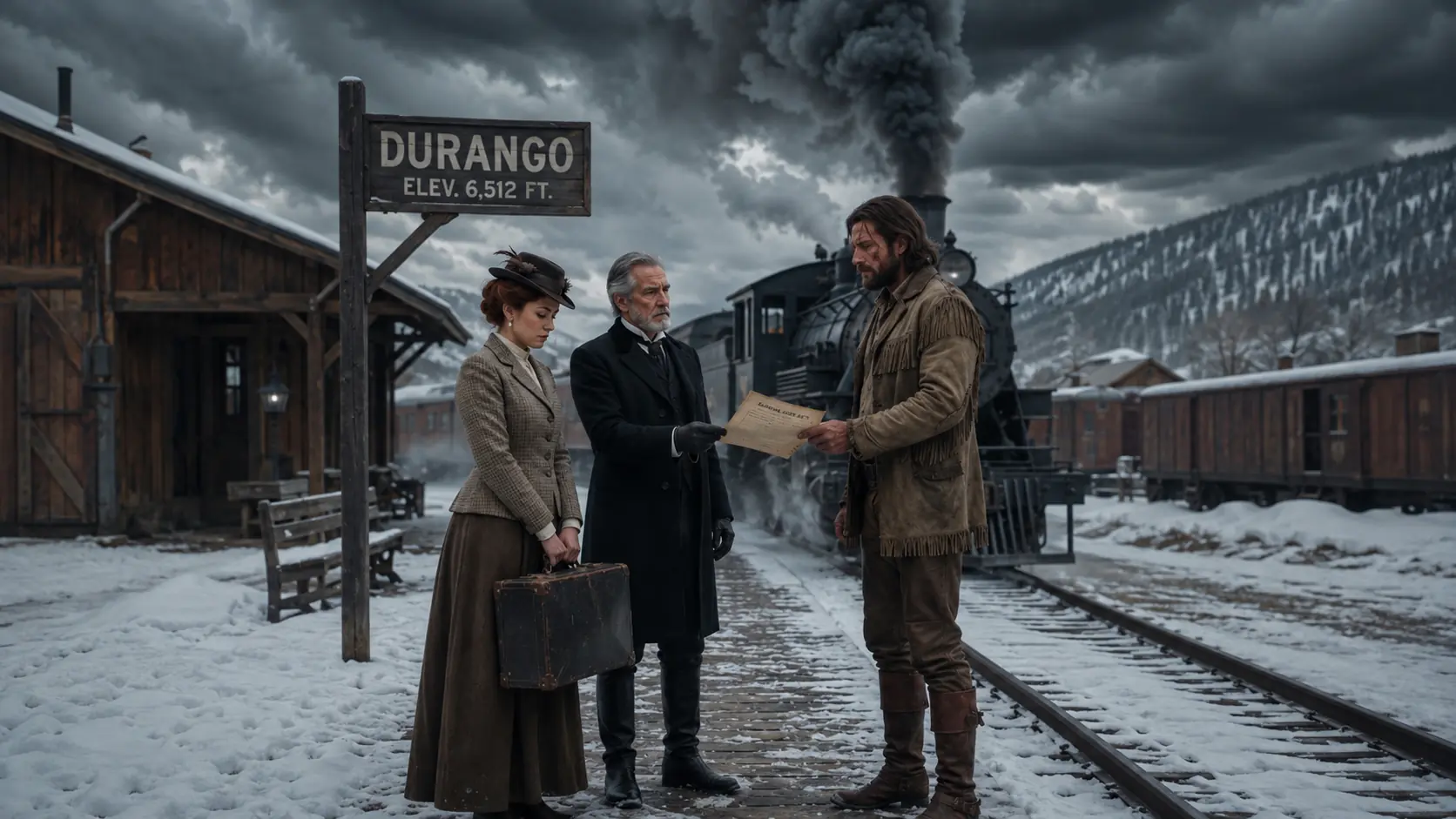
Don Octavio Becerra extended a folded contract toward the mountain man standing several feet away. At fifty-eight, Octavio still carried the polished authority of a wealthy railroad magnate who believed courts, banks, newspapers, and men could all be purchased at the proper price. His black frock coat remained immaculate despite the weather, his silver hair was combed neatly beneath his hat, and his gray beard framed a mouth that rarely spoke without issuing an order. “Take her,” he said. “She ruined my alliance, so now she can ruin your winter.”
Catalina’s grip tightened around the suitcase. “You forged my name and traded me like livestock.”
Octavio seized her arm. “Be grateful any man agreed to keep a woman your size.”
The stranger moved before Catalina could pull away.
Gabriel Rosales stepped between them, and Octavio’s hand disappeared beneath the mountain man’s broad fingers. Gabriel was thirty-five, tall enough to make Octavio lift his chin, with shoulder-length dark hair, a heavy beard, and a pale scar cutting across his right cheek. His weathered buckskin coat hung open over a powerful chest hardened by years of climbing, hunting, cutting timber, and surviving winters that killed men better equipped than he was.
“You call her punishment,” Gabriel said. “I call her a blessing. Touch her again, and you’ll leave this mountain without that hand.”
The platform fell silent except for the hiss of steam and the clatter of sleet against the station roof. Octavio studied Gabriel’s face, expecting hesitation or fear, but the mountain man did not release him until Catalina’s father stepped back. Gabriel then turned toward her without staring at her body, mocking her clothing, or allowing pity to enter his expression. He simply lifted the suitcase from her trembling hands as though helping her was the most natural action in the world.
Octavio recovered his composure. “The contract requires you to surrender Crow’s Ravine and acknowledge my company’s ownership of the pass.”
Gabriel accepted the pages with his free hand. He scanned the first paragraph, then the second, before looking at the signature near the bottom. Catalina noticed the slight tightening around his eyes.
“You signed this?” he asked her.
“No.”
Octavio smiled thinly. “Her consent was unnecessary. I signed as the head of her household.”
“She is twenty-four.”
“She remains my daughter.”
Gabriel folded the contract and tucked it inside his coat. “Not once she crosses that ridge.”
Octavio’s smile faded. “Do not mistake this arrangement for freedom, Rosales. The company recognizes your temporary occupancy only if you comply with every clause.”
“And if she dies?”
The question struck Catalina harder than the winter wind.
Octavio’s expression did not change. “Mountain winters are dangerous.”
Gabriel looked directly at him. “The contract says I won’t be investigated if she dies before spring.”
“A practical protection.”
“For whom?”
Octavio stepped toward the private railroad car waiting behind him. “Keep her alive or bury her. I no longer care. Just surrender the ravine when my surveyors arrive.”
He climbed aboard without looking back.
The train began moving several minutes later. Catalina remained beside Gabriel as the engine pulled her father south toward his mines, hotels, offices, and carefully controlled reputation. She watched the final carriage disappear through the snow and felt no relief. Octavio had not merely abandoned her—he had sent her into the mountains expecting either Gabriel or winter to finish what years of humiliation had begun.
“You can leave me here,” she said.
Gabriel adjusted the suitcase in his hand. “No.”
“You owe me nothing.”
“I owe your father less.”
“He expects you to hate me.”
Gabriel looked toward the road climbing into the white mountains. “Your father expects everyone to see the world the way he does. That is why men like him become dangerous.”
Catalina followed him toward a waiting wagon pulled by two sturdy brown horses. Her father’s servants had brought only one suitcase despite the fact that she was supposedly beginning a new life. Inside were two dresses, one pair of boots, several undergarments, a hairbrush, and none of the books she had collected since childhood. Octavio had chosen what she needed with the same care he had used when selecting the mountain where he hoped she would disappear.
Gabriel placed the case beneath the wagon seat and offered his hand. Catalina hesitated before accepting it. His palm was rough, warm, and strong enough to lift her easily, but he did not pull or hurry her when she placed one boot on the step.
The wagon climbed for nearly three hours.
Durango disappeared beneath the storm while the road narrowed between dark pines and steep walls of rock. Catalina expected Gabriel to question her about the broken engagement, her father’s business, or whether she could cook and wash. Instead, he guided the horses through the snow and occasionally pointed out safe paths hidden beneath the drifts.
Near sunset, they reached a high valley surrounded by jagged peaks.
Gabriel’s home stood beside a frozen creek beneath a wall of cedar and pine. It was larger than the crude sawmill shack Catalina expected: a sturdy two-story cabin built from heavy logs, with a stone chimney, a covered porch, a barn, and several sheds. Smoke rose from the roof, chopped wood stood beneath a lean-to, and warm light glowed through two glass windows.
“This is Crow’s Ravine?” Catalina asked.
“The entrance to it.”
“It doesn’t look like land worth killing for.”
Gabriel glanced toward the northern ridge. “Silver lies beneath those mountains. Timber covers the slopes. The pass is the only route wide enough for a road without blasting half the range.”
“And my father needs the road for his mines.”
“He needs the land beneath it too.”
Catalina looked toward him. “You know the contract is false.”
“I know the signature is.”
“How?”
“You form your C differently.”
She stared.
Gabriel reached inside his coat and unfolded the marriage contract. “Your name appears twice. The first came from another document. Whoever copied it did not notice your capital C curves inward. The signature below the marriage clause curves outward.”
“You saw that on a railroad platform?”
“My survival depends on noticing what men hope I won’t.”
He led her inside.
The cabin contained a large stone hearth, a clean wooden table, shelves of preserved food, simple furniture, and several books near an oil lamp. Catalina stopped when she recognized legal volumes among hunting journals and religious texts. One concerned territorial property claims. Another covered mining easements and water rights.
“You read law?” she asked.
“I read anything that might stop rich men from stealing land.”
“My father’s attorneys wrote some of those laws.”
“Then perhaps you can help me understand how they bend them.”
Gabriel showed Catalina the upstairs bedroom. A wide bed stood beneath a quilt, and a washstand waited beside the window. He placed her suitcase inside, then stepped back into the hallway.
“This room is yours.”
She looked past him. “Where will you sleep?”
“Below.”
“The contract says we are married.”
“The contract says many things neither of us agreed to.”
Catalina had spent years hearing that any husband willing to accept her would be doing her a favor. She had prepared herself for demands, disgust, or the cold tolerance of a man compensated with property. Gabriel’s refusal confused her more than cruelty would have.
“You called me a blessing,” she said.
“I wanted your father to hear it.”
“So you did not mean it?”
Gabriel met her eyes. “I meant that no human being delivered into another person’s hands should be called punishment.”
He closed the door gently behind him.
Catalina slept poorly.
The mountain wind pressed against the logs while branches scratched across the roof. She dreamed of Ramiro’s fingers around her wrist and her father’s voice asking who could ever marry a woman like her for love. Each time she woke, the room remained warm, the door remained unlocked, and no footsteps approached.
At dawn, she found Gabriel cooking eggs and thick slices of bacon beside the fire.
A plate waited for her.
Catalina stopped several feet from the table. “Is that mine?”
“Yes.”
Her father’s household had measured everything she ate. Breakfast had often been weak tea, one piece of fruit, or nothing at all before formal events. Doctors hired by Octavio prescribed starvation as though hunger were a moral cure.
Gabriel noticed her hesitation. “You don’t like eggs?”
“I do.”
“Then sit before they cool.”
She ate slowly at first, expecting him to comment on every bite. Gabriel finished his own meal, poured coffee, and examined the forged contract beneath the window. He did not watch her plate.
When Catalina finally stopped, half a slice of bread remained in her hand.
“You may eat all of it,” he said.
She lowered her eyes. “My father said women like me should never finish what was placed before them.”
“Your father is not here.”
The words were simple.
They felt revolutionary.
The next several days passed beneath steady snowfall. Gabriel repaired harnesses, checked trap lines, and cut wood while Catalina explored the cabin. She discovered ledgers documenting timber sales, letters from attorneys, maps of Crow’s Ravine, and property documents bearing seals older than Octavio’s railroad company.
Gabriel’s family had occupied the land since before Colorado became a state. His grandfather received recognition of the claim after helping survey the pass, but fire destroyed several county records years later. Octavio argued that missing records proved the Rosales claim had never existed.
Catalina found a flaw in that argument.
“The county copy burned,” she said one evening, spreading the papers across the table. “But your grandfather filed a duplicate with the territorial land office.”
Gabriel leaned beside her. “The office in Denver?”
“It was transferred twice. The records may now be in Santa Fe or Washington.”
“That is a long journey based on ‘may.’”
“My mother taught me that property documents often exist in three places because men trust neither fire nor other men.”
Gabriel studied her. “Can you find it?”
“With access to my father’s railroad files.”
“Those are in Durango.”
“Some are at the northern survey station.”
The station stood only a day’s ride away, but Gabriel warned that Octavio’s men controlled it. Catalina explained that her father’s engineers used duplicate ledgers to document land purchases. If a territorial reference existed, the survey station might contain it.
Gabriel did not dismiss the idea.
No man had ever listened to Catalina’s reasoning without interrupting, correcting, or praising her as though intelligence were an amusing accident. Gabriel asked precise questions, challenged weak assumptions, and changed his plans when her answers convinced him.
She began helping him review every document.
The forged marriage contract contained another deception. Octavio promised Gabriel recognition of the ravine deed in exchange for marriage and surrender of road access. Yet the attachment describing the land used coordinates shifted nearly two miles west.
“That property is not Crow’s Ravine,” Catalina said.
“What is it?”
“A useless slope above the abandoned Becerra sawmill.”
Gabriel’s face darkened. “He intends to give me land he already owns.”
“Then claim the ravine after your signature admits he owns it.”
“And if we die during winter, no one investigates.”
Catalina looked at the clause again. “He expects us both to die.”
The first attempt came three nights later.
Gabriel woke to the smell of smoke.
Flames climbed the barn wall while the horses screamed inside. He ran through the snow carrying an ax, with Catalina close behind despite his order to remain in the cabin. They freed the animals moments before the roof collapsed.
Gabriel found an oil-soaked rag beside the rear wall.
Fresh bootprints led toward the ridge.
“My father’s men,” Catalina said.
“Probably.”
“He will try again.”
“Yes.”
“Are you angry that I brought this here?”
Gabriel turned toward her through the orange light of the burning barn. “You did not bring them. They followed greed.”
She helped him carry water until the flames died.
At sunrise, Gabriel discovered one horse had been cut along the flank during the escape. Catalina cleaned the wound while he rebuilt a temporary shelter. Her hands remained steady, and the animal calmed beneath her voice.
“You have done this before,” Gabriel said.
“My mother kept horses.”
“Your father allowed that?”
“My father allowed whatever pleased her while she lived.”
“And after?”
“He removed everything that reminded him she once disagreed with him.”
Gabriel stood beside her. “You resemble her?”
“I have her eyes and none of her beauty.”
He frowned. “Who told you that?”
“Everyone.”
“Everyone was wrong.”
Catalina’s hands stopped against the horse’s coat.
Gabriel seemed unaware of what the sentence had done to her. He examined the bandage and nodded approvingly.
“You saved the muscle.”
She looked down so he would not see her eyes fill.
The journey to the survey station began the following morning.
Gabriel carried a rifle, blankets, food, and copies of the disputed deed. Catalina wore a heavy coat borrowed from him over her traveling clothes. They rode through narrow trails until reaching a ridge overlooking the company station.
Octavio’s men guarded the front building.
Catalina knew another entrance.
As a child, she had traveled with her father during inspection tours. A supply tunnel connected the old sawmill to the survey office basement, built so records could be moved during storms. Octavio assumed she remembered only the insults whispered during dinners.
He never understood what she learned while hiding in libraries and offices.
They entered after dark.
Catalina located the acquisition ledgers inside a locked cabinet. Gabriel forced it open without damaging the papers. Together, they searched entries from the years following the territorial survey.
Near midnight, Catalina found it.
A notation from 1871 referenced the Rosales family claim, recorded under Territorial Patent 4487 and preserved in Santa Fe. Another entry showed that Octavio’s company had requested a copy months earlier.
“He already knows the document exists,” she whispered.
Gabriel’s expression hardened. “Then the lawsuit was never about uncertainty.”
“It was about forcing you to surrender before the record arrived.”
Footsteps sounded above them.
Gabriel extinguished the lamp.
Two men entered the basement carrying guns. Catalina recognized one as Octavio’s foreman, Silas Creed, who had watched silently while her father dragged her from the anniversary celebration.
“Mr. Becerra said the daughter might help him,” Silas said. “Didn’t think she had the nerve.”
Gabriel moved in the darkness.
The first man struck the floor before firing. The second shot blindly, splintering a shelf. Catalina dropped behind a crate while Gabriel disarmed him and drove him against the wall.
Silas escaped through the tunnel.
They fled with the ledger page and rode through the night.
By dawn, a blizzard swallowed the mountain road.
Catalina’s horse stumbled near the ravine edge. Gabriel caught her before she fell, but the horse’s injured leg could no longer carry her. He placed Catalina on his own mount and walked beside it for six miles through waist-deep snow.
“You will freeze,” she protested.
“Not before we reach the cabin.”
“I can walk.”
“You’re exhausted.”
“I am too heavy for the horse.”
Gabriel stopped.
Snow covered his hair and beard. His face looked fierce enough to frighten winter itself.
“Do not repeat your father’s cruelty in your own voice.”
Catalina stared at him.
“The horse carried a deer heavier than you last week,” he continued. “You are not a burden. You are injured, cold, and still holding the paper that may save my home.”
“Our home,” she said before she could stop herself.
Gabriel’s expression softened.
“Yes,” he answered. “Our home.”
They reached the cabin after sunset.
Catalina developed a fever that night. Gabriel remained beside her, changing cool cloths, feeding the fire, and waking her to drink water. She drifted between dreams and remembered the contract stating he would not be investigated if she died.
When morning came, he was asleep in a chair with one hand resting near hers.
He had not left.
Catalina recovered slowly.
During those days, Gabriel prepared affidavits, copied the ledger entry, and sent a trusted rider toward Santa Fe. Catalina wrote the legal argument herself, citing the territorial patent, fraudulent coordinates, forged signatures, and Octavio’s prior knowledge.
Their marriage remained unconsummated.
Yet something quieter formed between them.
Gabriel brushed snow from her hair when she returned from the porch. Catalina repaired the torn lining of his coat. They spoke beside the fire about her mother, his brothers, books, mountains, fear, and the lives each had imagined before powerful men narrowed their choices.
One night, Catalina asked why he lived alone.
“People in town see the scar before they see me.”
“They call you savage.”
“They call you shameful,” Gabriel replied. “People give cruel names to what they do not control.”
She looked at him across the table. “What do you see when you look at me?”
“A woman who reads traps hidden inside contracts.”
“That is not what I meant.”
“I see courage disguised as patience. Hunger disguised as obedience. And someone taught to apologize for taking up space.”
Catalina’s throat tightened.
Gabriel reached across the table but stopped before touching her hand.
“I see you.”
She closed the distance herself.
Their first kiss was careful, almost uncertain. Gabriel did not claim her through a contract, a father’s order, or the payment of land. He waited until Catalina leaned closer and chose him.
Spring arrived late.
With it came Octavio.
He rode into Crow’s Ravine with twenty hired men, two attorneys, and a county official prepared to record Gabriel’s surrender. Octavio expected to find a frightened daughter, a desperate mountain man, and the remains of a failed winter.
Instead, Catalina stood beside Gabriel outside the cabin.
She wore a deep green wool dress made to fit her body rather than punish it. Her hair fell in thick waves over her shoulders, and the territorial patent rested inside her hands.
Octavio dismounted.
“You look healthier,” he said with disappointment.
“I eat every day.”
His eyes moved toward Gabriel. “You failed to control her.”
Gabriel rested one hand near his rifle. “She does not require control.”
Octavio held out the original contract. “Sign the surrender.”
Catalina stepped forward. “The contract is void.”
Her father laughed.
She presented the authenticated territorial patent delivered from Santa Fe. It confirmed the Rosales family’s ownership of Crow’s Ravine and identified the exact boundaries recorded before Octavio’s company existed.
The county official read it twice.
Octavio’s attorneys moved closer.
Catalina then produced the survey-station ledger showing that Becerra Rail had requested and received notice of the patent months earlier. Her father had knowingly concealed it while preparing a fraudulent deed.
“This proves nothing,” Octavio said.
“It proves attempted land fraud,” Catalina replied. “The forged marriage contract proves conspiracy. The false death clause proves intent.”
“You are my daughter.”
“No. I am the witness who knows where every record is buried.”
Octavio’s men shifted.
Catalina named the banks holding duplicated company accounts, the judges paid through consulting contracts, and the shell businesses used to acquire land below market value. She had studied her father’s empire for years while he dismissed her as a shame hidden in a library.
“You would destroy your own family?” he whispered.
“You tried to kill me.”
“I tried to make you useful.”
Gabriel stepped beside her. “She was useful before you learned how dangerous her knowledge was.”
Octavio looked at the mountain man with naked contempt. “You think she loves you? She was grateful because you were the first man desperate enough to accept her.”
Catalina reached for Gabriel’s hand.
“No,” she said. “He was the first man strong enough not to fear who I was.”
The county official refused to record Octavio’s claim.
Two of the railroad attorneys quietly separated themselves from the documents. The hired men had been paid to enforce a lawful transfer, not participate in fraud witnessed by a government representative.
Octavio’s authority began collapsing before he left the ravine.
Investigations followed.
Catalina testified about forged land purchases, bribery, and manipulated railroad claims. Several judges tried to protect Octavio, but copies of his records reached newspapers beyond his control. Investors withdrew, partners turned against him, and the empire he built through fear began breaking apart.
Crow’s Ravine remained with Gabriel.
Catalina remained because she chose to.
They held a lawful wedding in early summer beside the creek. No business alliance depended on it. No father signed on her behalf. Catalina spoke her own vows beneath the pine trees while Gabriel looked at her as though the mountains had given him something more valuable than land.
Afterward, they transformed the abandoned sawmill into a school and records office for isolated families defending their property claims. Catalina helped ranchers, widows, workers, and small landowners understand contracts designed to deceive them. Gabriel protected the pass and rebuilt the barn.
Years later, travelers still told the story incorrectly.
They said a wealthy father punished his unwanted daughter by giving her to a savage mountain man. They said Gabriel accepted her because he wanted the ravine, and Catalina survived because she learned to endure the wilderness.
The truth was different.
Catalina saved Gabriel’s land because she understood the laws her father believed only powerful men could use. Gabriel saved Catalina by refusing to see her body as a debt requiring gratitude.
And on the frozen railroad platform where Octavio Becerra tried to discard the daughter he considered his greatest shame, the mountain man had recognized what her father never could.
She was not the punishment.
She was the blessing.